Iran Lobby

Exposing the Activities of the lobbies and appeasers of the Mullah's Dictatorship ruling Iran

  • Home
  • About
  • Current Trend
  • National Iranian-American Council(NIAC)
    • Bogus Memberships
    • Survey
    • Lobbying
    • Iranians for International Cooperation
    • Defamation Lawsuit
    • People’s Mojahedin
    • Trita Parsi Biography
    • Parsi/Namazi Lobbying Plan
    • Parsi Links to Namazi& Iranian Regime
    • Namazi, NIAC Ringleader
    • Collaborating with Iran’s Ambassador
  • The Appeasers
    • Gary Sick
    • Flynt Leverett & Hillary Mann Leverett
    • Baroness Nicholson
  • Blog
  • Links
  • Media Reports

The Weakening Arguments of the Iran Lobby

April 27, 2015 by admin

A new Fox News poll showed a new record low of the administration’s handling of the Iran regime. By a 51-34 percent margin, American voters think President Obama is “being too soft” rather than “striking the right balance” in nuclear talks with Iran. The sizable 17-point margin reflects negative opinion among Democrats, Republicans and independents, with a paltry two percent thinking the administration was “being too tough” on Iran. Untitled-1

The poll also reflected growing opinion among Americans that any deal made with the regime would not work with half believing negotiating itself was the wrong thing to do since Iran’s mullahs could not be trusted to honor any agreement.

Overall, 65 percent of voters think the Iran regime poses a real national security threat to the U.S., representing a slight increase from the 62 percent who felt that way in 2006; a remarkable statistic after nearly a decade of effort by the regime’s allies and lobbyists who have worked tirelessly in an attempt to change the regime’s image with American voters.

The poll also indicated strong support for congressional approval of any deal with a whopping 76 percent supporting it; a troubling sign for the efforts by regime allies such as the National Iranian American Council who have launched several grassroots efforts to bypass Congress and failing at each point. The effectiveness of the NIAC efforts is akin to a weakling trying to lift weights and failing.

But even once staunch allies of the administration’s policies have voiced real concerns over the future direction Iran’s leaders might take should a nuclear agreement come to fruition. Writing in MSNBC, Suzanne Maloney, a senior fellow at the Saban Center for Middle East Policy at the Brookings Institution, said “a nuclear deal won’t alter the fundamental drivers of Iran’s efforts to extend its influence across the Middle East and it won’t sever Tehran’s relationships with the violent, often destabilizing proxy groups it supports and directs in Yemen, Iraq, Syria and beyond.”

“Nor, for that matter, would a nuclear deal have much immediate positive effect on the Iranian government’s treatment of its own people or its handling of judicial cases against Iranian-Americans, several of whom are currently held in Iranian prisons on trumped up charges,” Maloney adds.

Maloney correctly recognizes that the regime’s aims are not resource-driven, but ideological in nature, and the prize of lifting economic sanctions could flood Iran with over $100 billion in frozen assets in a windfall energizing the regime’s proxy wars and efforts to spread its influence far abroad. This deluge of cash is precisely what the mullahs are aiming for and what troubles American voters and allies who recognize what that kind of money could do for Iran’s leaders.

The argument posed by Iran’s lobbying machine that the assets would help ordinary Iranians is so much balderdash as Maloney notes “in fact, (Iran’s) most destabilizing policies have persisted and even worsened during times of economic pressure.” Ironically while the economy is at the verge of bankruptcy, Rouhani’s government has dedicated a bigger budget to the security forces this year in comparison to his “hardliner” predecessor that clearly washes away the illusion of moderation within mullah’s government

All of this serves as backdrop to Secretary of State John Kerry beginning another round of talks by meeting with Iranian foreign minister Javad Zarif in New York on Monday on the sidelines of the 2015 nuclear Non-Proliferation Treaty Conference with pressure mounting on the administration to hold firm for a deal that can pass congressional muster.

The point of maximum leverage for the P5+1 group of nations appears to be now with Iran’s leadership straining to keep its commitments in four major proxy wars going on at the same time in Lebanon, Iraq, Syria and Yemen straining its economy and budget to the breaking point.

With the backing of the American people, the U.S. should hold out only for a deal that does not reward Iran’s mullahs, but instead reins them in.

By Michael Tomlinson
Filed Under: Blog, National Iranian-American Council Tagged With: Appeasement policy, Iran, Iran Talks, Suzanne Maloney

Standing Up to Iran Regime Delivers Results

April 24, 2015 by admin

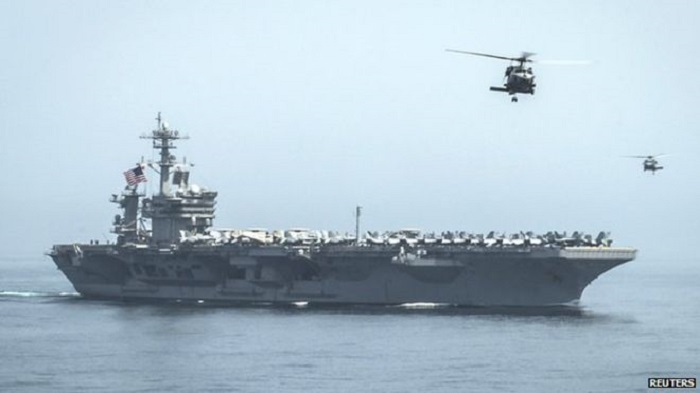
US carrier (1)A curious thing happened the other day. A nine-ship Iranian convoy believed to be filled with weapons bound for Houthi rebels in Yemen turned around after being followed by U.S. warships stationed in the area to prevent covert arms shipments. The convoy of seven freighters and two military frigates turned back to Iranian waters after nine U.S. Navy vessels set a parallel course alongside to monitor them.

Why is this significant? Because it represented one of the few opportunities lately where a direct response to a potential Iran regime violation of international agreements led to the mullahs backing down. Prior to this, the regime had aggressively flouted international agreements by funding Syrian president Bashar al-Assad after his forces used chemical weapons, supplied terror groups and Shiite militias in Iraq and Lebanon targeting Christians, Sunni Muslims, political dissidents, and engaging in a secret and rapid build-up in its nuclear enrichment program; all of which were acts done without a strong, determined international response.

In fact, Iran’s mullahs have long gambled on international passiveness to make their gains in proxy wars, territory or concessions in nuclear talks. It is a strategy built on the idea that if you cause enough chaos, people will look to anyone who might offer some solution – even the people who started the problems in the first place.

Historians have long called this policy by another name: “appeasement.” It’s a term filled with notoriety, especially after the failed effort by Western allies to sway Nazi Germany’s Adolf Hitler from his path to war by offering up parts of annexed countries like so many pork chops.

This policy of appeasement has never proven to work, yet diplomats consistently go back to it over and over again and use different names to describe it: “rapprochement,” “dialogue,” or “engagement.” In each case, it is another form of appeasement and does nothing to sway bullies, thugs or tyrants, instead encouraging them.

To use the analogy, it’s like giving a predator pieces of red meat in the hopes it doesn’t eat you. Eventually you get eaten as well since all you’ve done is stoke the hunger and identified yourself as being part of the food chain.

Iran’s mullahs have been emboldened by the weak response by the international community to its efforts to take over its neighbors and spread its form of extremist ideology. Boko Haram’s mass killings and kidnappings in Nigeria is met with hashtag slogans. Iraq’s exclusion of Sunni coalition partners is met with diplomatic shrugs. Even Yemen’s quick collapse elicited scant reactions until Saudi Arabia finally raised the alarm and put together an Arab coalition and started responding.

It is beyond mere coincidence that the Arab air campaign was suspended the day the U.S. nuclear aircraft carrier Theodore Roosevelt and her battle group were moved into the Gulf of Aden. It is also no coincidence that Iran turned back its arms convoy because the mullahs have correctly calculated they could not push their luck.

This reveals the key weakness of the mullahs ruling Iran which is when push comes to shove, they are not willing to push back. Iranian regime lacks the military capability for a traditional and modern military, having diverted funding to terror groups and lining the pockets of regime elites and their families.

After going all in with deep investment in its nuclear program, coupled with crippling economic sanctions and dropping oil prices, Iran’s mullahs now find their military capabilities to be severely limited. This was shown nowhere else more clearly than in the failed offensive mounted by Iranian-backed Shiite militias in Iraq who failed to take Tikrit and instead had to rely on U.S. airpower to help Iraqi forces take the city and save the effort.

A humbling moment and one that crystalized one key fact: when confronted by strong, unified action, the mullahs will back down. It’s a wonder why the same approach has not been used in nuclear talks instead of waving the white flag and giving into to whatever the mullahs want.

Fortunately, Democrats and Republicans in Congress have recognized this weakness of the mullahs and have decided to stand strong in voting for a voice in the nuclear talks through the Corker-Menendez bill and send a strong signal to the mullahs that the days of appeasement may finally be over.

By Laura Carnahan

Filed Under: News Tagged With: Appeasement policy, Iran, Iran Policy of appeasement

  • « Previous Page
  • 1
  • …
  • 11
  • 12
  • 13

National Iranian-American Council (NIAC)

  • Bogus Memberships
  • Survey
  • Lobbying
  • Iranians for International Cooperation
  • Defamation Lawsuit
  • People’s Mojahedin
  • Trita Parsi Biography
  • Parsi/Namazi Lobbying Plan
  • Parsi Links to Namazi & Iranian Regime
  • Namazi, NIAC Ringleader
  • Collaborating with Iran’s Ambassador

Recent Posts

  • NIAC Trying to Gain Influence On U.S. Congress
  • While Iran Lobby Plays Blame Game Iran Goes Nuclear
  • Iran Lobby Jumps on Detention of Iranian Newscaster
  • Bad News for Iran Swamps Iran Lobby
  • Iran Starts Off Year by Banning Instagram

© Copyright 2026 IranLobby.net · All Rights Reserved.