Iran Lobby

Exposing the Activities of the lobbies and appeasers of the Mullah's Dictatorship ruling Iran

  • Home
  • About
  • Current Trend
  • National Iranian-American Council(NIAC)
    • Bogus Memberships
    • Survey
    • Lobbying
    • Iranians for International Cooperation
    • Defamation Lawsuit
    • People’s Mojahedin
    • Trita Parsi Biography
    • Parsi/Namazi Lobbying Plan
    • Parsi Links to Namazi& Iranian Regime
    • Namazi, NIAC Ringleader
    • Collaborating with Iran’s Ambassador
  • The Appeasers
    • Gary Sick
    • Flynt Leverett & Hillary Mann Leverett
    • Baroness Nicholson
  • Blog
  • Links
  • Media Reports

Iranian Regime No Longer Hiding Its Military Intentions

April 18, 2016 by admin

Iranian Regime No Longer Hiding Its Military Intentions

Iranian Regime No Longer Hiding Its Military Intentions

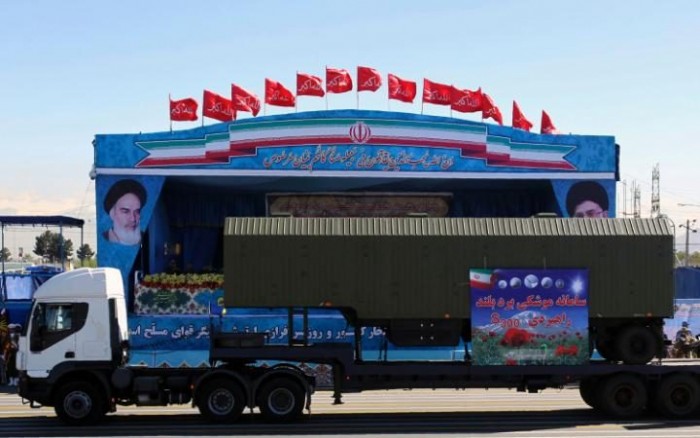
The Iranian regime held its annual Army Day parade as a showcase to pose itself as a mighty power in the region, but more importantly for the mullahs it provided an opportunity to show off parts of the long-awaited new S-300 air defense system from Russia.

While the advanced anti-aircraft missiles were originally ordered by Iran in 2007, their delivery was held up due to the imposition of sanctions related to Iranian regime’s violations concerning the development of nuclear weapons. Only after the nuclear agreement was reached last year was the delivery allowed to go through.

The delivery of the missile system is significant since it instantly brings the regime’s air defense to a much more modern and sophisticated level; a major issue for the mullahs and Revolutionary Guard since without it, any effort to restart its nuclear program would be subject to air attack by the U.S. and its allies.

The fact that the mullahs pushed hard to remove weapon systems such as this and the development of new ballistic missiles from the nuclear negotiations spoke volumes of their determination to upgrade their military capabilities far beyond where they stand today, particularly since they see this the only path to survival of the vast internal discontent.

According to pictures published by the semi-official ISNA news agency, S-300 missile tubes and the radar equipment were shown during the military parade held in southern Tehran.

Iran and Russia are also in talks on a sale of the advanced Sukhoi SU-30 fighter, another proposal criticized by the U.S. The regime’s current air force fleet dates from the pre-revolutionary era of the former Shah.

Speaking at Sunday’s parade, Hassan Rouhani insisted Iran’s plans to upgrade its military capabilities were defensive in nature, referring to the worst conflicts in the Middle East.

“Our military, political and economic power is not directed against neighboring countries and the countries of the Islamic world.

“When Baghdad was threatened by terrorists, the Islamic Republic of Iran responded to the call of the people, the army and the Iraqi government to defend Baghdad and the holy places,” he said, referring to the surge of the ISIL group in June 2014.

The argument he makes is similar to those consistently made by the Iran lobby from groups such as the National Iranian American Council which has sought to portray the Iranian regime as some sort of dedicated freedom fighter against Islamic extremism. The only difficulty with that portrayal is that Iran’s mullahs are the ones spreading it, not the other way around.

The beefing up of its military capability, including the multiple test launches of new ballistic missiles, comes at a time when the Iranian regime is also ramping up its military presence in Syria in support of the regime of Bashar al-Assad, except now the Iranians are not even trying to hide their deepening presence even as they pretend to advocate for peace talks.

Fearing that Russia may side with the U.S. and approve the removal of Assad from power, the Iranian government is now, more than ever, investing in propping up the regime’s dwindling army and air force.

“They [the Iranians] saw it as an opportunity to move closer to the regime,” one U.S. official told the Financial Times.

The Russian military pullback announced last month threatens Tehran’s position not only in Syria, but in the region. If Assad is ousted, Iranian military presence in the country will be diminished and Iran will no longer be able to present itself as a player in the region.

Iranian regime officials have in number of times reiterated that Syria is their front line and if they don’t fight the enemy in Syria, soon they have to do it in Tehran, referring to the strategic importance of Syrian dictatorship for the Ayatollahs in Iran. That’s why Iran is deploying more troops to Damascus. Those deployments, though, come at a cost. At least four Iranian soldiers have been killed in one week. Iranian media have reported that more than 150 Guards died in more than a year of fighting in Syria.

Tehran has kept its army at home for decades and tried to keep conflict at bay through a strategy — manned and managed by the Guards — of fighting its regional rivals through proxies in Iraq, Syria and Lebanon. Syria is crucial to its success. It is on the ‘frontline’ with Israel and is an important bridge to Hezbollah, Iran’s Shia proxy force in Lebanon.

Iran has vowed that it will not compromise on the fate of Assad, and backs his offer to include opposition figures in a national unity government while ruling out a “transitional governing body with full executive powers” — the formula agreed at talks in Geneva in 2012.

In the meantime, the high casualty rate among Revolutionary Guards — whose “military advisers” are reckoned by a western diplomat in Tehran to number fewer than 10,000 — has prompted Tehran to deploy its regular army to bolster Assad’s forces in Syria.

The stakes are high for the Iranian regime as it again sent Qassem Soleimani, the notorious leader of its Quds Force, to Moscow again in violation of international travel bans restricting his movements to discuss with Russian military officials on the deteriorating situation in Syria and the delivery of nearly $8 billion of new weapons just purchased by Iran.

The delivery of new military hardware is viewed by Tehran as an important adjunct to the use of Hezbollah proxies, Quds Force fighters, Basiji paramilitaries and thousands of paid mercenary Afghans that the Iranian regime has been sending to Syria in a desperate bid to keep Assad in power.

According to the BBC, the first Afghan militias began to arrive in 2012 in Syria.

“The Iranian Revolutionary Guards Corps decided that the Syrian military could not succeed on their own,” one former Afghan fighter told the BBC. “The frontlines were too depleted and men were trying to avoid conscription.”

The Iranians decided to set up a 50,000-strong National Defense Force to fight alongside the Syrian army.

With a shortage of willing fighters inside Syria, they began looking elsewhere – signing up Iranian Afghans, Lebanese, Iraqi and Pakistani Shia recruits. The fact that the mullahs are now committing Iranian regular army units to the Syrian fight shows a significant leap in their desperation over the situation there.

Mrs. Maryam Rajavi, the leader of the National Council of Resistance of Iran, one of the leading Iranian dissident groups in the world, took note of these changes in an interview with Asharq Al-Awsat on Sunday in which she pointed out that the Iranian regime would collapse consequentially should Assad be toppled in Syria, which is why Iran’s regime has been trying to keep Assad in power at any cost.

“If Assad falls out of power in Damascus, then the Iranian regime will evidently follow and collapse in Tehran,” Mrs. Rajavi said.

By Michael Tomlinson
Filed Under: Blog, News Tagged With: Ballistic Missiles, Featured, Ghassem Soleimani, Iran, Iran deal, Iran sanctions, NIAC, S300 Missiles

Iranian Regime Steps Up Provocative Actions

April 6, 2016 by admin

Iranian Regime Steps Up Provocative Actions

Iranian Regime Steps Up Provocative Actions

The Iran nuclear deal is pretty much dead…at least according to the Iranian regime as regime officials on Monday accused the U.S. of violating the agreement by working behind the scenes to stop American companies from conducting business with Iran, according to regional media reports.

The regime has been complaining for months that it is not being granted enough sanctions relief under the agreement in a bizarre example of bipolar thinking. On the one hand Iran complains about sanctions relief and on the other it boasts of the billions in new business deals it has signed with foreign companies.

These complaints have reportedly pushed the Obama administration to consider offering Iran greater concessions, including access to the U.S. dollar and American financial markets in an even more desperate bid to appease the mullah’s regime.

Sadeq Amoli Larijani, Iran’s judiciary chief, “warned” the United States in remarks on Monday, claiming that the administration’s current actions violate the agreement.

“The Americans are now acting in violation of the nuclear agreement,” Larijani was quoted as saying on Monday before high-ranking Iranian officials.

Larijani accused the Obama administration of “pressuring companies which are interested in investment in Iran to withdraw from their decision,” according to reports carried in Iran’s state-controlled media.

“The Americans should know that the Islamic Republic of Iran would never compromise its interests and would never agree with investment of foreign firms in the country at any price, while it enjoys rich resources and abundant talents,” Larijani was quoted as saying, obviously bluffing about regime’s bankrupt economy.

At the same time, ironically the regime leaders borrowed from President Obama’s own rhetoric in warning the U.S. not to cross a “red line” when it came to sanctioning the regime’s ballistic missile program.

Brig. Gen. Massoud Jazzayeri, deputy chief of staff of the Iranian military, claimed the Obama administration has been intentionally prolonging the removal of sanctions as outlined by the nuclear deal. He believes the U.S. is trying to connect the terms of agreement with the regime’s ballistic missile program, which it explicitly sought to delink during talks last year.

“The White House should know that defense capacities and missile power, specially at the present juncture where plots and threats are galore, is among the Iranian nation’s red lines and a backup for the country’s national security and we don’t allow anyone to violate it,” said Jazzayeri, as reported by Iranian media outlet and government mouthpiece Fars news.

The general’s reference appears to mirror language used by President Obama who claimed on September 4, 2013, that any use of chemical weapons by Syrian President Bashar al-Assad against the Syrian opposition would cross a “red line.”

The regime’s full-court assault on the Obama administration over the nuclear deal is part of an overall effort to set up the potential for walking away from the deal and blame its failure on the U.S. Such a move would allow Iran to restart its nuclear program with speed after it has received over $100 billion in fresh cash to stuff its coffers and complete a series of military deals with Russia to replenish and upgrade its forces.

Part of strategy can be seen in a series of moves to expand and reinforce its proxy forces currently fighting in Syria and Yemen, including deploying a top army unit to Syria in what commanders call an advisory mission, according to state-run media.

Regime general Ali Arasteh, deputy chief liaison of the army’s ground force, said the unit comprises “commandos” in a force from the 65th NOHAD — a Persian abbreviation for Airborne Special Forces Brigade.

“We are sending commandos from army’s Brigade 65 and other units to Syria as advisers,” Arasteh told the Tasnim news agency.

The move bolsters an already robust Iranian military presence in Syria, analysts say.

In the last two years, Iran has sent thousands of its Revolutionary Guard Corps (IRGC) to fight ground battles for the Syrian regime, joining with Iranian-backed Hezbollah fighters from Lebanon. Tehran reportedly increased the number of IRGC personnel in Syria in the final months of 2015, sending as many as 3,500 militia fighters to the frontlines, as well as recruit paid Afghan mercenaries to supplement its forces.

Additionally, the U.S. Navy intercepted and seized an arms shipment from Iran likely bound for Houthi fighters in Yemen in the Arabian Sea in a statement on Monday.

The weapons seized last week by the U.S. warships Sirocco and Gravely were hidden on a small dhow and included 1,500 AK-47 rifles, 200 rocket-propelled grenade (RPG) launchers, and 21 .50-caliber machine guns, according to the Navy statement.

“This seizure is the latest in a string of illicit weapons shipments assessed by the U.S. to have originated in Iran that were seized in the region by naval forces,” the statement said.

It cited a Feb. 27 incident in which the Australian Navy intercepted a dhow in late February and confiscated nearly 2,000 AK-47s, 100 RPG launchers, and other weapons. On March 20, a French destroyer seized almost 2,000 AK-47s, dozens of Dragunov sniper rifles, nine antitank missiles, and other equipment bound from Iran to the Houthis.

The evidence is abundant and widespread of the regime’s aggressive posturing and direct involvement in causing the wars now ranging in three different countries. The mullahs the last few months before the presidential election as a fire sale to grab everything they can before the appeasement potentially ends since virtually all of the leading candidates – both Democrat and Republican – have vigorously denounced Iran’s actions.

Ironically the Iran lobby has pushed the same party line as the mullahs in accusing the U.S. of not following through on the nuclear deal.

We can only hope the region doesn’t fall so far into a bottomless black pit of Islamic extremism and war that the world can’t dig the cancer of the Iranian regime out in 2017.

By Michael Tomlinson

Filed Under: Blog, News Tagged With: Ballistic Missiles, Featured, Iran, Iran Missile program, Iran sanctions

As Nuke Talks Fail, Trita Parsi Contributes to Global Warming With Hot Air

July 9, 2015 by admin

As Nuke Talks Fail, Trita Parsi Contributes to Global Warming With Hot Air

As Nuke Talks Fail, Trita Parsi Contributes to Global Warming With Hot Air

As yet another deadline slipped away in nuclear talks between the Iran regime and the P5+1 group of nations, the new trial balloon being floated was the idea of open-ended negotiations and keeping alive the November 2013 interim agreement which has already paid out to the Tehran’s mullahs a whopping $17 billion in cash.

But why did negotiators let a June 30 self-imposed deadline slip away, only to see another July 7 deadline fall by the wayside? It is because the Iran regime really has no interest in a deal that continues to deprive the mullahs of the $140 billion in frozen assets they need and restricts how they might spend all that cash.

Indeed, while regime supporters such as Trita Parsi of the National Iranian American Council, Jim Lobe of Lobelog and Atieh Khajehpour of Atieh International have all proclaimed loudly the mullahs commitment to a deal, Iran’s leaders have consistently sabotaged any progress in talks.

The latest example was that as Tuesday’s deadline came and went, Western news sources cited statements from a senior member of the Iranian negotiating team who disclosed the regime fully expects any agreement to also include a lifting of United Nation sanctions imposed on the sale of conventional weapons and ballistic missiles.

“This is one of the important issues we are discussing,” said the official, a negotiator who spoke to Western reporters on the condition of anonymity.

The demand was significant because the P5+1 had already conceded to the regime the idea of removing ballistic missile technology from discussions, but the regime’s insistence on lifting sanctions on all conventional weapons is telling because of the regime’s enormous level of support of three proxy wars with Hezbollah in Syria, Shiite militias in Iraq and Houthi rebels in Yemen.

The drain on Iranian regime’s military is significant as the mullahs ship guns, rockets, anti-tank weapons, missiles, ammunition and other equipment to their proxies in each of these wars. The fact the mullahs are demanding a lifting to sanctions to allow for the flow of cash and arms back into Iran is ample proof to anyone with a brain what Iranian regime’s future foreign policy direction is once a deal is completed; which makes what regime supporters such as Parsi say look foolish and ridiculous.

Parsi has repeatedly contended that a nuclear deal with Iran would aid moderates within the regime, boost America’s role in the region, improve security for American interests and help destroy ISIS.

But the evidence to the contrary has been as clear as crystal. Any political moderates remaining in Iran have been thrown in the regime’s notorious Evin prison or executed amongst the 1,800 sent to the gallows by Hassan Rouhani’s administration.

Americans have been taken hostage and remain as bargaining chips by the mullahs, while America’s traditional allies in Egypt, Saudi Arabia and Turkey have been faced with terror strikes in their borders, open warfare with Iranian proxies and have acted unilaterally to defend themselves.

The fact that the regime itself built the template by which ISIS has modeled itself is another rebuttal to what Parsi contends. Ironically while Parsi has been huffing and puffing claiming “moderate” aims of the mullahs, Jordanian security forces revealed the arrest of an Iranian agent working for the regime’s Quds Force who was caught with a sizable amount of explosives to be used in a strike against the U.S. ally.

But Parsi’s attempt at fooling the world is proving inept as the actions of the regime – almost all of which have contradicted everything Parsi has claimed – are finally being denounced on editorial pages everywhere.

“Now Iran’s negotiators are piling on more last-minute demands. They want the United Nations to lift restrictions on Iranian regime’s trade in missiles and other conventional arms. They act, at least publicly, as though they have all the leverage, that they know their adversary craves a deal more than they do,” said the Chicago Tribune in an editorial.

“Where would they get that idea? Probably from the U.S. and its allies, who reportedly have been backpedaling on key points to eke out a deal,” The Tribune added.

While Parsi and his colleague Reza Marashi enjoy the weather in Vienna and hob nob with journalists and fellow regime sympathizers who have gathered there like rock band groupies following the Iranian delegation, the world outside that bubble have already come to the conclusion that Iran’s mullahs have no interest in a deal, only in re-opening their bank accounts and restocking their military hardware for waging even more war.

By Michael Tomlinson

Filed Under: Blog Tagged With: Ballistic Missiles, Iran, Iran Lobby, Iran Talks, Iran Talks Vienna, Parsi

  • « Previous Page
  • 1
  • 2

National Iranian-American Council (NIAC)

  • Bogus Memberships
  • Survey
  • Lobbying
  • Iranians for International Cooperation
  • Defamation Lawsuit
  • People’s Mojahedin
  • Trita Parsi Biography
  • Parsi/Namazi Lobbying Plan
  • Parsi Links to Namazi & Iranian Regime
  • Namazi, NIAC Ringleader
  • Collaborating with Iran’s Ambassador

Recent Posts

  • NIAC Trying to Gain Influence On U.S. Congress
  • While Iran Lobby Plays Blame Game Iran Goes Nuclear
  • Iran Lobby Jumps on Detention of Iranian Newscaster
  • Bad News for Iran Swamps Iran Lobby
  • Iran Starts Off Year by Banning Instagram

© Copyright 2026 IranLobby.net · All Rights Reserved.