Iran Lobby

Exposing the Activities of the lobbies and appeasers of the Mullah's Dictatorship ruling Iran

  • Home
  • About
  • Current Trend
  • National Iranian-American Council(NIAC)
    • Bogus Memberships
    • Survey
    • Lobbying
    • Iranians for International Cooperation
    • Defamation Lawsuit
    • People’s Mojahedin
    • Trita Parsi Biography
    • Parsi/Namazi Lobbying Plan
    • Parsi Links to Namazi& Iranian Regime
    • Namazi, NIAC Ringleader
    • Collaborating with Iran’s Ambassador
  • The Appeasers
    • Gary Sick
    • Flynt Leverett & Hillary Mann Leverett
    • Baroness Nicholson
  • Blog
  • Links
  • Media Reports

Using Old Tricks to Lay New Lumps of Coal

December 18, 2014 by admin

FruitcakeDuring the holidays, most of dread that one gift that is destined for quick re-gifting. You know what I’m talking about. It might be the sad, lump of fruitcake or a Christmas sweater that might even make the world’s worst fashion designer cringe. In the world of politics, it is no different. The same old tired tropes are trotted out periodically to make an appearance on blogs before they are once again consigned to the junk bins of history.

In this category falls a recent blog entry by Holly Dagres in The World Post. In it, Ms. Dagres dusts off the same old invective against the National Council of Resistance of Iran (NCRI) and other groups engaged in a long struggle to free the Iranian people from the tyranny of religious mullahs that subverted the Iranian Revolution and turned it into a private fiefdom for their own brand of radicalized Islam.

She goes on to trot out old charges about designations as a terrorist organization that have long since been disproved and dispelled and attacks these pro-democracy organizations for exercising their growing influence and clout among elected officials in the U.S. and abroad as if it was some evil conspiracy. What she fails to talk about is the one elephant in the room which is Iran, as a nation-state controlled by a religious theocracy is at the center of virtually all of the current crises throughout the Middle East, Asia and Africa. Attacking NCRI without discussing Iran’s ruling mullahs is like discussing an antibiotic, but never mentioning the disease it is designed to combat.

That kind of intellectual hypocrisy comes into focus when Ms. Dagres attempts to describe the Iranian resistance groups as being anti-women. On the surface it’s a ridiculous claim to make since the United Nations and Amnesty International have extensively documented the long and agonizing price being paid by women in Iran over the decades, including being unable to pursue careers, unable to travel alone or wear clothing of their choice.

Most significant of all is the fact that NCRI is led by a woman, Mrs. Maryam Rajavi, a position of leadership and responsibility that so far has eluded the mullahs that control Iran and who have refused to grant women similar leadership roles with real power instead of token positions.

Ms. Dagres even has to go back to the 1980 s to dredge up more spurious claims in an attempt to discredit the Iranian resistance; a futile gesture when compared to the extensive work and sacrifices made to work in close cooperation with U.S. and European partners to expose the activities of the Iranian regime as it exports terror, evades economic sanctions, manipulates its neighbors, engages in clandestine warfare and continues to build a nuclear capability and advanced missile technology.

At no point does she reference the biggest obstacle to regional peace and security and that is Iranian regime’s Supreme Leader Ayatollah Ali Khamenei who has consistently sunk nuclear negotiations with his aggressive public speeches denouncing the West and adamantly sticking to the need for Iran to develop its nuclear capability. Ms. Dagres needs to look no further than Khamenei to find the greatest obstacle to peace and democracy in Iran.

But like a good little foot soldier for Iran’s massive global lobbying network such as the National Iranian American Council, she spews out old and tired rhetoric that shrinks in the harsh light of examination.

By: Hadi Ahmadi
Filed Under: American-Iranian Council

Equating Cuba to Iran is More Smoke and Mirrors

December 18, 2014 by admin

Cuba FlagPresident Obama laid out a move to normalize relations with Cuba after over half a century of unrest in relations. North Korea comes to mind too, but that involves another discussion on another day.

Sympathizers and supporters of Iran’s ruling regime have seized on the proposal to try and draw parallels to the U.S. approach to Iran. Most notably Trita Parsi and Ryan Costello of the regime’s foremost lobbyists at the National Iranian American Council, write in The HuffingtonPost that America’s perceived failed Cuba policy is akin to its similar flawed policy as it relates to Iran.

They attempt to draw parallels to economic sanctions placed on Cuba and Iran as both being failures in policy and deserving of retraction. They go to heap praise on President Obama’s recent efforts to advance a nuclear arms deal with Iran as evidence of this new pivot that can usher in an era of normalized relations between the two adversaries.

Unfortunately their obtuse logic is about as straightforward as a pretzel. Cuba and Iran are vastly different countries with vastly different economic, political and military histories.

Anyone over the age of 60 clearly remembers the Cuban Missile Crisis and the razor sharp edge the U.S. and old Soviet Union navigated as the world was pushed to the brink of global war. In a sharp twist of irony, Cuba’s placement of nuclear missiles aimed at the U.S. 90 miles away proved to be intolerable and were eventually removed through some last minute diplomacy and a heavy dose of military hardware in the Caribbean. Similarly, Iran faces the same choice in whether or not to pursue a nuclear arms program that could place Iran in the same position Cuba found itself in.

But the differences between Cuba and Iran are largely glossed over by Parsi and Costello. Whereas Cuba was a virtual vassal state to the Soviets and heavily dependent on imports of oil, food and other goods to keep the island nation going, Iran sits on one of the world’s largest reserves of oil and uses illicit petro dollars to fund a myriad of military activities as well as fund several of the world’s most notorious terror organizations.

It would be a remarkable display of honesty if Parsi and Costello were to actually use the terms “Hezbollah, ISIS and Iran” in the same sentence.

Iran has been governed by an unrelenting, unforgiving and uncaring religious cadre of mullahs who through advocacy of a particularly harsh and radicalized brand of Islam have managed to oppress the Iranian people for decades.

But par for the course for Parsi and Costello, they conveniently ignore the human rights abuses, depredations and decades-long effort by Iran to develop a nuclear capability in defiance of worldwide condemnations.

Iran remains deeply involved in the Syrian conflict, now manipulates Iraq in its fight against ISIS and continues to fund and support Hezbollah and Hamas, as well as shield its nuclear activities from international inspectors and continue to squeeze its own people with a stepped up campaign of arrests, imprisonments and executions that would make North Korea pale by comparison.

But none of that seems to make the proverbial exhortations of Parsi and Costello who remain slavishly obedient to Iran’s beck and call and are using the Cuba situation in another desperate attempt to push through a nuclear deal that would set Iran on a path not too dissimilar to the near global catastrophe of 1962.

By Michael Tomlinson

Filed Under: American-Iranian Council, Blog Tagged With: Cuba, Iran, Iran Lobby, National Iranian American Council, NIAC, Normalize relations with Cuba, Ryan Costello, Trita Parsi

Alavi Foundation

August 21, 2014 by admin

AlaviFoundationIran would appear to be highly appreciative of Amirahmadi’s support for the regime.  Rutgers University, where Amirahmadi works, was the largest recipient of grants by the Alavi Foundation, a non-profit organization secretly controlled by Iran’s mullahs.

A 36-story building on Fifth Avenue in New York City owned by the Foundation generated nearly $40 million in rental income from 1999-2007.  Some of the funds were transferred to the Iranian government; other monies were invested in mosques and Islamic centers in the US, and some of the income was directed to student loans and grants to universities.

Over the nine-year period, Alavi distributed $3.1 million to universities, based on IRS filings.  Of this total, Rutgers University received $675,100 – nearly 22% of the funds and almost twice the amount given to any other university in the US.

In 2013, a federal judge authorized the seizure of the Aliva building, after determining its owners had violated federal money laundering laws and sanctions against Iran.

The building was constructed in the 1970s by the Pahlavi Foundation, while the Shah was in power.  After the ’79 Revolution, its ownership was transferred to the Mostazafan Foundation in New York.  The property was 60% owned by the Alavi Foundation and 40% owned by the Assa Corporation, a shell company managed by Iran’s state-owned Bank Melli.

In 2014, US prosecutors unveiled a plan to sell the building and distribute the proceeds to the families of the 1983 bombing of the US Marine barracks in Beirut that killed 241 US military personnel and the 1986 bombing of the Khobar Towers in Saudi Arabia that killed 19 US service members – both attacks of which were instigated by Iran.

Filed Under: American-Iranian Council

American-Iranian Council

August 21, 2014 by admin

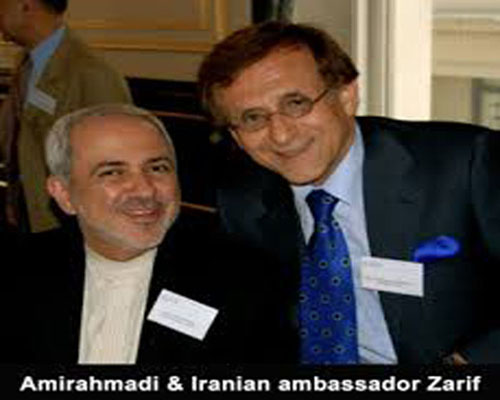
zarif-AmirAhmadiHooshang Amirahmadi,[1] a dual US-Iranian citizen and professor at Rutgers University, teamed up in 1997 with America’s largest oil companies to create the American-Iranian Council (AIC), a non-profit organization to promote the removal of US sanctions on Iran.[2]

Amirahmadi had earlier participated in conferences on US-Iran relations and usually presents Tehran’s position.[3]  He also often comes to the regime’s defense when it was attacked in news stories.

As an example, in 1994 Amirahmadi admonished US Secretary of State Warren Christopher for labeling Iran an “international outlaw,” following its bombing of a Jewish center in Buenos Aires, which killed 85 people and injured hundreds others.  Christopher said, “Groups like Hezbollah that wreak havoc and bloodshed must be defeated.  And Hezbollah’s patron, Iran, must be contained.”[4]

Amirahmadi retorted, “A catch phrase of the nature of ‘outlaw nation’ smacks of a discredited ‘do as we say’ cold-war brand of international policy, not the true diplomacy required in these sensitive times when the United States is, or should be, an equal player on the global stage.”[5]

AIC has been bankrolled by the who’s who of America’s big oil companies, including ARCO, Aramco, Ashland Oil, Conoco, Exxon, Mobil, Shell, and Unocal.

For a brief period it looked as if US oil companies might gain access to Iran’s oil market, but then Congress intervened.  In 1995, Conoco – after three years of negotiations – announced it had been awarded a contract by Iran to develop two oil fields in the Persian Gulf.

The news met the disapproval of members of Congress.  US Senator D’Amato (R-NY) introduced legislation to block the contract, stating, “We are subsidizing Iranian terrorism by purchasing their oil and it has to stop.”[6]

Since 1984, Iran has been on the list of state sponsors of terrorism.  The Iranian regime views terrorism as a legitimate tool to accomplish its foreign policy objectives.  Beginning in the early 1990s, it gained the dubious distinction of being the world’s most active supporter of international terrorism.

Among its many terrorist strikes, Iran instigated the March 1992 suicide bombing of the Israeli embassy in Buenos Aires, which killed 29 people and wounded nearly 250 others.  Iran financed Sheik Abdel-Rahman, the blind cleric who masterminded the 1993 attack on the World Trade Center in New York City.  And the regime was behind the bombing of the Jewish center in Buenos Aires.

Ten days after Conoco announced the contract with Iran, President Clinton signed an executive order banning US investments in the development of petroleum resources in Iran.

US Undersecretary of State Peter Tarnoff explained in November 1995, “A straight line links Iran’s oil income and its ability to sponsor terrorism, build weapons of mass destruction, and acquire sophisticated armaments.  Any government or private company that helps Iran to expand its oil must accept that it is contributing to this menace.”[7]

In 1996, the US enacted legislation – with a five-year sunset clause – that imposed economic sanctions on companies doing business with Iran and Libya.

US oil producers and other businesses were displeased to be shut out of Iran.  Working with the National Foreign Trade Council, they established USA*Engage in 1997 to lobby against the “ineffectiveness of unilateral economic foreign policy sanctions.”  And they reached out to Hooshang Amirahmadi and helped him establish AIC.

Like other anti-sanction groups, AIC minimizes the military and terrorism threat posed by the Iranian regime.  Amirahmadi suggests that all foreign policy conflicts between the US and Iran’s mullahs can be resolved through dialogue.

Amirahmadi completely disavows evidence of Iran’s support of terrorism, as well as terrorist attacks by its surrogates, Hezbollah and Hamas, both of which are on the US State Department’s list of Foreign Terrorist Organizations (FTOs).

Attacks by Hezbollah, according to the State Department include:

[T]he suicide truck bombing of the US Embassy and US Marine barracks in Beirut in 1983; the US Embassy annex in Beirut in 1984; and the 1985 hijacking of TWA flight 847, during which a US Navy diver was murdered.  Elements of the group were responsible for the kidnapping, detention, and murder of Americans and other Westerners in Lebanon in the 1980s.  Hezbollah was implicated, along with Iran, in the 1993 attacks on the Israeli Embassy in Buenos Aires…Two other attacks against UNIFIL peacekeepers – an attack in late July that wounded six French citizens and a second attack days later that injured three other French soldiers – were believed to have been carried out by Hezbollah.  Also in 2011, four Hezbollah members were indicted by the UN-based Special Tribunal for Lebanon (STL), an international tribunal investigating the 2005 assassination of Lebanese Prime Mininister Rafik Hariri…On January 12, Thai police detained a Hezbollah operative on immigration charges as he was attempting to depart Thailand from Suvarnabhumi International Airport.  He led police to nearly 10,000 pounds of Urea-based fertilizer and 10 gallons of liquid ammonium nitrate in a commercial building about 20 miles south of Bangkok….In 2012, Hezbollah stepped up the pace of its terrorist plotting, and was implicated in several terrorist plots around the world….[8]

Amirahmadi’s response to the many terrorist attacks is to deny they are acts of terrorism.   “The problem of terrorism is a true myth,” he said. “Iran has not been involved in any terrorist organization.  Neither Hezbollah nor Hamas are terrorist organizations.”[9]

The attacks by Hezbollah and Hamas, according to Amirahmadi, are legitimate “resistance movement” activities and not terrorism.  It is the “double understanding of terrorism,” Amirahmadi posits, that “hinders” Iran’s relations with the West.

Amirahmadi’s solution?  “I think Iran and Western countries should meet to discuss what they mean byterrorism,” Amirahmadi said. “They should come to an arithmetical meaning in the definition of terrorism.”[10]

[1] Amirahmadi lived and worked in Iran until 1975, and then traveled to the US to attend graduate school.

[2] Amirahmadi founded US-Iran Conference Inc. in 1991 to promote conferences and roundtables on US-Iran relations.

[3] “International Conference on Iran Concludes with Diverse Views of Iran’s Future,” PR Newswire, May 2, 1996.

[4] “Iran and Allies Are Suspected in Bomb Wave,” New York Times, July 29, 1994.

[5] “Demonizing Iran Doesn’t Equal Foreign Policy,” New York Times, August 8, 1994.

[6] “Condemning Iranian Oil Deal, US May Tighten Trade Ban,” New York Times, March 10, 1995.

[7] “Iran Freedom Support Act,” House Committee on International Relations Report, US House of Representatives, April 25, 2006.  Also see “Condemning Iranian Oil Deal, US May Tighten Trade Ban,” Jewish Telegraphic Agency, March 10, 1995.

[8] “Country Reports on Terrorism 2013,” US State Department, April 2014.

[9] “Rewarding Terrorism Denial,” National Review, October 3, 2008.

[10] “US, Iran Must Reach Common Denominator to Fight Terrorism: Experts,” Trend Daily News, May 3, 2009.

Filed Under: American-Iranian Council

  • « Previous Page
  • 1
  • 2

National Iranian-American Council (NIAC)

  • Bogus Memberships
  • Survey
  • Lobbying
  • Iranians for International Cooperation
  • Defamation Lawsuit
  • People’s Mojahedin
  • Trita Parsi Biography
  • Parsi/Namazi Lobbying Plan
  • Parsi Links to Namazi & Iranian Regime
  • Namazi, NIAC Ringleader
  • Collaborating with Iran’s Ambassador

Recent Posts

  • NIAC Trying to Gain Influence On U.S. Congress
  • While Iran Lobby Plays Blame Game Iran Goes Nuclear
  • Iran Lobby Jumps on Detention of Iranian Newscaster
  • Bad News for Iran Swamps Iran Lobby
  • Iran Starts Off Year by Banning Instagram

© Copyright 2026 IranLobby.net · All Rights Reserved.