Iran Lobby

Exposing the Activities of the lobbies and appeasers of the Mullah's Dictatorship ruling Iran

  • Home
  • About
  • Current Trend
  • National Iranian-American Council(NIAC)
    • Bogus Memberships
    • Survey
    • Lobbying
    • Iranians for International Cooperation
    • Defamation Lawsuit
    • People’s Mojahedin
    • Trita Parsi Biography
    • Parsi/Namazi Lobbying Plan
    • Parsi Links to Namazi& Iranian Regime
    • Namazi, NIAC Ringleader
    • Collaborating with Iran’s Ambassador
  • The Appeasers
    • Gary Sick
    • Flynt Leverett & Hillary Mann Leverett
    • Baroness Nicholson
  • Blog
  • Links
  • Media Reports

What is a Washington Post Hostage Worth to Iran Regime?

September 29, 2015 by admin

What is a Washington Post Hostage Worth to Iran Regime?

What is a Washington Post Hostage Worth to Iran Regime?

The world was treated to a third straight year of verbal nonsense from Hassan Rouhani, the handpicked leader of the Iran regime, who delivered his third speech to the United Nations General Assembly in what is fast becoming an exercise in linguistic firebombing as he lambasted the U.S., the West in general, Saudi Arabia and just about everyone else on the regime’s “Death to…” chant playlist.

Rouhani in his speech that managed to give implicit approval of the 9/11 attacks, called for the destruction of Israel, regime change in Saudi Arabia and permanent elevation of Iran as a global superpower all in one fell swoop.

It was noteworthy that Rouhani did not acknowledge Iran’s role in the spread of terrorism throughout the region through its support of Hezbollah in Lebanon and Syria, or its role in the death and maiming of thousands of Americans by training and equipping Shiite militias in Iraq and he failed to confront the truth of Iran’s facilitation of a global refugee crisis with over four million Syrians displaced because of the Syrian civil war.

Rouhani did spend much of his speech denouncing Saudi Arabia for the tragedy during the hajj stampede that killed a reported 167 Iranian pilgrims and calling for an international investigation. He neglected to mention Iran’s support of Houthi rebels who overthrew the Yemen government and sparked a shooting war with Saudi Arabia and other Gulf States that led to high seas showdowns in the Straits of Hormuz as Iran threatened international shipping lanes.

The Iran regime’s role in supporting the Syrian civil war and keeping Bashar al-Assad in office was of paramount importance to Rouhani as he went on CNN to make the blanket assertion that any hope for defeating ISIS and terrorism in general rested in keeping Assad in office.

“In Syria, when our first objective is to drive out terrorists and combatting terrorists to defeat them, we have no solution other than to strengthen the central authority and the central government of that country as a central seat of power,” Rouhani said.

It is a remarkable assertion since Assad has been found guilty of wantonly killing his own people with chemical weapons and using barrel bombs to wipe out entire civilian neighborhoods. At Iranian regime’s urging and through its military, Assad has specifically targeted moderate and Western-backed rebel forces, leaving ISIS and other extremist Islamic groups largely untouched in an effort to split the opposition.

Rouhani boosting Assad as a counter-weight to terrorism is like asking a candy manufacturer to promote weight loss programs.

Rouhani went a step further in his CNN interview where he compared opponents of the nuclear deal – specifically Republican presidential candidates who have vowed to tear it up if elected – to Saddam Hussein who launched the Iran-Iraq War.

Far from being the reform-minded advocate the Iran lobby has sought to portray, Rouhani has instead brought a vitriol, while subtle, every bit as incendiary as the much reviled Mahmoud Ahmadinejad.

The height of absurdity by Rouhani was reached when he again proposed the idea of a prisoner swap between the U.S. and regime; trading Iranian-American hostages such as Washington Post reporter Jason Rezaian, Christian pastor Saeed Abedini and former Marine Amir Hekmati for several Iranians convicted of arms trading and smuggling in nuclear components for Iran’s nuclear program – which Rouhani coincidentally denied ever existed.

“There are a number of Iranians in the United States who are imprisoned, who went to prison as a result of activities related to the nuclear industry in Iran,” Rouhani said. “Once these sanctions have been lifted, why keep those folks in American prisons? So they must be freed.”

So what are Jason Rezaian and other hostages worth to the Iran regime? Apparently at least 19 Iranian agents convicted of nuclear and weapons smuggling.

The proposed swap linked to convicted arms smugglers was condemned by the Washington Post and family members of the American hostages.

“Not until they’re on American soil can I trust what they say,” said Naghmeh Abedini, wife to Saeed Abedini. “My husband is not collateral. He’s a husband, a father, and he’s broken no law. They’re trying to barter his exchange for 19 criminals. It’s unbelievable. The Iranian government is no different than the government that held Americans hostage in the 1970s.”

Not surprisingly, Trita Parsi, head of the Iran lobby’s National Iranian American Council, tried to make the comparison U.S. airstrikes against ISIS in Syria were akin to bombing Oklahoma without approval of the U.S. government. He neglected to note that in Syria’s case, the government has been condemned as illegitimate and a mass killer by the world and embroiled in a civil war where Syria has invited in foreign governments such as Iran and Russia to kill its own people who are revolting.

Then again, lack of logic has never stopped Parsi from making ridiculous claims. He made the ultimate leap of fantasy when he authored an editorial claiming that the recent visit by Pope Francis to the U.S. could help defeat terror by persuading the U.S. to adopt a more accommodating tenor towards radicalized states such as Iran.

“What has fueled the Syrian crises more than anything else is the false illusion on all sides that a decisive military victory is around the corner,” Parsi said.

An appropriate sentiment if it was only applied to Iran’s military support of Assad, but in this case, Parsi only meant the rebel forces fighting to topple Assad and the rest of the world trying to get the tyrant out.

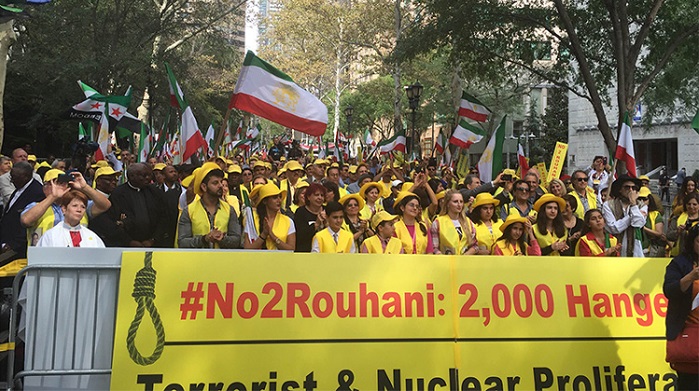
It was noteworthy that Rouhani’s appearance wasn’t all flowers and songbirds as thousands rallied outside of the UN to protest Rouhani’s speech; with delegations from Syria, Yemen, and Iranian dissidents talked about the abuses and injustices meted out since Rouhani took power.

By Michael Tomlinson
 

Filed Under: Blog Tagged With: Featured, hassan rouhani, NIAC, Rouhani CNN, Rouhani visit to New York, Trita Parsi

Iran Regime Begins Self Inspection Charade of Nuclear Sites

September 22, 2015 by admin


Iran Regime Begins Self Inspection Charade of Nuclear Sites

Iran Regime Begins Self Inspection Charade of Nuclear Sites

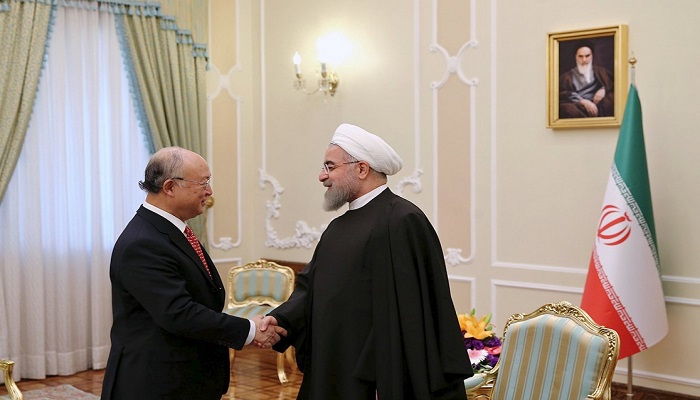
The Iran regime revealed it took its own samples at the Parchin military site as part of the secret side deal it made with the International Atomic Energy Agency as the head of that agency, Yukiya Amano, was in Iran to visit the site and give what appears to be his support of the regime’s handling of the self-inspection protocol.

The regime’s state-run IRNA news agency quoted a spokesman for the Iranian atomic energy agency, Behrouz Kamalvandi, as saying samples were taken at Parchin “only by the Iranian experts and without the presence of the agency’s inspectors.”

The fact that regime state media described Amano’s visit as “ceremonial” rather than an inspection tells you all you need to know of how the regime viewed the self-inspection process.

Sen. Tom Cotton (R-AK), a chief critic of the Iran nuclear deal, pointed to the regime’s latest disclosures as more evidence of the flaws in the nuclear agreement.

“The fact that Iran is taking its own soil samples shows that the verification scheme is an embarrassing charade, and yet another concession we can add to the pile of concessions that make up the dangerous Iran deal,” he said.

Even though the IAEA has had a long history of complaints lodged against the regime over the last decade for non-compliance, including not answering basic questions about the history of its nuclear program and its military dimensions, as well as the failure of the regime to make nuclear scientists and technical personnel available for interviews, the IAEA has seen fit to enter into a secret deal with the mullahs and not make it available to the rest of the world.

The fact that we even know about the self-inspection protocol and lack of international oversight of sampling from the Parchin site is due more to the intrepid reporting of journalists at the Associated Press than to any government disclosures from the United Nations or P5+1 group of nations that negotiated the deal.

The Obama administration, already duped into believing the regime will not cheat on an already badly flawed agreement, claimed that the self-inspections are a step in the right direction.

Breitbart.com reinforced the absurdity of self-inspection by reminding us the Congress was never shown the IAEA side deal, the regime was allowed to “sanitize” the Parchin site and hand-picked the areas to be sampled and handled the cameras taping the sampling that IAEA officials were watching.

You could not have asked for a more orchestrated act than if you paid a Hollywood studio to stage it.

The regime is certainly not wasting time flexing its new-found freedoms, not only by manipulating what will assuredly be a clean bill of health of Parchin, but also in busily acquiring new, advanced weapons and military hardware and arming its terrorist allies such as Hezbollah.

Al-Rai, a Kuwaiti newspaper, reported this weekend that Hezbollah received all of the advanced weaponry that the Syrian regime has obtained from Russia as the Russians have dramatically boosted their military operations with boots on the ground, tactical fighters flown to Syrian bases and new tanks being off-loaded.

The fact that all these military developments occurred since the nuclear deal was signed, demonstrates clearly the mullahs in Tehran feel extremely confident about their new-found status as international players and intend to flex their muscle visibly and without deception.

But the sales job for the Iran lobby never ends as Trita Parsi, the head of the National Iranian American Council, went on World Finance to laud the financial windfall the regime is due to receive because of the imminent lifting of sanctions. He continues to advance the absurd proposition that the regime’s newly emerging economic muscle could be used as a moderating influence in the region.

What he fails to discuss is the intent of the ruling mullahs. No one doubts that Iran can be a major economic player in the region; the only question was whether or not the mullahs primary mission was to improve the economic status of their people or push further their brand of fundamentalist Islamic faith? History demonstrates ably that the mullahs have no other concern than preserving and expanding their extremist views throughout the Muslim world.

Parsi’s statements about Iran’s economic potential are only one half of a joke, the real punchline comes with what the mullahs decide to do with all that newfound economic muscle. The unfortunate part is that the joke will be on those who supported and approved this deal based solely on the “hope” that Iran’s mullahs could be worthy of trust.

Nothing could be further from the truth.

By Michael Tomlinson

Filed Under: Blog Tagged With: Featured, Iran deal, NIAC, Nuclear Deal, Parchin, Trita Parsi

Iran Regime Continues “Moderate” Push

September 21, 2015 by admin

Iran Regime Continues “Moderate” Push

Iran Regime Continues “Moderate” Push

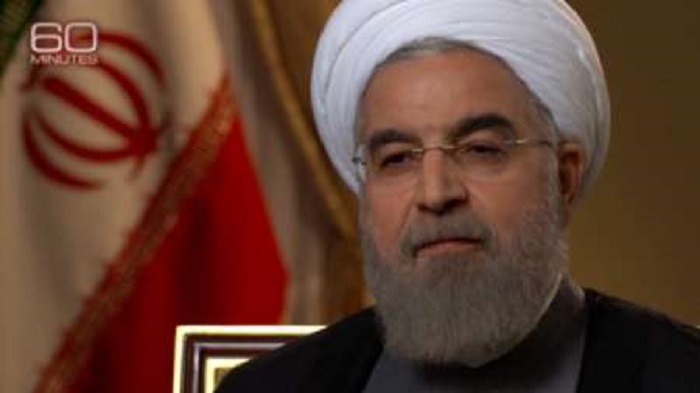
The Iran regime continues its campaign to push a moderate face for itself to news media and government officials through its lobbyists such as the National Iranian American Council and through its own media PR push as evidenced by Hassan Rouhani’s appearance on the venerable news show “60 Minutes;” his first interview with a Western news organization in over a year.

The interview of the regime’s handpicked “face of the regime” took place in Tehran and comes shortly before Rouhani’s scheduled appearance before the annual general assembly session of the United Nations in New York.

The interview was revealing because Rouhani continues to foist the misconception that there are factions within Iran between “moderate” and “hardline” groups and that the nuclear deal will empower these more “moderate” elements leading the heroic fight for Iran’s future. The fact that “60 Minutes” correspondent Steve Kroft falls for this deception is not entirely surprising given the ferocity of the Iran lobby’s efforts to push this fairy tale.

The reality is that within the Mullah’s regime, all power vests entirely within the ruling mullahs and their top leader Ali Khamenei who is empowered by the constitution with sole authority over the judiciary, foreign policy, religion and most military and economic decision making.

Kroft exposes his lack of understanding of how the regime operates when he asks Rouhani: “Some of the opponents are very powerful. The commander of the Revolutionary Guards, for example, has condemned the deal. How do you deal with that? That’s an important political force in this country.”

He assumes the Revolutionary Guard is similar to some U.S. federal agency that acts independently with its own politics when in fact the Guard serves solely to safeguard the mullah’s rule and does so not only through military muscle, but also through ownership of vast swatches of the Iranian economy, including the telecommunications industry and most heavy manufacturing.

But Rohani reveals the true nature of the regime when Kroft questions him about the use of “Death to America” chants and the labeling of the U.S. as the “Great Satan” in virtually every speech made by his boss Khamenei.

Rouhani claims the chant is not against the American people, but rather against the policies of the government; a subtlety that glosses over the fact that even after securing the nuclear deal, the regime still continues its traditions of death chants.

Most notably when the questioning turns to human rights abuses and Kroft raises the possibility of a prisoner exchange for the Iranian-Americans being held hostage, Rouhani is quick to point out the need for the U.S. to make the first move in a reference to Iranians being held for violations of economic sanctions in supplying nuclear components to the regime. The fact that Rouhani is suggesting a swap of nuclear arms merchants for a journalist, pastor and former Marine tells us much about the priorities of the regime.

Inside of the almost fawning “60 Minutes” interview, the Washington Beacon took note of a hilarious parody ad created by director David Zucker, the man behind the films Airplane! and the Naked Gun series, in which he characterized as efforts to sell the nuclear deal as an advertisement for an erectile dysfunction medication.

Zucker came up with the idea after watching the PR effort being waged by the Iran lobby’s presentation of the deal.

“Every prescription drug ad follows the same basic pattern—5 seconds of how amazing and wonderful the drug would be, and then 25 seconds of all the miserable side effects,” Zucker said.

But the Iran lobby continues its marketing efforts to rebrand the Iran regime as cute and cuddly with the disclosure coming out that The New York Times has opted to cohost an October 6-7 “Oil and Money” conference in London where attendees can have the opportunity to engage with “H.E. Seyed Mehdi Hosseini, chairman of the Oil Contract Restructuring Committee at the Iranian Ministry of Petroleum.”

The fact that the Times is offering up access to regime officials after championing passage of the nuclear agreement seems at best unsightly and at worst filled with appalling bad judgement.  This comes after an incident last year in which the Times offered 13-day tours of Iran guided by Times journalist Elaine Sciolino” at the bargain rate of $6,995 per person.

Among other things, it promised “excellent insights into … (the) life and accomplishments” of Ayatollah Khomeini, the ruthless extremist leader who posed as a liberator, but then imposed a fundamentalist Islamic state after taking control of that country in the late 1970s. Those tours are still active, and popular, according to Newsbusters.org.

All of which demonstrates the effort to cash in on the windfall associated with passage of the nuclear deal and the enormous profits many are anticipating in doing business with the regime regardless of the consequences in supporting a blood thirsty regime fueling virtually all of the turmoil in the Middle East right now.

By Michael Tomlinson

Filed Under: Blog, The Appeasers Tagged With: Featured, Iran deal, Iran Lobby, Moderate Mullahs, Moderate Rouhani

  Iran Lobby Shifts Focus, Now Demanding More Dialogue With Iran

September 18, 2015 by admin

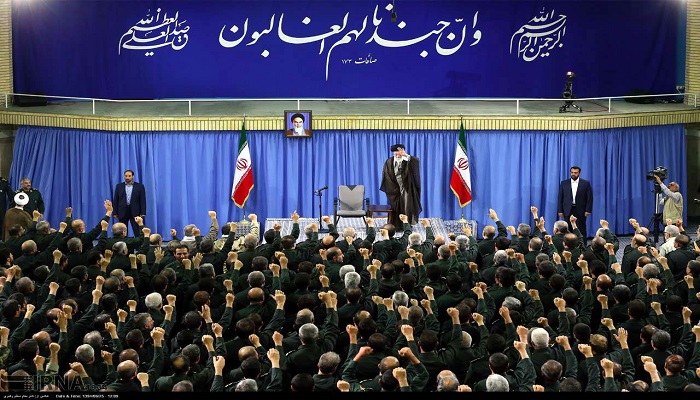
Khamenei-with-IRGC-The main force behind Terror in Iran, Iraq, Syria, Yemen, Lebanon, etc.

Khamenei-with-IRGC-The main force behind terror in Iran, Iraq, Syria, Yemen, Lebanon, etc.

The failure of Congress to halt the implementation of the nuclear deal with the Iran regime opens the floodgates for the regime to reap financial, military, economic and political rewards, but those gains may prove tenuous and illusory since in order to win passage of the agreement, the Obama administration took the unusual route of proposing it not as a full-fledged treaty, but as an administrative action that an incoming administration could conceivably reverse.

Since the Iran regime was adamant on delinking anything not related to the nuclear issue including human rights violations, support of terrorism, development of ballistic missiles and proxy wars, the reality is sinking in for supporters of the regime that they need to pay lip service to these other issues in order to stave off renewed calls to punish Iran for its transgressions.

This was evident by the issuance of a press release by lead regime lobbyist, Trita Parsi of the National Iranian American Council, who even acknowledged that the deal’s passage would not cause significant shifts in regime policy:

“While dialogue does not guarantee that Iran’s foreign policy conduct will shift to Washington’s liking, the absence of engagement all but guarantees that there will be either no change or a change in the wrong direction,” Parsi said.

While Parsi is showing its true face by advocating more dialogue with the criminal mullahs, his call for greater dialogue were again undermined by the statements of the regime’s top mullah, Ali Khamenei.

In his weekly televised speech, Khamenei warned commanders of the regime’s Revolutionary Guards to be on alert for “political and cultural” infiltration by the U.S. according to Agence France-Press.

“The main purpose of the enemies is for Iranians to give up on their revolutionary mentality,” Khamenei told a gathering of Guards commanders and personnel in Tehran.

“Enemy means global arrogance, the ultimate symbol of which is the United States,” he said, calling on the powerful branch of the military to protect the revolution.

“Economic and security breaches are definitely dangerous, and have dire consequences,” he said.

“But political and cultural intrusion by the enemy is a more serious danger that everyone should be vigilant about,” he added.

Parsi of course did not call for Khamenei to moderate his language or stop the continued depiction of the U.S. as Iran’s greatest “enemy.” Parsi saves his rhetorical fire – not to his mullah taskmasters – but for the U.S. leadership that he actively lobbies.

Khamenei threw more cold water on Parsi’s press release and his call for greater dialogue by saying last week that Iran would not hold any negotiations with the U.S. beyond the nuclear issue. Short of calling Parsi a liar, Khamenei certainly refutes most of what Parsi has to say.

It’s no surprise that Khamenei made his appeal directly to the leaders of the Revolutionary Guards which was created by the mullahs to preserve the mullah’s rule and maintain the stranglehold the leadership holds over Iran’s economy and its people.

The passage of the deadline to sink the nuclear deal also marked a celebration of sorts by supporters of the regime as evidenced by Ben Wikler, Washington director of Moveon.org, piece in Huffington Post which gleefully recounted how the regime’s supporters marshalled their forces to prevent the agreement’s demise.

The only thing missing was a photo of Wikler and Parsi holding hands in front of a “Mission Accomplished” banner over an Iranian missile battery.

But while Wikler breathlessly recounts the campaign to support the deal, this moment may prove Pyrrhic for supporters as the next year reveals the true nature of the regime as it no doubt continues to support conflicts in Syria, Iraq and Yemen and Americans grow increasingly uneasy about the deteriorating situation in the Middle East along with the rise of extremist groups and a full-blown refugee crisis.

Broad public disapproval of the nuclear deal has already been registered in virtually every public opinion poll and the fact the deal was passed with no bipartisan support and only through a minority vote of 42 Democratic senators may condemn any member running for re-election not only in 2016, but also 2018.

In essence, the regime lobby is praying mightily the American people will have a short memory and that the mullahs don’t blow it for them; neither scenario seems likely.

Already we’ve seen the veneer being peeled off of the Iran lobby with a flood of news articles examining the lobby, especially the NIAC and its financial backers. Ben Cohen, senior editor of TheTower.org, joined in this review by posting a story on JNS.org recounting the various investigative news stories recently published about the NIAC including The Daily Beast and others and smartly asks the inevitable question that should be on the lips of every Capitol Hill staffer:

“Now that the truth about NIAC is emerging, one has to ask why anyone who seeks respectability in Washington would have anything to do with Parsi and his cohorts,” Cohen said.

“The Islamist regime in Iran is the root of the problem, not its cure: as long as it remains in place, there should be no talk of normalization. Second, that there shouldn’t even be an Iran lobby in America, if by ‘Iran lobby’ we mean individuals and groups like NIAC, whose mission is to sell this vicious regime as an attractive partner for Western democracies,” Cohen added.

Cohen is correct when he assesses only regime change in Iran will force changes in policy away from sponsorship of terror and human rights abuses. The real hope and future lies not in the nuclear deal Parsi has championed, but in a new presidential administration that can tear it up.

By Michael Tomlinson

Filed Under: Blog, National Iranian-American Council, The Appeasers Tagged With: Dialogue with Iran, Featured, IRGC, Khamenei's speech, NIAC, Trita Parsi

Iran Regime Engages in More Extremists Actions

September 3, 2015 by admin

Iran Regime Engages in More Extremists Actions

Iran Regime Engages in More Extremists Actions

Who knew the American flag could be a “Satanic symbol” but in Tehran under the mullahs, it not only is, but along with the Union Jack, is a forbidden item for sale on T-shirts in the Islamic state as the religious theocracy cracks down on merchants looking to cash in on the perceived thawing in relations with the West.

“This morning we took these clothes off leading distributors,” said city police chief General Hossein Sajedinia as quoted by the ISNA news agency.

Sajedinia said reports about the activity had been received in the past two weeks, leading to surveillance and detentions and the closing of any stores selling such items.

So much for the “moderate” Iran government.

The disconnect between the perception being pushed by regime advocates such as the National Iranian American Council and apologists such as Ali Gharib and Paul Pillar of a cuddly and soft new Iranian government and the real on-the-ground truth of a brutal, harsh and unrelenting regime is stark and incontestable.

Since the July 14 agreement between the Iran regime and the P5+1 group of nations, the regime has done little to reassure the rest of the world that it has indeed changed. In fact, its actions since then have only reinforced critics of the regime who have long maintained that Iran’s mullahs have absolutely no intention of changing course.

The biggest concession the regime won from the rest of the world was not allowing it to keep the bulk of its nuclear infrastructure intact, nor was it the lifting of trade and financial embargoes allowing it to access $150 billion in frozen assets or sell four million barrels of oil on the open market or buy advanced military weapons systems again.

No, the biggest concession was uncoupling the actions of the regime from any future repercussions. In effect, the cutting of Iran’s conduct from any measurable yardstick of internationally accepted normative behavior from any consequences from future sanction or action has emboldened Iran’s mullahs to feel invigorated with their new-found freedom and they have left the starting gate running harder and faster than Triple Crown winner American Pharoah.

NPR correspondent Michele Kelemen focused on this disconnect in examining the Iran regime’s steadfast refusal to answer questions from the International Atomic Energy Agency over the past decade over the military dimensions of its nuclear program.

Harvard University’s Olli Heinonin, a former top official at the International Atomic Energy Agency, says having full knowledge about the past will be crucial in the future — when Iran gets out from under the current limits on its nuclear program,” Kelemen said.

“You want to understand how far did they get,” said Heinonin. “Then you know what else they need to do to manufacture a nuclear weapon.”

Heinonin, speaking at the Foundation for the Defense of Democracies, which has been critical of the Iran deal, said knowing about the past will also help inspectors know where they should concentrate their efforts now, according to Kelemen.

That defiance of in adhering to the proposed agreement was again reinforced by Iranian Defense Minister Hossein Dehghan who recently reaffirmed Iran’s position that issues involving Iran’s missile program are not matters for discussion. Presumably, Iran is determined to keep developing its missile force.

As for attempts to clarify Iran’s past activity regarding the “military dimensions” of its nuclear program, Dehghan noted that Iran will definitely not grant anyone access to its security and military “secrets.”

He was echoed by the head of the regime’s Revolutionary Guard who said the U.S. is still the “Great Satan,” regardless of the nuclear deal struck with the Americans and other world powers over the Islamic state’s contested nuclear program.

The comments by Gen. Mohammad Ali Jafari, reported by the official Guard website, said enmity against Iran by the U.S. hasn’t lessened.

“We should not be deceived by the U.S.,” Mr. Jafari reportedly said. “It wants to infiltrate into Iran, resorting to new instruments and method.”

But rhetoric alone is not the only tool the Iran regime is using as Kuwait yesterday charged 24 people suspected of links to Iran and the Hezbollah terror group with plotting attacks against the Gulf state according to a public prosecutor.

The men were charged with “spying for the Islamic republic of Iran and Hezbollah to carry out aggressive acts against the State of Kuwait” by smuggling in and assembling explosives, as well as possessing firearms and ammunition, the statement said.

They were also charged with “carrying out acts that would undermine the unity and territorial integrity” of Kuwait, and of possessing eavesdropping devices, it said.

The actions in Kuwait only serve to underscore the mistake by the P5+1 in giving Iran this major act of appeasement in the hopes of buying some short term security by forgoing any hope of containing the Iran regime in the future. It’s a Faustian bargain that Stephen Rademaker explained on PBS this weekend:

“Faust was this mythological figure who sold his soul for the — to the devil in exchange for magical powers for — I think it was 26 years,” he said.

“For 26 years, he had magical powers. At the end of 26 years, the devil came to claim his soul. And I think that is a pretty good analogy to what this deal provides. For 10 years, it’s not a bad deal. After 10 years, it becomes a horrible deal and it gives Iran regime everything they have always wanted. After — President Obama concedes, after 13 years, the breakout time is almost zero,” he added.

Rademaker was an assistant secretary of state for the Bureaus of Arms Control and International Security and Nonproliferation under President George W. Bush. He’s now a principal at the Podesta Group in Washington and an adviser to the Bipartisan Policy Center.

All of which demonstrates as clear as daylight that the Iran regime is fully committed to its extremist course of action and the proposed deal, far from hindering it, actually enables it.

All of which demonstrates as clear as daylight that the Iran regime is fully committed to its extremist course of action and the proposed deal, far from hindering it, actually enables it.

By Michael Tomlinson

Filed Under: Blog, News Tagged With: ALi Gharib, Featured, Hossein Sajedinia, Iran deal, Mohammad Ali Jafari, Trita Parsi

NIAC Funded Through Regime Sources as Iran Lobby Ramps Up

July 13, 2015 by admin

Tritta Parsi paying respect to the Iranian regime delegation in Geneva

Trita Parsi paying respect to Iran delegation in Geneva Talks

With the potential announcement of an agreement between the Iran regime and the P5+1 group of nations, the scene will undoubtedly shift to Congress where both houses will have 60 days to review the agreement under legislation authored by Sen. Bob Corker (R-TN), chair of the Senate Foreign Relations Committee, as part of a bipartisan compromise.

With that upcoming debate, a fierce lobbying campaign will break out between those opposed to the agreement and the lobbying machine deployed by Tehran’s mullahs to get it passed. Chief among them will be the National Iranian American Council, the leading advocacy group for the Islamic state, which has formally launched its own full-fledged lobbying arm in anticipation of the fight ahead.

The creation of the lobbying group has come under intense scrutiny given its timing just before congressional review, as well as the need to funnel and direct funds towards supporting the Iran regime. The question of financial support for the NIAC has been a persistent question and a recent story by The Daily Beast shed new light on where the chief cheerleaders for Iran’s mullahs are getting their money.

The story, written by Michael Weiss and Alex Shirazi and contributed by Jackie Kucinich, examined contributions made by Vahid Alaghband, an Iranian businessman who’s Balli Aviation Ltd., tried to sell 747 airliners to Iran despite a federal ban on such sales. His company pled guilty to two criminal counts in 2010 and under the plea deal with the U.S. Justice Department, paid a $2 million criminal fine, served five years of corporate probation and paid an additional $15 million in civil penalties.

“…Alaghband stands out from the rest, because the beneficiary of his firm’s deals with Tehran was an Iranian airline accused by the U.S. government of working with the regime’s foreign intelligence operatives and shipping arms and troops to Syria,” said the article.

“Plus, if an agreement between Iran and the world’s major powers is concluded in the coming days—as is widely expected—operators like Alaghband could stand to benefit.”

The deep ties to the regime also included a conspiracy in to export 747 aircraft by first obtaining export licenses from the U.S. government and then using an Armenian subsidiary to buy the planes for Mahan Air, Iran’s largest airline, which the State Department believes is controlled by former Iranian president Akbar Hashemi Rafsanjani.

Mahan Air was also sanctioned by the Treasury Department in 2011 for “providing financial, material and technological support to the Islamic Revolutionary Guard Corps-Qods Force (IRGC-QF),” or the expeditionary arm of the Islamic Republic’s praetorian military division, now heavily active in both Syria and Iraq. At the time, the Treasury Department accused the Qods Force of “secretly ferrying operatives, weapons and funds” on Mahan flights.

In 2007, Alaghband offered to give a $900,000 donation over three years to the PARSA Foundation, intended for the Brookings Institution to support pro-Iranian rapprochement. This followed a previous donation of $50,000 he made to PARSA.

PARSA’s second-largest recipient of funding was the NIAC which received a total of $591,500 from the group, but funding is not the only link between NIAC and the Iran regime with other news organizations and Iranian dissident groups having pointed out close ties between NIAC leaders such as Trita Parsi with regime officials that came to light as a result of a failed defamation suit brought by Parsi against an investigative journalist.

All of which casts doubt on NIAC Action, the new lobbying muscle being deployed to help the mullahs. As noted in an article in Commentary Magazine, the launching of the lobbying arm was followed by an email sent by NIAC staffer Tyler Cullis (and not from the NIAC Action ironically enough) calling for the immediate lifting of the United Nations arms embargo as part of the nuclear agreement.

As Commentary Magazine writes: “What the vast majority of Iranian-Americans know, and what Congress should ask NIAC, is how lifting the arms embargo meant to repress Iran’s sponsorship of terrorism is in anyway an interest of the United States, the Iranian-American community, or regional stability and security.”

“That NIAC would advocate the lifting of the arms embargo is both curious and revealing. Rather than promote Iranian-American political activism or public diplomacy, NIAC increasingly appears to align itself squarely with the publicly declared interests of the Islamic Republic of Iran,” the article adds.

Indeed, the mere fact that the NIAC is hard at work sending emails to congressional staffers urging the lifting of an arms embargo designed to prevent the Iran regime from exporting arms outside of Iran is hugely significant and provides proof that the mullahs are not intent on fostering peace, but instead are desperate to gets fresh supplies of arms and ammunition to their Hezbollah proxies in Syria, Shiite militias in Iraq and Houthi rebels in Yemen as three wars rage on.

As debate opens in Congress, it would be wise for Democratic and Republican staffers to look at the sender of these email missives and if it comes from the NIAC, they should send it straight to “Junk Mail.”


Filed Under: Current Trend, National Iranian-American Council Tagged With: alaghband, Featured, Iran, Iran sanctions, Irandeal, Irantalks, irantalksvienna

NIAC Discussion on Geopolitical Implications of Iran Deal or shameful Lobbying for mullah

June 27, 2015 by admin

Iran Lobby on the Nuclear Discussions

Iran Lobby on the Nuclear Discussions

In an article published on Center for Security Policy, written by Caitlin Anglemier, The National Iranian American Council (NIAC)’s usual approach in serving as Iran’s lobby in Washington D.C. has been highlighted. Excerpts from this article are published here to describe the path the Iranian lobby and fellow travelers are talking while we are getting very close to the June 30th self claimed nuclear talks deadline.

On June 25, NIAC held a discussion on “The Geopolitical Implications of an Iran Deal”. The panel of speakers included: Peter Beinart, contributing editor for The Atlantic and National Journal; Fred Kaplan, war stories columnist for Slate; Dr. Trita Parsi, President of the National Iranian American Council; and Barbara Slavin, South Asia Center senior fellow for the Atlantic Council, known within the Iranian community for appeasing the mullahs.

In her article, Caitlin Anglemier reports: “The talk began with a discussion on how foreign policy has become a primary focus of the Republican party and how generally, the Democratic party tends to place more emphasis on social and economic issues. The discussion then drifted towards discussing the negotiation talks themselves and the ten-year time period aspect. The panel acknowledged the concern that many have, which is that the ten-year period is just delaying the inevitable truth that Iran could obtain a nuclear weapon within a year. But the panel emphasized the importance of those ten years. While that negative viewpoint is out there, why not try to focus on the time positively and the opportunity it provides for even more talks, negotiations, and compromising?

In trying to frame the ten-year period in such a positive manner, the NIAC panel attempted to depict a reality that is simply not accurate. Solely based on how the nuclear deal negotiations have gone so far, it would be foolish to think that ten years of talks and additional demands would go any better than what has transpired-which has not been good at all.”

The report continues: “The discussion then moved to reflecting on the implications of all the money involved in the deal talks. “…[the US] will have released a total of $11.9 billion to the Islamic Republic [of Iran] by the time nuclear talks are scheduled to end in June, according to figures provided by the State Department”. The panel seemed to indicate that if a deal is successfully reached, Iran would utilize the freedom gained from lifted sanctions as well as the cash assets given from the United States to benefit the people of Iran. The panel’s theory was that if Iran continued, over the next ten years, to send money overseas for alternative projects, the people of Iran would start questioning the government and would become upset. In the past, Iran has used the funds it had to fund terrorism and terrorist organizations. If the country has placed an emphasis on aiding terrorism over taking care of its people in the past, why would that change after a new deal?”

It is also a fact that a big chunk of Iran’s economy is in the hands of IRGC, which is the main force behind all the nuclear activities, Regime’s meddling in Syria, Iraq, Yemen, etc (the Quds force), and therefore it goes without saying that all the money that will return to Iran will be channeled in the same manor it did before.

Caitlin Anglemier refers to the last part of the discussion about another tactic used by the Iranian lobby in counting “benefits of collaborations” with the Iranian regime on the fight against ISIS. She says: The last part of the discussion before questioning commenced revolved around the “misfortunate reality” that the US can’t work in alliance with Iran to combat the Islamic State. The panel emphasized how the Islamic State is well aware of the fact that all of its major opponents are at war with one another, and has already taken advantage of this situation. At first glance it does seem that Iran has taken steps towards combatting the Islamic State. However, Iran is actually continuing to fund Hezbollah as well as Shia tribes and militias. While the US clearly wants to abolish the Islamic State, this must be accomplished without simultaneously strengthening Iran and its militant connections. This hypothetical alliance with Iran against IS could never manifest itself in reality.”

Referring to the questions about the the exact details of the deal talks and their implications, she writes: “More importantly, even if we were able to compromise and establish a negotiation with Iran on their desires and demands, we have no reason to believe that they will be honest and follow through on said demands in the future. Therefore, this essentially indicates that a “deal” is just a blissfully ignorant façade.

Conclusive, the discussion was polite, peaceful, and very informative. It would be easy to imagine a listener walking away with a positive mental image of Iran and the extensive benefits a successful nuclear deal agreement. However, we must take it upon ourselves to not be so easily deceived. Pursuing an agreement with Iran in nuclear talks is not only a waste of time and resources, it would result in directly providing Iran with significant relief from sanctions as well as billions of dollars. And contrary to what some apparently believe, these billions will in fact not be used towards benefiting the wellbeing of the Iranian citizens, but will continue to be used in funding terrorism and terrorist organizations.

We must abandon these attempts at negotiations with Iran before we make ourselves out to be even greater pushovers than we have already portrayed.”

Filed Under: American-Iranian Council, Current Trend, Duping Anti-War Groups, Latest from Lobbies & Appeasers, National Iranian-American Council Tagged With: Barbara Slavin, caitlin Anglemier, Featured, Fred Kaplan, Iran deal, Iran Talks, NIAC, nuclear talks, Peter Beinart, Trita Parsi

  • « Previous Page
  • 1
  • …
  • 48
  • 49
  • 50

National Iranian-American Council (NIAC)

  • Bogus Memberships
  • Survey
  • Lobbying
  • Iranians for International Cooperation
  • Defamation Lawsuit
  • People’s Mojahedin
  • Trita Parsi Biography
  • Parsi/Namazi Lobbying Plan
  • Parsi Links to Namazi & Iranian Regime
  • Namazi, NIAC Ringleader
  • Collaborating with Iran’s Ambassador

Recent Posts

  • NIAC Trying to Gain Influence On U.S. Congress
  • While Iran Lobby Plays Blame Game Iran Goes Nuclear
  • Iran Lobby Jumps on Detention of Iranian Newscaster
  • Bad News for Iran Swamps Iran Lobby
  • Iran Starts Off Year by Banning Instagram

© Copyright 2026 IranLobby.net · All Rights Reserved.