Iran Lobby

Exposing the Activities of the lobbies and appeasers of the Mullah's Dictatorship ruling Iran

  • Home
  • About
  • Current Trend
  • National Iranian-American Council(NIAC)
    • Bogus Memberships
    • Survey
    • Lobbying
    • Iranians for International Cooperation
    • Defamation Lawsuit
    • People’s Mojahedin
    • Trita Parsi Biography
    • Parsi/Namazi Lobbying Plan
    • Parsi Links to Namazi& Iranian Regime
    • Namazi, NIAC Ringleader
    • Collaborating with Iran’s Ambassador
  • The Appeasers
    • Gary Sick
    • Flynt Leverett & Hillary Mann Leverett
    • Baroness Nicholson
  • Blog
  • Links
  • Media Reports

Iran Regime Grows Desperate as Sanctions Tighten

November 27, 2018 by admin

Iran Regime Grows Desperate as Sanctions Tighten

As the full weight of new economic sanctions are imposed on the Iranian regime, an uncomfortable truth is roiling the sleep of the mullahs in Tehran; oil prices are plummeting and putting the squeeze on them.

Leading that global glut of oil is surging U.S. production that is becoming a potential hammer blow to the mullahs’ faint hopes of weathering the economic storm.

According to the Wall Street Journal, “observers expected American energy production to reach a plateau. A lack of pipeline capacity was expected to constrain output in the Permian Basin through 2020. Instead, shippers found ways to use existing pipelines more efficiently, and new pipelines were constructed faster than expected. U.S. crude-oil production is expected to average 12.1 million barrels a day in 2019, 28% higher than in 2017. Surging production has roiled world energy markets.”

The biggest loser of this newfound energy production? Iran. As the Journal outlines, the economic windfall the mullahs hoped to reap from the nuclear deal forged by President Barack Obama were largely offset by the sharp price spiral of oil in 2016. Now rising American output is doing the same thing to Iran in 2018.

The financial profits the mullahs have traditionally carved out for themselves from black market sales of Iranian oil are unlikely to materialize as spotty sales on the bourse created by the Iranian government has already shown.

Hopes by the Iran lobby that countries opposed to the U.S. might pick up the slack by buying Iranian oil such as China are being dashed by falling oil prices. Just a few months ago oil was predicted to hit $100 per barrel, but instead the global benchmark has fallen to $50 per barrel.

Iran hasn’t been helped by record oil production by its regional opponent, Saudi Arabia, which raised production to an all-time high in November, pumping a colossal 11.3 million barrels per day.

The squeeze to the Iranian regime on all sides is fueling the domestic unrest spreading across the country as a result of deepening economic worries.

Predictions by the Iran lobby that the regime could weather this economic storm are becoming harder to make with a straight face. One such idea was the much-hoped for barter agreement system being proposed to allow Iran to sell oil in exchange for goods, thereby avoiding U.S. secondary sanctions on currency exchange.

Of course, the regime will resort to earlier sanction busting tactics including fraud, smuggling and even having Iranian tankers turn off position signals in an effort to go stealth.

The end result of all these shenanigans though is not to benefit or help the Iranian people, but rather to further enrich the ruling elites and Revolutionary Guard Corps which continues to spend prodigious amounts of cash in funding various terrorist actions abroad and proxy wars, as well as keep its loyal terror groups such as Hezbollah in the black.

The chief argument made by the Iran lobby against these sanctions is that they will be unlikely to motivate the Iranian people to rise up and demand change from their government.

“The theory behind it is, you make the population so miserable that they will rise up against the government,” said Trita Parsi, founder of the National Iranian American Council.

Unfortunately for Parsi and the NIAC, the Iranian people are rising up. Merchants have taken to the markets to protests. Truckers have stopped driving. Teachers have halted classes. Throughout Iran the people are making their voices heard and predictably, the regime is resorting to violence and intimidation in an effort to suppress it.

But that hasn’t topped the NIAC from pedaling more false ideas and schemes to get relief for the mullahs, including putting out a so-called report outlining the potential of restoring the nuclear deal.

That report is nothing more than a regurgitation of past NIAC misstatements assembled in a slim few pages and passed off as scholarly research. We might call it Cliff’s Notes version of Iran lobby messaging.

Also included are opinions by Paul Pillar, Nonresident Senior Fellow at the Center for Security Studies at Georgetown University, who has become such a fixture alongside Parsi one might wonder if they’re related as they appear on any policy panel they can get on in an effort to find any kind of audience for their messaging.

The culmination of all this doesn’t alter the trajectory of the Iranian regime under these sanctions. What is different now than from past sanctions is a U.S. administration committed to pushing the regime back to the bargaining table to address not only nuclear weapons but also its destabilizing influence throughout the region and support for terrorism, as well as its dismal human rights record.

What is also different is the willingness of the Iranian people to defy their own government and unlike the previous protests after disputed presidential elections in 2009, these protests resonate more deeply because it comes from all parts of Iranian society, including the poor and working class who helped fuel the overthrow of the Shah in the first place.

The parallels to that time may be painfully uncomfortable for the mullahs now.

Filed Under: Blog Tagged With: Featured, Iran deal, Iran Economy, IranLobby, NIAC, Sanctions, Trita Parsi

On Eve of UN General Assembly Session News Gets Worse for Iran Regime

September 25, 2018 by admin

On Eve of UN General Assembly Session News Gets Worse for Iran Regime

It seems the mullahs in Tehran can’t catch a break as events conspire to slowly and inexorably pry their fingers away from the stranglehold of control they’ve exerted over the Iranian people for the past nearly four decades.

With the United Nations General Assembly scheduled to start next week and chaired by President Donald Trump, the Iranian regime is being buffeted by attacks and threats from all sides not the least of which has been the economic hammer blows wielded by the Trump administration in the wake of pulling out of the Iran nuclear deal.

A flurry of European companies, who raced in once the deal was approved in 2015, are now racing out of Iran with looming secondary sanctions by the U.S. for anyone doing business with Iran in key areas.

The focus is on “bottleneck sectors” — areas where there is little or no way to avoid a U.S. connection, including aviation, insurance, shipping, logistics, and especially banking. This means many German companies are caught in the crosshairs and have pulled up stakes.

Many observers expect many more big firms to leave Iran. “We expect almost all of the European and Japanese companies along with major Korean companies to leave Iran,” Sara Vakhshouri, the president of SVB Energy International in Washington DC, told Deutsche Welle.

Major German companies scaling back or shutting down operations in Iran include automakers Volkswagen and Daimler, financial institutions Commerzbank, Deutsche Bank and DZ Bank, manufacturing giants Airbus and Siemens, insurance giants Allianz and Munich Re, airlines Lufthansa and Austrian, Deutsche Telekom and consumer goods company Henkel.

This follows pullouts by Total and Peugeot and many other European firms the Iranian regime has been desperate to keep. The exodus has prompted officials such as Hassan Rouhani and Mohammad Javad Zarif to beg the European Union to try and come up with alternative means of keeping Iran afloat.

The list of companies leaving Iran has been staggering and leaves the mullahs in a precarious position with unfinished projects, little capital investment available and unemployment driving growing protests across the country.

But Germany’s pullout only compounds the pressure the Iranian regime is receiving in its most vital economic sector: petroleum.

According to numerous media sources, OPEC is considering boosting oil production by half a million barrels a day to counter a perceived shortfall from Iran as customers cut orders because of U.S. sanctions.

The Organization of Petroleum Exporting Countries gathering in Algeria may indicate whether the group has “the barrels available to fully cover the Iranian lost output,” said John Kilduff, a partner at New York-based hedge fund Again Capital LLC, according to Bloomberg.

OPEC and allied producers are set for another contentious meeting: Iran has threatened to veto any decision that harms its interests. Iranian oil minister Bijan Namdar Zanganeh said the group had no authority to impose a new supply arrangement.

According to analysts, the shift in production to cover an Iranian shortfall could occur chiefly through more pumping from Saudi Arabia and Russia, the two largest producers within the OPEC+ group.

As a chief regional rival to Iran, Saudi Arabia could deal a harsh economic blow to Iran, and while the Iranian regime has worked tirelessly to keep Russia as a sponsor, the prospect of becoming a dominant global player in a reconfigured oil market without Iranian leverage appeals to the Russians according to analysts.

Events are quickly conspiring to further isolate the mullahs and strip them of the economic leverage they once had in controlling virtually all of the country’s industries through a vast network of shell companies.

In typical bluster, the Iranian regime held military exercises near the strategic Strait of Hormuz in the Persian Gulf according to the regime’s official IRNA news agency.

The drill involved the military’s and Revolutionary Guard fighter jets, including U.S.-made F-4, French Mirage and Russian Sukhoi-22 planes, the report said, adding that five logistics and combat helicopters are also taking part in the exercise over the Persian Gulf waters and the Sea of Oman.

IRNA said the maneuver is a warning to Iran’s enemies that they face a quick, “stern response” in case of any ill-will toward Iran.

The predictable military threats by Iran come on the heels of decision by the U.S. State Department to once again tag the regime as the world’s leading sponsor of state terrorism.

The annual survey on global terrorism said Iran and its proxies are responsible for intensifying multiple conflicts and undermining U.S. interests in the region.

“Designated as a state sponsor of terrorism in 1984, Iran continued its terrorist-related activity in 2017, including support for Lebanese Hezbollah, Palestinian terrorist groups in Gaza, and various groups in Syria, Iraq, and throughout the Middle East,” the report said.

The survey said that Iran used the Revolutionary Guards Corps’ Quds Force to provide support to terrorist organizations, provide cover for associated covert operations, and create instability in the region.

“Iran uses terrorism as a tool of its state craft, it has no reservations about using that tool on any continent,” Ambassador Nathan Sales, the State Department’s coordinator for counterterrorism, told journalists Wednesday. He cited Iran-linked fundraising networks in West Africa, weapons caches in South America and operational activity in Europe.

Michael Tomlinson

Filed Under: Blog Tagged With: Featured, Iran deal, Iran Economy, Sanctions

Iran Lobby Misinforms on Who is Hurt Most by Iran Sanctions

August 13, 2018 by admin

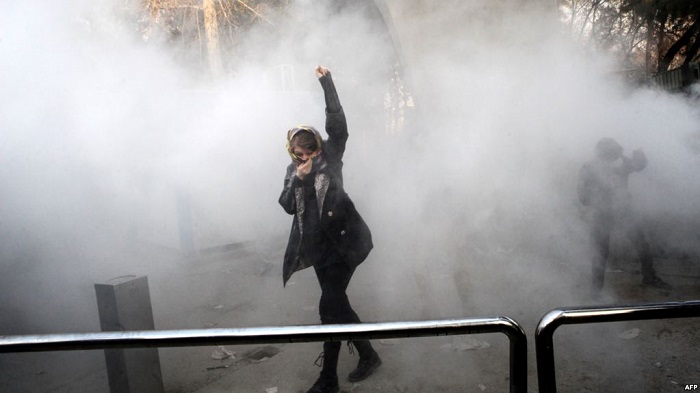
A student raises her arm in protest to the Iranian regime's repressive measures against peaceful protesters in Tehran-January 2018

The Iran lobby has scrambled to find the right kind of response to the re-imposition of economic sanctions by the Trump administration. It has tried to shield the mullahs from any culpability for leading Iran down this path with their support for terrorism and proxy wars that have devastated the region.

It has even tried to argue that sanctions will only spur a new regional arms race as the regime is sure to race towards developing a nuclear weapon now that it is freed from the nuclear agreement’s restrictions by the U.S. withdrawal.

In each case the response from news organizations and international governments has been muted because there is no argument with the facts that the regime is brutal and at fault for virtually all of the sins President Donald Trump cited in his decision to pull out of the nuclear deal.

The only feeble response from supporters of the regime has been the whining wail that the regime was in compliance with the agreement and all of the other despicable acts the regime commits, especially against its own people, are outside of the agreement’s scope.

That technicality is at the heart of what made the nuclear so problematic in the first place and why the Iran lobby is yet again shifting its message to a new tack.

Jamal Abdi, the new president of the National Iranian American Council and chief Iran lobby cheerleader, offered in an editorial in the progressive blog Lobelog.com, that the real victims of economic sanctions were the Iranian people.

“The reality is that Trump’s pressure campaign weakens those within Iran who seek more conciliatory foreign relations and a more open political and social domestic landscape. It also empowers Tehran’s most reactionary forces,” Abdi writes.

If it is impolite to call someone an outright liar, then we would have to watch our language and simply say Abdi is being disingenuous with his comments.

The stark reality is that there was never any hope of moderation within the Iranian regime with the Obama-negotiated nuclear deal since the ruling mullahs never had any intention of loosening their grip on power.

The elimination of any potential rival candidates from presidential and parliamentary election slates following the deal ensured that, as well as historically massive crackdowns on the Iranian people, including a round up and imprisonment of any dissenting viewpoint – real or imaginary – as thousands of women, students, journalists, activists, bloggers, artists and even YouTubers ended up in Iranian prisons.

“The repressive powers in the Islamic Republic are far more threatened by Iran’s integration into the global economy than by a tit-for-tat dispute with the United States. They worry that the lifting of sanctions will undermine the monopolies established by the well connected few who are aligned with the Revolutionary Guards and other government entities. Indeed, after the nuclear deal, the Supreme Leader issued edicts against a broader opening to the United States and hardliners repeatedly warned of ‘foreign infiltration’ in order to obstruct President Hassan Rouhani’s outreach to the West,” Abdi added.

Another fabrication from him as the reality is that virtually all of the Iranian economy is controlled by the state through the family dynasties of ruling mullahs or the Revolutionary Guard Corps which controls the largest companies in the petroleum, telecommunications, banking, manufacturing, transportation and energy industries.

Integration back into the global economy was a boon for the Iranian military, allowing it to refill its coffers, depleted by the wars in Syria and Yemen, and mobilize proxy militias in Iraq and Afghanistan.

When foreign companies such as Peugeot, Total and Airbus quickly moved in to sign deals with the regime, who was getting the benefits? Certainly not the Iranian people who’s standard of living has plummeted under the mullahs’ rule.

The much-promised economic windfall promised to the Iranian people after the nuclear deal was signed never came and in response the Iranian people have chosen to risk their lives in ongoing, massive demonstrations sweeping throughout the country since last December and into a sweltering summer of discontent.

“The real threats to repressive rule in Iran are a growing middle class, an organized civil society movement, and leaders who have the political capital to push for change against entrenched elements in the system. These trends make a democratic Iran inevitable. But outsiders, often led by the United States, have taken actions to arrest these developments. They have propped up Iran’s repressive rulers with threats of war and invasion, and bailed them out by slapping sanctions and travel bans to isolate Iranians and keep them weak,” Abdi said.

This last point is the most damning by the Iran lobby since the regime has done its level best to eradicate the Iranian middle class with manipulation of its currency and restrictions that have skyrocketed inflation and pushed the rial down to near Weimar Republic levels.

The defiance of Abdi’s claims comes in the form of the protests taking place throughout Iran by the Iranian people, including his much-vaunted middle class who have been hit hard by the regime’s deep corruption in the economy.

Couple that with the oppressive human rights situation in which women have been tossed in jail for protesting hijab requirements and the feisty mood of the Iranian people can be seen almost every day on Iranian streets and in town squares and marketplaces.

What many in the Iran lobby are terrified of is that the Iranian people will indeed be able to exert enough pressure internally to force the kinds of liberalization and democratization it promised with the nuclear deal but failed to deliver.

The Financial Times editorialized the same sentiment in but only gets it half-right:

“It would, however, be far preferable if Iran moved towards a more liberal and open regime through a process of domestic reform, rather than as a result of crushing external pressure. The history of Iran and the wider Middle East gives ample warning that sudden violent changes in government have rarely led to happy outcomes — particularly when they have had external sponsors,” the FT’s editorial board said.

Iran’s mullahs are never going to give up power as a result of gentle persuasion. Only a massive build up of outrage by the Iranian people coupled by economic sanctions aimed directly at gutting the financial pipeline to the military is the only pathway to gain the internal regime change the FT describes.

The history of the Middle East tells us that change does not come easily, nor politely. It comes only through the convergence of external pressure coupled with internal reforms.

We believe that opportunity is finally coming to Iran.

Filed Under: Blog, Current Trend, Duping Anti-War Groups, Latest from Lobbies & Appeasers Tagged With: Featured, Iran deal, Iran Lobby, IranLobby, Jamal Abdi, NIAC, Sanctions

Trump Invite for Meeting is Trap for Mullahs They Might Not Escape

August 2, 2018 by admin

Trump Offer to Meet Rouhani has Iran Lobby Boxed In

Trump Offer to Meet Rouhani has Iran Lobby Boxed In

President Donald Trump’s nearly off-hand comment about being open to a meeting with Iranian regime leader Hassan Rouhani “anytime” puts the Iranian regime and their Iran lobby supporters between a rock and a hard place.

On the one hand, if they simply denounce the invitation, they reaffirm the belief that the regime was never really interested in meaningful dialogue on topics not to their liking such as improving human rights, support for terrorism or interfering in neighboring countries.

It also calls out the Iran lobby’s persistent braying for diplomatic openings between the U.S. and Iran and once the president presents such an opportunity, critics such as the National Iranian American Council are quick to denounce it.

It seems the Iran lobby can’t have their cake and eat it too under this president.

If on the other hand, the mullahs accept the president’s offer, they might very run into a Trump version of what they have consistently done to others for decades which makes a show of diplomacy but grant nothing of substance and continue to apply pressure.

The prospect of the mullahs getting a dose of their own medicine is ironic and somewhat refreshing.

The varied responses from the regime are proof the mullahs in Tehran seem pretty confused as to what to do since it’s clear that President Trump’s offer is not really without preconditions. Rather, looming over Tehran is the precarious state of the economy, looming economic sanctions due to fall next week and mounting pressure internally from the Iranian people to change how the usual corrupt government operates.

“Unfortunately, right now there is no low-hanging fruit in U.S.-Iran relations or potential negotiations. And the primary reason is that Trump, by violating the Iran nuclear deal and withdrawing from it, he really eviscerated the Iranian trust in the United States,” said Sina Toossi, a research associate at the National Iranian American Council.

“He could potentially give that confidence to international banks and businesses, remove U.S. sanctions and allow Iran to get the benefits from the deal, and that could be used as a stepping stone for broader negotiations,” he added.

Therein lies the crux of the Iran lobby’s problem. It has in Trump a U.S. president who doesn’t care about appearances or how critics view him and is just as intent on forcing regime change as any president in the last 30 years. While the Iran lobby is pushing to recover the gains lost from the failed nuclear deal, it recognizes the awful truth of their position which is that there are no meaningful gambits left it can use on this president.

The Iran lobby and the regime have sought a bailout from Europe by trying to persuade the European Union to stay in the nuclear agreement.

Rouhani met with the new British Ambassador to Tehran Tuesday where he announced, not for the first time, the US withdrawal from the multilateral nuclear deal in May was “illegal,” adding that “the ball is in Europe’s court,” according to CNN.

But that prospect seems as likely as snow falling right now on a California beach as the president is already pressing the EU over the issue of bilateral trade tariffs that has Europe busy focusing on its own trade deals.

The poor mullahs are not at the top of the to-do list for Europe anymore and the trade they represent is a pittance compared to the whopping $690 billion in trade between the EU and U.S.

Nic Robertson at CNN offered his own analysis that the Iran regime may take a long view in responding to President Trump. He posits that Iran is willing to use a subtle approach in trying to divide the U.S. from its allies and by not ramping up extremist acts with its terrorist proxies such as Hezbollah is a sign of this approach.

He also offers that summits with Russian president Vladimir Putin and North Korea’s Kim Jong-Un are different since Iran’s leaders are not in as precarious a position.

With apologies to Robertson, that is a bad misread of the regime.

The mullahs are under intense pressure not only from a rial about to be less valuable than the paper its printed on to massive protests rocking the country since last year that have not abated and have taken on a dire tone with protests aimed directly at the regime’s top leaders.

The basket case economy is so bad, that Iranian parliament members have demanded Rouhani appear before them in one month to answer questions about the economy.

It is the first time parliament has summoned Rouhani, who is under pressure from rivals to change his cabinet following a deterioration in relations with the United States and Iran’s growing economic difficulties.

Lawmakers want to question Rouhani on topics including the rial’s decline, which has lost more than half its value since April, weak economic growth and rising unemployment, according to semi-official ISNA news agency.

Rouhani’s summon coincides with further shows of public discontent. A number of protests have broken out in Iran since the beginning of the year over high prices, water shortage, power cuts, and alleged corruption in the Islamic Republic.

On Tuesday, hundreds of people rallied in cities across the country, including Isfahan, Karaj, Shiraz and Ahvaz, in protest against high inflation caused in part by the weak rial, according to Reuters.

The mullahs are now faced with change or doubling down on crazy and potentially pushing the Iranian people too far or accept the truth that the regime’s days are numbered.

Laura Carnahan

Filed Under: Blog, News Tagged With: #NuclearDeal, Featured, Iran deal, Iran Lobby, Iran sanctions, National Iranian American Council, NIAC, NIAC Action, Rouhani, Sanctions, Sina Toossi

Iran Regime Teeters on the Brink of Change

July 11, 2018 by admin

A scene of Iranian protesters near Grand Bazar Tehran

Iranian protesters gather at Mobile market in Tehran on June 25, 2018.
Protesters in Tehran shouted slogans and threw rocks in the streets on June 25, before being dispersed by anti-riot policemen. / AFP PHOTO / ATTA KENAREATTA KENARE/AFP/Getty Images

In it, Shakespeare’s tragic villain, the ugly hunchback Richard schemes to depose his brother from the throne of England and steal it for himself after slaying the child heirs—his nephews. He eventually meets his fate, dying at the Battle of Bosworth Field.

In many ways, Shakespeare’s classic mirrors the ascension of the mullahs in Tehran who stole the revolution in 1979 that deposed the Shah of Iran only to turn it into a tyrannical Islamic theocracy that has regularly imprisoned, abused, tortured and hanged its own people including men, women and children.

It is only fitting today we may be witnessing the third and final act for the Iranian regime as it is rocked with an ever-increasing tempo of mass protests that have swamped the country and put the mullahs and military allies in the Revolutionary Guard Corps on the defensive.

The popular protests started spontaneously last winter and were rooted in economic woes being experienced by ordinary Iranians, including much of the poor in the more remote provinces outside of Tehran including farmers, coal miners, and other workers.

Unlike the protests in the wake of the disputed presidential elections of 2009 which were largely centered in Tehran and were powered by middle class and educated Iranians, these protests have swollen to include broad cross-sections of Iranian society.

The most recent protests have engulfed the Grand Bazaar in Tehran and reflect the despair and frustration of Iranian business owners and merchants over the virtual free fall in the Rial against the dollar, which hit an all-time low of 90,000 Rial for a single U.S. dollar.

The financial fallout is so bad, the mullahs have sought to halt trading in dollars and banned the import of 1,300 foreign goods such as household appliances and consumer technology products.

Additionally, the decision by the Trump administration to not re-certify the Iran nuclear deal and effectively end it brought on the reinstatement of economic sanctions that has crippled the Iranian economy that feeds its military adventures in Syria and Yemen.

The Trump administration’s focus on stiffening those sanctions have resulted in a cascade of business deals being canceled culminating in a warning from the U.S. State Department that companies currently buying Iranian crude oil must completely cut those exports by November this year or face sanctions.

The administration does not expect to grant any waivers to companies that purchase Iranian oil or invest in its energy industry, a State Department official said, putting these companies in a precarious position should they choose to continue doing business with the Iranian regime.

Things have gotten so bad that a senior Revolutionary Guard Corps commander went on television to tell all Iranians they were duty-bound to help the regime overcome its economic problems.

“It is our duty to work in coordination and synergy to help the government and other branches overcome economic woes and foil enemy plots for an economic war and psychological warfare,” said Gen. Yahya Rahim Safavi, a military adviser to top mullah Ali Khamenei.

The regime sought to blame the economic woes on outside forces such as the U.S., even though protestors such as those taking over the Grand Bazaar, have increasingly and loudly denounced the regime’s foreign military ventures such as the Syrian civil war which has drained the Islamic state’s coffers dry.

For Hassan Rouhani, the prospects look even bleaker as Khamenei weighs whether or not to sacrifice his puppet in order to satisfy calls for reform.

For Rouhani’s part, he dutifully sent France, Germany and Britain letters with a list of demands calling it the price that needs to be paid in order for Iran to stay in the nuclear deal in a Hail Mary effort to keep an economic lifeline open.

While the contents were not made public, we can easily assume Rouhani was demanding these countries keep their commitments for EU companies to continue fulfilling business deals, as well as continue buying Iranian oil. Without these lifelines, the collapse of the regime could be counted in months.

One example of those collapsing deals was the decision by French-Italian regional aircraft manufacturer ATR to halt delivery of its turboprop passenger aircraft Iran ordered in the wake of the nuclear deal.

IranAir, the regime’s national flag carrier, contracted to buy 20 planes from ATR and eight have been delivered with the remaining dozen now in limbo.

Large commercial manufacturers Boeing and Airbus also announced halts in delivering airliners ordered by the regime which has used its commercial air fleet, such as Mahan Air, to ferry troops, ammunition and weapons to Syria to help support the Assad regime during its bloody civil war.

Things have gotten so desperate for the regime that government spokesman, Mohammad Baqer Nobakht, called on diaspora Iranians to “bring their money to Iran” and urged all Iranians to invest their cash and gold into the economy.

Of course, he neglected to mention the practice of arrested and imprisoning dual-national Iranians coming back to visit relatives which increased dramatically following the nuclear deal.

The International Monetary Fund reported that a record amount of capital, $27 billion, was taken out of the country last year. Khamenei, in a sermon recently celebrating the end of Ramadan, called upon Iranians to stop taking leisure trips abroad, to make sure no more foreign exchange leaves Iran, according to the New York Times.

In comments following on his boss’, Rouhani promised his government would cut spending, reduce international travel and fly economy class to ease the burden on the public. He also said his government would import raw materials at affordable prices to help domestic manufacturers and ensure supply for Iranians.

Additionally, he urged ministries to issue government bonds to give people alternatives to the dollar and the euro for investing their assets.

“If anyone thinks the government will resign or step aside, or go, they are mistaken,” Rouhani said.

The clock is ticking on the Iranian regime and the mullahs.

Michael Tomlinson

Filed Under: News Tagged With: Featured, Iran Human rights, IRGC, Khamenei, Moderate Mullahs, Rouhani, Sanctions

Iran Lobby Reduced to Begging for Shoes

June 13, 2018 by admin

Iran Lobby Reduced to Begging for Shoes

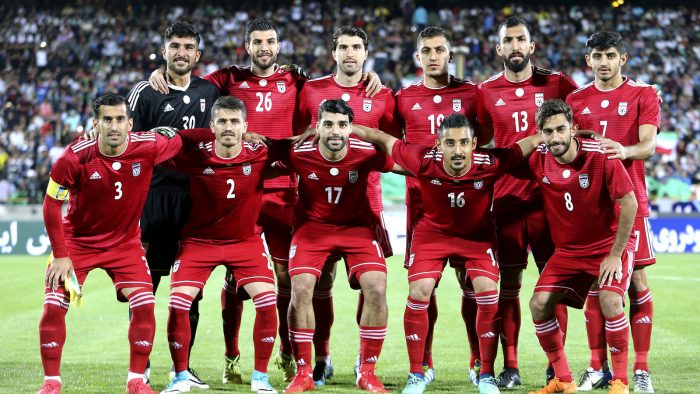
Iran’s team poses for a team photo prior the international friendly soccer match between Iran and Uzbekistan at the Azadi Stadium in Tehran, Iran, Saturday, May 19, 2018. (AP Photo/Ebrahim Noroozi)

The World Cup is about to begin in Russia with the world’s sports stage about to be taken up by soccer teams from around the world. All of them will be clad in gear provided by leading sports manufacturers, but one of the world’s biggest, Nike, will not be providing cleats for the Iranian regime’s soccer team.

On the eve of facing its first opponent in Morocco, Iranian players won’t be wearing Nike footwear after the U.S.-based sporting giant announced it would no longer supply the Iranian team because of new economic sanctions put in place by the Trump administration.

“The sanctions mean that, as a U.S. company, we cannot provide shoes to players in the Iran national team at this time,” Nike said in a statement.

The decision was accompanied by new economic sanctions. The U.S. Treasury can impose a penalty of up to $1 million and 20 years in prison against any company or person who violates the sanctions.

Predictably the Iran lobby spewed with rage at the perceived injustice with the National Iranian American Council leading the charge.

“I haven’t gotten clarity on what legal basis [Nike] is using to say this. They should reference what part of the sanctions they are talking about since technically they’re not selling anything,” said Trita Parsi, head of the NIAC.

The next incoming head of the NIAC, Jamal Abdi, chimed in as well in a press release issued by the NIAC.

“This flies in the face of any claims by the Trump Administration that it is targeting the Iranian government and not the Iranian people. We are well aware that the President’s National Security Advisor, John Bolton, has openly called for the U.S. to take steps to target even sports exchanges with Iran and may relish this shameful situation. Nothing symbolizes the wishes and hopes of the Iranian people more than their national soccer team. And nothing unifies them more than when that team is unjustly targeted and insulted,” Abdi said.

It shows just how far the influence of the Iran lobby has fallen now that President Trump has withdrawn from the Iran nuclear deal and has placed North Korea negotiations front and center of the global debate when the NIAC is reduced to begging for shoes for the regime’s soccer team.

It’s worthwhile recalling some of the lowlights for the Iran lobby and regime when it comes to sporting events which the Parsi and Abdi have conveniently forgotten about; namely, that regime has historically banned women from even attending and watching sporting events such as soccer, swimming, and wrestling.

Many Iranian women who are fans often resort to wearing beards and disguises to gain entry and cheer on their team. If they are discovered, it often leads to jail time.

Since 1979, women athletes have been subject to strict requirements when competing in Iran or abroad, with the Iranian Olympic Committee stating that “severe punishment will be meted out to those who do not follow Islamic rules during sporting competitions”. The committee banned women athletes from competing in Olympic events where a male referee could come into physical contact with them. At 1996, 2000, 2004 and 2008 Summer Olympics combined, a total of six women represented Iran.

Dorsa Derakhshani, 19, an Iranian chess grandmaster champion who grew up in Tehran, was forced out for choosing not to wear a hijab and now plays for the U.S. Chess Federation.

In many cases, especially women, the Iranian regime has often chased away its best and brightest in favor of maintaining the archaic nature of the theocracy’s laws.

These issues are never mentioned by the Iran lobby nor do they earn condemnation by the NIAC, which instead chooses to attack the issue of sanctions, by using the plight of the men’s soccer team as a PR tool.

The underlying concern for the Iran lobby is what the refusal by Nike represents, which is worry that the new sanctions imposed by the Trump administration will be deeper, harder and more effective than those that originally drove the Iranian regime to the nuclear bargaining table in the first place.

If sporting manufacturers are opting to stay from potential sanctions for participating with Iran, what does that say about heavy industries the regime’s economy and military depend on such as electronics, steel, petroleum, chemicals, and manufacturing?

The worry for Parsi and Abdi is that if other companies, including those in Asia and Europe, take these sanctions by the Trump administration more seriously, the Iranian regime could soon find its faltering economy knocked flat on its back which would pose significant threats to the rule of the mullahs in light of widening protests by ordinary working-class Iranians over the terrible economic conditions they are now facing.

While Abdi tries to frame the debate around noted hawk John Bolton, the reality is that he worries that the tough stance President Trump is taking, especially in recent trade talks, demonstrates his willingness to go after any company that engages in trade with Iran.

This is why regime leaders such as Hassan Rouhani have worked hard in an effort to preserve economic ties with the European Union following the U.S. pullout from the nuclear deal, but that effort looks increasingly like a failure as more and more private companies reassess their potential risk and weigh the disadvantage of doing business with the Iranian regime against the potential for crippling sanctions.

One example of the impact of U.S. sanctions was in the case of Chinese telecommunications giant ZTE Corp which was on the verge of extinction because of sanctions stemming from its illegal trading with Iran and North Korea.

Only after President Trump ordered a review and ZTE paid a whopping $1.4 billion fine and turned over its management and board did it manage to cling to life.

The example was unmistakable for any company deciding to do business with the Iranian regime, even more, a shoe manufacturer.

Michael Tomlinson

Filed Under: Blog, News Tagged With: Featured, Iran Lobby, Iran Mullahs, Iran sanctions, Iran soccer team, Jamal Abdi, Nike, Sanctions, Trita Parsi

 Iran Regime Chooses its Path Contrary to Iran Lobby Claims

June 7, 2018 by admin

 Iran Regime Chooses its Path Contrary to Iran Lobby Claims

In this picture released by an official website of the office of the Iranian supreme leader, Supreme Leader Ayatollah Ali Khamenei speaks at a meeting in Tehran, Iran, Saturday, April 14, 2018. Khamenei said that the U.S.-led attack on Syria is a “crime” and said the countries behind it will gain nothing. The Iranian Foreign Ministry strongly condemned the strikes and warned of unspecified consequences. (Office of the Iranian Supreme Leader via AP)

One of the central arguments being made by the Iran lobby, especially led by the National Iranian American Council, has been that the Trump administration is hell-bent on starting a war with Iran and doing all it can to engineer one, including pulling out of the Iran nuclear deal.

In all of its recent editorials and media appearances, NIAC staff have consistently tried to argue that the Trump administration alone was responsible for any negative consequences coming out of Tehran.

One such editorial was authored by Jamal Abdi, executive director for NIAC Action and the incoming leader to replace Trita Parsi as head of the NIAC, in Defense One.

“In the lead-up to Donald Trump’s decision to unilaterally withdraw from the Iran deal, the President operated with near-impunity from Congress and the media. His nomination of Mike Pompeo, an avowed Iran hawk who worked tirelessly in Congress to undercut Obama’s diplomatic efforts and unravel the nuclear deal, met with some controversy but ultimately passed over the toothless opposition of Senate Democrats,” Abdi writes.

“Trump’s appointment of John Bolton to round out his ‘Iran war cabinet’ provoked a handful of headlines but received far less media scrutiny than even Bolton’s 2006 recess appointment to a lower position in the Bush Administration. And in the immediate aftermath of Trump’s decision, it appeared he might also bully his way past Congress, the press, and Europe to begin escalating toward military conflict,” he adds.

Abdi and the rest of the Iran lobby seem to operate under the impression that Iran’s mullahs have no free will of their own and only respond like automatons to whatever provocation President Donald Trump aims at them.

In many ways, Abdi’s argument tries to absolve Iranian regime’s leadership of any responsibility since it can operate under the excuse of being “provoked” by President Trump.

Ultimately, the responsibility for everything Iran does lies not with President Trump, or his cabinet or the European Union or even social media influencers. The mullahs are the only ones who decide what happens in the theocratic dictatorship that is Iran’s government.

This is the inconvenient truth Abdi, Parsi and the rest of the Iran lobby studiously ignore because if the world’s media did affix responsibility on the mullahs for all of Iranian regime’s actions, then all of its atrocities committed in Syria, Iraq, Afghanistan, Lebanon, Yemen and other far flung places around the world—not to mention at home against its own people—would force the regime to pay a heavy price.

The Iran lobby fights mightily to ensure the mullahs do not have to pay that price.

For the NIAC, the war narrative is an important cog in its PR machinery to deflect any attention being focused on the actions of the regime and mullahs. If blame can be affixed on the Trump administration than anything bad that happens must be the president’s fault by this perverse piece of logic.

For example, Abdi boasts of a language inserted by a group of Iran-supporting members in the House in an authorization bill to support Pentagon operations prohibiting the use of U.S. armed forces against Iran as a landmark moment in halting the Trump war train.

What Abdi hopes the American people don’t notice is that the Trump administration is not preparing for war against the Iranian regime, but instead is relying on the diplomatic strategy of applying economic pressure on the regime as it has done with North Korea.

That threat is far greater to the mullahs and the real fear of the Iran lobby since cutting off the economic lifeline to Iran can only exacerbate the pressure on the Iranian economy and further drive deeper the wedge growing between the mullahs and the elites with the common, every day, oppressed Iranian citizen.

The language Abdi puts so much stock in will not survive in the Senate and raises the larger problem looming on the horizon for the Iran lobby which is the complete lack of interest in the American people in supporting the Iran nuclear deal in upcoming midterm elections.

There is literally no Senate or House candidate on either side of the political aisle out there campaigning for reinstatement of the Iran nuclear deal.

In this area, the Iran lobby stands conspicuously alone in the U.S. which is why the Iran lobby is focusing so much of its efforts on trying to keep the European Union in the fold as witnessed with a recent open letter sent to the EU’s High Representative for Foreign Affairs and Security Policy Federica Mogherini.

“In an increasingly unstable global climate and ever-more precarious ‘age of extremes,’ it is essential that one of the great diplomatic successes of the 21st century not find itself carelessly squandered. By your own estimation, it took some 12 years for this agreement to be reached. If Europe in coordination with its Russian and Chinese partners prove unable to salvage the JCPOA, the likelihood of further instability in the region and even war increases exponentially,” the letter said, which was signed by the usual suspects of Iran lobby academics and cheerleaders including Parsi.

It’s apparent how self-important this group sees itself, naming the Iran nuclear deal as being on par with such notable landmark agreements of the 21st century, especially when considering there have been no notable landmark agreements yet in the 21st century.

Typically the signers warn of “war” again but miss the essential point which is the decision of whether or not a pathway to conflict is followed lies firmly in the iron grip of the mullahs in Tehran.

Only leaders such as Ali Khamenei can decide what path the Iranian regime will take. They decided to use the financial windfall from the nuclear deal to prop up the Assad regime in Syria. They decided to build a ballistic missile program. They decided to topple the government in Yemen. They decided to deploy Revolutionary Guard Corps troops to Syria. No one made them do it and the Iran lobby has never criticized the regime for it.

The real threat of war is not in Washington but lies only in Tehran.

Laura Carnahan

Filed Under: Blog, News Tagged With: #NuclearDeal, Featured, Iran deal, Jamal Abdi, Khamenei, National Iranian American Council, NIAC Action, Sanctions, Trita Parsi

As Currency Plummets the Iran Regime Teeters on Collapse

April 15, 2018 by admin

As Currency Plummets the Iran Regime Teeters on Collapse

As Currency Plummets the Iran Regime Teeters on Collapse

Iran’s currency, the Rial, is on a skydive plummet downward to historic levels and poses the most significant threat to the stranglehold the mullahs have had on the Islamic state.

Pegged to the price of petroleum, the Rial has been rocked by the global glut of oil and a stagnant economy riven through by rampant corruption and the diversion of billions of badly-need dollars to fund wars in Syria, Iraq and Yemen as well as a massive military build-up including a ballistic missile program.

Now as Iran has been gripped by rising political tension with massive demonstrations sweeping across the country since last December, there has been a rush to the banks as Iranian citizens desperately try to cash out and swap to scarce U.S. dollars in a scene reminiscent of bank runs during the Great Depression.

The Rial has bled away a third of its value just this year alone with an exchange rate of 60,000 Rial to a single dollar. The track record for the mullahs in fiscal management is pretty rancid ever since the Iranian revolution in 1979 when one dollar bought 70 Rials.

Since Hassan Rouhani assumed power in 2013, 36,000 Rials equaled one dollar. The drop in value is as much a reflection of Iranians lack of confidence in their government as it is of an economy that is nearing Third World status.

The mullahs have reacted in their typical brutal manner setting an official exchange rate of 42,000 Rials to the dollar in an example of wishful thinking. To enforce that rate, the mullahs have promised harsh punishment including arrest for anyone trying to exchange Rials at a different rate than the one established by them.

The crisis is driven by an inability to access physical currency notes, which are estimated at only five percent of all foreign currency in Iran, while the rest is available in the form of credits for business and the government.

Long gone it seems are the images of pallets loaded down with dollars and euros being unloaded from airplanes as part of the ransom payment made by the U.S. in exchange for U.S. hostages as part of the Iran nuclear deal.

That nuclear deal has failed to deliver the benefits promised by Rouhani to ordinary Iranians; instead the regime has siphoned the economic relief it brought to state-owned industries and the powerful Revolutionary Guard Corps.

It has also failed to generate the flood of foreign investment promised by Rouhani with many foreign companies unwilling to risk capital in investments in Iran when the U.S. has contemplated additional sanctions for the regime’s abysmal human rights record and its involvement in the support of terrorism and the war in Syria.

The use of chemical weapons repeatedly by the Assad regime against its own citizens has also ostracized Iran for its support of Assad and the heavy use of Iranian military units in the conflict.

The sponsorship of the revolt in Yemen and support of Houthi rebels has also ignited another potential regional conflict with Saudi Arabia and brought the U.S. and Russia into contentious situations that could possibly start a wider war rattling any potential investors.

Other efforts by the Iranian regime to bring in more foreign currency include trying to increase oil production in order to generate more sales overseas, but that has been stymied by fields utilizing outdated equipment and failure to attract any significant foreign partners to develop oil fields.

“This currency crisis is another step in the collapse of the Iranian economy, which was expected to rebound after the signing of the nuclear agreement. Difficult economic conditions brought protestors to the streets in a number of Iranian cities earlier this year, however those protests were quelled by the government. It is important to continue watching the economic situation in Iran, because historically economic issues have typically led to the most significant political unrests in that country,” wrote Ellen R. Wald, a historian and scholar at the Arabia Foundation.

The regime hasn’t been helped by action this week by the European Union to extend sanctions on Iran over human rights violations in an effort to demonstrate its willingness to the Trump administration to hold Iran accountable, while trying to preserve the nuclear agreement.

France has pushed for new sanctions over Iran’s missile program and involvement in conflicts in the region, including in Syria where Tehran backs President Bashar al-Assad. Paris hopes that would show President Trump the EU takes his concerns seriously.

The Foundation for Defense of Democracies, offered in an editoRial in The Hill that the collapsing Rial represented an opportunity to apply even more pressure on the regime.

“The White House should re-impose sanctions on the Central Bank of Iran to vindicate currency traders’ fear that it now plans to inflict serious damage on Tehran’s economy,” they write.

“Based on our analysis of the Central Bank data, Iran’s currency has lost roughly half of its value, 46 percent, falling from 40,170 to 58,880 per dollar, since Trump put the future of the nuclear deal in doubt last October.  The Iranian economy looked particularly wobbly amidst protests in December when Iranians took to the streets to protest the regime-controlled banking sector, and lack of economic opportunity and political freedom,” they added.

They believe that additional pressure on Iran’s Central Bank could be the nudge necessary to send it into collapse and bring down the regime.

“Under the sanctions law applied prior to the nuclear deal, foreign financial institutions are generally prohibited from engaging in transactions with the Central Bank. In effect, the Bank’s foreign-held accounts are put on lock down, barring the regime from accessing its foreign exchange reserves.  On paper, Iran may get paid for its oil but the money sits in the purchaser’s country and is only available for Iran to buy goods from that country in the local currency. Without access to these reserves, the regime would find it much harder to defend the Rial,” the article said.

The proverbial hammer blow this would deal to the regime is significant since the Central Bank provides the funding for the Revolutionary Guard Corps and supplies the cash for its activities in Syria, Iraq and Yemen.

The irony is that the regime can be crippled without canceling the nuclear deal as the Iran lobby has feared and instead using the Rial as a leveraged weapon against the mullahs by hitting them where it hurts; wiping out popular support from the Iranian people.

Remember, the original revolution against the Shah was largely fueled by economic concerns before it was stolen by the mullahs. Wouldn’t it be delicious to see the same thing happen to them?

Laura Carnahan

Filed Under: Blog, News Tagged With: #NuclearDeal, Featured, hassan rouhani, Iran deal, Iran Human rights, Iran Lobby, Iran sanctions, Iran Terrorism, IRGC, Sanctions

Iran Regime Tapping Into Smartphones with Apps

February 23, 2018 by admin

Iran Regime Tapping Into Smartphones with Apps

Iran Regime Tapping Into Smartphones with Apps

One of the hallmarks of the Iran lobby, especially the National Iranian American Council, has been its consistent boasting of looking out of the interests of average, ordinary Iranian-Americans. That’s why it has spent considerable energy burnishing its credentials through attacking the Trump administration’s immigration proposals aimed at curbing terrorism and supporting the Iran nuclear agreement.

Of course, that’s exactly why the Iran lobby, especially the NIAC, cannot be trusted to advocate on behalf of ordinary Iranians; it is in the bag with the mullahs in Tehran.

This explains why the NIAC has been silent on blockbuster revelations by the National Council of Resistance of Iran, the largest dissident group to the Iranian regime, that Iran was using false front smartphone apps to secretly collect data on smartphone users in Iran, as well as around the world and may have been using the data to target and arrest protestors sweeping across Iran recently.

NCRI researchers allege in this new investigation that there are not only hundreds of smartphone apps currently being used by the Iranian regime to spy on its own citizens, some of them are available to users around the world via online marketplaces like Apple’s App Store, Google Play and GitHub.com, according to a Fox News report.

“The Iranian regime is currently hard at work to test the success of these apps on the people of Iran first,” said Alireza Jafarzadeh, the deputy director of the NCRI’s Washington office. “If not confronted, its next victims will be the people of other nations,” Jafarzadeh added, noting that the Iranian intel unit responsible for this alleged surveillance is the same group tasked with cyberwarfare against the West.

The NCRI report lists a handful of supposedly problematic apps that are available outside of Iran, despite these alleged connections to Iranian intelligence. The list includes Mobogram, Telegram Farsi and Telegram Black. Fox was able to confirm that most, if not all, are indeed still available for download.

The regime apps leverage the ability to text and communicate in native Farsi as an attribute driving many Iranians to download and use them, not knowing they are secretly developed by special cyberwarfare units within the Revolutionary Guard Corps.

It is estimated that some 40 million people in Iran were using the official Telegram app as a series of deadly protests broke out at the end of 2017, and the beginning of 2018. The apps have become popular because people outside of Iran are able to communicate with their family and friends, and because domestic users are able to evade government crackdowns on the internet.

This raises the very real specter that the regime is spying on family communications between Iranians and their American relatives and using that information to arrest and imprison any who might be viewed as dissenters.

During the mass protests that broke out last year and into this year, the regime shut down the popular Telegram app that many protestors were using to communicate with the outside world, including Western news agencies. This prompted many Iranians to switch to the fake regime apps and unwittingly placed them square in the bullseye of regime intelligence agencies.

Fox News reported that based on the NCRI revelations, Google was one of the first internet giants to remove some of the suspect apps from its Google Play and Android stores. We can only hope that Apple follows suit.

All of which makes curious why the NIAC remains silent on an issue of tremendous import to Iranian-Americans, but it silence should be surprising given its complete reticence in attacking any aspect of the Iranian regime’s policies.

In fact, why Iranian-Americans are being spied upon, the NIAC’s Trita Parsi was traveling through Kentucky to speak at a local World Affairs Council gathering and appear on local radio to again shill for the flawed Iran nuclear deal and flog the same tired myth that ditching the deal would surely lead the U.S. to war with Iran.

Ironically, it might be the Iranian regime and not the U.S. that ditches the nuclear deal first based on comments by Iranian Deputy Foreign Minister Abbas Araqchi who said if Iran did not continue to gain any benefits from the deal, especially more foreign investment, it would walk away from it first.

“If the same policy of confusion and uncertainties about the JCPOA (Joint Comprehensive Plan of Action) continues, if companies and banks are not working with Iran, we cannot remain in a deal that has no benefit for us,” Araqchi said. “That’s a fact.”

For Iran, the deal only serves as a means to an end, which is to reopen the flood-gates so cash could flow back into a regime dangerously teetering on the brink of insolvency from the cash it spent in supporting the Assad regime in Syria and the Houthi rebellion in Yemen, as well as development of its ballistic missile program.

It also means that the Iran lobby really doesn’t care much what happens to Iranians unless it benefits its PR efforts on behalf of the regime.

Laura Carnahan

Filed Under: Blog, News Tagged With: Featured, Iran deal, Iran Lobby, IRGC, National Iranian American Council, NIAC, NIAC Action, Sanctions, Trita Parsi

Why Iranians Have Little to be Thankful For

November 22, 2017 by admin

Why Iranians Have Little to be Thankful For

Why Iranians Have Little to be Thankful For

With Thanksgiving looming in the U.S., millions of Americans will gather around family dining rooms to enjoy holiday traditions such as consuming enormous quantities of food, watching football games on television and parents chiding their children for spending all their time posting on social media or surfing the internet.

It’s a time that reinforces the American traditions of family and freedoms that many others around the world do not get an opportunity to enjoy; namely ordinary Iranians living under the brutal repression of the Iranian regime.

Since the ruling mullahs stole the prospect for democracy away from the Iranian people after the Shah was deposed and the revolution turned into a religious theocracy, Iranians have simultaneously lived two lives: One in the public spotlight where the mullahs demand obedience to their strict religious views unable to express themselves; while they live another life in secret where Iranian women ride bicycles and teenagers post selfies on Instagram disobeying strict dress codes.

The normal everyday pleasures and freedoms Americans take for granted are almost universally restricted in Iran under the rule of the mullahs, which is why it has been important for American policy to make a distinction between the plight of the Iranian people and the policies of the oppressive regime.

The Iran lobby, led by such staunch advocates of the regime such as the National Iranian American Council, have always sought to portray American policies towards Iran as being harmful and punitive towards the Iranian people.

This was never more exemplified than in the long debate over U.S. sanctions aimed at Iran because of the regime’s support for terrorism and its secret nuclear development program.

NIAC leaders such as Trita Parsi and Reza Marashi went out of their way to try and link the suffering of the Iranian people of the alleged hardships imposed by these economic sanctions.

Fortunately, history has a way of clearing up the facts from the fiction and in the case of the Iranian regime’s conduct, the last several years have shown the truth about the regime’s oppressive policies and the dramatic impacts it has had on the lives of its citizens.

Nothing demonstrates that more clearly than the complete ineptitude with which the mullahs run their government.

Iran has regularly placed near the bottom of rankings for lack of transparency in government and public corruption. The mullahs and their allies in the Revolutionary Guard Corps control virtually all of the major industries and siphon enormous amounts of profits into family bank accounts to live lavish lifestyles or divert it away from the economy for proxy war efforts in Syria, Lebanon, Afghanistan, Iraq and Yemen.

The draining of capital has slowed the Iranian economy to a snail’s pace over the years and widened the gap between the privileged and the impoverished. A startling and shocking photographic essay recently revealed the depths of Iranian misery in showing how many of Tehran’s poorest and most destitute have resorted to making homes in the empty plots at nearby cemeteries.

The mismanagement of water policy has led to record droughts and the evaporation of historic lakes and turned verdant farmland into desert wastelands, while the lack of available jobs to women has wiped out nearly half of the available workforce for a country struggling with deep unemployment; especially among young people who are often drafted to serve as cannon fodder in the mullahs’ wars.

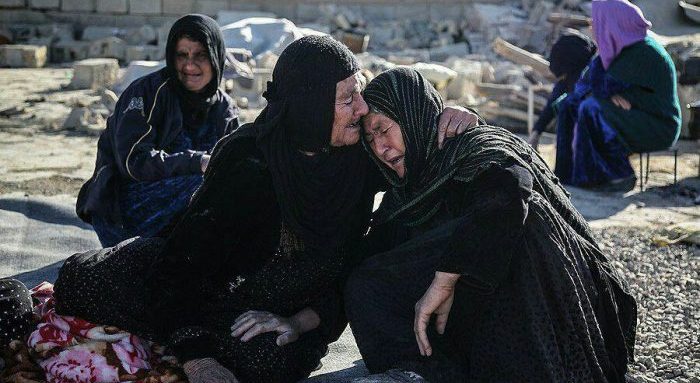
Even recent natural disasters such as the massive earthquake striking the Iran-Iraq northern border killing over 530 people and wiping out 30,000 homes are a testament to how badly run the regime’s emergency response is to this day.

Seven days after the earthquake took place, regime’s top mullah, Ali Khamenei, visited the devastated areas and expressed that he was “not satisfied” with the response and said officials needed to “redouble their efforts.” This was considered widely an attempt to respond to the wide spread anger against the mullahs’ carelessness in the aftermath of the earthquake.

His remarks are ironic given how he personally controls much of the Iranian economy, as well as personally selects many of the top provincial officials who have so far badly bungled the disaster response.

In many ways, the Iranian people ought to be viewed with admiration since they have suffered incredibly, but still find ways to voice their discontent in a myriad of ways that displays the optimism and hope they all have for a free Iran in the future.

In a nation where public dissent of any kind is often a sure sentence to prison and even a public hanging, ordinary Iranians resourcefully find ways to express their dissatisfaction.

During the recent presidential elections which unsurprisingly saw Hassan Rouhani re-elected, most Iranians simply stayed away from polling places to express their unhappiness; forcing the regime to manufacture fake ballots to justify election returns.

Some of the more daring among the population even took to unfurling banners and signs on overpasses and the sides of building expressing support for banned leaders of the outlawed Iranian resistance movement such as Mrs. Maryam Rajavi of the National Council of Resistance of Iran, an umbrella group comprising several dissident groups.

Ultimately, the message that Americans will celebrate this week with Thanksgiving, may soon be a message that will resonate throughout Iran when a future comes that allows for peaceful regime change and the downfall of the mullahs at the hands of the Iranian people who have grown tired of their restricted freedoms, unpleasant economic future and constant war-footing.

Laura Carnahan

Filed Under: Blog, News Tagged With: Featured, hassan rouhani, Iran Earthquake, Iran Human rights, Iran Lobby, Iran Mullahs, Iran sanctions, Khamenei, Reza Marashi, Sanctions, Trita Parsi

  • 1
  • 2
  • 3
  • …
  • 9
  • Next Page »

National Iranian-American Council (NIAC)

  • Bogus Memberships
  • Survey
  • Lobbying
  • Iranians for International Cooperation
  • Defamation Lawsuit
  • People’s Mojahedin
  • Trita Parsi Biography
  • Parsi/Namazi Lobbying Plan
  • Parsi Links to Namazi & Iranian Regime
  • Namazi, NIAC Ringleader
  • Collaborating with Iran’s Ambassador

Recent Posts

  • NIAC Trying to Gain Influence On U.S. Congress
  • While Iran Lobby Plays Blame Game Iran Goes Nuclear
  • Iran Lobby Jumps on Detention of Iranian Newscaster
  • Bad News for Iran Swamps Iran Lobby
  • Iran Starts Off Year by Banning Instagram

© Copyright 2026 IranLobby.net · All Rights Reserved.