Iran Lobby

Exposing the Activities of the lobbies and appeasers of the Mullah's Dictatorship ruling Iran

  • Home
  • About
  • Current Trend
  • National Iranian-American Council(NIAC)
    • Bogus Memberships
    • Survey
    • Lobbying
    • Iranians for International Cooperation
    • Defamation Lawsuit
    • People’s Mojahedin
    • Trita Parsi Biography
    • Parsi/Namazi Lobbying Plan
    • Parsi Links to Namazi& Iranian Regime
    • Namazi, NIAC Ringleader
    • Collaborating with Iran’s Ambassador
  • The Appeasers
    • Gary Sick
    • Flynt Leverett & Hillary Mann Leverett
    • Baroness Nicholson
  • Blog
  • Links
  • Media Reports

Why the Iran Lobby Avoids Discussing Human Rights and Terrorism

June 8, 2016 by admin

Why the Iran Lobby Avoids Discussing Human Rights and Terrorism

Why the Iran Lobby Avoids Discussing Human Rights and Terrorism

In a world where it is common place knowledge that the Iranian regime is a state sponsor of terrorism, with a long and bloody history, it always seems that the Iran lobby operates in a different plane of existence.

For regime supporters such as Trita Parsi of the National Iranian American Council and Joseph Cirincione of the Ploughshares Fund, issues such as human rights violations and terrorism are less than inconvenient truths about Iran; they are things never meant to be spoken of in public or on social media.

The Iran lobby consistently seems to operate on the premise that if you never mention either of these topics, then they must not be real.

This is obvious by simply perusing the blogs and social media feeds for these Iran support groups periodically. Reading them within the context of what is happening in real time in the Middle East and Iran provides a surreal view that is totally disconnected from reality.

It’s also pretty darn funny to read.

Take for example Trita Parsi’s Twitter feed (@tparsi) which can’t help but be viewed as comedy material or pure ignorance. More likely it resonates as part of the famed “echo chamber” that national security staffer Ben Rhodes boasted about in a recent New York Times Magazine article.

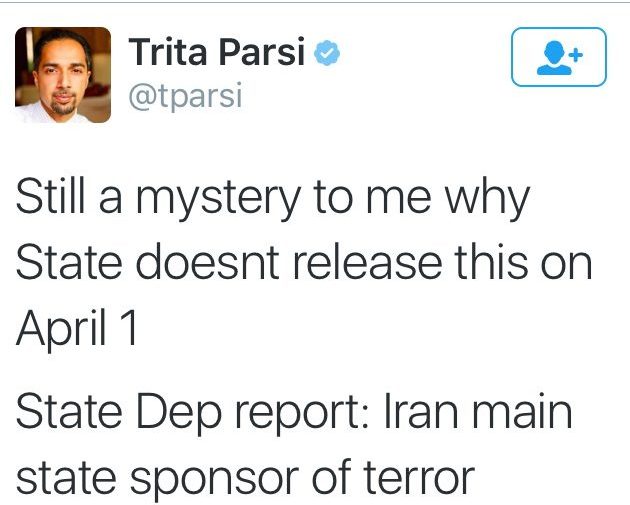
Take for example this nugget in which Parsi derides the U.S. State Department’s annual terrorism report in which it identifies Iran as a leading state sponsor of terrorism:

“Still a mystery to me why State doesnt release this on April 1,” he tweets, implying that the report is a joke better left for an April Fools prank.

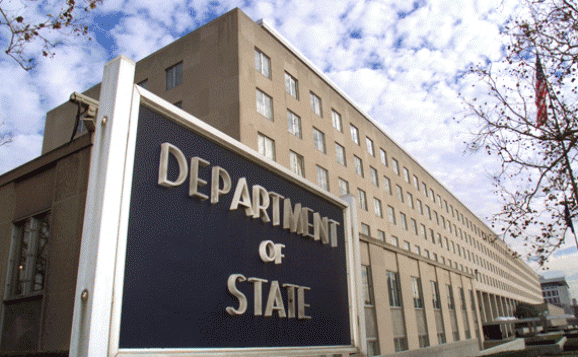
Unfortunately for Parsi and the rest of the Iran lobby, mockery and ridicule can’t hide the facts laid out in the report in which the State Department spells out the Iranian regime’s longstanding support for Hezbollah, a key cog in the regime’s long-running involvement in the Syrian civil war, and its support for Shiite militias in Iraq that have roamed throughout Sunni areas as death squads and Houthi rebels in Yemen that have displaced nearly half of the country’s population as part of a civil war.

Parsi’s Twitter feed is absent any mentions of those Iran-backed wars and the role the mullahs and the regime’s Quds Forces and Revolutionary Guard Corps play in them. He does make mention of the plight of Syrian refugees fleeing the war and the high price they pay in trying to cross the Mediterranean, but never urges Iran to seek a peaceful resolution of the conflict or even open its borders to those refugees it is forcing out.

Parsi does however spend considerable social media time attacking Saudi Arabia, the Iranian regime’s biggest rival, accusing it of “terrorism” and acts more readily identified with the mullahs in Tehran.

He even goes to the absurd level of defending top mullah Ali Khamenei’s incendiary speech over the weekend in which he denounced the U.S. and called Great Britain “evil” and blamed his country’s continued economic woes on existing U.S. sanctions on Iran’s access to U.S. currency markets tied to human rights violations and not the nuclear deal from last year.

“Khamenei said today what Iran’s been signaling the US for a while: Anti-ISIS cooperation on hold due to sanctions relief problems,” Parsi tweets.

The implication Parsi tries to make is that continued sanctions against Iran for the mass executions of over 2,500 Iranian men, women and children, as well as its sponsorship of three major wars is somehow halting the war against ISIS.

He conveniently ignores the bulk of Khamenei speech which is filled with vitriol and hate and the usual threats to wipe Iran’s enemies off the face of the Earth.

The more appropriate evaluation to make of Parsi social media postings and those his colleagues at NIAC is that they spend more time posting about Donald Trump than they do about the misery being suffered by Iranians at the hands of their own government.

They spend more time posting about the Cannes Film Festival than they do about the threats being made by the creation of a new morality police force designed to enforce strict Islamic codes against Iranian women.

They spend more time discussing the plight of Siamak Namazi, an Iranian-American arrested and imprisoned in Iran who is a long-time supporter of the NIAC, than the thousands of Iranian dissidents, journalists, artists, bloggers and activists that were rounded up, imprisoned and tortured leading up to parliamentary elections.

The priorities of the Iran lobby are always on display to anyone who wishes to scan through the social feeds of supporters such as Parsi. What is telling is what is NOT in those feeds, such as any criticism of the mullahs, any calls for a Syrian cease fire, any demands for a release of all Iranian journalists or dissidents, any urging for the end of the barbaric practice of public hangings of prisoners, or any hopes for a cessation of the practice of beating women who do not wear hijabs.

Parsi and his cohorts do not do any of these things because they are – above all else – committed to supporting the Iranian regime and keeping it safe from any threats.

By Michael Tomlinson
Filed Under: Blog, Current Trend, News Tagged With: Featured, Iran, Iran Human rights, Iran Lobby, National Iranian American Council, NIAC, NIAC Action, Reza Marashi, Ryan Costello, Trita Parsi

While Iran Maintains Hostility, Iran Lobby Stays Silent

June 6, 2016 by admin

While Iran Maintains Hostility, Iran Lobby Stays Silent

While Iran Maintains Hostility, Iran Lobby Stays Silent

Iran’s top mullah, Ali Khamenei, used his weekly appearance on state-run television to renew his hostility to the West and reinforce the commitment by the regime to pursuing policies that advance its own agenda of expanding the regime’s influence and control over the Middle East.

The statement by Khamenei, made in a nationally televised speech, was the latest in a series of signals that the regime’s senior leadership was not likely to allow any easing of hostility toward what he called “many small and big enemies”, referring to the U.S. and the West.

While much of the vitriol he directed at the U.S. and its allies is historically the same as he usually trowels out in these speeches, it is noteworthy to read media reports on the growing dissatisfaction within the regime about the inability to generate the significant economic benefits from the nuclear deal reached last year.

Much of that inability is attributed to the inept management of the Iranian economy by the mullahs in which corruptions runs deep and wide throughout a system rigged to benefit the ruling elites and the Revolutionary Guard Corps.

Some of that also is attributed to U.S. sanctions still in place not related to the nuclear deal, but linked to the regime’s historic support for terrorism and abysmal human rights record which prevents Iran from having access to U.S. currency markets and exchanges. These restrictions have stymied efforts by the regime to broaden its foreign trade, especially with European Union and Asian financial institutions reluctant to run afoul of any future U.S. sanctions.

Predictably the mullahs in Tehran and their allies in the Iran lobby have decried these sanctions and accuse the U.S. of trying to sabotage the nuclear deal, which is an absurd argument to make since the Obama administration has done virtually everything in its power to accommodate the Iranian regime including leading Americans astray with false arguments in support of the deal to doctoring official State Department video to cover up references to the early start of negotiations with hardliners in Tehran.

“They use human rights, terrorism … as pretexts to avoid fulfilling their commitments,” Khamenei said.

“If we remain strong and united and revolutionary, those who are trying to bully Iran and are against us will not succeed,” he told a gathering to commemorate the anniversary of the death of the founder of the Velayat-e-Faqih (The mullah’s supreme leader), Rouhollah Khomeini, in 1989.

Khamenei referred to Iran’s “important” role in the Middle East’s political direction, stating that Iran is the only obstacle preventing the triumph of Washington’s strategy for the volatile Middle East region.

They were planning for a “new Middle East”, a “greater Middle East”, several years ago, but their plans for Iraq, Syria, Lebanon and the Palestinian territories, have failed due to Iran’s defiance, Khamenei said.

Khamenei’s comments point out the regime’s expansionist policies to create an arc of Shia influence stretching from the Mediterranean to the Indian Ocean and have used terrorist proxies such as Hezbollah, armed militias in Iraq and rebel groups such as the Houthis in Yemen in blatant military efforts to topple governments, expel undesirables such as Christians and Sunni Muslims, and persecute dissidents.

The map of the Middle East is basically a human rights wasteland unlike anything the world has seen since the heyday of terrorism and Cold War in the 1970s, that in the absence of a firm policy towards the mullahs in Tehran, the mullahs have been eager to exploit and take advantage of.

The determination of the Iranian regime to push past the boundaries of the nuclear deal and make it a shambles was again on display as the Iranian regime announced the launch of an offshore bank on one of its Gulf islands according to a report by the regime’s IRNA news agency, as it continues to seek ways around restrictions on international payments.

The bank will be set up on Kish Island, which has been developed as a tourism destination and a free trade zone over the past few decades. The aim is to tap into rising demand for cross-border banking transactions, according to comments by Ali Jirofti, deputy head of the Kish Free Zone Organization. He told IRNA on June 5 that the new, unnamed offshore bank will be able to transfer money and facilitate domestic and foreign investment activities.

The establishment of such an offshore facility would make a mockery of sanctions on Iran for human rights and terrorism violations and if allowed, it would prove devastating in efforts to hold the regime accountable for its appalling human rights record.

Meanwhile, the U.S. State Department released its annual report on terrorism and again listed the Iranian regime as a chief sponsor of terrorism worldwide.

Predictably the regime rejected the damning report.

As in many previous years, the report identified Iran as the world’s “foremost state sponsor of terrorism in 2015” through its financing, training and equipping of various armed groups, notably Lebanon’s Hezbollah, as well as the government of Syrian President Bashar Assad.

The report said that despite reaching a landmark agreement with world powers on its nuclear program, Iran continued to use the Quds Force of its Revolutionary Guard to create instability throughout the Middle East.

In addition to arming Hezbollah and the Assad government, Iran also provided weapons and other assistance to militants in Bahrain and remained active in supporting groups such as Hamas, the report said.

The report is an annual rite of summer now to point a bloody finger at the mullahs. It is a reminder never to allow wiggle room to the mullahs and reinforce the efforts of Iranian dissident groups and human rights organizations working for freedom in Iran.

By Michael Tomlinson

Filed Under: Blog, News Tagged With: Featured, Iran, Iran Human rights, Iran sanctions, National Iranian American Council, NIAC

Why Iran Role in Syria Should be a Warning for Iraq

June 3, 2016 by admin

Why Iran Role in Syria Should be a Warning for Iraq

Why Iran Role in Syria Should be a Warning for Iraq

The Syrian civil war could have turned out much differently. With the advent of Arab spring democracy protests sweeping through the region in 2011, Syria was rocked by nationwide protests against the regime of Bashar al-Assad, which responded with violent crackdowns spawning armed conflict.

It quickly degenerated into sectarian conflict as Assad’s Alawite-dominated government forces joined with other Shia groups to fight against predominantly Sunni-led rebel groups. Those groups included non-sectarian groups backed by the West that gained significant wins against the Assad regime, threatening his rule.

In response, the mullahs in Tehran directed their Hezbollah terrorist proxy to join the fighting in 2013 in an effort to save Assad, who was a crucial ally to the Iranian regime. Coupled with indiscriminate bombings on civilians by the Assad regime with barrel bombs and the wholesale destruction of villages, the war quickly escalated into a humanitarian disaster and laid the ground for the birth of radicalized extremist groups such as ISIS which broke away from Al-Qaeda elements that had originally been given sanctuary in Iran after being forced out of Afghanistan by the U.S.-led invasion.

By September 2015, Iran entreated Russia to enter the conflict to rescue the Assad regime after Iranian-led forces faced defeat on the battlefield and losses mounted. The situation grew so dire for the mullahs that they forced the enlistment of thousands of Afghan refugees living in Iran to join the fight as mercenaries.

During this escalation, the Iran lobby led a PR campaign to hide the truth of the Iranian regime’s involvement and attempted to distance it from the nuclear agreement being negotiated at the same time. It was crucial for the Iran lobby to keep the issues separate even though the evidence was mounting of how deep the Iranian regime’s involvement in Syria.

At the same time, the Iranian regime increased its efforts in Yemen and Iraq. First by stirring up the Houthis and arming them and inciting them to rebellion aimed squarely at Saudi Arabia’s doorstep in an effort to distract the kingdom from confronting Iran’s expansionist aims in Syria and Iraq.

But it is in Iraq where the battle is shifting as Iran applies lessons learned in Syria to mounting a new effort to exert greater control over Iraq.

Iran has fought to maintain control in Iraq. During the administration of former prime minister Nouri al-Maliki, the mullahs in Tehran forced out Sunni partners and split the Iraqi government in an effort to gain absolute control, which backfired when ISIS attacked from Syria and took over Mosul and much of northern Iraq. The push into Iraq threatened Iran and the Maliki government fell as the debacle caused consternation among Iraqis with ire aimed directly at Iran.

Now Iranian regime is attempting to manipulate and control the battlefield in Iraq, much in the same way it tried to control what was happening in Syria. Iraq’s abrupt departure from the war against the Islamic State group, which its priority was above all else the liberation of Iraq’s second-largest city, Mosul, shows the influence of Iranian regime at work. Iran has reportedly been pressuring Iraqi government for weeks, if not months, to prioritize Fallujah.

Tehran has more influence on Iraq’s focus, whether on Fallujah or anywhere else, than Moscow, Washington and Ankara combined, says a former U.S. combat commander with extensive experience working with Iraq’s senior leaders.

Paul D. Shinkman, senior national security writer for U.S. News, pointed out the threat Iran poses to the future of Iraq as it purposely seeks to create a destabilized situation to better influence the Iraqi government in the absence of a U.S. presence.

Other forces are also at play behind the decision, including influences from Tehran that would like the Shiite majority in Iraq’s government to protect Baghdad from what it sees as the threat posed by the proximity of Sunni extremists, like the Islamic State group, while also solidifying its hold on power, Shinkman writes.

“Iran does not see a government of Iraq that has a Sunni presence in it,” says Scott Mann, who retired as a lieutenant colonel after 18 years as a U.S. Army Special Forces officer with deployments to Iraq and Afghanistan. “This is a way to further divide those ethnicities, between Persians and Arabs, and between Sunni and Shiite, and create a more polarized environment around that conflict.

It’s the same formula Iran pursued in Syria and is attempting to replicate in Iraq by purging the government of any Sunni influence and use sectarian conflict as the excuse to wage war, rather than allow a coalition government of Sunni and Shia work together for the benefit of Iraq.

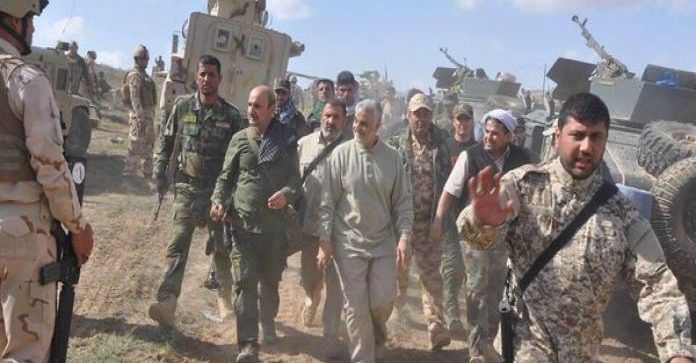
General Qassem Soleimani, commander of the Quds Force, the special operations branch of Iran’s Revolutionary Guards, met with leaders of the Iraqi coalition of Shi’ite militias known as the Popular Mobilization Forces, the most extremist forces in Iraq that have been massacring, burning alive innocent Sunnis in any area they have overtaken in the past few years.

Sunni politicians in Iraq condemned the involvement of Soleimani and other Iranian advisers in the battlefield preparations, saying it could fuel sectarian tension and unleash a new round of Sunni-Shi’ite bloodletting. They also cast doubt on the Iraqi government’s assurances that the offensive is purely an Iraqi-led effort to defeat Islamic State. “Soleimani’s presence is cause for concern,” said an Iraqi member of parliament from Falluja. “He is absolutely not welcome in the area.”

The threat of Iraq turning into an Iranian vassal state has alarmed Arab nations throughout the region and rightly so. What is even more alarming are news reports that Iraqi forces were assisting Iran in the construction of permanent military bases within Iraq’s Kurdistan region.

Last week, Arabic and Turkish media reported that Tehran had launched construction of the largest missile base in the Syrian Coastal Mountain Range in Iraqi Kurdistan, which reportedly aims to protect the religious borders of Iran.

If true, the news would only add to the powder keg Iranian regime is creating and potentially turn the Iraq-Turkey border into another Syria.

The international community needs to re-engage in Iraq and not allow the Iranian regime a free hand. All of which reiterates the fact that Iran mullahs are not part of the solution to any crisis in the region. They are indeed the source of the problem.

By Michael Tomlinson

Filed Under: Blog, News Tagged With: Featured, Iran, Iran Lobby, Iran sanctions, NIAC

Iran Regime Expands Reach to Save Itself

June 3, 2016 by admin

Iran Regime Expands Reach to Save Itself

Iran Regime Expands Reach to Save Itself

One of the central themes of the Iran lobby has been the idea that a schism exists within Iranian politics, pitting moderates against hardline conservatives. The perception and mythology of that idea is what propelled the Iran nuclear agreement last year and has served as a rhetorical red line in the sand against taking any actions against the regime in response to provocations such as illegal ballistic missile tests or human rights crackdowns.

The Iran lobby even pointed at the results of the parliamentary elections as proof of this myth calling it a win for “moderates” without acknowledging that almost every candidate with a shred of dissenting opinion in their heads or dissenting acts in their past was disqualified from even showing up on the ballot.

In the year since the nuclear deal was reached, the Iranian regime has been given an effectively free hand to do whatever it wishes without fear of reprisal or reproach and the mullahs in Tehran are responding accordingly.

The so-called moderate wins in the parliament were swept aside with the elections of notorious hardline extremists to head the parliament, Guardian Council and Assembly of Experts. Ali Larijani was re-elected speaker of the parliament with a resounding 237 votes in the 290 seat parliament. We can only assume that the “moderate” bloc must only amount to 53 seats now that the votes are tallied.

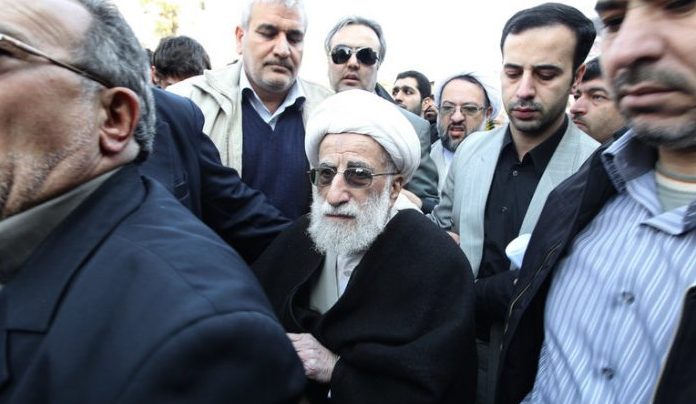
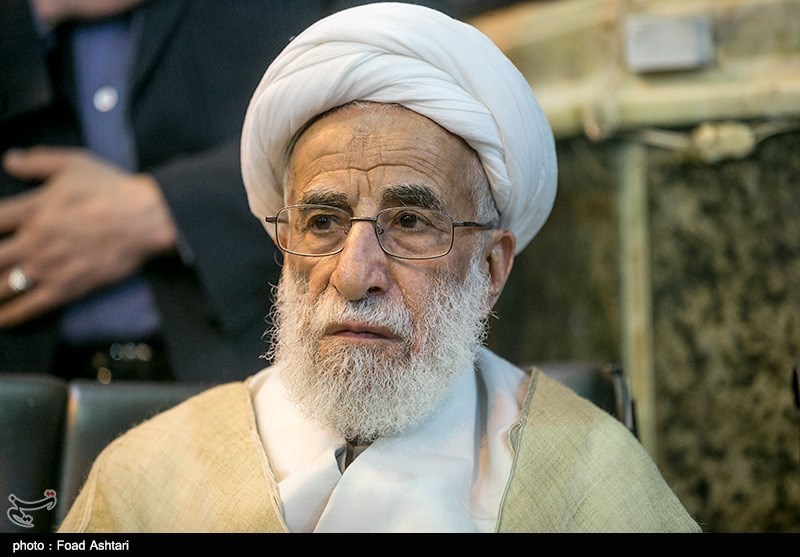
Ahamd Jannati, a hardened religious zealot, took control of the Assembly of Experts, which is responsible for picking the successor to top mullah Ali Khamenei. It is almost assured the next leader of the Islamic state will be as hardcore and unyielding as Khamenei.

Jannati also heads the Guardian Council, which tossed out all of the perceived “moderates” (12,000 of them) running for office; keeping Iran’s government ranks ideologically pure and committed to the Islamic extremist views.

Ahmad Khatami, a firebrand cleric and member of the Assembly of Experts, celebrated Jannati’s victory in a sermon last week, saying that “arrogant, powerful media in England and America did everything they could do against Ayatollah Ahmad Jannati” but “their analysis has not come true.”

The Iran lobby made much of the so-called “List of Hope” purporting to represent moderate candidates vying for seats. Well last Sunday, in an initial vote for parliamentary speaker, 50 of the nearly 100 regime lawmakers on the “List of Hope” sided with hard-liners. So much for that hope and “moderation”.

The Iranian regime is solidly in the grip of hardliners and its every action reinforces that reality, but those same hardliners are facing an equally harsh truth which is their reign is troubled and struggling to hang onto power as it is drained by reversals abroad.

The mullahs were forced to corral Russian military support in Syria to stave off disaster there. They were forced to rig elections because they knew they would lose if there was an open and free election. They are supplying proxy forces in Iraq and Yemen in a bid to maintain their tenuous control over both of their neighbors.

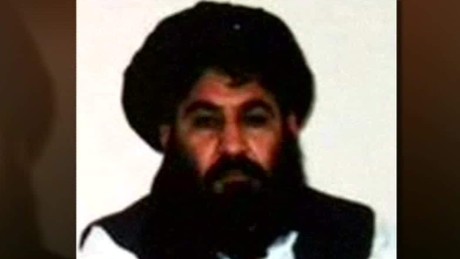
Now reports are coming out questioning why Taliban chief Mullah Mansoor was in Iran and what he was up to. In a bag near his burned out taxi was his Pakistani passport (in the name of Wali Muhammad) with immigration stamps suggesting he had been in Iran for almost two months, according to The Guardian.

Mortimer B. Zuckerman, the chair and editor-in-chief of U.S. News, blasted U.S. policy towards Iran and the actions of national security staffer Ben Rhodes who spearheaded the effort alongside the Iran lobby to sell the “moderates vs. hardliners” message.

“Whatever the case for impeding Iran’s advance to nuclear status, we are letting a tiger out of the cage by releasing more than $100 billion in frozen assets without a commitment on how it will be spent. Some of this money may be spent wisely, but Iran remains a central banker for Murder Inc. Millions of dollars will go to sustain the vision of restoring a Persian empire,” he writes.

“Of course the language of Iranian President Hassan Rouhani is that they seek more closeness, unity, brotherhood and better relations. Tell that to the families of more than 200,000 Syrians killed during that country’s civil war, courtesy of Iran’s lethal investment. Tell it to the nearly 5 million Syrian refugees begging for sanctuary in Jordan, Turkey, Iraq and Lebanon. Tell it to the people of Bahrain, the United Arab Emirates and Yemen coping with subversion financed by Iran. Tell it to the relatives and colleagues of officials murdered in Lebanon,” he added.

Zuckerman’s point is well served considering reports of how the Iranian regime is stepping up its presence in neighboring Iraq now that the U.S. has essentially walked away creating a power vacuum the mullahs are eager to fill.

Iraq’s elite forces who are leading the fight to retake Falluja from ISIS, have been trained by U.S. advisers, but many others on the battlefield were trained or supplied by Iran. It’s the latest example of how Washington has looked the other way as Iran deepened its military involvement in Iraq over the past two years.

In recent weeks, thousands of Iraqi soldiers and Shi’ite militia members supported by Iran assembled on the outskirts of Falluja for the expected attack on the Sunni city. In the lead-up to the assault, General Qassem Soleimani, commander of the Quds Force, the special operations branch of Iran’s Revolutionary Guards, met with leaders of the Iraqi coalition of Shi’ite militias known as the Popular Mobilization Forces.

The Iranian regime has several interests in its neighbor: Iraq provides strategic depth and a buffer against Saudi Arabia and other Sunni Arab states that are competing with Iran for dominance over the Persian Gulf.

The situation in Afghanistan and Pakistan has also become caught up in the proxy war between Iran and Saudi Arabia that is churning in Iraq, Syria and Yemen. Iran has recruited thousands of Afghan and Pakistani Shiites to fight alongside the Revolutionary Guard Corps and members of Hezbollah in support of the government in Syria against Saudi-backed Sunni militants. Hundreds of members of the so-called Zaynabiyun Brigade have died in the Syrian war.

The Iranian regime’s pervasive influence was uncovered in Bahrain as that nation charged 18 people with contacting the Revolutionary Guard and Hezbollah with the aim of stirring up unrest in the kingdom, state news agency BNA reported on Wednesday.

BNA said the prosecution had established after the investigation that the group had formed a “secret cell” to incite Bahrainis against the ruling system and to propagate information calling for changing the government by force.

Far from acting “moderately” the regime is in a struggle to stay alive amidst a world in turmoil.

By Michael Tomlinson

Filed Under: Blog, News Tagged With: Assembly of experts, Featured, Iran, Iran deal, Iran Lobby, Janati, National Iranian American Council

Iran Demands Social Media Sites Store Data Only In Iran

June 1, 2016 by admin

Iran Demands Social Media Sites Store Data Only In Iran

Iran Demands Social Media Sites Store Data Only In Iran

The Iranian regime issues ultimatums with the regularity of a cuckoo clock. Whether it’s an indictment of perceived transgressions by human rights groups to blustery pronouncements threatening devastation on its enemies, the mullahs in Tehran are frequently making demands, threats and promises.

The latest demand came this weekend courtesy of the regime’s Supreme Council of Cyberspace, which said:

“Foreign messaging companies active in the country are required to transfer all data and activity linked to Iranian citizens into the country in order to ensure their continued activity,” in new regulations carried by state news agency IRNA on Sunday.

Putting aside the fact that the regime has a group dedicated to cyberspace with a name straight out of bad James Bond villain list, the regime has put a public face to one of the more sinister efforts it pushes in using the internet to track down dissenters, activists and others that oppose the rule of the mullahs.

Iran has some of the strictest controls on internet access in the world and blocks access to social media platforms such as Facebook and Twitter, although many users are able to access them through widely available software; notably the regime’s leadership has free access to those same platforms to push out its propaganda such as social feeds for Hassan Rouhani and even Ali Khamenei.

The council, whose members are selected by Khamenei, gave social media companies a year to comply, IRNA said, adding that the measures were based on the “guidelines and concerns of the supreme leader.”

The new requirements could affect messaging app Telegram in particular. The cloud-based instant messaging service has gained popularity because of its high level of security and is estimated to have about 20 million users in Iran, which has a total population of about 80 million, placing it at the forefront of most of the digital communications taking place among ordinary Iranians the regime cannot spy on.

Iranians have proven adept at using technology to circumvent strict government rules in the past. The Gershad app, launched in February, helps Iranian women track the morality police in large cities, so they can avoid being stopped for dress code violations.

The technology community, especially social media companies based in Silicon Valley such as Facebook and Twitter and in Silicon Beach such as Snapchat, reacted negatively to the mullahs’ demands.

The tech blog TechCrunch noted how the “Iranian government wants to be able to track private and semi-private conversations on messaging apps. Many social networks are already blocked in Iran, but it looks like the government wants even more control.”

But TechCrunch explained the devil was in the details since moving servers to Iran might not be enough, as WhatsApp recently completed its rollout of end-to-end encryption. With end-to-end encryption, WhatsApp can’t even read the content of communications, as they are encrypted, and only WhatsApp users involved in these conversations can decrypt them.

Apple’s iMessage is another example of an encrypted messaging protocol. Apple isn’t able to hand out messages to a government.

Earlier this month Iranian authorities placed eight women under arrest for posting Instagram photos of themselves without a headscarf on as part of a larger crackdown on social media usage that began before the most recent parliamentary elections.

The regime had previously arrested the entire staff of an Iranian tech blog and actively seeks out Iranian citizens posting on social media anything that could be construed as defying the Iranian regime’s extremist rule and authority or posing a threat to the regime leaders.

Even in the face of tough web censorship, Iranians are still using the internet in droves. A government report last year showed that 67.4 per cent of the country’s youth are online, with 19.1 percent claiming that they use messaging apps, and 15.3 per cent on social media. It is also widely believed that Iran’s tech-savvy citizens are utilizing VPNs to access sites blocked by the government.

This poses a significant problem for the regime since news often is smuggled out electronically of the atrocities and human rights abuses within Iran by dissident and human rights activists, including shocking photos and videos of public executions, amputations and other medieval punishments enforced by the regime.

Unsurprisingly, the Iran lobby has remained silent on this issue and the threat to free speech and freedom it poses. For groups such as the National Iranian American Council, whose members such as Trita Parsi, Ryan Costello and Tyler Cullis make ample and aggressive use of social media, the attempt to electronically spy on and muzzle Iranians, including those living in places such as the U.S. with relatives in Iran, have been met with silence.

This move by the Iranian regime only adds to the mountains of evidence proving the mullahs are neither moderate, nor peaceful.

By Laura Carnahan

Filed Under: Blog, News Tagged With: Featured, Iran Human rights, Iran Lobby, National Iranian American Council, NIAC, Reza Marashi, Ryan Costello, Trita Parsi, Tyler Cullis

This Memorial Day Remember Victims of the Iran Regime

May 31, 2016 by admin

This Memorial Day Remember Victims of the Iran Regime

This Memorial Day Remember Victims of the Iran Regime

Memorial Day, which recognizes service personnel killed in the line of duty, originated from Decoration Day after the American Civil War in 1868 and formalized as a commemoration of all the men and women who died while serving.

Unlike Veterans Day, Memorial Day recognizes the greatest sacrifice made by those donning the uniform and making the ultimate sacrifice for the protection of their loved ones and the ideals and way of life embodied in America.

But for our purposes, Memorial Day is also an appropriate time to reflect on all those who have paid the ultimate sacrifice for freedom, dignity and human rights at the hands of the mullahs of Tehran.

Since the takeover of the revolution in Iran in 1979, the mullahs and religious cohorts have placed a stranglehold on the Iranian people; enforcing their own nihilistic vision of Islamic law that imposes the most dreaded penalties for the slightest deviations from their reactionary thought.

But the mullahs were never simply content to violate every basic right of the people of Iran, they also wanted to extend their extremist vision of Islamic revolution throughout the world and most especially to their closet neighbors in order to create a kind of Islamic Warsaw Pact to shield the revolution from potential challenges.

From the crafting of its constitution to the construction of its judiciary and religious courts, the mullahs have sought to impose their will in virtually every part of Iranian life; from fashion and the economy to foreign policy and women’s rights.

As part of that zealotry, the mullahs have undertaken a militant foreign policy over the last 30 years that has spurred war, terrorism and death throughout most of the Middle East. They have done so through the supplying of proxies such as Hezbollah, their long-time terrorist ally, to Shiite militias and insurgents in Iraq to Houthi rebels in Yemen.

Most notably, Iran largest military commitment outside of the Iran-Iraq War has been its full-fledged participation in the Syrian civil war to keep the regime of Bashar al-Assad firmly in control no matter the collateral damage or consequences.

The butcher’s bill for the mullahs over the years has been long and bloody and it is worth remembering this Memorial Day so the world does not forget the suffering, loss and misery inflicted by them:

  • On October 23, 1983, in Beirut, Lebanon, during the Lebanese Civil War, two truck bombs struck separate buildings housing United States and French military forces—members of the Multinational Force in Lebanon (MNF)—killing 241 U.S. and 58 French servicemen, six civilians, under the direction and with the support of the Iranian regime;
  • Almost 4,500 U.S. service members were killed in Iraq between 2003 and 2014 with at least 500 U.S. military deaths in Iraq and Afghanistan directly linked to Iran and its support for anti-American militants according the U.S. defense officials;
  • On April 23, 2016, the United Nations and Arab League Envoy to Syria put out an estimate of 400,000 people had died so far in the Syrian war, in which Iran has supplied Quds Force, Revolutionary Guard fighters and commanders, as well as supplied Hezbollah troops and Afghan mercenaries equipped with Iranian arms and ammunition;
  • According to the United Nations, from March 2015 to March 2016 over 6,500 people have been killed in Yemen, including 3,218 civilians, as part of the civil war being waged by Houthi rebels armed and supplied illicitly by the Iranian regime;
  • In March 2016, the UN special rapporteur for human rights in Iran, said in a report to the organization’s Human Rights Council that at least 966 people were put to death in the country in 2015, roughly double the number executed in 2010 and 10 times as many as were executed in 2005. The report noted that executions in Iran were at the highest level since 1989; and
  • Iranian dissident groups such as the National Council of Resistance of Iran have documented and chronicled over 2,500 executions since the installation of “moderate” president Hassan Rouhani, with almost near daily executions of men, women and children.

The reach of the regime is long and respects no boundaries. Agents of the regime have participated in bombings and attempted assassinations in places as far away as Argentina and Washington, DC. Its forces inflict suffering by attacking places such as Camp Liberty in Iraq, home of thousands of Iranian dissidents who oppose the mullahs and are targeted by them for that opposition.

The Iranian regime’s leadership is for all intents a purposes a death cult, devoted to an Islamic extremist ideal that has no place in today’s civilized world and should be met by the international community with condemnation and indignation, not negotiations and treaties.

For the families who have loved ones killed by the regime, for the wives, sons and daughters who lost fathers to Iran-supplied IEDs, to the children of Iran who have lost fathers and mothers to the gallows of the mullahs, this Memorial Day should be marked with moments of silence and remembrance for them and their suffering and the hope for a free Iran where these types of memorials will no longer be necessary.

By Michael Tomlinson

Filed Under: Blog, News Tagged With: Featured, Iran, Iran Human rights, Memorial Day

Iran Regime Continues on Path of Extremism

May 27, 2016 by admin

Iran Regime Continues on Path of Extremism

Iran Regime Continues on Path of Extremism

Recent revelations of the fraudulent nature of the debate about the Iran nuclear deal have forced news media outlets to rethink coverage of the Iranian regime and members of Congress from both sides of the political aisle to crackdown on ever rising acts of extremism coming from Iran.

Conventional wisdom would dictate that once the Iran lobby’s efforts to buy favorable media coverage, push false messages about moderation in Iran and hopeful scenarios of a more stable Middle East, were discovered that the lobby and mullahs in Tehran would retreat to preserve their ill-gotten gains.

Instead, the opposite has happened as the Iranian regime has widened the conflict in neighboring countries, cracked down at dissent at home, and is seeking to forge more military sales to bolster its weakened military.

The regime’s top leader, Ali Khamenei, has spent considerable television time reiterating the policy of opposing the West, warning of infiltration and corruption of its clerical tyranny through American pop culture and social media, and maintained the need to keep up a “resistance economy” to meet the demands for continued proxy wars in Syria, Iraq and Yemen, as major parts of countries resources are spent on these wars.

Khamenei expanded on that militancy by calling for vigilance against what he described as a “soft war” mounted by the West and aimed at weakening the clerical establishment, state television reported on Thursday.

“Our officials and all parts of the establishment should be vigilant about the West’s continued soft war against Iran…the enemies want to weaken the system from inside,” Khamenei said.

In a meeting with members of the Assembly of Experts, with authority to appoint and dismiss the supreme Leader, Khamenei told Iranian officials:

“By impairing centers of powers in Iran, it will be easy to harm the establishment from inside.”

The 88-member assembly, consisting mostly of elderly clerics, is expected to choose any successor to Khamenei, who has the final say on all state matters.

“The only way to materialize the (1979) revolution’s goals is national unity and not to obey the enemy,” he said.

The fact that Khamenei continues to describe the U.S. as the “enemy” demonstrates clearly his views on the relationship between the two countries and undermines the narrative put forward by groups such as the National Iranian American Council of an improvement in relations with Iran.

That desire to continue ruling Iran with an iron fist has led to such a widespread crackdown on human rights that the only avenues of informal protest left to ordinary Iranians are becoming few and far between as the regime deploys new morality police squads and arrests women, journalists, artists, bloggers and pretty much anyone else expressing a divergent opinion.

For example, last Saturday, the Independent reported how a number of women living in Iran chose to cut their hair short and dress as men in a bid to bypass morality police and evade hijabs which are a legal requirement in all public places and strictly enforced, often with public beatings.

But in recent weeks, women have started sharing photos of themselves with their hair short in some images and dressed in clothes more typically associated with men in others, which campaigns against compulsory hijab, in order to move freely in public.

Enforced hijab is just one of a number of laws in Iran which discriminate against women, who need permission from male relatives to study after marrying and leave the country in some cases. Single mothers are left equally disempowered as Iranian law gives all legal rights to the father after children turn seven.

On the foreign policy front, new revelations came out in the wake of the death of mullah Akhtar Mohammad Mansour, the Taliban leader who was recently killed in a U.S. drone strike along the Iran-Afghanistan border, showing he had several trips to Iran as part of efforts to raise funds for the terrorist organization.

Mansour’s death is a major blow to Pakistan and possibly also Iran, which may have forged links with the Taliban to spread extremism in the region, according to Waheed Muzhda, a former Foreign Ministry official in the Taliban regime who is now a political analyst in Kabul.

“Iran may also have been behind the curtain to stab the U.S. in the back using Taliban militants.” Muzhda said.

Although it is Pakistan that has traditionally been condemned for secretly supporting Afghan insurgents, analysts say Iranian regime also provides weapons, cash and sanctuary to the Taliban. Despite the deep ideological antipathy between a hardline Sunni group and cleric-run Shia state the two sides have proved themselves quite willing to cooperate where necessary against mutual enemies and in the pursuit of shared interests.

Mansoor first entered Iran almost two months ago, according to immigration stamps in a Pakistani passport found in a bag near the wreckage of the taxi he was travelling in when he was killed by a US drone strike.

The potential of close coordination between the Taliban and the Iranian regime would offer more proof of the regime’s chief role in supporting virtually all of the major Middle Eastern terrorist groups such as Hezbollah, Houthis, Shiite militias and now the Taliban.

Nonetheless police and intelligence officials in western Afghanistan often complain the local insurgency is being managed and supplied with weapons and training from Iran.

We can only hope more truth emerges from the wreckage of the Iran nuclear deal’s “echo chamber” revelations.

By Michael Tomlinson

Filed Under: Blog, News Tagged With: #NuclearDeal, Featured, Iran, Iran deal, Iran Human rights, Iran Lobby, Khamenei, National Iranian American Council, NIAC

Iran Lobby Paying Price for Echo Chamber of Lies

May 26, 2016 by admin

Iran Lobby Paying Price for Echo Chamber of Lies

Iran Lobby Paying Price for Echo Chamber of Lies

The much-discussed article in the New York Times Magazine describing the Iran Lobby orchestrating of the push for the Iran nuclear deal has set off a chain of events throughout American politics and news media have begun digging deeper into the Iran lobby’s role in the effort to portray the Iranian regime as a moderate government.

Revelations have rippled out like so many stones dropped into a still pond, intersecting and converging as more news reports have come out detailing the flow of cash throughout the Iran lobby and into news organizations to help promote the nuclear deal.

Other stories have gone on to examine in great detail the organization and structure of the Iran lobby’s plans years before actual negotiations began with the Iranian regime, all of which goes to demonstrate the long view the mullahs have in achieving their goals.

Now Congress has stepped up its scrutiny, including demands for greater accountability from the Obama administration, as well as the Iranian regime’s compliance of a nuclear deal that is now suspected of being badly and deeply flawed.

This all came to the forefront as Treasury and State Department officials appeared before the House Foreign Affairs Committee in an effort to reassure skeptical Republican and Democratic lawmakers.

“We need to make sure it’s implemented to the letter,” said New York Democratic Rep. Eliot Engel, “and hold Iran’s feet to the fire with respect to” what he called its troublemaking in the region.

Engel and other lawmakers cited Iran’s support for the militant groups like Hezbollah, as well as Shiia militants in Iraq, Houthi rebels in Yemen and the regime of Syria’s President Bashar al-Assad. They also raised Iran’s ballistic missile tests in March, in particular two test-fired rockets inscribed with the Hebrew phrase “Israel must be wiped off the Earth,” according to the regime’s semi-official Fars News Agency.

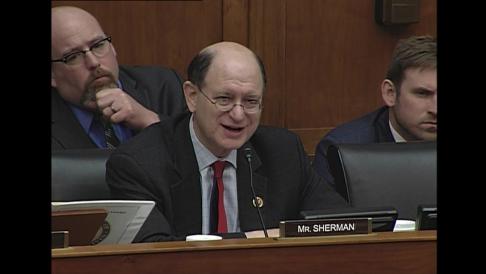
Rep. Brad Sherman (D., Calif.) heaped criticism on the Iranian nuclear deal at the hearing, calling for more sanctions on Iran to punish its military involvement in Syria.

“People in this country want us to get along with everyone around the world. We long for peace. And there are those who say that sanctions contradict that,” Sherman said. “But when you look at what Iran has done in Syria, hundreds of thousands, perhaps a million people killed by Assad, with funds provided, weapons provided, thugs provided by the Iranian government, when you see people killed by barrel bombs and sarin gas, we realize that the right response to the Iranian regime cannot be ‘kumbaya.’”

Sherman and Rep. Ed Royce (R-Calif.), the committee chairman, raised the potential for the reauthorization of the Iran Sanctions Act to keep the bulk of financial restrictions in place, especially in light of the regime’s actions following the completion of the nuclear deal.

Mark Dubowitz of the Foundation for Defense of Democracies, gave blistering testimony explaining how the Iranian regime is taking advantage of a weak nuclear deal and the Obama administration’s persistent efforts to assist the regime.

“Iran is engaged in a robust effort to legitimize its financial sector despite a decades-long rap sheet of financial crimes and illicit financial activities that it shows no sign of curbing. Since the conclusion of the JPCOA, the Obama administration has missed numerous opportunities to push back against Iran’s legitimization campaign,” Dubowitz said.

“Instead of insisting on an end to Iran’s continuing malign activities (terrorism, human rights violations, and other destabilizing activities in Syria, Iraq, Yemen, Lebanon, and other countries across the Middle East), and using non-nuclear sanctions to deter and punish these activities, the administration is now effectively acting as Iran’s trade promotion and business development authority. Indeed, the administration may be departing from its original JCPOA negotiating position that it would only suspend or lift so-called U.S. “nuclear sanctions” under its executive authority. Rather, the administration is allowing Iran to hold the U.S. responsible for delivering financial and economic outcomes,” Dubowitz added.

Dubowitz’s testimony also highlighted the awkwardness of Secretary of State John Kerry’s trips around the world recently as he found himself in the odd position of negotiating on behalf of promoting investment in the Iranian regime.

It is a situation that Rep. Royce highlighted at the hearing that Kerry was taking “the odd step” of reassuring foreign firms that Iran is open for business, Royce said, while “other administration officials go so far as to say that Iran economic growth is in our national security interest.”

It’s now a fact that the reassurances by the Iran lobby have less impact now that the full scope of their efforts have come to light. Coupled with the regime’s own actions over the past year, the entire basis of the Iran nuclear agreement – that the mullahs could be trusted to adhere to any international agreement – was built on an “echo chamber” of lies.

By Michael Tomlinson

Filed Under: Blog, News Tagged With: Brad Sherman, Featured, Iran, Iran deal, Iran Human rights, Iran Lobby, Iran sanctions, Iran Talks, JCPOA, National Iranian American Council, NIAC, NIAC Action

The Echo Chamber of Iran Rings with Hardliners

May 25, 2016 by admin

The Echo Chamber of Iran Rings with Hardliners

The Echo Chamber of Iran Rings with Hardliners

In the now-infamous article by the New York Times Magazine on how a network of Iranian regime lobbyists, activists and journalists was created to feed a false narrative about the Iran nuclear deal. National security staffer Ben Rhodes called it an “echo chamber” where so-called independent experts were in actuality actively working at the direction of the White House media operation.

The key messages, social media postings and parade of so-called “experts” was designed to put forward the story that the nuclear deal would put a stop to Iran’s nuclear development, empower moderate elements within the Iranian government and stabilize the Middle East.

Alternatively, this same echo chamber fought against any effort to link human rights, sponsorship of terrorism or strict guidelines on inspections of Iran military facilities as being destabilizing the prospects of an agreement.

Since the deal was struck last year, the world has discovered how completely wrong all those assumptions were, but worse, how the Iran lobby, directly funded with cash from groups aligned with Iran, was essentially lying.

The avalanche of disclosures now come fast and furious as we begin to see the scope, size and sophistication of the Iran lobby’s efforts, especially in swaying favorable media coverage by paying news outlets such as National Public Radio hundreds of thousands of dollars for positive coverage of the deal.

Bloomberg in a report examined the full scale of the Iran lobby’s network and operations in supporting the Iran nuclear deal based a series of leaked emails he received.

It discovered that the actual campaign for the nuclear deal did not start in 2015 with negotiations as Iran regime supporters claim, but rather launched a full four years earlier with Ploughshares Fund leading the initial organization long before Rhodes began meeting with progressive groups on shaping the Iran narrative, which may indicate that the administration itself may have been played for fools by the mullahs in Tehran all along.

Beginning in August 2011, Ploughshares and its grantees formed the Iran Strategy Group. Over time this group created a sophisticated campaign to reshape the national narrative on Iran. That campaign sought to portray skeptics of diplomacy as “pro-war,” and to play down the dangers of the Iranian nuclear program before formal negotiations started in 2013 only to emphasize those dangers after there was an agreement in 2015, Bloomberg writes.

The strategy group, which included representatives of the Arms Control Association, the National Security Network, the National Iranian American Council, the Federation of American Scientists, the Atlantic Council and others, sought to “develop process and mechanism to implement Iran campaign strategies, tactics and narrative,” according to an agenda for the first meeting of the group on Aug. 17, 2011, Lake adds.

The fact that Ploughshares funds the NIAC, the chief lobbyist for the Iran regime, and convened these strategy sessions back in 2011 clearly shows the planning by the Iran lobby to create a false narrative and then sell it to the White House. That sales job was undoubtedly helped in no small part by the inclusion of former NIAC staffers hired into the National Security Council, with one former Iran lobby staffer now heading up the NSC’s Iran desk.

The centerpiece of those early strategy meetings was that the Iran lobby needed to change the “message” narrative, even though facts on the ground in Iran proved otherwise. While Iran was developing links to Al-Qaeda and exporting terrorism via Hezbollah and Houthi proxies, the Iran lobby needed to kill those stories in the media and substitute a more favorable one.

According to Bloomberg, in an Aug. 20, 2013, e-mail to the Iran Strategy Group, Joseph Cirincione, president of Ploughshares, encouraged the Ploughshares grantees to “create a social media, web, expert push that carries our main points into the media and policy discussions in the first 12-24 hours.”

The rest is – as they say – history, as the Iran lobby, led by Ploughshares money and NIAC staff, began pushing alternative messages into the media and spread around cash to news media, as well as recruiting supportive journalists such as Laura Rozen of Al-Monitor to serve as mouthpieces.

The group relied on their own network of “experts” such as Paul Pillar to serve as “impartial” third-party analysts to discuss the nuclear deal on news outlets such as NPR which was receiving funding from Ploughshares.

The sad truth is that the Middle East is by far more chaotic and dangerous than at any other time in recent memory. The international community essentially has no idea what Iranian regime’s military is doing in developing ballistic missiles or nuclear warheads in fortified bunkers that no one even knew existed until the regime showed them off in videos.

Human rights in Iran are abysmal and thousands of innocent Iranian men, women and children have been hanged, had limbs amputated, acid thrown into their faces and eyes gouged out as part of the normal Iranian justice system.

And yet, the Iran lobby utters not one word of protest. Makes no harsh remark and takes no blame for essentially creating the world we have today.

Even their most basic claim of empowering moderate elements in Iran’s government was slapped hard in the face by the announcement of the appointment of Ahmad Jannati to head up the powerful Assembly of Experts.

The 89-year old hardliner is well known for being a religious radical devoutly committed to exporting the Islamic extremism and protecting the mullahs and their ill-gotten gains.

In addition to his new post, Jannati leads the influential Guardian Council, a vetting body that disqualified over 3,000 less loyal candidates for the February elections, which were held in parallel with the vote for the Assembly of Experts.

All of which just goes to show how there are really no moderates within Iranian politics and government and to make any such distinction is to play into the narrative the Iran lobby has so studiously cultivated over the last five years.

By Michael Tomlinson


Filed Under: Blog, News Tagged With: Featured, Iran, Iran deal, Iran Human rights, Iran Lobby, Iran sanctions, Iran Talks, Joseph Cirincione, National Iranian American Council, NIAC, NIAC Action, Paul Pillar, Ploughshares

Iran Lobby Damaged by Revelations of Funding for Nuclear Deal Campaign

May 24, 2016 by admin

Iran Lobby Damaged by Revelations of Funding for Nuclear Deal Campaign

Iran Lobby Damaged by Revelations of Funding for Nuclear Deal Campaign

The expose of national security staffer Ben Rhodes admission in the New York Times Magazine concocting a string of false messages to sell the Iran nuclear deal sent shock-waves through American politics and around the world as the revelations began to sink in that the entire basis of the agreement with the Iranian regime may have been built on lies.

Even more disturbing news reports has come out now that one of the principal advocates for the deal and a central pillar of the Iran lobbying effort had paid cash directly to news organizations in a brash effort to influence favorable coverage of the agreement.

The Associated Press reported that the Ploughshares Fund gave National Public Radio $100,000 last year to help it report on the nuclear deal according to the group’s own annual report, while also funding reporters and partnerships with a wide array of other news outlets.

In the Times article, Rhodes explained how he  worked with nongovernmental organizations, proliferation experts and even friendly reporters to build support for the seven-nation accord that curtailed Iran’s nuclear activity and softened international financial penalties on Tehran.

“We created an echo chamber,” said Rhodes, a deputy national security adviser, adding that “outside groups like Ploughshares” helped carry out the administration’s message effectively.

Most news organizations, including The Associated Press, have strict rules governing whom they can accept money from and how to protect journalistic independence.

Ploughshares’ backing is more unusual, given its prominent role in the rancorous, partisan debate over the Iran deal.

The Ploughshares grant to NPR supported “national security reporting that emphasizes the themes of U.S. nuclear weapons policy and budgets, Iran’s nuclear program, international nuclear security topics and U.S. policy toward nuclear security,” according to Ploughshares’ 2015 annual report, recently published online.

Ploughshares Fund provided over 90 grants to various organizations in 2015 in order to engage in reporting, research and analysis on Iranian nuclear issues. The over 90 grants given out in 2015 nearly doubles those the organization provided in 2014, and triples the amount given in 2013. Ploughshares’ increases in grant funding directly coincides with the time period during which the Iran nuclear deal was being finalized and presented to Congress.

Also receiving grants were think tanks such as the RAND Institute which was given $40,000 to write “a series of articles that analyze specific elements of the diplomatic agreement with Iran on its nuclear program.”

Ploughshares Fund President Joseph Cirincione spoke about the Iran deal on NPR twice last year. He was identified as a donor to the radio station on only one of the two occasions.

Ploughshares also provided over $280,000 to the Iran lobby leader National Iranian American Council (NIAC) for its work supporting the Iran deal, some of which went directly towards sending NIAC staff to the nuclear negotiations in Vienna. NIAC was accused of engaging in lobbying efforts on behalf of the Iranian regime around 2007, which led to the organization’s president Trita Parsi bringing suit against journalist Hassan Daioleslam for defamation. Parsi eventually lost the protracted legal battle.

The New York Post joined in the mounting criticism of the massive lobbying and PR effort with an editorial casting doubt on Ploughshares’ claims:

“And though Ploughshares claims to be working against nuclear proliferation, it backed a soft line toward Iran and worked to enable a deal that at best will only delay Tehran from acquiring nuclear weapons,” the Post said.

Meanwhile the Washington Free Beacon examined claims by NPR that it did not deliberately deny airtime for anti-Iran deal advocates such as Rep. Mike Pompeo (R-KS) who claimed to have scheduled interviews with NPR cancelled at the last time and spots given instead to Iran deal support Rep. Adam Schiff (D-CA).

While NPR executives claimed to have no records of such bookings, emails reviewed by the Free Beacon between NPR and Pompeo’s office show otherwise, casting more doubt on the validity of NPR’s claims of journalistic integrity on the Iran nuclear deal while it was being funded by the Ploughshares Fund.

These revelations expose the tangled connections between the Iranian lobby, its financial backers and its efforts to manipulate news media and manage directly the so-called “hundreds of often-clueless reporters” as characterized by Robert Malley, senior director at the National Security Council, as quoted in the Times article.

As to where Ploughshares gets its money? Ploughshares is financed by billionaire George Soros’ Open Society Institute, the Buffett Foundation, the Carnegie Corporation of New York, the Ford Foundation, the Rockefeller Brothers Fund and the Rockefeller Foundation, among others including several notable Hollywood celebrities such as actor Michael Douglas and entertainer Barbra Streisand.

Joseph Cirincione, the president of Ploughshares, went on the offensive in an effort to blunt the growing embarrassment of these revelations with an editorial on Huffington Post in which he blamed all the attacks on a right-wing, neo-con conspiracy.

While Cirincione took aim at the writers of the Times and AP stories, he neglected to mention the central characters in this entire episode and it wasn’t Ploughshares.

It was the mullahs in Tehran for which Ploughshares and others of the Iran lobby do their bidding.

The core issue is not about donations, coverage and lobbying. It is very much about how a despotic, extremist, religiously fanatical regime is escaping notice as it executes a record 2,500 people, brutalizes the women of Iran and fights three wars in Syria, Yemen and Iraq which has turned much of the Middle East and Europe into the largest refugee center in history since World War II.

Nowhere does Cirincione defend the recent conduct of the mullahs. Nowhere does he mention the rapid development and launching of illegal ballistic missiles designed to carry nuclear warheads. Nowhere does he mention the blatant violations of even the flimsiest provisions of the Iran nuclear deal such as the inability to inspect Iranian military facilities.

The money Ploughshares has spread around like so much horse manure was never intended to expose the Iranian regime, but only to cover it up.

By Michael Tomlinson

Filed Under: Blog, News Tagged With: Appeasement policy, Featured, Iran, Iran appeasers, Iran deal, Iran Lobby, Iran sanctions, Iran Talks, Irandeal, Joseph Cirincione, National Iranian American Council, NIAC, NIAC Action, Nuclear Deal, nuclear talks, Ploughshares, Trita Parsi

  • « Previous Page
  • 1
  • …
  • 33
  • 34
  • 35
  • 36
  • 37
  • …
  • 64
  • Next Page »

National Iranian-American Council (NIAC)

  • Bogus Memberships
  • Survey
  • Lobbying
  • Iranians for International Cooperation
  • Defamation Lawsuit
  • People’s Mojahedin
  • Trita Parsi Biography
  • Parsi/Namazi Lobbying Plan
  • Parsi Links to Namazi & Iranian Regime
  • Namazi, NIAC Ringleader
  • Collaborating with Iran’s Ambassador

Recent Posts

  • NIAC Trying to Gain Influence On U.S. Congress
  • While Iran Lobby Plays Blame Game Iran Goes Nuclear
  • Iran Lobby Jumps on Detention of Iranian Newscaster
  • Bad News for Iran Swamps Iran Lobby
  • Iran Starts Off Year by Banning Instagram

© Copyright 2026 IranLobby.net · All Rights Reserved.