Iran Lobby

Exposing the Activities of the lobbies and appeasers of the Mullah's Dictatorship ruling Iran

  • Home
  • About
  • Current Trend
  • National Iranian-American Council(NIAC)
    • Bogus Memberships
    • Survey
    • Lobbying
    • Iranians for International Cooperation
    • Defamation Lawsuit
    • People’s Mojahedin
    • Trita Parsi Biography
    • Parsi/Namazi Lobbying Plan
    • Parsi Links to Namazi& Iranian Regime
    • Namazi, NIAC Ringleader
    • Collaborating with Iran’s Ambassador
  • The Appeasers
    • Gary Sick
    • Flynt Leverett & Hillary Mann Leverett
    • Baroness Nicholson
  • Blog
  • Links
  • Media Reports

Iran Lobby Shows its Hypocrisy in Latest Attacks on US

December 4, 2017 by admin

Iran Lobby Shows its Hypocrisy in Latest Attacks on US

Iran Lobby Shows its Hypocrisy in Latest Attacks on US

The recent media speculation over U.S. Secretary of State Rex Tillerson’s alleged precarious employment status has given rise to a cottage industry overnight of second-guessing by various talking heads and analysts over what a potential change at Foggy Bottom might look like in terms of future US policy.

The Iran lobby, specifically the National Iranian American Council, was swift to jump on the bandwagon and raise the specter of a push by “neocons” to put one of their own into the seat and go to war against the Iranian regime.

The focus of that smear attack was Sen. Tom Cotton (R-Arkansas) who has been a vocal critic of the Iranian regime, especially the nuclear agreement.

It serves the Iran lobby’s purposes to push the narrative that Trump administration’s primary focus is to somehow foment a war with Iran; even though no administration official—from the president on down—has never even hinted at such an outcome, let alone advocated it.

The narrative though helps the Iran lobby by feeding into the fear factor it has long used in warning against taking any aggressive actions to restrain the mullahs in Tehran. Remember how during the run up in negotiations over the nuclear agreement how the NIAC and its allies pushed the image of a war between Iran and the US as the reason for completing the deal?

The Iran lobby has always used fear mongering as a PR tactic and in the case of Secretary Tillerson, it is going all out to push it again.

The best example was an editorial authored by Trita Parsi and Ryan Costello of the NIAC on its website with the provocative headline of: “Cotton, Pompeo and Trump are a Recipe for War with Iran.”

Hyperbole aside, Parsi and Costello argue a scenario where Tillerson is replaced by current CIA director Mike Pompeo and he is replaced at the intelligence agency by Cotton. Of course Parsi and Costello offer no proof for such a scenario other than a vague “reported plan.”

There is no better example of trolling fake news than what Parsi and Costello are doing.

They go on to recite a history of Pompeo and Cotton’s record—which is already well known—of their doubts about the Iran nuclear deal and of the ability to rein in Iranian extremism, but couch it in a way to convey the idea that both are some crazed blood thirsty war mongers.

“What of the man that Pompeo would replace, Rex Tillerson? It is indisputable that Tillerson has been a disaster on many fronts, in particular, his campaign to gut the State Department which will do untold damage to American diplomacy for years to come. Yet, on the Iran nuclear deal, Tillerson has actually allied with Secretary of Defense James Mattis to urge Trump against ripping up the deal. The loss of Tillerson, combined with Cotton’s elevation, would mean that Pompeo and Cotton could face little resistance in their campaign to unravel a nuclear accord that is working and downplay the likely alternative ― war,” Parsi and Costello write.

In the twisted little world that Parsi and Costello are trying to fabricate, they stick to the logic that unraveling the nuclear accord can only lead to war; a preposterous idea when considered alongside the reality of since the deal was passed.

In the wake of the Iran nuclear deal, the Middle East has devolved into a region-wide war zone due largely to actions by Tehran, including the bloody civil war in Syria that sent four million refugees flooding across Europe and another sectarian uprising in Yemen that now threatens to bring Saudi Arabia into direct conflict with Iran.

Far from producing a peaceful world, Iranian regime has been at the epicenter of some of the worst conflicts taking place now; a far cry from the absurdist claims made by Parsi and Costello.

Of course, neither ever takes Tehran to task for supporting those wars, nor for its North Korean-like fanatical support for developing ballistic missiles; a point reinforced by a regime spokesman in denouncing comments made by French president Emmanuel Macron criticizing the missile expansion program.

“French official, other officials, who want to speak about Iran’s affairs need to pay attention to the deep developments that have come to pass in the region in past decades and the big changes between the current situation and the past,” said Bahram Qassemi, regime foreign ministry spokesman, according to state media.

“The Islamic Republic of Iran will definitely not negotiate on defense and missile issues,” he added.

Tension between Iran and France increased last month when Macron said that Iran should be less aggressive in the region and should clarify its ballistic missile program. His foreign minister also denounced, during a visit to Saudi Arabia, Iran’s “hegemonic temptations.”

France’s criticisms only echo those made by then-candidate Donald Trump and his current administration’s positions, and yet Parsi and Costello avoid criticizing the French on the same issue.

The hypocrisy of their positions is readily apparent as they fabricate Tillerson’s potential demise in order to create a false narrative, but not apply the same standard in criticizing the much-more revealing truth behind Iranian actions over the past four years.

Pompeo and national security adviser HR McMaster spoke at length about Iranian expansion in “weak states” in the Middle East at the 2017 Reagan National Defense Forum in California this weekend.

Pompeo confirmed he sent a letter recently to Maj. Gen Qassem Soleimani, head of the Iranian Revolutionary Guard’s foreign operations arm or Quds Force.

“I sent a note. I sent it because he had indicated that forces under his control might in fact threaten US interests in Iraq,” Pompeo said.

“He refused to open the letter. It didn’t break my heart to be honest with you. What we were communicating to him in that letter was that we will hold he and Iran accountable for any attacks on American interests in Iraq by forces that are under their control. We wanted to make sure he and the leadership in Iran understood that in a way that was crystal clear.”

Far from being a call to war, Pompeo’s effort to reach out to Soleimani only illustrated the focus of the Trump administration to rein in Iranian expansionism, not start a shooting war.

If there are any real war mongers here, they live in Tehran, not Washington.

Michael Tomlinson
Filed Under: Blog, News Tagged With: Featured, Iran deal, Iran Lobby, Iran Talks, IRGC, Khamenei, National Iranian American Council, NIAC, NIAC Action, Pompeo, Ryan Costello, Tom Cotton, Trita Parsi

Reasons for Comparing Iran Top Mullah to Hitler

November 27, 2017 by admin

Reasons for Comparing Iran Top Mullah to Hitler

Reasons for Comparing Iran Top Mullah to Hitler

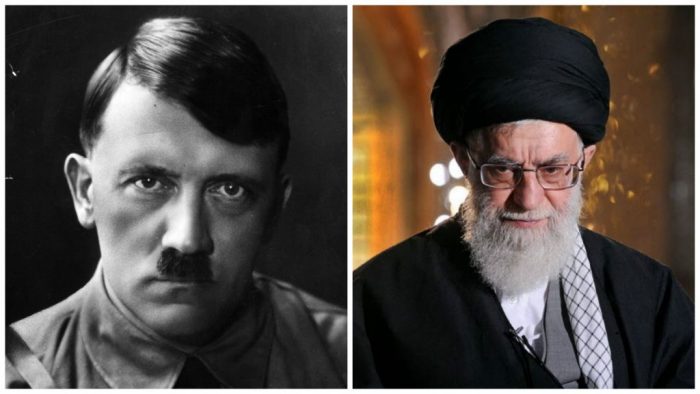
In an escalating verbal war of words, Saudi Arabia’s crown prince Mohammad bin Salman called the Iranian regime’s top mullah, Ali Khamenei, “the new Hitler of the Middle East” and warned that like the history of Europe, “appeasement doesn’t work.”

“We don’t want the new Hitler in Iran to repeat what happened in Europe in the Middle East,” bin Salman, told The New York Times in an interview published last week.

What is remarkable is not that the crown prince made those comments, but that news media treated it as earth-shattering. Human rights groups, Iranian dissidents, families of prisoners languishing in regime prisons have long called out Khamenei and his procession of handpicked presidents such as Mahmoud Ahmadinejad and Hassan Rouhani as tyrants long modelled on the bloody blueprint of Hitler’s Nazi Germany.

It is also remarkable that for once the Iran lobby was virtually silent on the crown prince’s remarks. Maybe Trita Parsi at the National Iranian American Council is finally getting the hint that shamelessly defending Khamenei is a useless exercise.

The comparison to Hitler is really neither extreme, nor shocking given the Iranian regime’s bloody history and the comparisons don’t start and stop with two megalomaniacal dictators who were power hungry for an apocalyptic vision for their countries.

No, the comparisons between the Iranian regime and Nazi Germany extend far into policies, military intervention and political propaganda.

The Nazi annexation of the Sudetenland and Austria is eerily like Iranian regime’s moves into Yemen and Syria, even using the pretext of fighting ISIS the same as the Nazi’s used the excuse of Bolsheviks to invade its neighbors.

But where the two regimes share the most is in their respective preferences for oppressing minorities and making liberal use of state courts to weed out less desirables from their societies.

For the Nazis, their policies of “racial purity” not only targeted Jews for extermination, but sent millions of Russians, Poles, gypsies, the mentally ill, gays and countless others to their deaths.

For the Iranian regime, its litmus test is religious where the mullahs view anyone not adhering to their branch of extremist belief an apostate and worthy of elimination. This explains why the regime has historically targeted minorities such as the Baha’i, Kurds, Christians and Sunnis for imprisonment and oppression.

Also, while the Nazis relied on the dreaded Gestapo and SS to enforce security at home and wage war abroad, the Iranian regime relies on its morality paramilitaries and zealous Revolutionary Guard Corps and Quds Force to achieve the same goals.

The resemblance between the two regimes is eerie and the crown prince does not make the comparison lightly.

Just as Nazi Germany gained appeasement with the West through the much-maligned Munich Agreement, Iranian regime did the same with the Iran nuclear deal; both documents weren’t worth the paper they were printed on and both launched a period of global unrest as the Nazis and mullahs took the opportunity to pursue their ambitions.

The Saudi crown prince has recognized that failure to act in defiance of the Iranian regime will only beg for another potential for war. The need for confronting the mullahs has long been a key talking point for Iranian dissidents who have warned repeatedly that failure to act to restrain the Iranian regime only emboldens the mullahs into acting more aggressively.

It is no coincidence that after Rouhani was elected to his first term and widely lauded as a “moderate” by news media that the regime undertook one of its most brutal crackdowns on dissent rounding up and imprisoning thousands of journalists, students, artists and activists.

Now the world is left to pick up the wrecked pieces of the Middle East that sees the Iranian regime now in control of Syria and Lebanon outright and having a pervasive influence over Iraq, Afghanistan and Yemen.

It’s almost like comparing Iran to Nazi Germany after the blitzkrieg of 1940 that saw it claim most of Western Europe.

But like Great Britain, Saudi Arabia has offered itself as a regional bulwark, opposing Iran in Syria, Yemen and the Gulf region and loudly calling on the rest of the world to recognize the danger the regime poses.

If the crown prince’s words are not enough, the Iranian regime added fuel to the fire when the regime’s deputy head of the IRGC warned Europe that the regime was increasing the range of its missiles to over 2,000 km, allowing it to strike at the heart of Europe.

The comments come as the French president has warned of the threat Iranian regime’s missile program poses and the Trump administration expands its sanctions list to include elements of the IRGC and those connected to its missile program.

The warning from Iran should not be considered superfluous, but rather a clear threat to the continent and an unmistakable shot across Europe’s bow.

The irony of Iran’s actions to Hitler’s speeches to blaming its enemies for driving Germany into the ground in the aftermath of World War I is striking and serves as a reminder that repeating the mistakes of the 1930s today will only lead down a path of regional conflict and even more suffering for the Iranian people.

Laura Carnahan

Filed Under: Blog, News Tagged With: #NuclearDeal, Featured, Iran, Iran Lobby, Iran Mullahs, Iran Terrorism, IRGC, Khamenei

Why Iranians Have Little to be Thankful For

November 22, 2017 by admin

Why Iranians Have Little to be Thankful For

Why Iranians Have Little to be Thankful For

With Thanksgiving looming in the U.S., millions of Americans will gather around family dining rooms to enjoy holiday traditions such as consuming enormous quantities of food, watching football games on television and parents chiding their children for spending all their time posting on social media or surfing the internet.

It’s a time that reinforces the American traditions of family and freedoms that many others around the world do not get an opportunity to enjoy; namely ordinary Iranians living under the brutal repression of the Iranian regime.

Since the ruling mullahs stole the prospect for democracy away from the Iranian people after the Shah was deposed and the revolution turned into a religious theocracy, Iranians have simultaneously lived two lives: One in the public spotlight where the mullahs demand obedience to their strict religious views unable to express themselves; while they live another life in secret where Iranian women ride bicycles and teenagers post selfies on Instagram disobeying strict dress codes.

The normal everyday pleasures and freedoms Americans take for granted are almost universally restricted in Iran under the rule of the mullahs, which is why it has been important for American policy to make a distinction between the plight of the Iranian people and the policies of the oppressive regime.

The Iran lobby, led by such staunch advocates of the regime such as the National Iranian American Council, have always sought to portray American policies towards Iran as being harmful and punitive towards the Iranian people.

This was never more exemplified than in the long debate over U.S. sanctions aimed at Iran because of the regime’s support for terrorism and its secret nuclear development program.

NIAC leaders such as Trita Parsi and Reza Marashi went out of their way to try and link the suffering of the Iranian people of the alleged hardships imposed by these economic sanctions.

Fortunately, history has a way of clearing up the facts from the fiction and in the case of the Iranian regime’s conduct, the last several years have shown the truth about the regime’s oppressive policies and the dramatic impacts it has had on the lives of its citizens.

Nothing demonstrates that more clearly than the complete ineptitude with which the mullahs run their government.

Iran has regularly placed near the bottom of rankings for lack of transparency in government and public corruption. The mullahs and their allies in the Revolutionary Guard Corps control virtually all of the major industries and siphon enormous amounts of profits into family bank accounts to live lavish lifestyles or divert it away from the economy for proxy war efforts in Syria, Lebanon, Afghanistan, Iraq and Yemen.

The draining of capital has slowed the Iranian economy to a snail’s pace over the years and widened the gap between the privileged and the impoverished. A startling and shocking photographic essay recently revealed the depths of Iranian misery in showing how many of Tehran’s poorest and most destitute have resorted to making homes in the empty plots at nearby cemeteries.

The mismanagement of water policy has led to record droughts and the evaporation of historic lakes and turned verdant farmland into desert wastelands, while the lack of available jobs to women has wiped out nearly half of the available workforce for a country struggling with deep unemployment; especially among young people who are often drafted to serve as cannon fodder in the mullahs’ wars.

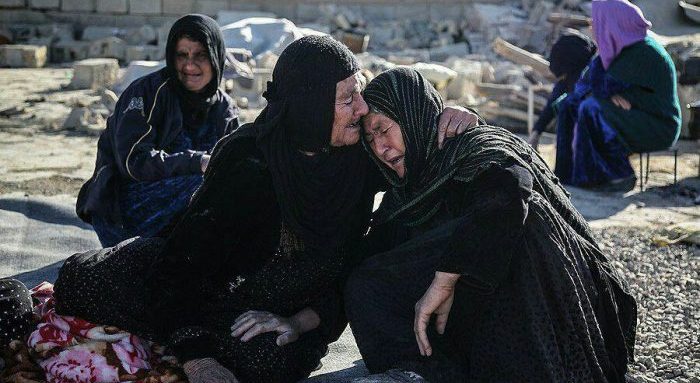
Even recent natural disasters such as the massive earthquake striking the Iran-Iraq northern border killing over 530 people and wiping out 30,000 homes are a testament to how badly run the regime’s emergency response is to this day.

Seven days after the earthquake took place, regime’s top mullah, Ali Khamenei, visited the devastated areas and expressed that he was “not satisfied” with the response and said officials needed to “redouble their efforts.” This was considered widely an attempt to respond to the wide spread anger against the mullahs’ carelessness in the aftermath of the earthquake.

His remarks are ironic given how he personally controls much of the Iranian economy, as well as personally selects many of the top provincial officials who have so far badly bungled the disaster response.

In many ways, the Iranian people ought to be viewed with admiration since they have suffered incredibly, but still find ways to voice their discontent in a myriad of ways that displays the optimism and hope they all have for a free Iran in the future.

In a nation where public dissent of any kind is often a sure sentence to prison and even a public hanging, ordinary Iranians resourcefully find ways to express their dissatisfaction.

During the recent presidential elections which unsurprisingly saw Hassan Rouhani re-elected, most Iranians simply stayed away from polling places to express their unhappiness; forcing the regime to manufacture fake ballots to justify election returns.

Some of the more daring among the population even took to unfurling banners and signs on overpasses and the sides of building expressing support for banned leaders of the outlawed Iranian resistance movement such as Mrs. Maryam Rajavi of the National Council of Resistance of Iran, an umbrella group comprising several dissident groups.

Ultimately, the message that Americans will celebrate this week with Thanksgiving, may soon be a message that will resonate throughout Iran when a future comes that allows for peaceful regime change and the downfall of the mullahs at the hands of the Iranian people who have grown tired of their restricted freedoms, unpleasant economic future and constant war-footing.

Laura Carnahan

Filed Under: Blog, News Tagged With: Featured, hassan rouhani, Iran Earthquake, Iran Human rights, Iran Lobby, Iran Mullahs, Iran sanctions, Khamenei, Reza Marashi, Sanctions, Trita Parsi

The Importance of the Hate Machine to Iran

November 6, 2017 by admin

The Importance of the Hate Machine to Iran

The Importance of the Hate Machine to Iran

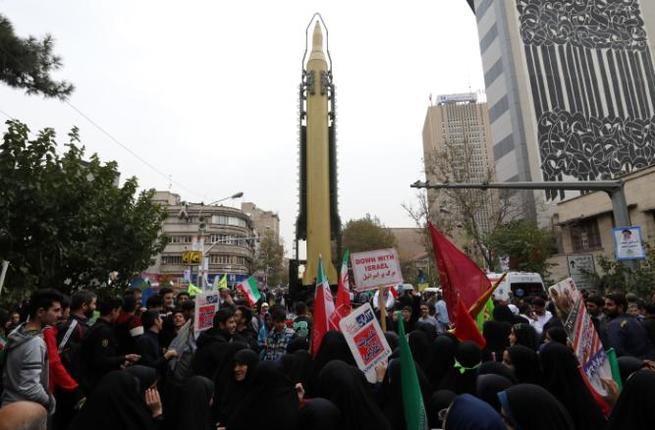
Ever since the Iranian revolution that deposed the Shah and installed an Islamic theocracy in Tehran, the ruling mullahs have invested heavily in a state-supported hate machine designed to gin up fierce hatred of the U.S., which typically reaches a crescendo on the anniversary of the 1979 U.S. Embassy takeover.

Last Saturday marked the latest iteration of a heavily choreographed spectacle designed to communicate Iranian hatred of the U.S., but also to divert the attention of the Iranian people away from the ever-growing mountain of problems they are struggling with under the mullahs’ rule and towards a perceived common enemy.

For the last nearly four decades, the mullahs have used the anniversary as the culmination of weekly and monthly demonstrations that include the now ritual “Death to America” chants and the parades across painted American flags and posters plastered on city walls mocking American political leaders.

The protests and observances have taken a different tone and edge over the years though; ceasing to be filled with vitriol by the Iranian people and carry more of a resigned air matched only by skies increasingly polluted by lack of regard by the mullahs for the environment or the health of the Iranian people.

For the mullahs these events commemorate a rare victory when hundreds of extremist regime related militant students (The very same militants that later formed the “Islamic Revolutionary Guards Corps”, IRGC) took 52 Americans hostage for 444 days in an event that helped cement the mullahs in power as they used the event for its propaganda value to legitimize the theocratic state they wanted to build; thereby stealing the promise of democracy ordinary Iranians had hoped for after the downfall of the Shah.

The mullahs learned from that singular event which is why they have carefully crafted a government built on a state-driven hate machine that attacks not only the U.S., but also other enemies such as the Sunni Arab nations such as Saudi Arabia, as well as perceived enemies from within like the Iranian resistance movement.

That machine is comprised of state-controlled media encompassing newspapers, television networks, bloggers, social media and pretty much every other avenue of communication within the regime.

It is backed by the thuggery of the Islamic Revolutionary Guard Corps and the paramilitaries that enforce the dreaded “morals codes” that oppress the Iranian people. Together with the Islamic religious courts and police, they work in concert to tightly orchestrate these observances and ensure obedience from the Iranian people.

In this aspect, the Iranian regime acts like a mirror image of the cultish North Korean dictatorship that forces citizens there to treat their leader as a deified entity.

While top mullah Ali Khamenei may not aspire to godhood, he certainly relishes having his wishes obeyed as if he was one.

To reinforce the militant aspects of this year’s anniversary celebrations, the Iranian regime’s military rolled out a surface-to-surface Sejjil ballistic missile with a range of 1,200 miles in a show of force. It marks the first time the regime has displayed this particular missile and comes shortly after President Donald Trump moved to decertify the Iranian regime under the current nuclear deal, partly because of the regime’s accelerated missile program.

The Fars news agency posted pictures of demonstrators burning an effigy of Trump and holding up signs saying “Death to America,” Reuters reported.

A statement read out at Saturday’s protest said Iranians “see the criminal America as their main enemy and condemn the denigrating remarks of the hated US president against the great Iranian people and the Revolutionary Guards.”

Khamenei speaking to the regime supporters urged them to never forget that “America is the enemy”. “To give in to the Americans makes them more aggressive and insolent. The only solution is to resist,” he said.

Ali Shamkhani, former chief commander of IRGC and current secretary of the regime’s Supreme National Security Council, addressed the crowd, saying Iran will make any sanctions imposed by the U.S. “ineffective” even as the U.S. targets Iran’s economic, nuclear and defensive power.

Shamkhani, alluding to Trump’s threats against North Korea, said even U.S. allies know that Trump “has no power to realize his bluffs, against Iran, too.” He called the U.S. the “eternal enemy” of Iran.

The regime needs to continually turn up the volume on the hate meter to continue using force and intimidation to keep the Iranian people in line and Iran in a perpetual state of conflict. The mullahs need to generate fear as a means of control as a way for justifying their increasingly punitive decisions.

Entry into the Syrian civil war? Necessary to save the Assad regime and preserve a Shiite ally.

Fostering of another civil war in Yemen? Necessary to counter Saudi expansion.

Fast tracking a ballistic missile program? Necessary to maintain a threat to the U.S. and Israel.

Ultimately though the deepest fears of the mullahs are that the Iranian people will see past these charades and choose a different path for their futures.

The Los Angeles Times quoted one such Iranian at the anniversary observances.

“I wish the hostility between the two countries would end as soon as possible because we are suffering from it,” said Hasan Mahmoudi, a shopkeeper near the embassy. “We want to have normal relations with America and foreign investment here to create jobs for our educated youth.”

For the mullahs, nothing would be more of a threat to their rule than the desire of the Iranian people for a normal life, devoid of fear, hate and conflict, where they could live in a democracy and focus on building a better life for their children.

It’s the one future that can defeat the Iranian regime’s hate machine.

Laura Carnahan

Filed Under: Blog, News Tagged With: Ballistic Missiles, Featured, Iran Human rights, Iran Mullahs, Iran sanctions, Iran Terrorism, IRGC, Khamenei, Syria, Yemen

NIAC Gets It Wrong About President Trump and Hassan Rouhani Again

October 26, 2017 by admin

NIAC Gets It Wrong About President Trump and Hassan Rouhani Again

NIAC Gets It Wrong About President Trump and Hassan Rouhani Again

The National Iranian American Council has become one of the most vocal and ardent purveyors of shameless cheerleading for the mullahs in Tehran and has established itself with a solid track record of making statements and promises about future behavior from the Iranian regime only to see virtually all of them proven false over time.

Yet, the NIAC’s continued churning of so-called “fake news” still finds a home in some publications and blogs—albeit a shrinking circle from the heady heydays enjoyed during the Obama administration’s policy of appeasing the regime.

The latest missive comes from Reza Marashi, NIAC’s research director, who has built an uncanny ability to publish “researched” editorials that are consistently wrong, in Al-Monitor in which he makes the claim that recent actions by President Donald Trump against Iran may have helped Hassan Rouhani.

Marashi bases his claim that President Trump’s decision not to recertify Iran in compliance with the nuclear deal, known as the Joint Comprehensive Plan of Action (JCPOA), and sending the matter for Congressional review, has helped fortify Rouhani’s troubled administration because it has rallied Iranian stakeholders against the U.S.

Let’s be very clear on a very important point Marashi ignores: There are no factions within the Iranian regime’s government that are even remotely favorably disposed towards the U.S.

This is an Islamic theological state run by clerics that mandate weekly “Death to America” observances, openly and actively fund terrorist groups that target and kill American service personnel in Iraq and Afghanistan, have taken American citizens hostage and held them for ransom, and have built a ballistic missile capability designed to deliver nuclear payloads as far away as Europe and Asia.

Marashi also claims that Rouhani and top mullah Ali Khamenei are united in a strategic vision to maintain a unified policy towards the U.S. regardless of whatever the outcome of nuclear deal negotiations.

On this point, he is partially correct since Rouhani is the handpicked front man for Khamenei to offer the West a kinder, gentler face of the regime that also tweets in order to build a perception that Iran was a moderate state when in fact it was plotting to massively expand its military operations in Syria, Iraq and Yemen.

“Whatever their differences, Khamenei needs Rouhani and his technocrats to repair the damage wrought by former President Mahmoud Ahmadinejad, and Rouhani needs Khamenei to provide political protection while he does so,” Marashi writes.

It’s a silly statement to make, especially for someone who purports to be a “research director” since it doesn’t take much research to know that the damage Khamenei needed for Rouhani to repair was an Iranian economy crippled by sanctions aimed at its secret nuclear program and the enormous drain on its treasury by bankrolling the Assad regime’s desperate war to hold onto power in Syria.

Marashi makes it sound that Rouhani is merely trying to rebuild an economy hurt by the mismanagement of the Ahmadinejad administration, when in fact Khamenei was desperate to gain an injection of billions of dollars in fresh capital to stave off a total collapse of the economy and consequently the Islamic state.

“Since entering office four years ago, Rouhani has maintained arguably the most diverse and inclusive political coalition in the 38-year history of the Islamic Republic,” Marashi adds.

This is one of the more astounding claims he makes since the Iranian regime allows no dissident political activities, and openly and aggressively rounds up dissenting voices and tosses them into prison, as noted by the harsh crackdown of journalists, artists, students and others by the Rouhani administration prior to parliamentary elections.

The contention Marashi makes that Rouhani was somehow in jeopardy has never been real in fact since Rouhani serves only at the pleasure of Khamenei and it is up to the supreme leader to decide when his usefulness is at an end. For as long as Khamenei perceives Rouhani can maintain the fiction of a more moderate Iran then Rouhani and his allies in the Iran lobby will continue to push their false messages.

The strategy Rouhani employs that Marashi defends in outlining support for the JCPOA had little to do with nuclear power and more with lifting economic sanctions to save the regime with a fresh infusion of capital.

The fact that the Obama administration were eager to do a deal with little consequences attached to its support for terrorism, abysmal human rights and the build out of ballistic missiles only served to reinforce the perception among the mullahs that Rouhani was useful in keeping up the perception that Iran was genuinely interested in becoming a “moderate” player when in fact it was only seeking massive piles of cash.

Marashi does not credit the Obama administration’s unsavory willingness to kowtow to the regime and even arrange for a midnight flight of pallets stuffed with cash sent to Tehran on the eve of the agreement as evidence not of Rouhani’s acumen, but rather American miscalculation that has been borne out over the last two years.

What Rouhani “sold” to Khamenei was a vision that Iran could have its cake and eat it too by negotiating a nuclear agreement that never eliminated its nuclear development—only delayed it—and freed it to move aggressively forward with its missile program to someday threaten its neighbors with ballistic missiles armed with nuclear warheads,

The only kernel of truth Marashi does offer is the idea that Iranians would not blame Rouhani for the nuclear agreement’s failure. The Iranian people would certainly not blame him since they live under a repressive government that punishes contrary thinking with stiff prison sentences and quick trips to the gallows mandated by clerical courts.

Marashi also failed to note how under Rouhani, Iran’s pace of public executions set a record-breaking pace pushing it far beyond almost every nation on Earth. It’s no wonder no Iranian would openly blame Rouhani since to do so almost guarantees a prison sentence.

Michael Tomlinson

Filed Under: Blog, News Tagged With: Appeasement policy, Featured, hassan rouhani, Iran, Iran deal, Iran Lobby, Iran sanctions, Khamenei, Moderate Mullahs, National Iranian American Council, NIAC, NIAC Action, Reza Marashi, Rouhani, Sanctions

What Happens If the Iran Nuclear Deal Stays?

October 5, 2017 by admin

President Donald Trump has been beset by a tumultuous September and now October with hurricanes battering Texas, Florida and Puerto Rico, North Korean belligerence and the horrific massacre in Las Vegas. No one would question that the burdens of being president right now are great

President Donald Trump has been beset by a tumultuous September and now October with hurricanes battering Texas, Florida and Puerto Rico, North Korean belligerence and the horrific massacre in Las Vegas. No one would question that the burdens of being president right now are great

President Donald Trump has been beset by a tumultuous September and now October with hurricanes battering Texas, Florida and Puerto Rico, North Korean belligerence and the horrific massacre in Las Vegas. No one would question that the burdens of being president right now are great.

But President Trump faces a self-imposed Oct. 15th deadline as well to decide what he wants to do with the Iran nuclear deal, which he has previously described as a terrible deal and with that decision comes a whole new raft of challenges.

In many ways, he has options that other presidents would not have since he comes at this point with essentially a clean slate. He can take several options such as continuing to certify the Iranian regime in compliance with the deal, but continuing to hold the mullahs over a proverbial cliff edge; threatening to pull out at any time. The agreement’s renewal window gives him the opportunity to continually threaten the mullahs.

Secretary of State Rex Tillerson offered that the president would have multiple options in addressing the Iranian conundrum.

What is clear though is that while the nuclear agreement is being widely hailed by the Iran lobby and regime supporters as a success, the issues many critics and even the president have with it is that the deal was too narrow and gave a free pass to the regime on a whole host of issues such as development of ballistic missiles that were nuclear-capable.

Much of the instability the Middle East is experiencing has its central roots planted in Iranian soil where the mullahs have sought to use their Revolutionary Guards and Quds Forces to actively initiate and carry out military conflicts on multiple fronts, including Syria, Iraq, and Yemen.

Those militant acts drew the U.S., Russia and Saudi Arabia into armed conflict and pitched the world dangerously closer to global confrontation.

The funneling of cash to the Assad regime in Syria and terrorist operations such as Hezbollah and Shiite militias in Iraq have been a fundamental reason for why sectarian conflicts have sprouted all around the world like noxious weeds.

The mullahs have always viewed the use of funded third-parties as a legitimate tool of state-craft, which is why Iran has consistently been at the top of the U.S. State Department’s list of states that sponsor terrorism.

But not only has Iran’s foreign policy been a source of consternation for the world, but its internal domestic policies have also fueled this militancy because the nuclear deal left in place all of the mechanisms of the theocratic regime and provided no boost or reprieve from embattled democracy and dissident advocates within Iran.

If anything, the deal only emboldened Hassan Rouhani and his puppet master, Ali Khamenei, to crack down even harder on internal dissident with impunity; leaving human rights within Iran shambles and subjecting the Iranian people to enormous hardship and deprivation.

Dissident groups such as the National Council of Resistance of Iran have long documented the steep, downward spiral of human rights in Iran since the nuclear deal was agreed to and lack of movement within Iran.

This disconnect between the nuclear deal and lack of any inclusion of restrictions on Iran beyond the very narrow scope centrifuges and uranium explains much of what has gone terribly wrong with Iran. In many ways, its failures mirror the failures of efforts to control North Korea whose own flawed nuclear agreements served as the templates for the Iran deal.

What is clear though is that the Iran lobby is working feverishly to frame the debate of a post-deal world as being an abysmal one for the U.S.

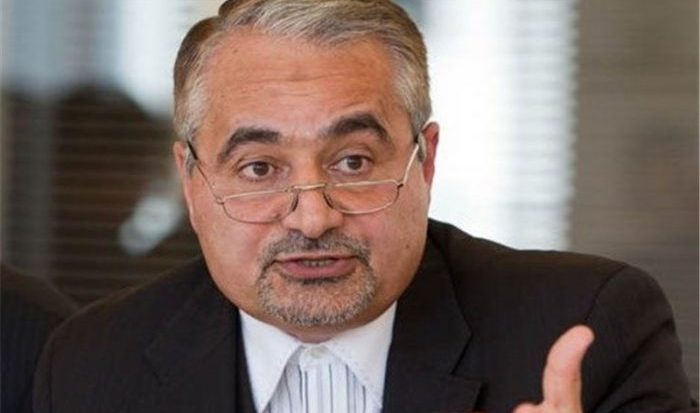
Take for example an editorial in the Los Angeles Times by Seyed Hossein Mousavian, a Princeton University scholar and a former Iranian regime official, in which he portrayed Rouhani’s 2013 election as an act of moderation now threatened by the nuclear deal’s demise.

Mousavian neglects to note Rouhani’s re-election against the backdrop of President Trump’s widely publicized views on the nuclear deal. If “hardliners” in Iran were empowered by the president’s rhetoric, then by Mousavian’s own standards, Rouhani’s 2017 campaign should have gone down in flames.

But as a former regime official, Mousavian’s insights are pointless since they do little to illustrate any opinions contrary to the wishes of Khamenei and his mullah brethren. Indeed, it would be explosive if Mousavian voiced any criticism of the regime’s support for terrorism and its quick build-up of ballistic missiles as excuses the president is using to dump the deal.

If Mousavian was truly an agent for global peace efforts, he would have encouraged his former colleagues to abandon the most odious portions of the regime’s abuses to give the president less ammunition to derail the deal.

Mousavian’s lack of any discernible criticism in any area places him squarely in the camp of Iran loyalists.

“Because Trump has put the deal in his crosshairs, advocates of diplomatic engagement with the West in Iran are being discredited. If he goes ahead with his stated wish to undo it, a domestic consensus will form not to trust, negotiate or cooperate with the United States on any future issue,” Mousavian writes.

It’s a ludicrous statement to make since everybody knows that when it comes to Iranian regime’s policies, it’s the Supreme Leader, Ali Khamenei who makes all the decisions; and the rift between various rivals within the regime is due to the power struggle they have on who gets a bigger share. It’s long known that it’s the Iranian lobby’s narrative to advocate more dialogue with the regime, to strengthen the so-called moderates within the regime, whereas when it comes to the foreign policies of the regime, Iran has done more in support of terrorism during the “reformist” Rouhani’s tenure, in its meddling in Syria, Yemen, Iraq and in employing the Hezbollah and other extremist proxy forces in those countries, than his predecessor, hardliner Ahmadinejad. Likewise,  human rights organizations reports show that under Rouhani, there have been a lot more executions than any of his predecessors in the past 25 years.

The reality is that the Iranian regime has squeezed everything it could get from the nuclear deal in terms of pallets of cash delivered by the Obama administration to a lifting of economic sanctions to allow foreign companies to broker deals.

Even if the president were to dump the deal, the reality is that very little would initially change except the rhetoric coming from Tehran and from supporters such as Mousavian.


Filed Under: Blog, News Tagged With: #NuclearDeal, Appeasement policy, Featured, hassan rouhani, Iran, Iran deal, Iran Human rights, Iran Lobby, Iran Mullahs, Iran Terrorism, Khamenei, Seyed Hossein Mousavian

Iran Lobby Tries to Separate North Korea from Iran Regime

August 19, 2017 by admin

Iran Lobby Tries to Separate North Korea from Iran Regime

Iran Lobby Tries to Separate North Korea from Iran Regime

In the long-running battle to combat the falsehoods of the Iran lobby, this site has uncovered the facts behind some of the most ridiculous assertions made by Iranian regime advocates such as the National Iranian American Council.

We’ve unveiled the inner workings of the lobby, its intertwined relationships with families of regime officials and the consistency its messages are aligned with those pushed by the regime.

Since the start of negotiations for the nuclear agreement over two years ago, we’ve documented the multiple falsehoods uttered by the Iran lobby in support of the deal, such as that it would help empower “moderate” elements in Iran’s government and usher in an age of international cooperation and good will.

Of course, none of that has come to pass and we’ve hit the Iran lobby hard on the utter failure of their promises. Iran has become arguably the most destabilizing force in the Middle East right now next to the Islamic State.

While ISIS has time and again spread its terror operations around the world, including most recently in Barcelona, Spain, the real linchpin to regional destabilization has been the Iranian regime and its proxy wars in Syria, Iraq and Yemen.

Most importantly though, Iran has helped fuel the sectarian nature of the conflicts going on, introducing the deep schism dividing Sunni and Shia populations and setting their respective governments against each other.

The mullahs in Tehran have sought to divide and conquer the Arab world and the result has been widespread chaos. Throughout all this, the Iran lobby has steadfastly sought to shift blame to more traditional whipping posts including the U.S., Israel and Saudi Arabia.

It didn’t matter which U.S. administration was in office or which political party controlled Congress; the Iran lobby always found it convenient to shift blame away from Iran no matter what the transgression was such as appalling human rights violations or the deepening wars in neighboring countries.

The arrest of dual-national Iranians? Blame the U.S. policy on immigration.

The execution of Iranians convicted as children with false confessions extracted under torture? Blame the opium trade from neighboring Afghanistan.

The miserable economic conditions strangling the Iranian people? Blame U.S. sanctions.

The Iran lobby has consistently always shifted blame and never affixed it squarely where it belonged: the mullahs in Tehran.

Now comes one of the more incredibly ridiculous claims made yet by the Iran lobby in the form of an editorial by Reza Marashi of the NIAC in Haaretz, which warned the U.S. from using the North Korean threat as a tie-in to Iran.

“First, conflating Pyongyang and Tehran is troublesome for an obvious reason: One has the bomb, and the other does not,” writes Marashi in one of the more glaring misstatements ever uttered by a member of the Iran lobby.

Iran’s own president, Hassan Rouhani, declared to Iranian lawmakers this week that Iran could walk away from the nuclear deal and restart its nuclear program in a “matter of hours” and bring a weapon to fruition in short order.

The gap between North Korea and Iran’s nuclear capabilities was supposed to be measured in years according to the Iran lobby, but in reality it’s only a matter of hours.

Marashi then goes on to claim that American policies in confronting other rogue regimes with nuclear ambitions such as Libya and Iraq have only motivated the Iranian regime to work harder to build their nuclear program.

Let’s think about that piece of fetid logic for a minute.

Iran only pursues a nuclear program because of American efforts to restrain other rogue regimes to create their own nuclear arsenals? Rarely have we read a more bizarre theory than that one.

But Marashi doesn’t stop there. He tries to tie in the Trump administration’s decision to kill the Transpacific trade deal and pull out of the Paris climate change agreements as motivating factors for Iran not to trust the U.S. on the nuclear deal.

The cherry on top of Marashi’s bloviating is the contention that the North Korea deal was doomed to failure since the U.S. never had any intention of ever allowing the Hermit Kingdom to ever develop a nuclear capability and thus provides an impetus for Iran to believe the U.S. is similarly disingenuous with its deal.

“If Trump corrects course and fully implements Washington’s JCPOA obligations, the risk of Tehran pursuing Pyongyang’s path is slim to none. The longer he continues violating the terms of the deal, the more likely it becomes that Iran resumes systemically advancing the technical aspects of its nuclear program – without the unprecedented, state-of-the-art monitoring and verification regime currently in place,” Marashi added.

These claims by Marashi are not even worth calling an obfuscation. They are clearly falsehoods. Tehran always intended to follow a nuclear pathway and ensured that the nuclear deal would preserve its enrichment infrastructure and allow it to restart quickly without any serious interruption.

Also, the “state-of-the-art monitoring” Marashi cites is neither state of the art, nor is it any meaningful monitoring. The agreement gave away any serious oversight by prohibiting international inspectors from most of Iran’s military bases and allowing collection of soil samples only after extensive scrubbing and removal of topsoil and only by Iranian hands to be handed over to inspectors.

But what is most appalling is how Marashi never mentions the word “missile” which is the most glaring connection between Iran and North Korea and the real reason why the two nations are indeed joined at the hip.

North Korea jump started Iran’s ballistic missile program by licensing its technology in the first place and has provided steady upgrades, improvements and technical advice. Iran is now following the exact playbook North Korea has followed in building ever-increasingly powerful missiles that can now reach the U.S. mainland.

North Korean officials have made regular visits to Iran and vice versa to exchange technical data and now there have been increasing news reports of the potential for Iranian scientists working in North Korea on learning its manufacturing processes for building nuclear warheads for its missiles.

Marashi is not only wrong, he is again engaging in the art of misdirection in trying to divert attention from the real alliance between Iran and North Korea.

Staff writer

Filed Under: Current Trend, National Iranian-American Council, News Tagged With: Appeasement policy, Featured, Iran, Iran deal, Iran Human rights, Iran Lobby, Iran Mullahs, Khamenei, National Iranian American Council, NIAC, NIAC Action, Reza Marashi, Rouhani

Iran Regime Adds Funds for Missile and Terrorism Programs

August 15, 2017 by admin

Iran Regime Adds Funds for Missile and Terrorism Programs

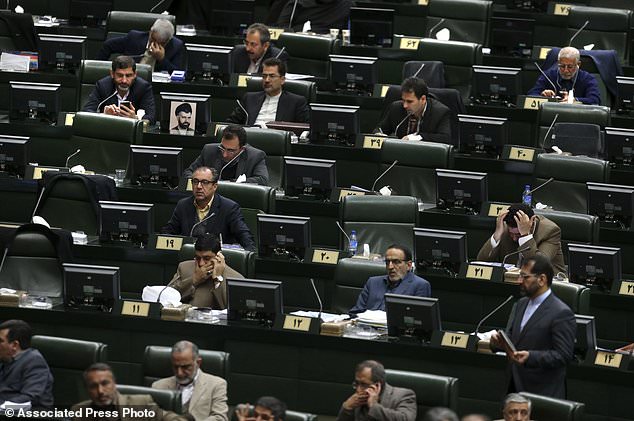
In this photo taken on Sunday, Feb. 19, 2017, lawmakers attend an open session of the Iranian parliament in Tehran, Iran. Iran’s parliament voted overwhelmingly Sunday, Aug. 13, to increase spending on its ballistic missile program and the foreign operations of its paramilitary Revolutionary Guard, chanting “Death to America” in a direct challenge to Washington’s newest sanctions on the Islamic Republic. (AP Photo/Vahid Salemi)

The Iranian regime parliament burnished its hardline credentials by approving an enormous boost in spending for its ballistic missile program and its Quds Forces within the Revolutionary Guard Corps, which has been at the heart at virtually all the proxy wars Iran is currently fighting throughout the Middle East.

The estimated $609 million boost will be divided evenly between the Quds Forces and missile effort, which the regime called the nation’s “deterrent capability,” according to regime-controlled Tasmin news agency.

Some lawmakers chanted, “death to America” as the bill was passed, according to state media.

The increase in funding comes as no surprise as the Iranian regime has steadily been funneling millions of dollars to fund its growing military commitments and support for proxies and terrorist organizations such as Hezbollah in Syria, Shiite militias in Iraq and Houthi rebels in Yemen.

If we think back to the completion of the Iranian nuclear agreement two years ago, the Obama administration shipped pallets full of cash via Iranian airliners in exchange for the release of American hostages. There were no conditions attached to the money which undoubtedly found its way to support Iran’s efforts to save the Assad regime in Syria.

Also, the Iranian regime does not report funding for its military nor for its paramilitary operations through its Quds Forces so we really don’t know how much money Iran really is spending on its missile and terror programs, but there can be little doubt the mullahs consider both high priorities.

Hassan Rouhani, the regime’s president, essentially tried to blame the Trump administration’s levying of new economic sanctions as the reason for the increase in funding, as well as the president’s public statements promising to rip up the nuclear deal.

“Anyone who harms the accord harms himself and his country,” Rouhani was quoted as saying by the Iranian Students News Agency. If the U.S. seeks to act against the agreement “everyone will side with us and against the person who wants to weaken it” he said in reference to other signatories to the deal including Germany and France, which have expressed their support for its continuation.

The move by the regime to boost its missile program comes in the wake of fellow rogue state North Korea’s rapid push into launching ballistic missiles capable of reaching the U.S. mainland, as well as intelligence reports that North Korea now possesses at least one nuclear device capable of being mounted on a missile.

It also follow’s North Korea’s threats to turn waters around the island of Guam and home to a sprawling U.S. naval base into a sea of fire with multiple missile strikes.

The roadmap North Korea has laid out in its missile and nuclear development is being closely followed by the Iranian regime in spite of the false promises consistently made by the Iran lobby that Iran was not pursuing nuclear capability.

North Korea’s licensing of its missile technology to Iran gave the regime a head start on missile development and provided a much-needed source of cash to the North Korean regime as it become the most isolated and sanctioned nation in the world.

In fact, North Korea’s Kim Yong Nam, the speaker of the parliament, attended Rouhani’s swearing in ceremony last week in a sign of the hermit kingdom’s close ties with the Iranian regime.

This isn’t Yong Nam’s first trip to Iran. He also visited in 2012 to attend the Non-Aligned Movement’s summit in Tehran. Then as now he was in the country for about 10 days, making many official visits and appearances, signing agreements for technical and educational cooperation between Iran and North Korea, according to the Daily Beast.

The connections between North Korea and Iran extend beyond building a missile fleet together as explained by David French in the National Review. The 1994 “Framework Agreement” between North Korea and the U.S. was almost a carbon copy of the Iran nuclear deal.

Like the Iran Deal, it sought to halt the pursuit of nuclear weaponry. Like the Iran Deal, it was supposed to bring a rogue nation back into the “global community.” Like the Iran Deal, it allegedly had enough safeguards to prevent cheating, French writes.

“Unfortunately, North Korea cheated. It maintained a secret uranium-enrichment program, and the deal collapsed soon after the Bush administration confronted the North Koreans with evidence of their noncompliance,” French added.

French goes on to point out that given this history, the Iran Deal may have been the worst possible model. For example, agreement with Iran famously provides the regime up to 24 days of notice before inspectors are allowed access to some suspect cites, and a regime with a record of cheating like North Korea’s is the worst possible regime to grant any leeway or any trust.

Moreover, the same deal granted Iran enormous economic benefits, access to international arms markets, and the ability to build ballistic missiles. A similar deal with North Korea would have the potential to supercharge the DPRK threat.

Instead, the Iran deal has pumped hundreds of millions of dollars into Iran which the mullahs are now funneling into the IRGC. North Korea demonstrates clearly that relying on “trust” to verify a nuclear agreement fails miserably when the rogue regime in question can’t be trusted in the first place.

The bolstering of Iran’s missile fleet and Quds Forces comes at the worst possible time for hopes of regional stability as Iran is now deeply involved in full-blown war and covert subversive campaigns in Syria, Iraq, Bahrain, Qatar, Kuwait, Yemen and now recently fired mortars and rockets along the Pakistan border.

All of the promises made by groups such as the National Iranian American Council that Iran would be a moderate force with the nuclear deal passed have been proven false and the world is now going to live under the threat of Iranian missiles because of it.

Michael Tomlinson

Filed Under: Blog, News Tagged With: #NuclearDeal, Featured, hassan rouhani, Iran, Iran deal, Iran Lobby, Iran Mullahs, Iran sanctions, Iran Terrorism, Khamenei, National Iranian American Council, NIAC, NIAC Action

Is the Open for Business Sign for Iran Now Closed?

July 11, 2017 by admin

Is the Open for Business Sign for Iran Now Closed?

Is the Open for Business Sign for Iran Now Closed?

One of the primary reasons why the Iran lobby was conceived and brought to life was a recognition by the mullahs in Tehran that they lacked all credibility when it came to the Western news media and needed surrogates to help shape the world’s perception of them as more open, accommodating and moderate than they really were.

This was especially important in light of the crippling economic sanctions that were bringing the Iranian regime’s economy to its knees, which was part of the discontent that was on display in the aftermath of the scandalous 2009 presidential election.

The massive street protests came at the height of the Arab Spring protests toppling governments throughout the Middle East and threatened to take down the mullahs in Tehran.

After brutally putting down the protests, the mullahs figured out they needed help to keep their grip on power which led to the election of “moderate” Hassan Rouhani in 2013 and a massive PR push aimed at the Obama administration to craft a nuclear deal that would lift the economic sanctions on Iran.

Much has already been written about the launching of Iran lobby advocates such as the National Iranian American Council and its prominent role in pushing for the nuclear deal by working in coordination with the Obama administration in creating the much-discussed “echo chamber” of supporters.

The aftermath of the nuclear deal and hasty implementation by the outgoing Obama administration created a narrow window of opportunity for the Iranian regime to get what it needed most at that time: cash and lots of it.

The regime was bleeding cash in its support of wars in Syria, Iraq and Yemen so accessing frozen assets, as well as the planeloads of cash paid as part of ransom payments for American hostages, helped stave off imminent collapse.

The next aim for the regime and Iran lobby was the lifting of economic sanctions so that business and investment deals could be struck to provide steady future sources of revenue.

After an initial rush by some European companies, later followed by Russian and Chinese military sales, the proverbial land rush slowed to a crawl amid uncertainty that the Trump administration and U.S. Congress might reinstitute sanctions because of Iranian regime’s support for terrorism and an alarming increase in ballistic missile launches.

It didn’t help the mullahs that their technological partner, North Korea, was busy flinging ballistic missiles into orbit faster than reruns of Real Housewives of Orange County, and alarming most of the nations in the Pacific.

The prospect that the U.S. might levy new sanctions slowed investment to a crawl, aside from a few high-profile sales of commercial jetliners, there has been few business deals announced.

That drought of new investment once again stirred ordinary Iranians to anger in the most recent presidential election a few months ago which saw mass protests throughout Iran; even including harsh demonstrations aimed at Rouhani himself.

The poor condition of the Iranian economy was also a contributing factor to the implosion of the candidacy of Ebrahim Raisi, the handpicked would-be successor by top mullah Ali Khamenei, leading to broad speculation that the mullahs’ grip on power was slipping.

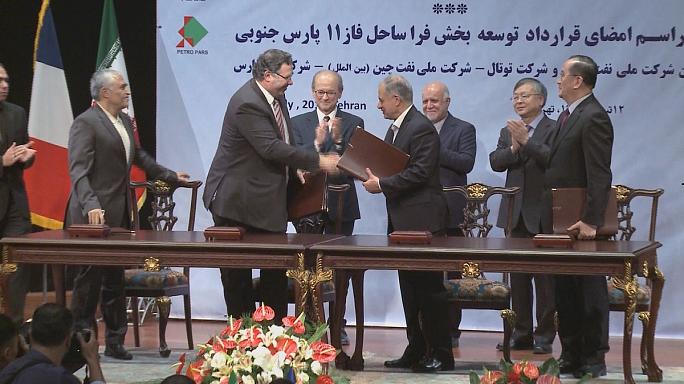
The most recent high-profile deal announced by Iran was with French petroleum giant Total, which agreed to a deal to jointly develop Iran’s massive South Pars gas field. Total was the first, and so far, only major oil player to commit to returning to Iran, while other firms, especially U.S. and British ones remain on the sidelines uncertain of the potential of the re-imposition of economic sanctions.

The risks for Total, and for that matter any other foreign company, doing business with Iran are substantial, as outlined in an insightful editorial by Dr. Majid Rafizadeh, president of the International American Council, in Arab News.

“U.S. pressure and sanctions on Tehran will likely continue to escalate, affecting American and non-American companies. The US may re-impose its sanctions bill that targets non-American companies doing business with Iran. If a company does business with both countries, its investments could be in peril. Quitting Iran’s market would not be easy for those with long-term investments,” Rafizadeh said.

He also alludes to the increasing political instability within Iran, as well as the tightening grip on the Iranian economy by Khamenei and the Revolutionary Guard Corps. That grip exists because of the rising need by the IRGC to funnel even more funds for its foreign adventures which have expanded in various fronts.

Also, as Iranian regime ramps up its ballistic missile program, the United Nations may feel compelled to act and sanction Iran lest it has to deal with both an Iran and North Korea crisscrossing the sky with ballistic missiles.

Recognizing the threat of possibly having its economy shutdown once again, the mullahs are moving rapidly to take advantage of the Total deal to ready an additional 14 oil and gas exploration for tender offers to foreign companies.

Sitting on some of the world’s biggest energy reserves, Iran has already been working on deals to develop fields such as South Pars, South Azadegan, Yadavaran, West Karoun, Mansouri and Abteymour, Reuters reported.

France’s Total last week became the first major to sign a post-sanctions development deal with Iran. Russia’s Lukoil and Denmark’s Maersk are also potential investors.

“Next on the horizon is the search for new oil, with the National Iranian Oil Company planning to tender 14 oil and gas blocks for exploration in the next two to three months,” NIOC’s deputy director for exploration blocks, Rahim Nematollahi, said in Istanbul.

But these deals may become moot should either the U.S. or UN act to impose new sanctions, especially any sanctions once again removing Iran from accessing the international wire transfer network or currency exchanges.

All of which places any foreign entity in a precarious position should it decide to invest in Iran. A company also runs the risk being labelled a supporter of terrorism since the vast majority of revenue Iran generates from one of these deals would inevitably be used to fund its proxy wars and support its terrorist allies.

This may mean that for the short-term at least, the “open for business” sign for Iran may be just another example of fake news.

Laura Carnahan

Filed Under: Blog, Current Trend, News Tagged With: #NuclearDeal, Appeasement policy, Featured, hassan rouhani, Iran, Iran deal, Iran Economy, Iran Lobby, Iran Mullahs, Iran sanctions, Iran Talks, Iran Terrorism, IRGC, Khamenei, National Iranian American Council

The Iranian Resistance Movement is Stronger than Ever

July 4, 2017 by admin

The Iranian Resistance Movement is Stronger than Ever

The Iranian Resistance Movement is Stronger than Ever

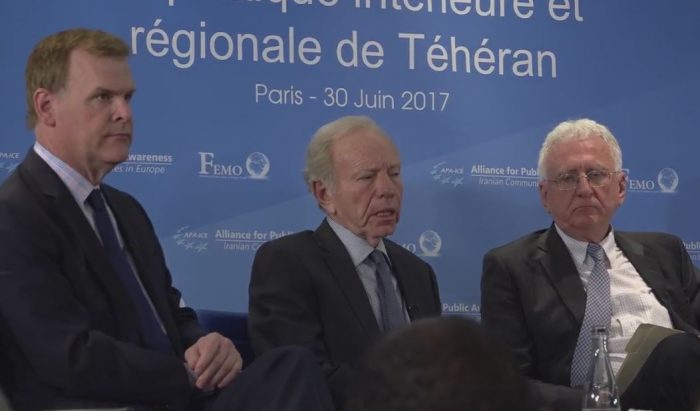
In a crowded hotel ballroom near Charles de Gaulle airport in France, speakers on three separate panels discussed the conundrum of Iran and the problems the regime poses for the region and the world.

While speakers came from different countries, from political and academic backgrounds, the message was the same: the Iranian regime was the key source of the region’s problems and that the Iranian resistance movement was the most viable pathway for regime change within Iran to a secular, democratic and pluralistic society.

The panel discussion, entitled: “Where is Iran Heading? Tehran’s Domestic and Regional Politics” was sponsored by The Foundation for Middle Eastern Studies (La Fondation d’Etudes pour le Moyen- Orient FEMO), an independent organization providing analysis on the Middle East to European institutions, international organizations and individuals, and the Alliance for Public Awareness, Iranian Communities in Europe (APA), comprised of various associations and individual expatriate Iranians living in Europe including a large number of second generation of Iranian expatriates.

The line up was a who’s-who is policy wonks, politicians and global influencers who weighed in on Iran’s influence in the Middle East and the role of the Iranian opposition (MEK) movement, especially the best pathway to regime change.

Regime change in Iran no longer seems to be a taboo word as U.S. Secretary of State Rex Tillerson cited it in recent testimony; a verbal leap forward from the reluctance of the Obama administration to utter anything that might offend Tehran.

Panelists all cited that the environment has shifted so dramatically over the last few months that the prospect no longer seems a fantasy, but now part of concrete policy discussions in capitals around the world.

Linda Chavez, founder and chairwoman of the Center for Equal Opportunity and a former White House staffer, cited a need for a “critical mass” of support for a burgeoning resistance movement being led by the National Council of Resistance of Iran, an umbrella group of several Iranian dissident and human rights groups.

It was a sentiment echoed by former Democratic Sen. Robert Torricelli who discussed his own experience in seeing the evolution of Iranian resistance groups such as the Mojahedin-e Khalq (MEK) from being ostracized unjustly as part of the appeasement policy towards Iran’s mullahs, to now being welcomed by world leaders seeking a strong partner in dealing with Iran.

The speakers reminded audience members that meaningful change was only going to happen from within Iran itself and not through any external manipulation which would only serve the interests of the mullahs in deflecting any efforts from outside as being meddling by foreign governments.

Former vice presidential candidate and Sen. Joe Lieberman expounded on the need for the Trump administration to hold the Iranian regime accountable for its actions and end the free hall pass the Obama administration gave in order to facilitate the nuclear agreement.

That realization lent a sense of focus and urgency on the day’s discussions on galvanizing the energy created by protests in the recent presidential election in Iran in which outsized banners and posters of NCRI leader Mrs. Maryam Rajavi where seen hanging from freeway overpasses in Tehran; an almost unthinkable act just a few months ago that would have earned any perpetrator a quick sentence to the gallows.

Struan Stevenson, president of the European Iraqi Freedom Association and former president of the European Parliament’s Delegation for Relations with Iraq, hit a key note when he called Iran the “godfather” of Islamic extremist groups likened Tehran’s influence among them.

With the rise of ISIS enabled by Tehran’s interference in the Syrian civil war and political meddling in Iraq, coupled with the use of terrorist proxies such as Hezbollah and Houthi rebels in Yemen, the Iranian regime manipulated the global stage to create a map for itself of Shiite control ranging from the Mediterranean to the Indian Ocean.

Michael Pregent, a fellow at the Hudson Institute and foreign policy analyst and former intelligence officer, described how the Iranian regime’s goals were to hold a navy base along Yemen’s coastline to control the flow of international commerce through the Suez Canal, and the creation of a land bridge running from Tehran, Baghdad and Damascus to move troops, goods, arms and supplies effortlessly.

The military muscle flexing by Iran was cited also by former Gen. Jack Keane, former vice chief of staff of the U.S. Army, who discussed how President Donald Trump’s election has set the stage for regime change with a halt to the concessions granted the mullahs by the Obama administration and an increased willingness to confront Tehran in Syria, Yemen and other fronts.

The panel discussion came in advance of a massive annual gathering held on July 1st by the NCRI and other groups to demonstrate the breadth and depth of the opposition movement and the broad international coalition supporting democratic change in Iran.

Part of the current policy discussion in Trump’s administration will have to take into account that there is no single, simple solution to the Iran problem as pointed out by the panelists, but instead would take a comprehensive approach including:

  • Re-imposing economic sanctions tying the regime’s support for terrorism and its ballistic missile program to improved relations;
  • Designating the Iranian Revolutionary Guard Corps (IRGC) as a Foreign Terrorist Organization and put the supply of easy cash for the regime’s activities at risk; and
  • Opening up greater support and recognition of the Iranian opposition movement to spur its growth within Iran similar to U.S. support of key dissidents such as Lech Walesa in Poland and Aung San Suu Kyi in Burma.

The NCRI has listed a more complete 10-point plan for a peaceful democratic future in Iran and with the changing political landscape around the world, we may be as close to seeing it happen as ever before.

Michael Tomlinson

Filed Under: Blog, News Tagged With: Featured, Free Iran Rally, Iran, Iran Human rights, Iran Mullahs, Iran Terrorism, IRGC, Joe Lieberman, Khamenei, mek, Struan Stevenson

  • « Previous Page
  • 1
  • 2
  • 3
  • 4
  • …
  • 11
  • Next Page »

National Iranian-American Council (NIAC)

  • Bogus Memberships
  • Survey
  • Lobbying
  • Iranians for International Cooperation
  • Defamation Lawsuit
  • People’s Mojahedin
  • Trita Parsi Biography
  • Parsi/Namazi Lobbying Plan
  • Parsi Links to Namazi & Iranian Regime
  • Namazi, NIAC Ringleader
  • Collaborating with Iran’s Ambassador

Recent Posts

  • NIAC Trying to Gain Influence On U.S. Congress
  • While Iran Lobby Plays Blame Game Iran Goes Nuclear
  • Iran Lobby Jumps on Detention of Iranian Newscaster
  • Bad News for Iran Swamps Iran Lobby
  • Iran Starts Off Year by Banning Instagram

© Copyright 2026 IranLobby.net · All Rights Reserved.