Iran Lobby

Exposing the Activities of the lobbies and appeasers of the Mullah's Dictatorship ruling Iran

  • Home
  • About
  • Current Trend
  • National Iranian-American Council(NIAC)
    • Bogus Memberships
    • Survey
    • Lobbying
    • Iranians for International Cooperation
    • Defamation Lawsuit
    • People’s Mojahedin
    • Trita Parsi Biography
    • Parsi/Namazi Lobbying Plan
    • Parsi Links to Namazi& Iranian Regime
    • Namazi, NIAC Ringleader
    • Collaborating with Iran’s Ambassador
  • The Appeasers
    • Gary Sick
    • Flynt Leverett & Hillary Mann Leverett
    • Baroness Nicholson
  • Blog
  • Links
  • Media Reports

Halloween Comes Early for Iran Lobby

October 27, 2015 by admin


Halloween Comes Early for Iran Lobby

Halloween Comes Early for Iran Lobby

Halloween involves kids (and adults) firing up their imaginations to come up with costumes and then go knocking door to door seeking treats and getting the odd trick played on them maybe in a haunted house. For the Iran lobby, Halloween came a week early as the chief advocate, the National Iranian American Council, held its annual leadership conference this weekend.

It’s worth noting that the NIAC bills its event as a premier conference for the nation’s Iranian-American community, but its agenda and participants hardly represent the views and beliefs of the estimated one million Iranian-Americans living in the U.S.

In fact, the line-up of speakers at this year’s conference reads more like a line-up card of Iran regime boosters and potential business partners than any group seriously examining the daunting challenges remaining between the U.S. and Iran. What is even more amazing are the lack of any speakers who have first-hand experience with the abysmal human rights situation in Iran, nor were there any speakers offering views on the sizable opposition worldwide to the regime amongst the Iranian diaspora.

Among the highlights of this gallery of apologists and appeasers includes:

  • Bijan Khajehpour, who founded Atieh International and the related Atieh Bahar which employed NIAC staffers to serve as a conduit for directing foreign companies to invest into the regime through the access it provided to top regime officials who controlled most of Iran’s economy through a complex web of shadow companies. Atieh was the subject of an in-depth piece in The Daily Beast on its start and close relationship with leading supporters of the regime and how it profited from those ties and in advocating for a lifting of sanctions against Iran;
  • Joseph Cirincione, president of Ploughshares Fund which was the largest funder of the lobbying campaign in support of the nuclear deal and the lifting of sanctions against the regime. It alone provided NIAC with at $150,000 for its advocacy work on behalf of the nuclear deal; not including money given by its staff. Commentary Magazine poured through tax records to glean the wide scope of Ploughshares giving to groups working on behalf of the regime’s cause; and
  • Alan Eyre, the U.S. State Department’s Persian-language spokesman who came under fire recently for promoting anti-Semitic conspiracy sites demonizing American Jewish groups, as well as postings on his personal social media praising the regime’s controversial Quds Force commander Qassem Soleimani according to the Washington Free Beacon. Eyre also posted links to Lobelog, a well-known blog dedicated to supporting the regime’s key messages.

The conference also featured several speakers who are actively seeking business deals within the regime including: Ned Lamont, chairman of Lamont Digital Systems; Jay Pelosky, a self-described advisor on emerging markets who recently visited Iran; and Amir Handjani, president of PG International Commodity Trading Services, a leading importer of agricultural commodities in the Iranian market.

We can’t resist one dig at Reza Marashi of NIAC who called the gathering the “world cup of Iranian-Americans.”

One interesting tidbit were comments made by Dr. Farideh Farhi who lamented the fact the nuclear deal had not led to substantial changes in U.S. policy towards the regime, but failed to note the swift shifts in Iranian policy towards the rest of the world in the rapid buildup of its military in Syria and launching of a new ballistic missile in violation of United Nations Security Council sanctions; both provocative acts.

This was followed by a tweet by Trita Parsi, NIAC’s head honcho, who described comments made by Shadi Hamid, a senior fellow at the Brookings Institution, and Mehdi Hasan, a commentator for Al Jazeera’s English broadcast, as saying about the panic from neighboring Arab nations about the nuclear deal: “If someone panics, you slap them in the face, you don’t indulge them.”

An appropriate comment since it neatly encapsulates the Iran lobby’s response to concerns over what the Iran regime will do now in the wake of the nuclear agreement. The recent rise in belligerent military action, coordination with Russia in blasting Syrian rebels back to the Stone Age and the conviction of Washington Post reporter Jason Rezaian all point to a slide into anarchy which has even alarmed Democratic lawmakers who initially supported the nuclear deal, but now have begun offering up new legislation designed to keep the regime in check.

The NIAC conference was predictable in celebrating its perceived win with the nuclear deal and the effort now to safeguard potential foreign investment after “Implementation Day” on December 15 when the U.S. will pave the way by lifting economic sanctions and allow Iran to rejoin the world of international commerce.

But the conference also revealed the biggest weaknesses of the lobby which was its inability or unwillingness to meet the most troublesome aspects of the Iran regime head-on; namely it horrific human rights record which leaves a deep and wide trail for the world’s media to follow.

With every arrest, every beating, every public hanging and every denunciation of a minority religious or ethnic group, the regime weakens any argument the lobby can make and increases the pressure on groups such as the NIAC to answer basic questions of “why aren’t you speaking out against the killing of X group?”

Which is why the NIAC conference was so focused on economic issues since the regime is desperate to not only get its hands on the estimated $150 billion in frozen assets to help pay off its military obligations in Syria, Lebanon, Afghanistan, Iraq and Yemen, but is equally anxious to bring in foreign investment to help prop up an economy devastated by gross mismanagement and corruption by regime officials.

By Laura Carnahan
 

Filed Under: Blog, National Iranian-American Council, News Tagged With: #NuclearDeal, Bijan Khajehpour, Farideh Farhi, Featured, Iran, Iran deal, Iran Lobby, Jason Rezaian, Joseph Cirincione, National Iranian American Council, NIAC, NIAC Action, Nuclear Deal, Reza Marashi, Trita Parsi

Why the Iran Lobby is Silent on Syria

October 22, 2015 by admin

Why the Iran Lobby is Silent on Syria

Why the Iran Lobby is Silent on Syria

During the long and contentious negotiations for a nuclear deal between the Iran regime and the P5+1 group of nations, the Iran lobby – led by the National Iranian American Council – was loud and boisterous in its efforts to prop up the regime’s arguments, denounce opponents and defend it as an instrument for positive change.

Trita Parsi, head of the NIAC, led the way with a steady stream of media interviews, editorials and even becoming a near permanent fixture in the hotel bars and lobbies in Austria and Switzerland during negotiations.

Parsi argued that the nuclear agreement would open the door to new solutions in Syria, writing that “the Iranians can help first to secure local cease-fires, and then later to begin a political process.”

“Once the nuclear deal has been sorted out, the door will be open for greater U.S.-Iran engagement,” he added.

Facts on the ground in Syria have proven Parsi to be wrong, if not an outright dissembler of the truth since in the wake of the nuclear agreement, the Iran regime launched a series of new offensives using thousands of fresh troops and forged an alliance with Russia to launch an air campaign that has targeted rebels to the Assad regime, not the ISIS strongholds it claims are its targets.

Ironically, last September, when Hassan Rouhani addressed the United Nations General Assembly, Parsi “compared the U.S. airstrikes in Syria to another country identifying terrorists in Oklahoma and bombing them without approval from the American government.”

We can only assume that Russian bombardment of Syrian civilians at the behest of Iran’s mullahs is more akin to being bombed by your own government with its blessing according to Parsi’s twisted logic.

The closest Parsi has come to biting the hand that feeds him was in a Huffington Post piece on Pope Francis’ visit to America where he writes “there are few signs that Tehran is decisively scaling back its support for the Syrian government and the Russians have recently moved in militarily to boost the Assad side. The end result of this inevitably will be more deaths and more stalemate. No side can escape responsibility for these dire consequences.”

“What has fueled the Syrian crises more than anything else is the false illusion on all sides that a decisive military victory is around the corner,” he added.

Parsi fails to cite that the reason why the Assad regime has been able to stay in power in the face of a peaceful and popular revolt against his rule which later turned bloody and brutal at his hands was the unquestioned and loyal support of the Iran regime.

Rather than advocate for the peaceful regime change in Syria that other nations embraced as part of the Arab Spring – most notably Tunisia which earned the Nobel Peace Prize this year for its peaceful transition to democracy – Parsi has opted to be an unabashed supporter and apologist for Tehran’s military support of Assad and excuses such support as “understandable.”

The example set by the Tunisian National Dialogue Quartet’s Nobel win has recharged democracy activists around the region and bolsters hope for the long-suffering members of the Iranian resistance who have peacefully opposed the mullahs in Tehran only to be arrested, imprisoned, tortured and often executed by the regime for simply protesting for basic human rights.

It is tragic, but altogether understandable that Parsi and the rest of the NIAC staff have never raised their voices in protest over the brutal suppression aimed at the members of the Iranian resistance, which is viewed harshly by the mullahs because of the simple fact the ordinary Iranians are living examples of the opposition to their rule and proof that their government is illegitimate.

Parsi’s contention of a more moderate pathway to regional stability through Tehran has been increasingly taken to task as more commentators see the proof in Iran’s recent actions and increased militarism.

“If the past is any guide, highly ideological regimes — see China, Vietnam, the former Soviet Union and Cuba — have proven adept at opening up economically but still retaining authoritarian and repressive control,” said Aaron David Miller, vice president at the Woodrow Wilson Center for Scholars in an editorial in the Wall Street Journal.

“Anyone who thinks Iran is on a linear course to moderation ought to lay down until the feeling passes,” Miller said.

Similarly, Jennifer Rubin writing in the Washington Post echoed the same thoughts as she praised Sen. Bob Menendez (D-NJ) for being right on Iran’s post-agreement rise in aggression.

“Sen. Robert Menendez, stalwart critic of the Iran deal, deserves to say ‘I told you so.’ He had suggested that sanctions would be lifted even without revealing the possible military dimensions of Iran’s program, that the inspection process (including self-selected samples) was nonsensical and that we would embolden Iran in the region to, among other things, further boost characters like Bashar al-Assad. Right on all counts,” Rubin writes.

As more thoughtful people recognize the folly of the arguments used by the Iran lobby in defending an indefensible agreement, the people of Syrian are reaping the punishment for allowing the mullahs of Iran a free hand in prosecuting their religious war.

Michael Tomlinson

Filed Under: Blog, News Tagged With: #NuclearDeal, Featured, hassan rouhani, Iran Lobby, NIAC, Trita Parsi

Adoption Day for Nuclear Deal Brings Uncertainty

October 19, 2015 by admin

Adoption Day for Nuclear Deal Brings Uncertainty

Adoption Day for Nuclear Deal Brings Uncertainty

Sunday marked what has been dubbed “Adoption Day” and we’re not talking about lost puppies. This weekend marked the start of the of what the Obama administration and other members of the P5+1 called the start of showing readiness to the Iran regime in lifting economic sanctions that have held the mullahs in Tehran in check for the past decade.

In a memo, President Obama directed the secretaries of state, treasury, commerce and energy “to take all necessary steps to give effect to the U.S. commitments with respect to sanctions described in (the Iran deal).”

This will be followed by “Implementation Day” on December 15 in which the U.S. and its partners will begin the actual process of lifting sanctions against the regime after certification by the International Atomic Energy Agency that the regime has lived up to its commitments to curb its nuclear program.

For the Iran regime, Sunday also marks the “put up or shut up” moment for the mullahs in which the regime will have to begin the process of dismantling parts of its nuclear program, including decommissioning nearly 15,000 centrifuges, converting its Arak heavy-water reactor so that it will produce less plutonium and reducing its stockpile of enriched uranium 98%. U.S. officials expect it will take about six months.

Ali Akbar Salehi, the head of Iran’s Atomic Energy Organization, told Iranian state television Sunday that the country would begin taking its next steps under the deal—including reducing the number of uranium centrifuges in operation, and removing the reactor core at the Arak facility—in short order, according to the Wall Street Journal.

But the real question is will the regime move aggressively forward in order to recoup frozen assets and foreign investments needed to stave off economic disaster from corrupt mismanagement at the hands of the mullahs, or will the regime simply slow walk changes while providing its usual propaganda lip-service, supported by loyal Iran lobbyists such as the National Iranian American Council, and stonewall any real changes?

Already we’ve seen efforts by the Obama administration and United Nations to provide some cover for the regime even as the mullahs have undertaken provocative steps in the wake of adopting the nuclear deal.

The most notable action has been the military buildup in Syria, including the mobilization and commitment of Iranian troops directly into the fight and coordination in drawing in Russia to fight the fights the Iran regime has been unable to win so far in support of the Assad regime.

This has been followed by the reported conviction of Washington Post reporter Jason Rezaian for espionage (ironically announced on the exact same number of days Iran held the 52 American embassy hostages), and the launching of a new ballistic missile design that has been denounced as a violation of UN Security Council resolutions banning the Iran regime from pursuing ballistic missile designs that could be used to deliver nuclear payloads.

U.S. Ambassador to the U.N. Samantha Power stopped short of any confrontational rhetoric, affirming Wednesday that the test violated a U.N. Security Council resolution “if the facts are as we believe them to be.” Iran has always considered such resolutions to be invalid and has violated their provisions numerous times since they were adopted in 2010. The Iranian government also denies the ballistic activity violates the Joint Comprehensive Plan of Action, the formal name for the nuclear agreement.

The fact that the U.S. recognizes that the regime has already violated the UN agreement, yet opts not to confront the regime is indicative of what lies in store for us as the regime continues to make its aggressive and increasingly desperate moves throughout the Middle East.

The regime’s actions are remarkably similar to moves made by North Korea as it first agreed to restrictions on its nuclear program, only to continue advancing it in secret until it tested fully functional nuclear weapons in spite of successive efforts to sanction North Korea after the fact with no effect.

The mullahs in Tehran have watched and learned what Pyongyang did in steering tis nuclear program past international sanctions, which may be why Iran unveiled to the world video of once-secret underground missile bunkers where it stored its arsenal of mobile missile launchers.

The most significant aspects of the revelation by the regime are that: a) no one knew about these secret bunkers; and b) that the bunkers hint at the size and scale of secret military facilities that have hardened against attack by being buried as much as 500 meters under a mountain range.

Why this is important is that it basically invalidates significant sections of the nuclear agreement dealing with limited inspections only of “known” facilities and not allowing inspections of military sites. It also puts into proper perspective the nefarious nature of the regime as it hides most aspects of its military capabilities.

According to the Daily Beast, “while details about the alleged 500-meters-down subterranean base are few and difficult to confirm, the bunker and others like it could upset the delicate military balance between the United States and Iran as the two countries move forward on an agreement to limit Tehran’s nuclear program in exchange for a gradual easing of economic and military sanctions targeting the Islamic regime.

“That’s because any facility a quarter mile below ground is way too deep for America’s existing bunker-busting bombs to directly destroy in the event Iran reneges on the nuke deal and tries to put atomic warheads on its long-range rockets,” the Daily Beast reported.

Then again, given the regime’s penchant for hyperbole, bluster and outright fabrication in order to make itself seem more militarily formidable than it really is, all of this could simply be fakery.

That begs the question of whether or not the U.S. and its allies should be making the $150 billion bet that the regime is a sheep in wolves’ clothing.

The people that know the regime best, the dissidents and members of the resistance movement worldwide, should be the ones we should be taking our cues from and in their view, the nuclear deal has only emboldened the Iran regime in its march towards oppression.

By Michael Tomlinson


Filed Under: Blog, News Tagged With: #NuclearDeal, Featured, Iran, Iran deal, Iran Economy, Iran Human rights, Iran Lobby, Irandeal

Iran Regime Unveils Missile Base to Cover Weakness

October 16, 2015 by admin

Iran Regime Unveils Missile Base to Cover Weakness

Iran Regime Unveils Missile Base to Cover Weakness

Mother Nature provides us excellent examples of weaker insects or animals using the art of disguise to shield themselves from predators. The katydid tries to look like a leaf, while the elephant hawkmoth caterpillar looks like a snake head. Both use deception to keep from becoming someone else’s lunch.

In a case of man imitating nature, the Iran regime’s Revolutionary Guard Corps released video footage of secret missile base in an underground tunnel deep in a mountain side.

“The video, aired on semi-official Fars TV and set to rousing music, shows an extensive tunnel packed with medium- and long-range missiles and launcher units. The Guard said the missiles were on their launch pads, ready to be fired in the event of an attack on the country,” according to Fox News.

The video of the missile base, so far unconfirmed by independent sources, follows the recent test firing of a new ballistic missile that the U.S. claims violates terms of a United Nations Security Council sanction prohibiting the regime from developing new missiles. The video’s airing raises some basic questions such as: Why?

Dominic Waghorn, reporting for Sky News, said the video’s release was designed for domestic consumption as leaders within the Revolutionary Guards Corps worry about appearing weak to the rivals such as Saudi Arabia, especially at a time when its Syria campaign all but collapsed until the last-minute intervention by the Russians.

“But an attempt to project strength is in itself a sign of weakness. Neither Russia nor Iran would be in Syria were their ally Bashar al Assad not in trouble,” Waghorn said. “Their forces are there because his have been crumbling and that has threatened their interests there. Their presence invites a response from his enemies and their backers, and is not therefore without considerable peril.”

But the Iran regime’s effort to project a more assertive posture as it has seen a rolling series of setbacks didn’t stop with the missile video and test launch. It included grainy video released through Twitter showing the regime’s Quds Force commander Qassem Soleimani, purportedly addressing Iranian and Syrian troops in Syria on the eve of launching a new offensive to attack rebel militias.

Showing Soleimani taking direct command of ground forces following the deaths of two other senior IRGC commanders strongly shows the mullahs near-desperation to pull out a victory in Syria after so much blood and treasure has been spent with little to show for it as Assad’s forces have been pushed nearly all the way back to the sea.

But with the looming deadline for certification by the International Atomic Energy Agency to complete its investigation of Iran’s past nuclear activities, the regime – which had been slow in responding to the inquiry – stepped up at the last minute to be responsive to the UN probe.

In the past two weeks, after Iran had largely brushed off serious questions about its past nuclear activities, the IAEA and some Western governments directly warned Tehran that it must increase cooperation if it wanted IAEA board members to conclude it had sufficiently addressed their concerns, according to the Wall Street Journal.

The board must decide in mid-December, based on a report by Director General Yukiya Amano, whether Tehran has done enough for the nuclear agreement it signed in July with six world powers to proceed.

As the regime is confronted with the costs of a massive new offensive in Syria, it may very well have concluded that it needs the scheduled $150 billion in frozen assets as quickly as possible to replenish its coffers as part of the nuclear deal, as well as keep its economy afloat.

That became painfully apparent as the engine from an Iranian Mahan Air 747 fell off shortly after takeoff from Tehran. The regime badly needs new aircraft to replace a fleet hampered by economic sanctions.

Ultimately, many of the regime’s most recent moves can be seen as desperate acts by a leadership of mullahs being pressed in on all sides.

By Michael Tomlinson

Filed Under: Blog, News Tagged With: #NuclearDeal, Featured, Iran, Iran Economy, Iran Mullahs, Nuclear, Nuclear Deal, Sanctions

Iran Regime About to Go All Out in Syria

October 15, 2015 by admin

Iran Regime About to Go All Out in Syria

Iran Regime About to Go All Out in Syria

“This agreement could be the key that unlocks solutions to some of the most intractable conflicts in the Middle East. The region suffers from a diplomacy deficit and the nuclear deal paves the way for an increase in dialogue and diplomacy on a whole set of issues – which is critical for stability in the Middle East,” said Trita Parsi, head of the National Iranian American Council, August 27, 2015.

“Iran has sent hundreds of troops into northern and central Syria in the first such open deployment in the country’s civil war, joining fighters from its Lebanese ally Hezbollah in an offensive against rebels and taking advantage of cover from Russia’s air campaign, a regional official and Syrian activists said Wednesday.

“Their arrival is almost certain to fuel a civil war in Syria which has already claimed the lives of more than 250,000 people and displaced half of the country’s population. It also highlights the far-reaching goals of Russia’s military involvement in Syria,” from the Associated Press, October 14, 2015.

You have to admire the chutzpah of Trita Parsi to shovel the kind of fragrant stuff he does only to be proven wrong time and time again, which begs the question of why anyone ever listens to him.

As the AP reports that upwards of 1,500 Iranian regime fighters begin arriving in Damascus, the picture in Syria is becoming increasingly bleak as combatants from Iran, Syria, Russia, Turkey, Iraq, Afghanistan, Lebanon, Jordan, Egypt, U.S. and pretty much from every country in the European Union now rush in for what promises to be the start of a new phase of bloody sectarian conflict.

What is even more impressive about Parsi’s comment only two months ago was that he held out the promise of diplomacy when the Iran regime in fact had absolutely no interest in diplomacy. Instead, the mullahs are committed to a path of military conquest in an all-or-nothing scenario.

Whether intentionally or not, Syria has quickly shaped up to becomes the ultimate bellwether of the ability of the Iran regime to stay alive because of Assad falls, Russia is likely to take a dim view of Iranian promises since Syria contains the only naval base Russia has in the Mediterranean. The loss of Syria would also prove conclusively the mullahs have no ability to expand their dominion beyond using the kinds of terror tactics it has relied on for the past three decades.

The buildup comes as Iranian Deputy Foreign Minister, Hossein Amir Abdollahian said on Tuesday that Tehran was working with Russia on drafting a peace plan for Syria. But Western powers, and many countries in the Middle East, say Assad must go as a precondition for peace.

Some peace plan, it just requires thousands of Iranian troops to make it work.

But the pending offensive in Syria also serves the Iran regime’s purposes by diverting attention from its other activities throughout the region as Tom Watson points out in The Independent:

“Events in Syria have, however, distracted attention away from Iran’s activities elsewhere in the region. Recently the Iranians were caught supplying weapons to Houthis rebels in Yemen, something Iran has long denied doing. Meanwhile, as a new report for The Henry Jackson Society: ‘Tehran’s Servants’ by Jonathan Spyer demonstrates, Iran has taken control of a vast force of Shia militias in Iraq that are now dominating much of the country. Western leaders may welcome these activities for helping to drive back IS, but no one should be under any illusions about just how extreme these Iranian-backed militias really are,” Watson writes.

“A glance across what is already a very troubled region endlessly turns up signs of Iranian involvement. Tehran has exploited the turmoil to advance its own hegemonic ambitions. It is doing exactly the same with the void left by Obama’s retreat from the world stage. Even as the Iranians look set to adopt the nuclear agreement, the Islamic Republic’s actual conduct rather suggests that the regime in Iran remains far from being a friendly or benign force in the world,” he added.

But why the rush by the regime in so many places around the world at once? The answer is simple: time is the enemy of the mullahs.

A presidential race in the U.S. will usher in what will most likely be a new president un-beholden to the nuclear agreement, and a new Congress eager to pass more sanction legislation against the regime on the wave of American public opinion polls showing vast dissatisfaction with Iran.

Military moves made by the regime have backfired in Syria, Iraq and Yemen and seen their allies in Hezbollah, Houthis and Shiite militias stall and even retreat from gains made earlier this year.

Ali Khamenei’s advanced age and recent health problems add to the uncertainty as does the surge in anti-regime protests that have now stretched into their third year and reveal a vast amount of discontent within the Iranian people.

The mullahs are on the clock and the big push in Syria is their wild last attempt to push all their chips on the table in a desperate bid to hang on.

Now if only Trita Parsi would tell us the offensive is just a new form of diplomacy then the cha  rade would be complete.

Michael Tomlinson

Filed Under: Blog Tagged With: #NuclearDeal, Appeasement policy, Featured, Iran, Iran deal, Iran Lobby, Iran sanctions, National Iranian American Council, NIAC, NIAC Action, Trita Parsi, Yemen

 The Paper Tiger of the Iran Regime

October 14, 2015 by admin

 The Paper Tiger of the Iran Regime

The Paper Tiger of the Iran Regime

How much of a threat is the Iran regime to the world? It’s a question that has preoccupied everyone from American congressmen to Saudi royalty to Sunni tribal leaders to Turkish newspapers. It’s a question that lies at the heart of policy discussions ranging from imposing economic sanctions to approving a nuclear agreement to opening up free trade.

In many ways, the regime represents a clear and present danger, especially to its neighbors. Syria, Iraq and Yemen have already felt the brunt of Iranian regime’s involvement in supporting terrorist groups operating within their borders as in the case of Hezbollah in Syria, and sponsorship of proxies fighting sectarian wars such as Shiite militias in Iraq and Houthi rebels in Yemen.

The regime also represents a significant threat in terms of its potential for causing more chaos, including the ongoing development of advanced ballistic missiles and the ability to acquire new military technology such as satellites, fighter jets and anti-aircraft missile batteries from Russia.

But is the Iran regime really more like a paper tiger, painted over in fierce colors, but fragile and capable of collapsing utterly in a strong wind?

Take the civil war in Syria for example. The mullahs in Tehran moved quickly to bolster support for the Assad regime in the face of democracy protests that quickly escalated to armed conflict. It did so through its reliable terrorist partners in Hezbollah and through use of its own Quds Forces in supporting the Syrian Army.

Even after Assad was internationally condemned for using chemical weapons on his own people, the Iran regime stood firm in supporting him and worked out a deal with Russia to help shield Assad as long as he gave up chemical weapons, which many outside observers claim he did, but only in part.

The Iran regime dipped deep into financial reserves to support the war effort, estimated at over $15 billion annually, a massive drain on the regime’s economy at the same time the global price of petroleum plummeted putting even more pressure on the mullahs.

As Ali Khamenei, the regime’s top mullah, ordered a “war economy” be imposed on the Iranian people, the first signs of economic dissent crept in with mass protests amongst underpaid teachers, small business owners and workers erupted in various parts of Iran.

Despite all of the support the Iran regime was providing Assad, the multitude of opponents, ranging from the religious extremists such as ISIS and terror groups such as Al-Qaeda to moderate backed secularists such as the Free Syrian Army, made substantial gains against Syrian and Iranian forces.

The gains were so significant and threatening to the Assad regime that Iran’s Quds Force commander, Maj. Gen. Qassem Soleimani, took a clandestine mission to Moscow to brief Russian leaders on the gravity of the situation and beg for Russian assistance in staving off an imminent disaster.

Since the Russians agreed and have launched a major air campaign and placed boots on the ground, a new chorus of discontent has arisen from the Syrian people and within the ranks of the Syrian military who are chafing under the virtual “Iranianization” of their country and military as the Iranian military has taken over almost all combat and control mechanisms and set up joint intelligence and command centers with Russia in Damascus and Baghdad.

But the regime is not impervious to losses as several notable and high ranking Iran regime military commanders have been killed on the Syrian battlefield recently including 67 year old Islamic Revolutionary Guard Corps (IRGC) Brigadier General, Hossein Hamedani.

According to The Daily Beast, Hamedani was reportedly killed in Aleppo. Officially, he was described by the Iranian officials as a, “high-ranking military advisor” to Assad. But to write Hamedani off as merely an “advisor” would be the equivalent of referring to Napoleon as just, “a French general.”

“With the loss of Hamedani came the loss of a major leadership element within the IRGC, one Tehran will not likely be able to regain. Still, Hamedani was not the last IRGC commander to have met his end in Syria in the past few days. On October 12th, two more IRGC Brigadier Generals were slain. Farshid Hasounizadeh and Hamid Mukhtarband, both were former commanders of the Sabreen and 1 Brigades, respectively,” said The Daily Beast.

The loss of these key regime commanders, the growing resentment among the Syrian military and people, coupled with the need for a Hail Mary intervention by the Russians all point to the floundering nature of the Iran regime’s Syrian enterprise.

As J. Michael McInnis, a resident fellow at the American Enterprise Institute, writes in the National Interest, “Tehran has been losing the Syrian fight since the civil war broke out on 2011. After major setbacks for Syrian government forces in 2012, Iran persuaded a reluctant Lebanese Hezbollah to send in ground forces in early 2013. That helped stabilize Assad’s position for a while, but by 2015 the regime was again at risk of losing its most critical positions near the Mediterranean coast and Damascus. Desperate times apparently drove Iran right into Moscow’s arms.”

The fortunes of the regime in Yemen, where Houthi rebels have been pushed back by a coalition of loyalist Yemen forces and Saudi and Gulf state militaries to such an extent that Yemen’s former government is slowly returning to normality.

Similarly in Iraq, the failed efforts by the regime to control former Prime Minister Nouri al-Maliki only led to the spawning of ISIS.

Couple that with the scores of almost comical announcements made breathlessly by regime-controlled media about some military advance such as the development of a new advanced torpedo system, sinking of a replica American aircraft carrier, unveiling of a new missile, all of which have come with a splash, but have proven to be more illusory than practical.

The real test for the mullahs and regime comes this Sunday which will be the “adoption day” for the nuclear agreement and marks the point where the regime must begin the process to dismantle its nuclear infrastructure, including the removal of 14,000 centrifuges from Natanz and Fordow facilities, getting rid of 12,000 kilograms of low-enriched uranium and removing the core of the Arak nuclear reactor.

Even though the agreement is badly flawed, the regime will have to demonstrate its compliance on these areas or face a reversal of the gains its lobbyist forces have achieved. In many ways, Sunday marks the “put up or shut up” phase for the regime.

The mullahs may now be facing a point where they may regret what they have so eagerly sought in this nuclear deal.

By Laura Carnahan

Filed Under: Blog Tagged With: #NuclearDeal, Featured, Iran, Iran deal, Yemen

Iran Regime Culture of Terror and Violence Unchanging

October 12, 2015 by admin

Iran Regime Culture of Terror and Violence Unchanging

Iran Regime Culture of Terror and Violence Unchanging

There are several constants in the universe: the theory of relativity, the speed of light and the single-minded commitment of the Iran regime to its path towards expansion of its vision of extremist Islam using all of the tools at its disposal.

Much has been made about the new nuclear deal with the regime as being a harbinger of improved relations; most of those arguments being exclusively made by the loyal Iran lobby led by the National Iranian American Council, but all of those arguments ignore one essential proof which is the regime has shown through its actions just how committed it is towards its revolutionary vision.

At the heart of the regime’s hold over Iran is its willingness to use brutal force and violence to reign in its opponents and liberal use of its prison system and death penalty to remove the most vocal and troublesome resistance elements. While the modern world is moving towards annihilation of the death penalty, in most nations, that still use death penalty, imposition of the ultimate punishment by the state comes as a last resort and is reserved for the most heinous of crimes; usually those involving mass murder, treason or the cruel torture and murder of a child.

But within the Iran regime, the death penalty and the entire judicial system is under political control and often used to silence dissidents, stifle free speech and oppress the dissatisfied. Within the regime judicial system, its various courts, police and paramilitaries fall under the authority of the top mullah, Ali Khamenei, and its religious courts hold sway over virtually every facet of Iranian life.

All of which came into stark relief this weekend as the United Nations designated World Day Against the Death Penalty and a large gathering was held in Paris of anti-death penalty activists from around the world.

The conference sponsored by the Committee Defending Human Rights in Iran, was entitled, “Iran, Human Rights, Stop Executions” and included notable participants such as Gilbert Mitterrand, former member of the French National Assembly and President of France Libertés (Danielle Mitterrand) Foundation, Phumla Makaziwe Mandela, women’s rights advocate and daughter of Nelson Mandela, the late leader of South Africa, David Jones and Mark Williams, members of the British House of Commons, Hanan Al-Balkhi, representative of the Syrian Coalition in Oslo, and Taher Boumedra, former human rights chief of the United Nations Assistance Mission in Iraq – UNAMI.

According to the National Council of Resistance of Iran, a coalition of leading Iranian resistance groups, there have been over 120,000 executions carried out by the regime, often performed as public hangings from construction cranes. Any casual Google image search of “Iran” and “hangings” produces the grisly bounty of the mullahs.

While the world has been concerned over the plight of notable prisoners such as Washington Post reporter Jason Rezaian, who has been convicted and sentenced by a regime court in a sham trial, they are but just a tip of what qualifies as one of the largest state-operated political prison systems since the Soviet-era gulags or Khmer Rouge killing fields.

One of those prisoners, Farzad Madadzadeh, told his story in an interview with The Daily Mail where he detailed routine torture including beatings, electrocution, forced drug use and solitary confinement. His only crime: speaking out against the regime.

Last year, the country had the second highest number of executions in the world after China and also killed the most juvenile offenders, according to Human Rights Watch.

And it remains one of the biggest jailers of bloggers, journalists and social media activists, all part of the strategy by the regime to suppress open political dissent and maintain its control over what is increasingly becoming a fractured society chafing underneath three decades of brutal Islamic rule.

But the regime’s reach is not just confined within the borders of Iran. Regime security agents and their proxy allies have launched attacks in places such as Lebanon, Syria and Iraq to get at its political opponents, such as the large number of dissidents from the People’s Mojahedin Organization of Iran relocated to Camps Ashraf and Liberty and subject to frequent attacks.

The very nature of the regime has given many in Congress pause after approving the nuclear deal, forcing Democrats and Republicans to join and reassess the most pressing question facing them with the 2016 elections looming: What do we do about Iran now?

While the NIAC and other regime allies would have us believe next year will bring economic opportunities and a revival for Iran’s people, the regime’s doubling down in Syria, willingness to call in Russian military aid to save the Assad regime and growing discontent at home points to a year of potentially extreme volatility.

The fact that news came out of a new ballistic missile test by the regime potentially violating the terms of the nuclear agreement tells the world all it needs to know about the Iran regime’s true intentions.

The missile — named Emad, or pillar — is a step up from Iran’s Shahab-3 missiles because it can be guided toward its target, the Iranian defense minister, Hossein Dehghan, told the semiofficial Fars news agency. In recent decades, with Iran’s air force plagued by economic sanctions and other restrictions, the country has invested heavily in its nuclear program and has produced missiles that can reach as far as Europe.

At a time when the world needs to recognize the essential nature of the Iran regime, it is vital that the regime’s most ardent opponents are giving more consideration in developing a strategy to confront the regime.

By Michael Tomlinson

Filed Under: Blog, Current Trend, News Tagged With: Featured, Iran, Iran deal, Iran Economy, Iran Human rights, Iran Lobby, Iran sanctions, National Iranian American Council, NIAC, NIAC Action

Iran Lobby Tries Clearing Economic Pathway for Regime

October 10, 2015 by admin

Iran Lobby Tries Clearing Economic Pathway for Regime

Iran Lobby Tries Clearing Economic Pathway for Regime

The Iran lobby, led by the National Iranian American Council, has been busy working to clear the economic runway for the Iran regime now that it has its nuclear deal because now that it has the opportunity to operate more freely in the world, the mullahs have opted to significantly increase the regime’s military operations in Syria, Yemen and Iraq; all of which requires cash and mountains of it.

As part of that NIAC propaganda push, Tyler Cullis and Amir Handjani, posted an editorial in The Hill arguing that the U.S. should open greater economic ties with the Islamic regime; the reason being that European and Asian nations are already quickly seeking to exploit these new markets.

Cullis and Handjani are correct that there are some companies and nations seeking to rush into this economic void. We know that China has a deep interest in securing contracts for cheap Iranian oil, while Russia has already begun selling weapons to the regime despite the fact that embargos on advanced ballistic missiles and weapons remains in effect.

They note however that the Obama administration has put the brakes on the rush to re-open economic ties with the regime. Part of delay comes from the huge groundswell of negative reaction from American voters to the nuclear deal which has forced many representatives who supported the deal to backtracked and offer up new pieces of legislation to address the perception that the Iran regime received a sweetheart deal and the U.S. got nothing in return; most notably Sen. Ben Cardin’s (D-MD) move to introduce to track compliance by the regime.

Most anti-regime critics called the effort too little, too late and still does not address the central and most critical issue surrounding the Iran regime: the delinking of human rights and sponsorship of terror from the deal and thus making no effort to reform or modify the regime’s bloodthirsty policies.

There has also been discussions and disagreements over the conflict between the nuclear deal and the Iran Threat Reduction and Syria Human Rights Act (ITRA) which was signed into law in August 2012 by President Obama which closes the foreign subsidiary loophole that the an annex in the nuclear deal makes open.

According to Fox News, “ITRA contains language, in Section 605, requiring that the terms spelled out in Section 218 shall remain in effect until the president of the United States certifies two things to Congress: first, that Iran has been removed from the State Department’s list of nations that sponsor terrorism, and second, that Iran has ceased the pursuit, acquisition, and development of weapons of mass destruction.

“Additional executive orders and statutes signed by President Obama, such as the Iran Nuclear Agreement Review Act, have reaffirmed that all prior federal statutes relating to sanctions on Iran shall remain in full effect.”

All of which drives a stake through the arguments made by Cullis and Handjani who by using the flawed tactic of supporting “moderates” against “hardliner” mullahs, argue that continued economic isolation of Iran only strengthens the “hardliners” and leaves American companies out in the cold versus their European and Asian competitors.

First of all, it is refreshing Cullis and Handjani are so interested in the economic well-being of American firms, but the reality is they recognize failure to fully open Iran to international trade and commerce will not bring in the cash and investment necessary for the regime to generate the revenue necessary to fund its expansionist policies.

The regime has spent upwards of $15 billion in direct financial aid and military support just to prop up the Assad regime in Syria alone. This doesn’t include the billions being spent to arm Houthis in Yemen and outfit Shiite militias in Iraq, not to mention the regime’s old terrorist partners in Hezbollah. With slumping oil prices, the mullahs desperately need that foreign investment to help keep them in power as ordinary Iranians have staged protests against the “war economy” top mullah Ali Khamenei has mandated for the past decade.

Oddly, Cullis and Handjani use the analogy of President Nixon opening up relations with China in the early ‘70s as an example of opening up to a closed society the U.S. was in conflict with, but what they don’t mention is the fact that coming out of the Vietnam War, China recognized the need to end its sponsorship of armed conflict and instead turn to embracing capitalism.

The fact that a deeply Communist nation that inflicted the Cultural Revolution on its people in brutal repression, recognized it needed to do a complete policy turnaround and embrace the very thing it denounced as part of its founding represents why the Nixon overtures were even possible in the first place; China’s leaders made that opening available by being receptive to change.

Iran’s mullahs have exhibited no such inclination. In fact since the nuclear deal was agreed to, Iran has partnered with Russia to step up an air and ground campaign in Syria, was caught smuggling weapons into Yemen and has turned Iraq into a virtual client state.

So while the Iran lobby may be hard at work trying to rewrite history, the Iran regime is busy trying to shape the future to its own perverted vision.

By Laura Carnahan

Filed Under: Blog, Latest from Lobbies & Appeasers, News Tagged With: Amir Handjani, Appeasement policy, Featured, Iran, Iran deal, Iran Economy, Iran Lobby, Iran Nuclear, Iran sanctions, Iran Talks, Jamal Abdi, National Iranian American Council, NIAC, NIAC Action, Sanctions, Tyler Cullis, Yemen

As Russian Missiles Land in Iran, Dissidents Plan Action

October 9, 2015 by admin

As Russian Missiles Land in Iran, Dissidents Plan Action

As Russian Missiles Land in Iran, Dissidents Plan Action

Things got a little weirder and much worse in Syria as Russia launched a barrage of cruise missiles at targets in Syria, only to have them land in presumptive ally Iran’s territory as reported by CNN. U.S. Defense Secretary Ashton B. Carter sharply criticized the Russian move which came without advance notice or warning.

Significantly the official Iranian regime state media did not issue any statements acknowledging the gaffe except for a short statement criticizing the CNN report and calling it “psychological warfare.” An interesting choice of phrase since the mullahs would be hard pressed to explain to the Iranian people why the ally Qassem Soleimani, the head of the regime’s Quds Forces, recruited ended up dropping bombs on Iran.

The Iranian role points to the influence of the country, which is the strongest backer of Syrian President Bashar Assad and is close to the Shiite-led leadership in Iraq’s U.S.-backed government.

Meanwhile, key lawmakers on both sides of the political aisle began pressing the Obama administration to do more to help relocate and protect members of the Iranian resistance who are confined to a camp in Iraq and subjected to periodic attack and assault by Iranian agents and Iraqi forces operating under Iran regime control.

The assertions came at a hearing Wednesday, during which President Obama’s former national security adviser warned that Iranian leaders have turned Iraq into a “client state” and are bent on exploiting the war against the extremist group Islamic State in the nation to promote their own brand of Shiite extremism.

Iran’s expanding influence in Baghdad, the general added, does not bode well for the members of the Iranian dissident Mujahedin-e-Khalq (MEK) group — some 2,500 members of which have been kept in a state of semi-captivity by the Iraqi government since U.S. forces pulled out of the nation in 2011. The MEK and other Iranian dissident groups have proven invaluable in getting information out from within Iran on the regime’s secret nuclear program, including disclosures about the Natanz enrichment facility and Arak heavy water nuclear reactor.

Sen. Jack Reed, the ranking Democrat on the Armed Services Committee, said that the “deteriorating security situation in Iraq only highlights the need to find safe refuge for these individuals outside that country.”

The resurgence of the Iranian resistance has been met head on by almost rabid-like hatred by the Iran lobby which has used every dirty trick in an attempt to discredit anything from the resistance. This has been especially true in using the tactic of calling any criticism of the Iran regime being sourced by the massive “Israel” lobby. In many ways, efforts by the National Iranian American Council(NIAC) and others in the Iran lobby to tie actions by the resistance movement to the traditional Israeli lobby is some kind of “guilt by association” move in order to try to make whatever the resistance has to say less worthy.

This has certainly been pushed by members of the Obama administration who have close ties to the NIAC and other Iran lobbyists such as Alan Eyre, the State Department’s Persian-language spokesman, who was taken to task by the Washington Free Beacon’s Adam Kredo for his efforts to downplay Iran regime terror acts and promote the ideas of such noted anti-Israel advocates such as Stephen Walt and Paul Pillar; both are staunch supporters of the NIAC and Iran regime.

Kredo notes that Eyre even appeared as the keynote speaker at the NIAC conference in Washington, DC.

The effort to continually denounce the Iranian resistance and somehow link it to Israeli politics is a ham-handed effort to cover up for the fact that large portions of the Iranian people actively and secretly oppose the mullahs and are living proof that their regime hangs precariously.

By Michael Tomlinson

Filed Under: Blog, News Tagged With: Appeasement policy, Featured, Iran, Iran deal, Iran Lobby, National Iranian American Council, NIAC

Iran Regime Reveals True Intentions

October 8, 2015 by admin


Iran Regime Reveals True Intentions

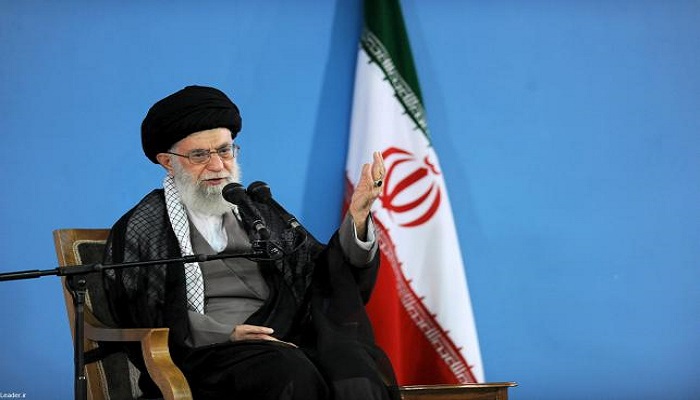
Iran’s Supreme Leader Ayatollah Ali Khamenei gestures as he delivers a speech during a gathering by Iranian forces, in Tehran October 7, 2015. REUTERS/leader.ir/Handout via Reuters

Ali Khamenei, the highest authority in the Iran regime, banned any further negotiations between the regime and the U.S. according to a statement released on his website, firmly putting the brakes to any idea of accommodation or moderation following the approval of a nuclear deal.

“Negotiations with the United States open gates to their economic, cultural, political and security influence. Even during the nuclear negotiations they tried to harm our national interests,” Khamenei was quoted as saying on his website.

Khamenei had previously said there would be no more talks with the U.S. last month, but this move was a step further in declaring an outright ban on any further discussions on any other topics.

The Obama administration, fed a steady stream of misrepresentations and false promises by the Iran lobby – led by the National Iranian American Council – expected a new phase of relaxed, open negotiations with the regime on a variety of issues including the ISIS, the Syrian conflict and sponsorship of terror.

Instead, now that the regime has achieved its goals in the nuclear deal – a lifting of economic and military sanctions, preservation of its nuclear infrastructure, delinking of human rights issues and release of billions in frozen cash – the regime sees no other reason to carry on the façade of moderation it has so assiduously pushed since the handpicked elevation of Hassan Rouhani as regime president.

In his address to Revolutionary Guards Navy commanders, Khamenei said talks with the U.S. brought only disadvantages to Iran.

“Through negotiations Americans seek to influence Iran”, Khamenei was quoted as saying to the IRGC commanders, who are also running much of Iran’s military involvement in Syria.

The bill of goods sold by the Iran lobby for hopes of a release of American hostages, removal of Assad and a reigning in of sectarian violence has now come due as Iranian regime’s leadership seeks to make all those promises false.

Michael Goodwin, a New York Post columnist wrote in Fox News:

“The White House deliberately downplayed the Russian buildup because it undercut central promises Obama made to Congress about the Iran nuke deal, which was then being debated.

“One of those promises was that Russia would help enforce the terms. Instead, Putin actually was making common cause with Iran, and both are now killing the Syrian rebels we supported.

“Here’s the scorecard: Obama got his Iran deal, and the world got a more aggressive Iran, an expanded Syrian war and wider Russian influence. With each passing day, the cost of stopping Putin grows more expensive.”

The yawning chasm between the promises made by the Iran lobby and the reality of what is taking place was discussed in another piece in Foreign Policy by Aaron David Miller and Jason Brodsky in which they write:

“One thing seems pretty clear: Somewhere in a parallel universe far, far away, the logic of a linear path to Iran’s moderation may be alive and well. But back here on planet earth, the odds on the health and prosperity of reform and the reformers, too, are still very long ones indeed.”

But supporters of the regime are still fighting back in trying to hold the line that a force for moderation exists in Iran and is fueled by post-nuclear deal euphoria, rather than the hangover the world is witnessing today.

One of those peddling this snake oil is Kourosh Ziabari who writes in Huffington Post:

“To the detriment of hardliners, Iran is reemerging as a regional power, and it’s easily predictable that with another four years in office plus the two intact years he has in hand – unless Ahmadinejad comes up with a new wizardry and wins the 2017 elections, President Rouhani will be able to build a strong and peace-making Iran which nobody will be able to demonize or depict as a threat to world peace and security.”

Ziabari pushes the Iran lobby message that there exists within Iran “moderate” and hard line” forces when in fact Khamenei has indelibly proven there exists only one voice on all policy matters and it is firmly his.

Even as Iran and Russia join with Hezbollah in launching a new phase in Syria, Iran’s mullahs are busy in other parts of the Middle East, including Yemen, where the Houthi rebels they support have been spotted in Iran getting support and new arms according to Al Arabiya.

The Houthi delegation “will convey to Iranian officials an urgent request by Houthi leader Abdulmalik al-Houthi to attain additional shipments of weapons after the Saudi-led coalition forces made several gains against the militia,” according to the report.

“Before visiting Tehran, the delegation had allegedly visited Beirut where it met with Hezbollah leader Hassan Nasrallah,” according to al Arabiya. “During the visit, the delegation allegedly voiced Abdulmalik’s al-Houthi’s gratitude for Hezbollah’s support in sending military experts to Yemen.”

President Obama’s former national security adviser also warned that Iranian regime leaders have effectively turned Iraq into a “client state” and are bent on exploiting the regional war against ISIS to promote their own brand of Shiite extremism throughout the Middle East.

“Iran’s grand strategy entails consolidating the hold it has gained in Iraq — a grip it seeks to tighten, directly and through proxies — and by stoking the sectarian fires,” said retired Marine Corps Gen. James L. Jones.

Gen. Jones testified alongside former Sen. Joe Lieberman, an independent, and both men lamented the administration’s failure to provide more assistance and refuge to members of the Iranian dissident group — commonly known in Washington as the “MEK” or “PMOI” — who have been left in the lurch in Iraq since the departure of U.S. forces in 2011.

On top of all this, word comes out that cybersecurity researchers have uncovered a network of fake LinkedIn profiles, which they suspect were being used by hackers in Iran to build relationships with potential victims around the world, according to a new report to be published by security firm Dell SecureWorks Inc.

This tactic, known as “social engineering,” is one where hackers trick people to get them to cough up personal or sensitive information. “Having those trust relationships gives [hackers] a platform to do a bunch of different things,” said Tom Finney, a security researcher at Dell Secureworks.

The 25 fake profiles described in the report were connected to more than 200 legitimate LinkedIn profiles — mostly individuals based in the Middle East who worked in sectors like telecom and defense. Those individuals and their companies likely have information that would be of interest to an Iranian cyber group, Dell Secureworks said.

Yes, the post nuclear deal world has indeed brought much change, just not the kind the Iran lobby promised.

By Michael Tomlinson

Filed Under: Blog, The Appeasers Tagged With: #NuclearDeal, Appeasement policy, Featured, Iran, Iran deal, Iran Economy, Iran Lobby, Iran Mullahs, Iran sanctions, Khamenei, NIAC, NIAC Action, Syria, Yemen

  • « Previous Page
  • 1
  • …
  • 45
  • 46
  • 47
  • 48
  • 49
  • …
  • 64
  • Next Page »

National Iranian-American Council (NIAC)

  • Bogus Memberships
  • Survey
  • Lobbying
  • Iranians for International Cooperation
  • Defamation Lawsuit
  • People’s Mojahedin
  • Trita Parsi Biography
  • Parsi/Namazi Lobbying Plan
  • Parsi Links to Namazi & Iranian Regime
  • Namazi, NIAC Ringleader
  • Collaborating with Iran’s Ambassador

Recent Posts

  • NIAC Trying to Gain Influence On U.S. Congress
  • While Iran Lobby Plays Blame Game Iran Goes Nuclear
  • Iran Lobby Jumps on Detention of Iranian Newscaster
  • Bad News for Iran Swamps Iran Lobby
  • Iran Starts Off Year by Banning Instagram

© Copyright 2026 IranLobby.net · All Rights Reserved.