Iran Lobby

Exposing the Activities of the lobbies and appeasers of the Mullah's Dictatorship ruling Iran

  • Home
  • About
  • Current Trend
  • National Iranian-American Council(NIAC)
    • Bogus Memberships
    • Survey
    • Lobbying
    • Iranians for International Cooperation
    • Defamation Lawsuit
    • People’s Mojahedin
    • Trita Parsi Biography
    • Parsi/Namazi Lobbying Plan
    • Parsi Links to Namazi& Iranian Regime
    • Namazi, NIAC Ringleader
    • Collaborating with Iran’s Ambassador
  • The Appeasers
    • Gary Sick
    • Flynt Leverett & Hillary Mann Leverett
    • Baroness Nicholson
  • Blog
  • Links
  • Media Reports

Iranian Regime Human Rights Abuses Go Back to 1980s

August 13, 2016 by admin

Iranian Regime Human Rights Abuses Go Back to 1980s

Iranian Regime Human Rights Abuses Go Back to 1980s

The Iranian revolution brought significant change not only to Iran, but the Middle East, but it was a revolution hijacked by religious mullahs intent on creating a strict theocratic state in which power was solely vested in their rule.

As part of that process in securing its base, the Iranian regime forged a bloody history based on the ruthless suppression of dissent and the cruel imposition of the most severe penalties for anyone that stepped out of line.

This bloody birthright has marked the chief characteristic of the mullahs reign since the 1980s and a bit of that history had some light shed on it when an audio file surfaced in which Hussein Ali Montazeri, the onetime deputy supreme leader for the regime and a leading Shiite cleric, spoke out against the murder of thousands of dissidents that were part of the Mujahedeen-e-Khalq (MEK) resistance group, who had been imprisoned by the regime after the revolution.

Montazeri’s objections led to his political downfall after the estimated 30,000 Iranian dissidents were murdered in one of the largest mass killings since the end of World War II.

Montazeri died in 2009, while the country was in the middle of the post-election uprisings using the presidential election results as an opportunity to come out to the streets and protest the reign of terror and repression of the mullahs. Completely sidelined from the government, he remained a critic until his final days, publishing letters and statements against many government policies and leaders.

Since then, the Iranian regime has cut a bloody swath of death and destruction aimed at the mullahs’ perceived enemies both within and outside Iran.

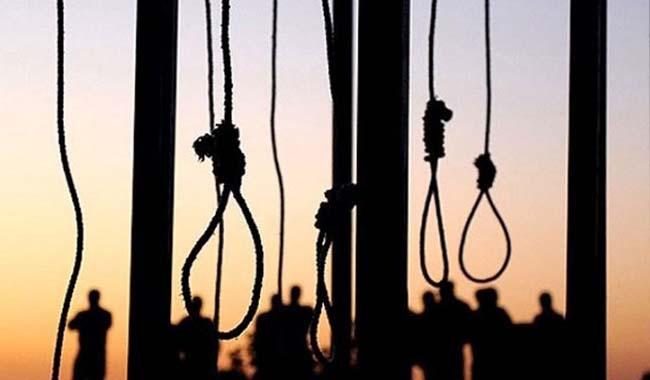
Averaging almost an execution every day in 2016, the regime has quickly moved into first place among all countries in executing people on a per capita basis demonstrating for all the world to see that no matter what Hassan Rouhani has said about a new more “moderate” Iran, the regime remains firmly committed to honoring its bloody heritage.

Rooting out dissent has become a full-time obsession for the regime, which devotes considerable resources to ferreting out any possible contrarian voice, even employing one of the largest networks of cyber hackers to monitor and break into social media and messaging platforms to catch suspected dissenters.

Iranian hackers with suspected ties to the regime penetrated the messenger app Telegram to monitor activists, journalists, and others dissidents, according to cybersecurity researchers.

With the help of an Iranian phone company, the hackers broke into more than a dozen Iranians’ Telegram accounts by intercepting text messages that contained activation codes to link the accounts to new devices, Claudio Guarnieri, an Amnesty International technologist, and Collin Anderson, an independent cybersecurity researcher, told Reuters.

“A majority of what the regime calls counterterrorism activity is not focused on what you imagine — managing threats posed by terrorist groups like the Islamic State,” Michael Smith II, chief operating officer of Kronos Advisory, a defense consulting firm, told The Christian Science Monitor. “Foremost among the regime’s concerns is the preservation of its authority. So ‘counterterrorism’ often refers to managing internal anti-regime activism.”

Amnesty International also announced on Wednesday that dozens of women’s rights activists in Iran were being arrested and interrogated for spurious charges of espionage and trying to overthrow the government.

According to Mediaite, since January, more than a dozen women’s rights activists in Tehran have been summoned for long interrogations by the Revolutionary Guards and threatened with imprisonment on national security-related charges. Many had been involved in a campaign launched in October which called for the increased representation of women in Iran’s recent parliamentary elections.

Women taken in for interrogations have been given no reason for their summonses, but once inside the interrogation room were bombarded with accusations of espionage and collusion with “foreign-based currents seeking the overthrow of the Islamic Republic system”.  Amnesty understands that the Revolutionary Guards subjected the women to verbal abuse, including gender-related slurs. The activists were not allowed to be accompanied by their lawyers during interrogations, which in some cases lasted eight hours.

“It is utterly shameful that the Iranian authorities are treating peaceful activists who seek women’s equal participation in decision-making bodies as enemies of the state. Speaking up for women’s equality is not a crime. We are calling for an immediate end to this heightened harassment and intimidation, which is yet another blow for women’s rights in Iran,” said Magdalena Mughrabi, Interim Deputy Middle East and North Africa Program Director at Amnesty International.

That attitude of mullahs pervades their anointed proxies as groups as such as Hezbollah and the Houthis exhibit the same bloodthirsty calculations to advance their goals. In the case of Iranian regime-backed Houthis rebels in Yemen, they have begun using hospitals as human shields from aerial attacks.

Hostilities in the Yemeni conflict resumed at the weekend following the collapse of peace talks in Kuwait. The talks came after Houthi fighters, who are backed by the regime’s Revolutionary Guards, rejected a U.N.-sponsored peace plan and announced the establishment of a 10-member governing body to run the country.

The revelation that Iranian-backed Houthi rebels are deliberately using civilian institutions for their war effort inevitably will draw comparisons with the tactics used by other extremist Islamist groups.

“It is clear that the tactics used by the Houthis, where they are using places like hospitals for their military campaign, has contributed significantly to the heavy civilian death toll,” said a senior Western official.

If breeding is an indication of future development, then the Iranian regime’s bloody start in the 1980s explains its continued bloody actions today.

By Michael Tomlinson
Filed Under: Blog, News Tagged With: 1988Massacre, Featured, Iran Human rights, Iran Mullahs, mek, Montazeri, Mujahedeen-e-Khalq (MEK)

Iranian Regime Proves Again It Cannot Accept Dissent

August 12, 2016 by admin

Iranian Regime Proves Again It Cannot Accept Dissent

Iranian Regime Proves Again It Cannot Accept Dissent

Abraham Lincoln famously once said on the eve of the Civil War that “a house divided against itself cannot stand.” His sentiment was a prophetic one that has applied not only to the U.S., but to virtually every other country on the planet.

Nation’s split along political, cultural, religious, economic or even tribal lines have always struggled to hold themselves together and in the end must find ways to reconcile their differences if they are to move forward as a nation.

In the modern era, we have seen an unprecedented number of historic conflicts resolve themselves and eventually chose a path of peace, reconciliation and partnership. Nations such as Northern Ireland bridged a religious war between Catholics and Protestants that dated back to the time of Henry the VIII.

South Africa installed Nelson Mandela as its president after confining him to prison for much of his adult life. Even Myanmar eventually ended its military dictatorship to hold free elections and install longtime dissident Aung San Suu Kyi as leader of the new democratically elected government.

Of course there are still some nations that have stubbornly refused to relinquish their grasp of power including North Korea and the Iranian regime, but if history teaches us anything, it is that these kinds of nations are not long for the future. Oppressed people rebel, governments turn to violence to keep the people in line and eventually world opinion shifts to force democratic change.

That process can decade years, even decades, but it eventually does happen, which makes the desperate acts of regimes such as Iran even more interesting as it continues to go after foes from 30 years ago like a dog that can’t let go of an old bone.

In the case of the Iranian regime, its nemesis—in the minds of the mullahs at least—has historically been the U.S. (as the Great Satan) and Iranian opposition and resistance groups such as the Mujahedin-e Khalq (MEK).

The mullahs’ distaste of the MEK runs so deep that membership or association with the organization within Iran often carries long prison terms or even a death sentence. The regime also diverts enormous resources to continually attack MEK members both in a literal sense and political one.

A large number of MEK members, refugees since the Islamic revolution in Iran, live in precarious conditions at a former U.S. military base in Iraq known as Camp Liberty. Their former home at Camp Ashraf was attacked regularly by Iranian agents and Iranian regime-backed Shiite militia and Iraqi military units, and their new location has also been subject of several deadly missile attacks.

The reason being, their presence in close proximity to the Iranian border a constant reminder that a substantial part of the Iranian population vocally and actively oppose the rule of the mullahs.

That presence is so noxious to the mullahs that they periodically engage in propaganda efforts to discredit these dissidents on a regular basis through the Iran lobby, bloggers and social media efforts designed to blame them for everything including spying, sabotage and maybe even global warming.

The more inane claims to come from the Iranian regime included a press release issued through regime-controlled media that claimed the dissident groups were comparable in brutality to ISIS.

The release attempted to draw links between MEK and ISIS through alleged links with Saudi Arabia, which is interesting because of the geopolitical realities the Iranian regime now finds itself.

Saudi Arabia has been a historic opponent to Iran, but since the Iranian regime’s support of Houthi rebels in leading a revolt in Yemen on the Saudi border, the Kingdom has sought to aggressively confront the regime’s expansion, including joining the international coalition against the Assad regime in Syria, which is heavily supported by Iran.

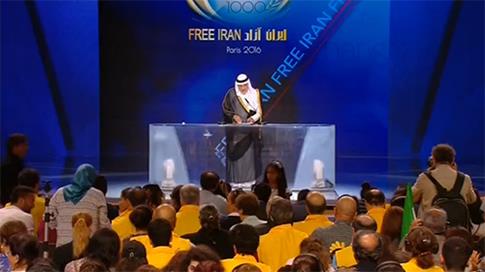
The fact that the Saudi Arabia’s Prince Turki al-Faisal, the former head of Saudi intelligence called for the overthrow of the Islamic Republic at a meeting of the Iranian opposition in Paris. His remarks coupled with recent diplomatic moves signal a new tougher policy toward Iran from Saudi Arabia. Though officially retired from government, no member of the royal family had ever so publicly embraced the Iranian opposition or called for regime change in Tehran.

Turki al-Faisal’s remarks on July 9 were followed on July 30 by a meeting between the head of the National Council of Resistance of Iran, an umbrella group of Iranian dissidents, including the MEK, and the President of the Palestine Authority Mahmoud Abbas in Paris.

Turki al-Faisal’s remarks and the meetings by the MEK with such high level leaders of the Arab world sent the Iranian regime into a mouth-frothing frenzy, which continues to this day.

Iranian regime officials went so far as to accuse Abbas as working together with the CIA, an interesting claim since Iran had previously lauded Abbas and the plight of the Palestinian people at the hands of Israel. Clearly, your utility to the Iranian regime only extends so far in the eyes of the mullahs.

The irony of the attacks the Iranian regime makes against MEK is that it accuses it of being a terrorist organization; a designation that was politically motivated at one point in getting it placed on the U.S. terror list, but corrected with its later removal; a distinction that the Iranian regime has failed to correct for itself.

In fact, the Iranian regime remains the world’s largest supporter of terrorism and continues on a path of proxy wars and harsh oppression at home. The mullahs understand the path of history for regimes like theirs, but they continue to struggle against it.

Eventually history will prove that Iran must succumb to regime change and reconciliation just as surely as Lincoln predicted.

By Michael Tomlinson

Filed Under: Blog, News Tagged With: Featured, Iran Human rights, Iran Mullahs, mek, Mujahedeen-e-Khalq, Mujahedin-e Khalq (MEK), Turki al-Faisal

The Disconnect Between Iran Lobby Priorities and Reality

August 9, 2016 by admin


The Disconnect Between Iran Lobby Priorities and Reality

The Disconnect Between Iran Lobby Priorities and Reality

Money makes the world go around

The world go around

The world go around

Money makes the world go around

It makes the world go ’round.


A mark, a yen, a buck, or a pound

A buck or a pound

A buck or a pound

Is all that makes the world go around,

That clinking clanking sound

Can make the world go ’round.


These are lyrics from the 1972 Academy Award-winning movie “Cabaret” which depicted the last final days of freedom in the Weimar Republic of Germany in 1931 during the rise of the Nazi Party.

The tune entitled “Money, Money” is sung by the cabaret’s emcee as a narrative about the pervasive influence of money and the desperate pursuit of it.

The movie was also noteworthy because of its depiction of issues such as homosexuality and hedonistic club life, as well as the virulence of anti-Semitism and even abortion. It was a movie widely considered to be one of the best 100 movies of all time.

The show tune is appropriate though for our world today and is still powerfully relevant as we consider the current priorities of the Iran lobby and its most conspicuous leaders such as the National Iranian American Council (NIAC).

It also helps illustrate the wide disparity between the priorities of the Iran lobby and the most pressing issues surrounding the Iranian regime today. If we examine the public statements and recent policy memos issued by the NIAC especially this week, we would assume that the most pressing issues confronting the U.S. and Iranian regime is how to get the mullahs more money.

At the top of NIAC’s legislative priorities is to prevent renewal of the Iran Sanctions Act of 1996 (ISA) which is up for consideration by Congress before the end of this year and along with it, the tacit lifting of all remaining restrictions and sanctions against the Iranian regime.

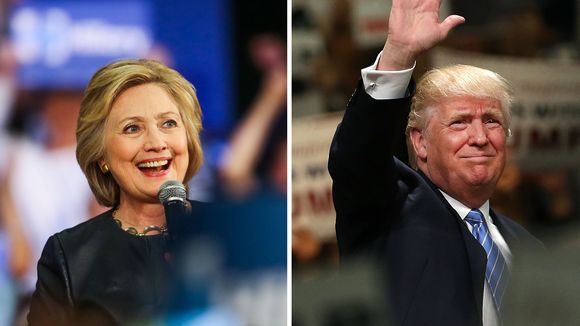
The impetus for the legislative push by NIAC and other Iran lobby allies is recognition that the upcoming presidential election is likely to bring significant changes in the U.S. foreign policy approach to the Iranian regime no matter who wins, be it Hillary Clinton or Donald Trump, because an incoming administration is likely to gain political capital by taking an aggressive stand against Iran, especially in light of the global deterioration of stability with terrorism and proxy wars on the rise.

To that end, the NIAC has been busy churning out policy papers arguing not only against renewing the ISA, but also the lifting of all remaining sanctions, especially prohibitions against the regime’s access to U.S. currency exchanges and the reluctance of foreign banks to handle Iranian regime transactions for fear of running afoul sanctions still in place pertaining to Iran’s human rights abuses and support for terrorism.

Interestingly, one policy paper authored by Ryan Costello of NIAC, argued that expiration of the ISA would still allow the president the ability to re-impose the same sanctions, but he neglects to mention the real reason the mullahs wish to shift authority away from Congressional legislation and onto the president: President Obama has demonstrated with his policies of appeasement the value to the mullahs of a president willing to accommodate their wishes and avoid the messy spectacle of a Congressional hearing and floor debate which would almost certainly go against them on almost any issue given the current climate.

More importantly, by trying to sell the idea that a new president could re-impose sanctions at will, ignores the most obvious flip side of that proposition, which is that the same president could choose to ignore Iran’s conduct and not impose sanctions that might otherwise be forced by a renewed ISA.

The NIAC and its allies in the Iran lobby are counting on their ability to duplicate last year’s “echo chamber” to apply political pressure on a new administration to keep the Iranian regime off the sanctions hit list.

Another policy memo authored by Tyler Cullis of NIAC, goes even further to make the explicit link between the need to lift all sanctions and the potential for the nuclear agreement with Iran—the  Joint Comprehensive Plan of Action (JCPOA)—to fail.

What Cullis and the NIAC fail to admit is that the limits of the JCPOA stop at the issue of human rights violations and support for terrorism; issues that the regime stridently wanted to be de-linked from the nuclear negotiations for fear that they would bring down any hope of a deal and the lifting of economic sanctions that had succeeded in crippling the Iranian economy and weakened the mullahs grip on power.

Cullis’ conclusion reveals the true goals of the Iran lobby when he writes:

“Despite the formal lifting of U.S. nuclear-related sanctions, implementation of U.S. obligations under the JCPOA has not proceeded altogether smoothly. In order to safeguard the decades-long restrictions on Iran’s nuclear program, the U.S. must faithfully observe its JCPOA sanctions-related obligations in full. To do so, though, there must be a common understanding as to the full scope of those U.S. sanctions-related commitments.”

It is a bizarre statement to make since it places the burden solely on U.S. actions and speaks of nothing in regards to growing Iranian regime’s recalcitrance and militant stances; nor takes into account the abysmal state of human rights in Iran.

That situation has grown appallingly worse as the regime has moved aggressively to execute citizens at a fast and monstrous clip, including the mass execution of 25 Sunni Muslims it accuses of “enmity against God,” which earned the regime a blistering condemnation from Human Rights Watch and other human rights groups.

“Iran’s mass execution of prisoners on August 2 at Rajai Shahr prison is a shameful low point in its human rights record,” said Middle East director at Human Rights Watch. “With at least 230 executions since January 1, Iran is yet again the regional leader in executions but a laggard in implementing the so far illusory penal code reforms meant to bridge the gap with international standards.”

Two lawyers who represented some of the men told Human Rights Watch that their clients did not get a fair trial and that their due process rights had been violated.

Ultimately, while the Iran lobby fights to fill the Iranian regime’s coffers, we have to ask why it doesn’t also fight to save Iranian lives.

Indeed, money does make the world go round.

By Michael Tomlinson

Filed Under: Blog, Current Trend, News Tagged With: #NuclearDeal, Appeasement policy, Featured, Iran deal, Iran Human rights, Iran Lobby, Iran Mullahs, Iran sanctions, National Iranian American Council, NIAC Action, Ryan Costello, Tyler Cullis

Why the Iran Regime Needs ISIS

July 28, 2016 by admin

Why the Iran Regime Needs ISIS

Why the Iran Regime Needs ISIS

Rev. Jacques Hamel was an 85-year old priest shepherding a flock in a small church in Normandy, France. He was celebrating Mass when two dedicated followers of the terrorist group ISIS stormed in, made him kneel at the altar and then slit his throat in front of two shocked parishioners and two nuns who then heard a sermon from the killers.

ISIS claimed responsibility for the attack and fulfilled its long-standing vow to bring a war against Christians and the Catholic Church by killing a priest in the sanctity of a church.

“They forced him to his knees and obviously he wanted to defend himself and that’s when the drama began,” said one nun, who identified herself as Sister Danielle, The Guardian reported. “They were filming themselves preaching in Arabic in front of the altar. It was a horror.”

The attack comes amid a spate of terror strikes in France, including Tunisian Mohamed Lahouaiej Bouhlel’s truck rampage in Nice on July 14, when he plowed into a crowd of Bastille Day revelers – killing 84 and wounded over 300.

For two years, the black-clad jihadist army has called for attacks on Christians in Rome, throughout Europe and across the world. It has even called for the assassination of Pope Francis. The attack — which the knife-wielding ISIS killers reportedly videotaped — in the northern French town of Saint-Etienne-du-Rouvray shows Islamist killers have heeded the call.

“The Islamic State is persistently demoralizing European unity by launching divisive attacks within its borders — the most recent attack on the Catholic Church aims directly at the French sense of identity,” said Veryan Khan, editorial director for the U.S.-based Terrorism Research & Analysis Consortium.

Over the weekend, ISIS Twitter accounts called for more operatives to take up arms in France and carry out additional deadly attacks, according to an analyst with the U.S. based company GiPEC.

ISIS warned that London and Washington DC are next on the list of target cities, with images threatening major world capitals being posted online.

With a secure base of operations extending from Syria to northern Iraq, ISIS can continue to recruit young extremists, engineer the return of fighters to their home countries and supply arms, cash and documents to move terrorists around the world.

The inability to crush ISIS in Syria and Iraq has been largely the result of the almost-never ending wars brought about by Iranian intervention in both countries. It has been well-known that Iran’s last minute support for the Assad regime kept it from falling during the Arab spring protests.

The decision by Iranian commanders to target not extremist Islamic groups, but instead go after Western-funded and backed rebels, was a key step towards freeing militants to expand their ranks. Iranian regime’s manipulation of the administration of former Iraqi prime minister Nouri al-Maliki was the defining blow though in driving out Sunnis from a coalition government straight into the arms of ISIS and leading to the downfall of Mosul, the most important victory for the terror group.

The cold calculation of the mullahs in Tehran explains why the regime did not go after ISIS and why ISIS has so far largely left Iranian interests and its citizens alone and untouched.

For the mullahs ruling Iran, the mere existence of ISIS and its sheer brutality provides a usual counterweight to attacks on its own human rights record and support for terrorism such as its long-standing partner Hezbollah. As ISIS ratchets up the severity, frequency and brutality of its attacks, Iranian regime’s conduct begins to pale in the opinions of media and governments.

Imagine a wife beating, rapist living on your block. You would be rightly worried about him, but instead a notorious serial killer moves into the neighborhood and starts slaughtering people. Who would you be more concerned about?

It’s a sleight of hand trick that gives the mullahs freedom to operate and gain some political cover for their abuses. If the world protests the arrests of dual-national citizens by Iran, don’t worry, there’s an ISIS attack on a church.

These efforts at deception have been part and parcel part of the tools the mullahs use to distract attention. They used it to great effect during the negotiations for the nuclear talks by pointing to the Syrian conflict’s start and how a more “moderate” Iran could help ease tensions there; never mind Iran started it all in the first place.

It is also why Iranian regime has done little to actually combat ISIS. Even with the enlistment of Russia to fight in Syria alongside Iran, the targeting list for Russian warplanes includes American-backed militias and not ISIS units.

Now that the regime has set the date for its next presidential election for May 2017, you can be assured the mullahs will use ISIS to demonstrate their commitment to helping combat terrorism, while continuing its own sponsorship of terror.

Predictably the media, with the help of the Iran lobby, was pedaling the notion that the election represents a battle between “moderates” vs. “hardliners.” If the past three years under Hassan Rouhani have taught us anything, it is that there are no real moderates within the Iranian regime.

Anyone espousing a dissenting view has either been put in prison or sent to the gallows to be hung. It’s a tidy way to clear your ballot of any dissenting views.

By Michael Tomlinson

Filed Under: Blog, News Tagged With: Featured, hassan rouhani, Iran, Iran Lobby, Iran Mullahs, Iran Terrorism, IRGC

Clinton and Trump Must Face Dealing with Iran

July 23, 2016 by admin


Clinton and Trump Must Face Dealing with Iran

Clinton and Trump Must Face Dealing with Iran

The Republican National Convention is going on in Cleveland where Donald Trump will become the nominee for the Republican Party. Hillary Clinton will follow suit in Philadelphia and then another season of American politicking will launch into its usual fall fury.

This election year though is different from any other in that the U.S. and the rest of the world are confronted by a problem it has never seen before and that is the rise and spread of Islamic extremism and the terror being perpetuated by organizations such as Hezbollah and ISIS, but also aided by nation states such as the Iranian and Syrian regimes.

Through the use of the internet and social media, extremist groups are now able to preach their hatred around the world and manipulate individuals to commit heinous acts, as well as coordinate terror cells in a playbook that has already been proven time and again from Sydney and Ottawa to Boston and San Bernardino to Paris and Bangladesh.

That makes the problem of dealing with terror not so much a law enforcement exercise of going after specific individuals, but rather a geopolitical strategic exercise in battling an ideology. This makes the problem facing the next president all the more daunting because the battlefront is in trying to kill an idea instead of just using a Predator drone to fire a missile at a terrorist leader.

This also helps frame a better understanding of the role the Iranian regime plays in the spread of global terrorism.

Iran remains on the U.S. State Department list of nations that is a state-sponsor of terror; a list that has ironically shrunk over the years as the Cold War ended much of the friction that occurred between the U.S. versus the old Soviet empire and each respective client states.

Instead, we are left with a world of unaligned rogue nations such as Iran and North Korea, and nations that have fallen apart to such a degree that terrorist organizations operate essentially freely such as Somalia, Syria and to a lesser degree now Libya.

The rise of Al-Qaeda and ISIS into essentially nation-state status illustrates the fundamentally changed nature of the world we live in and it is a world that could not happen unless countries such as Iran under the mullahs have provided support, cash, expertise and political cover for those rogue entities.

When Al-Qaeda was driven from Afghanistan after the U.S. invasion, many of its key leaders were granted refuge in Iran by the mullahs in Tehran. The mullahs also provided support to Shiite militias backed by Iran fighting U.S. troops in Iraq, killing many with Iranian-manufactured explosive devices.

When Syria’s Assad regime was on the brink of collapse, the Iranian regime stepped in with Quds Force fighters, Hezbollah terrorists, Afghan mercenaries recruited from refugees in Iran, billions of dollars in cash support and arms and ammunition.

Staving off Syria’s governmental collapse allowed Islamic extremist groups to flourish in the carnage of that war as Iran targeted Western-backed moderate rebel groups and left terror groups such as ISIS to spring forth and take root.

Iran did as much as anyone to pump ISIS up with the collapse of the Iraqi government of Nouri al-Maliki which drive disaffected Sunni tribes into the arms of ISIS and opened the door for the fall of Mosul and the rich oilfields in the north which have sustained ISIS with millions of dollars in illicit oil revenues a day.

These are all facts that the Iran lobby have mightily sought to deflect and hide from scrutiny. Groups such as the National Iranian American Council have concocted straw man issues out of immigration visas and banking transactions while ignoring the much more significant problems of human rights violations and the incredible suffering being caused by Iranian regime’s policies.

Iranian regime itself has publicly and aggressive announced its intentions for the all the world to see, most notably in flouting a nuclear agreement which was dead on arrival a year ago.

Even the regime’s foreign minister, Javad Zarif, who pulled this pathetic deal from the arms of a compliant and submissive Obama administration, boasted yesterday of Iran’s ability to bring its nuclear program back on track to producing literally tons of enriched uranium quickly as the deal eases off more quickly than the advertised 15 years promised.

Zarif said a document, submitted by Iran to the International Atomic Energy Agency and outlining plans to expand Iran’s uranium enrichment program, is a “matter of pride.”

The absurdity of the contention that Iran is abiding by the nuclear deal was on display when the United Nations issued a 17-page report that pointed out Iran may be abiding by the letter of the agreement, but not the spirit of it.

No greater understatement in diplomacy has been uttered since Neville Chamberlain claimed “peace in our time” after meeting with Adolf Hitler in Munich.

The report did have the common sense to point out the destabilizing nature of Iran’s recent test launches of ballistic missiles capable of carrying nuclear warheads and its illicit supplying of arms to Yemen and Iraq in those proxy wars.

Those understated concerns were too little and too late to offset the deaths and violence escalating around the world as Islamic extremist terrorist acts are now becoming the norm rather than the exception.

The fuel for that extremism comes from an Iranian regime that commits such cruel acts of barbarism as to set a bar that ISIS seems compelled to match and exceed with each new act of bloodshed.

Amnesty International took Iran to task with a new report on the denial of medical care to Iran’s numerous political prisoners; a reprehensible situation revealed broadly by Americans taken prisoner by Iran such as Christian pastor Saeed Abedini and former U.S. Marine Amir Hekmati.

The report, Health taken hostage: Cruel denial of medical care in Iran’s prisons, provides a grim snapshot of health care in the country’s prisons. It presents strong evidence that the judiciary, in particular the Office of the Prosecutor, and prison administrations deliberately prevent access to adequate medical care, in many cases as an intentional act of cruelty intended to intimidate, punish or humiliate political prisoners, or to extract forced “confessions” or statements of “repentance” from them.

“In Iran a prisoner’s health is routinely taken hostage by the authorities, who recklessly ignore the medical needs of those in custody. Denying medical care to political prisoners is cruel and utterly indefensible,” said Philip Luther, Director of Amnesty International’s Middle East and North Africa Program.

“Prisoners’ access to health care is a right enshrined in both international and Iranian law. When depriving a prisoner of medical care causes severe pain or suffering and it is intentionally done for purposes such as punishment, intimidation or to extract a forced ‘confession’, it constitutes torture.”

Iran sets the template and ISIS follows and unless Donald Trump or Hillary Clinton deal first and foremost with the behavior of the Iranian regime, its actions will never to checked and altered.

By Michael Tomlinson

Filed Under: Blog, News Tagged With: Featured, Iran deal, Iran Human rights, Iran Lobby, Iran Mullahs, Iran Terrorism, zarif

Different Day Same Outcome as Iran Arrests Another American

July 22, 2016 by admin

Different Day Same Outcome as Iran Arrests Another American

Different Day Same Outcome as Iran Arrests Another American

It feels like the summer version of Groundhog Day as the U.S. State Department said it was looking into reports that another American has been detained by the Iranian regime.

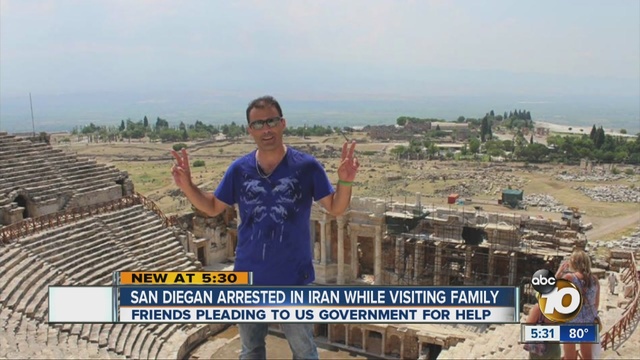
According to the San Francisco Chronicle, State Department spokesman John Kirby would not comment further Thursday on the detention of Robin Shahini. The girlfriend of the San Diego man said Shahini’s sister told her Iranian authorities took him into custody July 11 while he was visiting family in his native Iran and he has not been heard from since.

The girlfriend asked not to be identified because she has family in Iran and fears for their safety. She said she worries Shahini was detained because of his online comments criticizing Iran’s human rights record.

It’s getting to the point that if you want to get arrested all you have to do is post a tweet criticizing Iran’s human rights record and then wait for the knock on the door by the Revolutionary Guards.

The Chronicle noted that the Revolutionary Guard has increasingly targeted those with Western ties since the nuclear deal in which Iran agreed to limit its uranium enrichment in exchange for the lifting of sanctions.

Shahini, 46, graduated in May from San Diego State University with a degree in International Security and Conflict Resolution. He had been accepted to SDSU’s graduate program in Homeland Security.

The Chronicle said His girlfriend said he left for Iran on May 25 to see his mother who was diagnosed with Alzheimer’s. The girlfriend said she communicated with Shahini on July 10 and was expecting to hear back the next day to help him get his paperwork into the university. She grew concerned after not hearing from him.

She eventually reached his family who told him Iranian intelligence officials came to their home in Gordon, Iran, and took him away. Authorities searched the home and took his personal belongings, she said. The family has not talked or seen him since. He had a plane ticket to return to San Diego on July 25 and had planned to start classes on Aug. 22, the girlfriend said.

The day Shahini’s family says he was detained on July 11, Iran announced the indictments of a Lebanese man and three dual nationals. The four were arrested in connection with separate cases over the past year. Family members and representatives of the four say they did nothing wrong. All four have ties to Britain, Canada and the United States. The charges they face remain unclear.

The recipe for getting these prisoners of other nations released from Iranian prison often relies more on public pressure than diplomacy according to human rights groups.

“Fortunately, all the cases of Americans we’ve worked on were eventually resolved, but only after a great deal of public pressure was put on Iranian authorities,” said Elise Auerbach, Amnesty International USA’s Iran specialist.  “Very often the authorities will tell prisoners and their families to just be quiet and not go public and all will go well, but the opposite is true.”

The much-ballyhooed prisoner swap of five Americans in the wake of the Iran nuclear deal set the stage for the mullahs in Tehran to believe they can snatch up innocent citizens and hold them as bargaining chips later.

That policy of appeasing the regime has led to a veritable avalanche of arrests of foreigners who hold dual citizenship, which the regime has proclaimed not to recognize. Once a regime subject, always a regime subject no matter what passport you hold it seems the mullahs are saying.

The practice is getting so out of hand that the British Foreign Office issued a travel advisory for Iran warning its citizens, especially any with dual Iranian nationality, of the risk of being scooped up and arrested.

According to the Guardian, the British government relaxed its advice against all but essential travel to Iran in July 2015 after the landmark nuclear agreement. But a stalemate over the fate of at least two British-Iranians currently detained in Tehran appears to have led the FCO to amend its instructions, although it has not raised concerns to the same level as before the nuclear deal.

“British nationals – including dual British/Iranian nationals – face greater risks than nationals of many other countries,” reads the new advice, which was updated on Friday. “The security forces may be suspicious of people with British connections. The risks are likely to be higher for independent travellers or students than for people travelling as part of an organised tour or business people invited by the Iranian authorities or companies.”

The warning will be bad news for Iran as it struggles to strengthen economic ties with the UK and attract more foreign tourists. The ongoing detentions of Nazanin Zaghari-Ratcliffe, a British-Iranian woman held since April, and 76-year-old businessman Kamal Foroughi, a dual national in prison since May 2011, have undermined efforts by London and Tehran to improve relations.

In Why Does Iran Keep Taking American Hostages?, published in the September 2015 issue of The Tower Magazine, Iran expert Ali Alfoneh described the regime’s detainment of foreign and dual-nationals as “a perfectly normal procedure and political practice in the Islamic Republic. That has been the case since the first day of the revolution and continues until today.”

The public outcry over the regime’s hostage taking erupted into Canada as Lawyers Without Borders Canada and Quebec’s Bar association called on Iran’s government to make public its case against Homa Hoodfar, the Iranian-Canadian academic currently imprisoned in Tehran’s notorious Evin Prison on unknown charges.

Hoodfar was first arrested in March by the counter-intelligence unit of the Iranian Revolutionary Guards. They told her she could not leave Iran to return to Canada.

Over the next two months, relatives say she was interrogated without a lawyer and then summoned to the prosecutor’s office at Evin prison where she was allowed to post bond and was released on bail.

She was then re-arrested on June 6 and charges against her have now been filed, but Tehran prosecutor Abbas Jafari Dowlatabadi has not detailed the charges she faces.

“The failure to reveal the charges against professor Hoodfar, the limits and constraints that seem to be imposed on her attorney, the lack of clarity surrounding the case, and the treatment professor Hoodfar has received to date bring back dark memories for Canadians and raise serious questions regarding compliance with Iranian law and international law applicable to Iran,” Pascal Paradis, executive director of Lawyers Without Borders Canada, said in a statement.

“Like any other Iranian citizen, professor Hoodfar has the right to full answer and defense under the International Covenant on Civil and Political Rights, to which Iran has been a party since 1975”, he added.

Predictably, the Iran lobby, most notably the National Iranian American Council and other regime apologists, were silent on this latest round of hostage taking.

Hopefully public pressure and growing awareness that the Iranian regime hasn’t changed one bit since the nuclear deal agreement will prevent this Groundhog Day from repeating itself anymore.

By Michael Tomlinson

Filed Under: Blog, News Tagged With: Featured, Iran, Iran deal, Iran Human rights, Iran Lobby, Iran Mullahs, National Iranian American Council

Iran Regime Sets Sights on Canada and Cash

June 10, 2016 by admin

Iran Regime Sets Sights on Canada and Cash

Iran Regime Sets Sights on Canada and Cash

Incoming Canadian Prime Minister Justin Trudeau had expressed the hopes of improving relations with the Iranian regime, but those hopes are quickly running into the reality of the brutal policies and actions of the mullahs in Tehran.

Trudeau and Canada are learning the lessons from the Iranian regime playbook, much as the U.S. has had to learn the hard way, including the illegal abduction of its citizens. In this case, the plight of 65-year old Homa Hoodfar has placed Canada in the gun sights of the regime.

The university anthropologist was arrested by the regime this past weekend and thrown into Evin prison without charge. It was the second time she was arrested since arriving in Iran several months ago to do research work.

The regime accused Hoodfar, who holds both Canadian and Iranian passports, of “co-operating with a foreign state against the Islamic Republic of Iran.” A generic catch-all phrase the regime uses whenever it scoops up a dual-citizen like fish in a net. More often than not, the arrest is aimed at another agenda item for the mullahs.

In the case of several Americans held by Iran, Jason Rezaian, Amir Hekmati and Saeed Abedini, it was to serve as pawns to swap in a prisoner exchange in order to gain the release of suspected and convicted Iranian regime arms smugglers.

Shortly after Hoodfar’s family went public with her arrest and expressed concerns over health, the Iranian regime officials called out the Canadian government for failing to extradite an Iranian banker who settled in Toronto for what they call was his involvement in an embezzlement scheme.

The regime’s justice minister, Mostafa Pourmohammadi, was reported in a semi-official news agency report as saying that Canada was ignoring Iranian demands to extradite Mahmmoud Reza Khavari.

The report, which appeared Wednesday from the Fars News Agency, says Pourmohammadi told reporters in Tehran that Canada “is not committed and has not rendered any co-operation” with its extradition request.

The Canadian branch of human rights group Amnesty International announced Thursday it would take up Hoodfar’s case and called on Ottawa to pressure Iran for her release.

“The arrest of respected and accomplished scholar, Dr. Homa Hoodfar, is the latest attempt by the Iranian authorities at targeting individuals, including academics, for the peaceful exercise of their rights to freedom of expression and association.” said Alex Neve, secretary general of Amnesty International Canada.

“It is deeply troubling that someone whose research focuses on addressing women’s inequality can find herself arbitrarily arrested and held, possibly in solitary confinement, without access to a lawyer and her family.”

The family said it was unclear why Hoodfar had been arrested and that she had been “conducting historical and ethnographic research on women’s public role.”

Analysts say the recent arrest of Hoodfar and others seems to be part of a concentrated effort by the regime to pressure dual citizens. In recent months, the unit that arrested Hoodfar has questioned dozens of people with two nationalities and arrested several.

Among the current prisoners of the regime include:

  • Nazanin Zaghari-Ratcliffe, a British-Iranian employee of Thomson Reuters, was separated from her young daughter in April and taken to a prison in Kerman, in southern Iran. Another British-Iranian citizen, a businessman named Kamal Foroughi, was also arrested; and
  • Nizar Zakka, Lebanese information technology expert who has legal permanent residency in the United States.

But the turbulence between Iran and Canada also extended into a contentious court case in which the regime lost a key battle when an Ontario judge ordered the regime’s non-diplomatic assets in Canada to be handed over to the victims of terrorist attacks by groups sponsored and supported by the Iranian regime.

“As Canada seeks to re-engage Iran it is critical that Iran continue to be held to account in Canadian courts for its terrorism and human rights abuses,” said Danny Eisen of the Canadian Coalition Against Terror, which represents victims and lobbied for a 2012 law allowing victims to collect damages from state sponsors of terrorism.

The only states designated sponsors of terror by Canada are Iran and Syria.

What Canada is experiencing though is par for the course for how the regime acts and intimidates nations. Just like the Iran lobby, the regime pushes out a message of moderation when in reality it is gearing up for policies of extortion, political blackmail and terrorist actions.

Policies of appeasing the regime have done little to actually effect change and only encourage the regime to be more aggressive. The classic example of that is the regime’s continued test firing of illegal ballistic missiles and the tepid response by the world community.

Alireza Jafarzadeh, Deputy Director of the Washington office of the National Council of Resistance of Iran, made a persuasive argument in an editorial in The Hill.

“The current U.S. policy toward Iran threatens to enable the regime’s behavior by channeling money into the hands of the individuals and institutions associated with the Iranian Revolutionary Guard Corps and the unaccountable foundations, who still exert the greatest influence on Iranian foreign policy,” he writes.

“With U.S. presidential elections just around the corner, there is good reason to hope that this policy will come to an end. But every influential person in Washington who recognizes the danger posed by Iran’s ballistic missile program must help to make sure not only that change is guaranteed, but also that it will lead to an alternative policy that specifically constrains the power of the IRGC and similar entities,” he adds.

The experience Canada is having is another reminder that the world should not be trusting the messages of moderation coming out of Iran and its lobby, but rather should only be judged on its actions.

By Laura Carnahan

Filed Under: Blog, News Tagged With: Featured, Iran, Iran deal, Iran Human rights, Iran Lobby, Iran Mullahs, Irandeal, Moderate Mullahs, Rouhani

Human Rights Worsen in Iran and so Does Accountability

May 5, 2016 by admin


Human Rights Worsen in Iran and so Does Accountability

Human Rights Worsen in Iran and so Does Accountability

What price is the Iranian regime willing to pay to achieve its goals such as keeping the Assad regime firmly in power in Syria?

It has been willing to funnel billions of dollars in hard currency to keep Assad afloat.

It has been willing to order its Hezbollah proxy to send fighters there.

It has been willing to recruit Afghan refugees to fight as mercenaries, even threaten to deport their family members back to Afghanistan if they refused to fight in Syria.

It has been willing to send in its own Quds Force members and now even its regular army soldiers to fight and die and celebrate their martyrdom.

It has even been willing to recruit Russia to fight alongside its forces to target Western-backed rebels, including the deliberate targeting of civilians and relief agencies.

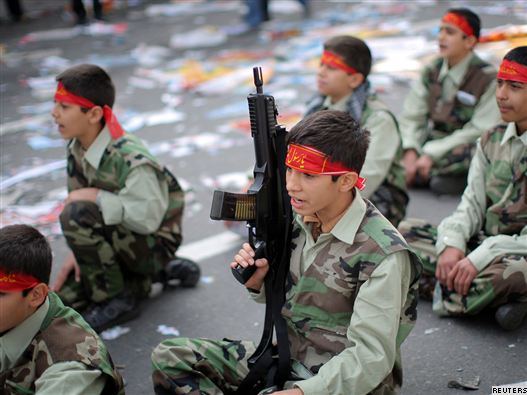
Now to top it all off, the Iranian regime has released a slick music video made by the Basij militia recruiting children to fight in Syria as well in a clear demonstration of how desperate the mullahs in Tehran have become to protect their partner in crime.

The lyrics, as translated by the National Council of Resistance of Iran, a leading dissident group, say:

“On my leader [Ayatollah Khamenei’s] orders I am ready to give my life.

The goal is not just to free Iraq and Syria;

My path is through the sacred shrine [in Syria], but my goal is to reach Jerusalem.

… I don’t regret parting from my country;

In this just path I am wearing my martyrdom shroud.”

Michael J. Totten, writing in World Affairs Journal, explained the regime’s past history of using children for war.

“Iran’s regime has done this before. During the Iran-Iraq War, which killed around a million people between 1980 and 1988, the Basij recruited thousands of children to clear minefields.

“After lengthy cult-like brainwashing sessions, the poor kids placed plastic keys around their necks, symbolizing martyrs’ permission to enter paradise, and ran ahead of Iranian ground troops and tanks to remove Iraqi mines by detonating them with their feet and blowing their small bodies to pieces,” he writes.

The Iranian government desperately needs the Assad regime in Damascus and the Abadi government in Iraq because they’re Iran’s only allies in the entire Arab world. A moderate and democratic Iran would have no trouble forging normal and friendly relations with moderate Arabs governments like Jordan’s, Tunisia’s, Morocco’s and possibly even Egypt’s, but the revolutionary state that’s been entrenched there since 1979 isn’t tolerated any better in capitals like Cairo and Riyadh than it is in Tel Aviv and Jerusalem, he added.

More than 280 Iranian troops have been killed in Syria since September of last year, according to an analysis by the Levantine Group of casualties reported by Iranian media.

The willingness to sustain such a heavy rate of losses is evidence of Tehran’s commitment to the Assad regime, but also seems to show that Iran is counting on its forces to stand in for what the Levantine Group describes as a “decomposing” regime army.

“Iranian operatives are not mere military advisers spread out along regime lines,” said geopolitical and security analyst Michael Horowitz.

The use of Afghan refugees as cannon fodder in Syria highlights the plight of these refugees who sought to escape violence in Afghanistan only to experience violence in Iran as shown by the brutal and ghastly rape and murder of a six-year old Afghan girl.

Her case could have disappeared in the Iranian regime’s court system — Afghan migrants, who number about two million, often face discrimination by the mullah’s judiciary and other institutions.

Instead, her death provoked a social media storm, with an online outpouring of grief and a show of solidarity with Afghan migrants. A vigil for the murdered child was organized via Telegram, a popular messaging app in Iran, and eventually the judiciary was forced to fast-track her case; finally succumbing to intense pressure to act in this particular case where so many others had been previously ignored.

There are other small slivers of hope as another successful social media campaign is helping a detainee of the notorious Evin Prison.

Omid Kokabee, an Iranian physicist associated with the University of Texas, has been in the jail since being arrested on charges of espionage in 2011. He is currently suffering from kidney cancer, and Iranians blame the regime for delaying treatment two years ago that could have helped prevent its spread.

A #freeomid Twitter campaign has prompted a response from Gholam-Hossein Mohseni-Ejei, a hardline spokesman of the judiciary who has denied any failure on the part of the authorities but said the prisoner’s 10-year sentence could be reconsidered depending on his medical condition.

We can only hope that more social media campaigns can lead to activism and pressure to bring about a fundamental change to the Iranian regime, which is what the mullahs ruling Iran are fearing from. An overwhelming majority of young and discontent Iranians who have lived under the iron fist and are now using every opportunity to revolt against the ruling theocracy.

By Michael Tomlinson

Filed Under: Blog, News Tagged With: Featured, Iran, Iran Human rights, Iran Mullahs

Iran Lobby Starts Blame Game for Failed Nuclear Agreement

April 26, 2016 by admin

Iran Lobby Starts Blame Game for Failed Nuclear Agreement

Iran Lobby Starts Blame Game for Failed Nuclear Agreement

The Iran lobby is at it once again. The various supporters, apologists and columnists that make up the spider web of support for the mullahs in Tehran is now spinning away a tale blaming the U.S. for the current failure of the nuclear deal only reached last year.

The twisted logic being espoused by faithful regime supporters such as Paul R. Pillar and Tyler Cullis is that the U.S. is not fulfilling its end of the bargain by allowing the Iranian regime unfettered access to U.S. currency markets and promising not to go after any foreign entity that moves forward to do business with Iran for violations of sanctions and restrictions on U.S. currency.

The reek of the arguments being made by these regime supporters is about as foul as the stench coming off a landfill and just as pleasant to experience.

Writing in the National Interest, Pillar tries to make the inane argument that U.S. sanctions are the chief impediment to successfully implementing the nuclear deal.

“The extensive and complicated U.S.-imposed sanctions are still the chief impediment to implementation, thus continuing to demonstrate how U.S. sanctions can actually reduce U.S. influence,” Pillar writes.

“When the complicated and cumbersome U.S. sanctions scare European banks away from making possible the kind of renewed trade with Iran that the European allies understood to be an intended consequence of the agreement, this presents a problem of U.S. credibility not only with Iran but with the Europeans. Talk among JCPOA opponents on Capitol Hill about imposing still more sanctions on Iran, in the name of whatever cause, damages U.S. credibility even further,” he adds.

What Pillar neglects to mention is that the history of U.S. sanctions on Iran has been a cumulative process, each added as Iran commits another transgression or gross violation of human rights or international law. Sanctions did not appear magically in one fell swoop, they occurred over years of Iranian provocations.

Pillar also tries to posit the theory that U.S. credibility is on the line and it is, just not the way he is proposing. Since the nuclear deal was agreed to, the Iranian regime has made a mockery of compliance by pushing the boundaries in other areas such as launching ballistic missiles, widening the wars in Syria and Yemen, detaining and parading U.S. sailors and rigging elections to eliminate virtually all other condidates.

Of course Pillar cannot cite these since it would undermine his arguments and only serve as a reminder as to why U.S. sanctions have not all fallen completely away. He also neglects to mention that many sanctions, including those related to access to U.S. currency exchanges by Iran were never part of the nuclear agreement since they were put in place after human rights violations and sponsorship of terrorism incidents.

The fact that the Iran lobby and regime argued so strenuously against linking related issues to the nuclear agreement such as development of ballistic missiles and human rights to the nuclear deal now works against them in arguing that all sanctions need to be lifted.

The credibility of the U.S. would indeed be on the line if it lifted these restrictions in order to appease an Iranian regime that sees no reason to curtail its military and terrorism activities. The rest of the civilized world would come to realize that no one would stand in the way of the militancy of the mullahs of Tehran.

Tyler Cullis if the National Iranian American Council, another long-time supporter of the regime, makes a similar irrational argument in the regime-sympathetic blog Lobelog.com and echoes the party line Pillar is pushing almost word for word.

“Iran’s ballistic missile program is not a serious threat. Without any real offensive capabilities, the program is second-rate and possesses only deterrent value. Surely, when compared to the current problems in the region, Iran’s ballistic missile program ranks low as a factor playing into the ongoing tumult,” Cullis writes.

It is shocking how plainly stupid the logic he uses here in arguing that developing a ballistic missile capable of hitting most of Europe, Asia and Africa is not a problem. An intercontinental ballistic missile doesn’t have to carry a nuclear warhead to be devastating. A simple biological or chemical warhead or even a mere 2,000 pounds of high explosives can do more than enough damage.

How does Iran’s development of a missile capable of hitting Berlin, Rome or Vienna serve to deter threats to the regime? Do the Swiss plan to assault Tehran with chocolate thereby requiring the mullahs to need a missile that can strike at Geneva?

Ballistic missiles by their very nature are first-strike weapons. They cannot be recalled after launching. They are virtually impossible to bring down. What’s next? Iranian ballistic missile submarines?

Cullis neglects to mention that the development of such missiles is already restricted by the United Nations and their launching is a violation which is separate and apart from the nuclear deal. But Cullis most strongly mimics Pillar in decrying the lack of flowing American dollars to the regime.

“Iran is not merely failing to see substantial trade and investment in Iran by foreign parties, but it is also unable to fully access much of its overseas oil revenues. These diminished expectations in Tehran could ultimately undermine the Rouhani government,” he writes.

Cullis again neglects to mention that Iran’s first moves once the deal was in place was to purchase $8 billion in Russian military hardware and take delivery of advanced anti-aircraft missile batteries. It wasn’t to shore up a crippled economy, bring Iranian citizens better healthcare or improve their shattered environment. Not even buying an iPhone or bringing in a neighborhood Starbucks was on the mullahs shopping list.

Cullis blames the U.S. reaction to Tehran’s launching of illegal ballistic missiles as the root cause of new tensions, but gives a pass to Iranian mullahs for launching the missiles in the first place! That’s like blaming a pedestrian for getting in the way of a drunk driver while crossing a street only to get run over.

It is even funnier when Cullis blames the situation on “hawks” within Iran’s government who are seeking to kill the deal as a perceived threat to their power. Of course, Cullis not too long ago wrote glowing pieces about the results of the parliamentary elections detailing how the “hawks” had been defeated and a new era of moderation was being ushered in.

Cullis and Pillar cannot have it both ways and their verbal gymnastics cannot hide the fact that Iranian regime is acting in bad faith and is demanding even more as it uses the threats of walking away from a nuclear deal it already has broken as a leverage point.

Washington should ignore these threats and continue to hold the regime accountable for every deceitful act it commits.

By Michael Tomlinson

Filed Under: Blog, Current Trend, News Tagged With: Featured, Iran Lobby, Iran Mullahs, Iran sanctions, National Iranian American Council, Paul Pillar, Tyler Cullis

Meeting of Arab States Shows Challenge of Confronting Iran

April 8, 2016 by admin

Meeting of Arab States Shows Challenge of Confronting Iran

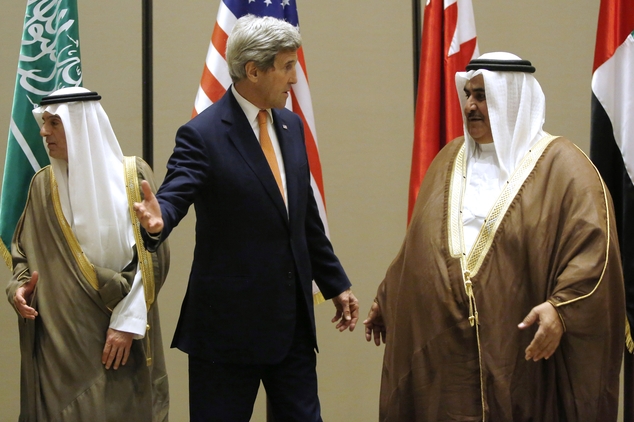
Secretary of State John Kerry talks with Bahrain Foreign Minister Khalid bin Ahmed Al Khalifa, right, after they and Saudi Arabia Foreign Minister Adel al-Jubeir, left, gathered for a family photo at the start of the Gulf Cooperation Council (GCC) Ministerial meetings in Manama, Bahrain, Thursday, April 7, 2016. (Jonathan Ernst/Pool Photo via AP)

The Gulf Cooperation Council (GCC) is a regional political and economic union of Arab States within the Persian Gulf and includes Bahrain, Kuwait, Oman, Qatar, Saudi Arabia and the United Arab Emirates. Since 1981 when it was founded, it has come to form a cohesive union of Arab states that share in the massive oil wealth of the Persian Gulf and within the last few years has created military alliances to combat the rise of ISIS and the increased militant forays of the Iranian regime.

These states have found themselves at the forefront of various Iranian provocations ranging from Bahrain battling insurgents armed by Iranian agents to Saudi Arabia which is trying to stem a full-scale insurrection on its border with neighboring Yemen fueled by Houthi rebels armed, trained and advised by Iran’s Revolutionary Guard Corps.

These Arab states have also intercepted considerable amounts of arms being smuggled by Iran to various proxies and terrorists to fuel insurrection and strikes at the various states in a stark reminder of how committed the mullahs in Tehran are in destabilizing their Arab neighbors.

All of this highlights one of the untruths uttered by the Iran lobby during the run up to the nuclear deal last year which was securing a deal would empower moderate forces within Iran to take greater control over Iran’s government and temper its more extreme elements.

We now know since the deal was agreed to last July, the Iranian regime has taken every opportunity to step up its military activities throughout the region; from Syria on the Mediterranean to Yemen on the Indian Ocean.

It is against this backdrop that U.S. Secretary of State John Kerry travels to Bahrain for a meeting of the GCC whose members are intent on reading Kerry the riot act about the rise of Iranian extremism.

Part of that process included statements from Kerry and Bahrain’s foreign minister on Thursday urging Iran to stop escalating its provocative behavior and pursue a more constructive foreign policy.

Kerry is in Bahrain to consult with officials from Bahrain and other Gulf Arab countries frustrated by Tehran’s policies and lay the groundwork for meetings between President Barack Obama and Gulf Arab leaders in Riyadh later this month. The president held a meeting in Washington last year with Gulf Arab leaders and senior officials to pledge military aid and calm allies’ nerves about Tehran as the nuclear deal neared completion.

“Today we are noticing two things that we kind have expected,” Sheik Khalid bin Ahmed Al Khalifa, Bahrain’s foreign minister, said, outlining the views of Bahrain and the GCC. “The missile program is moving forward with full support of the leadership of the Islamic Republic and we are seeing the hegemonic interventions through proxies in several parts of our region continuing unabated.”

While Kerry once again stressed the positive virtues of the nuclear agreement, the reality is that the almost slavish dedication to keeping afloat a nuclear deal that is already – for all intents and purposes – dead from the Iranian point of view has allowed the Iranian regime to move forward aggressively on several other fronts now that sanctions have been lifted and it can access a new credit line of $100 billion to replenish its military losses at a critical time for the mullahs.

That reality has forced Kerry to make a complex argument here to the ministers of the GCC, where he repeated that the U.S. would continue to lift the economic sanctions against Iran that it agreed to as part of the nuclear accord, even while imposing new ones to counter Tehran’s missile launches, an effort now underway in the United Nations Security Council.

The bipolar nature of American diplomacy has caused consternation and confusion among America’s allies such as the Gulf states and what can only be construed as unbridled joy amongst the mullahs who are taking advantage of the mixed messages.

But sentiment was hardening against Iran and the weak administration position as the editorial board for the Washington Post decried the ramp up in missile testing by Iran and the need to sanction the regime.

“Tehran’s behavior comes as no surprise to the many observers who predicted the deal would not alter its hostility to the West or its defiance of international norms. Unfortunately, the Obama administration’s response has also been much as critics predicted: It has done its best to play down Iran’s violations and avoid any conflict out of fear that the regime might walk away from a centerpiece of President Obama’s legacy,” the Post wrote.

In reference to a push by Iran to lift restrictions on accessing U.S. currency markets, the Post said “Secretary of State John F. Kerry, the accord’s architect, said Tuesday that the regime ‘deserves the benefits of the deal they struck.’ There’s logic to that. But there’s also a problem of reciprocity: Should the United States take steps not strictly mandated by the text of the nuclear accord at a time when Iran is testing nuclear-capable missiles?”

What has all this wrought? Not the peace and moderation promised by Iran lobby supporters such as Trita Parsi of the National Iranian American Council, but instead the world has witnessed a global military spending boost of nearly $1.7 trillion in 2015, the first increase in several years as a result of Iranian regime’s rise and increase in global terrorism and proxy wars fueled by Iran according to a new report.

Tiny Qatar has signed a deal for $7.6 billion to buy 24 Dassault Rafal fighter jets from France. Kuwait on Tuesday finalized a deal to purchase 28 Eurofighter Typhoons, a deal estimated to be worth around $8 billion; all in response to the uncertainty the Iranian regime is sowing.

By Laura Carnahan


Filed Under: Blog, News Tagged With: Featured, Iran, Iran deal, Iran Lobby, Iran Mullahs, Iran sanctions, National Iranian American Council, NIAC, Trita Parsi

  • « Previous Page
  • 1
  • …
  • 12
  • 13
  • 14
  • 15
  • 16
  • Next Page »

National Iranian-American Council (NIAC)

  • Bogus Memberships
  • Survey
  • Lobbying
  • Iranians for International Cooperation
  • Defamation Lawsuit
  • People’s Mojahedin
  • Trita Parsi Biography
  • Parsi/Namazi Lobbying Plan
  • Parsi Links to Namazi & Iranian Regime
  • Namazi, NIAC Ringleader
  • Collaborating with Iran’s Ambassador

Recent Posts

  • NIAC Trying to Gain Influence On U.S. Congress
  • While Iran Lobby Plays Blame Game Iran Goes Nuclear
  • Iran Lobby Jumps on Detention of Iranian Newscaster
  • Bad News for Iran Swamps Iran Lobby
  • Iran Starts Off Year by Banning Instagram

© Copyright 2026 IranLobby.net · All Rights Reserved.