Iran Lobby

Exposing the Activities of the lobbies and appeasers of the Mullah's Dictatorship ruling Iran

  • Home
  • About
  • Current Trend
  • National Iranian-American Council(NIAC)
    • Bogus Memberships
    • Survey
    • Lobbying
    • Iranians for International Cooperation
    • Defamation Lawsuit
    • People’s Mojahedin
    • Trita Parsi Biography
    • Parsi/Namazi Lobbying Plan
    • Parsi Links to Namazi& Iranian Regime
    • Namazi, NIAC Ringleader
    • Collaborating with Iran’s Ambassador
  • The Appeasers
    • Gary Sick
    • Flynt Leverett & Hillary Mann Leverett
    • Baroness Nicholson
  • Blog
  • Links
  • Media Reports

Trita Parsi Mounts Defense of Iran Nuclear on Eve of Election

November 7, 2016 by admin

Trita Parsi Mounts Defense of Iran Nuclear on Eve of Election

Trita Parsi Mounts Defense of Iran Nuclear on Eve of Election

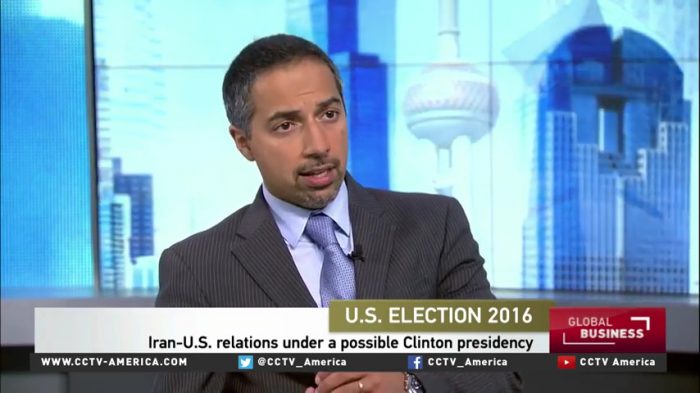
Tirta Parsi, the founder of the National Iranian American Council and one of the Iranian regime’s most ardent supporters, took to the airwaves in a final effort to shape impressions about an Iranian nuclear deal that is getting widely panned in the wake of a year of Iranian aggression and human rights violations.

Oddly though he appeared on CCTV, the Chinese-produced news channel, which doesn’t have a high Iranian-American viewership, but then again, Parsi isn’t trying to reach the constituency his organization is ostensibly supposed to be helping; rather he is trying to make the case to overseas governments to stay on board with the Iranian regime in spite of its involvement in three raging wars now in Iraq, Syria and Yemen.

His appearance amounts to another PR push to try and allay fears that the nuclear deal is going to be trashed by either Hillary Clinton or Donald Trump. He voiced his greatest optimism for saving the deal with Clinton’s election, but even tempered his language slightly from the normal dumping on Trump in light of the candidate’s closing in these last days in most polls.

For Parsi, the effort must be akin to gritting your teeth while getting a root canal since it seems every time he goes out there to be a loyal supporter of the mullahs’ agenda, they go ahead and do something to prove his statements wrong.

His famous claims that the nuclear deal would moderate Iran and empower more liberal elements in the regime to make gains in parliamentary elections fell flat as the ruling leadership wiped thousands of candidates off the ballots to ensure solid majorities for their supporters.

Parsi’s belief in Iran’s future role as a “stabilizing” influence in the Middle East’s conflicts evaporated like water on a hot plate when Iranian regime brought Russia into the Syrian conflict and escalated wars in Iraq and Yemen. Mass killings of civilians, bombed out villages, fleeing refugees, all have become staples of the post-nuclear deal era.

Most appalling of all has been Parsi’s complete silence on the Iranian practice of grabbing dual-national citizens, especially Iranian-Americans? Even the sentencing of his supposed friend Siamak Namazi to an extended prison term earned only minimal statements and none of the grassroots campaigns that have marked previous NIAC efforts to win support for the nuclear deal.

The irony is overwhelming when an organization supporting Iranian-Americans, abandons them to Iranian prisons.

For Parsi, the Iranian regime continually makes him out to be a false prophet and for the mullahs in Tehran, this year’s US presidential election is just another example—in their minds of the Great Satan’s decline—but in fact, they shined a bright light on of the great achievements of the US political system in comparison to theirs.

As the New York Times wrote, “In the past, Iranians looking to mock the United States would burn cardboard effigies of Uncle Sam or Lady Liberty. But in recent months, as the American presidential election took a series of bizarre turns, Iranians seeking to make fun of the ‘Great Satan’ have ditched the arts and crafts and simply switched on their TV sets.”

“Iran’s state television, a bastion of conservative ideologues, for once interrupted its regular programing about the ‘murders and crimes committed’ by the United States and broadcast all three debates between Hillary Clinton and Donald J. Trump — live,” the Times added.

In a country that tightly controls information about the United States and depictions of Western democracy generally, the decision to show the debates was unprecedented but by no means inexplicable: The presidential campaign shows the United States political system in such a poor light, hard-liners evidently want it to speak for itself.

And therein lays their weakness. While the mullahs look to make fun of the American political process they gave Iranians a glimpse of something they cannot have and only dream about; the ability to openly denounce, debate, disagree and even vote out their leaders.

In a regime where the top post of “Supreme Leader” is invested by the Iranian constitution with undisputed powers literally for life, the thought of openly disagreeing, even making fun of the regime’s leaders would be met with knocked down doors, secret trials and public hangings.

While the mullahs may think they are mocking the US, in reality they may have uncorked subtle questioning by their own people who may be asking “Why can’t we do this to our leaders?”

The Iranian people are deeply dissatisfied with the course of their nation, fed up with rampant corruption by regime officials, long wars claiming the lives of the young future of the country and tired of lacking even the most basic freedoms to post selfies, dress as they want or even ride a bicycle.

As Parsi even admits in his CCTV interview, the Iranian people are chafing under the lack of progress and improvements, but while he blames the lack of full implementation of the nuclear agreement, what he doesn’t admit is that the source of that discontent is within the regime’s policies itself.

Michael Tomlinson
Filed Under: Blog, Current Trend, Latest from Lobbies & Appeasers, National Iranian-American Council, News Tagged With: #NuclearDeal, Clinton presidency, Featured, Moderate Mullahs, National Iranian American Council, NIAC, NIAC Action, Nuclear Iran, nuclear talks, Rouhani, Sanctions, Trita Parsi, US election

Why is the Iran Lobby Obsessed with Sanctions?

November 3, 2016 by admin

Why is the Iran Lobby Obsessed with Sanctions?

Why is the Iran Lobby Obsessed with Sanctions?

For an organization that considers itself an activist group fighting for the rights of Iranian-Americans, you would think the National Iranian American Council would be hard at work trying to build grassroots support for the release of Iranian-American hostages.

Maybe Trita Parsi, head of the NIAC, might offer a blistering editorial attacking the regime’s policies of not recognizing dual nationalities?

Maybe Reza Marashi or Tyler Cullis could take a break from giving interviews demanding a lifting of economic sanctions and instead question what else could be done to help get these Iranian-Americans released?

The stark reality is that the NIAC and its members cannot even be bothered to send out tweets, let alone press releases in support of these captive Iranian-Americans, nor try to persuade the Iranian regime to let go of such a damaging and harmful policy that puts countless Iranian-Americans at risk who travel back to Iran to visit relatives.

Instead, the most pressing priority for the Iran lobby—judging by the volume of press releases, statements, editorials, tweets, interviews and speeches—is the lifting of all economic sanctions against the Iranian regime, including all of those not included in the nuclear agreement and were originally imposed because of Iranian regime’s support of terrorism and abysmal human rights record.

The arguments being made by the Iran lobby, especially the NIAC, for lifting of economic sanctions still in place, such as restrictions on Iran’s use of US currency exchanges, resemble the kind of twisted pretzel logic you might find from an extremist that claims to be helping people as he beats them with a club.

One recent example is an editorial by Marashi on the self-publishing blog TopTopic (probably because no self-respecting mainstream publication could print it with a straight face), in which he makes the silly argument that the US is not in compliance with the noxious nuclear deal and is purposely dragging its feet because:

  • It is intentionally squeezing Iran because it has nothing better to do;
  • President Obama wants to protect Hillary Clinton from having to bear an unpleasant political cost of appearing friendly to a bloodthirsty regime widely untrusted by American voters; and
  • The US government is still fighting an internal battle between those committed to punishing Iran and those wanting to set it free.

It is an utterly inane position to advocate since it ignores the most basic and unavoidable truth about the Iranian regime which is compelling most Americans and their leaders to be remain wary of the mullahs in Tehran: the Iranian regime is simultaneously engaged in three wars, while grabbing dual citizens and trying them in secret courts, all during a human rights crackdown that abuses women, religious minorities, children and even gays.

About the only thing most Americans can agree on in this divided political season is that Iran should be restrained, not encouraged.

The sight of pallets full of cash delivered on midnight flights to buy the release of Americans left a sour taste that is hard to forget. The sight of American sailors made to kneel under the guns of Iranian Revolutionary Guard Corps soldiers was unforgettable.

The sight of Iranians hanged publicly almost on a daily basis, including women and children as young as 15 when convicted horrifies most Americans.

And yet, the Iran lobby does not tackle any of these issues. Instead, it focuses on trying to get the mullahs more cash. One might think NIAC’s fundraising budget is dependent on earning commissions for every billion raised for Iran’s coffers.

The fact that the Iran lobby ignores the almost daily pronouncements proving the regime’s true intentions demonstrates clearly it has no regard for the enormous human suffering being caused by the Iranian regime.

Take for example statements made by Salar Abnoush, deputy coordinator of Iran’s Khatam-al-Anbia Garrison, an IRGC command front, who was quoted as saying in an Iranian state-controlled publication closely tied to the IRGC that is sending assets to infiltrate the United States and Europe at the direction of Iran’s top mullah Ali Khamenei.

The IRGC “will be in the U.S. and Europe very soon,” according to Abnoush, who said that these forces would operate with the goal of bolstering Iran’s hardline regime and thwarting potential plots against the Islamic Republic.

“The whole world should know that the IRGC will be in the U.S. and Europe very soon,” he said.

According to Fox News, the military leader’s comments come as Iran is spending great amounts of money to upgrade its military hardware and bolster its presence throughout the Middle East and beyond. Iran intends to spend billions to purchase U.S.-made planes that are likely to be converted for use in its air force.

Given these developments, it’s easier to understand the rationale for NIAC’s emphasis on lifting sanctions and it’s not about the poor Americans being held in Iranian prisons.

It’s about cash for Iran, plain and simple.

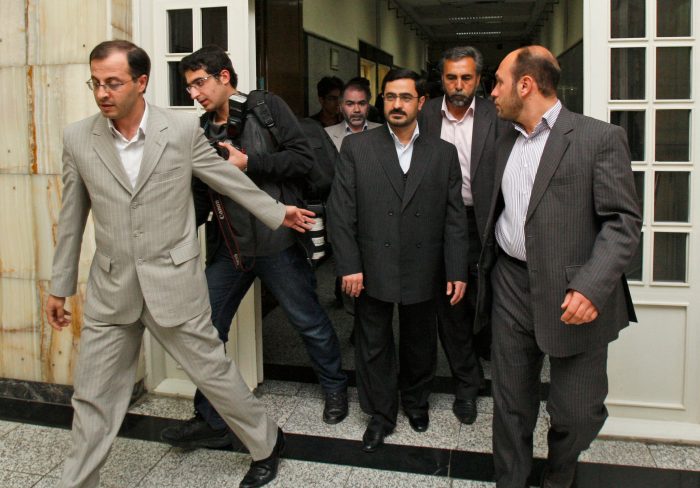
Not even the sham punishment of 135 lashes given to Saeed Mortazavi, former head of the regime’s Social Security, because of accusations of widespread financial violations and irregularities could cover from his past record as a former prosecutor who was responsible for the mass killings of detainees and political dissidents following the infamous 2009 protests over the stolen presidential election.

It seems in Tehran, you get punished for ripping off your fellow regime leaders, but not for killing innocent protestors.

Too bad the NIAC didn’t have anything to say about it.

Michael Tomlinson

Filed Under: Blog, News Tagged With: Featured, Iran, Iran deal, Iran Terrorism, IRGC, Khamenei, Marashi, Moderate Mullahs, National Iranian American Council, NIAC, NIAC Action, Nuclear Deal, nuclear talks, Reza Marashi, Sanctions, Trita Parsi, Tyler Cullis

Iran Regime Roadmap in Syria Includes Highway to Mediterranean

November 1, 2016 by admin

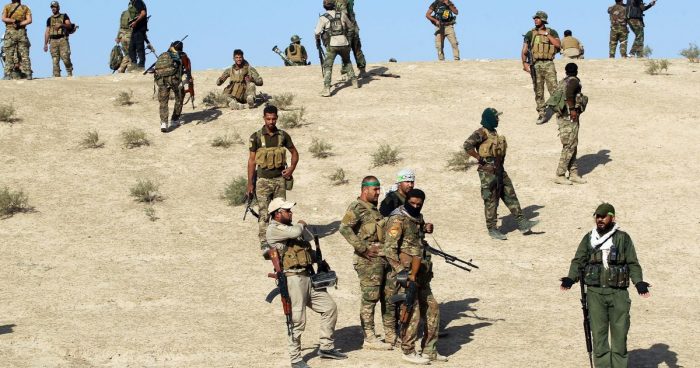
shiite-militiasSince the US-led invasion of Iraq, the Iranian regime has ratcheted up its military involvement in its neighbors. At first, the regime used the tried and true tactics of using terrorist groups and proxies to strike at coalition forces during the insurgency in Iraq, killing and wounding thousands of troops primarily through explosive devices its Quds Forces made and delivered to Shiite militias.

It’s a model Iranian regime used to great effect through two decades of civil war in Lebanon through its Hezbollah terror partners, which it then expanded to use in the Syrian civil war in support of the Assad regime.

Similarly, the Iranian regime used the Houthis to launch another civil war in Yemen, aimed at destabilizing Saudi Arabia, a major coalition partner opposed to the Assad regime.

But what is the master plan for the mullahs in Tehran? What are they trying to gain from all of the machinations and manipulations?

Leaders of the Iranian regime in the face of opposition among their own loyal forces due to the heavy loses they have had particularly in the Syrian invasion, have numerously said that Syria and Iraq are their battle field to keep the enemy from fighting at home. i.e. using the same tactic they have been using since the beginning of the 1979 revolution, to create and export crisis in the region in order to cover up the internal crisis and the lack of capabilities to resolve such crisis. Hence one way to legitimize repression inside Iran has always been to point to the external crisis and the outside enemy.

While some try to project the Iranian regime’s meddling in Syria, Iraq and Yemen as a sign of strength, it is in fact the same crippling situation that forced regime’s top leader, Ali Khamenei, cornered by the sanctions to put a more friendly face out to the world and as such, manipulated the next election ballot to clear the field for Hassan Rouhani, a long-time loyal servant of the regime and a genial actor. In him, Khamenei saw his opportunity to fool the West, hoping for a change in the equation with Iran.

The creation of the Iran lobby, including US-based groups such as the National Iranian American Council, helped pushed that narrative during the run up for nuclear negotiations. For the mullahs, the completion of a nuclear deal was the linchpin to their plans since it set into motion the lifting of economic sanctions and the flooding of fresh cash back into coffers depleted by war.

While the infusion of cash and lifting of sanctions has opened the door to foreign investment for the first time in decades, the support for three wars is aimed at a more practical consideration: the creation of a Shiite-sphere of influence that buffers Iran from its neighbors and allows it access vital trade routes, economic markets and the ability to move assets freely without observation or restriction, however the main issue for the regime is its fear of uprisings at home and therefore its need for continuing with its meddling in the region.

For the mullahs, they have created a house of cards, each balancing on the other precariously and should one fall, the whole house collapses. Such is the flimsy nature of the mullahs hold and yet the West fails to fully grasp the leverage it has over the regime; leverage it abdicated when it chose to approve a nuclear agreement without linking Iran’s support for terrorism or improvements in human rights to it.

Nothing illustrates the complex interconnections the Iranian regime is striving for than the battle for Mosul in Iraq and for Aleppo in Syria. In both cases, the lack of a clear and decisive US policy has allowed the mullahs to manipulate the situations where Iranian-backed Shiite militias that used to attack US forces in Iraq are now attacking Sunni insurgents under US air cover.

The manipulation of this chessboard has many layers. For example, the lifting of economic sanctions was important in order for the regime to enter into deals with Boeing and Airbus to acquire new passenger airliners to replace a decrepit fleet which has seen hard use ferrying troops and weapons via an air bridge from Iran and Lebanon into Iraq and Syria.

Of paramount importance though to the long-range plans of the Iranian regime is the consolidation of friendly territory. For Khamenei and Rouhani, they envision an unbroken land stretching from the Mediterranean with Lebanon and Syria, through Afghanistan and Iraq to Yemen and even the Gulf states on the Persian Gulf and Indian Ocean.

It is a grand vision, but one that can only come to fruition through war, terror, bloodshed and violence. After all this is perhaps the only way they know to come out of the deepening crisis back at home.

The Iranian resistance movement has fought this complicated game plan for decades, but the West has largely not caught on and similarly combatted it; seeing it more in terms of short term agreements. The fact that the nuclear agreement only buys less than a decade of nuclear-free time is incredibly short-sighted and indicative of why the mullahs think they can win this game by being patient.

What is handicapping Tehran though is the inability to generate much economic improvement in the lives of ordinary Iranians who chafe under the yoke of oppression. This is the area of greatest risk to the Iranian regime where the people themselves are capable of changing the regime.

If the West ever realized the true potential it holds to advance change in Iran, then the future of the Iranian people could be helped immensely.

Let’s hope it doesn’t take too long to figure out that holding Iran accountable instead of rushing forward with trade deals is the better way to block Iranian regime’s roadmap.

Michael Tomlinson

Filed Under: Blog, News Tagged With: Featured, Iran, Iran deal, Iran Human rights, Iran Lobby, Iran Mullahs, Iran sanctions, Iran Terrorism, Khamenei, National Iranian American Council, NIAC, NIAC Action, nuclear talks, Syria, Yemen

Why Hassan Rouhani’s Calls for Co-Existence Are Meaningless

October 21, 2016 by admin

Why Hassan Rouhani’s Calls for Co-Existence Are Meaningless

Why Hassan Rouhani’s Calls for Co-Existence Are Meaningless

Iranian regime controlled media loudly broadcast remarks made by Hassan Rouhani at a ceremony marking National Exports Day in Tehran in which he called for peaceful co-existence with the rest of the world and Iran’s neighbors.

No, this was not an April’s Fool joke come early, nor was it an attempt at early Halloween gallows humor.

Rouhani was making his appeal because the world has not reacted well to the regime’s militant and aggressive moves since a nuclear agreement was reach over 18 months ago. There has arisen significant uncertainty among foreign companies, institutional investors and many governments over entering into business agreements at a time when new sanctions may be coming.

Rouhani was making his appeal on a strictly commercial basis in which he hoped to see Iran enter the global marketplace as a significant consumer market, as well as an eventual exporter of goods.

According to Trend News Agency, “Iran has no choice other than forming a constructive interaction with the world in order to boost its export,” he said.

He further said that constructive interaction with the world means establishing suitable ties with global community for exports, and import of capital goods and raw materials as well as employment of youth.

There is good reason for Rouhani and his fellow mullahs to be worried. Iran’s economy remains stagnant, with little benefits trickling down to ordinary Iranians as promised by Rouhani. Youth unemployment remains staggeringly high and wages have not risen significantly in over a decade leading to widespread discontent and protests throughout Iran.

Scandals involving excessive compensation for high-placed executives at regime-controlled industries have rocked Rouhani’s term, as does a high-profile crackdown against journalists, students, artists, bloggers, dissidents, and religious and ethnic minorities.

The mullahs’ “morals” police squads are working overtime arresting and abusing everyone from Iranian women riding bicycles to Iranian youth congregating in coffee shops.

But what has most foreign companies and investors worried is the regime’s rapid escalation in its involvement in three widening proxy wars in Syria, Iraq and Yemen, in which US armed forces are increasingly being drawn into direct conflict with Iranian and Iranian-backed forces.

In Yemen, Iranian regime-backed Houthi rebels reportedly fired cruise missiles at US warships three times in one week; resulting a response from the US of three cruise missiles hitting radar installations in Yemen.

US Army Gen. Joseph Votel, commander of US forces in the Middle East, said on Wednesday that he believes Iran was behind the missile strikes on US Navy ships in Yemen.

“I do think that Iran is playing a role in some of this. They have a relationship with the Houthis, so I do suspect there is a role in that,” said Votel at the Center for American Progress, The Hill’s Kristina Wong reports.

Now news reports have surfaced detailing how the Iranian regime has stepped up weapons transfers to the Houthis threatening to widen and prolong the now 19-month-old war.

Much of the recent smuggling activity has been through Oman, which neighbors Yemen, including via overland routes that take advantage of porous borders between the two countries, the officials said.

U.S. and Western officials who spoke to Reuters about the recent trend in arms transfers said it was based on intelligence they had seen but did not elaborate on its nature. They said the frequency of transfers on known overland smuggling routes had increased notably, though the scale of the shipments was unclear.

A senior Iranian diplomat confirmed a “sharp surge in Iran’s help to the Houthis in Yemen” since May, referring to weapons, training and money.

“The nuclear deal gave Iran an upper hand in its rivalry with Saudi Arabia, but it needs to be preserved,” the diplomat said.

Ironically, the timing of the increased flow of cash and arms to the Houthis coincides with the ransom payments of $1.7 billion made to the Iranian regime by the US to free four American hostages.

Meanwhile in Syria, the growing failure of repeated cease-fires have placed US personnel dangerously close to being targeted by Russian and Syrian airstrikes, as well as facing Shiite militias imported from Iraq by Iranian airliners to fight alongside Syrian forces against US-backed rebels.

It is against this backdrop of global uncertainty that Rouhani is making one of the most absurd sales pitches anyone can recall since it is exactly because of the Iranian regime’s acts that have made many companies and investors skittish at risking billions of dollars.

That idea of co-existence draws little weight as Rouhani himself has admitted that the regime does not recognize dual national citizens and is in the midst of an unprecedented binge of hostage-taking of US, British, Canadian and other citizens.

Even more disturbing has been taunting statements made on regime-controlled websites demanding “billions in cash” as ransom payments for these new hostages.

Even Rouhani has taken a personal hand in tightening the figurative noose among his fellow Iranians by firing Minister of Culture and Islamic Guidance Ali Jannati, Education Minister Ali Asghar Fani and Minister of Youth Affairs and Sports Mahmoud Goudarzi all on the same day.

It’s interesting to note that all three ministers oversaw parts of Iranian society which enjoyed a bit more creative freedom during the run-up of the nuclear negotiations in an effort to present a more “open” society to the world. With the nuclear deal accomplished, their dismissals and subsequent crackdown on freedoms should not be a surprise.

Laura Caranahan

Filed Under: Blog, News Tagged With: Featured, Iran, Iran Mullahs, Iran sanctions, Iran Terrorism, IRGC, Nuclear Deal, nuclear talks, Sanctions, Syria, Yemen

US Presidential Election Concerns Iran Regime

September 30, 2016 by admin

US Presidential Election Concerns Iran Regime

US Presidential Election Concerns Iran Regime

The sunset is fast approaching on the Obama administration, and with it will come significant changes in the US foreign policy approach to the Middle East and Iran in particular. The mullahs learned their lesson from the two disastrous terms of Mahmoud Ahmadinejad who made it easy to caricature the regime as slightly crazy and evil.

Their manipulation of the election ballot in 2013 assured Hassan Rouhani’s election and helped assist the Iran lobby in trying to project an image of moderation to the West; even though Rouhani’s first term has actually been bloodier than Ahmadinejad’s ever was.

Rouhani has outpaced Ahmadinejad with an unprecedented wave of executions and mass hangings that is approaching 3,000, including women and children according to Amnesty International. His crackdown on religious minorities, journalists, dissidents, artists and students has rivaled the abuses of the infamous 2009 protests.

With the upcoming election of a new US administration, the mullahs are intensely interested in the election outcome, as well as preparing the ground to keep the policies of appeasement rolling in exchange for the false hope that Iran will curb its nuclear ambitions.

The deployment of the Iran lobby has been largely aimed at helping Senators and candidates deemed favorable and supportive towards the nuclear deal, as well as continue coaxing journalists to view the Iranian regime with less than suspicion.

Meanwhile in Iran itself, regime news outlets have been giving considerable space and airtime to the presidential campaign, especially with the rhetoric rising sharply about the effects of the nuclear deal and the best approach needed by a new president to restrain and control the Islamic state.

There is no doubt that Americans and Europeans are anxious about the state of the Middle East, especially the three wars being waged with deep support from the Iranian regime in Syria, Iraq and Yemen, which have contributed to an unprecedented wave of refugees flooding into Europe and the US.

Javan Online, the daily newspaper close to Iran’s Revolutionary Guard Corps, ran an article Sept. 27 titled “The Iranophobia race.”

Kayhan daily, whose editor is appointed by the country’s supreme leader, called the debate “a contest in Iranophobia” in which “Trump threatened to attack Iran and Clinton continued to stress the political and economic pressures against Iran.” Though it didn’t mention Mrs. Clinton’s defense of the Joint Comprehensive Plan of Action’s diplomatic approach.

Hamid Reza Assefi, a former spokesman for the regime’s Foreign Ministry, commented in an op-ed for the Shargh Daily on the likely effect of the US election on Iran. He concluded, “Because of the special rules and the internal sensitivities surrounding the election in Iran … external issues will have no effect.”

He also wrote, “The truth is, both parties in the Unites States share the same opinion on the general aspects of the conflict with Iran.”

On that point he is correct. In spite of the round the clock efforts by the Iran lobby at trying to drive a wedge in the US electorate and attempting to peel off Democratic support, the truth is the vast majority of American voters remain deeply suspicious of the Iranian regime and both Democrats and Republicans are less inclined to accommodate Iran’s agenda after the bloody year since the nuclear deal was reached.

A senior international policy analyst for the RAND Corp., wrote in Fox News that with “the continuing climate of repression, the next Iranian presidential election, and (Ali) Khamenei’s eventual demise may provide some important opportunities for America’s next president.”

“The next U.S. president is likely to be met with multiple international crises after assuming office, and Iran may be one of the most challenging of them,” he writes. “In theory, Rouhani, often portrayed as a ‘moderate’ by the Western media, would have been strengthened by the agreement and able to pursue his agenda of liberalizing Iran both economically and politically. In reality, Rouhani’s presidency has failed to deliver on most of his promises.”

The laundry list of provocative actions by the Iranian regime over the past year has clouded any real building of support for the mullahs by the Iran lobby. The recent spate of arrests of dual national citizens and Rouhani’s reaffirmation that Iran does not recognize dual citizenship on NBC News only provides more fodder for critics of the regime.

The significance of Iran to US policy is becoming more apparent as more analysts and policymakers weigh Iran’s influence and threat level even above that of ISIS. In an editorial in the Los Angeles Times, writes that:

“US political leaders of both parties argue that destroying Islamic State is America’s top priority in the Middle East. In reality, that’s not nearly as important as confronting the challenge posed by Iran. The nuclear deal that went into effect a year ago may have postponed the danger of an Iranian nuclear bomb, but the multifaceted threat of a militaristic, messianic Iran — 80-million strong — is much more menacing to Western interests than the Sunni thugs and murderers of Raqqah and Mosul.”

“From Tehran’s perspective, it gained much more than it gave up. In exchange for postponing its military nuclear project, it achieved the lifting of many economic sanctions, an end to its political isolation and the loosening of restrictions on its ballistic missile program,” he added.

Truthfully, time is running out for the mullahs. We can only expect that the next president and administration will have a more skeptical eye towards the Iranian regime with the benefit of 20-20 hindsight.

By Michael Tomlinson


Filed Under: Blog, News Tagged With: Featured, hassan rouhani, Iran, Iran deal, Iran Human rights, Iran Lobby, Iran Mullahs, Khamenei, Moderate Mullahs, nuclear talks

US Warns of Travel to Iran as Regime Shows off Military Might

August 24, 2016 by admin

US Warns of Travel to Iran as Regime Shows off Military Might

US Warns of Travel to Iran as Regime Shows off Military Might

In what is becoming annual rite of summer, the U.S. State Department on Monday issued a warning urging U.S. citizens to avoid traveling to Iran. This latest advisory, which emphasizes Iran’s desire to capture U.S. citizens, comes on the heels of a growing scandal over the Obama administration’s decision to pay Iran $400 million in cash on the same day that it freed several U.S. hostages, according to the Washington Free Beacon.

The new warning replaces an existing one the department issued on March 14, 2016 and reiterates and highlights the risk of arrest and detention of Americans, particularly dual national Iranian-Americans, which the Iranian regime does not recognize.

“Iranian authorities continue to unjustly detain and imprison U.S. citizens, particularly Iranian-Americans, including students, journalists, business travelers, and academics, on charges including espionage and posing a threat to national security,” the advisory said.

“Iranian authorities have also prevented the departure, in some cases for months, of a number of Iranian-American citizens who traveled to Iran for personal or professional reasons. U.S. citizens traveling to Iran should very carefully weigh the risks of travel and consider postponing their travel. U.S. citizens residing in Iran should closely follow media reports, monitor local conditions, and evaluate the risks of remaining in the country,” the advisory added.

The advisory goes on to warn of the threats posed to religious minorities and a wide range of other classifications of individual at risk of arrest, harassment and detention by regime authorities.

“The Iranian government continues to repress some minority religious and ethnic groups, including Christians, Baha’i, Arabs, Kurds, Azeris, and others.  Consequently, some areas within the country where these minorities reside, including the Baluchistan border area near Pakistan and Afghanistan, the Kurdish northwest of the country, and areas near the Iraqi border, remain unsafe.

“Iranian authorities have detained and harassed U.S. citizens, particularly those of Iranian origin. Former Muslims who have converted to other religions, religious activists, and persons who encourage Muslims to convert are subject to arrest and prosecution,” the advisory said.

Despite the warning, Iran remains a tourism destination for some with The New York Times offering two-week trips to Iran several times a year. It is noteworthy that the Times has long been an editorial supporter of accommodating the Iranian regime as part of the Obama administration’s echo chamber of support.

The warning flies in the face of the all of the claims made by the Iran lobby during the nuclear talks last year when prominent advocates for the regime such as Trita Parsi of the National Iranian American Council, bloggers Ali Gharib and Jim Lobe, all promised a more moderate and stabilizing Iranian regime.

Clearly the opposite has happened if the U.S. government has to update warnings about its citizens being kidnapped by the Iranian government and then warning that it can do little to help you out if you are taken hostage.

Top that level of aggressive militancy with new announcements by the Iranian regime of is newly grown military muscle which it puts on display with the glee of a child showing off a new bicycle.

The regime released images of its first domestically built long-range missile defense system on Sunday, a project started when the country was under international sanctions.

Images on multiple state news agencies showed President Hassan Rouhani and Minister of Defense Hossein Dehghan standing in front of the new Bavar 373 missile defense system, according to France 24 News.

The system was designed to intercept cruise missiles, drones, combat aircraft and ballistic missiles, according to earlier statements by Dehghan. He claimed that Iran’s missile range capabilities have been expanded by two to three times across its arsenal. The upgrades now give Iran’s current stock of cruise missiles the ability to hit targets 62 miles off its coast, easily putting ships traveling through the Persian Gulf’s Strait of Hormuz at risk.

Rouhani said in a televised speech on Sunday that Iran’s military budget had more than doubled compared with last year.

“If we are able to discuss with world powers around the negotiating table, it is because of our national strength” he said.

Rouhani also unveiled the first Iranian-made turbo-jet engine on Sunday, saying it was capable of flight at 50,000 feet.

“The Islamic republic is one of eight countries in the world who have mastered the technology to build these engines,” Rouhani said.

Dehghan added that Iran was now looking to develop seaborne cruise missiles capable of supersonic speed.

The new missile was developed as a response to the suspension of delivery of a Russian-made S-300 missile system because of earlier sanctions, but with those sanctions lifted because of the nuclear agreement, Russia completed delivery of the advanced weapons system this year.

Dehghan also boasted on regime television that the regime would also negotiate with Russia to acquire its sophisticated Sukhoi fighter and attack aircraft to bring its air force capability for long-range force projection and air combat against the more sophisticated air forces of regional rivals such as Saudi Arabia and the Gulf states.

Iran has also discussed with Russia the production licensing of the Russian T-90 tank inside Iran. The focus of the Iranian regime is on acquiring the capability and technology to produce the systems in-country rather than depending on the mood of the Kremlin to sell Iran weapons.

The world should be aware now that the Iranian regime’s intentions are anything but peaceful and moderate.

By Michael Tomlinson

Filed Under: Blog, News Tagged With: #NuclearDeal, Featured, hassan rouhani, Iran, Iran deal, Iran Human rights, Iran Terrorism, Khamenei, nuclear talks

Iran Lobby Assurances Proven False Again

August 21, 2016 by admin

Iran Lobby Assurances Proven False Again

Iran Lobby Assurances Proven False Again

The “echo chamber” created by the Obama administration to help push through passage of the badly flawed Iran nuclear deal has beat the drum repeatedly in efforts to defend the deal in the face of growing and incontrovertible proof that all of the assumptions of the Iran lobby have been proven false.

The revelations of the falsehoods surrounding the Iran lobby’s participation in that now infamous echo chamber have almost become legendary:

  • Allen S. Weiner, a Stanford law professor and contributor to the Washington Post’s opinions section who co-authored a piece arguing in favor of the $400 million “ransom payment” failed to disclose he had long been on the payroll of the Ploughshares Fund, an organization recently exposed as a key cog in a White House-orchestrated campaign to build what it called a pro-Iran “echo chamber;”
  • Shortly after approval of the nuclear deal, in which the Iran lobby argued it would empower “moderate” forces within the regime, parliamentary elections were rigged to eliminate virtually all perceived moderates and usher in solid majorities loyal to the ruling mullahs; and
  • Promises by the Iran lobby, especially the National Iranian American Council, that the deal would help steer Iran as a player in the Middle East to stabilize regional conflicts was proven wrong when wars in Syria and Iraq widened, ISIS rose up and Iran launched a rebellion in Yemen by the Houthis.

In each case, the Iran lobby has sought to assure the world of the good intentions of the Iranian regime, only to have those assurances fall flat in the face of new regime transgressions, but for the Iran lobby the battle being waged by its members is the battle of public perception.

It serves the purposes of the mullahs to have the perception there is a chance for moderation, rather than actually delivering any.

Nothing illustrates that point more than the controversy over the $400 million cash payment made by the Obama administration in what appeared to be linkage for the release of several American hostages.

Even though the Iran lobby remained relatively silent on the issue, “echo chamber” participants such as Weiner made a strong case for denouncing any link of cash for hostages. Of course, the Iranian regime did nothing to steer speculation away from that scenario; with various regime officials all but boasting of how the Islamic state cowed the U.S. and forced it to pay it millions of dollars.

Even though the Obama administration at first vigorously denied any connection, the issue was never what the administration thought, but what the regime thought since if the mullahs indeed believed this was a straight cash for hostage swap, it would only serve to validate their belief that this was a sound policy to pursue in advancing the goals of the regime.

That much was true when the Obama administration finally admitted the other day that the $400 million ransom payment was held up until confirmation of the hostages’ release and flight back home, thereby validating the use of the money as leverage tied directly to the hostages’ plight.

For months the Obama administration had maintained that the payment was part of a settlement over an old dispute and did not amount to a “ransom” for the release of the Americans. Instead, administration officials said, it was the first installment of the $1.7 billion that the United States intends to pay Iran to reimburse it for military equipment it bought before the Iranian revolution that the United States never delivered.

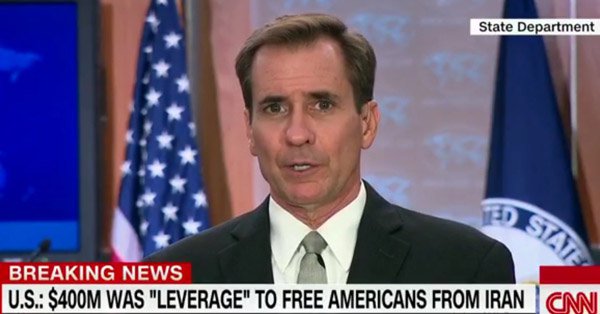
But at a briefing on Thursday, John Kirby, the State Department spokesman, said the United States “took advantage of the leverage” it felt it had that weekend in mid-January to obtain the release of the hostages and “to make sure they got out safely and efficiently.”

According to the New York Times, the acknowledgment by Kirby on Thursday touched off a torrent of criticism from Republicans.

“It was ransom,” said Representative Ed Royce of California, chairman of the House Foreign Affairs Committee. “We now know it was ransom. And on top of that it put more American lives at risk. And we’ve emboldened Iran. We’ve encouraged them, frankly, to take more hostages and put more American lives at risk of being taken hostage.”

Iranian regime press has described the payment as a ransom — which fits Tehran’s narrative that it has outmaneuvered the Obama administration.

Kirby conceded that while the deals were negotiated separately, the timing of the final transactions was linked. “As we said at the time, we deliberately leveraged that moment to finalize these outstanding issues nearly simultaneously,” he said.

The Wall Street Journal editorial board took a harsh tack with the ransom payment, saying the Obama Administration’s handling of the Iran ransom-for-hostages story brings to mind the classic Chico Marx line in the movie “Duck Soup”: “Who are you going to believe—me or your own eyes?”

“Mr. Obama, meanwhile, spent August denying that a ransom was a ransom. Since the January “leverage” moment, Iran has taken three more Americans as hostage and is now demanding the return of $2 billion in funds that U.S. courts have ordered held for the victims of Iranian-sponsored terrorism. The eyes of the world can simply stare,” the Journal added.

The campaign to pass this ill-fated nuclear deal has also been undergoing even more scrutiny with disclosures that Ploughshares Fund sought $750,000 from billionaire financier’s George Soro’s Open Society Foundation to pay off “experts and validators” to vouch for the nuclear agreement.

The disclosure of the Ploughshares request shines further light on backroom efforts by the White House and its top allies to create what they called an “echo chamber” to galvanize public support for the nuclear deal with Iran.

According to the Washington Free Beacon, one foreign policy consultant who has worked intimately with Congress on the Iran deal said that the Ploughshares funding request is further proof that the White House’s efforts were well funded and highly influential.

“You couldn’t turn around last summer without bumping into some Iran deal booster complaining about all the money that skeptics were spending,” the source said. “Now we find out that the architects of the Iran echo chamber were soliciting hundreds of thousands of dollars from dark money groups to pour into manipulating the media and pushing fabricated experts into the mainstream.

By Michael Tomlinson

Filed Under: Blog, News Tagged With: #NuclearDeal, Appeasement policy, Featured, Iran Lobby, National Iranian American Council, NIAC, Nuclear Deal, nuclear talks, Ploughshares

Iran Lobby Damaged by Revelations of Funding for Nuclear Deal Campaign

May 24, 2016 by admin

Iran Lobby Damaged by Revelations of Funding for Nuclear Deal Campaign

Iran Lobby Damaged by Revelations of Funding for Nuclear Deal Campaign

The expose of national security staffer Ben Rhodes admission in the New York Times Magazine concocting a string of false messages to sell the Iran nuclear deal sent shock-waves through American politics and around the world as the revelations began to sink in that the entire basis of the agreement with the Iranian regime may have been built on lies.

Even more disturbing news reports has come out now that one of the principal advocates for the deal and a central pillar of the Iran lobbying effort had paid cash directly to news organizations in a brash effort to influence favorable coverage of the agreement.

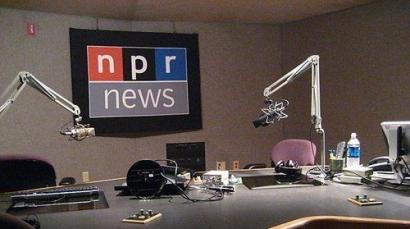
The Associated Press reported that the Ploughshares Fund gave National Public Radio $100,000 last year to help it report on the nuclear deal according to the group’s own annual report, while also funding reporters and partnerships with a wide array of other news outlets.

In the Times article, Rhodes explained how he  worked with nongovernmental organizations, proliferation experts and even friendly reporters to build support for the seven-nation accord that curtailed Iran’s nuclear activity and softened international financial penalties on Tehran.

“We created an echo chamber,” said Rhodes, a deputy national security adviser, adding that “outside groups like Ploughshares” helped carry out the administration’s message effectively.

Most news organizations, including The Associated Press, have strict rules governing whom they can accept money from and how to protect journalistic independence.

Ploughshares’ backing is more unusual, given its prominent role in the rancorous, partisan debate over the Iran deal.

The Ploughshares grant to NPR supported “national security reporting that emphasizes the themes of U.S. nuclear weapons policy and budgets, Iran’s nuclear program, international nuclear security topics and U.S. policy toward nuclear security,” according to Ploughshares’ 2015 annual report, recently published online.

Ploughshares Fund provided over 90 grants to various organizations in 2015 in order to engage in reporting, research and analysis on Iranian nuclear issues. The over 90 grants given out in 2015 nearly doubles those the organization provided in 2014, and triples the amount given in 2013. Ploughshares’ increases in grant funding directly coincides with the time period during which the Iran nuclear deal was being finalized and presented to Congress.

Also receiving grants were think tanks such as the RAND Institute which was given $40,000 to write “a series of articles that analyze specific elements of the diplomatic agreement with Iran on its nuclear program.”

Ploughshares Fund President Joseph Cirincione spoke about the Iran deal on NPR twice last year. He was identified as a donor to the radio station on only one of the two occasions.

Ploughshares also provided over $280,000 to the Iran lobby leader National Iranian American Council (NIAC) for its work supporting the Iran deal, some of which went directly towards sending NIAC staff to the nuclear negotiations in Vienna. NIAC was accused of engaging in lobbying efforts on behalf of the Iranian regime around 2007, which led to the organization’s president Trita Parsi bringing suit against journalist Hassan Daioleslam for defamation. Parsi eventually lost the protracted legal battle.

The New York Post joined in the mounting criticism of the massive lobbying and PR effort with an editorial casting doubt on Ploughshares’ claims:

“And though Ploughshares claims to be working against nuclear proliferation, it backed a soft line toward Iran and worked to enable a deal that at best will only delay Tehran from acquiring nuclear weapons,” the Post said.

Meanwhile the Washington Free Beacon examined claims by NPR that it did not deliberately deny airtime for anti-Iran deal advocates such as Rep. Mike Pompeo (R-KS) who claimed to have scheduled interviews with NPR cancelled at the last time and spots given instead to Iran deal support Rep. Adam Schiff (D-CA).

While NPR executives claimed to have no records of such bookings, emails reviewed by the Free Beacon between NPR and Pompeo’s office show otherwise, casting more doubt on the validity of NPR’s claims of journalistic integrity on the Iran nuclear deal while it was being funded by the Ploughshares Fund.

These revelations expose the tangled connections between the Iranian lobby, its financial backers and its efforts to manipulate news media and manage directly the so-called “hundreds of often-clueless reporters” as characterized by Robert Malley, senior director at the National Security Council, as quoted in the Times article.

As to where Ploughshares gets its money? Ploughshares is financed by billionaire George Soros’ Open Society Institute, the Buffett Foundation, the Carnegie Corporation of New York, the Ford Foundation, the Rockefeller Brothers Fund and the Rockefeller Foundation, among others including several notable Hollywood celebrities such as actor Michael Douglas and entertainer Barbra Streisand.

Joseph Cirincione, the president of Ploughshares, went on the offensive in an effort to blunt the growing embarrassment of these revelations with an editorial on Huffington Post in which he blamed all the attacks on a right-wing, neo-con conspiracy.

While Cirincione took aim at the writers of the Times and AP stories, he neglected to mention the central characters in this entire episode and it wasn’t Ploughshares.

It was the mullahs in Tehran for which Ploughshares and others of the Iran lobby do their bidding.

The core issue is not about donations, coverage and lobbying. It is very much about how a despotic, extremist, religiously fanatical regime is escaping notice as it executes a record 2,500 people, brutalizes the women of Iran and fights three wars in Syria, Yemen and Iraq which has turned much of the Middle East and Europe into the largest refugee center in history since World War II.

Nowhere does Cirincione defend the recent conduct of the mullahs. Nowhere does he mention the rapid development and launching of illegal ballistic missiles designed to carry nuclear warheads. Nowhere does he mention the blatant violations of even the flimsiest provisions of the Iran nuclear deal such as the inability to inspect Iranian military facilities.

The money Ploughshares has spread around like so much horse manure was never intended to expose the Iranian regime, but only to cover it up.

By Michael Tomlinson

Filed Under: Blog, News Tagged With: Appeasement policy, Featured, Iran, Iran appeasers, Iran deal, Iran Lobby, Iran sanctions, Iran Talks, Irandeal, Joseph Cirincione, National Iranian American Council, NIAC, NIAC Action, Nuclear Deal, nuclear talks, Ploughshares, Trita Parsi

Iran Regime Thumbs Nose at World with New Missile Launch

December 8, 2015 by admin

Iran Regime Thumbs Nose at World with New Missile Launch

Iran Regime Thumbs Nose at World with New Missile Launch

The old saying goes “The definition of insanity is doing the same thing over and over again and expecting a different outcome.”

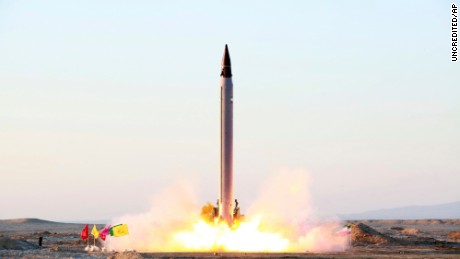
If the world expects the Iranian regime to change its ways in the wake of a completed nuclear deal last July, the answer it is getting from the mullahs in Tehran is depressingly the same as evidenced by yet another test launch of a new ballistic missile design in violation of United Nations sanctions against the testing of ballistic missiles capable of carrying a nuclear warhead.

According to Fox News, western intelligence sources say the test was held Nov. 21 near Chabahar, a port city in southeast Iran’s Sistan and Baluchestan Province near the border with Pakistan. The launch took place from a known missile test site along the Gulf of Oman.

The missile, known as a Ghadr-110, has a range of 1,800 – 2000 km, or 1200 miles, and is capable of carrying a nuclear warhead. The missile fired in November is an improved version of the Shahab 3, and is similar to the precision guided missile tested by the regime on Oct. 10, which elicited strong condemnation from members of the U.N. Security Council.

“The United States is deeply concerned about Iran’s recent ballistic missile launch,” Samantha Power, U.S. Ambassador to the U.N., said in a statement after the last Iranian ballistic missile test in October.

The regime appears to be in a race against the clock to improve the accuracy of its ballistic missile arsenal in the wake of the nuclear agreement signed in July.

The Security Council is still debating how to respond to the regime’s last test in October and therein lays the problem. While the world debates what to do in responding to the regime’s provocations, the regime continues on blissfully uninterrupted in its preparations.

The same scenario plays out in regards to the regime’s new offensive in Syria and its crackdown at home in an alarming rise in human rights abuses; all of which has been met by mostly silence and hand wringing in the rest of the world.

The regime’s new-found militancy has included a buying binge with Russia for new arms as a top aide to Russian president Vladimir Putin confirmed.

“When all the restrictions are removed and all the sanctions are lifted we will have quite a serious development in the field of military-industrial cooperation. It is already taking place in fields that are not covered by sanctions, and in future we are expecting to enter very large projects,” Vladimir Kozhin, a top military-industrial cooperation aide said in an interview with Izvestia daily.

The official added that Iran has shown great interest in cooperation with Russian weapons companies because practically all of its military forces require a major overhaul.

“Considering the fact that this is a large country with large military forces, we are talking very big contracts, worth billions,” Kozhin noted.

And now that the regime is due to receive a $100 billion payout as early as January because of the nuclear deal and a rushed incomplete investigation by the International Atomic Energy Agency that rubberstamped the regime’s compliance, the mullahs are due to get a huge payday.

The continued lack of action in the face of regime’s actions covers the large-scale such as military weapons to the small issues affecting individuals and their families as Washington Post reporter Jason Rezaian continues to languish in a regime prison on trumped up espionage charges; his incarceration now passing 500 days in captivity.

Even more disturbing is a report from cybersecurity firm Symantec which claims that regime hackers are using malware to spy on individuals including Iranian dissidents and activists.

The attacks aren’t particularly sophisticated, but the hackers have had access to their targets’ computers for more than a year, Symantec said, which means they may have gained access to “an enormous amount of sensitive information.”

Two groups of hackers, named Cadelle and Chafer, distributed malware that steals information from PCs and servers, including from airlines and telcos in the region, Symantec said.

“Reports have shown that many Iranians avail of these services to access sites that are blocked by the government’s Internet censorship,” Symantec wrote. “Dissidents, activists, and researchers in the region may use these proxies in an attempt to keep their online activities private.”

All of which means the regime is stepping up its efforts to identify specific and individual activists and dissidents, especially those living within Iran who may be communicating with outside dissident groups, as a means of tracking them down and arresting them.

It is a bitter irony that International Human Rights Day is approaching this week in light of this increased activity by the Iranian regime and highlights that no matter how the international community might buy the propaganda being spewed by regime lobbyists such as the National Iranian American Council; the reality has been much different.

If the attacks in Paris and San Bernardino do not wake up those who still refuse to believe that the rising tide of Islamic extremism is flowing from radical safe havens such as Syria and Iran is an imminent threat, then the Iranian regime’s actions in firing another missile in direct violation of sanctions should be an urgent alarm bell

By Michael Tomlinson

Filed Under: Blog, News Tagged With: Appeasement policy, Featured, Iran deal, Iran Human rights, Iran Lobby, Nuclear Iran, nuclear talks, Syria

Iran Regime Breaks Nuclear Agreement Already

November 11, 2015 by admin

Iran Regime Breaks Nuclear Agreement Already

Iran Regime Breaks Nuclear Agreement Already

The 159 pages in the nuclear agreement with the Iran regime is by the standards of most international agreements, pretty flimsy, but even its meager few pages specify clearly the expectations the rest of the world has for the regime’s centrifuges used to enrich uranium: dismantling them.

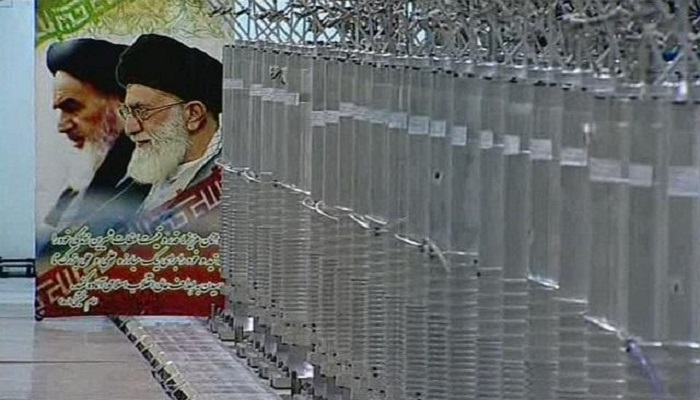
Reuters reported that the regime has halted work in dismantling centrifuges at the Natanz and Fordow nuclear enrichment plants. The nuclear agreement struck last July specified that initial dismantling work would begin on some 10,000 decommissioned centrifuges at the two facilities.

The halt in work was announced by Ali Shamkhani, secretary of the National Security Council for the regime, who was quoted as saying by the ISNA student news agency that “the (dismantling) process stopped with a warning.”

He did not specify what the warning was or who issued it, but the head of the regime parliament’s nuclear deal commission, Alireza Zakani, told Mehr news agency that the dismantling had stopped in Fordow because of a letter to Hassan Rouhani from a group of lawmakers complaining that the dismantling process was moving too swiftly and contradicted directives from top mullah Ali Khamenei.

Khamenei has publicly stated his opposition to several terms within the treaty, including refusal to allow regime military facilities to be inspected and the need for all Western sanctions to be lifted at once before the regime would comply fully with the agreement.

Khamenei has also said the deal should only be implemented once allegations of past military dimensions of the regime’s nuclear program had been settled.

The International Atomic Energy Agency is expected to announce its conclusions on PMD by Dec. 15, according to Reuters.

The 10,000 older, decommissioned centrifuges are only half of what the regime has available to it to enrich low-grade uranium into highly enriched weapons-grade fuel. The nuclear agreement only allows for the regime to actively use a few thousand centrifuges for medical and scientific research purposes.

As Rick Moran in American Thinker notes, “there’s very little difference between the so-called ‘hardliners’ and those the Western press has designated as ‘moderates.’ And Rouhani may try to use the hardliners as an excuse to not fully implement the deal.  Supreme Leader Khamenei has already redefined key elements of the deal to favor Iran’s nuclear program, which Rouhani will probably cite when he violates the terms of the agreement as we go along.”

It is clear now that the regime has no intention of complying with the nuclear agreement and in fact is doing everything it can to push the West with aggressive moves designed to take advantage of the Obama administration’s lame duck political status and lack of desire to force a confrontation on the eve of U.S. presidential elections.

This is why the mullahs in Tehran have doubled down on wiping out opposition to Assad in Syria with a new offensive alongside Russia, test fired a new ballistic missile that violates United Nations Security Council restrictions, attacked and killed Iranian resistance members in Iraq, smuggled new arms to Houthi rebels in Yemen, completed the sale of advanced anti-aircraft missiles from Russia, and cracked down at home by arresting and jailing dissidents and inflaming ethnic tensions with the Azeri minority group in northern Iran.

All of this has been done because the mullahs have already decided to break from the nuclear agreement and see the opportunity for significant gains in the absence of any real threat of retaliation from the U.S. and the rest of the world.

As the Iran lobby, led by the National Iranian American Council, put so eloquently during the debate over the nuclear agreement, the choice for Americans was between “war” and “peace.”

In fact, they were correct, but only in reverse. Approving the pact has surely put the world on a more dangerous path towards greater conflict, while rejecting it may very well have stopped Iranian aggression and brought about stability in the region.

By Michael Tomlinson

Filed Under: News Tagged With: #NuclearDeal, Appeasement policy, Featured, hassan rouhani, Iran, Iran deal, Iran Human rights, Iran Lobby, Iran sanctions, National Iranian American Council, NIAC, NIAC Action, nuclear talks, Parchin

  • « Previous Page
  • 1
  • 2
  • 3
  • 4
  • Next Page »

National Iranian-American Council (NIAC)

  • Bogus Memberships
  • Survey
  • Lobbying
  • Iranians for International Cooperation
  • Defamation Lawsuit
  • People’s Mojahedin
  • Trita Parsi Biography
  • Parsi/Namazi Lobbying Plan
  • Parsi Links to Namazi & Iranian Regime
  • Namazi, NIAC Ringleader
  • Collaborating with Iran’s Ambassador

Recent Posts

  • NIAC Trying to Gain Influence On U.S. Congress
  • While Iran Lobby Plays Blame Game Iran Goes Nuclear
  • Iran Lobby Jumps on Detention of Iranian Newscaster
  • Bad News for Iran Swamps Iran Lobby
  • Iran Starts Off Year by Banning Instagram

© Copyright 2026 IranLobby.net · All Rights Reserved.