Iran Lobby

Exposing the Activities of the lobbies and appeasers of the Mullah's Dictatorship ruling Iran

  • Home
  • About
  • Current Trend
  • National Iranian-American Council(NIAC)
    • Bogus Memberships
    • Survey
    • Lobbying
    • Iranians for International Cooperation
    • Defamation Lawsuit
    • People’s Mojahedin
    • Trita Parsi Biography
    • Parsi/Namazi Lobbying Plan
    • Parsi Links to Namazi& Iranian Regime
    • Namazi, NIAC Ringleader
    • Collaborating with Iran’s Ambassador
  • The Appeasers
    • Gary Sick
    • Flynt Leverett & Hillary Mann Leverett
    • Baroness Nicholson
  • Blog
  • Links
  • Media Reports

There is More Than One Presidential Election to Keep an Eye on

September 28, 2016 by admin

There is More Than One Presidential Election to Keep an Eye on

There is More Than One Presidential Election to Keep an Eye on

While the US watches a slugfest of a presidential election between Hillary Clinton and Donald Trump, another presidential election scheduled to take place next year on the other side of the world bears watching because of how it potentially impacts not only every American, but also the entire Middle East and Europe.

The “election” will be in Iran for the next president, however unlike the US election, there is likely to be no doubt, no drama, no recounting of ballots or examination of hanging chads. There probably won’t even be very many people on the ballot as well because in the Iranian regime, elections are inconveniences that have to be tolerated for the international community.

They are by no means, free, fair, open or even compelling. The last time there was even any controversy was in 2009 when the election was widely seen as rigged and in the heat of the Arab Spring movement, ordinary Iranians decided to do something they had not done since the downfall of the Shah of Iran; they protested—massively.

In response, top mullah Ali Khamenei and his fellow clerics did what they normally do, they ordered a crushing suppression of protests that results in deaths, mass imprisonment and harsh crackdowns on news media, technology and foreign journalists.

After figuring out the regime couldn’t stomach another debacle like that, Khamenei and his fellow conspirators cooked up a scheme to wipe names off future ballots and allow a handpicked successor to be elected without any protest and be seen as a “moderate.”

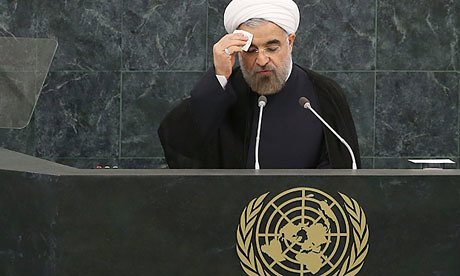
That man was Hassan Rouhani in 2013 who cruised to victory against a field of straw men and was widely praised as a “fresh” face by the Iran lobby; an odd phrase since Rouhani has been at the heart of the regime’s military and intelligence services for the past three decades.

Calling Rouhani a moderate is like calling a neo-Nazi “open minded.”

Now his re-election is coming up next year and already the field is being cleared to allow him an uncontested run and eliminate any choice for the Iranian people who would dearly love to dump him into the unemployment line after debilitating economic news continued to pour out of Iran even after a nuclear deal that Rouhani and the mullahs promised would open the flood gates to an improved quality of life.

Things are so bad for Rouhani at home that even Mahmoud Ahmadinejad, the man Rouhani succeeded, has considered another run for the presidency until he was slapped down by Khamenei. The prospect of another term by Ahmadinejad has the mullahs scared out of their turbans since he is widely reviled in the West and at home.

His run would be akin to having Richard Nixon take a stab against Jimmy Carter in 1980 fresh off his resignation and threatened impeachment from the Watergate scandal.

“In carrying out the intentions of the leader of the revolution, I have no plans to take part in the elections next year,” Ahmadinejad said in a letter to Khamenei, published on his website dolatebahar.com.

You could almost hear the sigh of relief coming from Khamenei and Rouhani.

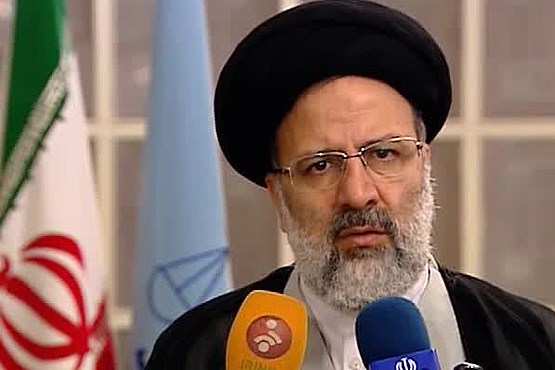
Besides Rouhani’s re-election, the looming prospect of who replaces an aging and ill Khamenei should have the US and its allies even more worried. Far from the prospect of getting a more moderate replacement, the name most often heard being bandied about as the next top mullah is Ibrahim Raisi.

As Ray Takeyh, a senior fellow at the Council of Foreign Relations, put it succinctly in an editorial in the Washington Post, Raisi “could be the only person in the Islamic Republic who could cause people to miss Khamenei.”

“Raisi is 56 years old and, like Khamenei, hails from the city of Mashhad. After a stint in the seminary, he has spent his entire career in the Islamic Republic’s enforcement arm, serving as prosecutor general, head of the General Inspection Office and lead prosecutor of the Special Court of the Clergy, which is responsible for disciplining mullahs who stray from the official line. In one of his most notorious acts, he served as a member of the ‘Death Commission’ that, in the summer of 1988, oversaw the massacre of thousands of political prisoners on trumped-up charges,” Takeyh writes.

“Raisi’s background fits nicely with the Revolutionary Guards’ mission of crushing dissent. In a recent interview, Revolutionary Guards commander Muhammad Jaffari conceded that since 2005, the regime has come to see domestic insurrection as an even greater challenge to its existence than external pressures. The ideal successor to Khamenei would have to not only share the Guards’ perspective but also have close ties to the security organs and the judiciary. The Guards seem to have found their man. Raisi is being increasingly touted by them as a vanguard of the regime and an enforcer of its will,” he added.

Khamenei’s clear preference for Raisi can be seen in his appointment of him to head one of the regime’s largest charitable foundations, Astan Quds Razavi, which gives Raisi access and control to vast land holdings and many other enterprises that funnel money to him, the IRGC and his allies.

With the endowment’s estimated value at $15 billion, Raisi is in prime position to buy votes and assemble his own network of loyal supporters and operatives.

All of which reinforces the central conceit of Khamenei, Rouhani and their ilk, which is to maintain the purity of the Islamic revolution and the ideological basis for it. Even with the opening of trade with the nuclear agreement, the mullahs have no intention of using these new funds to help the economy or Iranian people. Instead, they view these proceeds as necessary to continue the funding and expansion of the Islamic revolution.

Ultimately, while everyone is focused on if Rouhani will be re-elected, the more important question is whether or not Raisi will even allow Rouhani to speak without a script.

By Michael Tomlinson
Filed Under: Blog, News Tagged With: Featured, hassan rouhani, Iran, Iran deal, Iran Human rights, Iran Lobby, Iran Mullahs, Moderate Mullahs, Raisi

Why Does the Iran Lobby Want to Make Iran a Partisan Issue?

September 27, 2016 by admin

Why Does the Iran Lobby Want to Make Iran a Partisan Issue?

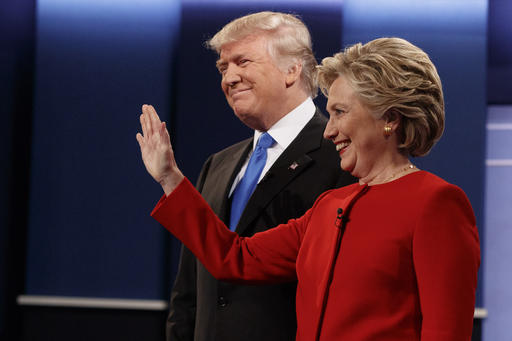
Republican presidential candidate Donald Trump, left, stands with Democratic presidential candidate Hillary Clinton before the first presidential debate at Hofstra University, Monday, Sept. 26, 2016, in Hempstead, N.Y. (AP Photo/ Evan Vucci)

The first debate between Hillary Clinton and Donald Trump was billed as literally the fight of the century; bigger than Ali vs. Frazier, bigger than Coke vs. Pepsi. While an innumerable number of columnists, analysts, lobbyists and anyone else with “-sts” at the end of their job description will critique this debate to death, we should be asking a question that didn’t come up in the debate.

Why does the Iran lobby want to make the issue of Iran a partisan political issue?

From the moment the Iran lobby was created, especially the launch of its principal leader—the National Iranian American Council—it has sought to wedge itself into the partisan political environment by trying to align itself with Democrats and attacking Republicans for the past several years.

At first it may have been because Republicans were the most visibly opposed to accommodating the mullahs in Tehran, but the NIAC even held its fire when it came to criticizing prominent Democrats opposed to Iran accommodation such as Sen. Robert Menendez (D-NJ), a prominent critic of the Iranian regime.

It was also no coincidence that many of NIAC’s staffers formerly worked for Democratic office holders and organizations, but that is a superficial reason for its efforts to politicize Iran issues.

The blueprint for this tactic comes from the mullahs themselves as displayed in their energetic efforts to tar and feather Saudi Arabia and portray its chief regional rival as the source of all terrorism and evil in the world. It’s a blatant effort at diverting attention away from Iran’s own failings and blunt criticism for its long support for terrorism and brutal human rights record.

If you treat any criticism of the Iranian regime as merely political point scoring, the NIAC and other supporters are hoping it diminishes the power and effectiveness of the criticism. The only problem with that argument is when both Democrats and Republicans both take aim at the regime anyway.

In stark contrast to that cynical tactic, Iranian dissident and opposition groups such as the National Council of Resistance of Iran have worked diligently to build bridges on both sides of the political aisle and worked on unifying themes such as human rights, support for women and opposition to sponsorship of terrorism.

Those efforts have won over many on both sides of the aisle with members such as Democratic House Leader Nancy Pelosi (D-CA), former Democratic Sen. Joe Lieberman, House Foreign Affairs Committee chair Ed Royce (R-CA), and former New York mayor Rudy Giuliani just to name a few.

Ultimately the Iran lobby must pursue this diversion strategy since its typical message points about Iranian cooperation and moderation have dissolved in a flurry of aggressive, militant and shocking moves by the mullahs since the nuclear deal was sealed and the “echo chamber” of support was revealed by the news media.

With the news coming out of Iran since the passage of the nuclear deal being mostly bad and only getting worse, the Iran lobby finds itself in a pickle with the upcoming presidential election promising a new president who plans to hold the Iranian regime much more accountable whoever wins.

For the Iranian regime, the pressure is on to grab as much as it can before that happens so the news coming out of Tehran is fast and furious. In the last day alone, we have seen:

  • The proposed cease-fire in Syria collapse as Russian and Syria aircraft have resumed massive bombing of primarily civilians in rebel-controlled areas, such as Aleppo as a major ground has been observed moving into the area with as many as 3,000 Iranian-backed fighters hoping to crush the rebellion against the Assad regime;
  • Iran will continue to test and improve the range and accuracy of its ballistic missiles to deter or coerce potential adversaries — the United States operating in the region, Gulf Arab states, Turkey and Israel – four Middle East experts said in a meeting of the Atlantic Council;
  • Hassan Rouhani and other regime leaders are under intense pressure back home from dissatisfied Iranians upset with the lack of benefits trickling down to them from the nuclear agreement and the perception that rampant corruption is siphoning off any economic improvement;
  • The head of Iran’s atomic energy agency warned that the landmark nuclear deal could be jeopardized by perceived foot-dragging on sanctions relief, promised in exchange for Tehran’s commitment to curb key atomic activities, even though US officials said those commitments were fulfilled but uncertainty over investing in Iran has been responsible for the delays; and
  • The regime’s top mullah, Ali Khamenei, tried to snuff out an insurgent return to the political stage by widely reviled past president Mahmoud Ahmadinejad who has hinted at a challenge to Khamenei’s handpicked minion, Rouhani.

The turmoil the Iranian regime is facing highlights the schisms that are running through Iranian society and the deepening split between the mullahs and the Iranian people. It also explains why the Iran lobby is so intent on trying to portray Iran policy issues as partisan political ones and not worthy of the attention of media.

Unfortunately for the Iran lobby, the American people, who have been subjected to near constant attacks inspired by extremist Islamists and worry about the growing carnage around the Middle East caused by Iranian regime’s active support of three proxy wars, have begun to suspect any supporter of the mullahs.

This may explain why the only people in America openly supporting the Iranian regime are those directly connected to the Iran lobby such as the NIAC, Ploughshares Fund and their cohorts.

By Michael Tomlinson

Filed Under: Blog, News Tagged With: Featured, Iran, Iran deal, Iran Human rights, Iran Lobby, Iran Mullahs, Iran sanctions, National Iranian American Council, NIAC, NIAC Action, Ploughshares

“NIAC Leadership” Conference Showcases Influence Pedaling

September 26, 2016 by admin

“NIAC Leadership” Conference Showcases Influence Pedaling

“NIAC Leadership” Conference Showcases Influence Pedaling

How much does it cost to meet your lawmakers in a venue where you can exert the influence of the mullahs in Tehran? Apparently only $349 and that also gets you three lunches and two breakfasts!

What a deal.

But if you’re strapped for cash, maybe because you have to pitch in for your family to hire a lawyer in an effort to reach your dual-nationality relative who is sitting in Evin prison in Iran, for only $175 you can still get access to lawmakers, but you miss out on a “Gala Reception” and hors d’oeuvres.

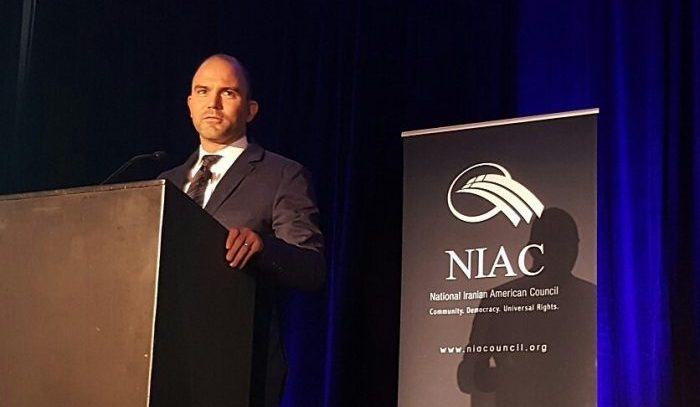
So less pizazz, but still you can buy access and who is selling this access at such bargain rate prices? The National Iranian American Council which held its “Leadership Conference” this weekend in Washington, DC.

The conference was a veritable who’s who of Iranian regime activists and lobbyists, all previously dedicated foot soldiers in the fight for securing a nuclear deal with Iran, as well as the fight to buy reprieves for the regime from ongoing sanctions for violations of human rights and sponsorship of terrorism.

Some of the more notable speakers included Joseph Cirincione of the Ploughshares Fund,which received and distributed cash to various members of the Iran lobby including NIAC according to investigative media reports, Ben Rhodes, deputy national security advisor to President Obama and architect of the now-infamous “echo chamber” of supporters used to deceive media and the American people as to the inherent flaws of the nuclear agreement.

Other key participants curiously included Christopher Backemeyer, deputy coordinator of sanctions policy in the State Department, and Michael Mosier, associate director at the Office of Sanctions Policy & Implementation in the Office of Foreign Assets Control. These two men hold considerable power over the question of whether or not Iran is complying with the nuclear agreement and whether or not certain sanctions should be enforced such as bans against the regime accessing US currency exchanges.

The fact that such key regulatory officials are participating in a conference sponsored by an organization identified as having strong links to high ranking Iranian officials should prove troubling. It is similar to having members of the Treasury Department’s securities enforcement division having drinks with executives from Enron or Lehman Brothers prior to the mortgage meltdown.

What is always fascinating about the NIAC’s annual confab is the packing of the speakers list with its own staffers, in this case Trita Parsi, Reza Marashi and Tyler Cullis, each of whom have worked diligently to carry Iran’s water and make excuses for the worst excesses of the regime. Watching these three “stooges” try to divert attention away from ballistic missile launches, mass arrests of journalists, public hangings of Iranians or arrests of Americans, Brits and other citizens is like watching a bad sketch comedy troupe.

Considering that one of the self-proclaimed mandates of the NIAC is “to ensure that human rights are upheld in Iran and that civil rights are protected in the US. NIAC believes that the principles of universal rights – Freedom of assembly, religion, and speech, as well as dignity, due process and freedom from violence – are the cornerstones of a civil society” one might ask why NIAC never invites any of the Iranian-Americans who can tell their story first hand of what Iranian justice is like.

Why is it that NIAC never has people such as Saeed Abedini, the Christian pastor held and tortured in Iran, or Amir Hekmati, the former US Marine brutalized in prison, or Jason Rezaian, the Washington Post reporter, to attend a conference and tell their story in furthering an understanding of the terrible forces at work within Iran’s religious leadership?

Of course the NIAC would never showcase any of these Americans since their presence would be a terrible embarrassment and highlight the true nature of the Iranian regime which is cruelty, punishment, abuse and control. Even though these Americans were released in exchange for $1.7 billion in cash, more Americans have been taken this year and the NIAC holds no fundraiser for them; launches no grassroots campaign for their release and holds no protest in their honor.

Even after the regime’s president, Hassan Rouhani, appeared on NBC prior to his speech before the United Nations General Assembly, he confidently admitted to Chuck Todd that Iran did not recognize dual nationalities.

“Therefore those who have dual citizenship, from the interpretation of the Iranian laws, are Iranian citizens solely and only,” Rouhani said. “And any legal prosecution is carried out on the foundation that they are Iranian citizens subject to Iranian law.”

And yet the NIAC issued no condemnation, no rebuke, not even a single tweet objecting to the extralegal procedures against Iranian-Americans, which the NIAC was ostensibly working on behalf of.

The height of absurdity was reached and exceeded by several speakers at this weekend’s proceedings, including this juicy quote from Rhodes.

“Acceleration of tensions between Gulf partners and Iran is a serious problem across the region,” said Rhodes as quoted by NIAC.

You think? It might be one of the better understatements, ranking up there with “peace in our time” by Neville Chamberlain.

The Iranian regime has pushed the possibility of all-out conflict with regional rival Saudi Arabia, while at the time supporting three proxy wars in Syria, Iraq and Yemen that have claimed the lives of almost 750,000 people. NIAC’s promises that Iran would be a partner for peace and moderation following the nuclear deal have turned out to be false and alarmingly so.

What was promising was the position taken by Philip Gordon, a senior foreign policy advisor to Hillary Clinton and senior fellow at the Council of Foreign Relations, who reiterated the presidential candidates public statements of skepticism about Iran’s conduct and the need to “distrust and verify” when it comes to enforcing the nuclear deal, much to the chagrin of Parsi who tried everything short of begging to get Gordon to make positive statements about the regime.

Gordon’s reticence provides hope that the next president will approach Iran with a clean slate and not be motivated to the falsehoods and “echo chamber” of the NIAC.

By Laura Carnahan

Filed Under: Blog, News Tagged With: #NuclearDeal, Ben Rhodes, Featured, hassan rouhani, Iran, Iran deal, Iran Human rights, Iran Lobby, Jason Rezaian, Joseph Cirincione, Marashi, National Iranian American Council, NIAC, NIAC Action, Ploughshares, Reza Marashi, Rouhani, Trita Parsi, Tyler Cullis, Yemen

Hassan Rouhani Peddling Fantasies in New York

September 25, 2016 by admin

Hassan Rouhani Peddling Fantasies in New York

Hassan Rouhani Peddling Fantasies in New York

The Iranian regime’s front man, Hassan Rouhani, was in New York for his annual propaganda address to the United Nations General Assembly session last week. During his New York stop, Rouhani availed himself of the usual media opportunities to pedal some pretty farfetched fantasies about the state of the Middle East and Iranian regime’s role in it.

One of his media stops was on NBC News in which he spun the story to Chuck Todd that the Syrian conflict must be solved politically.

Politically.

Let’s let that word sink in for a minute. The leader of the Iranian regime, which spent billions of dollars to prop up the brutal Assad regime at the brink of its collapse under protests by the Syrian people, was telling the American people that Syria required a political solution.

This is the same Iranian regime that sent thousands of Hezbollah fighters, led by Iranian Revolutionary Guard Corps commanders to fight alongside Syrian troops targeting rebel forces.

This is the same Iranian regime that gang pressed thousands of Afghan refugees into becoming mercenaries and sent them to fight in Syria.

This is the same Iranian regime that begged Russia to enter the war and save Assad from toppling as Iran’s forces were being exhausted by the years-long conflict. Russia’s entry included targeting and attacking of civilian locations and rebel military units not affiliated with ISIS or other radicalized Islamic militants.

Let’s also not forget that this is the same Iranian regime that supported Assad after he used chemical weapons to mass kill his own people.

The death toll in Syria is over 500,000 according to human rights groups with more than 11 million people displaced and becoming refugees.

“The rule of the ballot box and the rule of the Syrian people and the will of the Syrian people should be the sole determinant of the future of the country,” Rouhani said.

Rouhani also dismissed U.S. Secretary of State John Kerry’s demand Wednesday that Syria and Russia ground all aircraft in the northern part of the country after the bombing of a humanitarian convoy threatened a precarious ceasefire. The Pentagon has blamed Russia for the attack.

It is an absurd contention by Rouhani since Syrian elections are as about as free as the ones engineered in Iran. Assad has never held a truly free and open election subject to international monitoring, much as Rouhani was elected in similar fashion as thousands of moderate candidates were kicked off election ballots in Iran.

Beyond Rouhani’s fanciful ideas of Syrian democracy, his real goal on this tour was to loosen the purse strings and gain access to US currency exchanges for Iran. These sanctions were put in place as part of the punishments for Iran’s dismal human rights record and sponsorship of terrorism and were not part of the nuclear agreement reached last year.

Rouhani and his boss, top mullah Ali Khamenei, have banged the drum loudly warning of dire consequences if the sanctions are not lifted and are pushing to get relief before the US presidential election takes place and the Obama administration, which has followed a policy of appeasing the regime, leaves office.

Even the New York Times, which has been a sympathetic supporter of the nuclear agreement, recognizes the difficulty Rouhani faces and the consequences the regime faces if these sanctions are not lifted.

“Scared off by penalties imposed by the United States Treasury Department, European banks have not provided credit for large-scale projects in Iran. In fact, because of the American regulations, it remains nearly impossible for ordinary businesses to transfer money to and from Iran — a problem that has been enormously frustrating to Mr. Rouhani, who promoted the nuclear agreement by promising a new economic era,” writes Thomas Erdbrink in the Times.

“Mr. Rouhani faces an election in five months, and his hard-line opponents are sharpening their knives. Ayatollah Ali Khamenei, the supreme leader of Iran, has been hinting in speeches that he considers the nuclear deal to be a failure,” he adds.

That threat to walk away from what has proven to be an ineffective agreement anyway has been the pressure point on the Obama administration as it seeks to preserve its landmark foreign policy achievement at all costs; a pressure point that was again pushed by Tehran in getting the administration to approve licenses for the sale of new aircraft to Iran.

The U.S. government has given plane makers Boeing Co. and Airbus Group SE the all-clear to deliver jetliners to Iran Air. Iran Air announced in January it planned to buy Airbus planes, but the transaction stalled amid a lack of approvals from the U.S. Department of the Treasury’s Office of Foreign Assets Control rules. OFAC had to approve the license because a portion of Airbus planes are made in the U.S.

Iran’s plan to buy western planes has run into opposition in its own country and the U.S. Some U.S. lawmakers are trying to bar the sale of Boeing planes to Iran.

Rep. Peter J. Roskam (R., Ill.), a critic of Iran plane deals, said, “There is a still a long way to go and many more hurdles to overcome before Iran can actually take delivery of these planes—and thankfully Congress is committed to making the process as difficult and expensive as possible.”

The concern over the sale lies in the fact that the Iranian regime has often used its civilian airliners for military purposes in ferrying men, weapons, cash and supplies to it many proxies such as Hezbollah in Syria, Shiite militias in Iraq and Houthi rebels in Yemen.

The Treasury Department has previously sanctioned IranAir in recent years for helping Iran’s Islamic Revolutionary Guard Corps “transport military related equipment.”

With this action and others, we can only hope the US and Europe will not be able to finish caving in to the Iranian regime before it’s too late.

By Michael Tomlinson

Filed Under: Blog, News Tagged With: Appeasement policy, Featured, Iran, Iran deal, Iran Human rights, Iran Lobby, Khamenei, Rouhani, Sanctions

Hassan Rouhani Tries to Fool the World

September 23, 2016 by admin

Hassan Rouhani Tries to Fool the World

Hassan Rouhani Tries to Fool the World

In each prior appearance before the United Nations General Assembly session, the Iranian regime’s Hassan Rouhani has sought to project an image of moderation and openness. His entourage usually consisted of large swarms of advisers, economic aides and other dignitaries.

His schedule usually consisted of media interviews with network anchors and newspapers in which he offered a beguiling smile and chuckle to preserve the image of some kind of avuncular uncle.

But in his fourth and most recent appearance the other day, his schedule was a limited two day layover and consisted of few meetings on the sidelines with only one network interview with MSNBC’s Chuck Todd. Gone was the large retinue, but wasn’t missing was the same sly effort to try and conceal the truth behind Iran’s moves.

The Wall Street Journal noted the distinct change in this visit by Rouhani.

“Iran’s posture and agenda this year at the U.N. stands in contrast to years past, when the president brought large teams of advisers and ministers and capitalized on the trip by holding meetings with scholars, editors, Iranian-American business moguls and ordinary citizens,” wrote the Journal.

“The Iranian-American business community, which was heavily courted by Mr. Rouhani and his team during previous U.N. summits, kept its distance this year. Iran’s arrests of dual nationals, particularly Iranian-American businessman Saimak Namazi and his father, Baqir Namazi, who was formerly a U.N. official, sent chills through businesses considering investing in Iran,” the Journal added.

The circumstances have changed dramatically for Iran and the rest of the world in just one year with the nuclear agreement reached last year. Wars now rage throughout the region in Syria, Iraq, Afghanistan and Yemen and bloody extremist Islamic attacks of all stripes have peppered the world from Australia to Canada and the U.S. to throughout Europe and Africa.

Also, with the nuclear deal in hand, the mullahs in Tehran have focused their efforts on trying to press for more concessions before the window closes and either Hillary Clinton or Donald Trump are elected since both have expressed varying degrees of skepticism of the regime and the nuclear deal.

The hotly disputed ransom payment made by the US of $1.7 billion in cash for American hostages earlier this year emboldened the regime and spurred another round of hostage taking of dual national citizens, which Rouhani noted in an interview, Iran does not recognize.

Iran is currently detaining five British dual nationals, a Canadian-Iranian professor and four Iranian-Americans. In the past, Iran has jailed dual nationals as leverage to swap prisoners.

When asked about the case of the British-Iranian charity worker Nazanin Zaghari-Ratcliffe, who was sentenced to five years in prison in August, Rouhani simply said Iran doesn’t recognize dual nationals and denied using them as pawns. Zaghari-Ratcliffe’s husband has said Iran hasn’t revealed specific charges against his wife.

What hasn’t changed is the drivel that spewed out of Rouhani in his speech in which he heaped one absurd notion on top of another, first blaming sectarian violence in the region solely on Saudi Arabia, its chief regional rival, and assuring the world Iran supported inclusive, democratic governments.

It’s an appalling statement to make for Rouhani considering the Iranian regime is the most brutal nation in the Middle East, unless you count ISIS as a separate entity. His statement that Syria’s unrest could only be resolved by rooting out terrorist groups, neglected to mention that Iran’s military support of the brutal Assad regime has not targeted terror groups such as ISIS, but rather Syrian rebel groups opposed to Assad.

“If the Saudi government is serious about its vision for development and regional security, it must cease and desist from divisive policies, spread of hate ideology and trampling upon the rights of neighbors,” Rouhani said.

His blaming of the Saudi’s is beyond incredulous considering Iran’s mullahs run a 24/7 hate mongering propaganda machines through its state-owned media, cyberattacks and lobbying groups all aimed at pushing its own peculiar brand of extremist ideology.

In his speech, Rouhani criticized the United States for its “lack of compliance” with a landmark nuclear deal reached with six major powers and Iran in 2015 aimed at curbing Tehran’s nuclear program in exchange for lifting sanctions, which is the crux of the issue most concerning Rouhani and his cohorts.

The Iranian economy is stalled and unemployment, wage growth and household incomes have all stayed persistently below the targets Rouhani promised when he gained office. Making matters worse, the perception that Iranians would receive economic benefits from the nuclear deal have failed to materialize making ordinary Iranians restless and angry at their continued plight.

With the financial drains of supporting three proxy wars emptying the regime treasury, the money it has received from unfrozen assets and the hostage payment have principally been used to replenish its depleted military stores.

The irony of Rouhani praising peace while the Revolutionary Guard Corps showed off new long-range ballistic missiles with cluster bomb warheads against the backdrop of mass demonstrations and protests in Iran of people frustrated with deep seated corruption was not lost on most observers.

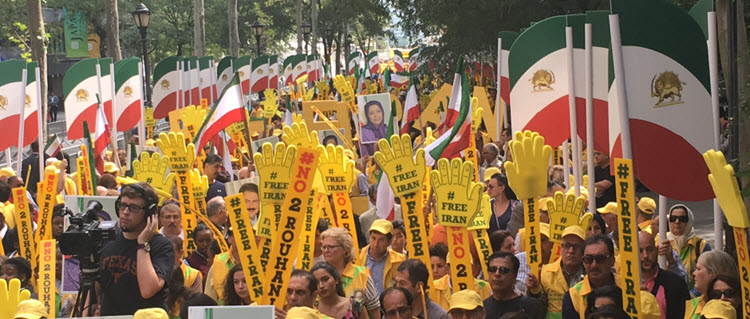
Nor did the thousands of protesters outside of the UN made up of human rights groups and Iranian dissidents let UN delegations forget that Rouhani should not be getting a free ride and ought to be held accountable for the lies he pedaled at the General Assembly.

As the hashtag said, #No2Rouhani on hundreds of signs, the world should say no more to his deceptions.

By Michael Tomlinson

Filed Under: Blog, News Tagged With: #NuclearDeal, Featured, hassan rouhani, Iran, Iran deal, Iran Human rights, Nuclear Deal, Rouhani

Rouhani UN Appearance Protested as Terror Strikes Again

September 20, 2016 by admin

Rouhani UN Appearance Protested as Terror Strikes Again

Rouhani UN Appearance Protested as Terror Strikes Again

A coalition of Iranian dissident and human rights groups held a protest outside of the United Nations in advance of a speech by the Iranian regime’s president, Hassan Rouhani, who is currently wrapping up a tour of countries that have all been hostile to the U.S.

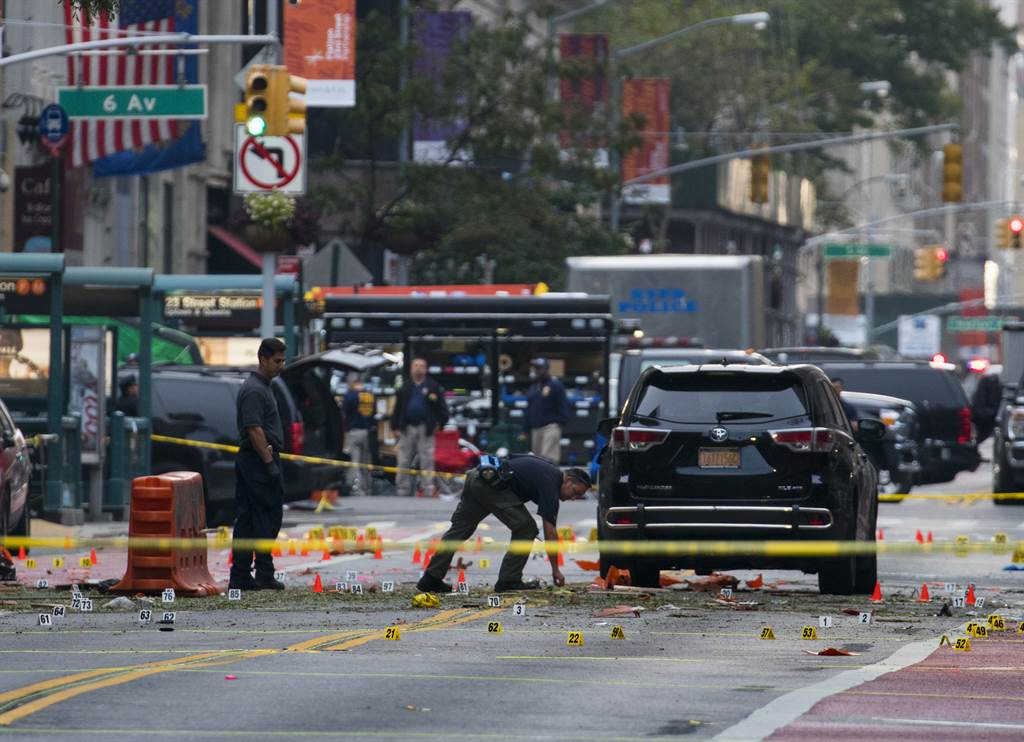
The anticipated speech by Rouhani comes at a precarious time in the tri-state area, which is recovering from bomb attacks in New York and New Jersey allegedly committed by Ahmad Khan Rahami, an Afghan immigrant who was captured after being wounded in a shootout with police.

Coupled with the stabbing attack at a Minnesota shopping mall by a man who was claimed by ISIS as a “soldier of the Islamic State,” these attacks have reminded the U.S. and the world of the ever present danger of radicalized individuals, lured by the seductive siren call of Islamic extremism.

These attacks have left nearly 40 people injured, fortunately none were killed, but in light of the growing list of terror-related attacks stretching from Boston to San Bernardino to Chattanooga to Dallas and to Orlando, it is clear that the U.S. is being subjected to the kind of waves of attacks that have become commonplace in the Middle East and increasingly in Europe.

What is becomingly increasingly clear is that radicalization of these new wave of would-be terrorists is coming rapidly through the easy access of materials online and the propaganda efforts of regimes such as ISIS and Iran to make their radical messages appealing to disaffected young people.

The protest takes a stand against the long running support of terrorism by the Iranian regime and its cruel indifference for human rights both at home and abroad. According to the Organization of Iranian American Communities (OIAC), the demonstrators called for a halt in Tehran’s extensive funding and sponsoring of terrorism in the region and demanded a halt in the executions in Iran, and urge the prosecution of the regime’s leaders.

According to the National Council of Resistance of Iran, the Iranian people have been the main domestic victims of the Iranian regime’s political violence. More than 2,500 have been hanged during Rouhani’s tenure, including dozens of dissidents, women, minors, ethnic and religious minorities.

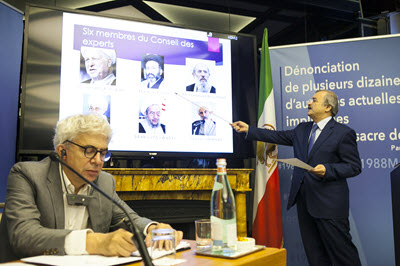
Also new evidence implicates Rouhani’s cabinet ministers, in the 1988 massacre of 30,000 political prisoners in Iran. The demonstrators held a symbolic enactment of the mass execution of thousands of political prisoners in Iran.

The Hon. Joe Lieberman, former Senator from Connecticut, Pastor Saeed Abedini, recently released from prison in Iran, and Sir Geoffrey Robertson, QC, President of the UN Special Court for Sierra Leone, were among the speakers alongside young Iranian-Americans.

Rouhani has been on a tour of some countries prior to his arrival in New York this week, including a meeting with Raul Castro in Havana. His stopover in Cuba came after a meeting of only a dozen heads of state of the 120-nation Non-Aligned Movement on the Caribbean island of Margarita off Venezuela’s coast. The meeting was a who’s who of some of the world’s most unpopular leaders including Venezuela’s Nicolas Maduro, Zimbabwe’s Robert Mugabe and Rouhani.

Syria’s ambassador to the United Nations, Bashar Ja’afari, used the forum to denounce U.S.-led air strikes he said had killed 83 Syrian soldiers, saying they were aimed at sinking a fragile U.S.-Russia ceasefire plan.

About the only dictators missing were North Korea’s leader and Syria’s Assad himself.

Far from burnishing his foreign policy credentials, Rouhani’s trip only highlights the isolation of the Iranian regime and inability to build any kind of legitimate diplomatic support; especially in light of worsening human rights moves by the regime and increased confrontations in the Persian Gulf.

Sadra Mohaqeq, a journalist with Iran’s reformist Sharq daily, was arrested in Tehran this week with no explanation by regime officials. Mohaqeq was also arrested in 2013 in a crackdown on media.

The semi-official Mehr news agency reported that Mohaqeq was arrested by a “security body.”

In April, four journalists arrested in November 2015 were sentenced to between five and 10 years in prison for “colluding” with foreign governments and acting against “national security”.

Media watchdogs say journalists in Iran have to work in a climate of fear and censorship.

In another example of how the regime cares little about world opinion, it also announced the sentencing of Nizar Zakka, a Lebanese citizen and U.S. permanent resident, to 10 years in prison as part of a wide crackdown on those with any foreign ties. Zakka advocates for Internet freedom and whose nonprofit group did work for the U.S. government.

“There’s no regard for any international order, any international agreement or any international state of relations that they care about,” said David Ramadan, a former Virginia state legislator who co-founded a group called Friends of Nizar Zakka.

A statement early Tuesday from Jason Poblete, a U.S. lawyer representing Zakka, said a Revolutionary Court in Tehran handed down the sentence in a 60-page verdict that Zakka’s supporters have yet to see. Amnesty International has said Zakka had only two court hearings before the ruling and received only limited legal assistance before the court, a closed-door tribunal which handles cases involving alleged attempts to overthrow the government.

Other known to have been detained in Iran since the nuclear deal include:

— Homa Hoodfar , an Iranian-Canadian woman who is a retired professor at Montreal’s Concordia University;

— Siamak Namazi , an Iranian-American businessman who has advocated for closer ties between the two countries and whose father is also held in Tehran;

— Baquer Namazi, a former Iranian and U.N. official in his 80s who is the father of Siamak;

— Robin Shahini , an Iranian-American detained while visiting family who previously had made online comments criticizing Iran’s human rights record; and

— Nazanin Zaghari-Ratcliffe , a British-Iranian woman sentenced to five years in prison on allegations of planning the “soft toppling” of Iran’s government while traveling with her young daughter.

Obviously it is not a priority of Rouhani’s to release any of these people, but only to hob nob with dictators. The world should listen to his speech at the UN with a critical ear.

By Michael Tomlinson

Filed Under: Blog, News Tagged With: Featured, Iran, Iran deal, Iran Human rights, Iran Mullahs, Iran Terrorism, Khamenei, Rouhani

Study Points to Iran Regime Funding of Terror from US Payment

September 16, 2016 by admin

Study Points to Iran Regime Funding of Terror from US Payment

Study Points to Iran Regime Funding of Terror from US Payment

Last year the US stacked bundles of euros and Swiss francs on pallets and loaded them onto a transport aircraft bound for Tehran. The $400 million was destined to be used as leverage in securing the release of American hostages being held illegally by the Iranian regime as part of the nuclear deal.

That $400 million would later swell to a total of $1.7 billion in cash paid out to the mullahs as part of a settlement agreement over a longstanding dispute regarding payment made by the deposed Shah of Iran’s government for US military hardware prior to the Islamic revolution.

What has caused concern among elected officials and policymakers is the doubt surrounding what the regime would do with the cash windfall. A recent study by the American Action Forum, a non-profit research organization, estimated that as much as $37.4 million of this $1.7 billion were funneled directly to fund operations of the Iranian Revolutionary Guard Corps.

These operations have stretched from supporting the Assad regime in Syria to Shiite militias and death squads in Iraq to Houthi rebel forces in Yemen, according to the Washington Free Beacon.

Leading US lawmakers now suspect that the IRGC played a key role in assuming control of this cash, which the White House has admitted to putting directly in Iranian hands, the Free Beacon disclosed Monday evening.

“Applying the official spending levels to the U.S. payment to Iran, the $1.7 billion would mean $37.4 million for the IRGC,” according to research published by Rachel Hoff, AAF’s director of defense analysis. “Paying ransoms in exchange for Americans held abroad is one bad policy—indirectly funding terrorism is another.”

AAF has determined based on public reports by Iran that the country spends 3.4 percent of its total budget on defense needs, though some experts, including Iranian dissident groups, estimate the number is much higher.

At least “65 percent of that funding [goes] to the Islamic Revolutionary Guard Corps (IRGC), the Iranian elite paramilitary force,” according to AAF. “That works out to 2.2 percent of Iran’s total budget for the IRGC, which actively supports terrorist organizations throughout the Middle East. It is unlikely that Iran accurately reports its military or paramilitary spending, but the reported budget figures are useful as a baseline.”

Most disturbing is the very real possibility that the US exchanged the cash payments directly to IRGC agents and members of its military intelligence units which have been at the forefront attacks against US personnel in Lebanon, Saudi Arabia, Afghanistan and Iraq over the past three decades.

The Iranian regime’s long support for terrorism has included more recent revelations about the mullahs links to Al-Qaeda; a fact that regime and Iran lobby have worked frantically to cover up by trying point blame on Saudi Arabia instead.

Thomas Joscelyn, a senior fellow at the Foundation for the Defense of Dmeocracies, recently took regime foreign minister Javad Zarif to task in a series of tweets lambasting an editorial Zarif penned in the New York Times.

“Where is Abu Hamzah al Khalidi, the head of al Qaeda’s military commission, currently? He’s in #Iran:http://www.longwarjournal.org/archives/2016/07/treasury-designates-three-senior-al-qaeda-members-in-iran.php …” read one of his tweets, correctly pointing out how the Iran regime provides safe havens for Al-Qaeda leaders.

Joscelyn reminds us that the State Department’s original sanction against Iran in 2011 was because of the revelations of a “secret deal” between Iran and Al-Qaeda to provide the terror group behind the 9/11 attacks support.

That burgeoning conflict between Saudi Arabia and the Iranian regime drew a strong rebuke a warning from Mecca province governor Prince Khaled al-Faisal who urged Iran to end what he called wrong attitudes toward Arabs and warned it against any use of force in its rivalry with the kingdom.

The Saudi Press Agency quoted Prince Khaled as telling journalists his message to the Iranian leadership was “I pray to God Almighty to guide them and to deter them from their transgression and their wrong attitudes toward their fellow Muslim among the Arabs in Iraq, Syria, Yemen and around the world”.

“But if they are preparing an army to invade us, we are not easily taken by someone who would make war on us.”

Alarmingly, it now seems in addition to the $1.7 billion in cash the regime received from the US, the total amount of cash released back to Iran as part of the nuclear deal could have reached as high as $34 billion, with no tracking of how that money is being used by the mullahs.

The Associated Press reports Iran brought home roughly $20 billion dollars from this deal. But nearly $12 billion dollars in previously frozen U.S. sanctions were given to Tehran as nuclear talks progressed. Add to that the $1.7-billion-dollar cash payout the White House gave Tehran before the release of several U.S. hostages this year and the sum total soars to nearly $34 billion dollars.

“So every dollar that goes to Iran you have to assume is going to go to Hezbollah,” said Senator Marco Rubio (R) FL. “Or it’s going to go to their missile program, or their nuclear ambition or their military.”

Unlike digital transfers of money, cash is untraceable. Some experts say we likely will never know how Iran will take advantage of this windfall.

By Laura Carnahan

Filed Under: Blog, News Tagged With: #NuclearDeal, Appeasement policy, Featured, Iran, Iran deal, Iran sanctions, IRGC, zarif

State Dept. Concedes Nuclear Deal May Have Fed Iran Regime Aggression

September 15, 2016 by admin

State Dept. Concedes Nuclear Deal May Have Fed Iran Regime Aggression

State Dept. Concedes Nuclear Deal May Have Fed Iran Regime Aggression

Ever since the U.S. and other nations entered into negotiations with the Iranian regime over a nuclear deal and completed it more than a year ago, critics including the Iranian resistance movement have been warning that a deal that did not also address the regime’s poor human rights record, oppressive government and support of terrorism would inevitably prove fruitless and only empower and embolden the mullahs in Tehran.

The Iran lobby also argued strongly that the nuclear deal would help “moderate” the regime and open the door for more liberal elements of the government to make gains. Notable regime supporters such as Trita Parsi of the National Iranian American Council and Ali Gharib pushed the idea that Iran could help stabilize the volatile Middle East once a deal had been passed.

Even sympathetic editorial pages and commentators were actively encouraged by the administration to support the deal on the basis that it would bring economic benefits to the Iranian people long beleaguered by crippling sanctions and gross corruption and mismanagement by regime officials.

Over the past year, reality has set in and the world has discovered that virtually none of those promises and assurances ever came true and in fact the litany of woe heaped on the world by the rising tide of radicalized extremism flowing from Iran since the nuclear deal has all but reshaped the landscape of the U.S., Europe, the Middle East, Africa and even touched Latin America.

The luxury of 20/20 hindsight has allowed the world to see the results of the nuclear deal and it is hard for even the most ardent member of the Iran lobby to put a positive spin that is remotely believable.

Things are so blatantly obvious that even the State Department has finally conceded that the nuclear deal may have in fact emboldened the Iranian regime to commit even more aggressive and militant acts; not diminish it.

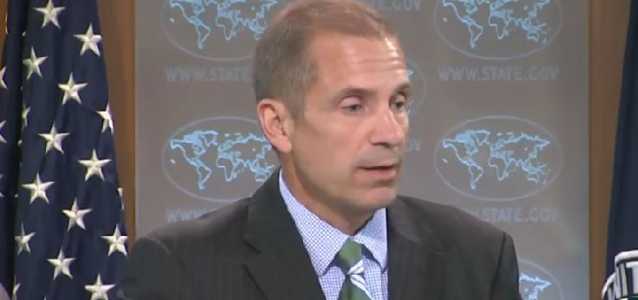
Under questioning from Fox News reporter James Rosen, State Department spokesman Mark Toner could not rule out that the deal “has served as a cause for this more aggressive posture” by the regime.

Rosen noted, Iran had recently threatened to shoot down two US Navy surveillance planes in international airspace. This was just the latest in a growing list of provocations, including taking 10 US sailors hostage and abusing them in violation of international law.

The New York Post editorial board was flabbergasted by the admission since if the Obama administration had even an inkling of this aberrant behavior on the part of the mullahs, it made no sense to continue a policy of appeasing them, including bending over backwards to ship the regime $1.7 billion in hard cash in exchange for American hostages.

The Post said that of course, after citing incidents that “needlessly escalate tensions” Toner then said it all makes the deal even “more important, because the last thing anyone would want to see in the region is a nuclear-armed Iran.”

“Especially, we’d add, an Iran grown even more aggressive and hostile precisely because of that very deal.

“The logic here is just mind-boggling.

“Yes, Iran has been emboldened by a deal that gives it billions in cash now and an easy road to going nuclear in a few years — thanks to a president who won’t dare challenge Tehran’s behavior and risk undoing his dubious diplomatic legacy.

“Nice to see someone finally admitting as much,” the Post added.

The Iranian regime isn’t taking the potential for blowback lightly. Iran’s semi-official ISNA news agency reports that the country’s foreign minister and his international counterparts will meet this month to discuss “some differences” over the implementation of the landmark nuclear deal.

The Wednesday report says they will focus on banking sanctions, which Iran complains have not been fully lifted. The meeting will take place Sep. 22, on the sidelines of the United Nations General Assembly, where the regime’s Hassan Rouhani is scheduled to speak in what we can only assume will be a verbal tongue lashing blaming the U.S. for a wide range of problems resulting from a now failed nuclear deal.

It has been clear from statements made by regime officials such as Ali Khamenei and members of the Iran lobby that the regime has shifted focus now to condemning the U.S. for the inability of the regime to participate in U.S. currency exchanges because of sanctions put in place for its support of terrorism and not related to the original nuclear deal.

The Iranian regime also recognizes that since the deal was passed, its conflict with Saudi Arabia, especially in Syria and Yemen, is stalling its plans for regional hegemony under a radicalized Shiite banner. The influence of Saudi Arabia in standing up to Iran including its active fighting in Yemen and interception of Iranian boast trying to smuggle illicit weapons through the Persian Gulf to Houthi rebels in Yemen has been effective and annoying to the mullahs in Tehran.

This helps explain why the Iranian regime has turned its attention and that of the Iran lobby into a full-blown smear campaign aimed at Saudi Arabia, and by association the U.S.

This can be seen in an editorial appearing in the New York Times penned by Mohammad Javad Zarif, the regime’s foreign minister, blaming Wahhabism and Saudi Arabia in particular for literally every terrorist act being committed around the world and chastised the Kingdom’s large lobbying efforts.

It is a preposterous piece since it blames Saudi Arabia for exactly what the Iranian regime is doing itself with its own substantial investment in PR firms, lobbyists, paid analysts, bloggers and commentators, as well as spreading cash to a large number of so-called grassroots organizations such as the Ploughshares Fund which strongly advocated for the nuclear deal.

Danielle Pletka, senior vice president for foreign and defense policy studies at the American Enterprise Institute, took Zarif to task and ticked off the Iranian regime’s own bloody history of support for terrorism around the world in a piece appearing on AEI’s site.

“It was the Islamic Republic that created Hezbollah and sponsored the groups that kidnapped and murdered Americans through Lebanon’s long civil war,” Pletka writes. “It is Iran that props up the murderous Assad regime — you know, the guys that have repeatedly gassed their own people. It is Iran that has assassinated its enemies the world over, and it is Iran’s own Islamic Revolutionary Guard Corps (and its expeditionary Quds Force) that was responsible, during the Iraq war, for hundreds of US servicemen dying.”

The first step in recovery for any addict is to admit they have a problem. We can only hope this admission by the State Department will be the first step in confronting the Iranian regime forcefully, honestly and openly again.

By Michael Tomlinson

Filed Under: Blog, News Tagged With: #NuclearDeal, Appeasement policy, Featured, Iran, Iran deal, Iran Human rights, Iran Lobby, Iran Mullahs, National Iranian American Council, Ploughshares, Sanctions, Trita Parsi, Yemen

Hassan Rouhani Begins Charm Tour Leading to UN Speech

September 13, 2016 by admin

Hassan Rouhani Begins Charm Tour Leading to UN Speech

Hassan Rouhani Begins Charm Tour Leading to UN Speech

The United Nations General Assembly Session over the years has been the scene of many speeches both famous and infamous. Some of the more memorable addresses by some infamous people include Venezuelan strong man Hugo Chavez in 2006, Libyan dictator Moammar Gadhafi in 2009 and Iranian regime leader Mahmoud Ahmadinejad in 2010.

It has been used as a platform to bully the world. It has been used to make extravagant accusations. It has been used to charm and lull the world into believing false narratives.

It has also been used to raise human rights issues. It has been used to advocate for peace, democracy and tolerance. It has been used to raise the hope for a world seeking to make a better place for the future.

The General Assembly exists to serve the aims of whoever chooses to speak and the annual general session is a free for all so world leaders can make their rhetorical claims on whatever topic they choose.

Into this platform has stepped Hassan Rouhani, the handpicked president of the Iranian regime who has used previous sessions to make lofty promises of openness, moderation and dedication to finding diplomatic solutions to intractable problems.

Unfortunately, the reality of the Iranian regime’s actions has never lived up to his rhetoric.

As recently as Rouhani’s address to the UN last year, he suggested that the nuclear agreement reached with Iran and world powers would help create the basis for broader engagement, in a speech that was noted for its departure from the strident tone of his boss, top mullah Ali Khamenei.

Last year Rouhani spent considerable time extolling the diplomatic success of the agreement, claiming it would lift years of painful economic sanctions on Iran in exchange for verifiable guarantees that its nuclear activities remain peaceful.

In the year since he gave that optimistic speech, relations between the Iranian regime and the rest of the world has plummeted to new lows. Among the regime low-lights since he gave his speech:

  • Iranian regime has stepped up arrests of dual-national citizens following the linking of releasing American hostages in exchange for $1.7 billion from the U.S.;
  • Iranian regime has expanded proxy wars in Syria, Iraq and Yemen through its continued support of terror groups such as Hezbollah and its recruitment of Afghan mercenaries and arming of Shiite militias and Houthi rebels;
  • The regime has continued development and test firing of ballistic missiles in defiance of UN restrictions, alongside being granted exemptions from the nuclear deal allowing it to maintain large stockpiles of heavy water and operating “hot cells” for the handling of nuclear materials;
  • Iranian regime has instituted large crackdowns against dissidents, students, journalists, ethnic and religious minorities, including knocking off the majority dissident and moderate candidates from parliamentary election ballots; and
  • Iranian regime stepped up open confrontations in the Persian Gulf with U.S. Navy warships, necessitating evasive maneuvers and even warning shots to be fired, even as the regime engages in a massive military build-up with purchases from Russia.

It has hardly been a year of peace and moderation as Rouhani claimed and the Iran lobby has argued for since the nuclear deal was reached.

A closer look at Rouhani’s travel itinerary shows his focus on a tour of designed to expand the regime’s sphere of influence into Latin America as he visits Venezuela this week.

At the UN General Assembly though, Rouhani’s task will be more difficult—not only because more people are likely disbelieve his assertions given the regime’s track record—but also that Khamenei may be finding Rouhani’s utility waning and the need for this particular puppet lessening.

Many analysts and Iranian dissidents have predicted that Rouhani’s selection in a purportedly rigged presidential election was designed to allow the regime to present a more genial and media-savvy face to open a rapprochement with the U.S. in order to secure a favorable deal alleviating the regime of crippling economic sanctions.

Now that the regime has been appeased through the nuclear agreement, the need for friendly regime face may be fading as Khamenei has indulged his desire for more aggressive confrontations with the U.S. and its allies.

Dr. Majid Rafizadeh, president of the International American Council, says a sign of that shift may come if Rouhani’s speech criticizes the U.S., highlighting Washington’s failure to let Tehran rejoin the financial global system.

Iran’s UN speech will most likely repeat Khamenei’s message, in a more diplomatic way, that the US has been “breaking oaths, not acting on their commitments and creating obstacles,” he said.

Rouhani’s speech is also unlikely to make any mention of the current hostages being held by the regime, including Nazanin Zaghari-Ratcliffe, a British-Iranian dual citizen, who was detained in April at Tehran’s Imam Khomeini Airport.

An Iranian court just handed down a harsh five year prison sentence on her, even though the exact charges have not been disclosed by the regime. Zaghari-Ratcliffe works at the Thomson Reuters Foundation, the charitable arm of the company that owns the Reuters news agency and her plight, along with other hostages such as Canadian professor Homa Hoodfar, have revived concern about the regime’s plans for more cash for hostage swaps.

As the Wall Street Journal editorialized in an opinion piece:

“One purpose of the harsh sentence is to remind Iranians in the diaspora tempted to return home in the wake of the nuclear deal that the regime sees them as traitors. It’s also no accident that the sentence came shortly after the U.K. upgraded its diplomatic relations back to ambassador level.

“Foreign Secretary Boris Johnson cheered the new opening to Tehran last Monday, only to receive a rude awakening days later. Now the regime has a new political and financial bargaining chip, and Mr. Obama has created a cash-for-hostages incentive system with his earlier ransom. Let’s hope the British government is wiser than to stuff briefcases with unmarked bills.”

The UN should plan on asking Rouhani the tough questions it didn’t ask him the last three times he spoke at the General Assembly.

By Michael Tomlinson

Filed Under: Blog, News Tagged With: Featured, General Assembly, hassan rouhani, Iran, Iran deal, Iran Human rights, Iran sanctions, UNGA

Holding Mullahs Accountable Should be Human Rights Priority

September 7, 2016 by admin

Holding Mullahs Accountable Should be Human Rights Priority

Holding Mullahs Accountable Should be Human Rights Priority

Whistleblowing is—by its very nature—a risky and sometimes hazardous activity to engage in, but it also is vital if any society is to be expected to be free and democratic. The U.S. has struggled with whistleblowers going back to the Pentagon Papers case with Daniel Ellsberg exposing the Vietnam War to the modern era with Edward Snowden and Julian Assange of WikiLeaks.

On the one hand we applaud people like them for exposing corruption or threats to democracy, but on the other hand we worry about national security or exposure of agents who might be caught and killed.

The strength of any free and open society though has been that exposing wrong doing, even if done for a worthy cause, eventually makes that society stronger. An informed public can hold its leaders accountable and for better or worse, the decisions they make are ones the public is responsible for eventually.

In dictatorial regimes though, whistleblowing is regarded with anathema, akin to treason and often prosecuted with the vigor of hunting down spies and traitors. In the case of the Iranian regime speaking out about any transgressions by the regime often gets you killed.

One case of Iranian whistleblowing involved Dr. Ramin Pourandarjani, who was an Iranian physician that examined prisoners who had been wounded or killed during the mass demonstrations against the stolen 2009 election.

He had worked at the Kahrizak detention center and was responsible for the medical care of several prisoners believed to have been tortured by regime officials. One of his patients was Mohsen Ruholamini, a government scientist’s son, arrested following his participation in the post-election protests.

Ruholamini, who was 25 years old, died in prison in July 2009. The death certificate originally identified Ruholamini’s cause of death as multiple blows to the head. A report given to judicial authorities stated that Ruholamini had died of “physical stress, the effects of being held in bad conditions, multiple blows and severe injuries to the body.”

Pourandarjani publicly testified about conditions at the center and following his testimony he was arrested by regime police. During his own imprisonment, Pourandarjani was repeatedly interrogated by an escalating range of regime agencies, after which he was released on bail, but was told to remain silent and received a stream of death threats.

He died under mysterious circumstances at the age of 26. Tehran’s public prosecutor’s office said he died of poisoning from a delivery salad laced with an overdose of blood pressure medication, but regime officials claimed at various points that Pourandarjani had been injured in a car accident, committed suicide, or died of a heart attack in his sleep at the health center at the police headquarters in Tehran where he worked.

That tradition of abusing whistleblowers was giving new life when the son of an Iranian cleric once in line to be supreme leader has reportedly been charged with acting against national security interests by releasing material from his late father that denounces senior Iranian figures for the mass killings of 30,000 dissidents almost 30 years ago.

After interrogation at a religious court in Qom, Ahmad Montazeri was released on bail of almost $23,000, and told to reappear on Wednesday, according to a report by the Iranian opposition group, National Council of Resistance of Iran/People’s Mujahedeen Organization of Iran, which claimed the vast majority of those massacred were affiliated with their groups.

Last month, Montazeri released an audio recording of a 1988 meeting between his father, Grand Ayatollah Hossein Ali Montazeri, and members of a so-called “death panel” charged with carrying out supreme leader Ayatollah Ruhollah Khomeini’s mass execution decree.

One of those on the “death panel” – and at the meeting featured on the audio file – was Mostafa Pourmohammadi, an official who has served in several cabinet positions over the years and was controversially appointed Minister of Justice by “moderate” Hassan Rouhani in 2013. In 1988 he was the intelligence and security ministry’s representative at Tehran’s notorious Evin prison.

“Standing up to the violations of human rights in Iran is also the responsibility of Western governments, because its consequences do not remain within Iran. The terrorism and fundamentalism emanating from it, have been hurting defenseless people in Nice, Paris, and Brussels,” said Maryam Rajavi, the leader of the NCRI at an event in Paris which included friends and relatives of those slain.

Bernard Kouchner, former French Foreign Minister and co-founder of Doctors without Borders (MSF) said: “I ask myself what were the human rights defenders doing at that time?” He called for a “special tribunal to prosecute the mullahs for their crimes.”

“The massacres did not take place only in 1988. Iran continues to have the highest execution rate per capita. The executions have even increased after the nuclear deal,” Kouchner added.

According to Mrs. Rajavi, since Rouhani took office over 2,700 executions have taken place Iran, including the latest, a mass execution of 25 Sunnis prisoners from Iranian Kurdistan.

The fact that the Iranian regime has willfully sought to suppress any dissent and execute those who publicly denounce its actions, means the regime acts with the impunity of a serial murderer that isn’t being hunted by law enforcement. The mullahs feel they can get away with the violence they dole out because the West has failed to hold them accountable.

The revelations by the NCRI of the composition of the infamous death panel in 1988 and how many of those same members have risen to hold important positions within the current regime shows how the promises of the Iran lobby of a new “moderate” regime in the wake of the nuclear agreement were all false.

Ultimately, the U.S. and its allies must no longer ignore the truth of these massacres, nor the willing participation of the mullahs now in power in Tehran to hide the truth from the world.

By Michael Tomlinson

Filed Under: Blog, News Tagged With: Featured, Iran, Iran deal, Iran Human rights, Iran Lobby, Maryam Rajavi, Moderate Mullahs

  • « Previous Page
  • 1
  • …
  • 11
  • 12
  • 13
  • 14
  • 15
  • …
  • 29
  • Next Page »

National Iranian-American Council (NIAC)

  • Bogus Memberships
  • Survey
  • Lobbying
  • Iranians for International Cooperation
  • Defamation Lawsuit
  • People’s Mojahedin
  • Trita Parsi Biography
  • Parsi/Namazi Lobbying Plan
  • Parsi Links to Namazi & Iranian Regime
  • Namazi, NIAC Ringleader
  • Collaborating with Iran’s Ambassador

Recent Posts

  • NIAC Trying to Gain Influence On U.S. Congress
  • While Iran Lobby Plays Blame Game Iran Goes Nuclear
  • Iran Lobby Jumps on Detention of Iranian Newscaster
  • Bad News for Iran Swamps Iran Lobby
  • Iran Starts Off Year by Banning Instagram

© Copyright 2026 IranLobby.net · All Rights Reserved.