Iran Lobby

Exposing the Activities of the lobbies and appeasers of the Mullah's Dictatorship ruling Iran

  • Home
  • About
  • Current Trend
  • National Iranian-American Council(NIAC)
    • Bogus Memberships
    • Survey
    • Lobbying
    • Iranians for International Cooperation
    • Defamation Lawsuit
    • People’s Mojahedin
    • Trita Parsi Biography
    • Parsi/Namazi Lobbying Plan
    • Parsi Links to Namazi& Iranian Regime
    • Namazi, NIAC Ringleader
    • Collaborating with Iran’s Ambassador
  • The Appeasers
    • Gary Sick
    • Flynt Leverett & Hillary Mann Leverett
    • Baroness Nicholson
  • Blog
  • Links
  • Media Reports

Iran Lobby Goes to Bat for IRGC and Ballistic Missiles

March 13, 2017 by admin

Iran Lobby Goes to Bat for IRGC and Ballistic Missiles

Iran Lobby Goes to Bat for IRGC and Ballistic Missiles

The twin pillars of the Iranian regime’s military future lies within the Revolutionary Guard Corps which puts boots on the ground to fight its battles and the development of intercontinental ballistic missiles capable of carrying out its biggest threats of global destruction.

They represent the center of power within the Iranian regime since without the IRGC to enforce its’ will, the mullahs in Tehran would be turned out like beggars in the streets by an oppressed Iranian people, while the threat of ballistic missiles hangs like a dagger over Europe and neighboring Arab countries.

It is no surprise then to see the Iran lobby going all out in pushing silly arguments in support of the IRGC and the regime’s missiles as evidenced by two pieces of fiction from the National Iranian American Council.

In one piece authored by Tyler Cullis and appearing in Foreign Affairs, the Iran lobby argues vehemently against designating the IRGC a “foreign terrorist organization, although many of its leaders and subsidiary commercial entities it controls have already been targeted for sanctions by the U.S. and other government for supporting terrorism.

Cullis argues that designating the IRGC would put “U.S. forces in Iraq” in danger and undermine the nuclear agreement reached with Iran, but Cullis argues against his own position when he readily admits that the IRGC is already heavily sanctioned because of its “Iran’s ballistic missile program, its human rights abuses around Iran’s June 2009 presidential election and its disruption and monitoring of Iranian citizens’ communications.”

He also calls any further sanctions a duplicate of current U.S. sanctions so why does he argue against this effort?

Because he knows, as does the rest of the Iran lobby, that designation of the IRGC as an organizational whole is vastly different that current sanctions which only target individuals within the IRGC and some entities. A designation of the whole effectively targets all of the criminal enterprises the IRGC is involved with that siphon monies away from the Iranian people and economy and directly into the coffers of the regime and the pocketbooks of the elites.

Cullis makes the same claim the Iran lobby has made over and over again which is that anything and everything needs to be done to preserve a badly flawed nuclear deal; including treating the chief sponsor of terrorism in Iran with kid gloves.

Cullis makes the absurd claim that Shiite militias controlled by the IRGC—which have been responsible for the deaths and attacks on American service personnel in Iraq through IEDs—would end up trying to frustrate American efforts against ISIS. It’s a claim so ridiculous that it doesn’t even deserve a response since we already know very well that Shiite militias already actively engage and fight American-backed forces and advisors in Iraq and Syria.

But the IRGC defense is only half the battle, as the NIAC’s Ryan Costello takes up the cause of defending Iran’s ballistic missile program in a briefing memo on NIAC’s website.

Costello bases his arguments on a lawyerly-like parsing of fine print to excuse Iran’s missile program, but ignores the intent of United Nations resolutions which seek to actively discourage Iran from becoming another North Korea. The fact that Costello is arguing against that development is deeply disturbing and indicative of how little the Iran lobby fears Iran’s crash course race to catch up to North Korea.

Where Costello falls in lock-step with his partner Cullis’ editorial, is in making the same silly argument that sanctions against ballistic missiles threatens the nuclear agreement. Using the same twisted pretzel logic virtually anything the mullahs dislikes threatens the nuclear agreement:

  • Protest the hanging of Iranian dissidents? That threatens the nuclear agreement;
  • Demand the freeing of American prisoners? That threatens the nuclear agreement;
  • Call for a halt to Iran’s support for Houthi rebels in Yemen? That threatens the nuclear agreement;
  • Force Iranian-backed Shiite militias to stop killing Sunnis in Iraq and Syria? That threatens the nuclear agreement;
  • Ask that Iran stop allowing its morality police to beat women on the streets? That threatens the nuclear agreement.

At a certain point, the NIAC’s logic becomes insanely stupid and that’s the point it has reached with Costello and Cullis’ propaganda pieces.

Costello even makes the excuse FOR the mullahs that Iran’s ballistic missiles program is “intrinsically” tied to its experience in the Iran-Iraq war and thus Iran has a right to these missiles to prevent any future attacks.

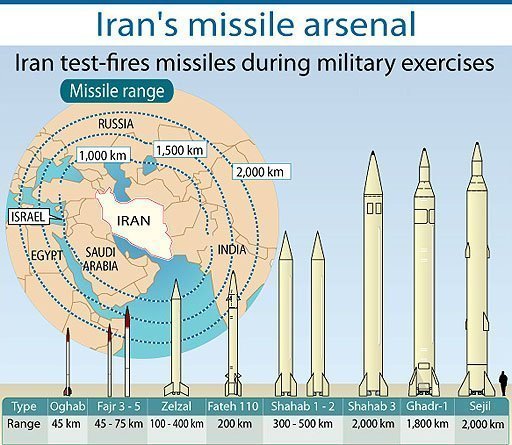
While Costello claims Iran has no interest in developing missiles with a range beyond 2,300 kilometers, he neglects to mention that allowing Iran to have a missile fleet with those ranges puts most of Europe, North Africa, the entire Middle East and virtually every important American military and naval base in the region in the crosshairs of Iranian missiles.

Neither Costello nor Cullis ever address the basic problem with their positions which is the lack of fundamental trust the world has in the religious leadership of Iran. The mullahs are fanatical in their pursuit of expanding the Islamic revolution and zealous in the crackdown of any dissenting opinions.

These heinous positions are illustrated in the decision over the weekend to sentence to death an Iranian and American-Iranian dual national on charges of promoting moral corruption.

The defendants, who have not been named, are believed to be a couple involved in the art industry who were arrested in July last year. They ran a leading art gallery in Tehran, the Iranian capital, and were known to associate with foreign diplomats, according to the Financial Times.

Iran has arrested several Iranians holding dual nationality in recent months in a move analysts suggest is intended to intimidate those associated with foreign businesses or who have social connections with foreigners, the Times said.

Abbas Jafari Dolatabadi, Tehran prosecutor-general, said on Sunday that the man and woman had been sentenced because they established “a new cult” and made “alcoholic beverages, encouraged vice . . . through throwing mixed parties [and] . . . exhibiting and selling obscene images at gallery”.

Laura Carnahan
Filed Under: Blog, Current Trend, News Tagged With: Featured, Iran Human rights, Iran Lobby, Iran Terrorism, IRGC, National Iranian American Council, NIAC, NIAC Action, Rouhani, Ryan Costello, Trita Parsi, Tyler Cullis

In Iran the Plight of Women Contradicts International Women’s Day

March 8, 2017 by admin

In Iran the Plight of Women Contradicts International Women’s Day

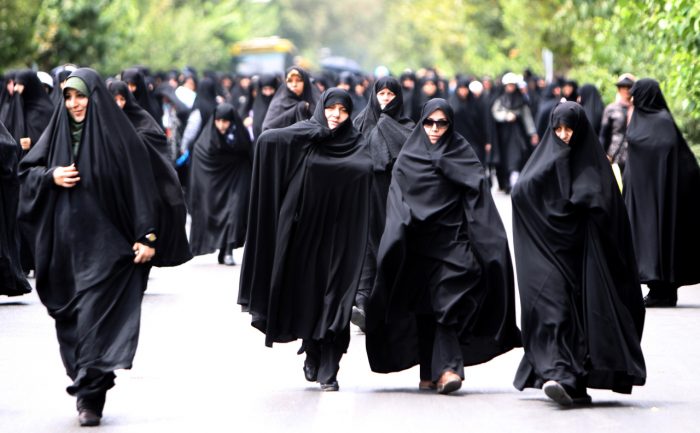
Iranian demonstrators march after weekly Friday prayers in Tehran on July 8, 2011 during a protest asking the government to intensify its crackdown on women and men to enforce the Islamic dress code. AFP PHOTO/ATTA KENARE (Photo credit should read ATTA KENARE/AFP/Getty Images)

The world is taking part in International Women’s Day in a myriad of ways; some of it commercial offering to donate $100 to the cause of your choice, and other’s political with marches planned in the U.S. protesting a wide range of issues from reproductive rights to opposition to administration’s policies.

Women the world over are gathering to reinforce their solidarity with their gender and to support issues of concern to them. It’s an annual spectacle that for many celebrates the freedom and opportunities women are now enjoying everywhere…except in the Iranian regime.

Although International Women’s Day has been around since 1908, its origins as a fight for equal pay and voting rights has morphed into the hashtag #IWD and lost some of its fervor. It’s also at times celebrated not as a call to political arms, but now used to tout corporate branding campaigns emphasizing a product or company’s openness to women.

Unfortunately, the harsh reality is that in many places in the world, women continue to be treated as second-class citizens or even property of their husbands and fathers. Nowhere is that more brutally explicit than in Iran where the ruling mullahs have consistently passed laws that would make any Western feminist breath fire in reaction.

The Iran lobby has tried to cover up this fact by praising window-dressing efforts to empower women in Iran, but those efforts have rung hollow in the face of escalating brutality aimed specifically at women.

Shahriar Kia, a political analyst and member of the Iranian opposition, the People’s Mujahedin Organization of Iran, outlined some of these practices in a piece for American Thinker.

“Iranian regime President Hassan Rouhani has recently been making remarks about women’s rights (!) in an attempt to cloak his portion of the Iranian regime’s misogynist report card,” Kia writes. “In his own memoirs, from page 571 to 573, Rouhani explains in detail how in 1980 he began enforcing mandatory hijab regulations as the mullahs began their historical campaign against Iranian women.”

Rouhani’s tenure has also been the hallmark home of systematic oppression against women, workers, college students, writers, journalists, dissident bloggers; imposing poverty and unemployment on a majority of Iranians; continuous threats made against the media; punishment of political prisoners have increased significantly even in comparison to the years of Iran’s firebrand Mahmoud Ahmadinejad. During Rouhani’s human rights violations-stained tenure, an average of two to three people have been executed on a daily basis, Kia adds.

The mistreatment of women in Iran extends also to non-Iranian women citizens as in the appalling treatment of Nazanin Zaghari-Ratcliffe, a British charity worker who was sentenced to prison for five years by a secret Iranian regime court and has been abused and denied much-needed medical care and given the option of only be able to see her child in prison.

Last year a UN body of human rights experts described her detention as “arbitrary” and said she had been denied a fair trial, according to the Telegraph.

This week, the UN released a new report on human rights in Iran, written by Asma Jahangir, the Special Rapporteur for Human Rights in Iran.

From the outset, it is clear that there has been no marked improvement in human rights in the Gulf nation, despite President Hassan Rouhani signing a Citizens’ Rights Charter in December 2016.

The 14,000-word report discusses both ongoing cases of abuse (like the execution of juveniles) and urgent situations (like the fate of political prisoners denied medical care).

Jahangir, who spoke to non-governmental organizations, intellectuals, lawyers and victims to ensure the accuracy of this report, also covers torture, the bias judicial system, free speech and women’s rights and clearly details just how far human rights, especially for women, have sunk in Iran.

For its part, the Iranian regime as usual blasted the UN report and defended the indefensible in its human rights situation.

In an address to a high-level meeting of the Human Rights Council in Geneva, Iran’s Deputy Foreign Minister Abbas Araqchi denounced a recent resolution raised in the council as “totally baseless and unacceptable,” claiming that political use of human rights by certain countries would pose a real challenge to the council’s goals and undermine and discredit the UN body, according to regime-controlled Tasnim News.

The UN report stated that “the Islamic Republic of Iran has reportedly executed the highest number of juvenile offenders in the world during the past decade. Despite an absolute ban on the practice under international law, the penal code continues to explicitly retain the death penalty for boys of at least fifteen lunar years of age and girls of at least 9 lunar years for qisas (retribution in kind) or hudud crimes, like homicide, adultery or sodomy.”

“The Special Rapporteur urges the Islamic Republic of Iran to take proactive steps to promote the full realization of the rights of human rights defenders and to refrain from any acts that violate the rights of human rights defenders because of their human rights work. The government should take strict measures to ensure that the security and intelligence apparatus does not use reprisals against families of those who monitor or campaign against human rights violations or express views that are contrary to government policies,” the report added.

Aside from the cruelty of human rights in Iran, which includes severe punishments for even minor infractions such as not wearing traditional hijab head coverings, Iranian women are denied economic growth and access to good paying jobs.

According to a Pew Research Center analysis of labor force statistics from 114 nations from 2010 to 2016, the median female share of a nation’s workforce was 45.4%, but in the case of Iran, women made up only a paltry 17.4% of the workforce, ranking near the bottom among all countries.

For all of the talk of empowerment and moderation in Iran by the regime and its Iran lobby supporters, the truth is dismal and the outlook for women even bleaker.

The next time women march for Women’s Day, it might be worth remembering the millions of Iranian women who are denied their futures and can’t even march in protest for fear of arrest and imprisonment.


Filed Under: Blog, News Tagged With: hassan rouhani, international Women's Day, Iran, Iran Lobby, Iran Terrorism, Khamenei, National Iranian American Council, Rouhani, Women's Day

Iranian Revolutionary Guard Corps Stands at Center of Terror

March 7, 2017 by admin

Iranian Revolutionary Guard Corps Stands at Center of Terror

Iranian Revolutionary Guard Corps Stands at Center of Terror

Like the beating heart of a wild animal, the Iranian regime’s Revolutionary Guard Corps stands at the center of almost every piece of chaos, violence and extremism happening in the Middle East today it seems.

The IRGC pumps the engine that powers all the arms of the Iranian war machine that results in terrible human rights abuses and proxy wars raging throughout the region. Its tentacles stretch into almost every part of Iranian society and have been well documented over the past three decades.

Its control of all aspects of Iran’s military and its leadership position in instigating almost every violent act militarily is impressive and deeply disturbing. Needless to say, its conducts warrants nary a word of protest from the Iran lobby. Not even the allegedly peace-loving Ploughshares Fund utters any protests over the IRGC’s worst military excesses.

Just recently, the Pentagon blasted the “unprofessional” behavior of the Iranian navy after two separate incidents in the Strait of Hormuz last week.

According to the Pentagon, an Iranian frigate on Thursday came within 150 yards of the civilian-crewed USNS Invincible.

Then on Saturday, a number of small assault craft came within 350 yards of the Invincible and other ships.

“This was assessed to be a combination of unsafe or unprofessional behavior,” Pentagon spokesman Navy Captain Jeff Davis said.

In both cases, the US ship had to change course to avoid any collision, he added.

According to Fox News, Iran test-fired a pair of ballistic missiles into the Gulf of Oman over the weekend as well. It was the first time Fateh-110 short-range ballistic missiles have been tested in two years. One of the missiles successfully destroyed a target barge at a range of 155 miles.

One of the missiles launched from the IRGC base in Bandar-e-Jask successfully destroyed a target barge at a range of 155 miles. The other missed its target. U.S. officials told Fox News the latest version of the Fateh-110 missile has an “active seeker” system that helps it target ships at sea.

The new Iranian short-range ballistic missile launches come a week after Iran successfully test-fired Russian surface-to-air missiles, part of the S-300 air defense system Russia sent to Iran recently.

According to the Foundation for Defense of Democracies, Iran has conducted as many as 14 ballistic missile launches since the landmark nuclear agreement in July 2015.

A senior U.S. military official told Fox News that Iran had made great advances in its ballistic missile program over the past decade.

Domestically, the IRGC also leads in the brutal crackdowns that have targeted political dissidents, journalists, artists, women and religious minorities.

The Center for Human Rights in Iran (CHRI) reported that two Iranian Catholic converts were arrested in their home by the IRGC in West Azerbaijan Province.

“At 7 a.m. on February 20 (2017), two plainclothes intelligence agents of the Islamic Revolutionary Guards Corps (IRGC) entered the home of Christian converts Anoohe Rezabakhsh and her son Sohail (Augustin) Zargarzadeh in Oroumiyeh (city) without prior notice and searched the premises and took away personal items such as religious and holy books,” Mansour Borji, the spokesperson for the Alliance of Iranian Churches known as Hamgam, told CHRI on March 3, 2017.

Despite President Hassan Rouhani’s pledges during his election campaign in 2013 that “all ethnicities, all religions, even religious minorities, must feel justice,” the targeting of Christian converts has continued unabated under his administration according to the CHRI.

The central role the IRGC plays in all of these actions means that its leaders are key players in the destabilization going on throughout the Middle East. As Dr. Majid Rafizadeh points out in an editorial in Arab News, the Quds Forces Qassem Soleimani could be called Iran’s “Osama Bin Laden” for his key role in directing much of this chaos.

“He is well-known as the Middle East’s deadliest and Iran’s most dangerous man. He prioritizes offensive tactics and operations over defensive ones, and rejoices in taking overconfident selfies with his troops and proxies in battlefields in many countries, including Iraq, Syria, Yemen and Lebanon,” Rafizadeh said. “When it comes to authority, he is Iran’s second man after Supreme Leader Ali Khamenei. Being a staunchly loyal confidante to Khamenei, Qassem Soleimani has great influence over foreign policy.”

“Soleimani commands at least 150,000 militants, many designated as terrorists and belonging to designated terrorist groups. This is why Iran has been repeatedly ranked as the top state sponsor of terrorism by the US State Department,” he added. “Based on my research, there are more than 250 terrorist groups worldwide, with different religious and sociopolitical backgrounds. Roughly 25 percent of them are funded, trained or supported by only one entity, the Quds Force.”

All of this is important as the Trump administration debates whether or not to designate the IRGC as a Foreign Terrorist Organization as a whole rather than simply designating individuals such as Soleimani.

No doubt the Iran lobby will raise its collective voices into another shrill call opposing any designation and warning of dire consequences, but this time the push back is coming strongly from many quarters.

Michael Tomlinson

Filed Under: Blog, News Tagged With: Featured, Iran, Iran deal, Iran Terrorism, IRGC, Khamenei, Sanctions

Iran Lobby Echo Chamber Banging Loudly for Iran Regime

March 5, 2017 by admin

Iran Lobby Echo Chamber Banging Loudly for Iran Regime

Iran Lobby Echo Chamber Banging Loudly for Iran Regime

It seems that the “echo chamber” created by members of the Obama administration and the Iran lobby is still alive and kicking and trying desperately to keep support flowing to the Iranian regime in light of increasing calls to get tough on Iranian regime because of its continued support for terrorism, brutal human rights abuses and flagrant violations of international sanctions with ballistic missile launches.

The Iran lobby, especially the National Iranian American Council, has been especially busy making excuses every time Iran hangs a dissident, puts down a protest or sentences a dual national to prison.

Many of those “experts” sympathetic to the regime and preserving the nuclear deal at all costs continue to push false narratives like a used car salesman pushing a clunker with a rolled back odometer.

One example is a piece authored by Jeffrey A. Sinclair in Foreign Affairs in which he argues that President Trump needs to strengthen Iran’s “moderates.”

“The goal should be to guard against any further escalation of hostilities. After all, unless the administration is willing to wage war with Iran, this confrontation won’t achieve anything useful for the United States. What it will do is further strengthen the hardliners in Tehran, a process that is already underway, and undermine moderates such as President Hassan Rouhani and Foreign Minister Mohammad Javad Zarif less than three months before Iran’s presidential election,” Sinclair writes.

Rarely has a paragraph been loaded with more inaccuracies than that one.

First of all, Trump has made it clear with his criticisms of the war in Iraq during the campaign that he is not in favor of nation-building by military force, but he has also made clear he was not going to offer a blank check to regimes such as Iran and Syria to do whatever they wanted since the end result of those kinds of actions has brought chaos to the Middle East.

Trump has laid out a belief that ignoring Iranian regimes’s militant actions does little to ensure regional stability and peace. Confronting the regime on issues such as human rights, proxy wars or provocative military acts are the right policy if Trump’s administration takes up that road, but saying that such a path only leads to war is one of the boldest falsehoods of the echo chamber.

Trump has at his disposal of plethora of tools, many used successfully by previous administrations, to force Iran to the bargaining table which is exactly what happened recently. The only problem was that the Obama administration fumbled the ball by caving in to every demand the Iranian mullahs had and getting little in return.

Contrary to Sinclair’s missives, confronting Iranian regime is exactly the right course of action since to do nothing except issue paper condemnations does nothing to rectify the situation. Using harsh language as Iran’s Quds Forces supply Houthi rebels in Yemen with arms so they can destabilize the country and risk a regional war between Saudi Arabia and Iran breaking out is not only bad foreign policy, it’s stupid.

Also, when Sinclair calls Rouhani and Zarif “moderates” the only polite thing to do is to keep from laughing hysterically out loud.

The only real moderates in Iran sit in Iranian prisons or have been driving out of the country as political refugees. As a religious theocracy, Iran’s mullahs maintain an iron grip on power. Rouhani did not become president to push a liberalizing agenda for reform. He was hand selected by Ali Khamenei to present the West with a more benign face in order to trigger negotiations to ease crippling sanctions.

The world is not going to see any competition during these upcoming presidential elections in Iran. Nothing is left to chance by the mullahs, which is why the vast majority of political dissidents, journalists, artists, filmmakers, students and anyone else stepping out of line has already been rounded up in advance of the elections.

“Because other U.S. and Western sanctions relating to Iran’s alleged terrorist activities remained in place, and because international banks remained highly skittish when it came to dealing with Iran, economic relief did not come quickly enough,” Sinclair said. “Overall, the administration made too few efforts to help Iran economically, as other terrorism-related sanctions were kept in place. The Obama team, it seemed, had taken its eye off the ball. U.S. Secretary of State John Kerry and others knew that Iranian moderates needed a post-deal economic boost to secure their position.”

This is another fallacious argument being made that the U.S. somehow was responsible for jumpstarting an Iranian economy that ranks almost dead last in the world in transparency and corruption. Also, since sanctions related to terrorism were not part of the nuclear deal, the U.S. and Trump are under no obligation to lift them, especially since Iranian regime regularly supports terrorist groups such as Hezbollah and Shiite militias responsible for wholesale slaughter of Sunni villages in Iraq.

Sinclair also criticizes discussions to designate Iran’s Revolutionary Guard Corps as a foreign terrorist organization and contends such a move would “escalate tensions.”

It’s hard to imagine how much worse tensions can get when Iranian regime’s navy detains American sailors, American citizens are being held in Iranian prisons and Iran’s proxies are causing the biggest refugee crisis since World War II.

Sinclair—and the rest of the Iran lobby—seems to place its collective hopes on the few wispy strands of less intensive anti-American actions than in the past as positive signs for change.

“For now, signs from Iran are somewhat positive. The yearly celebration of the founding of the Islamic Republic (expected to be a bonanza for the hardliners) turned out to be muted—excessively so, which was a clear sign of at least momentary moderation from the top leadership,” he writes. “In addition, a series of prominent hardliner clerics—including some of the leading clerics in Qom—have in recent days publicly expressed their support for keeping the nuclear deal in place.”

The claimed positive step is at a time that the Iranian regime test fired another Ballistic missile during this period and of course the mullahs are going to express support for the nuclear deal since its amounts to a giant ATM card the regime has been using to buy billions of dollars in new weapons from Russia.

These are not encouraging signs no matter what the echo chamber says and it’s about time we ignore it.

Michael Tomlinson

Filed Under: Blog, Current Trend, News, The Appeasers Tagged With: echo-chamber, Featured, Iran deal, Iran Human rights, Iran Lobby, Iran Terrorism, Jeffrey A. Sinclair, National Iranian American Council, nuclear talks, Rouhani, Sanctions, Sinclair

Hypocrisy of Iran Lobby Extends to Criticizing Trump Speech to Congress

March 1, 2017 by admin

Hypocrisy of Iran Lobby Extends to Criticizing Trump Speech to Congress

Hypocrisy of Iran Lobby Extends to Criticizing Trump Speech to Congress

There is no doubt that President Donald Trump is a polarizing figure and has become a lightning rod for criticism for everything ranging from his affinity for tweeting to his policies such as his roll back of regulations and imposition of a temporary moratorium on visas from several countries in the Middle East.

The jury is still out on much of his agenda since he has yet to collaborate with Congress to bring forth specific legislative proposals, but that has not stopped the torrent of criticism being directed at him by the Iran lobby as it works to oppose anything that might be perceived as upsetting the goals and plans of the mullahs in Tehran.

This was true when Iran lobby advocates such as the National Iranian American Council’s Trita Parsi blasted Trump’s decision to impose fresh sanctions on members of the regime’s Revolutionary Guard Corps for its support for ballistic missile launches that violated United Nations sanctions.

It has also been true of the Iran lobby’s efforts to deflect attention away from the Iran regime’s litany of problems at home with increasing mass demonstration and protests to issues abroad as it encounters growing calls for resistance amongst its Sunni neighbors such as Saudi Arabia and the Gulf States; alarmed at the turmoil surrounding them caused by the Iranian regime.

The Iran lobby has been particularly focused on the debate over Trump’s immigration policies leveraging it to its advantage to raise funds and maintain its ties to progressive Democratic groups that it previously aligned with in the efforts to support the Iran nuclear deal.

The reasons for these efforts are simple: In a post-Obama world, the Iran lobby is desperately trying to stay relevant.

Since the electoral sweep that not only saw Trump elected, but also radically changed the complexion of the Congress, the Iran lobby has been on the defensive ever since. It has found little support within the much-vaunted “echo chamber” of support previously cobbled together to help push for negotiations with the regime.

Iranian regime’s ever growing militant actions in launching ballistic missiles, supplying proxy wars in Yemen and Syria and flexing its military muscle in expansive war games have proven to be almost impossible for the Iran lobby to defend.

Predictably, after President Trump’s first address to a joint session of Congress, the NIAC’s Jamal Abdi sent out a statement criticizing the speech, but in his criticism he revealed the bias and hypocrisy of the NIAC and the Iran lobby.

Abdi makes the claim that “no Iranian has ever been implicated in a terrorism-related death inside America,” which is a convenient distinction since it ignores the fact that the Iranian regime has been directly responsible for the deaths of hundreds of Americans in terrorist attacks in Beirut, Lebanon, the Khobar Towers in Saudi Arabia and in IED attacks throughout the Iraqi war.

In each case, Iranian regime controlled, supplied, participated or directed the attacks directly resulting in the deaths of Americans. In fact, several court decisions have held the Iranian regime responsible for these deaths and injuries and confiscated financial assets of the regime as part of court settlements to the victims and their families.

Abdi also fails to mention the violence fueled by the Iranian regime’s efforts to export its brand of extremist Islamic vision that has sparked sectarian violence between Sunnis and Shiites all across the Middle East, including the Syrian civil war, the Houthi coup attempt in Yemen and the expansion of ISIS arising out of the dissolution of the coalition government in Iraq.

All of these debacles were fueled by the Iranian regime and have cost the lives of hundreds of thousands of men, women and children and Abdi and his colleagues have remained stonily silent.

But the hypocrisy of criticizing Trump’s policies while ignoring the much harsher realities of the regime’s policies echoes the same treatment given by regime foreign minister Mohammad Javad Zarif who lauded the protest by Iranian filmmaker Asghar Farhadi who won the Oscar for best foreign film against Trump’s immigration policies, yet at the same time did not acknowledge the regime’s imprisonment and torture of several prominent Iranian filmmakers for engaging in acts against the Islamic state.

The rank hypocrisy of the Iranian regime and Iran lobby was taken to task by prominent journalists such as CNN anchor Jake Tapper and Human Rights Watch.

“Farhadi’s movie deserves the praise it has received – and much more. Iranian cinema has a long-established and well-earned reputation for providing a powerful, nuanced perspective into Iranian society,” said Sarah Leah Whitson, executive director for Human Rights Watch’s Middle East and North Africa Division in an editorial. “Yet while Iranian officials bask in pride on the international stage, their rhetorical support does not translate into respect for filmmakers at home, where they have harassed and jailed movie directors and other artists for work they find displeasing.”

“In the aftermath of the 2009 presidential elections, authorities arrested Jafar Panahi, a prominent director, for allegedly attempting to make a movie about protests that followed the vote. In December 2010, Tehran’s revolutionary court sentenced Panahi to six years in prison and a 20-year ban on all his artistic activities. Following international outcry, the government did not execute Panahi’s sentence but kept the ban in place, forcing him to make movies without an official permit,” Whitson added.

“These filmmakers could serve as powerful messengers for the diversity and talent in Iran today. But until the authorities stop censoring and imprisoning them, they put into question the Iranian government’s expressed commitment to supporting the country’s millennia of “culture & civilization,” she warned.

Michael Tomlinson


Filed Under: Blog, News Tagged With: Iran Mullahs, Iran Terrorism, IRGC, Jamal Abdi, National Iranian American Council, NIAC, NIAC Action, Nuclear Deal, Syria, Trita Parsi, Yemen

Academy Awards Shocker Came From Iran Regime Comments Not Best Picture Gaffe

February 28, 2017 by admin

Academy Awards Shocker Came From Iran Regime Comments Not Best Picture Gaffe

Academy Awards Shocker Came From Iran Regime Comments Not Best Picture Gaffe

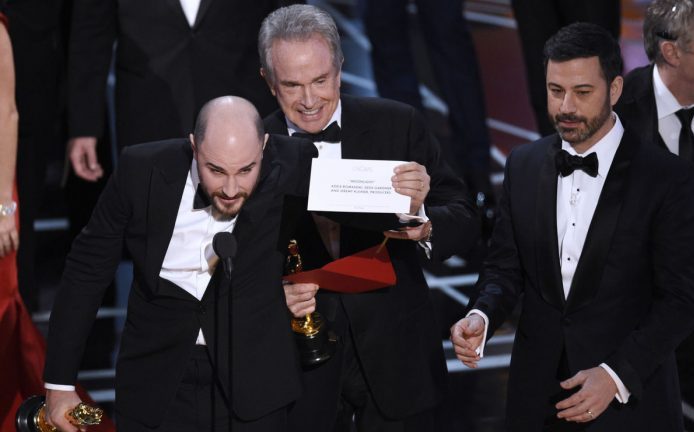
Pretty much the entire planet has seen or heard about the mistaken Best Picture announcement for “La La Land” only to find out that “Moonlight” had indeed won instead in a mistake that put Steve Harvey’s mistaken Miss Universe crowning to shame.

Aside from the stunned faces of the audience at the Dolby Theatre in Hollywood, the moment became an instant viral sensation as social media buzzed about the historic mistake, but the real shocker came a day later when the Iranian regime’s foreign minister Mohammad Javad Zarif lauded comments made by the cast and crew of the film “The Salesman” which won an Oscar for best foreign film critical of the Trump administration’s immigration visa moratorium.

Zarif tweeted out his own congratulations for the statement read for Iranian film director Asghar Farhadi who chose to stay away from the 89th Annual Academy Awards ceremony in protest over President Trump’s travel ban.

“Proud of cast & crew of ‘The Salesman’ for Oscar & stance against #MuslimBan. Iranians have represented culture & civilization for millennia,” said Zarif’s tweet.

Zarif’s tweet was met by a blistering series of responses from CNN anchor Jake Tapper who took Zarif to task for lauding an Iranian filmmaker while the regime regularly imprisons other dissident Iranian filmmakers.

On Monday, Tapper tweeted how Iran has treated filmmakers in the past, which included long jail sentences and not being permitted to leave the country for decades, according to the Daily Caller.

Tapper went on to list several prominent Iranian filmmakers who are languishing in regime prisons.

“2/Iran regularly jails its filmmakers. Such as Keywan Karimi guilty of ‘insulting sanctities’ in October 2015,” he tweeted.

“3/Jafar Panahi was sentenced to six years in prison for trying to make an ‘antiregime’ documentary,” he continued.

“4/Documentary filmmaker/women’s rights activist Mahnaz Mohammadi was jailed for collaborating with the BBC,” he added.

“5/ Musician Mehdi Rajabjan and filmmaker Hossein Rajabian were jailed for “insulting Islamic sanctities,” he tweeted.

“6/ So FM @JZarif? The traditions of your brilliant people are being oppressed by the tyranny of your government. Tweets notwithstanding,” Tapper concluded.

Tapper correctly points out the hypocrisy of the Iranian regime when it lauds comments that support its propaganda efforts, and yet deals harshly with anyone caught criticizing the regime of stepping outside of approved cultural or moral norms.

All of which makes comments made by top mullah Ali Khamenei earlier this month even more interesting when seen in the light of Zarif’s tweets.

In a speech in the East Azerbaijan region of Iran, Khamenei said that a war on Iran’s culture and economy is more dangerous to his Islamic regime than any military threat from the West, according to Breitbart News.

“A European official said to our officials that a war in Iran would have been inevitable if it had not been for the Bar-Jaam,” Khamenei said, referring to the nuclear agreement brokered by the Obama administration and Western allies. “That official said that if the Bar-Jaam had not been signed, the war would have been definite.”

“This is a blatant lie!” Khamenei said in the speech. “Why do they speak about war? They do so because they want to switch our minds to a military war, but the real war is something else.”

“The real war is an economic war, the real war is the war of sanctions, the real war is the arenas of work, activity, and technology inside the country,” Khamenei said. “This is the real war!”

“They draw our attention to a military war so that we ignore this war,” Khamenei said. “The real war is a cultural war.

“There are so many television and internet networks which are busy diverting the hearts and minds of our youth away from religion, our sacred beliefs, morality, modesty and the like,” Khamenei said.

In this regard Khamenei is correct since what the mullahs abhor more than anything else is free and independent thinking it seems. Free expression and divergent opinion is met with a fury from the mullahs akin to a full scale invasion; except for the ruling mullahs an invasion of ideas seems to be more dangerous than U.S. Marines landing on the beaches of Iran.

This also explains why the regime has always been especially brutal in its crackdowns of artists, journalists, bloggers and filmmakers as a means of controlling public discourse and the flow of creativity among the Iranian people.

It also explains why the regime has worked so hard at restricting access to social media platforms and web sites judged to have anti-regime materials on it.

Inevitably though, the slow creep of the arts have proven to be a strong antidote to totalitarian thinking and we can only hope that the Academy Awards will one day be celebrating the work of an Iranian filmmaker who know sits in prison.

Laura Carnahan

Filed Under: Blog, News Tagged With: #NuclearDeal, Featured, Iran deal, Iran Human rights, Iran Mullahs, Iran Terrorism, IRGC, Rouhani

Only Language Iran Regime Understands is Bullying

February 23, 2017 by admin

Only Language Iran Regime Understands is Bullying

Only Language Iran Regime Understands is Bullying

In some ways, the Trump administration may be as vexing to the mullahs in Tehran as the first British explorers glimpsing hieroglyphics in an Egyptian pyramid before discovering the Rosetta Stone.

In that regard, the mullahs are grappling with the same problem mystifying many journalists and members of both parties as they deal with a president who is undoubtedly one of the most unfiltered politicians since Winston Churchill.

For the mullahs, they have become accustomed to a string of U.S. leaders that have tried to engage the regime in the predictable language of diplomacy and through existing international structures such as the United Nations. Sometimes it has not worked to their advantage such as when Presidents Bill Clinton and George W. Bush imposed sanctions on the regime.

Other times it has as President Barack Obama sought to try and appease the mullahs in an effort to secure a nuclear agreement.

What has been clear from the start is that since the days of the Islamic revolution in 1979, the ruling clerics have operated by using a language of threats, coercion, bullying and invective and it has not changed since then.

For the Iranian regime, using bullying to make a splash in international media is akin to North Korea launching a missile or setting off a nuclear bomb test.

The latest example was at the conclusion of a new round of war games put on by the Revolutionary Guard Corps in which an IRGC commander said the U.S. should expect a “strong slap in the face” if it underestimated the regime’s military capabilities.

“The enemy should not be mistaken in its assessments, and it will receive a strong slap in the face if it does make such a mistake,” said General Mohammad Pakpour, head of the Guards’ ground forces, quoted by the Guards’ website Sepahnews.

On Wednesday, the Revolutionary Guards concluded three days of exercises with rockets, artillery, tanks and helicopters, weeks after Trump warned that he had put Tehran “on notice” over the missile launch.

“The message of these exercises … for world arrogance is not to do anything stupid,” said Pakpour, quoted by the semi-official news agency Tasnim.

“Everyone could see today what power we have on the ground.” The Guards said they test-fired “advanced rockets” and used drones in the three-day exercises which were held in central and eastern Iran, according to Reuters.

But the Iranian regime didn’t just take verbal potshots at the U.S., it also has been ratcheting tensions with its neighbor Turkey as it takes on a more important relationship with Russia and secured a seat at the table of Syrian peace talks; clearly a move that the mullahs seem to be threatened by.

“Iran is an important neighbor to us. We have always been in dialogue with Iran. But it does not mean we will ignore Iran’s efforts in penetrating the region,” said Turkish presidential spokesman Ibrahim Kalin in the latest thinly veiled threat between the countries during his weekly news conference.

Kalin was responding to comments by Ali Akbar Velayati, a key adviser to Iranian Supreme Leader Ayatollah Ali Khamenei, who told Turkish soldiers to leave Iraq and Syria, or the people would “kick them out.”

“They are very serious, I mean the competition between Iran and Turkey, everyone knows it, it’s like two elephants in a small room,” warns political consultant Atilla Yesilada of Global Source Partners. “Iran is clearly an expansionist country, their goal of building a Shia circle all the way from Tehran to Lebanon is no secret, at least from the Turkish perspective.”

Experts say religious sectarianism underscores the tensions between predominantly Shia Iran and mostly Sunni Turkey, according to Voice of America News.

The escalation in tensions and verbal fisticuffs with Turkey is nothing new for the Iranian regime as it has already threatened its other Sunni-dominant neighbors in Saudi Arabia and Gulf States. Its supply of Houthi rebels in Yemen has sparked a civil war that threatens to plunge the Persian Gulf region deeper into a shooting war.

The Iranian regime’s willingness to use military force to back up its verbal threats has not been lost on its nervous neighbors and explains why there is movement for a regional coalition aligned against Iran’s expansionism.

Turkish president Recep Tayyip Erdogan has been turning to other Sunni countries in the region for support. This month, he visited Saudi Arabia and the Gulf States for talks observers say focused on curtailing Iran’s influence. Analysts suggest Ankara’s assertive stance could be influenced by U.S. President Donald Trump.

“With Trump, flexing his muscles against Tehran, Ankara may have sensed an opportunity to bring this antagonism into the open and to finally resolve this longstanding low level conflict in Syria and Iraq space,” suggests consultant Yesilada.

None of which has stopped the Iranian regime from pushing aggressively on all fronts including news reports that the regime has started up a series of cyberattacks against Saudi Arabia after a four year hiatus.

Late last month, the Saudi government warned in a notice to telecommunications companies that an Iranian-origin malicious software called Shamoon had resurfaced in cyberattacks against some 15 Saudi organizations, including government networks, according to the Washington Free Beacon.

The Shamoon malware was last detected in the 2012 cyberattack against the major Saudi state oil producer Aramco. That cyberattack damaged or destroyed some 30,000 computers and was considered one of the more destructive state-linked cyberattacks to date.

A State Department security report issued Feb. 10 stated that the 2012 attack destroyed over three-fourths of Aramco’s computers, and that the damage took five months to mitigate at “an extreme cost.”

Shamoon also was used in Iranian cyberattacks against RasGas, a liquified natural gas company located in neighboring Qatar.

A new version of the malware, Shamoon 2, was linked to the recent cyberattack, which took place in November. Security officials linked that attack to a Middle East hacker group known as Greenbug that used fraudulent emails in phishing scams to acquire login credentials for Saudi networks.

The Iranian regime is clearly speaking the same language it has always used and it’s time for the rest of the world respond in kind.

Michael Tomlinson

Filed Under: Blog, News Tagged With: Featured, Iran Mullahs, Iran sanctions, Iran Terrorism, IRGC, Sanctions, Syria

Iran Regime Does Away With Moderate Façade

February 16, 2017 by admin

Iran Regime Does Away With Moderate Façade

Archive-Iran Regime Does Away With Moderate Façade

The old adage goes “judge me by my deeds, not my words.” It’s appropriate to apply it to the Iranian regime when weighing how to react to the Islamic state. In the case of the new Trump administration, it is becoming increasingly easy to figure out what is motivating the mullahs in Tehran.

The Iran lobby, most notably the National Iranian American Council, has always made the argument to ignore the rhetoric and judge Iran by its people and the “moderates” struggling to gain control of the government.

Notable Iran lobby advocates such as NIAC’s Trita Parsi have literally yelled from the rooftops that Iran was not really interested in confrontations with the U.S. and only wanted a new friendly relationship. It was this slippery slope the Obama administration fell down in acquiescing broadly to the demands of the mullahs in crafting a nuclear deal separate and apart from placing conditions on things such as support for terrorism and abusive human rights.

Unfortunately, virtually none of those promises have come to pass and in the face of a Trump administration that has opted for an aggressive posture towards Iran with newly announced sanctions and the appointment of several vocal regime critics in key cabinet positions, the mullahs seem to have finally decided to drop the charade and stop trying to portray themselves as moderates.

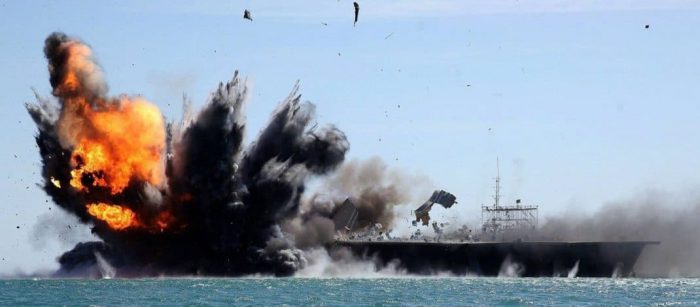
The latest evidence of that came in the form of a full-length animated film depicting an armed confrontation between Iran’s Revolutionary Guards and the U.S. Navy soon to open in Iranian cinemas.

According to Reuters, the director of the “Battle of Persian Gulf II”, Farhad Azima, said that it was a remarkable coincidence that the release of the film – four years in the making – coincided with a “warmongering” president sitting in the White House.

“I hope that the film shows Trump how American soldiers will face a humiliating defeat if they attack Iran,” Azima told Reuters in a telephone interview from the city of Mashhad in eastern Iran.

The 88-minute animation opens with the U.S. Army attacking an Iranian nuclear reactor, and the U.S. Navy in the Gulf hitting strategic locations across the county.

In the film, the IRGC retaliates by raining its ballistic missiles on U.S. warships.

“They all sink and the film ends as the American ships have turned into an aquarium for fishes at the bottom of the sea,” Azima said.

The main Iranian commander in the film has been intentionally depicted as Qassem Soleimani, the notorious IRGC commander who is overseeing Iran’s military operations in Syria and Iraq against Islamist militants and was designated a supporter of terrorism by the U.S. for his role in coordinating the manufacture and delivery of IEDs to Iranian-controlled Shiite militias in Iraq targeting U.S. personnel.

Soleimani was reportedly seen arriving in Moscow earlier this week in violation of sanctions restricting his travel. He has been to Moscow several times ignoring his travels bans on Iranian airlines to discuss military operations in Syria with Russian officials. His direct pleas have been widely regarded as key to persuading Russia to enter the conflict in order to save the faltering Assad regime.

This is Soleimani’s third trip to Moscow following visits in April and July 2015. Soleimani is thought to be the mastermind behind Iran’s proxy war in Syria in order to prop up the Assad regime. Soleimani met with Russian President Vladimir Putin and Russian Defense Minister Sergei Shoigu days after the Iranian nuclear deal was agreed to in Vienna.

According to Fox News, Soleimani was in Moscow to register the mullahs’ displeasure with Russia’s relationship with Iran’s regional foes, specifically the sale of Russian military equipment to Saudi Arabia and other Arab states.

Lest we forget, the Iranian regime has steadily increased the tempo of bell`igerent actions since the nuclear deal, including the detention and parade of American sailors, widening of the wars in Iraq, Syria and Yemen, and a steady stream of propaganda efforts including the routine “Death to America” depictions as well as the launching of increasingly more powerful ballistic missiles.

The latest disclosures of the IRGC’s operation of a vast network of training camps for its own and foreign fighters to be deployed in conflicts abroad by a network of Iranian dissident groups only solidifies the argument that the Iranian regime is done with the pretense of trying to be a more moderate nation.

The dissident groups, led by the National Council of Resistance of Iran, have issued calls for the IRGC to be designated a Foreign Terrorist Organization as a whole.

Iran already is part of the U.S. State Department’s State Sponsors of Terrorism list, along with Syria and Sudan. However, new calls are coming from leading critics of the regime to designate the IRGC as a foreign terrorist organization – and the Trump administration is said to be considering that.

“The people of Iran would welcome the designation of the IRGC, which is responsible for thousands of political executions and tortures in prison. It is also responsible for training terrorists supporting and engaging in terrorist activities outside Iran,” said Maryam Rajavi, the leader of the NCRI, which is the largest Iranian opposition group.

“I believe the time has come for a firm policy on Iran. The failed policy of appeasement has hurt the Iranian people, as well as global peace and security,” she said.

To emphasize the suffering of the Iranian people under the mullahs’ medieval rule, news reports came out of a 14-year old girl suffering a savage beating by the regime’s morality police for wearing ripped jeans.

Zahra*, who The Independent is not identifying for fear she may suffer reprisals, was celebrating her birthday with friends last week when a patrol of “morality police” pulled up.

The teenager said officers tried to force her and her friends into their car in the city of Shiraz, beating them when they resisted.

“There were two women and two men in a huge van and they pushed us into it with the force of their beatings,” she recalled. “Their objection was to the ripped jeans that we were wearing. There were really no other issues concerning my friends and I.”

“I still carry the bruises sustained from their beatings on my face,” she said. “I still feel their pressure on my arm and my ribs still hurt.”

In an exclusive interview with The Independent, her mother described the ordeal as “the worst day of my life, as if the world has ended for me”.

Rules are enforced by thousands of visible and undercover religious or “morality” police, who patrol the streets to check for violations.

Women found to have their hair or bodies inadequately covered can be publicly admonished, warned, fined or even arrested, while vigilantes are also active.

This is why any discussion of a moderate Iran under its current leadership is simply another case of “fake news.”

Laura Carnahan

Filed Under: Blog, News Tagged With: Featured, Iran Mullahs, Iran Talks, Iran Terrorism, IRGC, Moderate Mullahs, Nuclear Deal, Rouhani

Case For Designating the IRGC as Terrorists Builds

February 15, 2017 by admin

Case For Designating the IRGC as Terrorists Builds

Case For Designating the IRGC as Terrorists Builds

Momentum continues to build for the U.S. to designate the Iranian Revolutionary Guard Corps a Foreign Terrorist Organization as a whole. Much of that momentum stems from the IRGC’s own actions over the years in supporting terrorism worldwide as well as initiating, supplying and controlling many of the proxy wars breaking out throughout the Middle East.

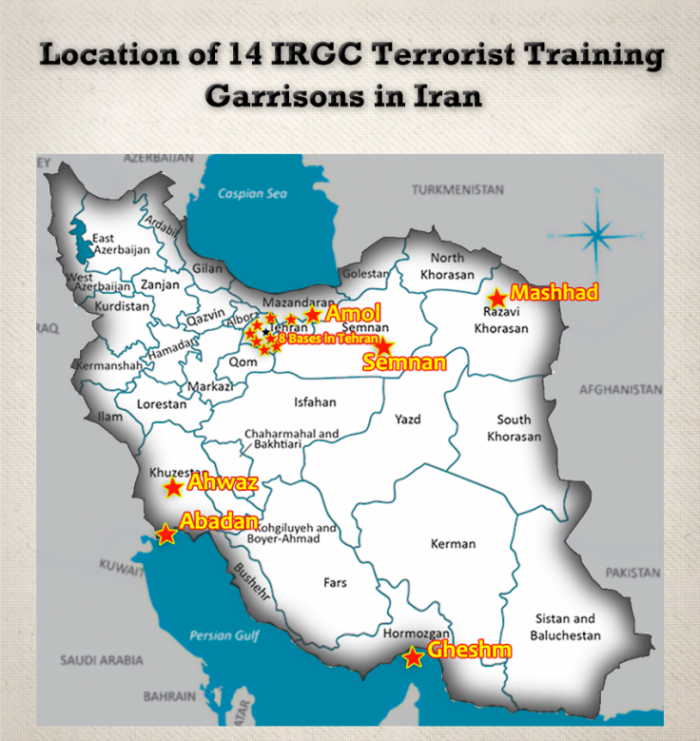
Even though there has already been well-documented disclosures about the IRGC’s illicit activities, new information continues to come to light as was the case on Tuesday when the National Council of Resistance of Iran (NCRI), a leading global organization of Iranian dissident and human rights groups, held a press conference in Washington, DC to disclose details of the IRGC’s terrorist training activities.

Alireza Jafarzadeh, deputy director of the Washington Office of the NCRI, presented information to reporters gathered by the social network of the People’s Mojahedin Organization of Iran, a dissident group located inside Iran. He said that information shows that since 2012, the NCRI has seen an increase in the training of foreign nationals in its terrorist training camps, which threatens a wide scope of countries, not just those beset by conventional warfare.

Using intelligence gleaned from sources within Iran, the NCRI claimed that the IRGC had created a training command operating dozens of military bases across Iran specializing in all aspects of warfare with units divided by national origin and specialization such as missile and naval operations to insurgency and urban warfare.

The IRGC that is answerable only to the Iranian regime’s top mullah, Ali Khamenei. It specializes in insurgency and guerilla tactics and is notorious for having supplied most of the IEDs used by Iranian-controlled Shiite militias in Iraq targeting U.S. and foreign troops; resulting in the deaths and wounding of thousands of Americans.

The IRGC was the initial unit that came to the rescue of the Assad regime in Syria as it teetered on the brink of collapse by smuggling in weapons and cash, as well as recruiting and directing Hezbollah fighters. It eventually expanded its role to include Iranian military, as well as the recruitment of Afghan mercenaries and deployment of Shiite militias from Iraq.

According to the NCRI, every month, hundreds of forces from Iraq, Syria, Yemen, Afghanistan and Lebanon — countries where the regime is involved in frontline combat — receive military training and are subsequently dispatched to the various frontlines. For operations in countries where there is no open warfare – including Persian Gulf countries, such as Bahrain and Kuwait – terrorists cells are trained instead.

The NCRI highlighted 14 IRGC training camps, as well as described the command structure, detailing how the commander of the Training Directorate, reports directly to Quds Force Commander, Qassem Soleimani.

Terrorist training for operatives from across the globe is commanded by Colonel Tahmasebi. Codenamed ‘320’, the commander of heavy weapons training at Imam Ali military base is Colonel Ali Mohammad. In charge of ‘VIP Security’ is Colonel Ramky, the NCRI said.

The sheer scale of the Training Directorate’s efficiency in producing fighters is underscored by the fact that just one of its training camps is currently sending 2,000 Afghans to Syria every week, according to the NCRI.

“The IRGC is actually the entity that runs the whole show when it comes to terrorism,” even though they are spearheaded by the Quds force, Jafarzadeh said. “You cannot do the separation. You cannot have the Quds force designated as a terrorist entity, but not the IRGC.”

Jafarzadeh said there is bipartisan support in Congress for the designation of the IRGC as a terrorist group, and suggested that with the new Trump administration, there is “a better possibility for those measures to move forward.”

The disclosures by the NCRI are significant since they provide first-hand and eyewitness accounts of the IRGC and Quds Force activities as it relates to the active support of terrorism and terror-related operations. It also points out with disturbing clarity the efforts by the Iranian regime to ramp up its military activities outside of its borders during the time it sought to portray itself as a “moderate” nation intent on resolving disputes peacefully.

Another example of those destabilizing activities has been the IRGC’s initiation of the revolt in Yemen with Houthi rebels supplied by IRGC forces; mostly smuggled aboard non-descript fishing boats in the Gulf of Aden.

Many of these ships have been intercepted and weapons confiscated by Saudi Arabian and Gulf State warships; the arms eventually traced back to Iranian factories.

Sanam Vakil, Ph.D an Associate Fellow at Catham House told IBTimes UK that the PMOI report spoke to the extent of the IRGC’s training scheme, although she could not independently verify the numbers.

“What I take from this is that this is a very sophisticated operation,” Vakil said. “Iran’s strategic strength is in a-symmetrical proxy relationships. Its conventional military is weak particularly in Iraqi and Syria they have had success in the past. Of course we also know they are the God Parents of Hezbollah.”

It is becoming increasingly clear that in order to effect the growth of Islamic-inspired terrorism abroad, the restraint of the IRGC will be a key factor. Designating it a FTO would be an important step in the right direction.

Michael Tomlinson

Filed Under: Blog, News Tagged With: Featured, Iran, Iran deal, Iran Human rights, Iran Mullahs, Iran Terrorism, IRGC, Khamenei, Syria, Yemen

Rebuilding the Global Coalition Against Iran

February 14, 2017 by admin

Rebuilding the Global Coalition Against Iran

Rebuilding the Global Coalition Against Iran

The early days of the Trump administration have offered opponents of the Iranian regime hope that a significant change in U.S. policy towards the Islamic state will presage a similar shift in global opinion towards the mullahs in Tehran.

If we reset back to when the first talks took place over Iran’s nuclear program, the unity amongst the international community was one of the hallmarks of forcing the regime to the bargaining table in the first place.

Three consecutive American presidential administrations imposed ever growing harsh sanctions on the regime. Coupled with the sinking Iranian economy due to gross mismanagement and corruption, the regime was brought to the bargaining table in a position of weakness. The mullahs recognized this in rigging a presidential election to install Hassan Rouhani as a benevolent “moderate” face following the much-reviled Mahmoud Ahmadinejad.

Unfortunately, instead of seizing the opportunity to effect significant changes to the regime’s conduct—especially its brutal human rights record and support for terrorism—the P5+1 group of nations, led by the Obama administration, picked the appeasement policy as its policy forward and folded like a cheap suit in caving to regime demands.

Gone were any restrictions on Iran’s ballistic missile program. Say goodbye to improving human rights within Iran. Forget about stemming the flow of terrorism around the world.

The opportunity to solve so many troubling problems through the single chance to make change within the Iranian regime was missed and for the past six years the world has paid a heavy price for that oversight.

While Iran lobby supporters such as the National Iranian American Council have been busy trumpeting the “wins” from the agreement, cities around the world have witnessed a much more dismal result.

Paris, Ottawa, Brussels, Sydney, Nice, Berlin, San Bernardino, Boston and Orlando are only some of the cities subjected to Islamic extremist terror, but far worse has been the whole sale slaughter committed in places such as Aleppo at the hands of Iranian regime forces.

Now with the Trump administration in place with the first encouraging signs of reversing the flow of moves aimed at appeasing the regime to one that is more confrontational and accountable, the diplomatic board has been reset with a fresh opportunity to rebuild that global coalition that was so effective before.

Reassembling a global consensus against the Iranian regime will be difficult, but it is achievable. The first promising signs have come from a Trump administration that has found prominent policy making positions for noted and vocal critics of the regime, including Mike Pompeo at the Central Intelligence Agency, Jeff Sessions as Attorney General and James Mattis as Secretary of Defense.

There has also been a unifying response from Iran’s neighbors, especially Arab nations who have been subjected to the prospect of terror attacks and outright war, including Saudi Arabia and the Gulf states. Their inclusion in any global consensus building against Iran will be vital.

Also, unlike the prior administration, the Iran lobby has been frozen out of the equation and does not have the same access it enjoyed previously into the White House and State Department. White House visitor logs are unlikely to show the National Iranian American Council’s Trita Parsi traipsing through the West Wing anymore.

Already, we have seen some possible signs of the Trump administration’s efforts to rebuild a relationship with Russia and drive a wedge between Russia and Iran. Of course, separating the two may prove unachievable, but it does set the scenario for Trump to engage in some old fashioned horse trading in which the Vladimir Putin might be induced to give up his support for Iran in exchange for something else.

An editorial by a scholar at the Foundation for the Defense of Democracies, offered some thoughts on how Russia might be persuaded to change its support for Iran in an editorial in the Wall Street Journal.

“What, then, is the best American strategy? Iran continues its campaign against the U.S., and it won’t end so long as the regime endures. Therefore American policy must rely on dismantling the Khamenei regime as peacefully as possible, perhaps from the inside out,” the editorial writes.

“Antiregime demonstrations erupt in Iran all the time, and most experts believe the vast majority of Iranians detest Mr. Khamenei and his henchmen. With U.S. support, these millions of Iranians could topple the Islamic Republic and establish a secular government resembling those in the West,” he adds. “With the Islamic Republic gone, the Trump administration would be in a much stronger position to strike a deal with Mr. Putin. The road to Moscow runs through Tehran.”

The more troublesome part of any international coalition might be getting a unified Europe which has responded to the lifting of economic sanctions on Iran with an unbridled rush to tap Iranian markets. Who can forget the parade of EU officials leading trade delegations to Tehran in the aftermath of the deal while Iranian men, women and children were being publicly executed.

Even after the swelling in terrorist attacks and flood of refugees fleeing the Iranian-caused Syrian civil war, some European leaders still seem to be adopting a position of bowing to Iranian regime demands.

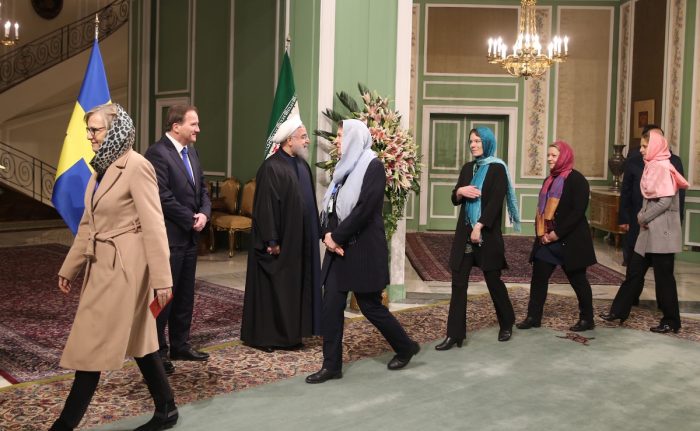
One such example was the much-criticized visit of the Swedish trade minister in which she and the female members of her delegation wore hijab coverings and met with Hassan Rouhani and an all-male team.

The irony of the photo opportunity was not lost on many human and women’s rights groups.

Considering that previous state visits to Saudi Arabia by female leaders such as Michelle Obama and German Defense Minister Ursula von der Leyen publicized their decisions to forgo wearing traditional head coverings, the willingness to acquiesce to Iranian demands is deeply troubling.

We can only hope that the rest of Europe realizes that winning a few dollars isn’t worth empowering more terrorism.

Laura Carnahan

Filed Under: Blog, News Tagged With: Featured, Iran deal, Iran Human rights, Iran Mullahs, Iran Terrorism, nuclear talks, Rouhani, Sanctions

  • « Previous Page
  • 1
  • …
  • 8
  • 9
  • 10
  • 11
  • 12
  • …
  • 17
  • Next Page »

National Iranian-American Council (NIAC)

  • Bogus Memberships
  • Survey
  • Lobbying
  • Iranians for International Cooperation
  • Defamation Lawsuit
  • People’s Mojahedin
  • Trita Parsi Biography
  • Parsi/Namazi Lobbying Plan
  • Parsi Links to Namazi & Iranian Regime
  • Namazi, NIAC Ringleader
  • Collaborating with Iran’s Ambassador

Recent Posts

  • NIAC Trying to Gain Influence On U.S. Congress
  • While Iran Lobby Plays Blame Game Iran Goes Nuclear
  • Iran Lobby Jumps on Detention of Iranian Newscaster
  • Bad News for Iran Swamps Iran Lobby
  • Iran Starts Off Year by Banning Instagram

© Copyright 2026 IranLobby.net · All Rights Reserved.