Iran Lobby

Exposing the Activities of the lobbies and appeasers of the Mullah's Dictatorship ruling Iran

  • Home
  • About
  • Current Trend
  • National Iranian-American Council(NIAC)
    • Bogus Memberships
    • Survey
    • Lobbying
    • Iranians for International Cooperation
    • Defamation Lawsuit
    • People’s Mojahedin
    • Trita Parsi Biography
    • Parsi/Namazi Lobbying Plan
    • Parsi Links to Namazi& Iranian Regime
    • Namazi, NIAC Ringleader
    • Collaborating with Iran’s Ambassador
  • The Appeasers
    • Gary Sick
    • Flynt Leverett & Hillary Mann Leverett
    • Baroness Nicholson
  • Blog
  • Links
  • Media Reports

There is No Battle Between Moderates and Hardliners in Iran

March 21, 2017 by admin

There is No Battle Between Moderates and Hardliners in Iran

There is No Battle Between Moderates and Hardliners in Iran

One of the cornerstones of the Iran lobby’s messaging has been the contention that a monumental battle is being waged in Iran between moderate elements in the Iranian regime and hardline conservatives intent on winning at all costs.

To the extent hardliners want to hang onto their power that part of the story is correct, but the image of moderates existing and having a meaningful role within the regime government is as illusory as a mirage of a desert oasis to a thirsty wanderer.

The regime’s leadership, under the hard rule of Ali Khamenei, has done a methodical job of eliminating any shred of moderate opposition. Ever since the original Islamic revolution was taken over by the religious clerics that now run Tehran, the regime has systematically arrested, imprisoned, tortured and executed anyone publicly voicing a dissenting point of view.

This has even extended to targeting and attack Iranian dissidents outside of Iran; the most notably example are members of the People’s Mujahedin Organization of Iran, one of the largest and oldest resistance groups to the mullahs. Many of these PMOI members had resided in refugee camps in Iraq that were constantly under attack by Iranian operatives, as well as local Shiite militias acting on Iranian control.

The most egregious example of Iran’s crushing of dissent was on display in the wake of the 2009 presidential elections in which mass demonstrations by ordinary Iranians was met with bullets and mass arrests that led to a near daily parade to the gallows.

Before each election cycle since, the regime has instituted broad crackdowns to remove any dissenting views. This has included mass arrests of journalists, bloggers, politicians, activists and even students and artists.

The regime’s highest policy making bodies have also ensured that only carefully vetted and approved candidates were on the ballot for presidential and parliamentary elections which is why Hassan Rouhani was elected before and may be re-elected this May and Iran’s parliament remains firmly in the control of the ruling mullahs.

Dr. Majid Rafizadeh, president of the International American Council and a leading expert on Iran and U.S. foreign policy, wrote about this Iran lobby myth in Arab News.

The truth is that Iran’s moderates are a critical part of the political establishment. Many of them, including the current President Hassan Rouhani, were robust supporters or founding fathers of the Islamic Republic’s Shiite theocracy. These “moderates,” such as the late former President Akbar Hashemi Rafsanjani, were once called “hard-liners,” Rafizadeh writes.

“In addition, it is crucial to point out that to be a politician in Iran, your loyalty to the core pillars of the political establishment should be firmly proven. Vilayat-e Faqih is the core pillar of Shiite political thought expounded by the late Ayatollah Ruhollah Khomeini, and forces a guardianship-based political system on the people, and requires that a Shiite religious figure be the leader of the nation,” he adds.

The terms “moderates” and “hardliners” are also a Western invention and not used in Iranian politics according to Rafizadeh. Consequently, the Iranian regime makes no distinction in political allegiances. You are either a loyal member of the regime or you are not. If you are not, your ticket is punched for a trip to Evin Prison.

The Iran lobby uses these terms with Western media in order to create the appearance of fissures in Iran’s political system where there is none.

“Iran’s supreme leader and the senior cadre of IRGC hold the final say when it comes to Iran’s foreign policy. They also have significant control over Iran’s economic, financial, and political sectors. For example, at the end of the presidential term of the so-called ‘moderate’ Hassan Rouhani, Iran has not altered its policies toward Syria, in supporting President Bashar Assad, along with Iraq, Lebanon, Yemen and other nations’ domestic affairs. In fact, it has intensified its expansionist policies through its military and additional revenues,” Rafizadeh said.

Since 1979 Iran has not altered the cornerstone of its foreign policy and revolutionary principles regardless of who was president and therein lays the harshest rebuttal to the Iran lobby. If Iran was indeed going to moderate its behavior as a result of the nuclear deal as the National Iranian American Council insisted on, then where has the emptying of Iran’s prisons begun of political prisoners?

Ultimately the price being paid by Iran’s religious and ethnic minorities such as Kurds, Christians, Sunni, Arabs and others demonstrate exactly how little has changed in Iran since 1979.

Not surprisingly, there has been a marked increase in human rights abuses including the ghastly use of acid in attacks against women.

After almost a year of calm, spraying people with burning acid has returned in Iran where a family of four has been attacked on Saturday in Sharada, within Isfahan province, Iran’s top tourist destination, according to Al-Arabiya.

Last month, unidentified people also attacked two women in Maashour, within the Ahwaz province, according to Iranian news agencies.

Isfahan’s Investigative Police Chief Sitar Khasraoui said in press statement that the families were taken to the hospital to treat the burns. The family consists of the father, 53, the mother, 48, the son, 23, and the daughter, 20. Both parents are said to be in critical condition.

In 2014, attacks in Isfahan shocked the public and provoked a major protest there from citizens who demanded better security and action over such violent crimes.

Reports on social networks have claimed that the victims were doused on the face and body because they were not properly veiled. They were targeted by assailants on motorcycles.

The next time the Iran lobby professes that moderates are battling for control in Iran, one might ask if that battle is being done from the back of a motorcycle.

Laura Carnahan


Filed Under: Blog, Current Trend, News Tagged With: #NuclearDeal, Featured, hardliners, hassan rouhani, Iran Mullahs, IRGC, Moderate Mullahs

Former Iran Lobby Staffer Burrowing Deeper into State Department

March 15, 2017 by admin

Former Iran Lobby Staffer Burrowing Deeper into State Department

Former Iran Lobby Staffer Burrowing Deeper into State Department

Sahar Nowrouzzadeh, the Iran director for former President Obama’s National Security Council (NSC), has burrowed into the government under President Trump. She’s now in charge of Iran and the Persian Gulf region on the policy planning staff at the State Department, according to Conservative Review.

The reason why this is of concern is because of her previous employment at the National Iranian American Council, an organization with well-documented ties to the Iranian regime and a long-time supporter and advocate as part of the larger Iran lobby apparatus created to help support the loosening of sanctions on the regime.

In February, a group of over 100 prominent Iranian dissidents called for Congress to investigate NIAC’s ties to the Iranian regime.

“One of Nowrouzzadeh’s primary duties under President Obama was to promote initiatives that pushed the Iran deal. As President Obama’s NSC director for Iran, Nowrouzzadeh sat in on high-level briefings along with President Obama, former VP Joe Biden, and former Secretary of State John Kerry, as top White House staff crafted false narratives on the Iran deal to sell to the American public,” reported Jordan Schachtel.

According to the head of a state-run Iranian newspaper, Nowrouzzadeh was an essential element to pushing through the Iran deal. Editor-in-Chief Emad Abshenass said that she opened up a direct line of communication with the Iranian president’s brother. “She helped clear a number of contradictions and allowed the entire endeavor to succeed,” Abshenass said of her efforts.

Towards the end of President Obama’s tenure, Nowrouzzadeh was embedded into the State Department and for a brief time served as its Persian language spokesperson.

Breitbart News had earlier investigated Nowrouzzadeh’s prior employment with NIAC, finding that a person with the same name has previously written several publications on behalf of NIAC. According to what appears to be her LinkedIn account, Nowrouzzadeh became an analyst for the Department of Defense in 2005 before moving her way up to the National Security Council in 2014.

A NIAC profile from 2007 reveals that Sahar Nowrouzzadeh appears to be the same person as the one who is currently the NSC Director for Iran. The profiles indicate that she had the same double major and attended the same university (George Washington).

Critics have alleged that NIAC is a lobby for the current Iranian dictatorship under Ayatollah Khamenei. A dissident journalist revealed recently that NIAC’s president and founder, Trita Parsi, has maintained a years-long relationship with Iranian Foreign Minister, Javad Zarif.

The rise of this NIAC mole within the State Department is troubling since it allows a member of the Iran lobby to still maintain a position of significant influence in developing U.S. policy towards Iran.

The timing of her continued work within the State Department coincides with the upcoming Iranian election for president which is already shaping up to be another rigged cakewalk for Hassan Rouhani to continue as parliament speaker Ali Larijani publicly threw his support behind Rouhani.

Of further note, Rouhani has been selected as the only candidate of the so-called “Reformists” for the election by the Electoral Supreme Council of Reformists for Policymaking, headed by Mohammad-Reza Aref, who was the sole candidate of the Reformists in the 2013 presidential elections but in the final days ahead of that vote withdrew in favor of Rouhani.

The coronation of Rouhani comes as estimates of the Iranian regime’s military expenditures in Syria have risen a whopping $6 billion a year to $20 billion a year, including $4 billion in direct costs as well as subsidies for Hezbollah and other Iranian-controlled irregulars, according to an editorial by David P. Goldman in Asia Times.

“The Iranian regime is ready to sacrifice the most urgent needs of its internal economy in favor of its ambitions in Syria. Iran cut development spending to just one-third of the intended level as state income lagged forecasts during the three quarters ending last December, according to the country’s central bank. Iran sold $29 billion of crude during the period, up from $25 billion the comparable period last year,” Goldman added.

Goldman went on to describe Iran’s financial system as a “black hole,” and how the regime cannot refinance its arrears, recapitalize its bankrupt banks, and finance a substantial budget deficit at the same time. Its infrastructure requirements are not only urgent, but existential.  The country’s much-discussed water crisis threatens to empty whole cities and displace millions of Iranians, particularly the farmers who consume more than nine-tenths of its disappearing water supply. Despite what the Tehran Times called “a desperate call for action” by Iranian environmental scientists, the government slashed infrastructure spending by two-thirds during the last fiscal year.

This leaves American policy in a quandary. The Obama administration— as Lieutenant General Michael Flynn warned in this and numerous other statements — inadvertently stood godfather to the birth of ISIS by blundering into the milieu of Syrian Sunni rebels.

All of which places a greater emphasis on just who is developing U.S. policy moving forward and why a housecleaning of former Iran lobby associates is necessary.

Michael Tomlinson

Filed Under: Blog, News Tagged With: #NuclearDeal, Appeasement policy, Featured, hassan rouhani, Iran, Iran deal, Iran Lobby, Moderate Mullahs, National Iranian American Council, NIAC, nuclear talks, Sanctions

Iran Regime Charting a Pathway for Aggression

March 14, 2017 by admin

Iran Regime Charting a Pathway for Aggression

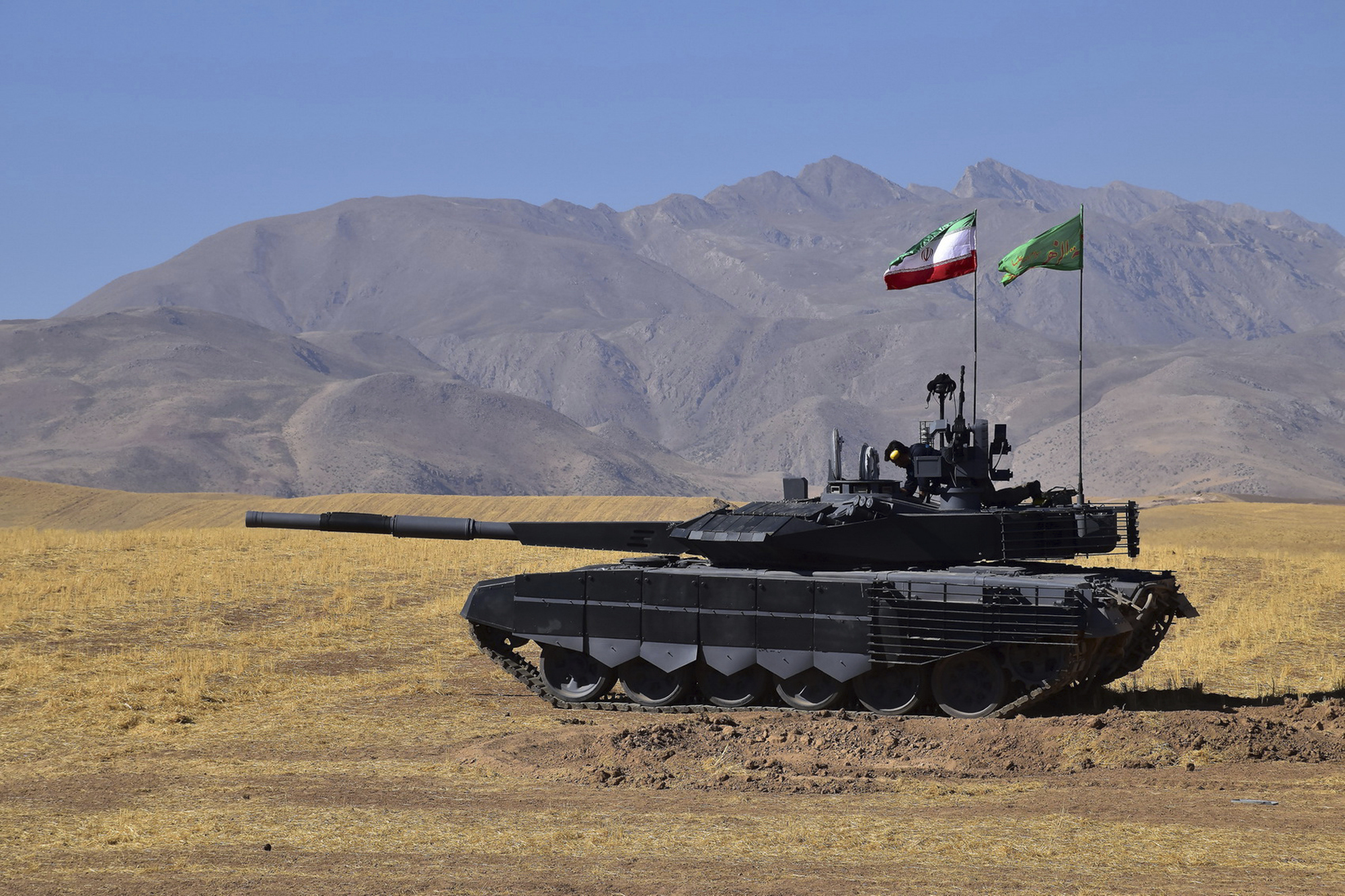
This picture released by the official website of the Iranian Defense Ministry on Sunday, March 12, 2017, shows domestically manufactured tank called “Karrar” in an undisclosed location in Iran. Iran’s semi-official Fars news agency is reporting that the country has unveiled a domestically manufactured tank and has launched a mass-production line. (Iranian Defense Ministry via AP)

The Iran lobby has consistently pushed a message that the Iranian regime was always interested in pursuing a pathway towards moderation and only needed the cooperation of the U.S. and its allies in empowering “moderate” elements in the government to take control and nudge the religious theocracy back to center.

The truth has been far bleaker and starker and nowhere has that been more obvious than in Iran’s constant efforts to build out its military capabilities and size of forces. Already possessing one of the largest standing armies in the world, the Iranian regime has been on a buying and building binge lately to expand its military using billions in new cash garnered from the lifting of sanctions under the nuclear agreement.

Iran has used its newfound wealth to buy advanced missile systems from Russia, along with sophisticated radar and communications equipment, as well as licenses to mass produce arms such as guns, rockets, missiles, drones and in its latest unveiling, a new main battle tank.

Tehran formally announced it will begin mass producing its domestically built main battle tank during a ceremony attended by the country’s defense leadership, according to Russia Today.

The tank has been compared to Russia’s T-90MS, the latest variant in the Kremlin’s T-90 series.

Russia’s Uralvagonzavod production corporation announced it was ready to export the new variant to foreign customers during the IDEX 2017 trade show in late February.

The T-90MS is able to conduct self-testing and self-diagnostics on the field, and is designed to integrate with foreign components including communication systems and air-cooling units.

The introduction of a new advanced tank system paves the way for a major upgrade to the Iranian Revolutionary Guard Corps and an imposing threat to its neighbors, which have already been under near constant assault from Iranian-backed proxies in Yemen, Iraq, Afghanistan, Lebanon and Syria.

  1. Todd Wood, a contributor to Fox Business, wrote about the concerns of this new found arms bazaar between Iran and Russia in the Washington Times.

“Russia has been keen to sell Iran military equipment and technology since the sanctions were lifted on the Islamic theocracy and the billions started flowing from the Obama administration. In fact, you could say that President Obama was the best thing that ever happened to the Russian armament industry. You could also say Hezbollah, the Iranian terror army in Lebanon and Syria, feels the same about Mr. Obama, as they were surely the recipient of all those pallets of billions in cash, but that’s another story,” he writes.

“The Iranian armor capability was severely degraded during the Iran-Iraq War and the real Shia Islamic state never had the money to change that reality. After the dollars started flowing, thanks to Valerie Jarrett and Ben Rhodes, Iran made noise about wanting to license the Russian T-90 tank technology and build the war machines ‘in-country,’” Wood added.

In addition to the upgrade in armor, the National Council of Resistance of Iran, a coalition of Iranian dissident and human rights groups, released information about claims made by a IRGC commander detailing the construction of several arms factories throughout Lebanon and handed over to Hezbollah three months ago.

These factories are able to build various types of missiles with ranges of over 500 kilometers. This includes surface-to-surface, surface-to-sea, and torpedoes designed to be launched from light and fast-attack boats. Armed drones, anti-tank missiles and fast armored boats are also built in these factories.

The weapons produced in these factories have been successfully tested in Syria, this IRGC commander added. These factories were handed over to Hezbollah experts through a step-by step process.

Anti-tank weapons built by these factories have been used time and again in Syria.

Rifles, cannons, anti-air artillery, mortar launchers, various types of missiles and bullets, especially anti-armor are other weapons built and tested by Hezbollah arms experts in these factories.

These sites, spread across the country in unknown locations, are located more than 50 meters below ground level and protected by numerous layers of armored cement to prevent Israeli fighter jets from destroying them, sources say.

Each factory produces a particular part of the missiles and weaponry, and they are assembled at yet another unknown site, according to a report published Saturday in the al-Jarida daily.

All of this military build-up is also being put on display in an aggressive fashion by the regime as detailed by Dr. Majid Rafizadeh in a piece in Huffington Post.

“It has become an alarming and dangerous pattern; a pattern of provocative actions initiated by Iran against many nations in the region, the U.K., the U.S. and its allies,” he writes.

“Just in the last week, several of these provocative operations unfolded. On March 4 U.S. officials pointed out that several of Iran’s assault crafts came dangerously close to the USNS, within 150 meters. A similar incident occurred two days earlier, on March 2 as well,” he added.

These swift-moving assault vessels operate under Iran’s Revolutionary Guard Corps (IRGC), which has been empowered and emboldened by the continuing relief of sanctions as well as the lack of a robust reaction against Iran from the international community.

These incidents clearly highlight the fact that Iran is attempting to showcase its military power and regional preeminence to the United States. Some of Iran’s Persian-language newspapers boasted about Tehran’s military capacity to counter the U.S. navy and dominate the Strait of Hormuz, an area that roughly a third of all oil traded by sea must pass through. Iran has frequently exploited the strategic location of the Strait of Hormuz by threatening to shut it down or conducting military exercises meant to intimidate, Rafizadeh points out.

As Iran puts its military might on display, it is clear that the mullahs in Tehran are not preparing for moderation, but a showdown.

Michael Tomlinson

Filed Under: Blog, News Tagged With: Featured, Iran Mullahs, Iran Terrorism, IRGC, Moderate Mullahs, NIAC, Sanctions

While Iran Regime Throws Roses It Denies Medical Treatment

February 19, 2017 by admin

While Iran Regime Throws Roses It Denies Medical Treatment

While Iran Regime Throws Roses It Denies Medical Treatment

Nothing illustrates the cold, calculating nature of the Iranian regime than two incidents happening this week.

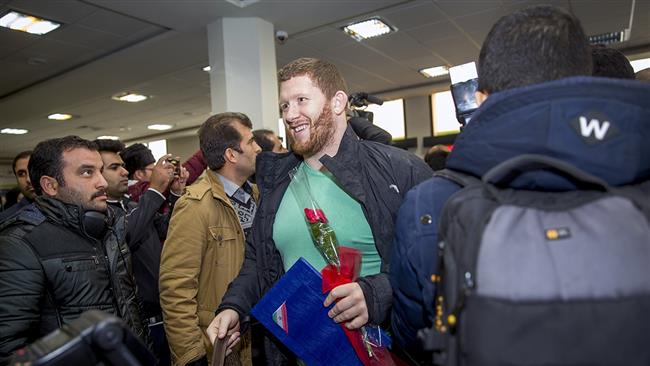
On the one hand, an American wrestling team was welcomed with open arms, red roses and a barrage of social media selfies as it arrived in Iran for a tournament that had been threatened in response to President Trump’s visa moratorium.

The two-day tournament began Thursday, when U.S. wrestlers faced off against Georgia, Russia and Azerbaijan. The Iranian regime didn’t miss the opportunity to stage photos of the Americans being surrounded by well-wishers and flooding social media with comments praising the team, but deriding the U.S. government.

“Welcome to Iran champ!!!!” one Iranian user, Saeed Mohammadi, commented on an Instagram photo.

Another, Nima Jan, said he was traveling to the stadium to cheer for the Americans,

“You proved that you are a noble man.… This is a big chance for us,”Nima Jan commented on an Instagram. “We do not pay attention to the behavior of America’s government” toward Iran, according to the Washington Post.

Widely considered a national sport, wrestling has been one venue to maintain a cultural channel between Iran and the U.S. In fact, a U.S. wrestling team became the first American sports team to visit Iran since the revolution.

In contrast to that public photo opportunity, in the dank, dark confines of Evin prison, a British-Iranian mother and an aid worker languishes, falling ill and being denied medical treatment by the regime.

According to the Times of London, Nazanin Zaghari-Ratcliffe, 38, who has been held in prison since April last year, was denied urgent medical treatment for a neck injury sustained in prison that has left her unable to lift her arms or carry her child.

Prison officials last week refused to refer the charity worker to a neurologist, despite an X-ray and MRI scan revealing that vertebrae in her neck were out of place.

She is unable to move her arms beyond a certain point or lift her two-year-old daughter Gabriella, who is also trapped in Iran after regime authorities confiscated her British passport.

The cruelty of Ratcliffe’s continued incarceration and denial of medical care has earned sharp rebukes from the British government and human rights groups, but it follows a typical pattern of abuse heaped on detained dual national citizens by the regime.

Repeated incidents like this, depict an essential truth of the Iranian regime which is that it is without compassion or mercy and utilizes innocent people to its political advantage on the world stage. It will willingly use a sports team to stage a photo opp to protest moves designed to restrict the movement of terrorists supported by the Iranian regime and it will also put the screws to an ailing mother to put pressure on a British government balking at opening up trade with the regime.

The mullahs are cruel and callous and any press releases or news interviews by Iran lobby supporters such as Trita Parsi of the National Iranian American Council cannot hide that simple truth.

The mullahs calculate every move and weigh every opportunity. They are less religious leaders and more like accountants and they count up the ill-gotten gains they receive from their various black market channels, especially with the nuclear agreement which opened up additional sources of funding to them.

Heshmat Alavi, an Iranian activist, penned a piece in Forbes looking at how the regime was benefitting from the nuclear agreement.

“Now in early 2017, however, signs indicate the main winners in Iran are none other than state-owned companies. This means Iranian Supreme Leader Ali Khamenei and the terrorist-supporting Revolutionary Guards are enjoying JCPOA benefits,” Alavi writes.  “At least 90 of the nearly 110 agreements, totaling nearly $80 billion, involve such state-controlled companies. This includes the National Iranian Oil Company, parallel to others run by regime pension funds and massive conglomerates of semi-public nature.”

“It is a known fact that Tehran maintains a heavy hand over the economy, providing circumstances allowing state-controlled firms to acquire most business deals made possible after sanctions were lifted. The private sector makes up a mere 20% of Iran’s economy, according to official estimates,” he added. “To this end, private companies have received a dismal 17 deals, including a hotel management contract sealed most probably because of the French partner’s chief executive being the brother of Eshaq Jahangiri, Iran’s vice president.”

For the Iranian regime, decision-making is all about perception, economic benefits and exporting its extremist brand of Islam.

Unfortunately, until the world joins together again to confront the Iranian regime, innocents such as Ratcliffe will continue to pay the price.

Laura Carnahan

Filed Under: Blog, News Tagged With: #NuclearDeal, Featured, Iran Mullahs, Moderate Mullahs, National Iranian American Council, NIAC, NIAC Action, nuclear talks, Trita Parsi

Iran Regime Does Away With Moderate Façade

February 16, 2017 by admin

Iran Regime Does Away With Moderate Façade

Archive-Iran Regime Does Away With Moderate Façade

The old adage goes “judge me by my deeds, not my words.” It’s appropriate to apply it to the Iranian regime when weighing how to react to the Islamic state. In the case of the new Trump administration, it is becoming increasingly easy to figure out what is motivating the mullahs in Tehran.

The Iran lobby, most notably the National Iranian American Council, has always made the argument to ignore the rhetoric and judge Iran by its people and the “moderates” struggling to gain control of the government.

Notable Iran lobby advocates such as NIAC’s Trita Parsi have literally yelled from the rooftops that Iran was not really interested in confrontations with the U.S. and only wanted a new friendly relationship. It was this slippery slope the Obama administration fell down in acquiescing broadly to the demands of the mullahs in crafting a nuclear deal separate and apart from placing conditions on things such as support for terrorism and abusive human rights.

Unfortunately, virtually none of those promises have come to pass and in the face of a Trump administration that has opted for an aggressive posture towards Iran with newly announced sanctions and the appointment of several vocal regime critics in key cabinet positions, the mullahs seem to have finally decided to drop the charade and stop trying to portray themselves as moderates.

The latest evidence of that came in the form of a full-length animated film depicting an armed confrontation between Iran’s Revolutionary Guards and the U.S. Navy soon to open in Iranian cinemas.

According to Reuters, the director of the “Battle of Persian Gulf II”, Farhad Azima, said that it was a remarkable coincidence that the release of the film – four years in the making – coincided with a “warmongering” president sitting in the White House.

“I hope that the film shows Trump how American soldiers will face a humiliating defeat if they attack Iran,” Azima told Reuters in a telephone interview from the city of Mashhad in eastern Iran.

The 88-minute animation opens with the U.S. Army attacking an Iranian nuclear reactor, and the U.S. Navy in the Gulf hitting strategic locations across the county.

In the film, the IRGC retaliates by raining its ballistic missiles on U.S. warships.

“They all sink and the film ends as the American ships have turned into an aquarium for fishes at the bottom of the sea,” Azima said.

The main Iranian commander in the film has been intentionally depicted as Qassem Soleimani, the notorious IRGC commander who is overseeing Iran’s military operations in Syria and Iraq against Islamist militants and was designated a supporter of terrorism by the U.S. for his role in coordinating the manufacture and delivery of IEDs to Iranian-controlled Shiite militias in Iraq targeting U.S. personnel.

Soleimani was reportedly seen arriving in Moscow earlier this week in violation of sanctions restricting his travel. He has been to Moscow several times ignoring his travels bans on Iranian airlines to discuss military operations in Syria with Russian officials. His direct pleas have been widely regarded as key to persuading Russia to enter the conflict in order to save the faltering Assad regime.

This is Soleimani’s third trip to Moscow following visits in April and July 2015. Soleimani is thought to be the mastermind behind Iran’s proxy war in Syria in order to prop up the Assad regime. Soleimani met with Russian President Vladimir Putin and Russian Defense Minister Sergei Shoigu days after the Iranian nuclear deal was agreed to in Vienna.

According to Fox News, Soleimani was in Moscow to register the mullahs’ displeasure with Russia’s relationship with Iran’s regional foes, specifically the sale of Russian military equipment to Saudi Arabia and other Arab states.

Lest we forget, the Iranian regime has steadily increased the tempo of bell`igerent actions since the nuclear deal, including the detention and parade of American sailors, widening of the wars in Iraq, Syria and Yemen, and a steady stream of propaganda efforts including the routine “Death to America” depictions as well as the launching of increasingly more powerful ballistic missiles.

The latest disclosures of the IRGC’s operation of a vast network of training camps for its own and foreign fighters to be deployed in conflicts abroad by a network of Iranian dissident groups only solidifies the argument that the Iranian regime is done with the pretense of trying to be a more moderate nation.

The dissident groups, led by the National Council of Resistance of Iran, have issued calls for the IRGC to be designated a Foreign Terrorist Organization as a whole.

Iran already is part of the U.S. State Department’s State Sponsors of Terrorism list, along with Syria and Sudan. However, new calls are coming from leading critics of the regime to designate the IRGC as a foreign terrorist organization – and the Trump administration is said to be considering that.

“The people of Iran would welcome the designation of the IRGC, which is responsible for thousands of political executions and tortures in prison. It is also responsible for training terrorists supporting and engaging in terrorist activities outside Iran,” said Maryam Rajavi, the leader of the NCRI, which is the largest Iranian opposition group.

“I believe the time has come for a firm policy on Iran. The failed policy of appeasement has hurt the Iranian people, as well as global peace and security,” she said.

To emphasize the suffering of the Iranian people under the mullahs’ medieval rule, news reports came out of a 14-year old girl suffering a savage beating by the regime’s morality police for wearing ripped jeans.

Zahra*, who The Independent is not identifying for fear she may suffer reprisals, was celebrating her birthday with friends last week when a patrol of “morality police” pulled up.

The teenager said officers tried to force her and her friends into their car in the city of Shiraz, beating them when they resisted.

“There were two women and two men in a huge van and they pushed us into it with the force of their beatings,” she recalled. “Their objection was to the ripped jeans that we were wearing. There were really no other issues concerning my friends and I.”

“I still carry the bruises sustained from their beatings on my face,” she said. “I still feel their pressure on my arm and my ribs still hurt.”

In an exclusive interview with The Independent, her mother described the ordeal as “the worst day of my life, as if the world has ended for me”.

Rules are enforced by thousands of visible and undercover religious or “morality” police, who patrol the streets to check for violations.

Women found to have their hair or bodies inadequately covered can be publicly admonished, warned, fined or even arrested, while vigilantes are also active.

This is why any discussion of a moderate Iran under its current leadership is simply another case of “fake news.”

Laura Carnahan

Filed Under: Blog, News Tagged With: Featured, Iran Mullahs, Iran Talks, Iran Terrorism, IRGC, Moderate Mullahs, Nuclear Deal, Rouhani

Why the NIAC Has Lost All Credibility

November 17, 2016 by admin

Why the NIAC Has Lost All Credibility

Why the NIAC Has Lost All Credibility

The National Iranian American Council has gotten virtually nothing correct over the last three years when it comes to predicting the behavior and actions of the Iranian regime.

That in and of itself should not be too surprising since in its role as a chief advocate and lobbying force for the Iranian regime, its responsibility is not to journalistic fact, but to lobbyist advocacy. That fact alone should make any journalist talking to them or reading their publications slightly skeptical from the outset.

Also, it is erroneous to consider the NIAC a “human rights” organization when its stated mission goal of helping Iranian-Americans is plainly shown to be ignored at best and duplicitous at worst since the NIAC does not mount media or grassroots efforts on behalf of imprisoned Iranian-Americans in Iran. Nor does the NIAC ever join with mainstream human rights groups such as Amnesty International in pressing the Iranian government to release these American hostages.

While the NIAC takes out full page ads in the New York Times touting the moderation of the Iranian regime, it does not similarly take out full page ads critical of Hassan Rouhani’s public statements in which he reaffirms the regime’s policy of not recognizing dual citizenship; the only nation on the planet to do so.

The NIAC promised Iranian moderation in light of a new nuclear agreement, but in the 18 months since, Iran has embarked on what is arguably the widest range of war, insurrection and human rights abuses spanning four countries including Syria, Iraq and Yemen.

At home it has defeated, removed and imprisoned virtually all political opponents. It has resorted to mass arrests of students, journalists, artists, bloggers and anyone else showing any inkling of rebellion to the mullahs.

It has conscripted Afghan refugees to fight and die as mercenaries in Syria, while it brought Russia into the conflict resulting in the mass bombing of civilians, hospitals and reduced Aleppo to a pile of dust.

All of these things NIAC promised would not happen, yet it has all come to pass.

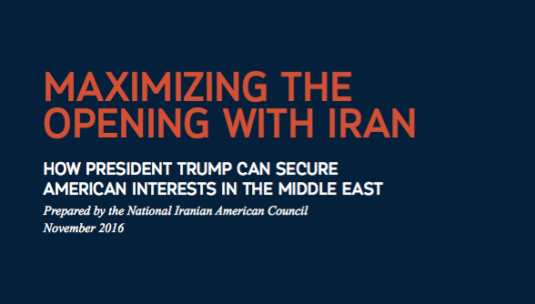
Now the NIAC has issued a 45 page “report” of recommendations to the incoming Trump administration on how to secure American interests in the Middle East.

While mildly entertaining as a work of fiction, the Trump transition team would be wise to consider using this report to wrap up food leftovers since that is all it is good for.

This document is nothing more than a retread of the same tired and now proven false assumptions the NIAC has been peddling now for the past decade. It loses all credibility for one basic omission: It never acknowledges nor criticizes Iran’s role in the escalation of tensions and bloodshed in the Middle East.

That’s like blaming the weather for a mass murderer on the loose.

If one understands that the NIAC is an Iranian regime advocate and not a human rights organization, it is easy to understand the priorities it places on its discussion topics in the document.

It places the nuclear agreement and the U.S. alliance with Saudi Arabia as its two more important topics, which coincidentally are the two most pressing concerns for the Iranian regime.

It then dives into Iraq and Syria, the two principle battlefields Iran is involved with in creating its Shiite sphere of influence. Oddly, the report does not mention Yemen or the rise of Islamic militants in sub-Saharan Africa which are now responsible for instability stretching from Egypt to Nigeria to Yemen.

Lastly, the report devotes a scant three pages to human rights and only from the perspective that Washington can only improve human rights by essentially trusting the Iranian regime to do the right thing if Washington caves in and appeases the mullahs fully.

The one thing the report does say is that the Trump administration “should heed the advice of Iranians themselves.” On this point, NIAC is correct, but not in whom it believes are the right Iranians to listen to.

The Trump administration needs to part ways from failed policies of the Obama administration and muzzle the “echo chamber” of Iranian lobbying it created. It needs to chart its own pathway and listen to the concerns, thoughts and advice of Iranian dissidents and opponents both within Iran and outside.

Let the Iranian people counsel on what are the best approaches to bringing back a secular, democratic government in Iran. That kind of advice is not likely to come from the NIAC, Ploughshares Fund or similar Iranian lobbyists.

It will come from opponents such as the National Council of Resistance of Iran, Amnesty International and outspoken leaders on the human rights situation in Iran such as Rudy Giuliani and Sen. Robert Menendez (D-NJ).

The most amusing part of the NIAC report is the claim that was signed by 76 “national security experts” but a closer review of those names and titles reveals that:

  • 3 are staff members of NIAC
  • 47 are professors, mostly from history, linguistics and anthropology disciplines
  • 1 has a military background
  • Zero are human rights activists

The overwhelming number of these so-called “experts” is in reality advocates and lobbyists for the Iranian regime or commercial interests tied to the Iranian regime such as Bijan Khajehpour, managing partner of Atieh International which works to line up foreign businesses with Iranian-state industries.

Mainstream media outlets would do well to finally stop quoting these sources that are as accurate as pollsters on election night.

Michael Tomlinson

Filed Under: Blog, News Tagged With: #NuclearDeal, Appeasement policy, Featured, Iran, Iran deal, Iran Human rights, Iran Lobby, Iran sanctions, Khamenei, Moderate Mullahs, National Iranian American Council, NIAC, NIAC Action, Ploughshares, Rouhani, Trita Parsi

Trita Parsi Mounts Defense of Iran Nuclear on Eve of Election

November 7, 2016 by admin

Trita Parsi Mounts Defense of Iran Nuclear on Eve of Election

Trita Parsi Mounts Defense of Iran Nuclear on Eve of Election

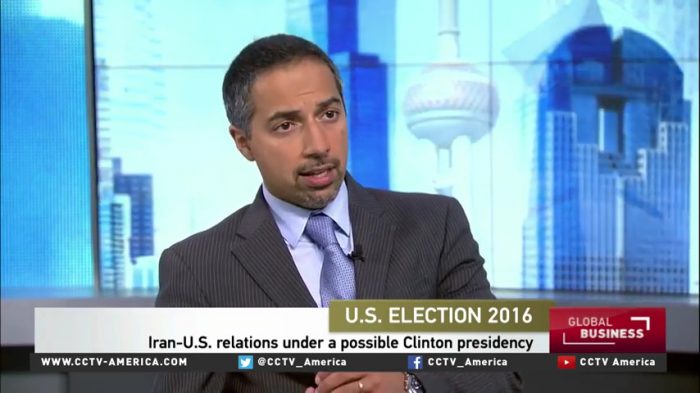
Tirta Parsi, the founder of the National Iranian American Council and one of the Iranian regime’s most ardent supporters, took to the airwaves in a final effort to shape impressions about an Iranian nuclear deal that is getting widely panned in the wake of a year of Iranian aggression and human rights violations.

Oddly though he appeared on CCTV, the Chinese-produced news channel, which doesn’t have a high Iranian-American viewership, but then again, Parsi isn’t trying to reach the constituency his organization is ostensibly supposed to be helping; rather he is trying to make the case to overseas governments to stay on board with the Iranian regime in spite of its involvement in three raging wars now in Iraq, Syria and Yemen.

His appearance amounts to another PR push to try and allay fears that the nuclear deal is going to be trashed by either Hillary Clinton or Donald Trump. He voiced his greatest optimism for saving the deal with Clinton’s election, but even tempered his language slightly from the normal dumping on Trump in light of the candidate’s closing in these last days in most polls.

For Parsi, the effort must be akin to gritting your teeth while getting a root canal since it seems every time he goes out there to be a loyal supporter of the mullahs’ agenda, they go ahead and do something to prove his statements wrong.

His famous claims that the nuclear deal would moderate Iran and empower more liberal elements in the regime to make gains in parliamentary elections fell flat as the ruling leadership wiped thousands of candidates off the ballots to ensure solid majorities for their supporters.

Parsi’s belief in Iran’s future role as a “stabilizing” influence in the Middle East’s conflicts evaporated like water on a hot plate when Iranian regime brought Russia into the Syrian conflict and escalated wars in Iraq and Yemen. Mass killings of civilians, bombed out villages, fleeing refugees, all have become staples of the post-nuclear deal era.

Most appalling of all has been Parsi’s complete silence on the Iranian practice of grabbing dual-national citizens, especially Iranian-Americans? Even the sentencing of his supposed friend Siamak Namazi to an extended prison term earned only minimal statements and none of the grassroots campaigns that have marked previous NIAC efforts to win support for the nuclear deal.

The irony is overwhelming when an organization supporting Iranian-Americans, abandons them to Iranian prisons.

For Parsi, the Iranian regime continually makes him out to be a false prophet and for the mullahs in Tehran, this year’s US presidential election is just another example—in their minds of the Great Satan’s decline—but in fact, they shined a bright light on of the great achievements of the US political system in comparison to theirs.

As the New York Times wrote, “In the past, Iranians looking to mock the United States would burn cardboard effigies of Uncle Sam or Lady Liberty. But in recent months, as the American presidential election took a series of bizarre turns, Iranians seeking to make fun of the ‘Great Satan’ have ditched the arts and crafts and simply switched on their TV sets.”

“Iran’s state television, a bastion of conservative ideologues, for once interrupted its regular programing about the ‘murders and crimes committed’ by the United States and broadcast all three debates between Hillary Clinton and Donald J. Trump — live,” the Times added.

In a country that tightly controls information about the United States and depictions of Western democracy generally, the decision to show the debates was unprecedented but by no means inexplicable: The presidential campaign shows the United States political system in such a poor light, hard-liners evidently want it to speak for itself.

And therein lays their weakness. While the mullahs look to make fun of the American political process they gave Iranians a glimpse of something they cannot have and only dream about; the ability to openly denounce, debate, disagree and even vote out their leaders.

In a regime where the top post of “Supreme Leader” is invested by the Iranian constitution with undisputed powers literally for life, the thought of openly disagreeing, even making fun of the regime’s leaders would be met with knocked down doors, secret trials and public hangings.

While the mullahs may think they are mocking the US, in reality they may have uncorked subtle questioning by their own people who may be asking “Why can’t we do this to our leaders?”

The Iranian people are deeply dissatisfied with the course of their nation, fed up with rampant corruption by regime officials, long wars claiming the lives of the young future of the country and tired of lacking even the most basic freedoms to post selfies, dress as they want or even ride a bicycle.

As Parsi even admits in his CCTV interview, the Iranian people are chafing under the lack of progress and improvements, but while he blames the lack of full implementation of the nuclear agreement, what he doesn’t admit is that the source of that discontent is within the regime’s policies itself.

Michael Tomlinson

Filed Under: Blog, Current Trend, Latest from Lobbies & Appeasers, National Iranian-American Council, News Tagged With: #NuclearDeal, Clinton presidency, Featured, Moderate Mullahs, National Iranian American Council, NIAC, NIAC Action, Nuclear Iran, nuclear talks, Rouhani, Sanctions, Trita Parsi, US election

Why is the Iran Lobby Obsessed with Sanctions?

November 3, 2016 by admin

Why is the Iran Lobby Obsessed with Sanctions?

Why is the Iran Lobby Obsessed with Sanctions?

For an organization that considers itself an activist group fighting for the rights of Iranian-Americans, you would think the National Iranian American Council would be hard at work trying to build grassroots support for the release of Iranian-American hostages.

Maybe Trita Parsi, head of the NIAC, might offer a blistering editorial attacking the regime’s policies of not recognizing dual nationalities?

Maybe Reza Marashi or Tyler Cullis could take a break from giving interviews demanding a lifting of economic sanctions and instead question what else could be done to help get these Iranian-Americans released?

The stark reality is that the NIAC and its members cannot even be bothered to send out tweets, let alone press releases in support of these captive Iranian-Americans, nor try to persuade the Iranian regime to let go of such a damaging and harmful policy that puts countless Iranian-Americans at risk who travel back to Iran to visit relatives.

Instead, the most pressing priority for the Iran lobby—judging by the volume of press releases, statements, editorials, tweets, interviews and speeches—is the lifting of all economic sanctions against the Iranian regime, including all of those not included in the nuclear agreement and were originally imposed because of Iranian regime’s support of terrorism and abysmal human rights record.

The arguments being made by the Iran lobby, especially the NIAC, for lifting of economic sanctions still in place, such as restrictions on Iran’s use of US currency exchanges, resemble the kind of twisted pretzel logic you might find from an extremist that claims to be helping people as he beats them with a club.

One recent example is an editorial by Marashi on the self-publishing blog TopTopic (probably because no self-respecting mainstream publication could print it with a straight face), in which he makes the silly argument that the US is not in compliance with the noxious nuclear deal and is purposely dragging its feet because:

  • It is intentionally squeezing Iran because it has nothing better to do;
  • President Obama wants to protect Hillary Clinton from having to bear an unpleasant political cost of appearing friendly to a bloodthirsty regime widely untrusted by American voters; and
  • The US government is still fighting an internal battle between those committed to punishing Iran and those wanting to set it free.

It is an utterly inane position to advocate since it ignores the most basic and unavoidable truth about the Iranian regime which is compelling most Americans and their leaders to be remain wary of the mullahs in Tehran: the Iranian regime is simultaneously engaged in three wars, while grabbing dual citizens and trying them in secret courts, all during a human rights crackdown that abuses women, religious minorities, children and even gays.

About the only thing most Americans can agree on in this divided political season is that Iran should be restrained, not encouraged.

The sight of pallets full of cash delivered on midnight flights to buy the release of Americans left a sour taste that is hard to forget. The sight of American sailors made to kneel under the guns of Iranian Revolutionary Guard Corps soldiers was unforgettable.

The sight of Iranians hanged publicly almost on a daily basis, including women and children as young as 15 when convicted horrifies most Americans.

And yet, the Iran lobby does not tackle any of these issues. Instead, it focuses on trying to get the mullahs more cash. One might think NIAC’s fundraising budget is dependent on earning commissions for every billion raised for Iran’s coffers.

The fact that the Iran lobby ignores the almost daily pronouncements proving the regime’s true intentions demonstrates clearly it has no regard for the enormous human suffering being caused by the Iranian regime.

Take for example statements made by Salar Abnoush, deputy coordinator of Iran’s Khatam-al-Anbia Garrison, an IRGC command front, who was quoted as saying in an Iranian state-controlled publication closely tied to the IRGC that is sending assets to infiltrate the United States and Europe at the direction of Iran’s top mullah Ali Khamenei.

The IRGC “will be in the U.S. and Europe very soon,” according to Abnoush, who said that these forces would operate with the goal of bolstering Iran’s hardline regime and thwarting potential plots against the Islamic Republic.

“The whole world should know that the IRGC will be in the U.S. and Europe very soon,” he said.

According to Fox News, the military leader’s comments come as Iran is spending great amounts of money to upgrade its military hardware and bolster its presence throughout the Middle East and beyond. Iran intends to spend billions to purchase U.S.-made planes that are likely to be converted for use in its air force.

Given these developments, it’s easier to understand the rationale for NIAC’s emphasis on lifting sanctions and it’s not about the poor Americans being held in Iranian prisons.

It’s about cash for Iran, plain and simple.

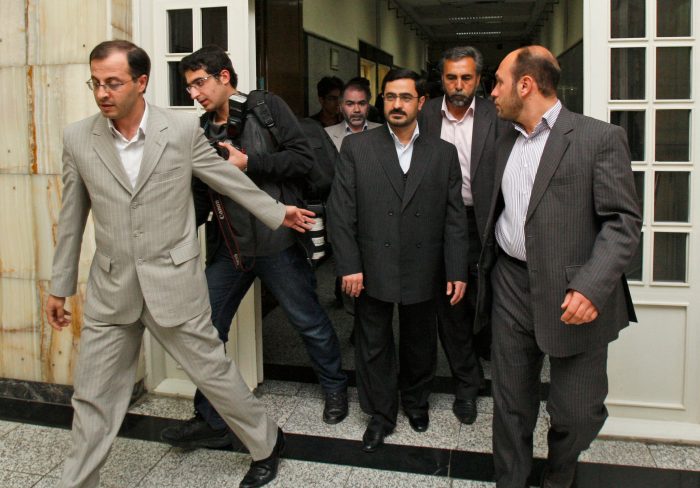
Not even the sham punishment of 135 lashes given to Saeed Mortazavi, former head of the regime’s Social Security, because of accusations of widespread financial violations and irregularities could cover from his past record as a former prosecutor who was responsible for the mass killings of detainees and political dissidents following the infamous 2009 protests over the stolen presidential election.

It seems in Tehran, you get punished for ripping off your fellow regime leaders, but not for killing innocent protestors.

Too bad the NIAC didn’t have anything to say about it.

Michael Tomlinson

Filed Under: Blog, News Tagged With: Featured, Iran, Iran deal, Iran Terrorism, IRGC, Khamenei, Marashi, Moderate Mullahs, National Iranian American Council, NIAC, NIAC Action, Nuclear Deal, nuclear talks, Reza Marashi, Sanctions, Trita Parsi, Tyler Cullis

Even Iran Lobby Is Not Immune From Regime Extremism

October 19, 2016 by admin

Even Iran Lobby Is Not Immune From Regime Extremism

Even Iran Lobby Is Not Immune From Regime Extremism

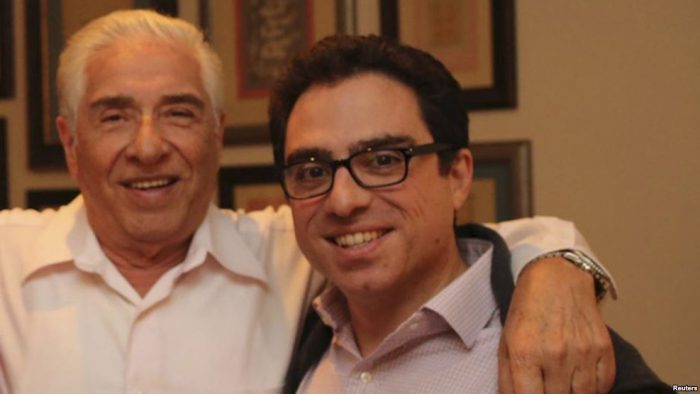
Siamak Namazi, a 45-year-old Iranian-American businessman who enjoyed close ties and access to one of the Iran lobby’s leading advocates in the National Iranian American Council, found himself on the wrong end of a 10-year prison sentence handed down by an Iranian court.

Sentenced alongside his 80-year-old father, Baquer Namazi, a former Iranian provincial governor and former UNICEF official who also has dual Iranian-American citizenship, Siamak has become another hostage pawn in the Iranian regime’s schemes to angle for more cash, more accommodation and more appeasement from the US.

Both men were sentenced to 10 years in prison for spying and cooperating with the U.S. government, said Tehran prosecutor Abbas Jafari Dolatabadi, according to the Fars news website, without specifying when exactly the sentences had been handed down.

The U.S. State Department’s deputy spokesman, Mark Toner, said the father and son had been “unjustly detained” in Iran, and called for their immediate release.

Babak Namazi, Siamak’s brother and Baquer’s son, called the sentences unjust.

“My father has been handed practically a death sentence,” Babak Namazi said in a statement.

Baquer Namazi has a serious heart condition and other medical issues requiring special medication, his wife wrote on Facebook in February. On Tuesday, UNICEF called for his release on “humanitarian grounds.”

The pleas for the Namazis echoed similar pleas made by desperate family members of previous regime hostages such as Washington Post reporter Jason Rezaian, Christian pastor Saeed Abedini, former US Marine Amir Hekmati and former FBI agent Robert Levinson, who still remains unaccounted for in Iran.

One significant difference though is that Siamak Namazi has been reported to have worked alongside long-time friend Trita Parsi in launching the NIAC with the idea of forming an advocate within the US to help push the Iranian agenda in the hopes of gaining a lifting of crippling economic sanctions.

For Parsi, the creation of NIAC and its companion lobbying arm, NIAC Action, has provided him and his colleagues with a comfortable living, access to influential power brokers and a platform to extol their support for the mullahs in Tehran.

Yet, Namazi was still snatched up by regime officials along with his father and sentenced to a long prison term without much disclosure as to why.

Mizan, the Iranian judiciary’s official news site, published on Sunday video images of Siamak, set to dramatic music and spliced together with images of President Barack Obama and Rezaian, who was released from an Iranian jail in January after more than 18 months in detention.

The video showed Siamak’s U.S. passport and identification card from the United Arab Emirates, where he previously lived. It then showed him standing and holding his arms outstretched, as if being searched, while being filmed by at least one other cameraman. The website said the video depicted “the first images of the moment of Siamak Namazi’s arrest.”

It is a stark and disturbing reminder to other supporters of the regime that their utility only goes so far and should be a sharp slap in the face for folks like Parsi who urged support for a more “moderate” Iran, but now find their associates as easily punished as anyone else; without any special status or immunity for their previous support for mullahs.

The arrests also expose the folly of regime president Hassan Rouhani’s much-touted visit to the United Nations in 2013 in which he famously urged Iranian ex-pats to come back to Iran and help their country; only to find virtually all dual national citizens are fair game for arrest.

In his most recent trip back to the UN last month, Rouhani remarked on CBS News’ “60 Minutes” program that the Iranian regime did not even recognize dual national status.

It’s an amazing turnaround in only two years and mirrors the sharp reversal of by the regime after getting its promised nuclear deal; leaving it free to deal harshly with its enemies both foreign and domestic in a broad and harsh crackdown.

The arrest and sentencing of such a close associate of Parsi and the NIAC, finally motivated Parsi to issue a press release with unusually tough language more in line with what his staunchest critics have said about the regime in the past.

“Both Siamak and Baquer Namazi have been denied basic due process and all indications are that the Iranian government has been using them as political pawns in violation of its own laws and basic human decency,” Parsi said.

“For the United States, the sentencing is a clear signal that more political capital and attention needs to be dedicated to securing the release of the Namazis and other Americans imprisoned in Iran. The United States should leave no stone unturned in utilizing diplomatic channels to press the Iranians to secure their release.”

If you didn’t know the statement came from Parsi, you might have mistaken it from a long-time Iranian regime critic from Congress or the pages of the Washington Examiner.

The irony should not be lost on anyone.

For all of its efforts to promote the regime and boost the lifting of economic sanctions and flood the regime with billions in cash that the mullahs are now using in three proxy wars in Syria, Iraq and Yemen, the NIAC and other Iran lobby members are faced with the inconvenient truth that supporting Iran is no guarantee of future safety or security from the same extremists actions against others.

Michael Tomlinson


Filed Under: Blog, News Tagged With: Featured, Iran Lobby, Iran Terrorism, IRGC, Moderate Mullahs, National Iranian American Council, NIAC, NIAC Action, Sanctions, Trita Parsi

US Presidential Election Concerns Iran Regime

September 30, 2016 by admin

US Presidential Election Concerns Iran Regime

US Presidential Election Concerns Iran Regime

The sunset is fast approaching on the Obama administration, and with it will come significant changes in the US foreign policy approach to the Middle East and Iran in particular. The mullahs learned their lesson from the two disastrous terms of Mahmoud Ahmadinejad who made it easy to caricature the regime as slightly crazy and evil.

Their manipulation of the election ballot in 2013 assured Hassan Rouhani’s election and helped assist the Iran lobby in trying to project an image of moderation to the West; even though Rouhani’s first term has actually been bloodier than Ahmadinejad’s ever was.

Rouhani has outpaced Ahmadinejad with an unprecedented wave of executions and mass hangings that is approaching 3,000, including women and children according to Amnesty International. His crackdown on religious minorities, journalists, dissidents, artists and students has rivaled the abuses of the infamous 2009 protests.

With the upcoming election of a new US administration, the mullahs are intensely interested in the election outcome, as well as preparing the ground to keep the policies of appeasement rolling in exchange for the false hope that Iran will curb its nuclear ambitions.

The deployment of the Iran lobby has been largely aimed at helping Senators and candidates deemed favorable and supportive towards the nuclear deal, as well as continue coaxing journalists to view the Iranian regime with less than suspicion.

Meanwhile in Iran itself, regime news outlets have been giving considerable space and airtime to the presidential campaign, especially with the rhetoric rising sharply about the effects of the nuclear deal and the best approach needed by a new president to restrain and control the Islamic state.

There is no doubt that Americans and Europeans are anxious about the state of the Middle East, especially the three wars being waged with deep support from the Iranian regime in Syria, Iraq and Yemen, which have contributed to an unprecedented wave of refugees flooding into Europe and the US.

Javan Online, the daily newspaper close to Iran’s Revolutionary Guard Corps, ran an article Sept. 27 titled “The Iranophobia race.”

Kayhan daily, whose editor is appointed by the country’s supreme leader, called the debate “a contest in Iranophobia” in which “Trump threatened to attack Iran and Clinton continued to stress the political and economic pressures against Iran.” Though it didn’t mention Mrs. Clinton’s defense of the Joint Comprehensive Plan of Action’s diplomatic approach.

Hamid Reza Assefi, a former spokesman for the regime’s Foreign Ministry, commented in an op-ed for the Shargh Daily on the likely effect of the US election on Iran. He concluded, “Because of the special rules and the internal sensitivities surrounding the election in Iran … external issues will have no effect.”

He also wrote, “The truth is, both parties in the Unites States share the same opinion on the general aspects of the conflict with Iran.”

On that point he is correct. In spite of the round the clock efforts by the Iran lobby at trying to drive a wedge in the US electorate and attempting to peel off Democratic support, the truth is the vast majority of American voters remain deeply suspicious of the Iranian regime and both Democrats and Republicans are less inclined to accommodate Iran’s agenda after the bloody year since the nuclear deal was reached.

A senior international policy analyst for the RAND Corp., wrote in Fox News that with “the continuing climate of repression, the next Iranian presidential election, and (Ali) Khamenei’s eventual demise may provide some important opportunities for America’s next president.”

“The next U.S. president is likely to be met with multiple international crises after assuming office, and Iran may be one of the most challenging of them,” he writes. “In theory, Rouhani, often portrayed as a ‘moderate’ by the Western media, would have been strengthened by the agreement and able to pursue his agenda of liberalizing Iran both economically and politically. In reality, Rouhani’s presidency has failed to deliver on most of his promises.”

The laundry list of provocative actions by the Iranian regime over the past year has clouded any real building of support for the mullahs by the Iran lobby. The recent spate of arrests of dual national citizens and Rouhani’s reaffirmation that Iran does not recognize dual citizenship on NBC News only provides more fodder for critics of the regime.

The significance of Iran to US policy is becoming more apparent as more analysts and policymakers weigh Iran’s influence and threat level even above that of ISIS. In an editorial in the Los Angeles Times, writes that:

“US political leaders of both parties argue that destroying Islamic State is America’s top priority in the Middle East. In reality, that’s not nearly as important as confronting the challenge posed by Iran. The nuclear deal that went into effect a year ago may have postponed the danger of an Iranian nuclear bomb, but the multifaceted threat of a militaristic, messianic Iran — 80-million strong — is much more menacing to Western interests than the Sunni thugs and murderers of Raqqah and Mosul.”

“From Tehran’s perspective, it gained much more than it gave up. In exchange for postponing its military nuclear project, it achieved the lifting of many economic sanctions, an end to its political isolation and the loosening of restrictions on its ballistic missile program,” he added.

Truthfully, time is running out for the mullahs. We can only expect that the next president and administration will have a more skeptical eye towards the Iranian regime with the benefit of 20-20 hindsight.

By Michael Tomlinson


Filed Under: Blog, News Tagged With: Featured, hassan rouhani, Iran, Iran deal, Iran Human rights, Iran Lobby, Iran Mullahs, Khamenei, Moderate Mullahs, nuclear talks

  • « Previous Page
  • 1
  • 2
  • 3
  • 4
  • Next Page »

National Iranian-American Council (NIAC)

  • Bogus Memberships
  • Survey
  • Lobbying
  • Iranians for International Cooperation
  • Defamation Lawsuit
  • People’s Mojahedin
  • Trita Parsi Biography
  • Parsi/Namazi Lobbying Plan
  • Parsi Links to Namazi & Iranian Regime
  • Namazi, NIAC Ringleader
  • Collaborating with Iran’s Ambassador

Recent Posts

  • NIAC Trying to Gain Influence On U.S. Congress
  • While Iran Lobby Plays Blame Game Iran Goes Nuclear
  • Iran Lobby Jumps on Detention of Iranian Newscaster
  • Bad News for Iran Swamps Iran Lobby
  • Iran Starts Off Year by Banning Instagram

© Copyright 2026 IranLobby.net · All Rights Reserved.