Iran Lobby

Exposing the Activities of the lobbies and appeasers of the Mullah's Dictatorship ruling Iran

  • Home
  • About
  • Current Trend
  • National Iranian-American Council(NIAC)
    • Bogus Memberships
    • Survey
    • Lobbying
    • Iranians for International Cooperation
    • Defamation Lawsuit
    • People’s Mojahedin
    • Trita Parsi Biography
    • Parsi/Namazi Lobbying Plan
    • Parsi Links to Namazi& Iranian Regime
    • Namazi, NIAC Ringleader
    • Collaborating with Iran’s Ambassador
  • The Appeasers
    • Gary Sick
    • Flynt Leverett & Hillary Mann Leverett
    • Baroness Nicholson
  • Blog
  • Links
  • Media Reports

Trump Invite for Meeting is Trap for Mullahs They Might Not Escape

August 2, 2018 by admin

Trump Offer to Meet Rouhani has Iran Lobby Boxed In

Trump Offer to Meet Rouhani has Iran Lobby Boxed In

President Donald Trump’s nearly off-hand comment about being open to a meeting with Iranian regime leader Hassan Rouhani “anytime” puts the Iranian regime and their Iran lobby supporters between a rock and a hard place.

On the one hand, if they simply denounce the invitation, they reaffirm the belief that the regime was never really interested in meaningful dialogue on topics not to their liking such as improving human rights, support for terrorism or interfering in neighboring countries.

It also calls out the Iran lobby’s persistent braying for diplomatic openings between the U.S. and Iran and once the president presents such an opportunity, critics such as the National Iranian American Council are quick to denounce it.

It seems the Iran lobby can’t have their cake and eat it too under this president.

If on the other hand, the mullahs accept the president’s offer, they might very run into a Trump version of what they have consistently done to others for decades which makes a show of diplomacy but grant nothing of substance and continue to apply pressure.

The prospect of the mullahs getting a dose of their own medicine is ironic and somewhat refreshing.

The varied responses from the regime are proof the mullahs in Tehran seem pretty confused as to what to do since it’s clear that President Trump’s offer is not really without preconditions. Rather, looming over Tehran is the precarious state of the economy, looming economic sanctions due to fall next week and mounting pressure internally from the Iranian people to change how the usual corrupt government operates.

“Unfortunately, right now there is no low-hanging fruit in U.S.-Iran relations or potential negotiations. And the primary reason is that Trump, by violating the Iran nuclear deal and withdrawing from it, he really eviscerated the Iranian trust in the United States,” said Sina Toossi, a research associate at the National Iranian American Council.

“He could potentially give that confidence to international banks and businesses, remove U.S. sanctions and allow Iran to get the benefits from the deal, and that could be used as a stepping stone for broader negotiations,” he added.

Therein lies the crux of the Iran lobby’s problem. It has in Trump a U.S. president who doesn’t care about appearances or how critics view him and is just as intent on forcing regime change as any president in the last 30 years. While the Iran lobby is pushing to recover the gains lost from the failed nuclear deal, it recognizes the awful truth of their position which is that there are no meaningful gambits left it can use on this president.

The Iran lobby and the regime have sought a bailout from Europe by trying to persuade the European Union to stay in the nuclear agreement.

Rouhani met with the new British Ambassador to Tehran Tuesday where he announced, not for the first time, the US withdrawal from the multilateral nuclear deal in May was “illegal,” adding that “the ball is in Europe’s court,” according to CNN.

But that prospect seems as likely as snow falling right now on a California beach as the president is already pressing the EU over the issue of bilateral trade tariffs that has Europe busy focusing on its own trade deals.

The poor mullahs are not at the top of the to-do list for Europe anymore and the trade they represent is a pittance compared to the whopping $690 billion in trade between the EU and U.S.

Nic Robertson at CNN offered his own analysis that the Iran regime may take a long view in responding to President Trump. He posits that Iran is willing to use a subtle approach in trying to divide the U.S. from its allies and by not ramping up extremist acts with its terrorist proxies such as Hezbollah is a sign of this approach.

He also offers that summits with Russian president Vladimir Putin and North Korea’s Kim Jong-Un are different since Iran’s leaders are not in as precarious a position.

With apologies to Robertson, that is a bad misread of the regime.

The mullahs are under intense pressure not only from a rial about to be less valuable than the paper its printed on to massive protests rocking the country since last year that have not abated and have taken on a dire tone with protests aimed directly at the regime’s top leaders.

The basket case economy is so bad, that Iranian parliament members have demanded Rouhani appear before them in one month to answer questions about the economy.

It is the first time parliament has summoned Rouhani, who is under pressure from rivals to change his cabinet following a deterioration in relations with the United States and Iran’s growing economic difficulties.

Lawmakers want to question Rouhani on topics including the rial’s decline, which has lost more than half its value since April, weak economic growth and rising unemployment, according to semi-official ISNA news agency.

Rouhani’s summon coincides with further shows of public discontent. A number of protests have broken out in Iran since the beginning of the year over high prices, water shortage, power cuts, and alleged corruption in the Islamic Republic.

On Tuesday, hundreds of people rallied in cities across the country, including Isfahan, Karaj, Shiraz and Ahvaz, in protest against high inflation caused in part by the weak rial, according to Reuters.

The mullahs are now faced with change or doubling down on crazy and potentially pushing the Iranian people too far or accept the truth that the regime’s days are numbered.

Laura Carnahan
Filed Under: Blog, News Tagged With: #NuclearDeal, Featured, Iran deal, Iran Lobby, Iran sanctions, National Iranian American Council, NIAC, NIAC Action, Rouhani, Sanctions, Sina Toossi

Iran Lobby Approaches Near Hysteria in Statements

July 27, 2018 by admin

Iran Lobby Approaches Near Hysteria in Statements

Iran Lobby Approaches Near Hysteria in Statements

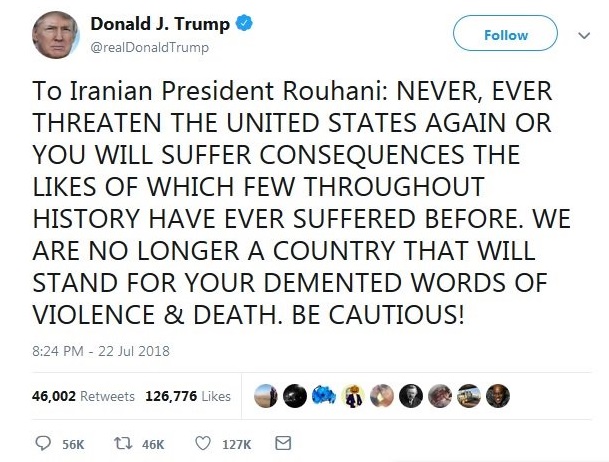
Last weekend, Hassan Rouhani after delivering a speech warning the U.S. of starting the “mother of all wars” President Trump locked his ALL CAPS key and threatened the Iranian regime with destruction if it ever attacked the U.S. And as some put it the world’s blowhards and fanatics have finally met their verbal match.

But even though the president was responding to a provocation by Rouhani, the Iran lobby predictably went hysterical claiming the president was readying for war against Iran.

Lobby members such as the National Iranian American Council were especially vocal in trying to flood news outlets with statements all blasting the Trump administration for the tough stand against the mullahs.

Jamal Abdi, the incoming head of the NIAC, issued a statement that was hard pressed to find new harsh adjectives to use against President Trump.

“The Iranian-American community was deeply disturbed by Trump’s warmongering last night. When Donald Trump threatens that Iran will suffer the consequences that few in history have ever suffered before, Iranian Americans fear that this unhinged President will follow through on his threats to bomb our friends and family,” Abdi said.

“It is past time for our elected officials to step up and ensure that Trump cannot launch a disastrous war of choice based on his deranged tweets and foolish advice of officials who have been pushing to bomb Iran for decades. The Iranian-American community will not sign up for Trump’s war push, and will push back more than ever to restrain this President,” he added.

Abdi neglected to differentiate that the president’s tweets were in response to Rouhani making threats in the first place. He also neglected to mention the wave of protests spreading across Iran since last December aimed at the mullahs and their corrupt rule.

The same Iranian-Americans Abdi claims who are fearful of the president’s policies are in fact the ones who are nervously talking to relatives in Iran who are subject to mass arrests and imprisonment for committing “crimes” such as taking part in a peaceful demonstration for not receiving their paychecks for months, for not having drinking water, and for the nationwide poverty as a result of the government’s corruption and wasting all resources to prop up Assad’s dictatorship in Syria and to support other terrorist groups such as the Hezbollah in Lebanon and the Houthis in Yemen.

But the NIAC’s fusillade didn’t stop with Abdi, as Trita Parsi weighed in with his own diatribe on CNN in which he outlined why he believed any pivot to diplomacy similar to what President Trump did in North Korea was likely to fail with Iran.

Parsi’s arguments ring hollow as he skips over inconvenient truths and glosses over the hard reality of dealing with a religious theocracy hellbent on maintaining its grip on power no matter the cost in lives.

For example, Parsi claims that North Korea and Iran are entirely different situations because of the geopolitics of their neighbors. In this Parsi is correct to a point. While North Korea is surrounded by countries eager to use diplomacy as a tool such as China, Japan, and South Korea, Iran is surrounded by countries it has actively tried to destabilize with military action and proxies such as Syria, Afghanistan, Iraq, Yemen, Saudi Arabia, Lebanon and the Gulf States.

By comparison, if North Korea sent special forces into Japan or built explosives to be used by terrorists in China, the “diplomacy” Parsi so craves would never take place.

Parsi goes to explain that economic sanctions didn’t force Iran to the negotiating table, it was only after the Obama administration caved and granted the concession for Iran to continue enriching nuclear materials. Again, Parsi mistakes the concession of proof that diplomacy works, when in fact the lesson is that the Iranian regime is only interested in getting its own way and will not bend.

It is precisely why President Trump’s hardline approach to Iran is the cold, shock of reality the mullahs are afraid of because they know they will not be able to bully him as they did with Obama.

Parsi’s claim also that North Korea is a one-man show and Iran has a complicated political situation is laughable. Iran is a one-man country, ruled by Ali Khamenei. The only complicated factor is the web of financial ties, payoffs, and graft that ties the clerics, army, and bureaucracy to Khamenei.

Iranian regime’s solution to in-fighting is as simple as North Korea’s: arrest any dissidents and hang them.

Lastly, Parsi claims that all the Trump administration wants is a war – all evidence to the contrary – and its cabinet members are working towards that goal. The narrative that the Iranian lobby keeps pressing for in order to divert the attention from the fact that it’s the malign activities of the Iranian regime that is being reciprocated with a firm response.

Parsi forgets to mention how President Trump flogged his Republican opponents in the election over the ill-fated decision to invade Iraq and how he has openly opposed U.S. military commitments abroad; even questioning the role of NATO much to the consternation of European allies.

Far from a war hawk, President Trump has openly called on the Iranian people to lead a push for democratic change.


Filed Under: Blog, News Tagged With: Featured, Iran Lobby, Iran Mullahs, Jamal Abdi, Khamenei, National Iranian American Council, NIAC, NIAC Action, Trita Parsi

Why Does the Iran Lobby Obsess About the MEK?

July 21, 2018 by admin

Maryam Rajavi speaks at Free Iran Rally in Paris- july 2018

Maryam Rajavi, President-elect of Iran’s main opposition, the National Council of Resistance of Iran(NCRI), speaks during the Free Iran 2018 gathering in Paris-july 2018

In the scope of issues facing Iranian-Americans today related to their homeland, you would think the Iran lobby would have better things to do than publicly trash Iranian dissident and opposition groups on a near-daily basis.

The Iran lobby, especially the National Iranian American Council and a variety of bloggers sympathetic to the Iranian regime, have recently stepped up the vitriol considering widening and near constant protests and demonstrations that have rocked the regime’s grip on power.

What is interesting is that almost all the groups making up the Iran lobby are using nearly identical language focused on trying to disprove the idea that the Mujahedeen-e-Khalq(MEK), one of the largest and oldest Iranian dissident groups, has any support within Iran.

For example, Nahal Toosi, a foreign affairs correspondent at POLITICO, writes in a piece about the Trump administration’s efforts to support regime change in Iran, that:

“One Iranian diaspora faction that has supported many Trump policies is the Mujahedeen-e-Khalq, a group with leftist roots that the U.S. previously listed as a terrorist outfit. But the MEK has few backers in Iran, even though it has major defenders among Trump’s aides and confidants. Among those who’ve spoken at MEK, events are Trump’s national security adviser, John Bolton.”

Notably, she mentions that the NIAC is being excluded from a meeting between Secretary of State Mike Pompeo and members of the Iranian-American community at the Ronald Reagan Presidential Library in Simi Valley, California this weekend, but neglects to mention the NIAC’s deep ties to Iranian regime leaders.

Against the backdrop of hot national debate over the Russian government’s use of third-parties to infiltrate American organizations such as the National Rifle Association to affect U.S. policy, the lack of any investigation or focus on the NIAC’s efforts to do the same thing with the backing of the Iranian government is hypocritical to say the least.

Mahsa Rouhi, a research fellow with the nonproliferation and nuclear policy program at the International Institute for Strategic Studies, similarly tries to belittle the MEK in a piece for Foreign Policy, writing “the MEK has no support base inside Iran; in fact, etc.”

But what both Toosi and Rouhi fail to mention are the significant contributions the MEK has made over the years in revealing the regime’s human rights abuses and uncovering its secret nuclear program; none of which could be accomplished without the support and help of Iranians living within Iran who smuggled out clandestine photos and video.

These are not the acts of a few lone dissenters, but rather a strong, clear and forceful expression of the willingness of Iranians to cooperate and help the MEK over the years even though the regime has worked obsessively hard at criminalizing any cooperation with the MEK punishable by imprisonment or even death.

It is hard to credit the Iran lobby with any factual data pointing to zero support within Iran for the MEK given its long history of organizing protests from large-scale mass demonstrations to small, individual acts of defiance such as hanging a banner praising dissident leader Mrs. Maryam Rajavi, the acting president of the National Council of Resistance of Iran, over a Tehran overpass to standing atop a box waving a hijab in defiance of morality codes.

Even top mullah Ali Khamenei has been forced to give several speeches recently to denounce the MEK as he recognizes the group’s growing influence on the protests rocking the country; at last count over 142 cities has experienced protests despite massive security crackdowns by the regime.

It’s noteworthy that the Iran lobby discounts the similarities between Iran and other despotic regimes such as North Korea, Cuba and even the old Soviet Union, in which compulsory voting often delivered election “mandates” for the government, but never reflected the true feelings of the population.

Similarly, Iran discounts any support for the MEK when it actively bans its participation in any elections and refuses to allow any of its members to run for elected office. It is doubtful that Toosi or Rouhi can even justify denying a group such as the MEK a chance at the polls to settle the question once and for all about who the Iranian people back to lead them into democracy and freedom.

Most disturbing and yet telling has been the recent arrests of an Iranian diplomat and other agents accused to attempting to plant a 500-gram bomb at an annual gathering of the MEK and other resistance groups outside of Paris last month.

The captured explosive was comprised of TATP, a favorite explosive for terrorists because it is easily prepared from readily available retail ingredients, such as hair bleach and nail polish remover. It is also able to evade detection because it is one of the few high explosives that do not contain nitrogen and can, therefore, pass undetected through traditional explosive detection scanners designed to detect nitrogenous explosives.

TATP has been used in bomb and suicide attacks and in improvised explosive devices, including the London bombings on 7 July 2005, where four suicide bombers killed 52 people and injured more than 700. It was one of the explosives used by the “shoe bomber” Richard Reid in his 2001 failed shoe bomb attempt and was used by the suicide bombers in the November 2015 Paris attacks, 2016 Brussels bombings, Manchester Arena bombing and June 2017 Brussels attack.

The arrest in Germany of Asadollah Assadi, a diplomat at the Iranian embassy in Vienna who – in his capacity as an operative for the Iranian Ministry of Intelligence and Security (MOIS) – provided the explosives, draws a clear line from the Iranian regime to efforts to destroy the MEK.

Had the terror plot been successful there is no telling what toll it would have taken on the gathering of roughly 100,000 supporters of the NCRI. In addition to Iranian expatriates and NCRI officials, the event included participation and speeches by hundreds of political dignitaries from throughout the world – including prominent American and European politicians representing multiple political parties.

It’s unfortunate the Iran lobby doesn’t talk about those potential lives lost.


Filed Under: Blog, Current Trend, News Tagged With: Featured, Mahsa Rouhi, Maryam Rajavi, mek, Mujahedeen-e-Khalq, Nahal Toosi, NIAC

Iran Regime Plot to Attack Resistance Gathering Foiled

July 4, 2018 by admin

Iran Regime Plot to Attack Resistance Gathering Foiled

Iran Regime Plot to Attack Resistance Gathering Foiled

Outside of Paris, France, tens of thousands of Iranians gathered to protest the Iranian regime and demonstrate for the peaceful transition to a free and democratic Iran unshackled from the control of the ruling mullahs.

Amid the sea of flags and enthusiastic supporters was the optimistic feeling that the moment was fast approaching where that transition could finally happen as Iran is rocked with mass protests that have so far spread to over 140 cities, towns and villages and represent the most serious threat to theocratic rule in the Islamic state’s history.

Those protests have been fueled by a faltering economy including a near-death spiral in the value of the rial which ballooned to over 90,000 rial to a single U.S. dollar; doubling in only a few months.

While the regime has tried to blame President Donald Trump’s decision to pull out of the Iran nuclear deal for the economic implosion, the truth on the streets of Iran is that Iranians are pointing the finger at rampant corruption in the government and the decision to spend billions on wars in Syria and Yemen that have only succeeded in ostracizing Iran further from the international community.

The conclusion being reached in Iran is not that the U.S. is killing the nuclear deal as much as Iranian regime’s involvement in the Syrian war and support for global terrorism is what is driving the isolation.

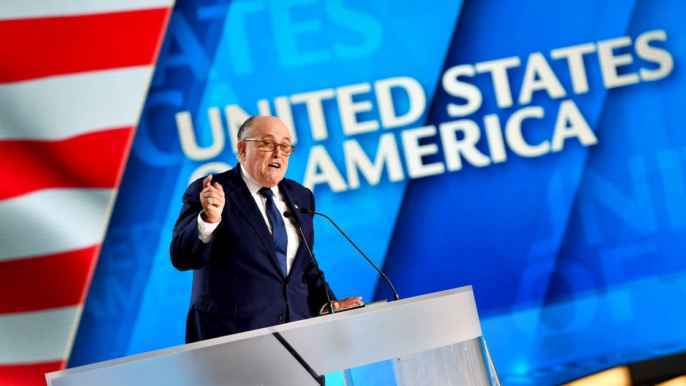
It is against this backdrop that the annual gathering in Paris of the Iranian opposition movement represents an almost intolerable image for Tehran; thousands of Iranians all united in supporting democratic change and being addressed by speaker after speaker including prominent members of the Trump administration, former New York mayor Rudy Giuliani who is now the president’s personal attorney.

Giuliani made a strong call to ramp up sanctions as the protests in recent months have continued spread.

“When they do that, and when these protests continue to grow and grow, this threatens to topple the regime, which means freedom is right around the corner,” he said. “This is the time to put on the real pressure. The sanctions will become greater and greater.”

Amidst that image of united opposition came the news that an Iranian diplomat was among four people arrested in connection with what Belgian authorities said was a foiled bombing attack targeting the rally.

Belgian authorities said an unnamed Iranian diplomat, who works for Tehran’s mission to Austria, was arrested in Germany, while a married couple – Belgian citizens of Iranian heritage – were detained with “attempt at terrorist murder and preparing a terrorist crime” against the MEK. A fourth suspect was arrested in France.

The arrests come ahead of a rare visit to Europe by the Iranian president, Hassan Rouhani, who is scrambling to salvage the 2015 nuclear deal after Trump said the US would not honor it.

A statement by the secretariat of the National Council of Resistance of Iran (NCRI), an umbrella group of the MEK, said: “The conspiracy of the terrorist dictatorship ruling Iran to attack the grand gathering of the Iranian resistance in Villepinte, Paris, was foiled.

“The mullahs’ regime’s terrorists in Belgium, helped by the regime’s diplomat terrorists, had designed for the attack.”

According to the press, the Iranian couple were in a Mercedes car when they were stopped by special forces and arrested on Saturday in Woluwe-Saint-Pierre, which is close to EU institutions in Brussels. According to Belgian media, police found 500 grams of TATP explosive and a detonator hidden in a toiletries bag.

German police arrested a 46-year-old diplomat at the Iranian embassy in Austria, whom police described as a “contact person” for the couple. And French police arrested a 54-year-old described as an accomplice. Authorities said they had monitored communications among the individuals.

A Belgian law enforcement official said investigators suspect the couple took orders from the Iranian diplomat.

Security analysts and Western officials say Iranian intelligence agencies maintain extensive networks in Europe to carry out covert operations.

The Iranian regime has a long history of mounting attacks on the various Iranian dissident groups opposing it including a publicized series of attacks on refugee camps in Iraq housing thousands of MEK members before they were finally resettled in Europe.

The bombing plot is further proof of the Iranian regime’s lack of regard for peaceful relations with the rest of the world. The fact that the plot involved agents and operatives in Germany, France and Belgian pointed out the rank hypocrisy in the supposed moderation in Rouhani’s administration and why EU policy in trying to keep the nuclear deal alive is terribly flawed.

The efforts by the regime to blunt the effectiveness of the resistance movement have included making membership by any Iranian or support for the group in any manner punishable by death. The regime has also vigorously invested time and money to fund the Iran lobby in an active effort to mount PR campaigns aimed at discrediting these groups; most notably the National Iranian American Council which has made it its mission to discredit the MEK.

This includes the creation of fake websites operated by the regime’s intelligence services and using comment boards for news organizations to disparage any positive news stories of the resistance movement.

The arrests in Belgium are noteworthy because of the rise in Islamic extremist terrorist attacks there which have been supported and encouraged by the Iranian regime.

This escalation to directly attack a peaceful rally attended by men, women and children with speakers such as Giuliani should convince any doubters of the blood thirsty intent of the mullahs in Tehran.

Michael Tomlinson

Filed Under: Blog, News Tagged With: Featured, Iran Lobby, Iran plot to bomb MEK rally, mek, NIAC, Terrorism

Why Does the Iran Lobby Fear the Iran Resistance Movement?

June 9, 2018 by admin

Supporters of MEK protest against Rouhani's visit to the United Nations.

Why Does the Iran Lobby Fear the Iran Resistance Movement?

Why is the Iran lobby terrified of the Iranian resistance movement around the world? Almost every spokesperson, lobbyist and PR flak with a vested stake in the Iranian regime’s continued well-being has been intent on discrediting any Iranian dissident to diminish the messenger.

Why?

The answer is simple: The existence of a viable, vocal and demonstrative dissident movement comprised of Iranians offers an alternative narrative to the Iran lobby and mullahs in Tehran that directly contradicts virtually every key message they articulate.

Key advocates for the regime such as the National Iranian American Council have made it a career to find new and inventive ways to discredit, discount and disregard even the idea of an Iranian dissident movement.

The existence of any dissident movement threatens everything the Iran lobby has sought to achieve. During the run-up to the Iran nuclear deal in 2015, the NIAC’s Trita Parsi was a constant fixture on news programs and shuttling in and out of the White House and Switzerland to plant the seeds of ideas such as that the nuclear deal would empower “moderate” Iranian political forces and help stabilize the government and build trust with the U.S.

Unfortunately for Parsi, the opposite has happened with several presidential and parliamentary elections have come and gone with no viable moderates or true political opposition even allowed onto the ballot.

The reason for this is simple since the mullahs have never harbored any thoughts of actual political liberalization. Top mullah Ali Khamenei has ruled Iran in the same manner as his predecessors ever since the Islamic revolution was hijacked by the religious theocracy and turned into a virtual dictatorship.

In the intervening decades, the mullahs have grown fat and comfortable skimming off the Iranian people and economy and funneling billions to themselves, their families and the military that backs them.

The NIAC and other Iran lobby advocates, therefore, have worked to avoid the question of the dismal human rights condition within Iran and instead focused on tarring anyone who dares raise a voice of dissent against the ruling mullahs.

It’s a paradoxically insane position since it relies on the suspension of disbelief; namely that you have to ignore all of the terrible things being done internally to any political opposition in Iran and because of the lack of internal dissent, everything must be blissfully cooperative and collegial according to the Iran lobby.

This also explains why the Iran lobby spends almost no editorial time ever criticizing the Iranian regime over the treatment of its people as evidenced by the lack of commentary over the massive protests that have swept throughout Iran since last December.

Unlike the political protests that followed the disputed election of Mahmoud Ahmadinejad, which was centered on major urban areas and supported largely by educated, more well-off protestors, these protests have been supported by the Iranian poor and working classes and been centered in the more remote provinces and cities indicating how widespread discontent is with the ruling classes.

All of which has led the NIAC and the rest of the Iran lobby to focus its current anti-dissident barrage squarely at the Mujahideen-e Khalq (MEK), one of the oldest Iranian dissident groups, in an effort to discredit the U.S. administration’s aggressive policies against the regime, including the decision to pull out of the nuclear deal.

That PR offensive has focused on the fact that official such as former New York mayor Rudy Giuliani and current National Security Advisor John Bolton have addressed meetings of Iranian dissidents before. Interestingly, the NIAC and other Iran lobbyists have neglected that notable Democratic officials have also addressed these same groups but have not drawn similar rhetorical fire.

All of which lends more credence to the idea that these attacks are less about fending off Iranian dissidents as much as it’s about partisan politics.

But several academics, columnists, bloggers and journalists who were part of the so-called “echo chamber” created by the Iran lobby to support the nuclear deal, are now attacking the MEK as a stalking horse by calling it a “cult” and depicting it as a terrorist group for its past efforts to fight the Iranian regime early in Islamic revolution’s birth.

Some of those hit pieces have come from William Hartung in the Philadelphia Tribune, Bernd Debusmann in the Arab Weekly, Philip M. Giraldi in Mintpress News and Hamid Dabashi in Aljazeera.

They all use nearly identical language in an effort to single out and attack the MEK, such as Hartung’s editorial which says:

“Next-level steps could include supporting anti-regime groups like the Mujahadeen-e-Khalq (MEK), which was for many years on the U.S. list of terrorist organizations. But its ability to win over influential supporters like John Bolton does not mean that the MEK has either the capacity or the support to overthrow the Iranian government. To think that an organization that the New York Times has rightly described as a ‘fringe dissident group’ could overthrow the government of Iran is a fantasy,” he writes.

It’s not surprising he quotes the New York Times since virtually all of the opposition to the Trump administration’s Iran policy seems to be more motivated by partisan political bickering and less about what is best for the Iranian people.

One of the central tenets of the Iranian resistance movement as articulated by Mrs. Maryam Rajavi, the head of the National Council of Resistance of Iran which is the major umbrella group of Iranian dissident organizations, is that any movement towards regime change and democratization in Iran must begin and be grounded in the Iranian people. Any outside influence would only play into the hands of the mullahs, which is precisely why the NIAC and rest of the Iran lobby have sought to portray all this as a manipulation by the Bolton and his cronies.

The reality is that the protests flaring all across Iran is genuine, organic and rooted deeply in the dissatisfaction Iranians have over the corruption of their government and that’s a topic the Iran lobby doesn’t want to talk about.

Michael Tomlinson

Filed Under: Blog, Current Trend, National Iranian-American Council, News Tagged With: Appeasement policy, Bernd Debusmann, Featured, Hamid Dabashi, National Iranian American Council, NIAC, NIAC Action, Philip Giraldi, Trita Parsi, William Hartung

Iran Lobby Myth of War Finds Little Traction

May 30, 2018 by admin

Iran Lobby Myth of War Finds Little Traction

Iran Lobby Myth of War Finds Little Traction

“Iran was not about to capitulate,” said Trita Parsi, the now former head of the National Iranian American Council, in an editorial in The Nation blasting the Trump administration’s efforts to rein in Iranian expansionism.

It is a simple statement by Parsi, but one that reflects years of deep connection between the key Iran lobbyist and his masters in Tehran. Parsi knows the minds of the mullahs better than most and is also the one providing the narrative they wish propagated in the wake of President Trump’s decision to pull out of the Iran nuclear agreement by not re-certifying Iranian compliance with its terms.

His editorial lays out the new terms of the debate the Iran lobby wants to have with the Trump administration and the American media landscape moving forward.

In essence, Parsi argues that:

  • The idea that President Obama had Iran on its heels due to strangling economic sanctions and had the opportunity for a more comprehensive deal was a fiction;
  • Iran was already well on its way to becoming a nuclear power in response to those increased sanctions;
  • The breakthrough in negotiations was due to President Obama’s willingness to concede Iran had a right to enrich uranium; and
  • The idea that Iran was brought to the table by economic sanctions was a fabrication by the Obama team to blunt criticism at home.

Unfortunately for Parsi every single one of his arguments have been proven wrong with the passage of time and no thanks to his masters in Tehran who have striven to disprove everything through their own actions.

First and foremost, the impact of economic sanctions was deep and far-reaching and pushed the Iranian regime’s leadership to look for a pathway out. Parsi highlights how the mullahs stepped up their nuclear activities in response to sanctions and credits that as proof that sanctions had no impact, but he misses the point—or more accurately covers the truth—that the mullahs crashed dived their nuclear program to force the issue of negotiations over a nuclear deal in order to gain relief from those sanctions as quickly as possible.

This explains the regime’s adamant demands that the deal be front-loaded with economic relief, such as the immediate release of frozen Iranian assets without oversight or pre-conditions, as well as the immediate sale of Iranian oil back on the open market.

For Iran, its economy was stagnating and its military resembled a shell of itself. And for the regime’s top mullah, Ali Khamenei, the pathway forward was simple: get a deal done as quickly as possible so the regime could begin rebuilding its military.

After the deal was signed, that was exactly what the regime did, going on an epic spending spree with over $100 billion in new orders for everything from new advanced anti-aircraft missile batteries to new jet fighters and main battle tanks.

A little side note that Parsi neglected to mention, prior to the nuclear deal, Iran was prohibited from buying offensive weapons systems, but under the agreement, the regime was free to acquire those weapons which it has put to use in Syria on behalf of the Assad regime.

The most disturbing item never discussed by Parsi and the rest of the Iran lobby is a simple one, which is the mental state of the Iranian leadership.

Any international agreement is predicated on an assumption that both parties are rational, truthful and obligated to the deal, but in the case of the Iranian regime, a religious theocracy is in charge that has little regard for human life and values survival above all else.

Parsi’s argument all fail when you start from the premise that the Iranian leadership has an agenda very different from what he claims. Case in point:

  • If Iran was committed to improving the state of the economy and the lives of its citizens, why did it divert virtually all of the financial windfall it received towards supporting terrorist groups such as Hezbollah, financing the Assad regime in Syria and upgrading its military with offensive weapons?
  • If Iran was hoping to broaden its government to open the door to political moderates and opponents, why did it virtually eliminate all potential candidates from presidential and parliamentary elections following the nuclear deal?

The Iran lobby is left only with two lies in its verbal arsenal. It can only argue that the Trump administration’s true aim with Iran is to seek war but offers no proof.

All of the evidence points to a very different pathway President Trump has chosen. As with the current push for a diplomatic solution to a nuclear North Korea, the strategy towards Iran is to pursue diplomacy and work within the framework of America’s allies; a far cry from the drum beating Parsi is engaged in portraying.

Secondly, Parsi and the rest of Iran lobby is trying to portray U.S. efforts at regime change to topple Iran and install dissident groups he terms as “terrorists.”

It’s another fanciful claim to make since the groups he has singled out such as the Mujahedin-e Khalq (MEK) has publicly staked their future on the idea of a secular, free and democratic Iran in which the people are allowed to make their own choices in free elections.

That hardly sounds like a sinister conspiracy, but then again Parsi is left with little else than making Deep State conspiracy claims.

Laura Carnahan

Filed Under: Blog, News Tagged With: Featured, Iran deal, Iran Lobby, National Iranian American Council, NIAC, Trita Parsi

Jamal Abdi Responds to Mike Pompeo with Absurdities

May 23, 2018 by admin

Jamal Abdi Responds to Mike Pompeo with Absurdities

Jamal Abdi Responds to Mike Pompeo with Absurdities

In a landmark speech to the Heritage Foundation, U.S. Secretary of State Mike Pompeo laid out the Trump administration’s new policy towards the Iranian regime including a list of a dozen conditions the mullahs would need to address to move forward with the U.S. in a new relationship.

Chief among those conditions was a new requirement that the Iranian regime would have to stop enriching all uranium and supporting militant groups such as Hezbollah and the Houthi; conditions that the Obama administration had tossed aside in its haste to nail down a nuclear deal with almost no pre-conditions.

In exchange for accepting these new conditions, Pompeo laid out the U.S. would lift punishing economic sanctions, restore diplomatic relations, open up commercial activity and give Iran access to advanced technology it badly needs to revitalize its economy and infrastructure.

The policy as laid out by Pompeo essentially resets the clock to the period before the Iran nuclear negotiations ran off the rails when crushing and comprehensive economic sanctions from countries around the world had dragged the Iranian regime kicking and screaming to the bargaining table where the Obama administration promptly gave away the proverbial house.

If this was a game of high stakes poker, the Obama team folded even before the flop, paying the price of the ante, but never seeing the hole cards.

Of course, the idea of a new, revised agreement that finally corralled the regime’s worst instincts was greeted with skepticism by European leaders.

Boris Johnson, the British foreign secretary, said the U.S. decision to fold all of its disputes with Tehran into a “jumbo Iran treaty” would be very difficult to achieve “in anything like a reasonable timetable,” according to the Wall Street Journal.

Federica Mogherini, the European Union’s foreign-policy chief, insisted the Iran agreement President Trump had abandoned remained the best way to contain Tehran’s nuclear efforts and said the EU would support it as long as Iran did. “The deal belongs to the international community,” she said.

But the new policy articulated by Pompeo is a clear demonstration of what should have been on the table in the original negotiations back in 2015. If the U.S. had exercised its leverage at that crucial moment, the devastating wars in Syria and Yemen may have never taken place.

Predictably the National Iranian American Council led the braying chorus of naysayers attacking Pompeo’s speech and leading the charge was Jamal Abdi, recently anointed as the new president for NIAC.

“The Trump Administration is setting the stage for a war of choice with Iran, with Mike Pompeo offering a smokescreen of diplomacy to distract from the administration’s pursuit of Iraq-style regime change,” Abdi said in a statement released by NIAC.

“Trump is renting out U.S. Middle East policy to the highest bidder – in this case Saudi Arabia, the GCC states, and Israel – and expecting ordinary Americans and U.S. service members to shoulder the burden of a regional escalation, a potential trade war with our allies, and a new Iraq-style regime change war in the Middle East.”

Abdi may be replacing Trita Parsi, but the rhetoric and misstatements are still the same. NIAC once again trots out the war fears in a false flag effort to convince Americans that the president wants to wage war against Iran; forgetting that then-candidate Trump was the one of the first on the campaign trail to criticize the Bush administration’s decision to invade Iraq and has been reluctant to commit U.S. combat troops to any new escalation, especially during the bloody Syria civil war.

Abdi of course neglects to mention that Iranian regime was responsible for the escalation that killed over 400,000 people in Syria, when it shipped Hezbollah fighters, then its own Revolutionary Guards to fight there.

Abdi doles out the same tropes the Iran lobby has used before, but now they ring hollow with the benefit of hindsight. The three years since the deal have shown how an unrestrained Iran has radically reshaped the Middle East and resulted in deaths from the Mediterranean to the Indian Ocean and the essential failure of the promises made by NIAC and the Iran lobby: the nuclear deal did not moderate the Iranian regime but unleashed it.

Now that Iran’s economy is reeling from corruption, mismanagement and diversion of billions of dollars to its military and terrorism, the mullahs in Tehran are under enormous pressure from mass protests across the country since last December, which is why the Trump administration views this as an opportunity to reset the situation and bring about a more comprehensive deal.

In his own unconventional style, President Trump sees an opportunity here to correct what the previous administration fumbled and the Iran lobby has been rendered largely impotent in trying to stop him.

Laura Carnahan

Filed Under: Blog, Current Trend, News Tagged With: #NuclearDeal, Appeasement policy, Featured, Iran Lobby, Iran sanctions, IRGC, Jamal Abdi, National Iranian American Council, NIAC, NIAC Action, Trita Parsi

Trita Parsi Delusions and Victimhood Reach New Highs

May 14, 2018 by admin

Trita Parsi Delusions and Victimhood Reach New Highs

Trita Parsi Delusions and Victimhood Reach New Highs

In picking through the debris field of losses suffered by the Iran lobby under the Trump administration—namely the death knell of an Iran nuclear deal that gave the mullahs billions and gave the rest of the world Syria, chemical weapons attacks, terrorism and ballistic missiles—Trita Parsi, the leader of the Iran lobby’s most faithful foot soldiers at the National Iranian American Council sought to place blame on a shadowy effort to smear his good name.

In the effort to be fair, we should mention that Parsi doesn’t have much of a good name left after shamelessly shilling for the mullahs in Tehran for the past 15 years. During that time, he has relentlessly defended even the most horrific human rights abuses by the regime on its own people, let along the hostage-taking of Iranian-American citizens.

He’s also barely batted an eyelash when Iran sent billions in cash released by the Obama administration to fund Hezbollah and pay for a rapid arms upgrade while on a buying spree in Moscow.

In the course of a defamation lawsuit he lost against journalist Hassan Dai, his deep connections to key figures in the Iranian regime and his role as an instrument of Iranian propaganda efforts came to light.

Believe us when we say Parsi doesn’t need much in the way of tar and feathers from detractors to smear his name; he’s provided plenty of it on his own.

All of which leads us to the predicament Parsi and the rest of his Iran lobby fellow travelers now find themselves: What to do now that the Iran deal has been knocked off by President Trump’s decision to pull out?

Initially, Pari and his colleagues got on the tallest soapboxes they could find to bray about the end of the world and inevitability of war with Iran.

It was a curiously discordant note to strike against the dramatic backdrop of North Korea releasing three imprisoned American hostages being brought back to the U.S. by newly-installed Secretary of State Mike Pompeo.

It’s worth noting that their release was secured without a swap of North Korean operatives, nor were any pallets of cash rushed onto waiting for North Korean jets to take as payment, unlike what happened under the previous administration with the nuclear deal it struck with Iran under Parsi’s careful cheerleading.

It’s also silly for Parsi to be warning of war with Iran when North Korea has unilaterally called for denuclearization and invited world journalists to come see the destruction of its nuclear testing facility in advance of an epic summit between President Trump and North Korean leader Kim Jong Un in Singapore, confirming that the president’s approach works.

To have this much egg on his face, Parsi must be trying out for clown school.

All of which has not stopped Parsi from now spooling out a fanciful tale of espionage and secret smear campaigns being aimed at him. In an editorial, Parsi recounts a daring tale of his being interviewed by a sinister shadowy organization in an effort to smear him. He even manages to work in Harvey Weinstein into his tale.

“Several weeks after the 2016 election, I had received a chilling message from a person in the US intelligence community (via an intermediary). The team around Donald Trump, my contact warned, was going to try to discredit me and my organization, the National Iranian American Council, and some of our allies,” he writes.

“We had been staunch supporters of the nuclear deal, and we were now considered obstructions that needed to be removed in order to kill it. As a first step, the intermediary advised me, I need to get a much more secure p

/hone, which I did.”

He goes on to claim that it was only through the efforts of NIAC that heroically stalled President Trump’s earlier efforts to kill the deal and only when he replaced his then-secretary of state Rex Tillerson and then-national security advisor H.R. McMaster was the way cleared for him.

Parsi does seem to have an eternally high opinion of himself.

It’s interesting to note that Parsi claimed that he was warned by U.S. intelligence as early as the presidential transition in the fall of 2016 that the Trump camp was trying to discredit which raises a whole host of questions that he neglects to delve into, such as:

  • Why didn’t Parsi disclose this tidbit of information back in 2016? It would have been a blockbuster revelation, but strangely he never mentioned it;
  • Exactly why would a U.S. intelligence operative warn off Parsi, the leader of an organization tied to the Iranian regime? It raises the disturbing prospect of collusion between Obama intelligence officials taking care of an Iranian lobbyist; and
  • How did a U.S. intelligence agency actually know the Trump team was looking into members of the Iran lobby and why was it a priority to warn them?

We hate to break it to Parsi, but a whole lot of people have been working on hard on discrediting him and his colleagues for a long time. It isn’t much of a revelation that he was being targeted.

Parsi has been the subject of scrutiny from journalists and bloggers to human rights officials and Iranian dissident groups; all of whom have questioned his connections to the regime and obvious reluctance to criticize it even when it commits horrific offenses.

So for Parsi to claim he is the target of scrutiny is profoundly ironic given that he has been under a public microscope for a long time, but now he finds himself under scrutiny by a much more skeptical audience that has had the benefit of looking at his track record of public support for the Iranian regime.

The lack of balance from Parsi and the NIAC in offering even mild criticism in response to come of the more egregious actions by the Iranian regime is the most damning proof of the lack of any effort to be non-partisan.

The fact that Parsi has calculated President Trump is the enemy and has tried to join in the partisan bashing of the president’s policies only signals that the Iran lobby has run out of ideas to advance the regime’s cause.

It is reduced to throwing verbal assaults and concocting spy tales in lieu of real policy.

Michael Tomlinson

Filed Under: Blog, News Tagged With: Featured, Iran Lobby, National Iranian American Council, NIAC, NIAC Action, Trita Parsi

No Surprise the Iran Regime Lies

May 3, 2018 by admin

Archived documents revealed proves Iran had a nuclear weaponry program

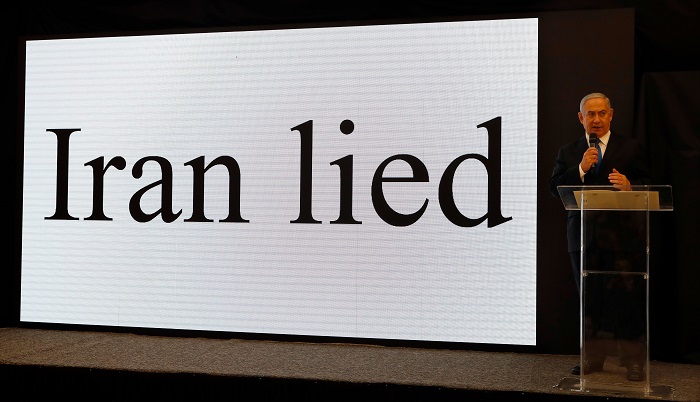
Israeli Prime Minister, Benjamin Netanyahu presented findings from a secret nuclear archive in Iran-April 30, 2018

Israeli Prime Minister Benjamin Netanyahu held a televised address that was part news conference, part reality show and part TED talk, in which he revealed a trove of over 100,000 files and 180 CDs full of data allegedly from the Iranian regime’s “atomic archive” detailing its program to design and build nuclear weapons in a program code named “Amad,” which ended in 2003.

The revelations in and of themselves were not too surprising since the Iranian resistance movement originally revealed the existence of the nuclear program and has been regularly exposing regime’s nuclear activities including revealing secret military sites where the regime conducted tests for high explosive detonators.

The National Council of Resistance of Iran, the leading dissident organization, has held its own press conferences to unveil smuggled documents, videos and photos of the regime’s nuclear program so what Netanyahu unveiled demonstrated a flair for showmanship, but didn’t shake the earth with new information.

But what was underscored is the simple truth that seems to have eluded many news organizations who were taken in by the PR push by the Iran lobby, especially the National Iranian American Council, which is that the regime has consistently lied about its nuclear program.

During the run up towards the Iran nuclear deal, the NIAC always maintained that Iran was not actively building towards a nuclear weaponization program but was instead building a civilian nuclear program. It tried to justify the weak inspections regimen by contending the Iranian regime wasn’t pursuing a bomb anyway, but the agreement would ensure that one could be postponed by a decade or longer.

Since the agreement didn’t include inspections of Iranian military sites, those assurances could never be fully realized and the Iranian resistance movement and Netanyahu’s disclosures only verified what was arguable one of the worst kept secrets that Iran was in fact trying to build a bomb, but somehow that past coverup never was called out as a reason not to trust verification by the regime under the deal.

The most explicit example of that conundrum was in the clean-up of Parchin facility before international inspectors could visit the site in 2015. Classified satellite images obtained by the U.S. government showed bulldozers and heavy machinery working at the site which was used by the regime as part of its nuclear program.

Of course, NIAC issued a statement by Trita Parsi that skirted the issue of Iranian lies and instead focused on the one thin shred of hope it has left before President Trump decides whether or not to decertify Iranian compliance with the deal by the May 12th deadline.

“Anyone familiar with the history of Iran’s nuclear program or the Joint Comprehensive Plan of Action will not be surprised by allegations that Iran had an active nuclear weapons program fifteen years ago. Those well-known concerns were the reason why the international community negotiated an agreement to limit Iran’s nuclear program and subject it to intrusive international inspections,” Parsi said.

Unfortunately, Parsi was one of the key advocates for ignoring the Islamic state’s penchant for boldly lying about its nuclear program and urging the rest of the world to simply trust and believe in Iranian “moderation.”

Three years later we know now that Iran merely used the nuclear deal as a tool to gain access to billions in badly needed cash to save its military adventures in Syria, as well as launch its ballistic missile program.

While it didn’t come as a surprise that the mullahs lie, it was a useful reminder moving forward that Iran has to be held to a different standard, akin to North Korea which broke every international agreement it entered into until President Trump decided to play hardball.

Again, the NIAC tries to stoke war fears in order to dissuade public opinion from taking harsh action against the Iranian regime.

“Amid an already ruinous regional proxy war in the Middle East, a war against Iran could be even more disastrous for global security than the 2003 invasion of Iraq. Iran is nearly four times the size of Iraq, with influence in military conflicts from Syria to Yemen and with missiles capable of striking U.S. ships and bases in the region. Bombing cannot erase Iran’s nuclear know-how and would only empower those in Iran eager to obtain a nuclear deterrent. Moreover, it would set the region aflame and draw the U.S. into a prolonged quagmire that would cost American blood and treasure and set U.S. security back decades,” said NIAC’s Ryan Costello in a statement.

It’s remarkable how many misconceptions are in that one paragraph. First and foremost, he neglects to mention that the Iranian regime is the only one responsible for the “ruinous” proxy war engulfing the region through its support and control of the terrorist group Hezbollah and its use in Syria.

It is gratifying though for Costello to admit Iran has developed a ballistic missile capability aimed directly at U.S. military bases but falls flat on his face in supposing the U.S. aim is to fight a war with Iran.

If anything, President Trump has been an outspoken opponent to using U.S. troops in the Middle East, being a frequent and harsh critic of President George W. Bush’s decision to invade Iraq.

President Trump has made it clear that his desire is to use the punitive power of economic sanctions which brought Iran to the bargaining table in the first place before the giveaways began under the Obama administration to appease the mullahs.

The threat of war doesn’t come from the U.S., it comes from Tehran and the mullahs there for are becoming increasingly desperate to hold onto their power.

What NIAC won’t tell you is that it isn’t worried about the threat of war, but the threat of renewed economic sanctions coming at a time when the regime is as weak and vulnerable as it has ever been. The prospect of regime change under those conditions is what terrifies Parsi and Costello and their comrades in arms.

Laura Carnahan

Filed Under: Blog, News Tagged With: #NuclearDeal, Benjamin Netanyahu, Featured, Iran deal, National Iranian American Council, NIAC, NIAC Action, Ryan Costello, secret nuclear archive

Mike Pompeo Wastes No Time Focusing on Iran Regime

April 30, 2018 by admin

Mike Pompeo Wastes No Time Focusing on Iran Regime

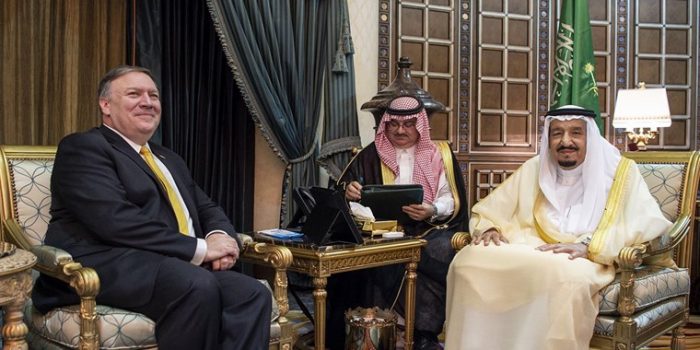
Pompeo meets with Saudi officials on his first trip as the new Secretary of States, April 2018

Fresh off his Senate confirmation despite a desperate effort by the Iran lobby to torpedo it, Secretary of State Mike Pompeo kicked off a whirlwind trip overseas with stops at a NATO summit in Brussels, Saudi Arabia and Israel in which he put the Iranian regime front and center of U.S. foreign policy moving forward.

The turnaround from the Obama administration’s attitude towards the Iranian regime is startling and badly needed. Under the previous administration, the focus of making the Iran nuclear deal the centerpiece of its foreign policy achievements drove out all other considerations.

Iranian regime’s long and brutal history of human rights violations was largely ignored as an inconvenient truth. Iran’s status as a state sponsor of terrorism was overlooked and its threats to its neighbors were glossed over by measly promises of “moderation” that never came to pass.

If hindsight is 20/20, then in the three years since the deal was struck, the world has seen Iran’s true colors and it’s largely consisted of red for the blood spilled and black for the charred remains of cities and villages blasted into oblivion in Syria, Iraq, and Yemen.

To say the world became a much more dangerous place with the rise of Islamic extremism coupled with the outflow of Iranian money supporting terrorist groups is a gross understatement.

And yet, the Obama administration held on to the hope that things would get better, if nothing else because it couldn’t stand to admit that it made a colossal mistake in the approving of the nuclear deal without any conditions on inspection of Iranian regime military sites, its ballistic missile program or meddling in the affairs of its neighbors.

The Trump administration hasn’t been under illusions about Iran’s role in destabilizing activities and has correctly called the mullahs out for their role as the center of troubles in the Middle East. Even more fortunate, this administration frankly doesn’t care much about its perceived public image or the goodwill of academics, television analysts or armchair foreign policy wonks.

Under Pompeo and new national security advisor John Bolton, this administration has been blunt and to the point; a shock to the system of typically mild-mannered diplomacy practiced over the past decade.

Pompeo kicked off his first full day as secretary of state this past Friday at a NATO summit for foreign ministers in Brussels in which he said it was “unlikely” the president would remain in the Iran nuclear deal after the May 12th deadline unless European leaders agreed to a “substantial fix” addressing the president’s concerns.

“Absent a substantial fix, absent overcoming the flaws of the deal, he [Trump] is unlikely to stay in that deal,” Pompeo said.

While President Trump has met with French President Emmanuel Macron and German Chancellor Angela Merkel in two visits in which both pressed him to remain in the deal, the president has made it clear what his conditions are to stay in the agreement. The diplomatic ball is now firmly in the hands of European and Iranian negotiators.

But beyond the nuclear agreement, Pompeo continued on to Iranian rival Saudi Arabia to make clear the U.S. position that now views Iranian regime as the greatest threat to regional stability.

Speaking to reporters in Saudi Arabia, Pompeo said the multi-party agreement reached in 2015 to curb Tehran’s nuclear program did not do enough to contain the Islamic Republic. “In fact, Iran has only behaved worse since the deal was approved,” he said.

Secretary Pompeo, cited Iranian regime’s support for the “murderous” government of Syrian President Bashar Assad and also accused the country of arming Houthi rebels in Yemen who have repeatedly targeted Saudi cities with ballistic missiles — a charge denied by Tehran.

“Iran destabilizes this entire region,” Pompeo said, standing alongside his Saudi counterpart in Riyadh. “It is indeed the greatest sponsor of terrorism in the world, and we are determined to make sure it never possesses a nuclear weapon.”

That thematic was carried to Israel as Pompeo repeated his talking points while meeting with Israeli officials.

The trip highlighted the forming of a new alliance in the Middle East opposed to Iran’s expansion making strange bedfellows of traditional foes in Saudi Arabia and Israel, along with the Gulf states, many of which have been on the receiving end of Iranian machinations to stir up unrest with protestors and terrorist acts.

The bluntness of the Trump administration has turned the tables on the mullahs who now are the ones on the proverbial hot seat and have to make the decision on whether or not to stay in the deal by acquiescing to the U.S. demands.

While the Iran lobby, especially the National Iranian American Council, has worked mightily in an effort to portrays the president’s tough talk as a pathway to war with Iran, the reality has been a clear definition of the expectations for Iranian compliance moving forward and failure of the deal rests squarely with the mullahs in Tehran and nowhere else.

There is no small irony that the discussions taking place now are not about what concessions the U.S. must give to Iran to preserve the nuclear deal, but rather what will the Iranian regime do to stay in a deal that it needs more than the U.S.

The inescapable fact right now confronting the mullahs and Hassan Rouhani is that Iran is a basket case of a nation with a free-falling currency, stagnant economy, dwindling foreign cash reserves and beset with civil unrest and protests on an almost daily basis.

The regime needs the deal badly in order to hang on to any kind of ability to convince the world that it’s indeed a reformed nation, a fiction that has served it well the past few years but has become an outright lie.

Just as North Korea has promised to decommission its nuclear test site and reactor, the president’s tough approach may soon yield the same dividends with Iran.

Laura Carnahan

Filed Under: Blog, News Tagged With: Iran deal, Iran Lobby, NIAC, Pompeo

  • « Previous Page
  • 1
  • 2
  • 3
  • 4
  • 5
  • …
  • 26
  • Next Page »

National Iranian-American Council (NIAC)

  • Bogus Memberships
  • Survey
  • Lobbying
  • Iranians for International Cooperation
  • Defamation Lawsuit
  • People’s Mojahedin
  • Trita Parsi Biography
  • Parsi/Namazi Lobbying Plan
  • Parsi Links to Namazi & Iranian Regime
  • Namazi, NIAC Ringleader
  • Collaborating with Iran’s Ambassador

Recent Posts

  • NIAC Trying to Gain Influence On U.S. Congress
  • While Iran Lobby Plays Blame Game Iran Goes Nuclear
  • Iran Lobby Jumps on Detention of Iranian Newscaster
  • Bad News for Iran Swamps Iran Lobby
  • Iran Starts Off Year by Banning Instagram

© Copyright 2026 IranLobby.net · All Rights Reserved.