Iran Lobby

Exposing the Activities of the lobbies and appeasers of the Mullah's Dictatorship ruling Iran

  • Home
  • About
  • Current Trend
  • National Iranian-American Council(NIAC)
    • Bogus Memberships
    • Survey
    • Lobbying
    • Iranians for International Cooperation
    • Defamation Lawsuit
    • People’s Mojahedin
    • Trita Parsi Biography
    • Parsi/Namazi Lobbying Plan
    • Parsi Links to Namazi& Iranian Regime
    • Namazi, NIAC Ringleader
    • Collaborating with Iran’s Ambassador
  • The Appeasers
    • Gary Sick
    • Flynt Leverett & Hillary Mann Leverett
    • Baroness Nicholson
  • Blog
  • Links
  • Media Reports

Trump Effect on Iran Already Seen in Syrian Talks

January 18, 2017 by admin

Trump Effect on Iran Already Seen in Syrian Talks

Trump Effect on Iran Already Seen in Syrian Talks

Donald Trump hasn’t even been inaugurated yet and his effect on U.S. foreign policy is already being felt throughout the Middle East:

  • Saudi Arabia is cautiously optimistic that the policy of trying to appease the Iranian regime under the Obama administration is at an end and that U.S. policy will once again shift back to traditional alliances in the regime that provided security for U.S. allies for the past 50 years;
  • After inserting itself into the Syrian civil war at the behest of the Iranian regime, Russia is now preparing to open new avenues of cooperation with the Trump administration even if Iran is vehemently opposed to them; and
  • The Iranian regime has reaped quick benefits from the Obama administration and the nuclear deal it negotiated including receiving $10 billion in cash and gold, but now is desperate to rake in as much cash as possible with the looming potential of the spigot being shut off by Trump.

A much ballyhooed summit is planned in the Kazakhstan capital of Astana this weekend to discuss a pathway for peaceful resolution of the Syrian conflict, involving Russia, Iran and Turkey, but now Iran is protesting Russia’s proposal to include the U.S. in these talks once Trump assumes office.

Iranian regime foreign minister Javad Zarif stated the regime’s opposition to the U.S. participating in what the regime hoped would be a photo opp moment in the diplomatic limelight for the mullahs in Tehran with these talks.

“We have not invited the U.S. and oppose their presence” at the talks, Zarif said, according to Iran’s Press TV.

Whether Iran would refuse to attend if the United States were invited was not immediately clear. The talks are part of a three-way process led by Russia and including Turkey and Iran — now the three most powerful international players on the ground in Syria. The process is aimed at forging a settlement in Syria after the failure of the Obama administration’s diplomacy, according to the Washington Post.

The opening round is expected to be a modest affair, with representatives of Syrian rebels meeting with members of the Syrian government to discuss the modalities of a shaky cease-fire that went into effect on Dec. 29, Russian Foreign Minister Sergei Lavrov told reporters in Moscow. Representatives of the invited countries will attend in the role of observers, rather than participants.

Although Iran is one of the three sponsors of the peace talks, it has not signed the agreement reached between Russia and Turkey that launched the cease-fire, suggesting that Tehran has reservations about an effort that could potentially erode its extensive influence in Syria.

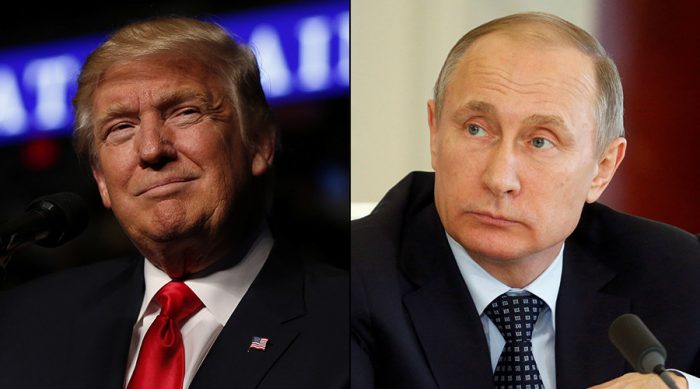
Both Trump and Russian President Vladimir Putin have said they regard Syria as one of the areas in which the United States and Russia could cooperate more closely. Trump has said on a number of occasions that he hopes better relations with Moscow will help counterbalance Iran’s expanding regional role.

That expansion and deepening relationship between Russia and the U.S. could very well leave the Iranian regime out in the cold and without the ability to leverage the two superpowers against each other for its own gain.

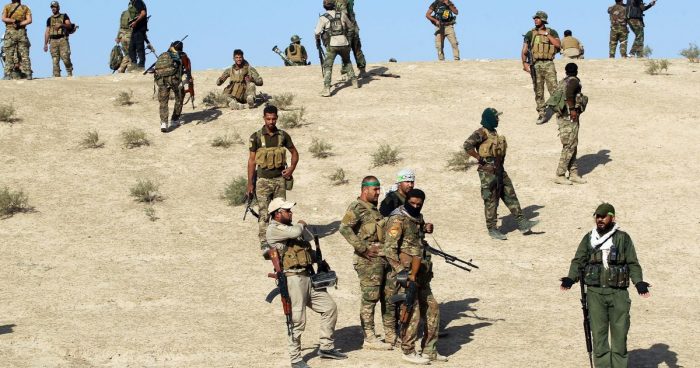
Iran has been instrumental in providing the manpower and resources that have helped Assad’s government hold the rebellion at bay. Thousands of Iranian-trained Shiite militia fighters from Iraq and Afghanistan are on the front lines, the Iranian-backed Lebanese Shiite militia Hezbollah is at the forefront of most of the major battles, and Iranian military advisers and commanders are embedded with them in many locations around the country.

All of those gains could be erased should Trump and Putin see eye-to-eye on the necessity to rein in Islamic extremism and view Iran as the regional godfather of radicalized Islamic terror.

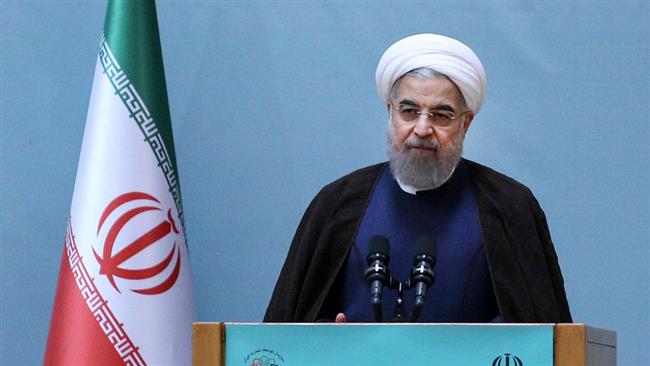
That prospect is frankly freaking out the Iranian regime and Hassan Rouhani took to state-owned airwaves to try and keep its attachment to Russia as close as Siamese twins.

“Iran, Russia and Turkey managed to bring a ceasefire to Syria … It shows these three powers have influence,” Rouhani said. “The (Syrian) armed groups have accepted the invitation of these three countries and are going to Astana.”

Asked why the United States and Saudi Arabia had no direct role in the talks, Rouhani said: “Some countries are not attending the talks, and their role was destructive. They were helping the terrorists.”

The prospect of a Trump presidency and realignment with Russia has caused the mullahs to issue pronouncements on a daily basis to try and spin the potential outcomes for the regime after January 20th; most of them bad for the mullahs.

Rouhani went on television to insist that any effort to “renegotiate” the nuclear agreement by Trump is “meaningless” and attributed it simply to Trump making campaign slogans, while his boss, Ali Khamenei, insisted that if the U.S. were to alter the agreement “we will light it on fire.”

Even European Union leaders are coming to the realization that the outcomes over the nuclear deal no longer rely on them, but rather now rest firmly on Trump’s decisions.

Federica Mogherini, the EU high representative for foreign affairs and security policy, who received withering criticism for trips to Iran while political prisoners were being executed, penned an editorial in the Guardian praising the nuclear deal in the hope of staving off its elimination.

It is worthy to note that Mogherini places her support squarely on the economic benefits towards European firms, but makes no mention of the year of terrorism and human rights abuses perpetrated by the Iranian regime and is silent on Syria and the absolute disaster for Europe from millions of refugees that has flooded in.

That kind of silence on important issues of terrorism and war are precisely why Europe has been blistered with multiple attacks in Brussels, Paris, Nice and Berlin and why solving the problem of Iran’s Islamic extremism is the surest path to peace.

Michael Tomlinson
Filed Under: Blog, News Tagged With: #NuclearDeal, Appeasement policy, Featured, hassan rouhani, Iran, Iran deal, Iran sanctions, Iran Terrorism, Khamenei, Rouhani, Syria

Iran Lobby Pleading to Save Iran Nuclear Deal Despite Regime Militancy

January 17, 2017 by admin

Iran Lobby Pleading to Save Iran Nuclear Deal Despite Regime Militancy

Iran Lobby Pleading to Save Iran Nuclear Deal Despite Regime Militancy

With only a few days left until Donald Trump is sworn in as the next president of the United States, the Iran lobby and their Iranian regime leaders are in an absolute tizzy about the nuclear agreement and its future.

For the Iran lobby, especially the National Iranian American Council and the Ploughshares Fund, the nuclear deal with Iran represented a high water mark for their perceived effectiveness, but like a evaporating lake in a desert, their success was illusory since it was largely built on the decision by the Obama administration to try a policy of appeasing the Iranian regime.

With the ascension of the Trump administration with such noted critics of the Iranian deal in many of cabinet nominees now undergoing confirmation hearings, the Iran lobby is faced with rollback of all of their gains in one fell swoop.

Iran lobby supporters such as Trita Parsi have tried all sorts of tactics in an effort to save the deal in a shotgun approach of messages. First they openly criticized Trump during the presidential election, joining the tactics of his opponents with personal attacks.

When that failed and he won election, Parsi and his cohorts shifted to the threat of war if the Iran nuclear deal was scrapped by Trump. When that fell on deaf ears and gained almost no traction with the media and Trump announced his cabinet picks, the attacks shifted to the nominees.

Now that line of attack has essentially failed, the Iran lobby is now trying to float the idea that the Trump is actually in support of the nuclear deal and not likely to scrap it because the consequences would be so devastating.

Trying to keep track of all the misses by the Iran lobby is like trying to keep track of clanks off the rim by a worst shooting team in the NBA.

And now their worst fears are finally starting to come to fruition: the U.S. is finally beginning to realize that instead of appeasing the mullahs in Tehran, it is now time to hold them accountable for their actions.

The Iranian lobby fears that deeds and not words are likely to be the new currency of diplomacy in 2017.

But it isn’t just a Trump administration that is causing the Iran lobby to freak-out, it is the changeover in Congress and the potential for a whole raft of actions aimed at the mullahs ranging from the re-imposition of economic sanctions on the federal level to state-by-state sanctions means the Iran lobby is poised to be overwhelmed.

Congress has already begun offering up a series of bills taking aim at various aspects of the Iranian regime’s conduct including the near unanimous passage of the Iran Sanctions Act. Now comes a bill offered up last week to initiate an investigation into Iran Air and other regime airlines by the new Director of National Intelligence into whether or not they provide support to the Revolutionary Guard Corps or other terrorist groups.

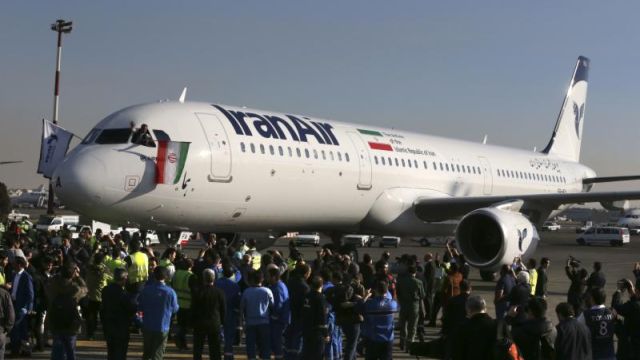
The timing of this legislation is important to the Iranian regime as it takes delivery of new commercial airliners from Airbus and soon Boeing to replace aging aircraft in its fleet. Iran Air took delivery last week of the first of 100 jets it ordered from Airbus with Boeing scheduled to deliver in 2018.

Should the investigation of Iranian airlines lead to the discovery of a link between them and support for terrorist activities, the suspect airline could end up back on the U.S. sanctions list and be prevented from receiving any new aircraft or U.S.-made parts according to CNN News.

There has always been deep suspicion that the Iranian regime uses commercial airliners to ferry troops, ammunition and cash to hotspots such as Syria and Iraq. Should that link prove true, the Iran lobby could find itself fighting for the economic survival of the regime again.

Mahan Air, Iran’s second biggest carrier, is still on the sanctions list for aiding Iran’s military and is barred from buying Western planes and parts.

Iran Air was removed from the U.S. sanctions list in January 2016 as part of an agreement to convince Iran to restrain its nuclear program. It opened the path for multi-billion dollar sales by Boeing and Airbus. That prompted an outcry from some lawmakers who said the Obama administration offered no proof that Iran Air had stopped its support of the Iranian military or designated terrorist organizations.

The news for the Iran lobby got worse with the release of a letter from 23 former U.S. officials urging the Trump administration to open up a dialogue with Iranian dissident groups, specifically the National Council of Resistance, which counts as one of its members the People’s Mujahedin Organization of Iran; a dissident group the mullahs in Iran have made it their mission to pursue and destroy.

Trump transition officials did not immediately respond to a request for comment. An NCRI spokesman, Ali Safavi, said the group had no “role whatsoever” in the letter, but forwarded a statement from an NCRI official, Soona Samsami, welcoming the letter as an “appropriate and timely initiative.”

In spite of these changing political fortunes, the Iranian regime seems intent on maintaining the same militant attitude to the rest of the world as news came out of Iran of the mass execution of 20 prisoners over the past two days.

Amnesty International reports indicate that Iran executed at least 977 people in 2015, mainly for drug-related crimes.

The human rights activist NGO also blames Iran for continuing to execute juvenile offenders, those aged under 18 at the time of the crime, in violation of the international law.

For the mullahs, some things don’t change.

Michael Tomlinson

Filed Under: Blog, Current Trend, National Iranian-American Council, News Tagged With: #NuclearDeal, Appeasement policy, Featured, Iran, Iran Lobby, Iran Terrorism, IRGC, National Iranian American Council, NIAC, NIAC Action, Nuclear Deal, Ploughshares, Syria

Evidence Mounts of Iran Leadership in Aleppo Atrocities

December 23, 2016 by admin

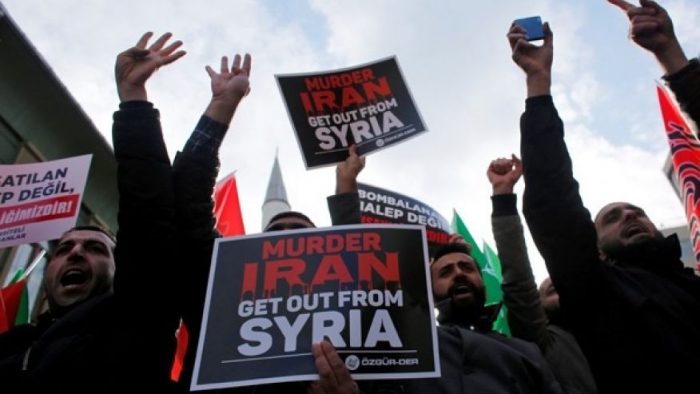
Outrage over the carnage in Aleppo has so far been directed mainly at Damascus, but activists on the ground say Tehran has a top general on the scene and has established secret camps where Iraqi mercenaries are trained to root out rebels in the Syrian city.

Evidence Mounts of Iran Leadership in Aleppo Atrocities

Evidence Mounts of Iran Leadership in Aleppo Atrocities

According to information provided to FoxNews.com, the forces currently controlling the city of Aleppo are under the command of the Iranian regime’s Revolutionary Guards Corps (IRGC). The military outfit under its command includes foreign mercenaries such as Lebanese Hezbollah, Iraqi militias, and also the Shiite fighters of the Liwa Fatemiyoun from Afghanistan and the Liwa Zainebiyoun from Pakistan.

At the same time, Iran participated in a summit in Moscow with Turkey and Russia to begin discussions on dividing up the spoils of the conflict now that Aleppo had fallen under merciless bombardment.

The meeting was further evidence of Iran’s emerging role in Syria, both during the ongoing civil war and the expected aftermath.

According to reports received by the opposition to the Iranian regime, the number of IRGC forces and its hired hands in Aleppo and the surrounding area has reached 25,000, while the number of military personnel from Assad’s army is very limited.

“This report leaves no doubt that the Iranian regime is the primary obstacle to any solution in Syria,” Shahin Gobadi, spokesman for the National Council of Resistance of Iran (NCRI) told FoxNews.com. “The current situation in Aleppo and the role of the Iranian regime in the atrocities committed on the ground require the immediate expulsion of the IRGC and its mercenaries from Syria. By meddling in other countries the mullahs try to cover up their vulnerability at home. The survival of the [Iranian] regime has been intertwined with maintaining the Assad dictatorship in power in Syria.”

The reports, which were obtained by the NCRI and its sister organization People’s Mujahedin of Iran (MEK), state that the commander of the Quds Force – as IGRC units operating outside Iran are known – in Aleppo is Brigadier General Javad Ghafari, who is described as the right-hand man of the Revolutionary Guard’s commander-in-chief, Qassem Soleimani, who has been referred to as the architect of Iran’s role in Russian operations in Syria, according to FoxNews.com

The MEK has established a track record of accurately reporting misdeeds by Tehran over the past decade, including its attempts to hide nuclear weapons-related facilities from UN inspectors, according to Middle East Eye.

The NCRI has also alleged that the Revolutionary Guard has established its main headquarters around 20 miles southeast of Aleppo in a garrison called Behuth, or Fort Behuth, which used to be one of the most important centers of missile and chemical weapon production for the Assad regime.

It is now under the supervision of Ghafari, but it also contains a center operated by Lebanese Hezbollah commanders, as well as a number of Syrian army officers who are also present, according to the intel reports.

“The fact is that Aleppo has been occupied by the IRGC and its mercenaries,” Gobadi said to FoxNews.com. “Mass executions, preventing the transfer of civilians including women and children, attacking the civilians – has all been done by the forces of the mullahs’ regime.

“[They] are the main source of crisis in Syria and the region,” he went on. “By abusing the inaction of the international community and being convinced of not being held accountable for its crimes, [Iran] has continuously become more emboldened.”

The U.N. puts the overall death toll in Syria’s civil war at 400,000. More than 30,000 have died in the Battle of Aleppo, a last urban rebel holdout against President Bashar Assad’s regime.

The Institute for the Study of War, a nonprofit research group in Washington, has reported that Iran organized thousands of Shiite militias in Iraq not only to fight the Sunni Muslim Islamic State there, but also to deploy them to fight rebels in Aleppo.

The Washington Times recently interviewed Iranian dissidents who had escaped to Western Europe. They said Iran’s brutality at home and aboard has increased, not decreased, since the landmark nuclear deal with the U.S. that provided Tehran billions of dollars.

The MEK report provided to The Times says that Syrian government forces are scarce around Aleppo, meaning it is Iran doing the lion’s share of offensive maneuvers and killings.

“On two occasions the transfer of Aleppo residents were hindered and their buses were fired upon under the instructions of the IRGC to gain concessions on the residents [of] al-Foua and Kefraya,” said the MEK, referring to two towns north of Aleppo.

State Department spokesman John Kirby was asked Monday whether the U.S. will protest to the U.N. Security Council the fact that Gen. Soleimani has been spotted in Aleppo. The U.N. has banned him from international travel for his role in terrorism.

“We do intend to consult with our partners on the Security Council about how to address our concerns with this,” Kirby said. “We’ve long said that Iran needs to choose whether it’s going to play a positive role in helping peacefully resolve conflicts such as in Syria or whether it will choose to prolong them. And you’re absolutely right: His travel is a violation.”

Jim Phillips, a Middle East expert at The Heritage Foundation, said that Assad’s army is depleted and stretched thin protecting government-held territory.

“Without Iran’s expanding military intervention, the Assad regime would have fallen months ago,” Phillips said. “While Russia’s military intervention has dominated media coverage on Syria, Iran has been responsible for almost all of the ground offensives in recent months that clawed back territory from the rebels and encircled Aleppo. It has deployed thousands of Revolutionary Guards.”

Michael Tomlinson


Filed Under: Blog, News Tagged With: #NuclearDeal, Featured, hassan rouhani, Iran, Iran Mullahs, Iran Terrorism, IRGC, Khamenei, Syria, Yemen

Why Do Sanctions Not Apply to Qasem Soleimani?

December 20, 2016 by admin

Why Do Sanctions Not Apply to Qasem Soleimani?

Why Do Sanctions Not Apply to Qasem Soleimani?

What is the purpose of a sanction? According to the dictionary, a sanction is “a threatened penalty for disobeying a law or rule.” Sanctions come in all forms ranging from your mother grounding you for painting the family dog to imposing economic sanctions on your nation because you’re trying to build nuclear weapons.

In either case, the basic premise is still the same: you do something wrong, you suffer the consequences. It’s not a complex idea and one as basic as human nature, except in the case of the Iranian regime, sanctions don’t seem to apply.

Take for instance the case of Qasem Soleimani who is the commander of the regime’s Quds Force, the arm of the Iranian military often engaged in irregular operations and is the primary contact for terrorist groups and militias around the world.

If Wal-Mart is the world’s largest retailer, the Quds Force is the bazaar for militants, terrorists, mercenaries and rebels.

The Quds Force is unique because it directly and solely reports to the regime’s top mullah, Ali Khamenei. That would be like if the Navy SEALS only reported to the president and were accountable to no one else. As the Quds Force commander, Soleimani wields enormous influence which he has used in carving out a personal theater of operations ranging from Lebanon and Syria to Iraq and Yemen.

Since 2007, the Quds Force has been a supporter of terrorism by the U.S. and Soleimani was singled out and sanctioned by the United Nations as well. He was also cited by the European Union in 2011 for his role in supporting the violent suppression of protests in Syria which sparked that civil war.

Since then, Soleimani has been at the heart of the Syrian conflict and the faceless man standing behind Syrian dictator Bashar al-Assad in a war that has claimed over 800,000 lives and turned large swathes of Syria into desolate wreckage.

Soleimani was also the principle player in flying to Moscow to plead with Russia to intervene militarily in Syria just as rebels had gained the upper hand and Assad was pushed to the brink.

The fact that Soleimani has been able to fly to Russia and travel throughout the Mideast has been amazing considering he is under an international travel ban as part of the sanctions imposed on him and yet he travels as freely and frequently as any reputable businessman.

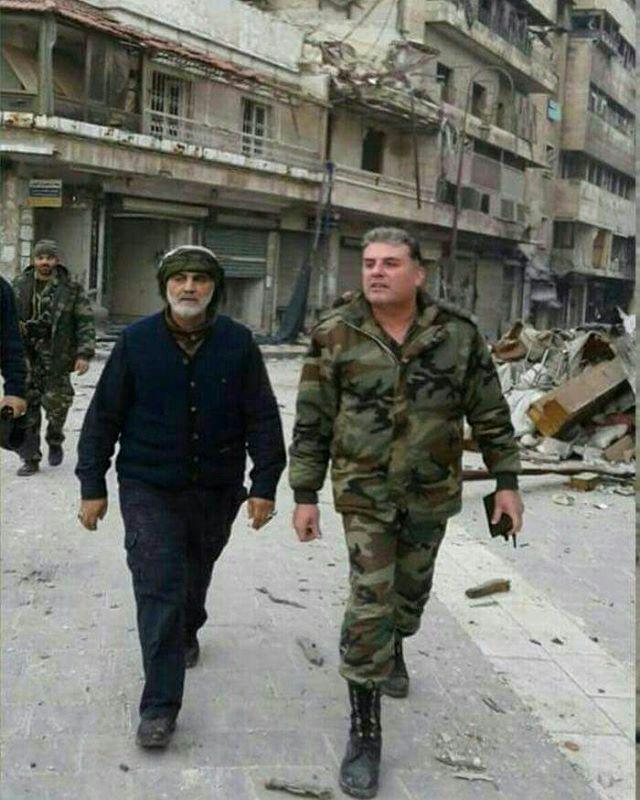
Now we have recent photos and social media posts of him touring the ruins of Aleppo in the wake of that city’s surrender this weekend. Soleimani tour of Aleppo was a demonstration of Iran’s waxing influence in Syria and disregard for international resolutions barring such behavior. Soleimani’s presence in Syria is a direct violation of the United Nations resolution governing the nuclear deal, according to the Washington Free Beacon.

Soleimani’s visit coincided with moves by the terror group Hezbollah, which is controlled by Iran, to establish its own claim in Syria, according to regional reports and footage.

Iran’s public presence in Syria has not been met with action by the Obama administration, which has come under increasing pressure in recent weeks to explain why it is not enforcing current sanctions against Iran. Soleimani continues to direct Iranian forces in both Iraq and Syria and has long been sanctioned for the murder of U.S. citizens.

Mutliple sources who spoke with the Washington Free Beacon about the matter disclosed that the Obama administration is taking a soft approach with Iran, including not enforcing sanctions, in order to preserve the nuclear deal and diplomacy with Tehran, which has threatened repercussions for any new sanctions.

Sanctions imposed by the international community to prevent the flow of arms and foreign fighters to Syria have proven just as impotent as Soleimani has used the Quds Force to recruit Afghan mercenaries from the ranks of refugees living in Iran, as well as shipped in Shiite militias from Iraq to fight for Assad.

He has also orchestrated the dramatic escalation in the use of air power first through Syria and later through Russia resulting in the use of barrel bombs and similar weapons of mass destruction on civilian targets.

Most disturbing, the Quds Force supported Shiite militias in Iraq with IEDs that were responsible for killing hundreds of American service personnel there and Soleimani has never been called to account for those American deaths.

In 2011, Soleimani and other members of the Qods Force were implicated in the failed Iranian plot to assassinate the Saudi Arabian ambassador to the U.S. at a popular restaurant in Washington, D.C. As part of the nuclear deal reached with Iran, the UN travel ban on Soleimani will be lifted either in October 2020 or when the International Atomic Energy Agency determines that all nuclear material in Iran is for peaceful purposes.

That lack of accountability and enforcement of sanctions points the greatest weakness in the argument made by the Iran lobby and other supporters of the nuclear which was that Iran wouldn’t be able to evade it.

Soleimani and the Quds Force are proof that Iran can not only evade international sanctions, but do so freely and without consequences.

Ultimately, the challenge for the incoming Trump administration and the rest of the world will be not in forging new agreements with Iran, but just enforcing the myriad of sanctions already in place.

Michael Tomlinson

Filed Under: Blog, News Tagged With: Featured, Iran Mullahs, Iran sanctions, Iran Terrorism, IRGC, Sanctions, Syria

Complications and Conflicts Are Coming with Iran in 2017

December 19, 2016 by admin

Complications and Conflicts Are Coming with Iran in 2017

Complications and Conflicts Are Coming with Iran in 2017

Sir Isaac Newton’s Third Law of Physics states that for every action there is an opposite and equal reaction. The same could be said for geopolitics as it relates to the Middle East where every act of terror seems to be met with a corresponding act of retribution and every scheme is met with another scheme by a competing entity or enemy.

For the Iranian regime, its actions throughout the Mideast has wrought suffering and destruction on a level not seen since World War II as the fall of Aleppo demonstrated with pictures and images reminiscent of bombed out cities such as Dresden or Tokyo.

Iran’s intervention at the start of the Syrian civil war to prop up the Assad regime set into motion a conflict that has claimed over 800,000 men, women and children and turned into refugees a whopping eight million people who have overwhelmed nations from Greece to Sweden.

Iranian regime sits at the center of most of the foreign policy challenges facing it in 2017, including:

Hezbollah

Long a loyal military proxy for the Iranian regime, the terrorist group Hezbollah has risen in prominence with its long campaign in Syria culminating in the fall of the rebel stronghold Aleppo. Iran has supplied Hezbollah with arms, cash and advanced weaponry for its campaigns, but the terror group’s bank account got a huge influx in cash coincidentally when the Obama administration secretly transferred $1.7 billion to Iran as part of the nuclear deal and hostage swap.

“While we cannot establish whether the money transferred from the U.S. went directly into the expanded defense budget, it, at a minimum, enabled the government to release an equal amount of money for defense purposes,” said Nimrod Raphaeli, a senior analyst at the Middle East Media Research Institute.

“It is noteworthy that the increase in the proposed defense budget for 2017 is approximately equal to the amount transferred by the U.S.,” he continued.

Raphaeli explained the government of Rohani “has submitted to the Majlis (parliament) a draft budget for the fiscal year March 2017-March 2018 for a total of $99.7 billion equivalent.”

That, he said, is up 13.9 percent, with a “sharp increase of 39 percent … in funds earmarked for defense, including a big increase in the budget of Iran’s Islamic Revolutionary Guards.”

The report described the IRGC as “a potent military force accountable to the supreme leader, in regional politics, and particularly in Syria and Iraq.”

“A branch of the IRGC, the Qods Force Brigade, commanded by Gen. Qasem Soleimani, is responsible for spreading Iran’s subversive and, often, terrorist activities across the Middle East and beyond.”

Soleimani was seen in eastern Aleppo this weekend surveying the remains of the city as residents, long trapped by the fighting, struggled to evacuate.

Syria

Syrian rebel leaders blamed Iran for halting the evacuation of civilians from Aleppo, leaving an uncertain fate for residents as Iranian forces backed Syrian government troops entering the beleaguered city.

The operation to evacuate fighters and civilians from the last opposition-held area of Aleppo was suspended on Friday, its second day, after pro-government militias demanded that wounded people also be brought out of al-Foua and Kefraya, and protesters blocked the road out of Aleppo.

Munir al Sayal, the head of the political wing of the Ahrar al Sham rebel group involved in negotiations over the deal said Iranian-backed Shi’ite fighters led by Hezbollah militia and other Iraqi Shi’ite groups were behind the detention of hundreds of people trying to leave on Friday, leading to some deaths before they were turned back, in an effort to disrupt the evacuation.

Iran Nuclear Deal

The success or failure of the Iran nuclear deal (depending on your affiliation with the Iran lobby) hinges not so much on whether or not Iranian regime adheres to the deal (since it already has broken several sections of it) but rather whether or not the U.S. finally holds Iran accountable for specific violations instead of trying to paper them over with waivers and exemptions.

The process of appeasing of the Iranian regime in order to support an illusory “moderate” movement within the Iranian government has yielded nothing of tangible worth and has only emboldened and empowered the regime and strengthened the hold the Revolutionary Guards Corp has on virtually every aspect of Iran.

In many ways, the UN’s international nuclear watchdog agency has already been compromised by politics by looking the other way with violations by Iran in heavy water limits, enrichment levels and amounts of enriched uranium. Hassan Rouhani’s recent pledges to launch a crash program to develop nuclear-power naval vessels would require fuel far in excess of the agreement’s levels; thereby putting the UN’s watchdog again on the spot.

Economic Sanctions

Unfortunately, the Obama administration’s insistence on paying $1.7 billion in cash to Iran and opening up the doors to foreign investment weakened the usefulness of future of economic sanctions by providing the Iranian regime with an economic cushion.

The mullahs recognize their vulnerability on this score and are in a mad dash to complete as many business deals as possible even threatening Trump with harsh repercussions should he interfere in the recently announced deal by Boeing to sell $16.6 billion worth of jet airliners to Iran.

For the mullahs, the airliners are vital since a nation cannot operate in a global economy without a strong and viable air network, but in Iran’s case airliners also serve as the vital air bridge to move arms, cash, supplies and fighters to their proxies in far flung battlefields. Emanuele Ottolenghi wrote in the Hill of Iran’s use of its airlines to support its wars.

“It is well known that Iranian passenger planes ferry Iranian-backed militias to Damascus from Iran’s airports such as Abadan, Yazd and Tehran. The aircraft also carry weaponry in their cargo compartment. Weapons flown to Damascus supply Lebanon’s Hezbollah, the regime forces of the Syrian army, Iran’s Islamic Revolutionary Guard Corps (IRGC), and their Afghan, Iraqi and Pakistani Shiite militias,” Ottolenghi wrote.

“Conclusive evidence that Iran’s aircraft is the principal conduit for Tehran’s weapons and military personnel airlift in support of Assad’s war of extermination against his own people emerged recently, as Boeing representatives were in Tehran to finalize a $16.6 billion aircraft deal with Iran Air. Airbus will soon follow suit with an even larger deal,” he said.

While the outlook for the Mideast remains murky to say the least, there is no doubt that Iranian regime’s role and how it can be confronted will dominant much of 2017.

Michael Tomlinson

Filed Under: Blog, News Tagged With: #NuclearDeal, Appeasement policy, Featured, hassan rouhani, Iran, Iran Lobby, Khamenei, Nuclear Deal, nuclear talks, Rouhani, Sanctions, Syria

Iran Lobby Launches Media Blitz to Save Iran Nuclear Deal

December 9, 2016 by admin

Iran Lobby Launches Media Blitz to Save Iran Nuclear Deal

Iran Lobby Launches Media Blitz to Save Iran Nuclear Deal

We’ve already chronicled recent efforts by the National Iranian American Council to try and save the flawed Iran nuclear agreement with a flurry of press releases, editorials and social media posts in an attempt to attack everything from President-elect Donald Trump’s tweets to his Cabinet selections.

Not to be outdone, the other leader in the Iran lobby stepped up the plate with another media blitz by the Ploughshares Fund, which sent out its own editorials in an effort to dredge up the same old arguments similar to the arguments used by the Iran lobby during the run up to the nuclear agreement last year in which groups such as Ploughshares and NIAC tried to portray anyone opposed to the deal as a militaristic hawk hell bent on carpet bombing Iran.

In the year since the deal was approved, it is ironic to see the Iranian regime being the one to carpet bomb cities in Syria and funnel arms to terrorist proxies and militias in Iraq and Yemen. Of course Ploughshares offers no editorials condemning the cycle of war and violence the Iranian regime feeds and nurtures.

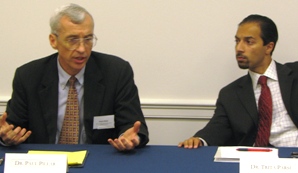
Paul Pillar, a former intelligence officer that has been penning on behalf of the Iranian mullahs in various occasions, joined at the hip to the Ploughshares Fund, offered up one such editorial in the National Interest in which he pedaled the same old idea that anyone critical of the Iran nuclear deal was a neo-con war hawk.

Pillar again raises the specter of the Iraq war as a harbinger of war with Iran in order to try and scare readers as he bangs the drum against President-elect Trump.

“None of this is a prediction that there will be such a war.  But the danger of one is greater now than it was before November 8th and the appointments that followed.  Vigilance is required to avoid further steps that would increase the chance of a war,” Pillar adds. “Also to be watched for are any moves, such as aggressive U.S. military operations in the Persian Gulf, that could become steps down a slippery slope to conflagration.”

That last statement by Pillar really demonstrates how bought in he is for Iranian regime, when he makes no mention of the devastation Iranian regime’s military actions in the region have caused.

Unlike what Pillar says, the aggression is coming from Iran.

But Pillar wasn’t the only Iran lobbying ally to get in on the act, Tytti Erästo, a fellow at Ploughshares, also offered up her own editorial at the National Interest as well trying to sell the idea that Trump needs the Iran nuclear deal to engage with Russia and North Korea.

She tries to make the case that North Korea would somehow view an intact nuclear deal as the appropriate pathway since it would demonstrate the benefits of diplomacy.

Let’s think about that idea carefully for a moment:

  • North Korea supplied Iranian regime with information and designs for its nuclear program, as well as licensed its ballistic missile designs to jumpstart the regime’s missile program;
  • North Korea has consistently been the most sanctioned nation on the planet over its nuclear program as it developed the capability, actually built warheads and then exploded them in tests; and
  • North Korea is widely regarded as the world’s most notorious rogue state after it consistently broke every international agreement negotiated with it.

Yes, that sounds like a wonderful template of how Iran can positively influence North Korea!

And how could nuclear deal influence anyone, particularly since we are talking about a flowed agreement with no teeth that provides ample exemptions and waivers for violations and lift all economic sanctions without the need for compliance monitoring?

In fact, her statement reflects a key component of all the Iran lobby’s positions which is that the International community bears the burden for compliance and any failure in the agreement must stem from the U.S. and others not from anything the Iranian regime did.

It is the same frivolous thinking that paved the way for a badly flawed deal which led us to the crises the world currently faces.

While such efforts by the Iran lobby reveals the weak position and the fear the mullahs have, it also proves that the right policy towards Iran is and has always been a firm policy that should hold the Iranian regime finally accountable for its actions and not the other way around.

Michael Tomlinson

Filed Under: Blog, News Tagged With: #NuclearDeal, Appeasement policy, Featured, Iran deal, Paul Pillar, Ploughshares, Syria, Trita Parsi, Yemen

Iranian Regime Tries Its Own Regime Building

November 2, 2016 by admin

Iranian Regime Tries Its Own Regime Building

Iranian Regime Tries Its Own Regime Building

The Iranian regime has been busy building its own Islamic version of the old Soviet Union’s Warsaw Pact through the use of proxies and terror groups to fight civil wars in Syria, Iraq and Yemen. The template for such a tactic began in Lebanon where Iran’s chief partner, Hezbollah, has become the dominant political force after three decades of bloody sectarian conflict.

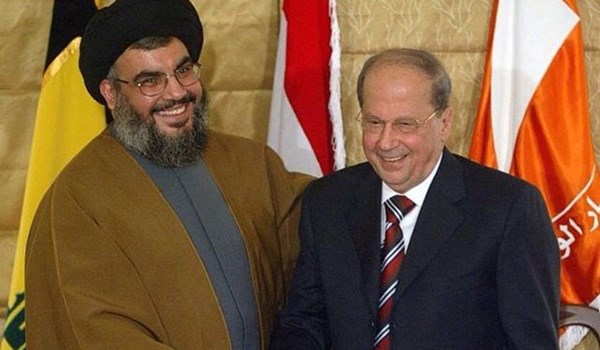
Lebanon took another step in aligning itself more closely with Iran when Lebanon’s lawmakers elected Michel Aoun, an Iran-backed politician and former general, as president Monday, ending more than two years the country has gone without a leader.

Aoun, 81, is an ally of Hezbollah, the Shiite militia and political party backed by Iran that has helped Syrian President Bashar Assad survive a five-year civil war on Lebanon’s border.

According to USA Today, the vote for Aoun, by 83 of parliament’s 127 members, shows Iran-backed political factions shouldered past those aligned with Saudi Arabia, replacing Syria as Lebanon’s chief foreign power broker.

It’s an important development since it adds to the growing sphere of influence the Iranian regime is trying to build in the Middle East as it tries to set itself apart as the dominant power in the area; overtaking Saudi Arabia.

It is also an attempt by the mullahs in Tehran to send a message to other countries in the region to either cozy up to Iran or face possible repercussions. But far from being a clear-cut victory for Iran, Lebanon sought to navigate a narrow path and not serve a pawn solely for Iran.

Saad Hariri, a pro-Western and Saudi-oriented politician, formally endorsed Aoun last week after failing to garner enough support for the presidency. In return, Aoun is expected to appoint Hariri prime minister in a power-sharing move aimed at keeping both Saudi Arabia and Iran from gaining total leverage within Lebanon.

Of course, Iran tried to portray the election as a vindication for its policies. Aoun’s election drew immediate praise from a top adviser to Iran’s top mullah Ali Khamenei.

The adviser, Ali Akbar Velayati, described the choice as a victory for Iran and its allies in Lebanon, because the Lebanese president is “a very significant ring in the chain of the Islamic resistance,” according to Iran’s government-owned Tasnim News Agency.

The election of Aoun to the presidency, instead of the much more political powerful prime minister post also makes Iran’s claims of victory ring slightly hollow, but the mullahs are willing to trumpet any positive news when so little good news is coming across right now as a stagnant economy at home stirs unrest and the colossal drain of supporting three wars has Iran clamoring for lifting more sanctions and even nabbing a few more American hostages in the blind hope of shaking down more ransom money.

The efforts by Iran to influence its neighbors fly in the face of warnings issued by regime leaders against foreign nations from intervening in the region.

In a meeting with Cypriot Parliament speaker Demetris Syllouris, Iranian regime parliamentary speaker Ali Larijani censured foreign countries for “meddling” in the fate of nations in the Middle East in what could be classified as one of the bigger lies uttered by the mullahs recently.

In an usual twist of irony for the regime, while Larijani was warning against foreign intervention, Hossein Salami, the deputy commander of Iran’s Revolutionary Guard Corps, told a crowd of Basij paramilitaries that regime forces recently demonstrated “its capability of not recognizing the red lines in pursuing and punishing the regime adversaries.”

He bragged on the expansion of the Islamic state’s boundaries from the Red Sea to the Mediterranean, vowing that the “defenders of the holy shrines” forces would crash Tehran opponents anywhere in the world in a definitive statement on the regime’s territorial ambitions.

“You can see how our borders expanded reaching the Red Sea and the eastern Mediterranean, due to the sacrifice of our martyrs,” he added according to Tasnim news agency.

So even while the regime complains about foreign intervention, it sees for itself a blank check to meddle in the affairs of its neighbors and even recognizes its own mandate to push forward its own boundaries in pursuit of a larger swath of territory.

All the while the administration of Hassan Rouhani is making changes to Iran’s media laws to further muzzle journalists from any possible dissent and tighten the screws on criticism.

His administration reportedly plans to do this through two bills: one designed to ultimately replace the current Press Law and the other to create a state media commission. While the new Press Law may appear relatively similar to the current one, it leaves more room for interpretation when determining if someone has committed an offence. This could make it easier for prosecutors or judges with political motivations to silence journalists or newspapers through arbitrary charges, according to Global Voices.

The proposed Media Affairs Commission bill to “oversee the journalism profession” would make journalists and media agencies more directly accountable to the government. The Commission will be responsible for issuing permits to journalists, draft a Journalism Ethics Code and ensure “high moral standards” in the media. At present, local Iranian journalists do not need permits to work for publications, in contrast to foreign journalists who go through a rigorous accreditation process through the Ministry of Culture and Islamic Guidance’s foreign press department. Only special accreditation is applied for journalists through their new agencies to attend official settings such as Parliament, or speeches by the President and Ministers.

Hardline politician Hossein Entezami, well known for repressing media freedoms, reportedly will take a leading role in the Commission. His appointment to this post, by the Rouhani administration, is leading to feelings of disquiet for freedom of the press in Iran.

Laura Caranahn

Filed Under: Blog, News Tagged With: Featured, Hezbollah, Iran, Michel Aoun, Syria

Iran Regime Roadmap in Syria Includes Highway to Mediterranean

November 1, 2016 by admin

shiite-militiasSince the US-led invasion of Iraq, the Iranian regime has ratcheted up its military involvement in its neighbors. At first, the regime used the tried and true tactics of using terrorist groups and proxies to strike at coalition forces during the insurgency in Iraq, killing and wounding thousands of troops primarily through explosive devices its Quds Forces made and delivered to Shiite militias.

It’s a model Iranian regime used to great effect through two decades of civil war in Lebanon through its Hezbollah terror partners, which it then expanded to use in the Syrian civil war in support of the Assad regime.

Similarly, the Iranian regime used the Houthis to launch another civil war in Yemen, aimed at destabilizing Saudi Arabia, a major coalition partner opposed to the Assad regime.

But what is the master plan for the mullahs in Tehran? What are they trying to gain from all of the machinations and manipulations?

Leaders of the Iranian regime in the face of opposition among their own loyal forces due to the heavy loses they have had particularly in the Syrian invasion, have numerously said that Syria and Iraq are their battle field to keep the enemy from fighting at home. i.e. using the same tactic they have been using since the beginning of the 1979 revolution, to create and export crisis in the region in order to cover up the internal crisis and the lack of capabilities to resolve such crisis. Hence one way to legitimize repression inside Iran has always been to point to the external crisis and the outside enemy.

While some try to project the Iranian regime’s meddling in Syria, Iraq and Yemen as a sign of strength, it is in fact the same crippling situation that forced regime’s top leader, Ali Khamenei, cornered by the sanctions to put a more friendly face out to the world and as such, manipulated the next election ballot to clear the field for Hassan Rouhani, a long-time loyal servant of the regime and a genial actor. In him, Khamenei saw his opportunity to fool the West, hoping for a change in the equation with Iran.

The creation of the Iran lobby, including US-based groups such as the National Iranian American Council, helped pushed that narrative during the run up for nuclear negotiations. For the mullahs, the completion of a nuclear deal was the linchpin to their plans since it set into motion the lifting of economic sanctions and the flooding of fresh cash back into coffers depleted by war.

While the infusion of cash and lifting of sanctions has opened the door to foreign investment for the first time in decades, the support for three wars is aimed at a more practical consideration: the creation of a Shiite-sphere of influence that buffers Iran from its neighbors and allows it access vital trade routes, economic markets and the ability to move assets freely without observation or restriction, however the main issue for the regime is its fear of uprisings at home and therefore its need for continuing with its meddling in the region.

For the mullahs, they have created a house of cards, each balancing on the other precariously and should one fall, the whole house collapses. Such is the flimsy nature of the mullahs hold and yet the West fails to fully grasp the leverage it has over the regime; leverage it abdicated when it chose to approve a nuclear agreement without linking Iran’s support for terrorism or improvements in human rights to it.

Nothing illustrates the complex interconnections the Iranian regime is striving for than the battle for Mosul in Iraq and for Aleppo in Syria. In both cases, the lack of a clear and decisive US policy has allowed the mullahs to manipulate the situations where Iranian-backed Shiite militias that used to attack US forces in Iraq are now attacking Sunni insurgents under US air cover.

The manipulation of this chessboard has many layers. For example, the lifting of economic sanctions was important in order for the regime to enter into deals with Boeing and Airbus to acquire new passenger airliners to replace a decrepit fleet which has seen hard use ferrying troops and weapons via an air bridge from Iran and Lebanon into Iraq and Syria.

Of paramount importance though to the long-range plans of the Iranian regime is the consolidation of friendly territory. For Khamenei and Rouhani, they envision an unbroken land stretching from the Mediterranean with Lebanon and Syria, through Afghanistan and Iraq to Yemen and even the Gulf states on the Persian Gulf and Indian Ocean.

It is a grand vision, but one that can only come to fruition through war, terror, bloodshed and violence. After all this is perhaps the only way they know to come out of the deepening crisis back at home.

The Iranian resistance movement has fought this complicated game plan for decades, but the West has largely not caught on and similarly combatted it; seeing it more in terms of short term agreements. The fact that the nuclear agreement only buys less than a decade of nuclear-free time is incredibly short-sighted and indicative of why the mullahs think they can win this game by being patient.

What is handicapping Tehran though is the inability to generate much economic improvement in the lives of ordinary Iranians who chafe under the yoke of oppression. This is the area of greatest risk to the Iranian regime where the people themselves are capable of changing the regime.

If the West ever realized the true potential it holds to advance change in Iran, then the future of the Iranian people could be helped immensely.

Let’s hope it doesn’t take too long to figure out that holding Iran accountable instead of rushing forward with trade deals is the better way to block Iranian regime’s roadmap.

Michael Tomlinson

Filed Under: Blog, News Tagged With: Featured, Iran, Iran deal, Iran Human rights, Iran Lobby, Iran Mullahs, Iran sanctions, Iran Terrorism, Khamenei, National Iranian American Council, NIAC, NIAC Action, nuclear talks, Syria, Yemen

Iran Regime Executions During Dignitary Visits Become Routine

October 29, 2016 by admin


Iran Regime Executions During Dignitary Visits Become Routine

Iran Regime Executions During Dignitary Visits Become Routine

One of the more peculiar actions taken by the Iranian regime is the unusual habit of executing people during visits by foreign dignitaries. Typically, countries wrestling with intense international scrutiny due to perceived human rights violations have normally been more circumspect when hosting a visiting leader.

The accompanying media attention of a state visit usually has forced countries to hold off on high profile actions such as a crackdown or round up of dissidents or staying the executions of political prisoners.

The one glaring exception to that rule has been the Iranian regime, which seems to perversely revel in executing prisoners whenever someone comes calling.

The most recent example was the execution of three Turkish nationals accused of drug trafficking last year on the heels of a high-profile visit to Tehran by Turkish president Recep Tayyip Erdogan.

The Iranian regime – which executed nearly 1,000 people alone last year, more than any other country apart from China – usually refrains from sending foreign nationals to the gallows, especially in cases involving countries with which Tehran has maintained friendly relations, according to the Guardian.

The family of a 46-year-old man, Faruk Güner, a father of nine children, confirmed to the Guardian that he was executed. He was a lorry driver working between Afghanistan and Turkey who passed through Iran. “We tried for four years to save him. They didn’t tell us that he was going to be executed. They hanged him in the morning; we got the news in the afternoon,” Güner’s brother said.

The information about the executions was published by several human rights organizations. One of these organizations based in Norway, said two other Turkish nationals, identified as Mehmet Yilmaz and Matin, whose surname is not known, were executed at the same time.

The organization that monitors the human rights situation in Iran, said more than 450 people have been put to death in the country this year. It said at least 264 of them were executed for drug offences. Iran has also executed at least seven people who committed their crimes while they were under the age of 18.The execution of juveniles is prohibited under international law.

The regime has also taken the opportunity to commit executions during other high profile visits in a perverse move that defies logic, such as:

  • Matteo Renzi, Prime Minister of Italy, during April 12, 2016 visit, eight prisoners hanged;
  • Federica Mogherini, European Union foreign policy chief, during April 16-17, 2016 visit, three women executed by regime;
  • Christine Defraigne, president of the Senate of Belgium, during April 27, 2016 visit, 17 executions including three juveniles; and
  • Kolinda Grabar-Kitarovic, president of Croatia, during May 17, 2016 visit, 21 hangings in a stunning 48 hour window.

The willingness of the regime to execute people relentlessly during these high profiles—even when a dignitary pleads with the regime not to commit any executions—demonstrates the true nature of the mullahs in Tehran which is to signal to the world loudly and clearly that Iran will do as it sees fit regardless of what the world thinks.

What is even more disturbing is how the mullahs are working hard to indoctrinate Iran’s children into the same perverted mindset where violence and executions are a normal part of Iranian society.

Deutsche Welle looked at this trend and what it portends as a new generation of Iranians are taught at an early age that violence as a state tool is welcome.

Books in Iran, in general, are subjected to a strenuous approval process. But, the glorification of violence, even in children’s books, does not appear to be a problem.

“Children’s books have become much more religious. More stories involve mosques or religious ceremonies,” Iranian mother, Shohreh, (name changed) said. She isn’t surprised that books including hanged animals sell well. “People attend public executions and even bring their kids.”

“Society is being intentionally desensitized,” told DW, a human rights lawyer and children’s rights activist that specializes in cases regarding the execution of minors, which is allowed in Iran once they reach 18.

“Statistics show that violence particularly within families has strongly increased,” he said. “There are many causes for this. Violence in public is certainly one of them. People exposed to so much violence don’t shy away from using violence themselves. This must be countered, not celebrated everywhere.”

It is a deeply disturbing trend that harkens to similar indoctrination undertaken by totalitarian regimes such as the Khmer Rouge in Cambodia which employed children to select people for instant executions as part of the notorious killing fields.

Even Hitler’s Nazi Germany relied on the Hitler Youth to serve as a fanatical conduit for its armies; the Iranian regime is no less dedicated to the same tactics.

Ultimately, the fight for human rights in Iran is not just to preserve the people of Iran, but their future through their children.

Michael Tomlinson

Filed Under: Blog, News Tagged With: Featured, Iran Mullahs, Iran Terrorism, IRGC, Jason Rezaian, Rouhani, Sanctions, Syria

Why Hassan Rouhani’s Calls for Co-Existence Are Meaningless

October 21, 2016 by admin

Why Hassan Rouhani’s Calls for Co-Existence Are Meaningless

Why Hassan Rouhani’s Calls for Co-Existence Are Meaningless

Iranian regime controlled media loudly broadcast remarks made by Hassan Rouhani at a ceremony marking National Exports Day in Tehran in which he called for peaceful co-existence with the rest of the world and Iran’s neighbors.

No, this was not an April’s Fool joke come early, nor was it an attempt at early Halloween gallows humor.

Rouhani was making his appeal because the world has not reacted well to the regime’s militant and aggressive moves since a nuclear agreement was reach over 18 months ago. There has arisen significant uncertainty among foreign companies, institutional investors and many governments over entering into business agreements at a time when new sanctions may be coming.

Rouhani was making his appeal on a strictly commercial basis in which he hoped to see Iran enter the global marketplace as a significant consumer market, as well as an eventual exporter of goods.

According to Trend News Agency, “Iran has no choice other than forming a constructive interaction with the world in order to boost its export,” he said.

He further said that constructive interaction with the world means establishing suitable ties with global community for exports, and import of capital goods and raw materials as well as employment of youth.

There is good reason for Rouhani and his fellow mullahs to be worried. Iran’s economy remains stagnant, with little benefits trickling down to ordinary Iranians as promised by Rouhani. Youth unemployment remains staggeringly high and wages have not risen significantly in over a decade leading to widespread discontent and protests throughout Iran.

Scandals involving excessive compensation for high-placed executives at regime-controlled industries have rocked Rouhani’s term, as does a high-profile crackdown against journalists, students, artists, bloggers, dissidents, and religious and ethnic minorities.

The mullahs’ “morals” police squads are working overtime arresting and abusing everyone from Iranian women riding bicycles to Iranian youth congregating in coffee shops.

But what has most foreign companies and investors worried is the regime’s rapid escalation in its involvement in three widening proxy wars in Syria, Iraq and Yemen, in which US armed forces are increasingly being drawn into direct conflict with Iranian and Iranian-backed forces.

In Yemen, Iranian regime-backed Houthi rebels reportedly fired cruise missiles at US warships three times in one week; resulting a response from the US of three cruise missiles hitting radar installations in Yemen.

US Army Gen. Joseph Votel, commander of US forces in the Middle East, said on Wednesday that he believes Iran was behind the missile strikes on US Navy ships in Yemen.

“I do think that Iran is playing a role in some of this. They have a relationship with the Houthis, so I do suspect there is a role in that,” said Votel at the Center for American Progress, The Hill’s Kristina Wong reports.

Now news reports have surfaced detailing how the Iranian regime has stepped up weapons transfers to the Houthis threatening to widen and prolong the now 19-month-old war.

Much of the recent smuggling activity has been through Oman, which neighbors Yemen, including via overland routes that take advantage of porous borders between the two countries, the officials said.

U.S. and Western officials who spoke to Reuters about the recent trend in arms transfers said it was based on intelligence they had seen but did not elaborate on its nature. They said the frequency of transfers on known overland smuggling routes had increased notably, though the scale of the shipments was unclear.

A senior Iranian diplomat confirmed a “sharp surge in Iran’s help to the Houthis in Yemen” since May, referring to weapons, training and money.

“The nuclear deal gave Iran an upper hand in its rivalry with Saudi Arabia, but it needs to be preserved,” the diplomat said.

Ironically, the timing of the increased flow of cash and arms to the Houthis coincides with the ransom payments of $1.7 billion made to the Iranian regime by the US to free four American hostages.

Meanwhile in Syria, the growing failure of repeated cease-fires have placed US personnel dangerously close to being targeted by Russian and Syrian airstrikes, as well as facing Shiite militias imported from Iraq by Iranian airliners to fight alongside Syrian forces against US-backed rebels.

It is against this backdrop of global uncertainty that Rouhani is making one of the most absurd sales pitches anyone can recall since it is exactly because of the Iranian regime’s acts that have made many companies and investors skittish at risking billions of dollars.

That idea of co-existence draws little weight as Rouhani himself has admitted that the regime does not recognize dual national citizens and is in the midst of an unprecedented binge of hostage-taking of US, British, Canadian and other citizens.

Even more disturbing has been taunting statements made on regime-controlled websites demanding “billions in cash” as ransom payments for these new hostages.

Even Rouhani has taken a personal hand in tightening the figurative noose among his fellow Iranians by firing Minister of Culture and Islamic Guidance Ali Jannati, Education Minister Ali Asghar Fani and Minister of Youth Affairs and Sports Mahmoud Goudarzi all on the same day.

It’s interesting to note that all three ministers oversaw parts of Iranian society which enjoyed a bit more creative freedom during the run-up of the nuclear negotiations in an effort to present a more “open” society to the world. With the nuclear deal accomplished, their dismissals and subsequent crackdown on freedoms should not be a surprise.

Laura Caranahan

Filed Under: Blog, News Tagged With: Featured, Iran, Iran Mullahs, Iran sanctions, Iran Terrorism, IRGC, Nuclear Deal, nuclear talks, Sanctions, Syria, Yemen

  • « Previous Page
  • 1
  • 2
  • 3
  • 4
  • 5
  • 6
  • Next Page »

National Iranian-American Council (NIAC)

  • Bogus Memberships
  • Survey
  • Lobbying
  • Iranians for International Cooperation
  • Defamation Lawsuit
  • People’s Mojahedin
  • Trita Parsi Biography
  • Parsi/Namazi Lobbying Plan
  • Parsi Links to Namazi & Iranian Regime
  • Namazi, NIAC Ringleader
  • Collaborating with Iran’s Ambassador

Recent Posts

  • NIAC Trying to Gain Influence On U.S. Congress
  • While Iran Lobby Plays Blame Game Iran Goes Nuclear
  • Iran Lobby Jumps on Detention of Iranian Newscaster
  • Bad News for Iran Swamps Iran Lobby
  • Iran Starts Off Year by Banning Instagram

© Copyright 2026 IranLobby.net · All Rights Reserved.