Iran Lobby

Exposing the Activities of the lobbies and appeasers of the Mullah's Dictatorship ruling Iran

  • Home
  • About
  • Current Trend
  • National Iranian-American Council(NIAC)
    • Bogus Memberships
    • Survey
    • Lobbying
    • Iranians for International Cooperation
    • Defamation Lawsuit
    • People’s Mojahedin
    • Trita Parsi Biography
    • Parsi/Namazi Lobbying Plan
    • Parsi Links to Namazi& Iranian Regime
    • Namazi, NIAC Ringleader
    • Collaborating with Iran’s Ambassador
  • The Appeasers
    • Gary Sick
    • Flynt Leverett & Hillary Mann Leverett
    • Baroness Nicholson
  • Blog
  • Links
  • Media Reports

Iran Regime Stands by Assad in Chemical Attack

April 6, 2017 by admin

Iran Regime Stands by Assad in Chemical Attack

Iran Regime Stands by Assad in Chemical Attack

In the aftermath of the grisly chemical weapons attack on Syrian civilians that killed more than 100 men, women and children, the Iranian regime predictably stood by their man in Syrian president Bashar al-Assad, even as it publicly condemned the attack.

“Iran strongly condemns all use of chemical weapons regardless of who is responsible and who are the victims,” Foreign Ministry spokesman Bahram Ghassemi told reporters in Tehran, according to an account carried by the official Islamic Republic News Agency.

But Ghassemi cautioned against “rushed judgments and accusations that benefit … certain actors,” claiming that anti-Assad rebel groups — which Tehran calls “terrorists” — have also been known to have stored and used chemical weapons.

It’s a strange position to take since the only people attacked were in rebel-controlled areas. It is unlikely rebels would be dropping chemical agents on their own positions, but logic was never a strong suit of the Iranian regime.

Citing Assad’s frequent past use of chemical weapons, the Trump administration and governments across Europe have said Damascus was most likely behind the attack on the Syrian province of Idlib.

The reaction of Assad’s patron is not unexpected, but while media attention is focused on their denials, one important fact seems to be escaping most analysts’ attention which is the fact that Iran had previously committed to the removal of Syria’s chemical weapons earlier as part of an agreement to avoid President Obama’s infamous “red line” mandate.

The fact that chemical weapons were used, especially a more sophisticated compound in sarin gas, demonstrates the Iranian regime’s comfort level with its ally using these weapons.

On another account, Dr Joseph Kechichian, an author and writer, penned an editorial in Gulf News detailing how Iran actually continues to focus on interfering in the affairs of its neighbors.

“The intrepid Iranian spokesperson further rejected as groundless all of the claims made by several Arab leaders in their pronouncements that the Islamic Republic of Iran openly interfered in the internal affairs of Arab countries, saying that Tehran ‘never interfered in the internal affairs of any country and feels no need at all for such interference,’ which must also be challenged. He added his deep sorrow as several Arab and Muslim leaders, ‘either intentionally or by mistake… go astray and fail to distinguish friend from foe,’ allegedly because they point the finger at Iran instead of ‘dealing with the most important crises in the region,’” Kechnichian writes.

In fact, and lest the fearless Qassemi may have forgotten, it was Ali Akbar Velayati, a former Iranian minister of foreign affairs and an adviser on international affairs to Supreme Leader Ali Khamenei — as well as the president of the Expediency Council’s Centre for Strategic Research — who told a group of Yemeni clerics gathered in Tehran in October 2014 that “The Islamic Republic of Iran supports the rightful struggles of Ansar Allah [Al Houthis] and considers this movement as part of the successful materialisation of the Islamic Awakening [the name Iran uses for the Arab Uprisings] movements”.

Velayati boasted of Al Houthi victories in Yemen, which came to naught after the Kingdom of Saudi Arabia led a coalition to restore the legitimately elected president in Sana’a, even if the war is now in its third year. Velayati and his colleagues may be sure of an Al Houthi triumph in Yemen, though there is little to back that presumption, except that Tehran successfully managed to empower Al Houthis to play the same role that Hezbollah plays in Lebanon, he added.

Article in the Commentary Magazine added another perspective in the Iranian regime’s willingness to keep using Afghan refugees impressed into service as mercenary fighters for the regime’s campaigns.

“Increasingly, however, the Islamic Republic of Iran is replicating the former Soviet and Cuban strategies in Syria, where its intervention to support Bashar al-Assad has cost the Islamic Republic several thousand Iranian soldiers and cadets. The Iranian use of Hezbollah in Lebanon should have put permanently to rest any notion that Hezbollah has evolved into a Lebanese national organization. Rather, it remains what it always has been: A proxy for the Islamic Republic of Iran. But Hezbollah is not alone. A couple of years ago, I noted the increasing number of funerals of foreign nationals—especially Afghans—occurring in Iran whom Iranian news sources said had died fighting in Syria,” The Commentary Magazine writes.

The chemical attack in Syria is just symptomatic of the broader problem of the Iranian regime’s control of the battles being waged in Syria with the influence of the Revolutionary Guard Corps. Unless Iranian control is removed from the equation more Idlib attacks will happen.

Michael Tomlinson
Filed Under: Blog, News Tagged With: Chemical Attack, Iran Terrorism, IRGC, Khamenei, Syria

New Chemical Attack in Syria Shows Iran Complicity

April 4, 2017 by admin

New Chemical Attack in Syria Shows Iran Complicity

New Chemical Attack in Syria Shows Iran Complicity

If your neighbor is about to get arrested for being a pedophile and polluting the neighborhood by burning toxic waste in his backyard, it seems like a no-brainer to remove the offending person.

But what if their distant cousin from across town moves in to save them from being arrested and evicted by persuading authorities they will serve as a careful guardian and custodian? Now imagine the courts and law enforcement allow that creep to stay, but he just goes right on pillaging the neighborhood kids.

That pretty much sums up Bashar al-Assad in Syria and his Iranian benefactors.

But now the United States blamed the Syrian government and its patrons, Russia and Iran, on Tuesday for one of the deadliest chemical weapons attacks in years in Syria, one that killed dozens of people in Idlib Province, including children, and sickened scores more, according to the New York Times.

A senior State Department official said the attack appeared to be a war crime and called on Russia and Iran to restrain the government of President Bashar al-Assad of Syria from carrying out further chemical strikes.

Britain, France and Turkey joined Washington in condemning the attack, which they also attributed to Assad’s government. The United Nations Security Council was scheduled to be briefed on the attack on Wednesday.

On Tuesday, the White House called the attack a “reprehensible” act against innocent people “that cannot be ignored by the civilized world.”

The State Department official who briefed reporters on Tuesday, also said that it appeared Russia was unable or unwilling to hold the Syrian government to the agreed cease-fire.

He reiterated that the attack on civilians appeared to be a war crime. The official, who could not be identified under the State Department’s protocol for briefing reporters, also asserted that even before the alleged chemical strike, the Trump administration had shelved the idea of cooperating militarily with the Assad government against the Islamic State.

The Syrian Observatory for Human Rights, a U.K.-based monitoring group, said 58 people were killed in the town of Khan Sheikhoun in northern Idlib province, including 11 children. The  death toll is likely to rise, the group said.

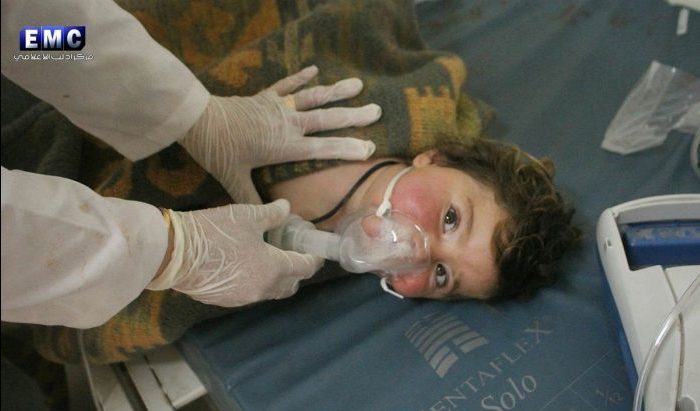
Turkey said it dispatched 30 ambulances to Idlib following chlorine gas attacks in the northwestern province, the Turkish Anadolu news agency reported. Syrian opposition health minister Firas Jundi put the death toll at more than 100 civilians and said 500 others, mostly children, were sickened or burned by the gas.

“I believe this horrible memory will stay with me for the rest of my life,” Jundi told CNN.

The Syrian anti-government activist group Idlib Media Center published photos of young children receiving medical treatment, and a video showed what appeared to be bodies of children lined up on a blanket.

On Tuesday, Tillerson released a statement condemning the attack, one that took aim at Russia and Iran.

“There are reports of dozens dead, including many children.  While we continue to monitor the terrible situation, it is clear that this is how Bashar al-Assad operates: with brutal, unabashed barbarism,” the statement said. It also called on the countries to act. “As the self-proclaimed guarantors to the cease-fire negotiated in Astana, Russia and Iran also bear great moral responsibility for these deaths.”

French Foreign Minister Jean-Marc Ayrault called the attack “further evidence of the barbarity suffered by the Syrian people.” British Foreign Minister Boris Johnson said he was “horrified” by the attack that “bears all the hallmarks” of chemical weapons previously used by the Syrian regime. Turkish President Recep Tayyip Erdogan called the attack “inhuman” and “unacceptable.”

Maryam Rajavi, the leader of the National Council of Resistance of Iran, the largest Iranian resistance group, pointed blame at Iran’s Revolutionary Guard Corps for protecting and enabling the Assad regime with fighters, arms, cash and equipment.

“Persistence of the war crimes in Syria with the growing involvement of the Iranian Revolutionary Guards Corps and its affiliated militia clearly shows that as long as the Iranian regime is not evicted and its IRGC not expelled from Syria, and so long as their puppet government is in power in Damascus, peace, tranquility and even a ceasefire could not be upheld in that country and the region,” she said.

The attack appeared to be the largest and deadliest chemical attack in Syria since August 2013, when more than 1,000 people were killed in the Damascus suburbs by the banned toxin sarin. Under threat of United States retaliation, Assad agreed to a Russian-American deal to eliminate his country’s chemical weapons program, which until that time it had denied having, and to join an international treaty banning chemical weapons.

With this week’s attack, it clearly shows that guarantees on chemical weapons being banned in Syria are pretty much worthless.

Laura Carnahan

Filed Under: Blog, News Tagged With: Assad, Chemical Attack, Featured, Idlib, Iran Terrorism, IRGC, Khan Sheikhoun, Syria

Iran Regime Plays With Lives of Innocent Pawns

April 4, 2017 by admin

Iran Regime Plays With Lives of Innocent Pawns

Iran Regime Plays With Lives of Innocent Pawns

One of the hallmarks of the Iranian regime has been its callous disregard for the value of human life. It is a characteristic that pervades much of the regime’s activities from its foreign policy to judicial process to economy.

If one examines history, totalitarian and fascist governments have often worked diligently to reduce the value of an individual life in favor of the collective good as a means of exerting greater control over the people.

Iran is no different as the mullahs figured out that the pathway to ironclad control in the wake of the revolution was to ensure that dissenters could be arrested, beaten, imprisoned, exiled and even killed with virtual impunity.

That philosophy has been at the center ever since and to this day has manifested itself in policies that have caused pain and suffering across the entire Middle East.

In foreign policy, the Iranian regime has pursued conflicts that have resulted in some of the worst humanitarian disasters since the end of World War II, namely the Syrian civil war which has claimed 400,000 lives and displaced over four million people.

The mullahs’ decision to enter that war—after the Assad regime was found to be using chemical weapons on its own people—and save Assad sparked a sectarian conflict that now rages across Iraq, Yemen and has sparked now into the Gulf States.

The fact that Iranian regime is so willing to start conflicts, especially through the use of proxies such as terror groups like Hezbollah and the Houthis. Now come increasingly more worrisome reports over evidence that the Iranian regime may be behind terror activities in Bahrain including the operation of a secret bomb factory.

According to the Washington Post, the men who built the secret bomb factory had been clever — suspiciously so, Bahraini investigators thought, for a gang known mostly for lobbing Molotov cocktails at police. The underground complex had been hewed, foot by foot, beneath the floor of a suburban villa, with no visible traces at street level and only a single entrance, hidden behind a kitchen cabinet.

But the real surprises lay inside. In one room, police found $20,000 lathes and hydraulic presses for making armor-piercing projectiles capable of slicing through a tank. Another held box upon box of the military explosive C-4, all of foreign origin, in quantities that could sink a battleship the Post said.

“Most of these items have never been seen in Bahrain,” the country’s investigators said in a confidential technical assessment provided to U.S. and European officials this past fall that offered new detail on the arsenals seized in the villa and in similar raids that have occurred sporadically over nearly three years. In sheer firepower, the report said, the caches were both a “game-changer” and — matched against lightly armed police — “overkill.”

The report, a copy of which was shown to The Washington Post, partly explains the growing unease among some Western intelligence officials over tiny Bahrain, a stalwart U.S. ally in the Persian Gulf and home to the Navy’s Fifth Fleet. Six years after the start of a peaceful Shiite protest movement against the country’s Sunni-led government, U.S. and European analysts now see an increasingly grave threat emerging on the margins of the uprising: heavily armed militant cells supplied and funded, officials say, by Iran.

That disturbing revelation shows that the mullahs’ decision to widen conflict in the region and continue pursuing their vision of a greater sphere of Shia influence; contrary to all the protestations and messaging of the Iran lobby, is a core cause of most of the turmoil in the Middle East.

Even the practice of snatching hostages has become a standard practice for the mullahs from the very beginning of the revolution with the American embassy takeover to the recent practice of arresting and imprisoning dual-national citizens based on the despicable principle that Iran does not recognize dual citizenship.

For the mullahs, the value of hostages has been unfortunately proven true by the rash and unwise decision by the Obama administration to effectively ransom American hostages as part of the nuclear agreement negotiations. That only emboldened the mullahs to continue the practice.

Several of their current prisoners include a British mother and charity aid worker, a missing American former FBI agent, two businessmen and an American college student who was recently released on bail.

The American of Iranian descent was arrested in Iran in July and sentenced to 18 years’ imprisonment on dubious charges has been released on bail after he went on a hunger strike, rights activists reported on Monday, according to the New York Times.

The American, Robin Shahini was released about two weeks ago, just before the start of Nowruz, the Persian New Year, according to news by rights groups.

It was unclear whether Shahini’s release was temporary or if he could leave the country, Shahini had been required to post bail of 2 billion rials — about $60,000 — and that he could be sent back to prison if his conviction were affirmed on appeal.

Shahini, a graduate student at San Diego State University, is one of at least four Americans of Iranian descent who have been imprisoned in Iran since the country negotiated a nuclear agreement with major powers including the United States in 2015.

Many rights activists regard the imprisonments as a warning to Americans of Iranian descent not to view the nuclear agreement as a sign of better relations between the United States and Iran.


Other Americans held in Iran include Siamak and Baquer Namazi, a father and son who were sentenced in October to 10 years’ imprisonment, as well as Karan Vafadari, an art gallery owner, and his wife, Afarin Niasari, an Iranian with permanent United States residency status. The precise nature of the charges against them are unclear.

Iranian regime considers imprisoned Iranian-Americans to be citizens of Iran and does not afford them consular privileges ordinarily granted to foreign citizens.

For the mullahs, granting any individual basic human rights seems to be out of their plans.

Michael Tomlinson

Filed Under: Blog, News Tagged With: Bahrain, Featured, Iran Terrorism, IRGC, Moderate Mullahs, Rouhani, Sanctions, Syria

The Double Standard of the Iran Lobby

April 3, 2017 by admin

The Double Standard of the Iran Lobby

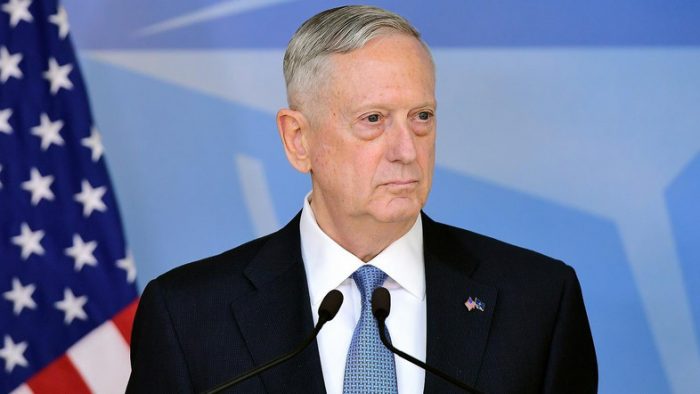
US Defence Minister James Mattis addresses the press during a NATO defence ministers’ meetings at the NATO headquarters in Brussels on February 15, 2017. / AFP PHOTO / EMMANUEL DUNAND

Consistency of thought has never been the strong suit for members of the Iran lobby such as the National Iranian American Council. Often staffers from the NIAC write editorials that passionately argue to right some perceived wrong being perpetrated by the U.S. government, while at the same time ignoring the exact same violation being committed by the Iranian regime.

Take for example the issue of detention of Iranians within the U.S. under the Trump administration’s new immigration rules versus the long-running policy of the mullahs in Tehran of snatching up and imprisoning dual-national citizens.

The NIAC issued a statement by Ryan Costello arguing against the arrest of an Iranian citizen holding a U.S. visa in Michigan. According to the statement, the “news comes amidst an uptick in government harassment of visa holders and citizens entering the U.S. We are concerned this is further evidence of a discriminatory culture being promoted by Donald Trump and his administration, particularly towards people of Middle Eastern descent.”

While the attention to this case seems to be the primary focus of the NIAC, the notorious supporters of the Iranian regime are virtually silent on the same practice by the mullahs in arresting dual-nationals such as Iranian-Americans on bogus or secret charges and held in deplorable conditions.

Consider the long-running saga of British charity worker Nazanin Zaghari-Ratcliffe who was arrested at Tehran Airport on April 3 last year while visiting family with daughter Gabriella.

She was imprisoned for five years in September for allegedly plotting to topple the Iranian government and lost an appeal against her sentence in January but maintains her innocence.

On Sunday – the 365th day since the arrest – family and friends gathered at Fortune Green close to Zaghari-Ratcliffe’s home in north-west London according to the Standard.

Supporters tied yellow ribbons to a tree in the park along with quotes from inmates at Evin prison in Iran, where Zaghari-Ratcliffe is being held, describing what they would do with one day of freedom.

Her painful and heartfelt wish reads: “My fondest dream has always been to arrive at our home, you ask me if I want to have a cup of tea, then make me one.”

“I just sit back and watch you two play. This is the image I had most when in solitary confinement.

“How I wish I could watch you both dance in the middle of our sitting room to the Michael Jackson music – like when Gabriella was only tiny.”

The NIAC makes no mention of her incarceration, not even a plea for humanitarian release because of her sharply declining health and denial of adequate medical care. Why the double standard?

One of the more stunning double standards was an editorial in the Atlantic Council by NIAC’s Adam Weinstein which argued why Iran views its ballistic missile program as a “red line” that warrants full protection by the mullahs.

He predictably recounts the same old arguments from Iran’s experiences in the Iran-Iraq War in which Saddam Hussein showered Iranian troops with missile barrages and how the mullahs in Tehran vowed to develop their own missile capability to defend themselves in the future, especially as a deterrent from perceived enemies such as the U.S. and Saudis.

Weinstein argues—incredibly—that alleviating Iran’s sense of vulnerability might be a better way to approach Iran.

Using his logic, if your neighbor has decided to arm himself and occasionally takes shots at you, Weinstein argues that you should be the one of reassure your violent neighbor, not the other way around?!

Weinstein even stretches his bizarre logic by trying to tie into a historically revisionist view of Shi’ism portraying it as choosing pragmatism over ideology.

Not many Syrians or Yemen civilians being subjected to Iranian bombs, mortars, rockets, drones and militia would find any proof of that sentiment.

What Weinstein never discusses though is the rapid development of Iran’s missile program in creating and testing ever more powerful boosters designed to reach intercontinental distances and lift capability approaching via nuclear payload capabilities.

Why Iran needs a ballistic missile with the range to reach into New Delhi or Rome is never mentioned by Weinstein because there is no reason other than to hold a dagger over Europe, Asia and the rest of the Middle East like the sword of Damocles.

But that double standard is nothing new to the Iranian regime as Iran’s Foreign Ministry called on the United States to pressure its regional allies into abandoning their support for terrorism and not level “malicious” allegations against the Islamic state.

Foreign Ministry Spokesman Bahram Qasemi made the statement on Saturday, reacting to earlier comments by US Defense Secretary James Mattis claiming that Iran continued to sponsor terror, Press TV reported.

Asked about comments Mattis made in 2012 that the three primary threats the United States faced were “Iran, Iran, Iran,” Mattis told reporters in London on Friday that Iranian regime’s behavior had not changed in the years since.

“At the time when I spoke about Iran I was a commander of US central command and that (Iran) was the primary exporter of terrorism, frankly, it was the primary state sponsor of terrorism and it continues that kind of behavior today,” Mattis said.

Laura Carnahan


Filed Under: Blog, News Tagged With: Adam Weinstein, Featured, Iran, Iran Lobby, Iran Mullahs, Iran Terrorism, IRGC, National Iranian American Council, Nazanin Zaghari-Ratcliffe, NIAC, NIAC Action, Ryan Costello, Tyler Cullis

Iran Economy Delivering Only for Military and Regime Elites

April 2, 2017 by admin

Iran Economy Delivering Only for Military and Regime Elites

Iran Economy Delivering Only for Military and Regime Elites

The Iranian economy should be an economic powerhouse backed by one of the largest petroleum reserves in the Middle East and a population that historically has been one of the best educated and entrepreneurial.

The Iranian people have spread throughout the world as part of the diaspora stemming from the Islamic revolution and have helped make scientific advances, create masterpieces of art and build globe-spanning industries.

Yet, given all of these accomplishments, the Iranian economy remains mired in stagnant growth with huge unemployment numbers, especially for Iranian youth who face a bleak future. All too often their choices are to struggle in finding jobs or join the regime as part of its military to be sent off to fight and die in far-flung battlefields far from home.

The truth of the Iranian economy is that it has been shaped and molded to serve not the Iranian people, but to fund the whims and lavish lifestyles of the ruling elites, including the families of mullahs in a dynastic fashion, as well as prime the engine of war for the Revolutionary Guard Corps.

In Al-Arabiya, Tony Duheaume examined the contradictions in the economic windfalls benefitting the elites and the hopelessness and poverty being experienced by Iran’s poor.

“While many of Iran’s citizens have suffered all of the hardships of a failing economy, in a land of increasing unemployment and low pay, the ruling mullahs lead the lives of past emperors, living in absolute luxury, with billions they have made off the backs of the Iranian people, now insulating them from the crumbling nation they reside over,” he writes.

“Beggars wander the streets of Iran in droves, drug addicts with nothing to live for litter the thoroughfares, while the homeless find shelter where they can, some known to have taken up residence living under bridges, or in the sewerage canals that run alongside the country’s highways,” Duheaume added.

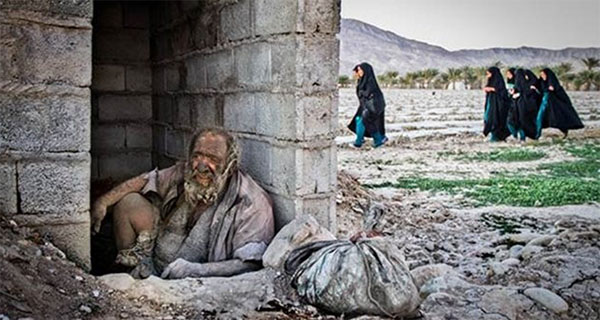
Duheaume pointed out a shocking photo essay published in the Shahrvand Daily last year that depicted many of these hapless vagrants sleeping in empty graves in Shahriar, a town about 12 miles from Tehran, the nation’s capital, in images that shocked the nation.

Reports suggested that at least 50 men, women and children were living in this cemetery, with many of their number addicted to drugs. Dressed in grimy rags, their emaciated, dirt-streaked features stare vacantly out of open graves, with only tattered tarpaulins or sheets of well-worn polythene covering the holes to protect them from the elements, in an area where the temperature in winter can drop to well below freezing, he said.

With hundreds of millions of dollars already pouring into the Iranian administrations coffers from released frozen assets, which could eventually total $150 billion, none of this has yet been designated to relieve the suffering of its people. Already billions have been earmarked to spend purchasing Russian T-90 tanks, artillery, advanced Su-30 fighter jets, and helicopters, and during 2016, Iran’s defence sector grew by 45 percent, with the regime spending billions on its long-range missile program, and the development of indigenous weapons systems, Duheaume pointed out.

There is also the delivery of long-promised S-300 air defence systems, said to have cost the Iranian government $900 million. On top of this there are the multi-billion dollars the regime is using to prop up Syrian President Bashar al-Assad, the $60-$100 million a year it is paying in financial assistance to Hezbollah, plus its expenditure in financial support or weapons to aid terror groups such as Hamas and the Houthis, he explained.

But at the other end of the social scale, Duheaume correctly pointed out the group that is siphoning off large amounts of the nation’s assets, are the ultra-rich mullahs that rule Iran, all of them claiming to live frugal lives, but who are in fact living in the lap of luxury, and are said to be squirreling away vast fortunes in foreign bank accounts.

The pictorial evidence of this lavish lifestyle appeared on social media as these children of the mullahs shamelessly posted selfies as they tore down Tehran streets in exotic sports cars swathed in haute couture fashion more appropriate to the catwalks of Paris and Milan.

Top mullah Ali Khamenei himself sits at the top of the ladder as far as the millionaire mullahs are concerned, known to be in control of a financial empire worth $95 billion, which far exceeds the accumulated wealth of the late Shah Mohammad Reza Pahlavi. It was Khamenei’s predecessor Ayatollah Ruhollah Khomeini, the founder of the Iranian Islamic Republic, who used the Shah’s plundering of the Iranian economy, and his unequal distribution of wealth, as one of the main excuses to depose him, and now this plundering has been repeated by his ousters, Duheaume said.

But as far as Iran’s leadership is concerned, all are worthy of the Rich List. To name but a few of Iran’s richest mullahs, Akbar Hashemi Rafsanjani was said to have netted $1.2 billion, Mohammad Ali Taskhiri $90 million, Mohammad Khatami $84 million, Ali Larijani $70 million, Mir Hossein Mousavi $58 million, Mohammad Hossein Adeli $43 million, Mohammad Javad Zarif $32 million, Ahmed Bourghani $19 million, and a little further down the scale, Mahmoud Ahmadinejad with $5 million.

The mullahs have concentrated this wealth into their own pockets and have created a system designed to preserve their wealth and power. The Islamic regime does not tolerate dissent, nor does it provide for its people.

It deals with desperate pleas for jobs and aid from the Iranian people with crackdowns, mass arrests and imprisonment.

Any government that has to maintain control through fear and intimidation is not long for success.

Laura Carnahan

Filed Under: Blog, News Tagged With: Featured, hassan rouhani, Iran, Iran Economy

Bipartisan Consensus Forming on Dealing with Iran Regime

March 30, 2017 by admin

Bipartisan Consensus Forming on Dealing with Iran Regime

Bipartisan Consensus Forming on Dealing with Iran Regime

In today’s turbulent political environment there is not much anyone agrees on, except that maybe the New England Patriot comeback in the Super Bowl was astounding or that the Chicago Cubs win of the World Series was historic.

Other than that, most politicians can’t even seem to agree on the weather and what causes a shift in temperature day to day.

On one topic though there seems to be a growing bipartisan consensus, not just in the U.S. but around the world and that is more needs to be done to rein in the intransigence of the Iranian regime and the threat posed by its burgeoning military and ballistic missile program.

Monday’s Senate Foreign Relations Committee hearing on Iran was an example of a political environment with a rare and welcomed unanimity. Ranking member Sen. Benjamin L. Cardin (D-Md.) remarked that although he voted against the Joint Comprehensive Plan of Action on Iran, he doesn’t think it would be wise to withdraw, saying:

“Iran’s activities today are as bad as they have ever been and probably worse. They are certainly increasing their terrorist sponsorship in the Middle East as we see in so many different countries in that region. Their record on violating the ballistic missile obligations are well known and well understood. Their human rights violations against their own citizens are horrible, one of the worst countries in the world. They violate the arms embargo and the list goes on and on. So, it is appropriate to get this Committee to look at what we can do to make sure that first, the Iran nuclear agreement is honored so that Iran does not become a nuclear weapons state, but then secondly, look at those activities that were not covered under the JCPOA as to how we can play a stronger role.”

He was joined by his Republican colleague, Sen. Bob Corker (R-Tenn.), chairman of the committee who said:

“One of my criticisms of the JCPOA was that it would become our de facto Middle East policy and Iran would expand their destabilizing activities. I think we are seeing a lot of that today. Regionally, we’ve seen an escalation in Iranian intervention. Iran, along with its allies in Russia, has continued to prop up Assad at the cost of countless lives in Syria. Iran’s support to the Shia militias in Iraq threatens the interests of Sunnis and Kurds alike, not to mention the Shia in Iraq that don’t subscribe to the anti-American, zero-sum politics of the militias that are there.”

Jennifer Rubin in the Washington Post’s Right Turn blog opined that “given this shared assessment of Iran — the JCPOA is not going away but the United States needs to confront Iran in other arenas — it’s not surprising that a bipartisan bill, the Countering Iran’s Destabilizing Activities Act of 2017, with seven co-sponsors from each party, was introduced last week.”

“The act establishes new sanctions targeting Iran’s testing of ballistic missiles and its backing for terrorism, and also seeks to block the property of any entity involved in the sale of arms to or from Iran. It does not reintroduce sanctions lifted from Iran as part of the 2015 nuclear deal.”) In a summary released last week, senators described potentially far-reaching measures including mandatory sanctions on those involved with Iran’s ballistic missile program, new sanctions against the Islamic Revolutionary Guard Corps and a requirement for the president “to block the property of any person or entity involved in specific activities related to the supply, sale, or transfer of prohibited arms and related material to or from Iran,” Rubin added.

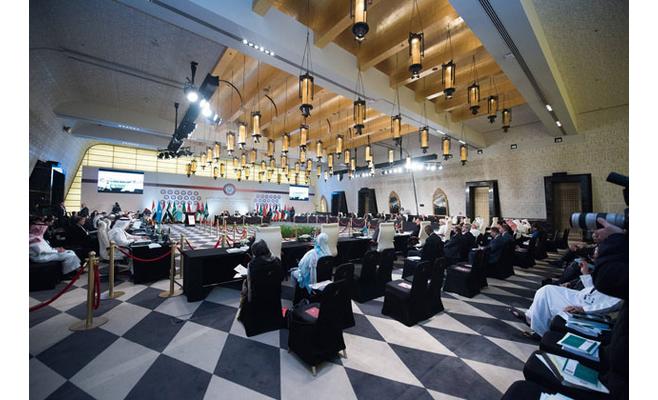
But it wasn’t just on Capitol Hill where there was unanimous consent as all 15 resolutions passed by the Arab summit which took place in Jordan Wednesday were devoted to an indictment of Iran, its Revolutionary Guards Corps and Lebanese surrogate, Hezbollah. They were a testament to the depth of Arab-Iranian animosity and exposed the extent of the rift between the Sunni and Shiite Muslim worlds.

Iran was accused of meddling in the internal affairs of Arab nations, inciting Shiites against Sunnis, and arming and training Shiite terrorist groups for operations against legitimate Arab governments. The Arab rulers combined to put Tehran in the dock for its interference in the Syrian civil war and assault on its sovereignty.

It was notable that at an Arab summit that has in the past concerned itself with issues related to Israel and the plight of the Palestinian people, the entire focus of the summit was on the Iranian regime; demonstrating how important the issue of confronting Tehran has become to the wider Arab world.

In the annual AIPAC conference a clearer united vision of the importance to oppose the Iranian regime was surfaced. American authorities and law makers used the opportunity to show their unanimous visions on the threat they feel from the Iranian regime and the need to take action to contain the growing destabilizing activities of the mullahs in the region.

The speaker of the US House of Representatives, Paul Ryan, called to designate the Revolutionary Guards as a terrorist group, describing it as a “terrorist army.” He said “Iran supports the terrorist dictator of Damascus and the militias in Yemen, Baghdad and Beirut.”

Furthermore, Nikki Hailey, the US ambassador to the United Nations asserted at the conference that “Iran’s nuclear deal is worrisome because it empowered Russian and Iran and encouraged the latter to act freely without fear of accountability.”

Mitch McConnell, the Republican majority leader in the Senate added: “Today we must adopt a different approach. We must combat Iran’s ability to finance, arm and train terrorists, such as Hezbollah, Hamas and its proxies in Syria.”

McConnell criticized Iranian regime’s nuclear deal, saying that it disabled the United States from taking more aggressive steps against Iran.

Meanwhile the Iran lobby was once again beating the war drum in an editorial in Huffington Post by Jamal Abdi of NIAC Action and Adam Weinstein of the National Iranian American Council, in which they claimed that this bipartisan consensus would only provide incentives for the U.S. to be plunged into a war with Iran at the behest of President Trump.

They go on to argue that if the proposed sanctions bill passes, Tehran would respond negatively and all the positive gains made by the nuclear deal would evaporate. What positive gains?

Since the deal was agreed to, the Iranian regime has broken every promise of moderation, stability, peace and partnership made by the NIAC and other Iran lobby supporters.

The harsh proof of Iranian regime’s track record over the past years has been so convincing that a bipartisan consensus is seen among both houses of congress to try to oppose the mullahs in Tehran.

All we can say is that it’s about time.

Michael Tomlinson

Filed Under: Blog, News Tagged With: #NuclearDeal, Adam Weinstein, Featured, Iran deal, Iran Lobby, Iran Mullahs, Iran sanctions, Iran Terrorism, IRGC, Jamal Abdi, National Iranian American Council, NIAC, NIAC Action, Syria, Yemen

Iran Regime Desperate for Foreign Policy Wins

March 29, 2017 by admin

Iran Regime Desperate for Foreign Policy Wins

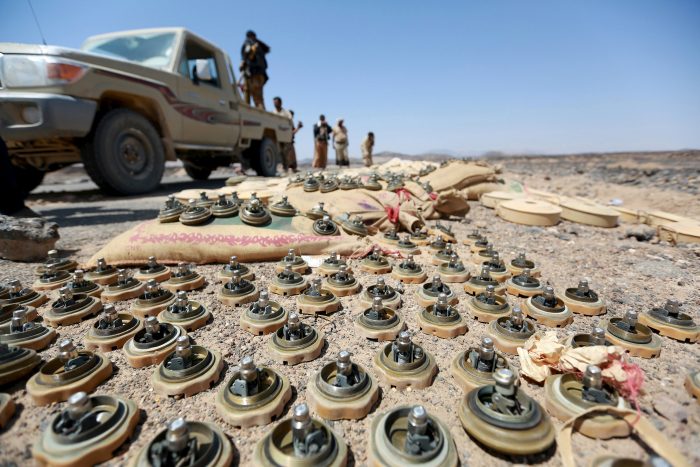
Soldiers loyal to Yemen’s government stand next to mines planted by the al-Houthi group in locations where they controlled in frontline in the province of Marib, October 4, 2015. REUTERS/Stringer TPX IMAGES OF THE DAY

Next May Iran will hold a presidential “election” that will lack for one thing: suspense. In the Iranian regime, uncertainty is anathema to the mullahs, especially Ali Khamenei and his handpicked minions on the various parliamentary councils that review and decide which candidates will appear on the ballot.

For all the handwringing and angst being generated by the Iran lobby over the perceived vulnerability of current president Hassan Rouhani, there is no doubt that if Khamenei wants Rouhani back to carry out his policies, he’s going to be the next president.

Given that certainty, the domestic situation for the ruling mullahs is anything but favorable to them. The Iranian economy remains stuck in reverse. Any hopes for it to be jumpstarted by the billions of dollars released as part of the nuclear agreement evaporated as the mullahs chose to redirect those funds to support the teetering Assad regime in Syria and the war in Yemen, as well as go on a multi-billion dollar buying binge of Russia weapons.

Unemployment remains high, especially among Iranian youth, coupled with rising prices for everything from fuel to consumer goods. Add that to miserable environmental conditions that have resulted in long droughts that have devastated farming and turned vast stretches of Iran into desert, and you get massive street protests—not about politics, but about economic conditions.

The mullahs are not fools, they are crafty political hands, adept at deception and misdirection, and they have dredged up another diversion in constantly pitting Iran in perpetual cycles of war and foreign policy crisis.

If it wasn’t the Syrian civil war, it was the rebellion in Yemen. If it wasn’t the sectarian conflict in Iraq, it was the decades-long civil war in Lebanon. Throughout all of it, the mullahs have used foreign policy to divert attention from the misery at home and gin up a jingoistic fervor.

Now as Iran stares at another presidential election, the mullahs don’t want a repeat of 2009 where massive street protests were violently put down in response to cries of a rigged election.

This explains why Rouhani has made a trek to Moscow to call upon Russia to serve as a guarantor of sorts for Iranian regime’s interests in Syria. Rouhani is dangling the prospect of forming a mutual barrier to U.S. policy interests in the Middle East, as well as the tempting offer of access to Iranian bases for Russian military forces.

Iran’s foreign minister Javad Zarif reopened the door to Russian use of Iranian airbases to carry out strikes in Syria, in another sign of increasing cooperation between the two countries, according to the Daily Caller.

Russia carried out some airstrikes on Syria from an Iranian airbase in August, but was later rebuked by Iranian authorities for bragging about it. After Russian state media trumpeted the strike as a major strategic coup, Iran’s minister of defense accused them of a “betrayal of trust” publicly. He declared at the time, “it is finished, for now.”

Zarif signaled that this time-out may be over saying “Russia doesn’t have a military base (in Iran), we have good cooperation, and on a case by case basis, when it is necessary for Russians fighting terrorism to use Iranian facilities, we will make a decision.”

In Moscow, Rouhani and Putin signed several bilateral agreements that served as window dressing for these kinds of state visits. The two leaders affirmed their commitment to peace in Syria, where they have both backed the Assad regime, as well as introducing new economic cooperation mostly in energy and industry, especially calls for reduction in oil production as a means of boosting global oil prices.


Both nations’ economies have been severely impacted by the steep decline in petroleum as a result of stepped up production from the U.S. and Saudi Arabia.


Though Moscow and Tehran both support Assad, their views on Turkey and its involvement in the conflict have differed. Though Moscow envisions Ankara as a part of the solution to the Syrian conflict, Tehran has been more wary – particularly after Moscow and Ankara left Tehran out of a truce they brokered in December, according to Voice of America News.


Aside from the photo opportunities for Rouhani, the Iranian regime stayed the course in maintaining its ever-increasing variety of militant and extremes actions, including reports of a renewed military commitment to Houthi rebels in Yemen in an increasingly volatile war that threatens to drag Saudi Arabia and the Gulf States into direct conflict with Iran.

A group of analysts known for research in global security threats said in a new report that the increase in Iranian involvement is to offset the gains made by Yemeni government troops supported by the Saudi-led Arab coalition forces.

An increased Iranian role will prolong Yemen’s civil war and make the conflict more sectarian, worsening Yemen’s humanitarian crisis and allowing Al Qaeda in the Arabian Peninsula (AQAP) to expand its support base within Yemen, according to Gulf News.

“The deployment of inter-operable proxy forces is part of Iran’s evolution of a form of hybrid warfare that will allow it to project significant force far from its borders and fundamentally alter the balance of power in the region. Iran may increase its engagement in Yemen if US support for the Saudi-led coalition threatens the Al Houthi-Saleh faction’s survival,” they said.

The Critical Threats Project run by the public policy think tank the American Enterprise Institute has published the analysis on their website, providing information on Iranian military assistance to Yemeni rebels.

“Iran may attempt to incorporate the Al Houthis into its Axis of Resistance coalition, which Iran uses to contain the US and its regional allies,” the report stresses, warning that further escalation in the Yemeni civil war will threaten freedom of navigation in the Red Sea, risking both global commercial markets and the US Navy’s freedom of movement in the region.”

The analysis claimed that Iran had attempted to smuggle over 2,000 small arms into Yemen in 2015 and 2016, in addition to a large stockpile of other weapons.

“Iran likely facilitated the development of an Al Houthi-Saleh naval mining program. Mines struck a government coast guard ship near Mokha port, Taiz governorate on March 11 and a fishing vessel near Midi district, northwestern Hajjah governorate on March 8. Iran provides sophisticated weaponry that allows the Al Houthi-Saleh faction to hold terrain, counter Saudi-led coalition capabilities, and threaten US freedom of movement in the Red Sea,” the report warned.

As the flashes go off in Moscow, the rest of the Middle East is dreading what next chapter of hell the Iranian regime is set to unleash.

Michael Tomlinson

Filed Under: Blog, News Tagged With: al houthis, Featured, hassan rouhani, Iran Terrorism, IRGC, Khamenei, Rouhani, Sanctions

Iran Regime Steps Up Global Spy and Lobbying Efforts

March 29, 2017 by admin

Iran Regime Steps Up Global Spy and Lobbying Efforts

Iran Regime Steps Up Global Spy and Lobbying Efforts

The Iranian regime is sensing an opportunity to expand its influence through its use of its operatives and proxies in the Ministry of Intelligence and its lobbying and public relations efforts that were used during the run up to the nuclear agreement reached with the U.S. and five other nations.

The regime’s own intelligence minister has been busy boasting about the regime’s ability to run a lobbying group in the very heart of the “Great Satan” in Washington, DC.

Amir Basiri, a contributor to the Washington Examiner’s Beltway Confidential blog and an Iranian human rights activist, detailed these claims in an editorial.

“Mahmoud Alavi, Iran’s spy chief, bragged about the regime’s capability to run a lobby group in Washington with the aim of promoting Tehran’s hardline agenda,” Basiri wrote.

According to Alavi, Iranian dual citizens in the United States, Canada and the United Kingdom have maintained their loyalty to the “Islamic revolution,” the mullahs’ hallmark motto ever since 1979, through which they have wreaked havoc across the region and beyond, he said.

A “lobby group for the Islamic Republic of Iran” is actively bolstering Tehran’s status in the international stage and helping to sell and legitimize its nuclear ambitions as just causes to the globe, Alavi claimed.

“The head of Iran’s intelligence apparatus did not bother to name the specific lobby entity. One certain group, however, the National Iranian American Council, has been the target of major criticism in the past several months, with accusations of the group lobbying on Tehran’s behalf. Various dissident organizations are demanding the Trump administration to launch an official probe digging into NIAC’s history and nature of its current events,” Basiri added.

What was interesting was that the NIAC, did not deny Alavi’s claims.

Basiri pointed out that Congress has also been petitioned to investigate ties between Iran and the NIAC, and the latter’s active drive to promote a pro-Tehran agenda in Washington. Sen. Bob Corker, R-Tenn., and Rep. Ed Royce, R-Calif., who chair the foreign affairs committees in each chamber of Congress, have received specific letters signaling the importance of urgent action in this regard.

NIAC was once again under the spotlight this January for its actions of presenting a positive image of the Iran nuclear deal and advocating a pro-diplomatic approach with Tehran. The media reported extensively on how two senior Iranian regime supporters, former Iranian nuclear diplomat Hossein Mousavian and NIAC founder and president Trita Parsi, enjoyed access to the Obama White House on more than 30 occasions, conducting meetings with senior administration officials, while a former NIAC staffer now directs Iran policy at the State Department.

Alavi’s recent remarks are source for serious concern as entities advocating Iran’s agenda in the American capital are obliged by the Foreign Agents Registration Act to disclose the nature of their work. This even includes conditions where the relationship does not involve money exchanges, at least not through legal and opaque channels.

For years Iran has been known to forward an official plot of boosting relations with groups promoting anti-war and pro-regime policies in the West. Improving contacts with Iranian dual nationals living in the West has been high on Tehran’s agenda on this matter.

One major task of this network has been discrediting those opposing the regime in Tehran and taking measures against any efforts voicing support for Iran regime change. The main Iranian opposition group, the National Council of Resistance of Iran, and its most important member, the People’s Mojahedin Organization of Iran (PMOI/MEK), have been the constant target of smear campaigns launched and orchestrated by the Iranian regime and NIAC, according to Basiri.

Not only has the Iranian regime worked hard to develop its lobbying resources, but it has continued to expand on its efforts to spy and conduct terror operations on its neighbors as the government of Bahrain announced Sunday that it had arrested over a dozen individuals believed to have planted a bomb on a police bus and received training from Hezbollah and the government of Iran.

Bahrain’s interior ministry issued a statement Sunday confirming the arrests of 14 individuals who “are suspected of receiving overseas military training under the supervision of the Iranian Revolutionary Guards and Hezbollah in Iraq,” according to the Associated Press. The men were arrested as part of a larger raid on a property that authorities claimed was stocked with weapons; police say the terror cell was planning assassinations, though they did not specify if they believed the men were targeting any officials in particular.

Al-Arabiya adds that authorities believe the alleged terrorists arrested were working under the supervision of Mortadha Majeed al-Sindi and Qassim Abdullah Ali, the latter of which has received a “Specially Designated Global Terrorist” label from the U.S. State Department. Reuters identifies both men as “exiled Bahrainis living in Iran.” In addition to being led by individuals living in Iran, the terror cell boasted a number of individuals with ties to Iranian terror groups. Voice of America cites local outlets who reported that official identified five alleged terrorists as having received training from Hezbollah, and another six who had been trained by IRGC leaders.

In another case, a Pakistani man was convicted in Germany on Monday of spying for Iran to search out potential attack targets for the Revolutionary Guards.

The defendant, 31-year-old Mustufa Haidar Syed-Naqfi, was sentenced to four years and three months in prison “for working for a foreign intelligence service”, a spokeswoman for Berlin’s superior court said.

The court found he spied “against Germany and another NATO member”, France, for the Quds Force, the foreign operations wing of the elite Revolutionary Guards.

Syed-Naqfi compiled dossiers on possible attack targets – a German lawmaker who is the former head of a German-Israeli organisation, and a French-Israeli economics professor.

Investigators found detailed dossiers on the men and their daily routines, with hundreds of photos and video clips.

A representative of Germany’s domestic intelligence service, which handles counterespionage, said it was alerted to the defendant by a “reliable” source.

The service suspected the Quds Force was preparing for a possible future conflict with the United States and Israel, when it could hit targets in Europe in a form of “asymmetrical warfare”.

Laura Caranahan

Filed Under: Blog, News Tagged With: Appeasement policy, Featured, Iran Lobby, Iran Terrorism, IRGC, National Iranian American Council, NIAC, NIAC Action, Trita Parsi

Iran Regime Plays Absurd Sanctions Game

March 27, 2017 by admin

Iran Regime Plays Absurd Sanctions Game

Iran Regime Plays Absurd Sanctions Game

In what has to be considered one of the more absurd acts by the Iranian regime, the mullahs decided to impose their own sanctions on 15 U.S. companies for alleged human rights violations and cooperating with Israel, the state news agency IRNA reported on Sunday, in a tit-for-tat reaction to a move by Washington, according to Reuters.

The agency quoted Iran’s foreign ministry as saying the companies had “flagrantly violated human rights” and cooperated with Israel in its “terrorism” against the Palestinians and the expansion of Jewish settlements.

It was not immediately clear if any of the companies, which included defense technology firm Raytheon, had any dealings with Iran or whether they would be affected in any way by Tehran’s action, which IRNA said would include seizure of their assets and a ban on contacts with them.

The sanctioned companies also included ITT Corporation, United Technologies and specialty vehicles maker Oshkosh Corp. For a full list click on: bit.ly/2noZWNo

The Iranian move came two days after the United States imposed sanctions on 11 companies or individuals from China, North Korea or the United Arab Emirates for technology transfers that could boost Tehran’s ballistic missile program. This was on top of sanctions levied against 30 foreign companies or individuals for transferring sensitive technology to Iran for its missile program or for violating export controls on Iran, North Korea and Syria.

Iran could face tighter U.S. sanctions over ballistic missile launches and other non-nuclear activities under a bill announced on Thursday by a bipartisan group of senators, echoing a harder line on Tehran espoused by President Donald Trump.

While the move by the Iranian regime has practically no effect on the U.S. economy, nor on the companies being sanctioned since few have any assets or business dealings with the regime, who is not on the list is telling.

Boeing for example is not on the list of firms sanctioned, even though it is one of the largest military suppliers to Israel, but also happens to be selling Iran new commercial airliners to replace its aging fleet.

The hypocrisy of the Iranian regime doesn’t end there since it ostensibly is imposing these sanctions for human rights violations against the Palestinian people by Israel, but excuses its own blatant human rights violations against the Syrian people through its proxies and armed forces fighting on behalf of the Assad regime.

It is also hypocritical for the Iran lobby and the regime to consistently oppose any new sanctions and claim they threaten the nuclear agreement with Iran, but in this case the regime has no problem in engaging in the same behavior it condemns.

We have no doubt that if any of the U.S. companies on Iran’s list wanted to sell equipment or arms to Iran, the mullahs would be eager to do business with them.

As with the constant harassment of U.S. Navy ships throughout the Persian Gulf by Iranian speed boats, the net effect is akin to a gnat bothering a bear and these sanctions are typical of the real strength of the Iranian regime which is in propaganda and visuals and not in practical effect.

It is interesting though how the Iran lobby, especially the National Iranian American Council is silent on these new sanctions since it has been so vocal about the threat U.S. sanctions would have on the nuclear deal and the future of relations between the two countries.

In fact, a casual Google search would reveal a trove of apocalyptic warnings from Trita Parsi and his cohorts at the NIAC about the damage future sanctions could bring and yet when Iran engages in the same practice there is not a signal note of dissent from them.

It is damning proof once again that the Tehran can do no wrong in their eyes and how they are solely a mouthpiece for the mullahs in Tehran.

It is also interesting how U.S. sanctions were aimed specifically for effect at Iranian Revolutionary Guard Corps leaders directly involved in ballistic missile activities or control of terrorist activities, including past actions that killed American service personnel, while these Iranian sanctions are aimed at the Israeli-Palestinian conflict.

Iran has frequently trotted out the plight of the Palestinian people as a Trojan horse to try and galvanize support within the Arab world, but it has lost much of its morale standing since it now engages in wars in Syria and Yemen that are setting Muslims to kill Muslims on a wholesale basis.

Ultimately the mullahs in Tehran care not a whit about the Palestinian people and use them in the same way they have used Afghan refugees to serve as mercenaries in Syria or Shiite militias or Houthi rebels to serve their twisted purposes.

Michael Tomlinson


Filed Under: Blog, News Tagged With: Featured, Iran, Iran Human rights, Iran Mullahs, Iran sanctions, IRGC, National Iranian American Council, Nuclear Iran

Bipartisan Senators Move New Iran Sanctions Bill Forward

March 24, 2017 by admin

Bipartisan Senators Move New Iran Sanctions Bill Forward

Bipartisan Senators Move New Iran Sanctions Bill Forward

While the political divide between Democrats and Republicans may feel like the Grand Canyon, one at least one subject both sides seem to be able to agree: New sanctions need to be levied against the Iranian regime.

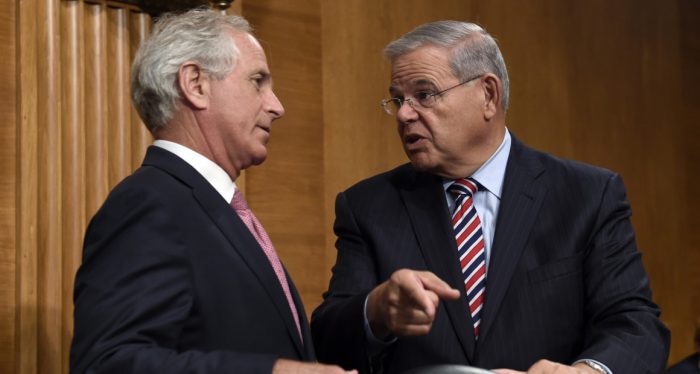
Senate Foreign Relations Chairman Bob Corker (R-Tenn.) on Thursday unveiled a bipartisan bill to slap the Iranian regime with new sanctions because of the country’s ballistic missile development, support for U.S.-designated terrorist groups and human rights violations, according to Politico.

Democratic co-sponsors, including Robert Menendez of New Jersey and Foreign Relations ranking member Ben Cardin of Maryland, emphasized that the measure was designed explicitly so as not to undermine the 2015 Iran nuclear deal.

The bill is supported by more than a dozen senators, according to a news release, including Marco Rubio (R-Fla.), Tom Cotton (R-Ark.), Bob Casey (D-Pa.) and Chris Coons (D-Del.) — giving it a strong chance of being taken up in the Senate.

“This legislation demonstrates the strong bipartisan support in Congress for a comprehensive approach to holding Iran accountable by targeting all aspects of the regime’s destabilizing actions,” Corker said in a statement. “These steps will allow us to regain the initiative on Iran and push back forcefully against this threat to our security and that of our allies.”

Menendez, who didn’t vote for the nuclear deal, said that the legislation was crafted to specifically avoid any sanctions lifted as part of the nuclear agreement, according to the Hill.

“This legislation was carefully crafted not to impede with the United States’ ability to live up to its commitments under the JCPOA, while still reaffirming and strengthening our resolve by imposing tough new sanctions,” he said.

Lawmakers were expected to roll out new sanctions on the Iranian regime ahead of a key foreign policy conference taking place early next week, Reuter reported.

The Senate legislation, according to an outline from Corker’s office, would include mandatory new sanctions on individuals tied to Iranian regime’s ballistic missile program and would expand terrorism-related sanctions to include the Islamic Revolutionary Guard Corps (IRGC).

It would also codify who is sanctioned over Iranian regime’s support for terrorism and force President Trump to enforce an arms embargo by blocking property for anyone tied to Iran’s sale or transfer of military arms.

In February, the Trump administration imposed sanctions on 25 individuals and entities in Iran, which it said were just “initial steps” in response to the regime’s repeated testing of ballistic missiles, which the United States maintains is in violation of UN resolutions.

Tehran has been supporting Yemen’s rebel Houthi movement, and Syrian President Bashar al-Assad in his country’s six-year-long civil war.

Menendez told Reuters the bill was intended to take a “regional” strategy because of the breadth of Iran’s activities in the Middle East.

“It calls for a regional strategy because Iran is obviously involved in the region in various ways, whether it be in Yemen or Syria and beyond,” he said.

The bipartisan action taken in the Senate is a response to the growing provocations coming from the Iranian regime as it prepares for its presidential election in May.

On Tuesday, the aircraft carrier USS George W. Bush entered the Strait of Hormuz from the Indian Ocean, a vital waterway that handles about 30 percent of the world’s oil shipping. As it has done so often over the past few years, Iran sent a swarm of speedboats to harass the carrier, according to Breitbart News.

“What reason were they to be in an international corridor, other than to harass us? Was today the day they were going to come out and potentially deploy kinetic actions against us?” asked Rear Admiral Kenneth Whitesell, commander of Carrier Strike Group 2, as reported by Japan Times.

Captain Will Pennington of the George W. Bush said the U.S. Navy changed its security procedures after a Saudi ship was attacked off the coast of Yemen by what some describe as a “drone” boat, roughly comparable in size to the Iranian Revolutionary Guard Corps patrol boats.

“It’s unprofessional behavior, it’s harassment behavior and it’s something you wouldn’t expect when you’ve got a hundred giant vessels per day going through the Strait of Hormuz, and – at least from the flow of oil – the most critical strait in the world,” Whitesell said. “This is their routine behavior, which in any other area of the world, any other maritime environment, this would be seen as a violation of international law.”

The allegations of Iranian-made drones extended to ones used by Houthi rebel forces to attack Saudi and UAE missile defense sites in Yemen, an arms research organization said in a report Wednesday, according to the Washington Post.

The report, put out by the group Conflict Armament Research, or CAR, looks at seven Houthi Qasef-1 drones and one drone engine recovered by forces from the United Arab Emirates. Six of the drones were captured in October on a known Iranian smuggling route that runs through Oman, while another was found after an attack by Houthi forces near Aden, Yemen, last month.

The Qasef-1 is “consistent with descriptions and imagery” of an Iranian drone called the Ababil-T, produced by Iran’s Aircraft Manufacturing Industrial Company, according to the report.

The identification of the Qasef-1 as a possible Iranian drone variant comes almost two months after Houthi forces used an explosive drone boat to attack a Saudi frigate. Vice Adm. Kevin M. Donegan, commander of the U.S. Fifth Fleet, told Defense News that the drone boat probably had been supplied by Iran. The attack killed one, and the frigate returned to port with minor damage.

On Tuesday, Reuters reported that Maj. Gen. Qasem Soleimani, the head of Iranian regime’s Quds Force, recently met with top military officials in the Iranian capital in a bid to explore ways to better assist the Houthis. The outcome of the meeting appears to be an influx of military equipment and advisers into the civil war, which has now been running for two years.

Michael Tomlinson


Filed Under: Blog, News Tagged With: Featured, Iran, Iran deal, Iran Human rights, Iran Mullahs, Iran sanctions, Sanctions

  • « Previous Page
  • 1
  • …
  • 17
  • 18
  • 19
  • 20
  • 21
  • …
  • 64
  • Next Page »

National Iranian-American Council (NIAC)

  • Bogus Memberships
  • Survey
  • Lobbying
  • Iranians for International Cooperation
  • Defamation Lawsuit
  • People’s Mojahedin
  • Trita Parsi Biography
  • Parsi/Namazi Lobbying Plan
  • Parsi Links to Namazi & Iranian Regime
  • Namazi, NIAC Ringleader
  • Collaborating with Iran’s Ambassador

Recent Posts

  • NIAC Trying to Gain Influence On U.S. Congress
  • While Iran Lobby Plays Blame Game Iran Goes Nuclear
  • Iran Lobby Jumps on Detention of Iranian Newscaster
  • Bad News for Iran Swamps Iran Lobby
  • Iran Starts Off Year by Banning Instagram

© Copyright 2026 IranLobby.net · All Rights Reserved.