Iran Lobby

Exposing the Activities of the lobbies and appeasers of the Mullah's Dictatorship ruling Iran

  • Home
  • About
  • Current Trend
  • National Iranian-American Council(NIAC)
    • Bogus Memberships
    • Survey
    • Lobbying
    • Iranians for International Cooperation
    • Defamation Lawsuit
    • People’s Mojahedin
    • Trita Parsi Biography
    • Parsi/Namazi Lobbying Plan
    • Parsi Links to Namazi& Iranian Regime
    • Namazi, NIAC Ringleader
    • Collaborating with Iran’s Ambassador
  • The Appeasers
    • Gary Sick
    • Flynt Leverett & Hillary Mann Leverett
    • Baroness Nicholson
  • Blog
  • Links
  • Media Reports

The Race is On for Iran to Close All Deals

December 12, 2016 by admin

hourglass-running-out-1January is not only the start of the New Year and 2017, it also marks a race against the clock for the Iranian regime as it struggles to close as many business deals as it can before Donald Trump is sworn into office as the new president.

There also seems to be a fever gripping the mullahs in Tehran beyond the normal insanity of religious fervor that grips them. In this case, it is a fever for cash.

With the nuclear agreement reached with Iran and the P5+1 group of nations came a lifting of economic sanctions. The Iran lobby argued that the removal of these sanctions would empower moderate elements in the Iranian government and usher in a new period of cooperation and diplomacy.

Unfortunately none of that has come to pass as Iran’s government became even more rigidly dominated by the mullahs and their cohorts in the military and Revolutionary Guards and Iran’s military activities through its terrorist proxies have plunged it into fighting wars in three countries at once.

The drain on the regime’s coffers have been enormous and led to a stagnation of the economy that has caused the Iranian people to become restless to a point where the regime instituted a large-scale crackdown aimed at journalists, students, artists and other dissidents.

The election of Trump poses a new risk for the regime as he selects cabinet picks that have a long and critical history of U.S.-Iran relations under the Obama administration. The comprehensive nature of his cabinet choices has clearly shown the mullahs that the free ride of appeasement they have enjoyed the past several years is coming to an end.

All of which leads to an astonishing effort by the Iranian regime to close as many investment and business deals as possible before the potential re-imposition of economic sanctions since Iran has done little to conform to the spirit, let alone letter of the nuclear agreement.

Hassan Rouhani and his master, Ali Khamenei, know the necessity of securing as many business deals as possible since the regime is badly in need of cash. It is also why the Iran lobby, especially the National Iranian American Council, have been fixated with preserving the commercial aspects of the agreement.

The New York Times described the race by Rouhani to close these deals, especially bolstering its oil industry in regaining its international status as a top oil producer.

Iran’s oil industry, the lifeblood of its economy, was devastated by the cumulative impact of the nuclear sanctions, which halved petroleum exports and left the country ostracized economically, the Times wrote.

The international nuclear agreement that lifted those sanctions nearly a year ago, one of the Obama administration’s signature foreign policy initiatives, has enabled Iran to partly recover. But Mr. Trump has warned that he may dismantle the deal, a threat that has injected new urgency into Iran’s push to build up its oil industry before Mr. Trump takes power next month,” the Times added.

Over the last four weeks, Tehran has negotiated agreements with the oil field services giant Schlumberger and companies from China, Norway, Thailand and Poland, including a deal just announced with Royal Dutch Shell.

“They are signing before Trump does something,” said Dragan Vuckovic, president of Mediterranean International, a Texas-based oil services company that works in North Africa and the Middle East. “The Iranians will give the Europeans favorable terms because of Trump. They want to send a message to Trump that if you try to cancel this agreement, we will just go to the Europeans.”

It’s a strategy that carries significant risk since the combative election demonstrated how the incoming president reacts to threats from opponents.

The Iranian regime also announced the completion of its $16.6 billion deal to buy 80 jetliners from Boeing. Planned aircraft sales by Boeing and European plane maker Airbus Group SE have been among the most high-profile transactions pursued by Iranian regime after Western powers in January removed sanctions in return for its agreeing to constrain its nuclear program. U.S. officials cleared the way in September for Airbus and Boeing to start contract talks.

The plane deals have been staunchly opposed by critics of the nuclear accord with Iran, which has come under fire from Trump and his emerging national-security team. Some U.S. lawmakers have also tried to block any financing for the planned sales, the Wall Street Journal reported.

What troubles the mullahs and Iran lobby is that the members of Trump’s team include ex-military officers who have been battle-tested in combat against Islamic extremist groups and terror proxies. For them, their world view has been shaped by actual experience with terror and Islamic extremism and the horrors they bring.

According to the Washington Post, the three generals making up the core of Trump’s foreign policy team have views cutting against the grain of U.S. policies seeking to empower moderates in Iran and of U.S. intelligence assessments that terrorism no longer stands alone atop the rankings of global security threats now crowded by concerns about cyberattacks and renewed aggression by China and Russia.

Their views, though far from uniform, have been heavily influenced over the past 15 years by intensely personal battlefield losses, the country’s waning attention to the wars and an up-close view of a ruthless enemy, said the Post.

“I think it’s likely there will be terrorist attacks in the coming years, and I think Trump will feel tremendous pressure to be seen as acting very decisively,” said Dan Byman, a former Middle East analyst at the CIA and a professor at Georgetown University.

Byman cited the example of the Iranian seizure of American sailors shortly before the Iran nuclear deal was signed as an example of an overseas provocation that had the potential to derail broader U.S. policy goals.

Trump’s advisers “have a lot of personal experience and might be more inclined to see Iranian hostility as deeply planned,” rather than the act of a rogue faction or a function of chaos, Byman said. “They’re more likely to read things negatively than the Obama administration would have.”

While the Iran lobby may believe that is a pathway to armed conflict, the growing consensus is that Trump’s team is more likely to avoid that option by simply finally holding the Iranian accountable diplomatically and through a rigorous sanctions process that does now reward Iranian regime for belligerent behavior.

For Tehran, the clock is running out on them.

Michael Tomlinson
Filed Under: Blog, News Tagged With: Featured, Iran, Iran deal, Iran Human rights, Iran Lobby, Iran Mullahs, Iran sanctions, Khamenei, Nuclear Deal, nuclear talks, Sanctions

Iran Lobby Launches Media Blitz to Save Iran Nuclear Deal

December 9, 2016 by admin

Iran Lobby Launches Media Blitz to Save Iran Nuclear Deal

Iran Lobby Launches Media Blitz to Save Iran Nuclear Deal

We’ve already chronicled recent efforts by the National Iranian American Council to try and save the flawed Iran nuclear agreement with a flurry of press releases, editorials and social media posts in an attempt to attack everything from President-elect Donald Trump’s tweets to his Cabinet selections.

Not to be outdone, the other leader in the Iran lobby stepped up the plate with another media blitz by the Ploughshares Fund, which sent out its own editorials in an effort to dredge up the same old arguments similar to the arguments used by the Iran lobby during the run up to the nuclear agreement last year in which groups such as Ploughshares and NIAC tried to portray anyone opposed to the deal as a militaristic hawk hell bent on carpet bombing Iran.

In the year since the deal was approved, it is ironic to see the Iranian regime being the one to carpet bomb cities in Syria and funnel arms to terrorist proxies and militias in Iraq and Yemen. Of course Ploughshares offers no editorials condemning the cycle of war and violence the Iranian regime feeds and nurtures.

Paul Pillar, a former intelligence officer that has been penning on behalf of the Iranian mullahs in various occasions, joined at the hip to the Ploughshares Fund, offered up one such editorial in the National Interest in which he pedaled the same old idea that anyone critical of the Iran nuclear deal was a neo-con war hawk.

Pillar again raises the specter of the Iraq war as a harbinger of war with Iran in order to try and scare readers as he bangs the drum against President-elect Trump.

“None of this is a prediction that there will be such a war.  But the danger of one is greater now than it was before November 8th and the appointments that followed.  Vigilance is required to avoid further steps that would increase the chance of a war,” Pillar adds. “Also to be watched for are any moves, such as aggressive U.S. military operations in the Persian Gulf, that could become steps down a slippery slope to conflagration.”

That last statement by Pillar really demonstrates how bought in he is for Iranian regime, when he makes no mention of the devastation Iranian regime’s military actions in the region have caused.

Unlike what Pillar says, the aggression is coming from Iran.

But Pillar wasn’t the only Iran lobbying ally to get in on the act, Tytti Erästo, a fellow at Ploughshares, also offered up her own editorial at the National Interest as well trying to sell the idea that Trump needs the Iran nuclear deal to engage with Russia and North Korea.

She tries to make the case that North Korea would somehow view an intact nuclear deal as the appropriate pathway since it would demonstrate the benefits of diplomacy.

Let’s think about that idea carefully for a moment:

  • North Korea supplied Iranian regime with information and designs for its nuclear program, as well as licensed its ballistic missile designs to jumpstart the regime’s missile program;
  • North Korea has consistently been the most sanctioned nation on the planet over its nuclear program as it developed the capability, actually built warheads and then exploded them in tests; and
  • North Korea is widely regarded as the world’s most notorious rogue state after it consistently broke every international agreement negotiated with it.

Yes, that sounds like a wonderful template of how Iran can positively influence North Korea!

And how could nuclear deal influence anyone, particularly since we are talking about a flowed agreement with no teeth that provides ample exemptions and waivers for violations and lift all economic sanctions without the need for compliance monitoring?

In fact, her statement reflects a key component of all the Iran lobby’s positions which is that the International community bears the burden for compliance and any failure in the agreement must stem from the U.S. and others not from anything the Iranian regime did.

It is the same frivolous thinking that paved the way for a badly flawed deal which led us to the crises the world currently faces.

While such efforts by the Iran lobby reveals the weak position and the fear the mullahs have, it also proves that the right policy towards Iran is and has always been a firm policy that should hold the Iranian regime finally accountable for its actions and not the other way around.

Michael Tomlinson

Filed Under: Blog, News Tagged With: #NuclearDeal, Appeasement policy, Featured, Iran deal, Paul Pillar, Ploughshares, Syria, Trita Parsi, Yemen

Iran Lobby Working Hard to Protect Regime Allies

December 8, 2016 by admin

Iran Lobby Working Hard to Protect Regime Allies

Iran Lobby Working Hard to Protect Regime Allies

Trita Parsi, the founder and leader of the Iran lobby’s chief support group—The National Iranian American Council—has been busy on editorial pages variously condemning picks by President-elect Donald Trump for his national security and foreign policy team and boosting and defending the Iranian regime in light of the wave of administration appointees skeptical and critical of the regime.

The latest example was Parsi’s attacks on Rep. Mike Pompeo (R-Kan.) Trump’s pick to head the CIA, on BBC, where he said “it is not the job of the CIA director to formulate policy.”

Parsi added that the criticisms made of the Iran deal by Pompeo, who is a graduate of West Point and Harvard Law School, are “a clear indication that [his] understanding of the functions of the U.S. government and the different parts of the U.S. government is somewhat limited.”

That statement itself demonstrates how desperate Parsi must be to throw dirt at anything and everything related to Trump as his selections clearly show the clock is running out on the policy of appeasing the mullahs in Tehran that have dominated U.S. foreign policy the past several years.

Saying that Pompeo doesn’t understand how the government works only shows Parsi is willing to say anything, even outrageous untruths to demean and degrade American policy makers.

In Pompeo’s case, the CIA director nominee has an extensive history as a military officer, including serving in the Gulf War, and being elected to the House in 2010, where he served on the Select Committee on Intelligence and the Committee on Energy and Commerce.

In spite of attacking Pompeo, Parsi was magnanimous enough to offer his own advice saying “It is going to be very, very difficult for them to be able to roll back the deal or get rid of the deal or even renegotiate the deal.”

At the end of the day, preserving the Iran nuclear agreement has quickly become Parsi’s mission as he seeks to stave off efforts by Trump to hold the Iranian regime accountable for its militant actions in the year following passage of the deal.

Parsi has been busy trying out an almost daily message against Trump in an effort to find any excuse to keep the nuclear deal intact. This includes Parsi’s latest whine, which is that should the deal fall through, there would be no way Trump could reassemble the coalition of sanctions against the regime.

This line of reasoning is even dumber than Parsi’s claim that Pompeo doesn’t know anything about government since deep cracks are already appearing in the countries that agreed to the nuclear deal.

Most of Europe has reeled from the exodus of millions of refugees from conflicts in Syria and Iraq and the wave of terrorist attacks that have rattled Paris and Brussels. Recent votes in the U.K. and decisions by current leaders in France and Italy to decline re-election all point towards electorate that have been badly rattled over the rise of Islamic extremism and the growing proxy wars in the Middle East fomented by Iranian regime.

Even allies of Parsi are starting to get the microscopic once-over that Parsi is trying to give opponents of the Iranian regime.

One example is a piece by Armin Rosen, a New York-based writer who has written for The Atlantic, City Journal and World Affairs Journal, who wrote a piece in Tablet Magazine detailing the close relationship Parsi has with Rep. Keith Ellison (D-Minn.) who has announced his candidacy as chair of the Democratic National Committee.

Rosen points out that in 2009, then freshman Ellison urged a radically different approach to U.S.-Iran relations when he echoed positions offered by Parsi as he launched the NIAC. In fact, Ellison submitted an editorial into the House Foreign Affairs Committee hearing record on Iran sanctions by Parsi opposing sanctions.

Ellison went on to deliver a speech in 2011 at a NIAC event in which he thanked Parsi for being an “an indispensable partner” in helping to develop a 2009 bill that would have sanctioned individual human abusers in Iran while lifting U.S. restrictions on NGO work in the country, and refers to the NIAC founder as a “friend.”

Ellison’s selection as DNC chair might prove to be a political albatross on Democrats moving forward, especially in the 2018 midterm elections in which the bulk of Senate seats up for election then would be occupied by Democrats.

Extensive exit polling in the presidential election showed that American voters cited terrorism as their chief concern only after the state of the economy. Any office holder who had a previous association with Parsi and the NIAC might be well served to begin distancing themselves from the Iran lobby since the political price to be paid might be severe.

Those ties to Parsi and the detrimental effects of being seen to support the Iranian regime can only grow as the regime engages in more and more radical and frankly bizarre behavior.

One example of that comes from the woman who leads female volunteers in Iran’s hardline conservative militia, the Basij, who has identified a new foe.

Minu Aslani has reportedly called the promotion of gender equality illegal and demanded that the country’s powerful judiciary take action against people who speak out against such state-sponsored discrimination.

“These activities are in fact against our laws and the judiciary should take action,” the semiofficial Mehr news agency quoted Aslani as telling reporters on December 2.

In the past, Aslani has condemned efforts to increase the number of women in parliament and opposed campaigns to curb domestic violence as perceived assaults on Iranian society and traditional family values. Pushing for greater female participation threatens to “distort” the identity of Iran’s women, she has said.

Aslani also criticized United Nations Secretary-General Ban Ki-moon’s eight-year-old UNiTE To End Violence Against Women campaign, which is aimed at raising awareness about violence against women and girls.

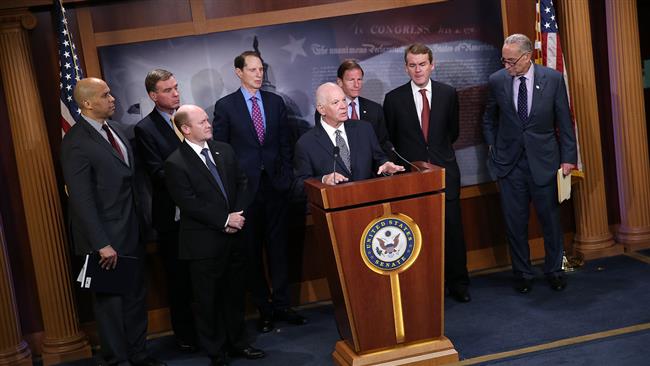
Also, the Congress began to take a new look at the Iranian regime’s extensive use of proxies to wage war and commit acts of terror as both Democratic and Republican senators took aim at the regime.

“Iranian proxies remain a direct threat to the United States and our allies today,” said the chairman of the Senate Foreign Relations Committee, Republican Bob Corker of Tennessee, pointing to Lebanese Hezbollah, Shia militias in Iraq, and Houthi insurgents operating from Yemen, as well as Tehran’s influence in Syria.

“American citizens, uniformed and civilian, have been victims of Iranian terror. Iranian regime-sponsored [entities], directed, trained and equipped are a threat to U.S. forces and American citizens today,” said the committee’s top Democrat, Senator Ben Cardin of Maryland.

At the committee hearing, experts warned that unless there were ideological changes to the Iranian regime, the mullahs’ basis for supporting these proxies would not change.

Michael Tomlinson

Filed Under: Blog, News Tagged With: #NuclearDeal, Appeasement policy, Featured, Iran Lobby, Iran Terrorism, National Iranian American Council, NIAC, NIAC Action, Sanctions, Trita Parsi

Pressure on Iran Shows Cracks in the Regime

December 6, 2016 by admin

Pressure on Iran Shows Cracks in the Regime

Pressure on Iran Shows Cracks in the Regime

It is a basic principle of physics that if you heat a liquid in a confined space, it will build up pressure until the container explodes unless the material is strong enough to withstand the pressure.

In the case of the leadership of the Iranian regime, the cracks are beginning to show as they struggle to absorb the implications of a Trump presidency and a newly energized Congress determined to demonstrate to the American voter that it can get tough on a militant regime in Iran.

One clear sign of Donald Trump’s attitude towards foreign policy and national security is his emerging Cabinet selections, in which he has assembled a large number of fierce opponents to the Iranian nuclear agreement.

As Adam Kredo outlines in the Washington Free Beacon, the selections include retired Marine Gen. James Mattis as secretary of defense, Rep. Mike Pompeo (R., Kan.) as CIA director, and retired Army Lt. Gen. Michael Flynn as national security adviser, picks that have won plaudits for their vocal opposition to the nuclear deal.

“It’s no secret that Flynn considers Iran to be the linchpin of a global alliance of hostile rivals” said one source familiar with the backroom talks about future national security picks. “He was in the Middle East during the Iraq war and knows first-hand how Iranian proxies killed hundreds of American troops, and he has seen the intelligence showing that they’ve targeted Americans around the world.”

Other recent national security picks include KT McFarland, a longtime national security analyst and commentator who has vocally criticized Iranian regime and the nuclear deal, and Yleem Poblete, who served for nearly two decades as a senior staffer for the House Committee on Foreign Affairs.

A senior congressional aide familiar with Poblete’s work on key national security matters told the Washington Free Beacon that Trump’s picks would not back down from a showdown with Iran as it continues to fund terrorism across the Middle East.

Poblete played a key role in crafting sanctions against the Iranian regime and was the senior staffer on the Foreign Affairs Committee when they were initially signed into law.

For the mullahs in Tehran, the assembling team must be a nightmare for their future plans on counting on American appeasement. More importantly, the pressure seems to be getting to them as Iran has issued some pretty bizarre statements and actions over the past few days.

One incident involved the arrest of 12 people in the fashion industry in Iran who were jailed for “spreading prostitution” via images posted online.

The eight women and four men were handed sentences of between five months and six years by a court in Shiraz, a lawyer told the Ilna news agency.

They were also banned from working in fashion and travelling abroad for two years afterwards, Mahmoud Taravat said.

The 12 were convicted of charges including spreading prostitution and promoting corruption via the publication of obscene images online, inciting Muslims to corrupt themselves through putting on fashion shows, and spreading a “Western-style culture of nudity.”

The crackdown follows a similar crackdown earlier this year when in May, the prosecutor of Tehran’s cybercrimes court announced the arrest of eight people involved in posting photographs of women without headscarves on social media. Iranian law requires that all women cover their hair in public.

But that wasn’t the only episode of growing paranoia within the regime leadership. Al-Monitor also reported that even Iranian children born to foreign fathers are even under suspicion by the regime.

Based on Iran’s civil code, the marriage of an Iranian woman to a foreign national is dependent upon special permission from the Foreign Ministry. In practice, this means that Iranian women need to get permission to marry non-Iranian Muslims. Iran’s civil code forbids Muslim women from marrying non-Muslim men. An estimated 70,000 marriages between Iranian women and Afghan men are not registered with the National Organization for Civil Registration. Meanwhile, Iran’s Interior Ministry has declared all marriages between Iranian women and Afghan men that took place after 2001 invalid.

In contrast, Iranian men may marry Muslim or non-Muslim women and Iranian or non-Iranian women without obtaining permission from the Foreign Ministry. Under Iranian law, children born to an Iranian father — whether residing in Iran or abroad — are considered Iranian. Meanwhile, children born to Iranian mothers are not granted automatic citizenship rights, creating a complicated situation for Iranian women who marry non-Iranian citizens.

The contradiction is yet another example of the misogynistic attitude of the regime’s leaders and ongoing harsh treatment of women under the regime’s religious rule. Since there is no religious basis for this different treatment of men and women, it is clear the regime’s legal provisions stem from old fashioned sexism and the devaluing of Iranian women and their children by the mullahs.

In many ways, these antiquated laws are reminiscent of racial laws that prohibited mixed race marriages or considered children of mixed races to be less than human; an apt comparison considering the Iranian regime’s eagerness to apply to death penalty broadly.

On a more practical level, the Iranian regime’s continued denial of the legal status of dual national Iranians has brought visits from abroad to a grinding halt as members of the Iranian diaspora rethink visits back to Iran in light of arrests and imprisonment of Iranians with citizenship from countries such as the U.S., Canada and the U.K.

The Los Angeles Times examined the growing fears among the largest Persian community outside of Iran in Los Angeles.

Last summer, San Diego resident Reza “Robin” Shahini became one of several U.S. citizens detained in Iran, joining dual nationals from Britain and France who had been arrested earlier this year.

His prison sentence came a week after Iranian American businessman Siamak Namazi, who was living in Dubai before his arrest, and his ailing father, Baquer Namazi, were sentenced to 10 years in prison each on similarly vague charges of spying for the United States, according to a report by Mizan, the Iranian judiciary’s news service.

It is noteworthy that groups ostensibly working on behalf of Iranian-Americans, such as the National Iranian American Council, has remained largely silent as the practice of dual-nationals continues.

In August, the State Department updated its travel warning, advising that “Iranian authorities continue to unjustly detain and imprison U.S. citizens, particularly Iranian Americans, including students, journalists, business travelers, and academics on charges including espionage and posing a threat to national security.”

Ultimately, the pressure on the mullahs may cause them to take even more aggressive actions and the world will need to be prepared for it.

Michael Tomlinson

Filed Under: Blog, News Tagged With: #NuclearDeal, Appeasement policy, Featured, Iran, Iran Human rights, Iran Mullahs, Iran sanctions, NIAC, NIAC Action, Sanctions

Unanimous Passage of Iran Sanctions Act Signals End of Appeasement

December 2, 2016 by admin

Unanimous Passage of Iran Sanctions Act Signals End of Appeasement

Unanimous Passage of Iran Sanctions Act Signals End of Appeasement

The experiment to see if the Iranian regime could be moved to join the community of nations and act in a moderate manner is officially over with the unanimous passage of the extension for renewal of the Iran Sanctions Act (ISA).

The U.S. Senate passed a 10-year extension of sanctions against the Iranian regime, following a similar vote in the House, sending the bill to President Obama’s desk where he is expected to sign it.

The measure passed by a 99-0 vote after passing the House with only one dissenting vote in a bipartisan display of unity among Democrats and Republicans rarely seen in Washington.

Without the votes, the ISA was due to expire on December 31st. Leaders of both parties and the U.S. State Department have said passage of the extension would not violate the terms of the current nuclear agreement with Iran, even though the Iranian regime has threatened harsh retaliation in response.

Senate Foreign Relations Committee Chairman Bob Corker (R-TN) said the renewal ensures Trump can re-impose sanctions Obama lifted under the deal, in which Iran curbed its nuclear program in exchange for sanctions relief.

“Extending the Iran Sanctions Act … ensures President-elect Trump and his administration have the tools necessary to push back against the regime’s hostile actions,” Corker said in a statement.

“Given Iran’s continued pattern of aggression and the country’s persistent efforts to expand its sphere of influence across the region, preserving these sanctions is critical,” the Senate majority leader, Mitch McConnell of Kentucky, said on Thursday. He said he expected the Trump administration and the new Congress to “undertake a total review of our overall Iran policy.”

As the U.S. legislation advanced, Iranian regime officials said that the country may increase its stockpile of enriched uranium, a move that could spark a new international crisis in the weeks before Donald Trump takes office.

“Iran has made necessary preparations for potential U.S. decisions about the extension of sanctions,” the head of Iran’s Atomic Energy Organization, Ali Akbar Salehi, said Monday, according to Iranian state media.

The threats are not surprising since top mullah Ali Khamenei has been making regular threats about tearing up the agreement even during negotiations last year.

What has changed though is that the gravy train of appeasement policies coming from the Obama administration in the hopes of moderating Iranian behavior probably has come to an end. The stunning majorities in passing the renewal demonstrate both political parties desire to taker tougher stand against Iran especially as yet another potential terror-related attack occurred on the campus of Ohio State University.

“The practical effect is the Iran nuclear agreement depends on our resolve, on our commitment to… stop a nuclear-armed Iran by using sanctions and other means if necessary,” said Sen. Richard Blumenthal (D-CT), who supported the Iran deal.

The passage marks just how far American opinion has swung over the past year in which the Iran lobby trumpeted the nuclear agreement as a landmark effort to bring the U.S. and Iran closer together only to see the Iranian regime launch three wars, arrest American citizens and threaten the U.S. with military confrontations almost everywhere throughout the Middle East.

Iranian regime’s actions have only grown worse under the nuclear agreement and the 99-0 vote is a recognition that more needs to be done to confront Iranian extremism and push back on it even as the mullahs devise new ways to sow chaos and confrontation.

One example of those methods came in the form of a new report issued by Conflict Armament Research (CAR), an independent research group, which tied markings on munitions used by Houthi rebels in Yemen to arms shipments from Iran.

The markings found on rifles, rocket launchers, anti-tank guided missiles and munitions provided some of the more concrete evidence to date of Iranian regime’s logistical support to Houthis fighting in Yemen’s nearly two-year-old civil war, according to the Washington Post.

Vice Admiral Kevin M. Donegan, the commander of U.S. Naval Forces in the region, told reporters that the first of the five weapons shipments were seized in April 2015. CAR’s report focuses on three weapon caches recovered in early 2016.

“CAR’s analysis of the seized materiel … suggests the existence of a weapon pipeline extending from Iran to Somalia and Yemen, which involves the transfer, by dhow, of significant quantities of Iranian-manufactured weapons and weapons that plausibly derive from Iranian stockpiles,” the report says.

A Somalia-bound dhow was stopped with 2,197 weapons onboard. Aside from a smattering of small arms including Kalashnikovs and medium machine guns, the vessel was laden with roughly 100 Iranian-made RPG-7-style rocket launchers.

While the Iran lobby continues to try and discount the votes on ISA, they ignore the unanimous majorities it garnered for its passage. Most disturbing for Iranian regime sympathizers such as the National Iranian American Council is how far the pendulum has swung away from appeasing the regime to finding ways to hold it accountable.

Laura Carnahan

Filed Under: Blog, News Tagged With: Appeasement policy, Featured, hassan rouhani, Iran deal, Iran Lobby, Iran Mullahs, Iran sanctions, Iran Terrorism, National Iranian American Council, NIAC, NIAC Action, Sanctions, Yemen

Pressure Mounts on Iran Lobby as Consensus Builds Against Iran Regime

December 1, 2016 by admin

Pressure Mounts on Iran Lobby as Consensus Builds Against Iran Regime

Pressure Mounts on Iran Lobby as Consensus Builds Against Iran Regime

Since the Iran nuclear deal was agreed to last year have things gotten better or worse in the Middle East?

It isn’t just a speculative question for polite cocktail conversation. It goes to the heart of a key question facing not only the incoming Trump administration, but the entire world really since if the answer is a definitive “No” the world will have to significantly alter its approach to the Iranian regime since the policy of appeasing it over the past two years has been an abject failure.

Part of the challenge in dealing with the mullahs in Tehran is that while the nuclear agreement only dealt with the nuclear portion of Iran’s actions, it has been the Iranian regime’s actions in all other areas that have contributed to what can only be called a mess of global proportions.

One of the central tenets of the Iran lobby’s support for the nuclear agreement was that it would foster more moderate behavior from Iran, empower moderate elements in the government and lead to a pathway for regional peace with Iran as a central broker.

None of those things have come to pass. In fact, since the agreement, things have only gotten significantly worse, which is why a debate is raging in Washington and other capitals about what to do with Iran and the nuclear agreement moving forward after the Trump administration assumes office.

For the Iranian regime and the Iran lobby, the threats have been clear and loud; revocation of the agreement would lead to “dire” consequences with intimations of a new arms race and confrontation.

It’s hard to imagine how much worse things could get as the Iranian regime has helped contribute to the deaths of 800,000 people in Syrian, turned another four million in refugees swamping nations from Germany to Hungary to Greece, to starting a conflict in Yemen that threatens to start a regional war with Saudi Arabia and potentially drawing in the U.S. and Russia into direct military conflict.

This is not hyperbole. It is a very real possibility and much of it can be blamed squarely at the policies of Ali Khamenei and Hassan Rouhani and their clerical brethren.

The response from U.S. lawmakers has become increasingly tough as Democrats and Republicans have joined in criticizing the Iranian regime as they recognized the political mood of the American voter after a historic election.

Senate Democrats are ripping Iran over threats issued by top Iranian officials to retaliate if Congress extends sanctions that the Obama administration has said are permitted under last summer’s nuclear deal, according to conversations with lawmakers conducted by The Weekly Standard.

Iranian regime officials have threatened reprisal in recent weeks if Congress extends the longstanding Iran Sanctions Act (ISA) and have called the potential 10-year extension a violation of the nuclear deal.

“Iran is making this up. These problems don’t exist,” Maryland senator Ben Cardin, ranking member on the Senate Foreign Relations Committee, told The Weekly Standard. “Congress, by extending ISA, is not taking any new steps against Iran at all.”

Fellow New Jersey Democratic senator Bob Menendez, who also voted against the deal, said that the ISA is critical for reigning in illicit Iranian activity and should be reapplied regardless of Iranian threats.

The ISA had already been passed by the House by a near-unanimous vote and the Senate vote is expected to deliver a similar result even though Secretary of State John Kerry made a last-ditch appeal to Senate Democrats.

The Obama administration has joined the Iran lobby is trying to stoke fears of Iranian retaliation should the ISA be renewed. A remarkable position to take since the administration has not offered any retaliation for similar missteps by the regime including two clear violations of the agreement found by the UN’s watchdog agency.

Last month, seven Democrats who voted for the deal last year wrote to Senate Majority Leader Mitch McConnell, R-Ky., to urge him to schedule a vote on the bill, arguing that it strengthens the deal by giving the White House an “unambiguous ability to immediately snap back sanctions in the coming years.”

But none this has stopped supporters of the Iranian regime from continuing to make silly claims such as Massoumeh Torfeh in Al-Jazeera, in which she claimed that if Trump were to confront Iran, it would embolden and help “hardliners” in Iran.

This is again the same misleading argument made endlessly by the Iran lobby which tries to mask the inescapable fact of life now in Iran: the hardliners have always been in charge anyway.

“The year 2017, in which Iran would be holding presidential and provincial elections, would be dominated by a heated debate between the hardliners and the centrists on how to handle the new US presidency and the nuclear deal signed with the so-called P5+1 endorsed by the United Nations Security Council,” Torfeh writes.

It is nearly word for word the same argument made earlier this year in advance of Iran’s parliamentary elections which were supposed to deliver a larger “moderate” body, but instead became ever more hardline as Khamenei’s handpicked councils wiped away thousands of potential candidates from even appearing on the ballot.

A similar outcome is expected in 2017 regardless of what Iran sympathizers like Torfeh promise.

The reality of Iran’s bad behavior is undisputable. The top U.S. military commander in the Middle East reinforced that view this week.

Army Gen. Joseph Votel said the agreement, which lifted sanctions on Iran in exchange for limits to its nuclear program, was being “implemented appropriately,” but that it has not changed Iranian behavior.

“I am concerned about continued malign activities of Iran across the region,” Votel, commander of U.S. Central Command, said at a forum hosted by the Foreign Policy Initiative.

Those included Iran’s cyber activities, the use of surrogate forces, facilitation of lethal aid, buildup of missile and anti-access capabilities, and unprofessional and aggressive activities in the Persian Gulf, he said.

Michael Tomlinson


Filed Under: Blog, News Tagged With: #NuclearDeal, Appeasement policy, Featured, hassan rouhani, Iran, Iran Lobby, Iran Sanction Act, Iran sanctions, Iran Talks, Iran Terrorism, ISA, Khamenei, Rouhani, Sanctions, Senate

Iran Lobby Broadens Attacks Against Trump Nominees

November 30, 2016 by admin

Iran Lobby Broadens Attacks Against Trump Nominees

Iran Lobby Broadens Attacks Against Trump Nominees

The full-scale assault against President-elect Donald Trump’s nominees for key positions by the Iran lobby is underway as Rep. Mike Pompeo (R-KS), his pick for director of the Central Intelligence Agency, became the latest target of a hit piece; this time in Huffington Post by Ryan Costello, a policy fellow at the National Iranian American Council.

Costello attacks Pompeo for his fierce opposition to the Iran nuclear agreement and attempts to portray the nominee as some wild-eye lunatic seeking to carpet bomb Tehran.

“Pompeo has been a fierce ideological opponent of the Iran nuclear accord and gone out of his way to work to roll back the multilateral agreement. Perhaps most disconcertingly, Pompeo has downplayed the costs of bombing Iran, hyped bogus ‘secret side deals’ in order to discredit the accord and engaged in public political stunts harmful to U.S. diplomatic efforts,” Costello writes.

Costello then goes on to laughably attempt to portray the Iran nuclear agreement as having delivered benefits to the U.S. intelligence community by allowing closer monitoring of Iran nuclear activities.

Of course, this is one of more idiotic assertions that could be made since U.S. intelligence largely missed Iran’s burgeoning nuclear program in the first place and even some secret nuclear facilities only came to light when revealed by Iranian dissident groups and not U.S. intelligence assets.

Costello also neglects to mention how since the deal was passed, the United Nation’s nuclear watchdog, the International Atomic Energy Agency, has already reported several violations of the agreement by Iran and sought waivers and exemptions rather than enforcement.

His laundry list of rewriting history includes trying to portray the secret side deal given to Iranian regime and not disclosed to Congress at the time of debate over the agreement as nothing more than a business as usual action.

Even more interesting was Costello’s attempt to brush off Pompeo’s efforts to visit Iran to observe parliamentary elections last February that were widely viewed as rigged given the regime’s decision to wipe off thousands of candidates from the ballot. Costello also criticizes efforts to visit Americans being held captive in Iranian prisons as a political stunt.

It should be noted that not even Costello nor his NIAC colleagues ever expressed a desire to check on the status of their fellow Iranian-Americans being held in Iran, nor did they ever mount a grassroots or media campaign on their behalf for their release.

Hypocrisy seems to be a common thread through NIAC’s public statements versus public actions.

But the NIAC and the rest of the Iran lobby are never ones to miss an opportunity as well as it has issued a fundraising call based on the election results; putting itself squarely in the camp opposed to the Trump administration from the outset.

Elham Khatami, NIAC’s outreach director, posted a fundraising appeal on the group’s website asking for donations to combat the perceived injustices of a future Trump administration.

“Trump has selected a man with ties to the White Nationalist movement, Steve Bannon, as chief strategist, pro-war lawmaker Mike Pompeo as CIA Director, and noted Islamophobe Gen. Michael Flynn as National Security Advisor,” Khatami writes.

Clearly the NIAC has chosen the best course of action to oppose any initiative set for by the new administration and has raised the stakes in describing Trump’s nominees in such graphic and alarming ways.

None of this should be too surprising since the Iran lobby has already calculated the policy of appeasing Iran by the U.S. is rapidly coming to an end and as such is now reduced to essentially fighting a rear-guard action to minimize the damage to Tehran.

The mullahs in Tehran recognize this may be the end of their gravy train as well as more provocative actions by Iran’s military aimed at U.S. forces have stepped up including another incident in the Persian Gulf in which Iranian regime warships aimed their weapons at U.S. helicopters; an action that U.S. defense officials called “provocative.”

Two U.S. defense officials told Reuters on Monday that a small vessel operated by Iran’s Revolutionary Guard Corps (IRGC) trained its weapon on a Navy MH-60 helicopter on Saturday as it flew within half a mile of two Iranian vessels in international waters.

Several similar incidents have occurred this year. In September, a U.S. Navy coastal patrol ship changed course after an Iranian fast-attack craft came within 295 feet of it.

This incident only reinforces the Iranian regime’s intent to advance their extremism as a mean to their survival and hence appearing in confrontation with the West  at every turn since the nuclear deal was agreed to last year, including using its forces to attack U.S.-backed forces in the Syrian civil war, in Iraq in the sectarian war begun by Iran and in Yemen where Iranian-backed Houthis now battle U.S. and Saudi-supported forces.

Ultimately, the sooner Trump’s foreign policy team can be put in place, then the sooner the business of holding the Iranian fully accountable for its actions can begin…and none too soon.

Michael Tomlinson

Filed Under: Blog, News Tagged With: Appeasement policy, Featured, Iran, Iran Lobby, Iran Terrorism, IRGC, NIAC, NIAC Action, Rouhani, Ryan Costello

As Iran Lobby Covers for Iran, the Regime Acts Worse

November 30, 2016 by admin

As Iran Lobby Covers for Iran, the Regime Acts Worse

As Iran Lobby Covers for Iran, the Regime Acts Worse

So much for Iranian moderation.

The Iran lobby, led by the National Iranian American Council, has long maintained that following the nuclear agreement, Iran would become a more moderate force in the Middle East and a new period of U.S.-Iranian relations would spring forth.

The unfortunate truth has been the complete opposite—much to the Iran lobby’s chagrin—but Iran’s militant actions are continually defended by their staunch advocates with nary a word of criticism ever coming out.

It did not matter if top mullah Ali Khamenei threatened destruction on the U.S. or restated continually that Iran would be on a war footing to oppose the U.S. as the “Great Satan.”

It did not matter if Iran took American citizens against their will and locked them up only to demand billions of dollars in ransom and even after negotiating a prisoner swap, the mullahs again took more Americans hostage and again stated plainly and openly its hope to garner more billions of dollars.

It did not matter what the Iranian regime did because the Iran lobby was always going to ignore the bad news and keep pushing a positive narrative.

But now with the new Trump administration assembling its national security team, which appears to be comprised of many critics of the Iranian regime, the Iran lobby finds itself trying out new tactics to protect the regime.

Part of this new effort includes trying to throw mud at potential Trump appointees in an effort to discredit them such as former New York mayor Rudy Giuliani who is being touted as a potential Secretary of State, or former UN ambassador John Bolton who is also being considered for a top foreign policy post.

An example of the smear campaign by the Iran lobby was a scandalous editorial that ran in Politico authored by Daniel Benjamin who attacked Giuliani ruthlessly by using information provided by Iran’s intelligence agencies in their efforts to smear Iranian opposition groups.

It is interesting to note that the information Benjamin used was taken almost word for word from similar postings made by Iranian-linked sources attacking opposition and democracy groups, but the fact that he went so aggressively after Giuliani demonstrates the level of pressure the Iran lobby must feel as Trump’s cabinet is beginning to shape up with well-known Iran skeptics.

Robert Torricelli, the former U.S. Senator from New Jersey, penned a scathing rebuke to Benjamin in Politico that correctly pointed out the attack against Giuliani had little to do with the former mayor, but rather was aimed at the broader Iranian resistance movement that has gained substantial support from both Democrats and Republicans in recent years.

It is this democracy movement that causes the most panic amongst the mullahs in Tehran since it represents a homegrown opposition of fellow Iranians and makes a lie of the idea the Iranian government indeed has moderate elements within it.

Instead, the mullahs have cracked down harshly against opponents both political and otherwise with mass arrests of journalists, students and other activists and ensuring the election of a parliament securely filled with their loyal supporters.

These are all things the Iran lobby chose to ignore and with every Iranian provocation, groups such as the NIAC maintain their deafening silence.

Take for example statements made the other day by the chief of staff of Iran’s armed forces where he openly called for an expansion of Iranian military bases in other countries.

“We need distant bases, and it may become possible one day to have bases on the shores of Yemen or Syria, or bases on islands or floating (bases),” said General Mohammad Hossein Baqeri, quoted by the Shargh daily newspaper.

“Is having distant bases less than nuclear technology? I say it is worth dozens of times more,” added Baqeri, who was speaking at a gathering of naval commanders.

It is no accident he names Syria and Yemen, both countries that Iran has spent considerable resources in financing, weapons and fighters to hold as vassal states.

This part of the larger narrative and vision the mullahs in Tehran have openly talked about in creating a Shiite sphere of influence stretching from the Mediterranean to the Indian Ocean. It is also why Iran is engaged in sectarian wars against Sunni tribes in Iraq and Sunni-majority nations such as Saudi Arabia and the Gulf States.

Even Iran’s fight against ISIS is not about combatting terrorism but trying to eliminate a Sunni rival for regional hegemony.

So long as the Iran lobby continues its efforts to provide cover for the mullahs, it is reasonable to believe that whatever groups such as the NIAC has to say about Iranian intentions will always be suspect.

Michael Tomlinson

Filed Under: Blog, News Tagged With: #NuclearDeal, Appeasement policy, Daniel Benjamin, Featured, Iran, Iran deal, Iran Human rights, Iran Lobby, Iran sanctions

Iran Lobby Members Step Up Their Own PR Efforts

November 28, 2016 by admin

Iran Lobby Members Step Up Their Own PR Efforts

Iran Lobby Members Step Up Their Own PR Efforts

Prior to the Thanksgiving holiday, the Iran lobby launched a large PR effort aimed at trying to influence the debate starting to form as to how the incoming Trump administration should approach the problem of Iranian extremism in the Middle East, especially its support for terrorism and the escalating conflicts in Syria, Iraq and Yemen.

President-elect Trump has already begun forming his national security team with the announced appointments of South Carolina Gov. Nikki Haley as United Nations ambassador, Lt. Gen. Michael T. Flynn as national security advisor, Fox News commentator K.T. McFarland as deputy national security advisor, and Rep. Mike Pompeo (R-KS) as CIA director.

His selections signal a likely end to the previous administration’s policies of trying to appease the Iranian regime in order to secure a more accommodating stance from Tehran. Those policies—as evidenced by the aftermath of the nuclear agreement—clearly demonstrated that the mullahs in Tehran were no mood for moderation and clearly believed they could take advantage of the U.S. and other nations that brokered the agreement.

Since the election, the Iran lobby has been faced with the uncomfortable truth that its influence in Washington is going to be greatly diminished in light of the new election results and the continued skepticism of the Iran nuclear deal by leaders like Rep. Ed Royce (R-CA) and Sen. Robert Menendez (D-NJ).

But the Iran lobby is doing the bidding of the mullahs by ramping up its efforts in a last-ditch effort to try and spin a new web of obfuscations to replace the failed “echo chamber” of voices urging accommodation with Iranian leaders.

The most offensive product to be produced as part of that effort was a so-called “report” issued by the National Iranian American Council and signed by 76 so-called “national security” specialists, the vast majority of whom lack any national security or military credentials or experience at all. Most were either paid staffers or consultants allied with the NIAC or academics from fields as national security related as linguistics and anthropology.

While the issuance of the report itself and accompanying NIAC statement did not garner much media attention outside of blogs such as Lobelog.com supportive of the Iranian regime, some of the individuals named in the report have taken up the cause with their own media efforts to flog the idea of support for Iran.

One of those was Stephen Kinzer, who penned an editorial in the Boston Globe urging Donald Trump to pursue a pathway of what he calls “dual conciliation” which reads more like a warmed over version of the failed policy of appeasement he previously urged.

Kinzer’s piece is interesting for several reasons, especially one thing he wrote which was that the U.S. should judge Iran not by sentiment, “but strictly according to whether their actions promote our interests. Our central interest in the Middle East is containing violent radicalism.”

It is an odd thing to say since the actions of the Iranian regime have not matched the sentiments it has publicly urged. While leaders such as Hassan Rouhani have purred lines of peace and moderation, the leadership of Ali Khamenei has directed Iranian forces to deepen the war in Syria, widen sectarian violence in Iraq and start an insurgency in Yemen that threatens a direct conflict with Saudi Arabia.

Kinzer is right, we should judge Iran on its actions and not the sentiments the Iran lobby would have us believe. It’s a path that Trump’s national security team has already publicly advocated during the course of the campaign in urging significant reforms to the nuclear deal, as well as holding Iran accountable for its actions.

Kinzer also tries to portray Iranian mullahs as a valiant enemy of Islamic extremism in the form of ISIS, but does not even attempt to distinguish the type of Islamic extremism Iranian regime itself is responsible for. It’s another attempt by Kinzer to try and portray Iran as a “good” Islamic extremist and ISIS as a “bad” Islamic extremist.

The distinction he tries to make is like trying to distinguish between Hitler’s SS and Brownshirts. To their victims, there is no difference.

Similarly, he fails to note that the Iranian regime is the central source of the instability raging through the Middle East. By trying to link the unrest to a supposed Saudi Arabia vs. Iran conflict, he ignores Iranian regime’s use of terrorist proxies in Hezbollah or insurgents such as the Houthis in Yemen or Shiite militias in Iraq to wage unrelenting war. Therefore unlike his proposal, Iranian regime is not going to be any kind of security partner for the rest of the world.

Iranian regime has attempted to build a Shiite extremist dominant empire with wars in Syria, Iraq and Yemen to wrest those controls under its control alongside Lebanon and possible Egypt.

None of this should be unexpected since Kinzer is widely known to be a left leaning and a strong critic of the correct policies, especially as it relates to in confronting Latin American and Middle Eastern dictatorships, authoring books on the subject, which we assume makes him a “national security” expert.

Kinzer has long advocated policies of non-intervention which makes him an adequate tool for the NIAC in trying to protect Iranian regime from any repercussions for its actions.

Like his fellow Iran lobby advocates such as Trita Parsi of the NIAC, they are finding a shrinking audience for their message of appeasing the mullahs in Tehran in light of the evidence of a year of Iranian human rights crackdowns and several violations of the nuclear agreement.

We can only hope the Trump administration maintains its skeptical eye to future promises of Iranian moderation.

Michael Tomlinson

Filed Under: Blog, News, The Appeasers Tagged With: #NuclearDeal, Appeasement policy, Featured, hassan rouhani, Iran, Iran Lobby, Iran Mullahs, NIAC, NIAC Action, Nuclear Deal, Rouhani, Stephen Kinzer, Trita Parsi, Yemen

Reasons to be Thankful on Campaign Against Iran Regime

November 24, 2016 by admin

Reasons to be Thankful on Campaign Against Iran Regime

Reasons to be Thankful on Campaign Against Iran Regime

This Thanksgiving will be a momentous one for a lot of people, not only for an end to a bruising, contentious presidential election campaign season, but also for the hope it brings in fostering a new approach and outlook on how to address the Iranian regime’s growing militancy and expansion efforts.

Closer to home, this Thanksgiving is also one for us to be grateful to see how the true nature of the Iran lobby movement has been revealed and uncovered for the rest of the nation to see.

We should be thankful that the past year after the Iran nuclear deal was approved we have seen just how flat out false the promises were made by Iran supporters such as the National Iranian American Council and Ploughshares Fund.

They promised a more moderate Iranian government. We got a midterm parliamentary election that was rigged by the mullahs who wiped off thousands of names from the ballot and ensured they remained firmly in control of the government and it remained a religious theocracy.

They promised an Iran that could serve as a stabilizing force in the Mideast and solve the Syrian civil war diplomatically. What we got was an alarming escalation of sectarian war in Syria, Iraq and Yemen that caused the greatest refugee crisis since World War II and broadened the conflict to pull in Saudi Arabia, Russia and the U.S. into dangerous confrontations.

They promised a liberalization of moderate forces in Iran and an improvement in the lives of ordinary Iranians. Instead, the Iranian people experienced one of the harshest crackdowns since the Islamic revolution with thousands of people arrested, imprisoned and sentenced without fair trials and many hanged publicly. The crackdown has been so widespread and deep that even posting a selfie on Instagram can get you arrested.

We can also be thankful that the tactics of the Iran lobby have finally been revealed as nothing more than carrying the water for the mullahs in Tehran.

Advocates such as Trita Parsi of the NIAC talk a good game about supporting Iranian-Americans, but we now see how they have remained largely silent on the snatching up of dual national Americans by Iran and how the NIAC and its allies have mounted no grassroots campaigns, no lobbying efforts, no hashtag campaigns, nothing to help those Iranian-Americans languishing in Iranian prisons.

We should also be thankful that with a new administration, we will hopefully see an end to the experiment of appeasing the Iranian regime in the hopes of an end to the tyranny in Iran.

The past year has aptly demonstrated how foolish that belief was and now with the new administration, we hope for a change in the policy of appeasement of the mullahs in Iran, and in that way, we may finally have an administration that will hold Iranian regime accountable and not treat the symptoms but go after the core problem which is the regime’s religious leadership.

Ultimately, we should be thankful that as a nation and global community the luster has finally worn off on the idea of appeasing Iran’s dictatorship and now we need to cobble back together the international consensus to hold Tehran accountable for its actions and finally focus on improving the human rights situation there.

No solution to Iranian intractability can occur without addressing a liberalization of its policies against its own people, ending the executions, freedom of the press and freedom of religion.

We can be grateful and thankful on this Thanksgiving weekend that those are all things we celebrate here.

Laura Carnahan

Filed Under: Blog, News Tagged With: Featured, Iran deal, Iran Human rights, Iran Lobby, Iran Talks, Iran Terrorism, National Iranian American Council, NIAC, NIAC Action, Thanksgiving, Trita Parsi

  • « Previous Page
  • 1
  • …
  • 23
  • 24
  • 25
  • 26
  • 27
  • …
  • 64
  • Next Page »

National Iranian-American Council (NIAC)

  • Bogus Memberships
  • Survey
  • Lobbying
  • Iranians for International Cooperation
  • Defamation Lawsuit
  • People’s Mojahedin
  • Trita Parsi Biography
  • Parsi/Namazi Lobbying Plan
  • Parsi Links to Namazi & Iranian Regime
  • Namazi, NIAC Ringleader
  • Collaborating with Iran’s Ambassador

Recent Posts

  • NIAC Trying to Gain Influence On U.S. Congress
  • While Iran Lobby Plays Blame Game Iran Goes Nuclear
  • Iran Lobby Jumps on Detention of Iranian Newscaster
  • Bad News for Iran Swamps Iran Lobby
  • Iran Starts Off Year by Banning Instagram

© Copyright 2026 IranLobby.net · All Rights Reserved.