Iran Lobby

Exposing the Activities of the lobbies and appeasers of the Mullah's Dictatorship ruling Iran

  • Home
  • About
  • Current Trend
  • National Iranian-American Council(NIAC)
    • Bogus Memberships
    • Survey
    • Lobbying
    • Iranians for International Cooperation
    • Defamation Lawsuit
    • People’s Mojahedin
    • Trita Parsi Biography
    • Parsi/Namazi Lobbying Plan
    • Parsi Links to Namazi& Iranian Regime
    • Namazi, NIAC Ringleader
    • Collaborating with Iran’s Ambassador
  • The Appeasers
    • Gary Sick
    • Flynt Leverett & Hillary Mann Leverett
    • Baroness Nicholson
  • Blog
  • Links
  • Media Reports

Iran Lobby Attacks Trump Administration for Favoring Regime Change

June 16, 2017 by admin

Iran Lobby Attacks Trump Administration for Favoring Regime Change

Iran Lobby Attacks Trump Administration for Favoring Regime Change

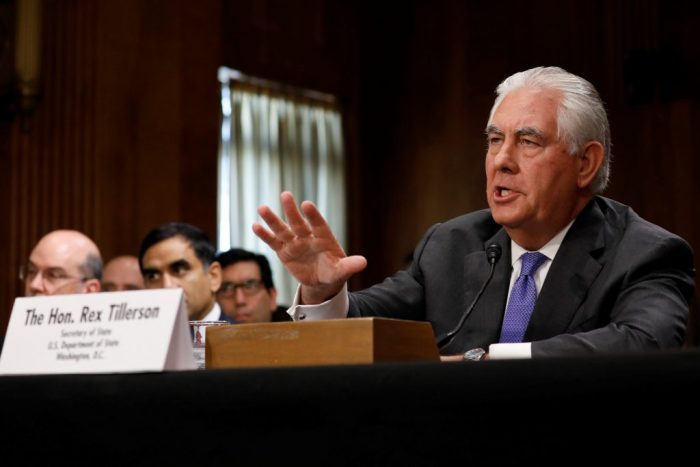
U.S. Secretary of State Rex Tillerson gave testimony to the House and Senate Foreign Affairs Committees this week in detailing the State Department budget priorities for the upcoming year. While the bulk of his testimony concerned the issues such as North Korea and Russian relations, Tillerson made a few comments on Iran that engendered a full-fledged response from the Iran lobby.

While the majority of news media gave ample coverage to Tillerson’s testimony concerning Russia, he was asked a question regarding Iran by Rep. Ted Poe (R-TX), a noted critic of the Iranian regime and the mullahs who control it, that drew scant attention, but clearly worried the Iran lobby.

Tillerson was asked about future plans to enter into negotiations with the Iranian regime and he replied the administration had no immediate plans to do so and expressed support for elements within Iran working towards regime change and a transition to democracy in Iran.

Predictably, the National Iranian American Council, staunch supporters of the Iranian regime, led the charge against Tillerson’s comments; literally breathing fire.

It appears that the concept of promoting democracy in Iran strikes mortal terror in the hearts of Trita Parsi and his fellow travelers at the NIAC.

Darius Namazi at NIAC whipped out a statement condemning Tillerson’s remarks and taking a swipe at Iranian dissident movements, namely the Mujahedin-e-Khalq (MEK), which had supporters in attendance at the hearings to express support for democratic change in Iran.

Poe asked Tillerson whether the U.S. supports “a peaceful regime change” and whether it is U.S. policy “to lead things as they are or set up a peaceful long-term regime change.”

Namazi claimed that Tillerson implied that it was U.S. policy to move toward supporting regime change, stating the U.S. would “work toward support of those elements inside of Iran that would lead to a peaceful transition of those governments.”

Only the NIAC would have a problem with the concept of a “peaceful regime change,” but that is par for the course for the Iran lobby.

The NIAC contends that any effort to force regime change would naturally be tantamount to an open declaration of war on the mullahs in Tehran, which is understandable considering the last time there was a mass effort for regime change following the disputed 2009 presidential elections, protests were brutally put down and innocent Iranians killed in the streets.

Of course, Namazi accuses the MEK of seeking to “violently overthrow the Iranian government,” as part of the Iran lobby’s continuing efforts to denigrate any organized opposition movement to the mullahs’ rule.

Namazi goes on to criticize Tillerson’s statements that the administration had no plans to negotiate with Iran on a range of issues such as the situations in Syria and Yemen, but Tillerson only correctly pointed out that granting Iran a seat at the bargaining table when it is the key agent causing the chaos in the first place was a pointless exercise.

According to Tillerson, “The Iranians are part of the problem…They are not directly at the table because we do not believe they have earned a seat at that table. We would like for the Iranians to end their flow of weapons to the Houthis, in particular their flow of sophisticated missiles to the Houthis. We need for them to stop supplying that, and we are working with others as to how to get their agreement to do that.”

These are not unreasonable sentiments, but apparently for the NIAC they are totally unreasonable.

Not that their efforts mattered since the Senate passed new sanctions on the Iranian regime by near unanimous margins in a further sign that the U.S. is moving past the failed policies of appeasing the Iranian regime under the Obama administration.

The Senate passed the sanctions bill by a 98-2 margin. The bill places new sanctions on Iran over its ballistic missile program and other activities not related to the international nuclear agreement reached with the United States and other world powers.

To become law, the legislation must pass the House of Representatives and be signed by Trump. House aides said they expected the chamber would begin to debate the measure in coming weeks, according to Reuters.

The Iranian regime itself didn’t waste time in attacking Tillerson’s assertions that Iran has “aspirations of hegemony in the region.”

The top U.S. diplomat’s remarks are “interventionist, in gross violation of the compelling rules of international law, unacceptable and strongly condemned,” Foreign Ministry spokesman Bahram Qassemi said in Tehran Thursday.

Qassemi went on to blame a history of U.S. “meddling in Iran in different forms” since the 1950s, saying the policy has only brought about “defeat and global shame” for Washington.

For all the bombastic the Iranian regime and its allies are hurling, the plain truth is that the U.S. is moving quickly and broadly on a number of fronts to rein in Iranian expansionism and militancy.

Congress is seeking new authorities that would enable it to expose and crack down on an Iranian state-controlled commercial airline known for transporting weapons and terrorist fighters to hotspots such as Syria, where Iranian-backed forces have begun launching direct attacks on U.S. forces in the country, according to new legislation obtained by the Washington Free Beacon.

Congressional efforts to expose Iran’s illicit terror networks more forcefully come as U.S. and European air carriers such as Boeing and Airbus move forward with multi-billion dollar deals to provide the Islamic Republic with a fleet of new airplanes, which lawmakers suspect Iran will use to amplify its terror operations.

The new sanction legislation targets Iran’s Mahan Airlines, which operates commercial flights across the globe while transporting militants and weapons to fighters in Syria, Yemen, and other regional hotspots.

A crackdown on Mahan could indicate that Congress is more seriously eyeing ways to thwart Iran’s mainly unchecked terror pipeline in the region.

We breathlessly await the NIAC’s next bout of hyperbole.
 

Filed Under: Blog, Latest from Lobbies & Appeasers, National Iranian-American Council, News Tagged With: Darius Namazi, Featured, Iran, Iran Human rights, Iran Lobby, Iran Mullahs, Iran sanctions, Iran Terrorism, IRGC, National Iranian American Council, NIAC, NIAC Action, ُTillerson. Ted Poe, Trita Parsi

As Iran Warns Against US Aggression Its Navy Targets US Vessels

June 16, 2017 by admin

As Iran Warns Against US Aggression Its Navy Targets US Vessels

As Iran Warns Against US Aggression Its Navy Targets US Vessels

The Iranian regime’s leadership kept up its steady drumbeat of issuing warnings against any U.S. military action against the mullah’s regime. Those warnings have come to encompass not only direct U.S. action, but also any potential for action through American allies such as Saudi Arabia.

Iran’s mullahs regard President Donald Trump’s recent sale of $110 billion in new arms to the kingdom as an existential threat no different than if the U.S. decided to launch airstrikes at Tehran.

Describing the U.S. arms agreement with Saudi Arabia as “unprecedented,” Maj. Gen. Yahya Rahim Safavi, a senior adviser to top mullah Ali Khamenei, warned the Arab states not to forget the fate of former Iraqi dictator Saddam Hussein and former Shah of Iran Mohammad Reza Pahlavi, who was toppled in 1979, in a not-too-subtle jab at its neighbors.

“The volume of weapons purchased by the Arab countries — and especially Saudi Arabia — is unusual, and the signing of a $110 billion arms package between the US and Saudi Arabia and the arms sale will not contribute to the security of southwest Asia, and it will also be used to make the region unsafe and create tension in an area that is the heart of the world’s [source of] energy,” Safavi said.

The irony in the Iranian regime warning of causing regional instability is laughable if it wasn’t so tragically true. Iran’s use of its own military in Syria and Iraq, along with proxies in both countries as well as Yemen has turned the Middle East into an abattoir.

“I hope that the weapons that were sold to these Arab countries will fall into the hands of the Arab nations of the region, like the weapons that were sold to Iran under the shah, and will be used against the Americans..” Safavi warned. “If America wants to start a war against Iran, all of its military bases in the region will be put in [danger of] insecurity.”

His remarks underscored a steady ramp up in potentially dangerous encounters between Iranian and U.S. military forces in the Syrian conflict, in Iraq and in the Persian Gulf.

Another such incident took place in the international waters of the Strait of Hormuz, a common hot spot for Iranian aggressiveness.

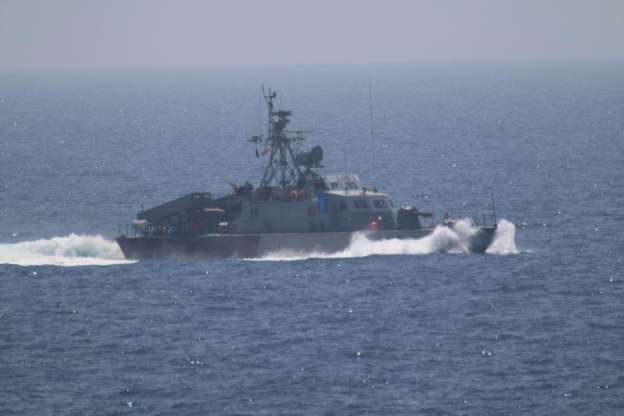
An Iranian Navy vessel has prompted ire from the U.S. military after an “unsafe and unprofessional” test of its capabilities on a U.S. helicopter.

According to a U.S. military statement, the vessel used an on-board laser against a U.S. Marine Corps CH-53E helicopter, moving above a trio of U.S. naval ships, transiting the strait.

The group was crossing the strait when an Iranian military vessel approached one of the three—the amphibious assault ship U.S.S. Bataan. The two came within 800 yards of each other, with the guided-missile destroyer U.S.S. Cole and dry cargo ship U.S.N.S. Washington Chambers not far away, Bill Urban, a spokesman for the US Navy’s Fifth Fleet said.

“The amphibious assault ship USS Bataan (LHD 5), guided-missile destroyer USS Cole (DDG 67) and dry cargo ship USNS Washington Chambers (T-AKE-11) were transiting the strait when the Iranian vessel paralleled the U.S. formation, shining a spotlight on Cole. Shortly thereafter, the Iranian vessel trained a laser on a CH-53E helicopter that accompanied the formation. The Iranian vessel then proceeded to turn its spotlight on Bataan, scanning the ship from bow to stern and stern to bow before heading outbound from the formation,” Urban said in a statement.

The aircraft’s presence prompted the Iranian boat—a missile boat according to one defense official speaking to CNN on the condition of anonymity—to point its targeting laser toward it. The same official said that not only does this fly in the face of safety protocols, but it also set off the CH-53E’s automatic defense system, firing flare signals.

“Illuminating helicopters with lasers at night is dangerous as it creates a navigational hazard that can impair vision and can be disorienting to pilots using night vision goggles,” Urban said.

According to U.S. Navy records, 2016 yielded 35 incidents of unsafe or unprofessional behavior by Iran’s navy alone—although the “vast majority” took place in the first half of the year.

There have been incidents this year too, including in January when the guided-missile destroyer USS Mahan fired three warning shots at four Iranian fast attack boats in the Strait of Hormuz. Another “unprofessional but also provocative” maneuver by the Iranians happened in April, the U.S. said according to CNN.

Incidents on the high seas were not limited to U.S. warships as Iranian-backed Houthi rebels in Yemen claimed to have attacked a Saudi-led coalition warship near a strategic Red Sea waterway, China’s state-owned Xinhua News Agency reported Wednesday.

The reported attack took place off the coast of the Yemeni city of Mocha, about 60 miles north of the Bab al-Mandeb Strait. An estimated 4.7 million barrels of oil pass daily through the strait, which links the Gulf of Aden to the Red Sea.

“The navy of the army and popular forces on Wednesday targeted a warship belonging to a Saudi-led coalition while it was carrying out hostile acts off Mokha coast of Taiz province,” a Houthi military official was quoted as saying by the Houthi-affiliated Saba news agency.

Al Massira TV, which is also linked to the Houthis, reported that “the navy forces of the national army fired a missile targeting the enemy coalition warship at the Red Sea early morning of Wednesday.”

Iranian shipments of weapons to the Houthis have been repeatedly intercepted by U.S. naval forces. The shipments included thousands of rifles, RPGs, anti-tank missiles, and other light and medium arms. Iran has openly acknowledged its support for the Houthis, and in early March 2015, Lebanon’s NOW Media reported that Houthi fighters were receiving training in Syria on behalf of Iran.

The increasing tempo of Iranian aggression prompted the U.S. military to deploy a truck-mounted missile system into Syria, an official said Wednesday, to a forward operating group of rebels and US military advisers that have repeatedly clashed with government forces.

The deployment raises the stakes in eastern Syria, where Iranian-sponsored pro-government forces have outflanked US advisers and rebels holding the Tanf border crossing to establish their own link to Iraq for the first time in years.

Shifting the HIMARS missile system into eastern Syria from Jordan will give the US a precise, long-range weapon to protect its advisers and allies in Tanf, and to attack ISIS militants further downfield. It has a range of 186 miles.

With the recent provocative activities in the region, it is now clearer that there will not be any change in the behavior of the Iranian regime’s aggression in the region, after Rouhani has been “elected” for the second term.

Michael Tomlinson

Filed Under: Blog, News Tagged With: Featured, Iran Mullahs, Iran Terrorism, Khamenei

Iran Regime Tries to Blame ISIS Attacks on Opposition

June 8, 2017 by admin

Iran Regime Tries to Blame ISIS Attacks on Opposition

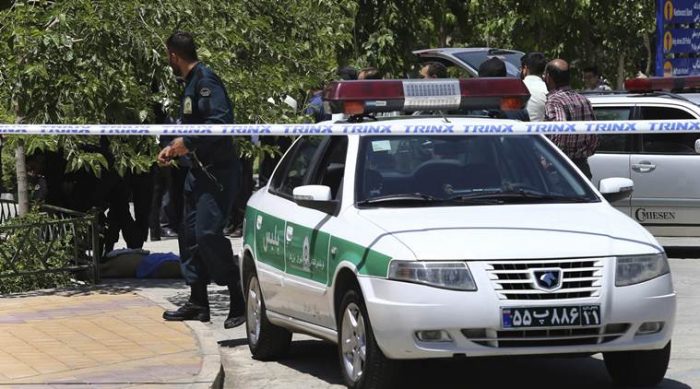
The body of a terrorist, at background left, lies on the ground while police control the scene at the shine of late Iranian revolutionary founder Ayatollah Khomeini, just outside Tehran, Iran, Wednesday, June 7, 2017. Several attackers stormed into Iran’s parliament and a suicide bomber targeted the shrine of Ayatollah Ruhollah Khomeini on Wednesday, killing a security guard and wounding 12 other people in rare twin attacks, with the shooting at the legislature still underway. (AP Photo/Ebrahim Noroozi)

An attack by six assailants armed with rifles and explosives took Iranian regime security forces by surprise the other day in a series of attacks aimed at the heart of the government, including a takeover of the Parliament building and the tomb of the regime’s founder, leaving a dozen dead and 46 wounded that shook the religious theocracy ruling Iran.

The attacks lasted for hours and was claimed by ISIS, which if true, would represent the first successful attack by the terror group on Iranian soil and a significant and somewhat ironic turn of events in the growing sectarian conflict between and extremist Sunni and extremist Shiite ideologies.

Predictably, the default response from Iranian officials was to point the finger of blame at regional rival Saudi Arabia and even Iranian dissident groups such as the Mujahedeen-e Khalq. As Iranian officials struggled in the wake of the attack, one could sense confusion and even a slight note of panic setting in as the prospect of Tehran joining the ranks of cities such as London, Paris and Berlin as prime terror targets began to seep.

For the Iranian regime, much of the blame for the notable rise in Islamic extremist groups lies squarely on its doorstep. The mullahs constant vitriol aimed at Israel, the U.S. and the its Sunni Arab neighbors has only made routine the kind of hate that groups like Hezbollah have acted on for decades.

The use of proxies and terrorist groups has always been a part of the statecraft toolbox for Iran as it has used Hezbollah and the Houthis to conduct open warfare in Syria and Yemen, meanwhile bolstering Shiite militias in Iraq to push Sunnis out of the coalition government there and into the waiting arms of ISIS recruiters.

According to the New York Times, tensions in the Middle East were already high following a visit by President Trump last month, in which he exalted and emboldened Saudi Arabia, Iran’s regional rival. Saudi Arabia and several Sunni allies led a regional effort on Monday to isolate Qatar, the tiny Persian Gulf country that maintains good relations with Iran

In a statement, the Revolutionary Guards Corps said, “The public opinion of the world, especially Iran, recognizes this terrorist attack — which took place a week after a joint meeting of the U.S. president and the head of one of the region’s backward governments, which constantly supports fundamentalist terrorists — as very meaningful,” a reference to Saudi Arabia’s ruling monarchy.

Saudi Arabia swiftly rejected the claim and the Trump White House, while expressing sympathy for the victims, was quick to note that “states that sponsor terrorism risk falling victim to the evil they promote” in a statement.

The MEK also denied any involvement and accused regime officials of a smear attack saying “their intention is to either use this event” against the group or justify their own previous crimes” in a statement.

But that didn’t stop members of the Iran lobby from stepping up to also blame Iranian dissident groups for the attack either directly or indirectly.

Paul R. Pillar, a stalwart for the Iran lobby, wrote in Consortium News blaming the MEK for alleged terrorist attacks in Iran and claiming that prior attacks had left the regime much better prepared to counter terrorism.

We hate to tell Pillar that his measure of “preparedness” by Iranian security forces leaves much to be desired judging by the daylong standoff at the Parliament building.

Pillar even begins laying the ground work for the Iranian regime to step up its terrorist activities in the wake of the attacks saying “in the months ahead, Iran may take actions outside its borders in response to the attacks.”

“Iran may see a need to be more aggressive in places such as Iraq or Syria in the interest of fighting back against ISIS,” Pillar said.

His comments are instructive since the mullahs are likely to use the attacks as an excuse to step up their fights in Syria in to preserve the Assad regime and in Yemen to continue destabilizing the border to Saudi Arabia.

It is not inconceivable that the Iranian regime will use the attacks as a pretext to launch fresh initiatives in places such as Bahrain and Qatar to further split apart the Gulf states and weaken opposition to its regional ambitions to build a Shiite sphere of influence.

Pillar wasn’t alone in trying to drag the MEK into the mud, as Trita Parsi of the National Iranian American Council, gleefully attacked the resistance group in interviews claiming that the MEK was equipped to carry out these attacks because of its channels into the regime and its ties to Saudi Arabia.

“If the goal was to penetrate and destabilize Iran, the MEK clearly was Saudi Arabia’s best bet,” Parsi said. “Still unclear who’s behind the current attack in Iran, but the MEK (and their Saudi backers) are a main suspect. Timing is of course curious. Just last month, A Saudi Crown Prince said Riyadh is working hard to take battle to inside of Iran.”

Parsi and Pillar offered no proof, only suspicions that read like they came from a talking points memo from Ali Khamenei’s office as Iran struggles with the aftermath of the attacks and desperately seeks any scapegoat other than its own support for terrorism.

The roots for these attacks lie squarely in the Iranian regime’s long history of exporting terror as a tool and it has finally come home to bite them.

Michael Tomlinson

Filed Under: Blog, Current Trend, News Tagged With: Featured, hassan rouhani, Iran Attacks, Iran Lobby, Iran Mullahs, Iran Terrorism, IRGC, Khamenei, National Iranian American Council, NIAC, Paul Pillar, Syria, Trita Parsi

Qatar Crisis Has Roots in Iranian Regime

June 6, 2017 by admin

Qatar Crisis Has Roots in Iranian Regime

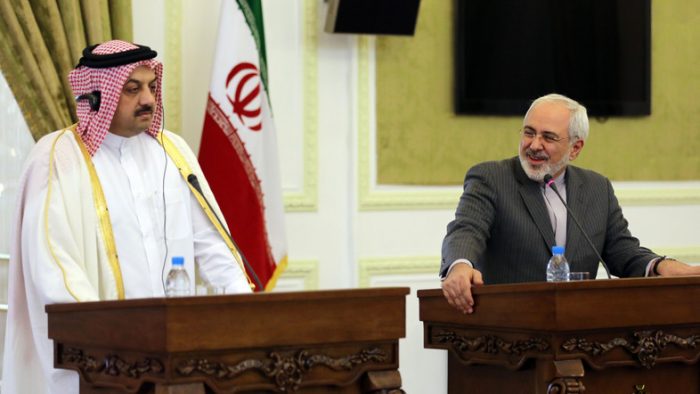
Qatar’s Foreign Minister Khalid al-Attiyah (L) holds a joint press conference with his Iranian counterpart Mohammad Javad Zarif on February 26, 2014 in Tehran. AFP PHOTO/ATTA KENARE

President Barack Obama had long viewed the conflicts raging in the Middle East as having their roots in the classical expansionism of Western powers exerting control over their former colonies and territorial holdings. He also viewed American military use in the region problematic and an incentive for countries such as Iran to oppose U.S. ambitions any way possible, including terrorism.

President Obama understood the rationale for terror and adjusted his foreign policy accordingly in the mistaken belief that openness would be rewarded with cooperation and civility.

This was a driving belief in his quest to negotiate a nuclear agreement with the Iranian regime and caused him to grant concession after concession to secure a deal. His willingness to disconnect issues such as Iran’s support for terror or its abysmal human rights record to the deal cleared a runway for Iranian extremism to become an export product as legitimate as its oil.

While you can’t fault his motives, his judgment was clouded by the allure of a landmark deal that could cement his status in history books as a peacemaker. It’s also why he steered away from every seriously wading into the Israeli-Palestinian conflict; seeing no end game resolution for that problem. This also carried the price of sending the U.S.-Saudi relationship to a historic low point.

The problem is that his basic assumptions about the nature of the Middle East was wrong and the new calculus of a new order in the region is quickly taking shape.

For many decades, the Arab world was uniformly united in using the Israeli-Palestinian conflict as the primary talking point in diplomatic circles, but with the ascendance of the Iranian regime over the last few years, the Arab world and Iran’s neighbors have quickly re-calculated the risks of allowing Iran unfettered freedom.

For the Syrian people, that price has been exorbitant as Iran has used its own Revolutionary Guard Corps and Quds Force troops, alongside Hezbollah fighters, Iraqi Shiite militias and recruited Afghan mercenaries to fight on behalf of the Assad regime.

In Yemen, Iran has armed Houthi rebels to open another front against Saudi Arabia and pose a very real and significant threat to the Kingdom. Add to that efforts to control Iraq as a Shiite proxy and you get the birth of ISIS and other extremist groups.

The Middle East has quickly devolved into a free-fire zone of wars breaking out everywhere.

It doesn’t take a rocket scientist to see the mullahs in Tehran behind much of the machinations taking place aimed at their Sunni rivals, which explains why the latest flare up involving the tiny Gulf state of Qatar exploded this week.

The Atlantic spelled out the problems Qatar’s neighbors have had with the oil-rich nation over the past decade.

Bahrain, Saudi Arabia, and the UAE, last cut ties with Qatar in 2014, withdrawing their ambassadors from the country for nine months. But this latest standoff has gone markedly further. For one thing, it includes economic sanctions—and given that Qatar’s only land border is with Saudi Arabia, any disruption to the flow of goods and people by air, land, or sea, could cause rapid economic dislocation and lead to social or political unrest, the Atlantic reported.

While it remains unclear what the Saudi and Emirati endgame is, the roots of the tensions between Qatar and its neighbors go deep, predating the Arab Spring in 2011 and Qatar’s subsequent high-profile support for Islamist transitions in North Africa and Syria. In fact, nearly every “crisis” in the six-member Gulf Cooperation Council (GCC) over the past quarter-century has, in some way, involved Qatar. The other Gulf leaders’ patience with Doha’s sometimes-maverick regional policies may have finally snapped.

A key preoccupation of Qatar’s post-1995 leadership has been the pursuit of autonomous regional policies designed to bring the country out of the Saudi shadow. Qatar’s support for regional Islamists, notably but not only the Muslim Brotherhood, and provision of Doha-based Al Jazeera as a platform for groups criticizing regional states, incited periods of intense friction.

The history of tension between Qatar and the rest of its neighbors has been fraught which explains why the Iranian regime sees an opportunity to extend its influence to Qatar.

Iran immediately blamed President Donald Trump for setting the stage during his recent trip to Riyadh.

“What is happening is the preliminary result of the sword dance,” Hamid Aboutalebi, deputy chief of staff of Iran’s President Hassan Rouhani, tweeted in a reference to Trump’s recent visit to Saudi Arabia.

Trump and other U.S. officials participated in a traditional sword dance during the trip in which he called on Muslim countries to stand united against Islamist extremists and singled out Iranian regime as a key source of funding and support for militant groups.

The prospect of a U.S. president forging a new Arab coalition against Iran must be freaking out the mullahs in Tehran which may explain their near hysterical response to Trump in blaming him for everything.

The fact that Iran and Qatar share a massive gas field in the Persian Gulf provides a strong economic incentive tying them together which may help explain why Qatar has embraced radical Islamist groups.

For Iran’s part, the mullahs are hoping to gain an opportunity to strengthen its relationship with Qatar and drive a deeper wedge into the Gulf states by offering to move food and supplies by convoy into Qatar; a move that Saudi Arabia is blocking.

While the public spat with Qatar may be about regional issues, the underlying central issue has always been about the Iranian regime.

Michael Tomlinson

Filed Under: Blog, News Tagged With: Featured, Iran Mullahs, Iran Terrorism, IRGC, Qatar

London Bridge Attacks Puts Spotlight on Iran Extremism

June 5, 2017 by admin

London Bridge Attacks Puts Spotlight on Iran Extremism

London Bridge Attacks Puts Spotlight on Iran Extremism

The terrorist attacks that have struck London and Manchester have reinforced the essential problem facing nations confronted with homegrown radicalization: How to stem the tide of extremism flowing from a few select terrorist actors in the world.

The core truism about extremism is that it is not something that magically springs into a young man’s mind. It is something created by example and revealed as a pathway of redemption for the disenfranchised, the unhappy, the mentally unstable.

While ISIS and before it, Al-Qaeda, spewed out hate-filled propaganda designed to energize and slightly dement these men and women around the world, the pathfinder for this process has always been the Iranian regime.

Radicalization begins with an idea. From such innocuous beginnings can spring forth great horrors. Nazism in Germany plunged the world into a cataclysmic war. The Iranian regime’s twisted perversion of Islam has created a similar tidal wave of misery around the world.

From its earliest days when the religious clerics took over the leadership of a revolution that meant to topple the Shah’s dictatorship and turned it into a referendum on dictatorial religious power, Iran has been at the epicenter of conflicts not only with the West, but its neighboring Muslim neighbors.

The ruling mullahs have always operated with a fervent belief in the expansion of their control and theocracy; partly to gain material control of funds and assets, but also to build buffer between Iran and the rest of the world.

The mullahs sought to build alliances or simply overthrow governments to create a Shiite sphere of influence in Lebanon, Syria, Afghanistan, Iraq and Yemen; stretching from the Mediterranean to the Indian Ocean.

It has used proxies and terrorist organizations to help fights battles, assassination political rivals, destabilize governments and provide a safe landing zone for Iranian Revolutionary Guard Corps and Quds Force troops to jump in and consolidate its gains.

But for all its successes, Iran now faces a very basic problem: the rest of world now knows the true colors of the Iranian regime.

With each terrorist attack, the world asks a simple question: Why?

The answer is increasingly: Islamic extremism.

The equation is simple to understand; expose potential subjects to an ideology of hate and intolerance and you can turn anyone into a guided weapon.

Iran mullahs have excelled at the practice for decades through their own terrorist proxies and espousing the language of hate. It didn’t matter who the mullahs directed their vitriol at since everyone was fair game.

Death to the Great Satan.

Death to Sunni apostates.

Destroy Israel.

Overthrow the Kingdom.

The targets changed, but the message never did.

Now the mullahs are sensing the tide is changing on them around the world and they are trying to do a backstroke upstream.

That was evident when top mullah Ali Khamenei declared that the London terror attacks were a “wake-up call” for Western nations to go after the sources of terrorism.

Rarely has anyone said something so completely correct and so wildly wrong.

“Repeated blind terror attacks around the world are a wake-up call for the world community,” the official Iranian news agency IRNA quoted Foreign Ministry spokesman Bahram Qasemi as saying.

“To uproot terror, it is necessary that they (Western states) address the root causes as well as the main financial and ideological sources of extremism and violence, which are clear to everyone,” Qasemi was quoted as saying by Press TV.

Iran denies Western charges of sponsoring terrorism, and it is no coincidence that Khamenei tried to hoist blame on Saudi Arabia since the U.S. under the Trump administration has set its sights squarely on containing Iran and forming a new international coalition.

That opposition began with a renewed military commitment in Syria where U.S. forces actively targeted and engaged Iranian-backed forces for the first time.

U.S. military said on Thursday it had bolstered its “combat power” in southern Syria, warning that it viewed Iran-backed fighters in the area as a threat to nearby coalition troops fighting Islamic State.

The remarks by a Baghdad-based spokesman for the U.S.-led coalition battling Islamic State was the latest sign of tension in the region, where the United States has forces at the base around the Syrian town of Al Tanf supporting local fighters.

“We have increased our presence and our footprint and prepared for any threat that is presented by the pro-regime forces,” said the spokesman, U.S. Army Colonel Ryan Dillon, referring to Iran-backed forces supporting Syrian President Bashar al-Assad.

Trump has begun the laborious process of building a new coalition in halting Iranian expansion.

Most recently, during his trip to Saudi Arabia, Trump called for unity against Tehran and told assembled Arab leaders that, “For decades, Iran has fueled the fires of sectarian conflict and terror.”

Under its new director, former Republican Rep. Mike Pompeo, who was a ardent foe of the Iran deal, the intelligence agency has made moves toward more aggressive spying and covert operations.

And, according to The New York Times, Pompeo has found a skilled leader for his Iran operations: Michael D’Andrea, an experienced intelligence officer known as the “Dark Prince” or “Ayatollah Mike.”

D’Andrea, a Muslim convert, has gotten much of the credit for US efforts to weaken Al Qaeda.

Robert Eatinger, a former CIA lawyer who was involved in the agency’s drone program, told The Times it would not be “the wrong read” to see D’Andrea’s appointment as step toward a more hardline policy on Iran.

The attacks in London are only a symptom of the much larger disease of Islamic extremism fueled by Tehran and it’s time to rein it in.

Michael Tomlinson

Filed Under: Blog, News Tagged With: Featured, Iran, Iran Mullahs, Iran Terrorism, IRGC, Khamenei

Human Rights Groups Protest Iran Regime Destruction of Mass Graves

June 2, 2017 by admin

In the summer of 1988 following a decree by Ayatollah Ruhollah Khomeini, Iran’s Supreme Leader at the time, thousands, with some estimate as many as 30,000 political prisoners were executed in a matter of few months, the majority in the first few weeks. A crime against humanity that remained largely out of media limelight.

Iranian regime’s current leaders, including presidential candidate Ebrahim Raisi and re-elected president Hassan Rouhani were complicit in those atrocities, especially Raisi who served as a prosecutor on one of the “death commissions” that dispensed execution orders.

Bodies were buried in mass graves throughout Iran without markers or notice of who these people were or why they died. Their existence only commemorated by their families and relatives.

Now comes reports that the Iranian regime is erasing even these unmarked graves from existence in a disturbing effort to hide the awful truth of these massacres.

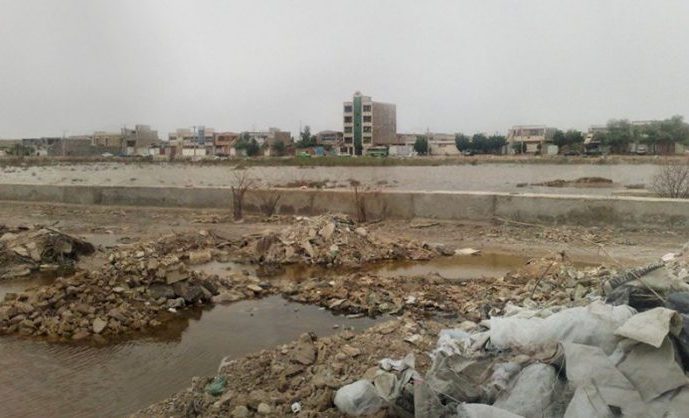
The desecration of a mass grave site in Ahvaz, southern Iran that contains the remains of at least 44 people who were extrajudicially executed would destroy vital forensic evidence and scupper opportunities for justice for the mass prisoner killings that took place across the country in 1988, said human rights groups Amnesty International.

Photo and video evidence obtained by the NGO Justice for Iran and reviewed by Amnesty International shows bulldozers working on a construction project directly alongside the mass grave site at Ahvaz, as well as piles of dirt and construction debris surrounding the grave. Although the Iranian authorities have made no official announcements about Ahvaz, families learned through a construction worker that the plan is to ultimately raze the concrete block marking the grave site and build over the area.

“By attempting to destroy the mass grave in Ahvaz, the Iranian authorities appear to be embarking on a sinister and deliberate effort to destroy crucial evidence of their past crimes and deprive the families of the victims of the 1988 mass prisoner killings of their right to truth, justice and reparation. This is a shocking assault on justice that must be stopped immediately,” said Magdalena Mughrabi Amnesty International’s Deputy Director for the Middle East and North Africa.

The action is akin to other mass murdering regimes that have attempted to erase the evidence of their crimes. It is no different than the Nazis burning down a concentration camp or a Serbian army unit digging up bodies from a mass grave to move them.

“For years the authorities have inflicted unbearable suffering on the families of the victims of the 1988 extrajudicial executions. They have denied them the right to give their loved ones a dignified burial and forced them to walk through piles of rubbish to visit their dead. Now they are planning to destroy their final resting place and trying to obliterate their memory from history,” said Shadi Sadr, the Executive Director of Justice for Iran.

According to Amnesty International, mass graves are crime scenes that require professional forensic expertise to undertake exhumations and ensure preservation of evidence and accurate identification of bodies. By desecrating the site, the authorities will be destroying vital evidence that could one day be used to shed light on the number and identity of those killed in state custody.

The Ahvaz mass grave is located on a barren piece of land 3km east of Behesht Abad Cemetery. It is believed to contain the bodies of dozens of people who were among several thousand political prisoners killed in a wave of extrajudicial executions across Iran in the summer of 1988. The prisoners were rounded up and forcibly disappeared before being killed in secret.  Their bodies were then dumped into freshly dug trenches overnight.

The regime plan is to widen a roadway near the grave site and eventually raze the concrete block sitting on top of it in favor of a green space or even a commercial development. The idea the regime would allow construction of an office building built on top of a mass grave site shows the mullahs disregard for these people who were viewed as enemies of the Islamic revolution.

This is not the only mass grave from the mass killings of 1988 at risk of destruction. Justice for Iran has learned of apparent efforts to tamper with another site in the north-eastern city of Mashhad, Khorasan Razavi province, where up to 170 political prisoners are believed to be buried.

Many of the prisoners in 1988 that were rounded up and executed were either members of the dissident group, the People’s Mujahedin Organization of Iran (PMOI), or suspected of being members. Even if a prisoner had no affiliation with the dissident group, regime officials would tag the prisoner with an association to expedite their execution.

The vast majority of those killed had already spent years in prison, often for peacefully exercising their rights by distributing newspapers and leaflets, taking part in peaceful anti-government demonstrations, or having real or perceived affiliations with various political opposition groups. Some had already completed their sentences but had not been released because they refused to “repent”.

To date, no Iranian officials have been investigated and brought to justice for the extrajudicial executions. Some of the alleged perpetrators continue to hold political office or other influential positions, including in the judiciary, according to Amnesty International.

Laura Carnahan

Filed Under: Blog, News Tagged With: 1988 massacre, amnesty international, Featured, Iran Human rights, Iran Mullahs, Mass graves

Iran Regime Expands Its Militant Activities

June 1, 2017 by admin

Iran Regime Expands Its Militant Activities

Iran Regime Expands Its Militant Activities

With Hassan Rouhani ensconced for another four years, the mullahs in Tehran can turn their attention back to the work at hand which is continuing the expansion of the Iranian regime’s extremism and secure the gains it made during four years of an Obama administration’s failed policy of appeasement.

That expansion is on a variety of fronts. First and foremost, the regime is focused on expanding its military capabilities and has made aggressive moves to do so. It’s a vital step for the regime since the Revolutionary Guard Corps and its related units, such as the Quds Force, are the tip of the spear that also happen to control the economic purse strings of the country.

Through an elaborate network of shell companies, the IRGC control most of the major industrial sectors such as oil, manufacturing, telecommunications and financial services. It regularly uses the profits from these enterprises to pay for its military expenditures as well as the proxies it uses in its fighting.

The IRGC also pushed hard for the nuclear deal for one specific purpose which was to lift crippling economic sanctions that were cutting off its supplies of cash and arms. That was vital since the handwriting was on the wall since the Arab Spring democracy protests and the disputed Iranian presidential election of 2009 that the regime was under significant pressure that threatened the rule of the mullahs.

The flawed nuclear offered unjustified concessions for the regime not only because it lifted sanctions and flooded cash back into the mullahs’ coffers, but also it allowed the regime to unlink its abysmal human rights record and support for terrorism from the agreement itself.

This essentially gave the regime a blank check to continue to engage in militant actions without fear of reprisal.

Part of that military support has been a destructive expansion on Iran’s use of proxies such as the terrorist group Hezbollah to fight its battles, especially in the ever-widening Syrian civil war and the insurgency in Yemen with the Houthi.

News reports have pointed towards a fresh influx of support for Hezbollah and what that may mean for U.S.-backed rebel forces in Syria.

A top U.S. military official says rather than using any additional monies to invest more heavily in conventional forces, there are indications Tehran continues to focus on cultivating special operators to help lead and direct proxy forces, according to Voice of America.

“If anything, increased defense dollars in Iran are likely to go toward increasing that network, looking for ways to expand it,” U.S. Special Operation Forces Vice Commander Lieutenant General Thomas Trask told an audience in Washington late Tuesday.

“We’ve already seen evidence of them taking units and officers out of the conventional side that are working with the IRGC in Syria,” Trask added. “We’re going to stay focused on these proxies and the reach that Iran has well past Syria and Yemen but into Africa, into South America, into Europe as well.”

Yet despite Iran’s heavy involvement in Syria to help prop up the regime of President Bashar al-Assad, U.S. military officials see no indications much of that money has been set aside for bolstering Tehran’s conventional forces.

Nor do they see that as a likely scenario, even though the latest estimates from the U.S. intelligence community warn Iran is trying to develop “a range of new military capabilities,” including ballistic missiles, cruise missiles and armed drones.

Already, Iran is supplementing its own forces inside Syria by providing arms, financing and training for as many as 10,000 Shia militia fighters, including units from Iraq, Afghanistan and Pakistan, according to U.S. intelligence officials.

Military and intelligence officials further worry about the sway Iran has over tens of thousands of additional fighters who are part of Shia militias fighting in Iraq.

Fighting involving U.S. aircraft against Iranian-backed forces in the border town of al Tanf where Syria, Jordan and Iraq meet gave a prelude to what may be a wider war as Iran continues to pour resources into Syria to consolidate gains made by the Assad regime with the backing of Russia.

But conventional warfare isn’t the only area the mullahs want to expand as Steve King, COO and CTO of Netswitch Technology Management, pointed out Tehran’s investment in cyberattacks in Lifezette.

Since 2015, Iran has been conducting a sophisticated online cyberattack campaign that uses custom-built malware to deliberately infect and gain access to sensitive industrial control systems and critical infrastructure in companies across the globe, King writes.

All of this activity during the last two years has been like spring training for the Iranians: mostly practice attacks designed to sharpen their skills, he added.

King noted that according to a 2016 Defense Department report, Iran has evolved its cybersecurity operations to become the primary pillar of its national security strategy and has been testing the limits of sanctions and repercussions associated with the nuclear deal as they might be applied to their activities in cyberspace. So far, no reaction from the West.

Cyberwarfare is now as important to Iran’s military strategy as its ballistic missile program used to be, he warns.

The broad array of threats being presented by the Iranian regime is becoming readily apparent even though the Iran lobby and its supporters continue to work to obscure all of the regime’s actions.

One example is a piece by Cornelius Adebahr in Carnegie Europe that extols the virtues of a Rouhani win and what it means for Europe. It’s a puff piece for the regime and ignores the historical record of Iranian extremism.

Sadly, Adebahr only regurgitates the same false messages offered by groups such as the National Iranian American Council. The brutal reality of Iranian policy can’t be seen in the ballot box but in the battlefields across the Middle East.

Michael Tomlinson

Filed Under: Blog, News Tagged With: Appeasement policy, Cornelius Adebahr, Featured, hassan rouhani, Iran Human rights, Iran Lobby, Iran Mullahs, Iran Terrorism, IRGC, National Iranian American Council, NIAC, NIAC Action

Chances of US and Iran Confrontation Grows in Syria

May 31, 2017 by admin

Chances of US and Iran Confrontation Grows in Syria

Chances of US and Iran Confrontation Grows in Syria

The Iranian regime has been instrumental in the evolution of the Syrian civil war. From its earliest days when the regime of Bashar al-Assad violently put down pro-democracy demonstrations, the mullahs in Tehran have done everything they could to keep Assad in power.

As one of its few allies, the Assad regime represents a vital link for Iran to the Mediterranean and serves as a counterweight to the Iranian regime’s rivals. As one of the few partners the Iranian regime has, Syria serves as more than an ally, but also as a sign of Iranian strength and reach.

The dark days for the Iranian regime and Assad in the early days of a growing rebellion revealed deep fissures in Syrian society and forced Iran’s mullahs to open up its larder to supply Assad as he quickly was running out of cash, ammunition, weapons and soldiers as mass defections within the Syrian army took hold.

As the Iranian regime launched an air bridge between Tehran and Damascus using its own airlines to ship badly needed supplies to Assad, the situation on the ground changed as well as radicalized Islamic extremist fighters began to trickle in from safe havens in Afghanistan and Iran.

For the mullahs in Iran, they saw an opportunity to use these militants to target and attack more moderate Western-backed rebel groups fighting Assad and turn the terms of the rebellion away from democracy and towards a war against terror; an ironic twist considering Iranian regime’s own long history of supporting terror.

The fact that Iran was using Hezbollah fighters as its shock troops on the ground in Syria was no mere coincidence. The regime has long used these terrorists in proxy operations around the world.

In response, the world aligned to fight these new terror groups, including ISIS thereby buying time for Assad and breathing room for Iran’s mullahs to make moves.

After years of ISIS-inspired and led terror attacks around the world in Paris, Brussels, Orlando, Nice, Boston, San Bernardino, Sydney, Ottawa and Berlin, the world finally took the fight to ISIS and worked to drive it back out of Mosul in Iraq and now has made advances in Syria, but those gains have brought a new situation that is only gaining in tension.

Military forces from the U.S., Russia, Iran, Turkey, Saudi Arabia, Iraq and Afghanistan are now all converging on similar territory in Syria as ISIS forces get pushed further back bringing on the very real possibility that these forces may inadvertently start shooting at each other.

In one border crossing between Syria and Iraq, in a town called Tanf, that possibility loomed large as U.S. aircraft dropped leaflets warning pro-Syrian regime militia to avoid one the so-called deconfliction zones around a small U.S. occupied base there, according to the Military Times.

Officials at the Pentagon have acknowledged that pro-regime forces are active in the area and were conducting armed patrols in the vicinity of Tanf.


U.S. and British Special Forces use the facility to train Syrian opposition forces for the fight against ISIS, according to U.S. Central Command officials. The deconfliction zone encompasses a 55-kilometer radius around the base.

“These patrols and the continued armed and hostile presence of pro-regime forces inside the deconfliction zone are unacceptable and threatening to coalition forces,” said a CENTCOM official.

With the pending liberation of the Syrian city of Raqqa by U.S.-backed Kurdish forces, elements of the Syrian regime and proxies allied to Iran have been jockeying for control.

Without any agreement between parties to the conflict in Syria on what to do with formerly held ISIS territory, confrontation becomes a likely avenue, said Fabrice Balanche, a leading French expert on Syria and a visiting fellow at The Washington institute for Near East Policy.

Ultimately, Syria is worried about the permanent presence of a U.S.-backed Syrian opposition group blocking a strategic route for the regime.

Over the weekend, members of the Katib Imam Ali, an Iraqi Shiite militia associated with the Iranian regime, positioned a large number of forces to include tanks and technicals — modified pickup trucks with mounted heavy machine guns — just outside the 55-kilometer zone.

Officials in Baghdad say they will use force to defend the installation where U.S. forces are operating. Only two weeks ago, pro-regime militias tested U.S. forces requiring strikes from U.S. aircraft to attack a pro-regime tank and bulldozer.

Syrian rebels say the U.S. and its allies are sending them more arms to try to fend off a new push into the southeast by Iran-backed militias aiming to open an overland supply route between Iraq and Syria.

The stakes are high as Iranian regime seeks to secure its influence from Tehran to Beirut in a “Shi’ite crescent” of regime’s influence through Iraq, Syria and Lebanon, according to Reuters.

A commander in the military alliance fighting in support of Assad told Reuters the deployment of government forces and pro-Damascus Iraqi fighters in the Badia would “obstruct all the plans of the MOC, Jordan and America”.

The commander, a non-Syrian, said Assad’s enemies were committed to blocking “what they call the (Shi’ite) Crescent”. But, he said, “Now, our axis is insistent on this matter and it will be accomplished.”

The mullah’s backed Iraqi Badr militia said its advance to the Syrian border would help the Syrian army reach the border from the other side. “The Americans will not be allowed to control the border,” its leader, Hadi al-Amiri, told al-Mayadeen TV.

As all these forces converge, it’s clear that Iranian regime’s long support of Assad is finally leading it into direct conflict with the U.S. and its allies and that will be a scenario the mullahs in Tehran should surely avoid.

Michael Tomlinson

Filed Under: Blog, News Tagged With: Featured, Iran Mullahs, Iran Terrorism

Iran Election Leaves Confusion and Chaos in its Wake

May 30, 2017 by admin

Iran Election Leaves Confusion and Chaos in its Wake

Iran Election Leaves Confusion and Chaos in its Wake

The re-election of Hassan Rouhani to another term as president of the Iranian regime came as no surprise to experienced Iran watchers and the larger dissident community; particularly since the election process in Iran is essentially rigged from the start by the process of eliminating thousands of candidates who register to run for the office, but this has not stopped the Iran lobby from claiming the win was a mandate for so-called “moderate” policies.

One example of this myth-making comes from the National Iranian American Council which noted Rouhani’s win with an analysis on its website.

According to the NIAC, more than 41 million Iranians voted in Iran’s May 19th Presidential election, or nearly 75% of the electorate. The NIAC claims that figure included tens of thousands of Iranians in the diaspora with a remarkable feat given the obstacles imposed by Iran’s unelected institutions.

It’s a silly argument to make since many election analysts who have studied Iranian elections have noted the past practice of ballot stuffing and double counting of ballots cast in presidential and city council races in order to boost overall numbers.

There is also the infamous 2009 election “victory” of Mahmoud Ahmadinejad which was widely considered to be illegitimate for the same tactics.

The claim of high Iranian voter turnout would be similar to basing the election turnout for the Hillary Clinton vs. Donald Trump race on counting ballots cast for state races as separate and unique.

It is even more ironic for the NIAC to claim a high turnout from the Iranian diaspora when it has previously openly condemned large portions of the diaspora involved in the Iranian resistance movement, such as the People’s Mujahedin Organization of Iran.

The NIAC also claims that the election was a 57-38% landslide for incumbent Rouhani, and a defeat for so-called hardliners – including the leadership of Iran’s judiciary and Revolutionary Guard Corps (IRGC) – which publicly mobilized for perceived conservative candidate Ebrahim Raisi

What the NIAC doesn’t admit to is that the election was precisely a victory for the hardliners because the regime government is controlled and directed by the same hardliners who claim to be moderates. All Iranian officials from the Rouhani on down to the lowliest village representative all have to swear the same oath of fealty and allegiance to the regime’s religious leadership and theocracy.

There is no distinction within the Iranian regime between moderates or hardliners since all are beholden to the same power structure.

The NIAC also claimed the election was a referendum on the nuclear deal, but what it fails to do is make the distinction of how the election was engineered to deliver a pre-determined outcome. By setting up a race between Rouhani and Raisi, the mullahs created the perception of a moderate vs. hardliner battle and all but ensured Rouhani’s election as a choice of the lesser of two evils.

The election was never about the nuclear deal since most Iranians have not received any benefits from the deal and probably won’t for many more years. For Iranians who voted for Rouhani, the election was simply a choice of choosing a less odious candidate than another, which tends to be the basic choices provided by the mullahs.

To keep that fiction up, Raisi and his supporters are now even accusing Rouhani of rigging the vote with widespread voter fraud.

“Tampering with the numbers of people’s participation is inappropriate. Not sending ballots to centers where the government’s opponent has a chance of getting votes is very inappropriate,” Raisi was quoted as saying.

“I ask the Guardian Council and the judiciary not to let the people’s rights get trampled. If this vote-tampering is not looked into, then the people’s trust will be damaged.”

The claim is humorous given the regime’s predilection for rigging elections, but Raisi’s claims might very well be genuine, but in the end irrelevant since the mullahs got the result they wanted, which was to fool the rest of the world.

The need to fool the world is necessary for the Iranian regime as it continues to implement an aggressive agenda seeking to expand its sphere of influence throughout the region, which is why recent news that Iranian-backed Iraqi Shiite militias were on the very of opening a land corridor from Iran to Assad-regime controlled territory in Syria is worrisome.

The opening of such a corridor would accelerate Iran’s ability to ship weapons and fighters to Syria without having to resort to more clandestine methods such as using commercial Iranian airliners to ferry troops and supplies.

Syrian rebel sources have warned of advances by the Syrian army and Iranian-backed militia to reach the border.

The news of Iranian involvement in other regions included reports from Afghanistan of Pakistani and Iranian nationals fighting for ISIS elements.

Afghanistan Nangarhar provincial Police Chief Abdul Rahman Rahimi said that the Pakistani and Iranian detainees confessed that militants were being funded by Iran and Pakistan.

The attack against the U.S. didn’t stop either after the election as top mullah Ali Khamenei continued his customary verbal broadsides against the U.S. by marking the start of the Muslim holy month of Ramadan by ripping Saudi Arabia, saying its Sunni rival is being pumped for money by the U.S., according to Agence France-Presse. 

Khamenei’s comments comes after President Trump brokered a $110 billion defense deal with the Saudis during his first foreign trip in office.

The defense deal between the U.S. and the Saudis will bolster Riyadh’s defense capabilities by providing more equipment and services to combat extremist terror groups and Iran.

Even as the Iran lobby claims the Iran election has resolved much, the opposite has been the truth.

Michael Tomlinson

Filed Under: Blog, News Tagged With: Ebrahim Raisi, Featured, hassan rouhani, Iran, Iran Election 2016, Iran Lobby, Iran Mullahs

On Memorial Day We Should Honor Everyone Who Died for Freedom

May 29, 2017 by admin

On Memorial Day We Should Honor Everyone Who Died for Freedom

On Memorial Day We Should Honor Everyone Who Died for Freedom

Memorial Day will see families and friends gather for backyard BBQs and hit stores for shopping sprees. In other, more quiet gatherings, people will gather to honor the memory of those who gave their lives for defending freedom in wars and battles at home and abroad.

But Memorial Day should be a day for a broader and more inclusive remembrance of people who fought for freedom. It should also be a time for honoring those who did not wear a uniform, but still paid the ultimate sacrifice on behalf of a better world.

Many of those people are activists and dissidents who have fought for democracy and human rights against authoritarian regimes around the world such as Iran and North Korea. For them, active protests against their government can cause arrest, torture, imprisonment and often execution.

Their sacrifice is an ultimate demonstration of the courage it takes to stand up to tyranny and oppression. For many who make that sacrifice, the bravery shown as they are led to the gallows is no different than soldiers going over a hill to attack an enemy position or brave fire to save fellow soldiers or civilians.

In a way, Memorial Day is a celebration; a celebration of the courage it takes for one person to act, to suppress their fears and do something most normal people wouldn’t even consider doing. Memorial Day is a recognition that to be brave is a choice and a moral one at that.

Across America, we observe Memorial Day legacies from the recent past in recognizing soldiers, sailors, airman and Marines who have fought and died in the global war on terror in places such as Afghanistan, Iraq, Somalia, Syria and other remote locations.

We should also recognize the sacrifices made by those who have acted on similar instincts in their own way.

In places such as Iran, the Iranian regime has been ruthless and relentless in seeking out and punishing dissidents severely. The regime has a long history of murder and massacres as a tool of statecraft, going back to the mass slaughter of 30,000 Iranian dissidents back in the ‘80s and the continued arrest and execution of dissidents to this day.

In the prior decades of the Islamic state, dissidents were primarily political and often came from opposition and resistance parties and groups such as the People’s Mujahedin Organization of Iran (PMOI) and the Mujaedin-e Khalq Organization (MEK).

Now the range of dissident in Iran is as broad as the entire population itself. It has grown to include students who oppose restrictions on their education, small business owners upset with a struggling economy, women resisting moral codes that require hijabs or handcuff their ability to choose careers or even a husband, or even artists and bloggers who are imprisoned for expressing themselves or critiquing the mullahs.

The list of people executed by Iran and regimes such as Syria and North Korea is long and bloody. It is the hallmark of these regimes that wanton murder is a preferred method of eliminating opponents.

In the case of the Assad regime in Syria, using the full power of the military to drop chemical weapons and barrel bombs to wipe out entire villages or eliminate families or ethnic groups on a wholesale basis. There could be no better Memorial Day remembrance than to observe the sacrifices made by the Syrian to protest and oppose the Assad regime in the first place that sparked the civil war there.

In most of their cases though, as in the case of dissidents in Iran, there will be no parades, no festivals, no special sales at the malls and no documentaries or TV specials. For most of them, the memory of their sacrifice lives on in their families and in the dissident organizations that keep up the fight such as the National Council of Resistance of Iran.

Now we see many of these activists and dissidents fight back in their own ways, many staging hunger strikes to bring international attention to their plight while international groups stage demonstrations and protests around the world and keep their visibility up through social media campaigns.

On this Memorial Day, it would be fitting if we took a moment to recognize their sacrifices as being no less meaningful than the soldier on the battlefield and for their sacrifice, we should all be grateful.

Laura Carnahan

Filed Under: Blog, News Tagged With: Featured, Iran, Iran Human rights, Iran Mullahs

  • « Previous Page
  • 1
  • …
  • 4
  • 5
  • 6
  • 7
  • 8
  • …
  • 16
  • Next Page »

National Iranian-American Council (NIAC)

  • Bogus Memberships
  • Survey
  • Lobbying
  • Iranians for International Cooperation
  • Defamation Lawsuit
  • People’s Mojahedin
  • Trita Parsi Biography
  • Parsi/Namazi Lobbying Plan
  • Parsi Links to Namazi & Iranian Regime
  • Namazi, NIAC Ringleader
  • Collaborating with Iran’s Ambassador

Recent Posts

  • NIAC Trying to Gain Influence On U.S. Congress
  • While Iran Lobby Plays Blame Game Iran Goes Nuclear
  • Iran Lobby Jumps on Detention of Iranian Newscaster
  • Bad News for Iran Swamps Iran Lobby
  • Iran Starts Off Year by Banning Instagram

© Copyright 2026 IranLobby.net · All Rights Reserved.