Iran Lobby

Exposing the Activities of the lobbies and appeasers of the Mullah's Dictatorship ruling Iran

  • Home
  • About
  • Current Trend
  • National Iranian-American Council(NIAC)
    • Bogus Memberships
    • Survey
    • Lobbying
    • Iranians for International Cooperation
    • Defamation Lawsuit
    • People’s Mojahedin
    • Trita Parsi Biography
    • Parsi/Namazi Lobbying Plan
    • Parsi Links to Namazi& Iranian Regime
    • Namazi, NIAC Ringleader
    • Collaborating with Iran’s Ambassador
  • The Appeasers
    • Gary Sick
    • Flynt Leverett & Hillary Mann Leverett
    • Baroness Nicholson
  • Blog
  • Links
  • Media Reports

After Syria Strike Next Move Should be Pushing Iran Out

April 13, 2017 by admin

After Syria Strike Next Move Should be Pushing Iran Out

After Syria Strike Next Move Should be Pushing Iran Out

You can almost pinpoint to the day when things turned really bad in Syria. For much of the fall and spring of 2012-2013, the Assad regime was on the ropes from a series of victories by rebel forces including the loss of a key airbase and provincial capital.

The Syrian army suffered from several publicized defections of key leaders and the rebel coalition had grown significantly around moderate groups backed by the U.S.

Then in April of 2013, the Iranian regime directed its terrorist proxy Hezbollah to join in the fray, along with advisors and commanders from the Iranian Revolutionary Guard Corps. Coupled with a massive influx of cash and weapons, the restocked Syrian army launched a series of counteroffensives that began to turn the tide.

Up until that point, the rebels had pushed to within eyesight of Damascus and Assad was frantically figuring out where his exile should take place.

For the mullahs in Tehran, it was an equally scary time as its major Shia partner was about to fall.

But with the reinforcements and direct intervention by Iran, the tide of the war changed and with it the situation we are now mired in.

Not only did Syria alongside Iranian forces fight rebels, they specifically targeted, moderate Western-backed units in order to decimate their numbers and leave only radical Islamic groups on the battlefield forcing the U.S. and its allies to pick between a certifiable mass murderer in Assad or groups such as ISIS and Al-Nusra.

It was a clever strategy and one that worked too well given the Obama’s support of the corrupt Al-Maliki government in Iraq, preserving ISIS at a critical time when its numbers were small and lacked cash and weapons. It gained both when it exploited the divided government in Iraq; split apart by Iranian regime’s insistence on a Shia only leadership thereby pushing some of the Sunnis straight into the waiting arms of ISIS and leading directly to the blitzkrieg that toppled Mosul and delivered ISIS its first major victories.

Less than two years later, as Iran was again on the ropes with its resources depleted and rebel forces on the verge of breaking out again in Syria, Iranian mullahs took the step of begging Russia to intervene and save its proverbial goat, which Vladimir Putin was all too happy to oblige, sensing an opportunity to preserve its naval base on the Mediterranean while filling the power vacuum left by the Obama administration’s total withdrawal from the region.

But President Trump’s decision to retaliate against Syria for the use of chemical weapons changed the game plan entirely and now raises the question of how to best move forward?

There is no doubt that the most desirable solution in Syria is a diplomatic one, but focusing on removing Assad from power is only treating the symptom. The real sickness that afflicts Syria is the presence of the Iranian regime there; it is so embedded many Syrians have taken to view Iranian soldiers as an occupation force.

By removing Iran from Syria, the situation resolves itself in a myriad of ways: Russia would lose its key partner on the ground; A peace deal with rebels will definitely prevail; and the Syrian people would have the chance to choose their own destiny.

It would also allow for the repatriation and resettlement of the four million refugees that have fled Syria since the war began.

And the key to pushing Iran out of Syria lies within supporting—fully—the dissident movement within Iran itself.

As Reuel Gerecht, a senior fellow at the Foundation for Defense of Democracies, and Ray Takeyh, a senior fellow at the Council on Foreign Relations, explained in an editorial in the New York Post:

“The regime’s survival is now dependent on unsteady security services and the power of patronage, which ebbs and flows with the price of oil. Iran’s continuing stage-managed elections and colorless apparatchiks, including President Hassan Rouhani, a founding father of the feared intelligence ministry who mimics reformist slogans, have failed to convince, much less inspire,” they said.

“Today, the Islamist regime resembles the Soviet Union of the 1970s — an exhausted entity incapable of reforming itself while drowning in corruption and bent on costly imperialism,” they added. “If Washington were serious about doing to Iran what it helped to do to the USSR, it would seek to weaken the theocracy by pressing it on all fronts. A crippling sanctions regime that punishes the regime for its human-rights abuses is a necessity. Such a move would not just impose penalties on Tehran for violating international norms but send a signal to the Iranian people that the United States stands behind their aspirations.”

Re-prioritizing human rights as a dominant issue with Iran moving forward would place the U.S. back on the moral high ground that the Obama administration vacated and serve as an effective counter to the ceaseless arguments made by the Iran lobby opining about potential economic benefits of trade with Iran.

A new report by human rights group Amnesty International showed that Iran remained a dominant executioner of its own people, second in the world only to China, which makes hammering the regime on human rights all the more critical.

That emphasis on human rights was boosted by the European Union’s decision to extend sanctions until April 2018 on Iran for “serious human rights violations.”

The bloc has also extended by a year its travel ban and an asset freeze on 82 Iranian people and one entity, as well as a ban on exports to Iran of equipment for monitoring telecommunications and other gear that “might be used for internal repression.”

Sir David Amess, a member of the British Parliament, pointed out in an editorial in the Washington Examiner that the key to confronting Iran ultimately is to cut off the IRGC’s commerce as outlined by a leading Iranian dissident group.

“The National Council of Resistance of Iran (NCRI) specifically identified the sites of some 90 docks operated exclusively by the IRGC within Iranian ports. The information was obtained from the network of the People’s Mojahedin Organization of Iran (PMOI/MEK), which has assets within the clerical regime and the IRGC itself and made international headlines in 2002 when it revealed key details about the regime’s nuclear program,” Amess said.

“Iran’s destabilizing regional influence and its subversive activities will only be diminished if the domestic and international power of the IRGC is confronted and constrained, first through the rightful designation of the organization as a terrorist organization and then through the sanctioning of all its economic activities followed by financing regional conflicts and threats against the West,” he added.

Ultimately the U.S. should use its influence to specifically diminish the IRGC and its influence in Syria if there is ever to be any hope of a lasting peace there.

Michael Tomlinson
Filed Under: Blog, News Tagged With: Featured, Hezbollah, Iran, Iran Terrorism, IRGC, Khamenei, Rouhani, Sanctions, Syria

Years of Obama Compromise Finally Come to End

April 10, 2017 by admin

Years of Obama Compromise Finally Come to End

Years of Obama Compromise Finally Come to End

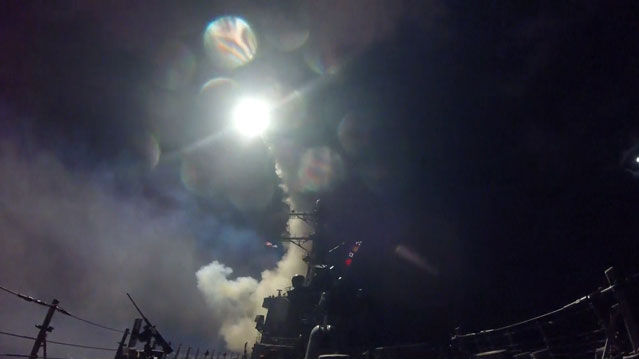
With the launching of 59 Tomahawk cruise missiles from two U.S. Navy warships aimed at a Syrian airbase last week, the Trump administration took an enormous step in reversing the policies of appeasement and accommodation that marked the Obama administration’s approach to Middle East conflicts.

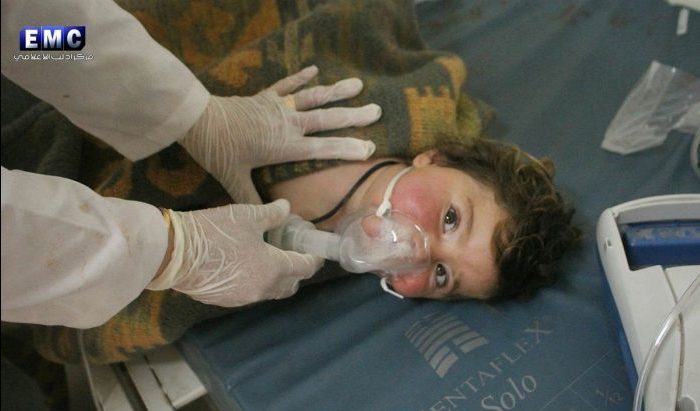
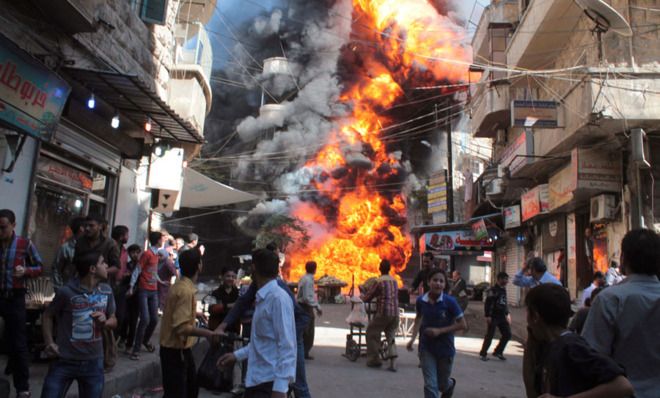
The airstrike was done in response to a chemical weapons attack in which at least 87 people were killed – including women and children – in the assault on the Syrian town of Khan Shaykhun last Tuesday. Medical personnel on the ground indicated the chemical agent was sarin, a nerve agent so deadly that mere drops inhaled or absorbed on skin kill within minutes.

U.S. military personnel allegedly tracked the aircraft launched from the airbase in question and took a flight path to the town, dropping its ordinance and returning.

The chemical attack was not the only one the Assad regime has been accused of conducting since a much-publicized deal that Russia brokered to remove Syria’s chemical weapons stockpile. These recent attacks demonstrate clearly that the Assad regime retains its chemical weapons and is unafraid of using them.

These incidents demonstrate clearly the utter failure of the Obama administration’s past policies that sought to broker agreements with regimes that have no intention of abiding by them; be it Syria with chemical weapons or Iran with its nuclear program.

As the New York Post editorial board pointed out in a scathing piece pointing out that administration’s failures and more importantly what it means for the nuclear agreement with the Iranian regime.

Last week’s horrific attack in Syria disproved the Obama administration’s boast of stripping Bashar al-Assad of “100 percent” of his chemical weapons. And that has big implications for the nuclear deal with Iran. After all, the nuke deal relies on the same kind of verification and accountability system entailed in the agreement with Assad, the Post said.

“We will, for the first time, be in a position to verify all of [Iran’s] commitments,” President Barack Obama said at the time, insisting the deal had at least temporarily halted Tehran’s pursuit of nuclear weapons.

Critics insist it did no such thing. Just as many refused to believe Team Obama’s claim that it had fully rid Syria of its weapons of mass destruction. The Syria accord allowed Obama to save face for failing to enforce his “red line” against Assad’s use of chems after the dictator got caught using sarin nerve gas to kill up to 1,500 Syrian civilians, the Post added.

“We are getting chemical weapons out of Syria without initiating a strike,” said Obama. And Secretary of State John Kerry: “We got 100 percent of the chemical weapons out.”

Just this past January, former National Security Adviser Susan Rice insisted, “We were able to get the Syrian government to voluntarily and verifiably give up its chemical weapons stockpile” in a way “that the use of force would never have accomplished.”

The Post summed up by saying “Just how wrong they all were has now become dead obvious. So why should anyone still believe the same team’s assurances on Iran’s ability to produce nukes?”

While the strike by the Trump administration didn’t do much tactical damage to the airbase since American officials warned the Russians of the pending attack, who then promptly tipped off their Syrian allies who quickly moved most of their assets out of harm’s way, the attack was a major strategic masterstroke by President Trump.

The attack was the first by the U.S. against Syrian regime assets and crosses the “red line” that President Obama had previously laid down the first time the Assad regime used chemical weapons, only to infamously balk at crossing its own line.

The airfield bombed is significant, because it is also used by members of Islamic Revolutionary Guard Corps (IRGC) and the Quds Force, according to a report from Asharq Al-Awsat Arabic language website. The field has been used for a long time by IRGC to operate not only in Syria but also in Iraq.

It also neatly puts the Iranian regime on notice that the conditions of the conflict have shifted dramatically. The U.S. was willing to take unilateral military action without U.N. approval or consultation with regional partners in response to a clear and present danger.

For Bashar al-Assad and Hassan Rouhani, the prospect of a surprising and swift U.S. response must have come as a shock.

Of course that did not stop Iran from doubling down on its bets on a murderous Assad regime.

Iranian regime rallied around the Syrian strongman and pledged to respond to US “aggression” after the Trump administration bombed a military airfield in retaliation for a poisonous gas attack.

Assad has drawn heavily on foreign Shi’ite militias sponsored by Iran, led by Lebanon’s Hezbollah group, for his most important gains since the Russian intervention.

In Iran, Supreme Leader Ayatollah Ali Khamenei said the U.S. missile strike was a “a strategic error, and a repeat of the mistakes of the past,” the state news agency IRNA reported.

“The Islamic Republic has shown that … it does not back off and its people and officials … do not retreat in the face of threats,” said Khamenei.

Many Syrians opposed to Assad’s rule consider Lebanon’s Hezbollah and Iranian-backed troops as occupiers seeking to drive out mainly Sunni Syrians from the areas they live in. They hold Iran and its allies responsible for the displacement of millions outside the country, according to Reuters.

Allies including the United Kingdom and Australia Friday, applauded Trump’s decision to launch the strike.

Michael Tomlinson

Filed Under: Blog, News Tagged With: Featured, Iran, Iran Mullahs, Iran Terrorism, IRGC, Khamenei, Syria

Iran Regime Stands by Assad in Chemical Attack

April 6, 2017 by admin

Iran Regime Stands by Assad in Chemical Attack

Iran Regime Stands by Assad in Chemical Attack

In the aftermath of the grisly chemical weapons attack on Syrian civilians that killed more than 100 men, women and children, the Iranian regime predictably stood by their man in Syrian president Bashar al-Assad, even as it publicly condemned the attack.

“Iran strongly condemns all use of chemical weapons regardless of who is responsible and who are the victims,” Foreign Ministry spokesman Bahram Ghassemi told reporters in Tehran, according to an account carried by the official Islamic Republic News Agency.

But Ghassemi cautioned against “rushed judgments and accusations that benefit … certain actors,” claiming that anti-Assad rebel groups — which Tehran calls “terrorists” — have also been known to have stored and used chemical weapons.

It’s a strange position to take since the only people attacked were in rebel-controlled areas. It is unlikely rebels would be dropping chemical agents on their own positions, but logic was never a strong suit of the Iranian regime.

Citing Assad’s frequent past use of chemical weapons, the Trump administration and governments across Europe have said Damascus was most likely behind the attack on the Syrian province of Idlib.

The reaction of Assad’s patron is not unexpected, but while media attention is focused on their denials, one important fact seems to be escaping most analysts’ attention which is the fact that Iran had previously committed to the removal of Syria’s chemical weapons earlier as part of an agreement to avoid President Obama’s infamous “red line” mandate.

The fact that chemical weapons were used, especially a more sophisticated compound in sarin gas, demonstrates the Iranian regime’s comfort level with its ally using these weapons.

On another account, Dr Joseph Kechichian, an author and writer, penned an editorial in Gulf News detailing how Iran actually continues to focus on interfering in the affairs of its neighbors.

“The intrepid Iranian spokesperson further rejected as groundless all of the claims made by several Arab leaders in their pronouncements that the Islamic Republic of Iran openly interfered in the internal affairs of Arab countries, saying that Tehran ‘never interfered in the internal affairs of any country and feels no need at all for such interference,’ which must also be challenged. He added his deep sorrow as several Arab and Muslim leaders, ‘either intentionally or by mistake… go astray and fail to distinguish friend from foe,’ allegedly because they point the finger at Iran instead of ‘dealing with the most important crises in the region,’” Kechnichian writes.

In fact, and lest the fearless Qassemi may have forgotten, it was Ali Akbar Velayati, a former Iranian minister of foreign affairs and an adviser on international affairs to Supreme Leader Ali Khamenei — as well as the president of the Expediency Council’s Centre for Strategic Research — who told a group of Yemeni clerics gathered in Tehran in October 2014 that “The Islamic Republic of Iran supports the rightful struggles of Ansar Allah [Al Houthis] and considers this movement as part of the successful materialisation of the Islamic Awakening [the name Iran uses for the Arab Uprisings] movements”.

Velayati boasted of Al Houthi victories in Yemen, which came to naught after the Kingdom of Saudi Arabia led a coalition to restore the legitimately elected president in Sana’a, even if the war is now in its third year. Velayati and his colleagues may be sure of an Al Houthi triumph in Yemen, though there is little to back that presumption, except that Tehran successfully managed to empower Al Houthis to play the same role that Hezbollah plays in Lebanon, he added.

Article in the Commentary Magazine added another perspective in the Iranian regime’s willingness to keep using Afghan refugees impressed into service as mercenary fighters for the regime’s campaigns.

“Increasingly, however, the Islamic Republic of Iran is replicating the former Soviet and Cuban strategies in Syria, where its intervention to support Bashar al-Assad has cost the Islamic Republic several thousand Iranian soldiers and cadets. The Iranian use of Hezbollah in Lebanon should have put permanently to rest any notion that Hezbollah has evolved into a Lebanese national organization. Rather, it remains what it always has been: A proxy for the Islamic Republic of Iran. But Hezbollah is not alone. A couple of years ago, I noted the increasing number of funerals of foreign nationals—especially Afghans—occurring in Iran whom Iranian news sources said had died fighting in Syria,” The Commentary Magazine writes.

The chemical attack in Syria is just symptomatic of the broader problem of the Iranian regime’s control of the battles being waged in Syria with the influence of the Revolutionary Guard Corps. Unless Iranian control is removed from the equation more Idlib attacks will happen.

Michael Tomlinson

Filed Under: Blog, News Tagged With: Chemical Attack, Iran Terrorism, IRGC, Khamenei, Syria

New Chemical Attack in Syria Shows Iran Complicity

April 4, 2017 by admin

New Chemical Attack in Syria Shows Iran Complicity

New Chemical Attack in Syria Shows Iran Complicity

If your neighbor is about to get arrested for being a pedophile and polluting the neighborhood by burning toxic waste in his backyard, it seems like a no-brainer to remove the offending person.

But what if their distant cousin from across town moves in to save them from being arrested and evicted by persuading authorities they will serve as a careful guardian and custodian? Now imagine the courts and law enforcement allow that creep to stay, but he just goes right on pillaging the neighborhood kids.

That pretty much sums up Bashar al-Assad in Syria and his Iranian benefactors.

But now the United States blamed the Syrian government and its patrons, Russia and Iran, on Tuesday for one of the deadliest chemical weapons attacks in years in Syria, one that killed dozens of people in Idlib Province, including children, and sickened scores more, according to the New York Times.

A senior State Department official said the attack appeared to be a war crime and called on Russia and Iran to restrain the government of President Bashar al-Assad of Syria from carrying out further chemical strikes.

Britain, France and Turkey joined Washington in condemning the attack, which they also attributed to Assad’s government. The United Nations Security Council was scheduled to be briefed on the attack on Wednesday.

On Tuesday, the White House called the attack a “reprehensible” act against innocent people “that cannot be ignored by the civilized world.”

The State Department official who briefed reporters on Tuesday, also said that it appeared Russia was unable or unwilling to hold the Syrian government to the agreed cease-fire.

He reiterated that the attack on civilians appeared to be a war crime. The official, who could not be identified under the State Department’s protocol for briefing reporters, also asserted that even before the alleged chemical strike, the Trump administration had shelved the idea of cooperating militarily with the Assad government against the Islamic State.

The Syrian Observatory for Human Rights, a U.K.-based monitoring group, said 58 people were killed in the town of Khan Sheikhoun in northern Idlib province, including 11 children. The  death toll is likely to rise, the group said.

Turkey said it dispatched 30 ambulances to Idlib following chlorine gas attacks in the northwestern province, the Turkish Anadolu news agency reported. Syrian opposition health minister Firas Jundi put the death toll at more than 100 civilians and said 500 others, mostly children, were sickened or burned by the gas.

“I believe this horrible memory will stay with me for the rest of my life,” Jundi told CNN.

The Syrian anti-government activist group Idlib Media Center published photos of young children receiving medical treatment, and a video showed what appeared to be bodies of children lined up on a blanket.

On Tuesday, Tillerson released a statement condemning the attack, one that took aim at Russia and Iran.

“There are reports of dozens dead, including many children.  While we continue to monitor the terrible situation, it is clear that this is how Bashar al-Assad operates: with brutal, unabashed barbarism,” the statement said. It also called on the countries to act. “As the self-proclaimed guarantors to the cease-fire negotiated in Astana, Russia and Iran also bear great moral responsibility for these deaths.”

French Foreign Minister Jean-Marc Ayrault called the attack “further evidence of the barbarity suffered by the Syrian people.” British Foreign Minister Boris Johnson said he was “horrified” by the attack that “bears all the hallmarks” of chemical weapons previously used by the Syrian regime. Turkish President Recep Tayyip Erdogan called the attack “inhuman” and “unacceptable.”

Maryam Rajavi, the leader of the National Council of Resistance of Iran, the largest Iranian resistance group, pointed blame at Iran’s Revolutionary Guard Corps for protecting and enabling the Assad regime with fighters, arms, cash and equipment.

“Persistence of the war crimes in Syria with the growing involvement of the Iranian Revolutionary Guards Corps and its affiliated militia clearly shows that as long as the Iranian regime is not evicted and its IRGC not expelled from Syria, and so long as their puppet government is in power in Damascus, peace, tranquility and even a ceasefire could not be upheld in that country and the region,” she said.

The attack appeared to be the largest and deadliest chemical attack in Syria since August 2013, when more than 1,000 people were killed in the Damascus suburbs by the banned toxin sarin. Under threat of United States retaliation, Assad agreed to a Russian-American deal to eliminate his country’s chemical weapons program, which until that time it had denied having, and to join an international treaty banning chemical weapons.

With this week’s attack, it clearly shows that guarantees on chemical weapons being banned in Syria are pretty much worthless.

Laura Carnahan

Filed Under: Blog, News Tagged With: Assad, Chemical Attack, Featured, Idlib, Iran Terrorism, IRGC, Khan Sheikhoun, Syria

Iran Regime Plays With Lives of Innocent Pawns

April 4, 2017 by admin

Iran Regime Plays With Lives of Innocent Pawns

Iran Regime Plays With Lives of Innocent Pawns

One of the hallmarks of the Iranian regime has been its callous disregard for the value of human life. It is a characteristic that pervades much of the regime’s activities from its foreign policy to judicial process to economy.

If one examines history, totalitarian and fascist governments have often worked diligently to reduce the value of an individual life in favor of the collective good as a means of exerting greater control over the people.

Iran is no different as the mullahs figured out that the pathway to ironclad control in the wake of the revolution was to ensure that dissenters could be arrested, beaten, imprisoned, exiled and even killed with virtual impunity.

That philosophy has been at the center ever since and to this day has manifested itself in policies that have caused pain and suffering across the entire Middle East.

In foreign policy, the Iranian regime has pursued conflicts that have resulted in some of the worst humanitarian disasters since the end of World War II, namely the Syrian civil war which has claimed 400,000 lives and displaced over four million people.

The mullahs’ decision to enter that war—after the Assad regime was found to be using chemical weapons on its own people—and save Assad sparked a sectarian conflict that now rages across Iraq, Yemen and has sparked now into the Gulf States.

The fact that Iranian regime is so willing to start conflicts, especially through the use of proxies such as terror groups like Hezbollah and the Houthis. Now come increasingly more worrisome reports over evidence that the Iranian regime may be behind terror activities in Bahrain including the operation of a secret bomb factory.

According to the Washington Post, the men who built the secret bomb factory had been clever — suspiciously so, Bahraini investigators thought, for a gang known mostly for lobbing Molotov cocktails at police. The underground complex had been hewed, foot by foot, beneath the floor of a suburban villa, with no visible traces at street level and only a single entrance, hidden behind a kitchen cabinet.

But the real surprises lay inside. In one room, police found $20,000 lathes and hydraulic presses for making armor-piercing projectiles capable of slicing through a tank. Another held box upon box of the military explosive C-4, all of foreign origin, in quantities that could sink a battleship the Post said.

“Most of these items have never been seen in Bahrain,” the country’s investigators said in a confidential technical assessment provided to U.S. and European officials this past fall that offered new detail on the arsenals seized in the villa and in similar raids that have occurred sporadically over nearly three years. In sheer firepower, the report said, the caches were both a “game-changer” and — matched against lightly armed police — “overkill.”

The report, a copy of which was shown to The Washington Post, partly explains the growing unease among some Western intelligence officials over tiny Bahrain, a stalwart U.S. ally in the Persian Gulf and home to the Navy’s Fifth Fleet. Six years after the start of a peaceful Shiite protest movement against the country’s Sunni-led government, U.S. and European analysts now see an increasingly grave threat emerging on the margins of the uprising: heavily armed militant cells supplied and funded, officials say, by Iran.

That disturbing revelation shows that the mullahs’ decision to widen conflict in the region and continue pursuing their vision of a greater sphere of Shia influence; contrary to all the protestations and messaging of the Iran lobby, is a core cause of most of the turmoil in the Middle East.

Even the practice of snatching hostages has become a standard practice for the mullahs from the very beginning of the revolution with the American embassy takeover to the recent practice of arresting and imprisoning dual-national citizens based on the despicable principle that Iran does not recognize dual citizenship.

For the mullahs, the value of hostages has been unfortunately proven true by the rash and unwise decision by the Obama administration to effectively ransom American hostages as part of the nuclear agreement negotiations. That only emboldened the mullahs to continue the practice.

Several of their current prisoners include a British mother and charity aid worker, a missing American former FBI agent, two businessmen and an American college student who was recently released on bail.

The American of Iranian descent was arrested in Iran in July and sentenced to 18 years’ imprisonment on dubious charges has been released on bail after he went on a hunger strike, rights activists reported on Monday, according to the New York Times.

The American, Robin Shahini was released about two weeks ago, just before the start of Nowruz, the Persian New Year, according to news by rights groups.

It was unclear whether Shahini’s release was temporary or if he could leave the country, Shahini had been required to post bail of 2 billion rials — about $60,000 — and that he could be sent back to prison if his conviction were affirmed on appeal.

Shahini, a graduate student at San Diego State University, is one of at least four Americans of Iranian descent who have been imprisoned in Iran since the country negotiated a nuclear agreement with major powers including the United States in 2015.

Many rights activists regard the imprisonments as a warning to Americans of Iranian descent not to view the nuclear agreement as a sign of better relations between the United States and Iran.


Other Americans held in Iran include Siamak and Baquer Namazi, a father and son who were sentenced in October to 10 years’ imprisonment, as well as Karan Vafadari, an art gallery owner, and his wife, Afarin Niasari, an Iranian with permanent United States residency status. The precise nature of the charges against them are unclear.

Iranian regime considers imprisoned Iranian-Americans to be citizens of Iran and does not afford them consular privileges ordinarily granted to foreign citizens.

For the mullahs, granting any individual basic human rights seems to be out of their plans.

Michael Tomlinson

Filed Under: Blog, News Tagged With: Bahrain, Featured, Iran Terrorism, IRGC, Moderate Mullahs, Rouhani, Sanctions, Syria

Bipartisan Consensus Forming on Dealing with Iran Regime

March 30, 2017 by admin

Bipartisan Consensus Forming on Dealing with Iran Regime

Bipartisan Consensus Forming on Dealing with Iran Regime

In today’s turbulent political environment there is not much anyone agrees on, except that maybe the New England Patriot comeback in the Super Bowl was astounding or that the Chicago Cubs win of the World Series was historic.

Other than that, most politicians can’t even seem to agree on the weather and what causes a shift in temperature day to day.

On one topic though there seems to be a growing bipartisan consensus, not just in the U.S. but around the world and that is more needs to be done to rein in the intransigence of the Iranian regime and the threat posed by its burgeoning military and ballistic missile program.

Monday’s Senate Foreign Relations Committee hearing on Iran was an example of a political environment with a rare and welcomed unanimity. Ranking member Sen. Benjamin L. Cardin (D-Md.) remarked that although he voted against the Joint Comprehensive Plan of Action on Iran, he doesn’t think it would be wise to withdraw, saying:

“Iran’s activities today are as bad as they have ever been and probably worse. They are certainly increasing their terrorist sponsorship in the Middle East as we see in so many different countries in that region. Their record on violating the ballistic missile obligations are well known and well understood. Their human rights violations against their own citizens are horrible, one of the worst countries in the world. They violate the arms embargo and the list goes on and on. So, it is appropriate to get this Committee to look at what we can do to make sure that first, the Iran nuclear agreement is honored so that Iran does not become a nuclear weapons state, but then secondly, look at those activities that were not covered under the JCPOA as to how we can play a stronger role.”

He was joined by his Republican colleague, Sen. Bob Corker (R-Tenn.), chairman of the committee who said:

“One of my criticisms of the JCPOA was that it would become our de facto Middle East policy and Iran would expand their destabilizing activities. I think we are seeing a lot of that today. Regionally, we’ve seen an escalation in Iranian intervention. Iran, along with its allies in Russia, has continued to prop up Assad at the cost of countless lives in Syria. Iran’s support to the Shia militias in Iraq threatens the interests of Sunnis and Kurds alike, not to mention the Shia in Iraq that don’t subscribe to the anti-American, zero-sum politics of the militias that are there.”

Jennifer Rubin in the Washington Post’s Right Turn blog opined that “given this shared assessment of Iran — the JCPOA is not going away but the United States needs to confront Iran in other arenas — it’s not surprising that a bipartisan bill, the Countering Iran’s Destabilizing Activities Act of 2017, with seven co-sponsors from each party, was introduced last week.”

“The act establishes new sanctions targeting Iran’s testing of ballistic missiles and its backing for terrorism, and also seeks to block the property of any entity involved in the sale of arms to or from Iran. It does not reintroduce sanctions lifted from Iran as part of the 2015 nuclear deal.”) In a summary released last week, senators described potentially far-reaching measures including mandatory sanctions on those involved with Iran’s ballistic missile program, new sanctions against the Islamic Revolutionary Guard Corps and a requirement for the president “to block the property of any person or entity involved in specific activities related to the supply, sale, or transfer of prohibited arms and related material to or from Iran,” Rubin added.

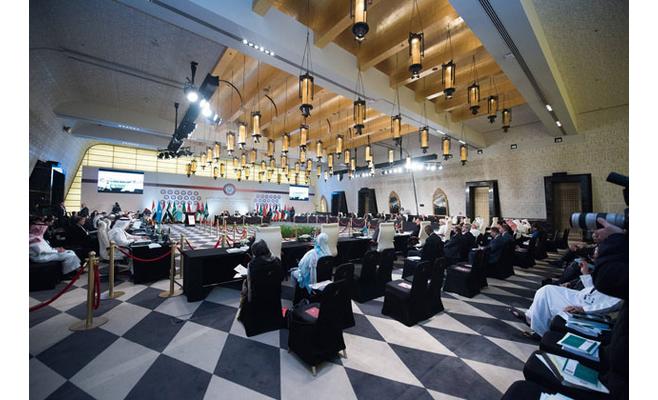
But it wasn’t just on Capitol Hill where there was unanimous consent as all 15 resolutions passed by the Arab summit which took place in Jordan Wednesday were devoted to an indictment of Iran, its Revolutionary Guards Corps and Lebanese surrogate, Hezbollah. They were a testament to the depth of Arab-Iranian animosity and exposed the extent of the rift between the Sunni and Shiite Muslim worlds.

Iran was accused of meddling in the internal affairs of Arab nations, inciting Shiites against Sunnis, and arming and training Shiite terrorist groups for operations against legitimate Arab governments. The Arab rulers combined to put Tehran in the dock for its interference in the Syrian civil war and assault on its sovereignty.

It was notable that at an Arab summit that has in the past concerned itself with issues related to Israel and the plight of the Palestinian people, the entire focus of the summit was on the Iranian regime; demonstrating how important the issue of confronting Tehran has become to the wider Arab world.

In the annual AIPAC conference a clearer united vision of the importance to oppose the Iranian regime was surfaced. American authorities and law makers used the opportunity to show their unanimous visions on the threat they feel from the Iranian regime and the need to take action to contain the growing destabilizing activities of the mullahs in the region.

The speaker of the US House of Representatives, Paul Ryan, called to designate the Revolutionary Guards as a terrorist group, describing it as a “terrorist army.” He said “Iran supports the terrorist dictator of Damascus and the militias in Yemen, Baghdad and Beirut.”

Furthermore, Nikki Hailey, the US ambassador to the United Nations asserted at the conference that “Iran’s nuclear deal is worrisome because it empowered Russian and Iran and encouraged the latter to act freely without fear of accountability.”

Mitch McConnell, the Republican majority leader in the Senate added: “Today we must adopt a different approach. We must combat Iran’s ability to finance, arm and train terrorists, such as Hezbollah, Hamas and its proxies in Syria.”

McConnell criticized Iranian regime’s nuclear deal, saying that it disabled the United States from taking more aggressive steps against Iran.

Meanwhile the Iran lobby was once again beating the war drum in an editorial in Huffington Post by Jamal Abdi of NIAC Action and Adam Weinstein of the National Iranian American Council, in which they claimed that this bipartisan consensus would only provide incentives for the U.S. to be plunged into a war with Iran at the behest of President Trump.

They go on to argue that if the proposed sanctions bill passes, Tehran would respond negatively and all the positive gains made by the nuclear deal would evaporate. What positive gains?

Since the deal was agreed to, the Iranian regime has broken every promise of moderation, stability, peace and partnership made by the NIAC and other Iran lobby supporters.

The harsh proof of Iranian regime’s track record over the past years has been so convincing that a bipartisan consensus is seen among both houses of congress to try to oppose the mullahs in Tehran.

All we can say is that it’s about time.

Michael Tomlinson

Filed Under: Blog, News Tagged With: #NuclearDeal, Adam Weinstein, Featured, Iran deal, Iran Lobby, Iran Mullahs, Iran sanctions, Iran Terrorism, IRGC, Jamal Abdi, National Iranian American Council, NIAC, NIAC Action, Syria, Yemen

Hypocrisy of Iran Lobby Extends to Criticizing Trump Speech to Congress

March 1, 2017 by admin

Hypocrisy of Iran Lobby Extends to Criticizing Trump Speech to Congress

Hypocrisy of Iran Lobby Extends to Criticizing Trump Speech to Congress

There is no doubt that President Donald Trump is a polarizing figure and has become a lightning rod for criticism for everything ranging from his affinity for tweeting to his policies such as his roll back of regulations and imposition of a temporary moratorium on visas from several countries in the Middle East.

The jury is still out on much of his agenda since he has yet to collaborate with Congress to bring forth specific legislative proposals, but that has not stopped the torrent of criticism being directed at him by the Iran lobby as it works to oppose anything that might be perceived as upsetting the goals and plans of the mullahs in Tehran.

This was true when Iran lobby advocates such as the National Iranian American Council’s Trita Parsi blasted Trump’s decision to impose fresh sanctions on members of the regime’s Revolutionary Guard Corps for its support for ballistic missile launches that violated United Nations sanctions.

It has also been true of the Iran lobby’s efforts to deflect attention away from the Iran regime’s litany of problems at home with increasing mass demonstration and protests to issues abroad as it encounters growing calls for resistance amongst its Sunni neighbors such as Saudi Arabia and the Gulf States; alarmed at the turmoil surrounding them caused by the Iranian regime.

The Iran lobby has been particularly focused on the debate over Trump’s immigration policies leveraging it to its advantage to raise funds and maintain its ties to progressive Democratic groups that it previously aligned with in the efforts to support the Iran nuclear deal.

The reasons for these efforts are simple: In a post-Obama world, the Iran lobby is desperately trying to stay relevant.

Since the electoral sweep that not only saw Trump elected, but also radically changed the complexion of the Congress, the Iran lobby has been on the defensive ever since. It has found little support within the much-vaunted “echo chamber” of support previously cobbled together to help push for negotiations with the regime.

Iranian regime’s ever growing militant actions in launching ballistic missiles, supplying proxy wars in Yemen and Syria and flexing its military muscle in expansive war games have proven to be almost impossible for the Iran lobby to defend.

Predictably, after President Trump’s first address to a joint session of Congress, the NIAC’s Jamal Abdi sent out a statement criticizing the speech, but in his criticism he revealed the bias and hypocrisy of the NIAC and the Iran lobby.

Abdi makes the claim that “no Iranian has ever been implicated in a terrorism-related death inside America,” which is a convenient distinction since it ignores the fact that the Iranian regime has been directly responsible for the deaths of hundreds of Americans in terrorist attacks in Beirut, Lebanon, the Khobar Towers in Saudi Arabia and in IED attacks throughout the Iraqi war.

In each case, Iranian regime controlled, supplied, participated or directed the attacks directly resulting in the deaths of Americans. In fact, several court decisions have held the Iranian regime responsible for these deaths and injuries and confiscated financial assets of the regime as part of court settlements to the victims and their families.

Abdi also fails to mention the violence fueled by the Iranian regime’s efforts to export its brand of extremist Islamic vision that has sparked sectarian violence between Sunnis and Shiites all across the Middle East, including the Syrian civil war, the Houthi coup attempt in Yemen and the expansion of ISIS arising out of the dissolution of the coalition government in Iraq.

All of these debacles were fueled by the Iranian regime and have cost the lives of hundreds of thousands of men, women and children and Abdi and his colleagues have remained stonily silent.

But the hypocrisy of criticizing Trump’s policies while ignoring the much harsher realities of the regime’s policies echoes the same treatment given by regime foreign minister Mohammad Javad Zarif who lauded the protest by Iranian filmmaker Asghar Farhadi who won the Oscar for best foreign film against Trump’s immigration policies, yet at the same time did not acknowledge the regime’s imprisonment and torture of several prominent Iranian filmmakers for engaging in acts against the Islamic state.

The rank hypocrisy of the Iranian regime and Iran lobby was taken to task by prominent journalists such as CNN anchor Jake Tapper and Human Rights Watch.

“Farhadi’s movie deserves the praise it has received – and much more. Iranian cinema has a long-established and well-earned reputation for providing a powerful, nuanced perspective into Iranian society,” said Sarah Leah Whitson, executive director for Human Rights Watch’s Middle East and North Africa Division in an editorial. “Yet while Iranian officials bask in pride on the international stage, their rhetorical support does not translate into respect for filmmakers at home, where they have harassed and jailed movie directors and other artists for work they find displeasing.”

“In the aftermath of the 2009 presidential elections, authorities arrested Jafar Panahi, a prominent director, for allegedly attempting to make a movie about protests that followed the vote. In December 2010, Tehran’s revolutionary court sentenced Panahi to six years in prison and a 20-year ban on all his artistic activities. Following international outcry, the government did not execute Panahi’s sentence but kept the ban in place, forcing him to make movies without an official permit,” Whitson added.

“These filmmakers could serve as powerful messengers for the diversity and talent in Iran today. But until the authorities stop censoring and imprisoning them, they put into question the Iranian government’s expressed commitment to supporting the country’s millennia of “culture & civilization,” she warned.

Michael Tomlinson


Filed Under: Blog, News Tagged With: Iran Mullahs, Iran Terrorism, IRGC, Jamal Abdi, National Iranian American Council, NIAC, NIAC Action, Nuclear Deal, Syria, Trita Parsi, Yemen

Only Language Iran Regime Understands is Bullying

February 23, 2017 by admin

Only Language Iran Regime Understands is Bullying

Only Language Iran Regime Understands is Bullying

In some ways, the Trump administration may be as vexing to the mullahs in Tehran as the first British explorers glimpsing hieroglyphics in an Egyptian pyramid before discovering the Rosetta Stone.

In that regard, the mullahs are grappling with the same problem mystifying many journalists and members of both parties as they deal with a president who is undoubtedly one of the most unfiltered politicians since Winston Churchill.

For the mullahs, they have become accustomed to a string of U.S. leaders that have tried to engage the regime in the predictable language of diplomacy and through existing international structures such as the United Nations. Sometimes it has not worked to their advantage such as when Presidents Bill Clinton and George W. Bush imposed sanctions on the regime.

Other times it has as President Barack Obama sought to try and appease the mullahs in an effort to secure a nuclear agreement.

What has been clear from the start is that since the days of the Islamic revolution in 1979, the ruling clerics have operated by using a language of threats, coercion, bullying and invective and it has not changed since then.

For the Iranian regime, using bullying to make a splash in international media is akin to North Korea launching a missile or setting off a nuclear bomb test.

The latest example was at the conclusion of a new round of war games put on by the Revolutionary Guard Corps in which an IRGC commander said the U.S. should expect a “strong slap in the face” if it underestimated the regime’s military capabilities.

“The enemy should not be mistaken in its assessments, and it will receive a strong slap in the face if it does make such a mistake,” said General Mohammad Pakpour, head of the Guards’ ground forces, quoted by the Guards’ website Sepahnews.

On Wednesday, the Revolutionary Guards concluded three days of exercises with rockets, artillery, tanks and helicopters, weeks after Trump warned that he had put Tehran “on notice” over the missile launch.

“The message of these exercises … for world arrogance is not to do anything stupid,” said Pakpour, quoted by the semi-official news agency Tasnim.

“Everyone could see today what power we have on the ground.” The Guards said they test-fired “advanced rockets” and used drones in the three-day exercises which were held in central and eastern Iran, according to Reuters.

But the Iranian regime didn’t just take verbal potshots at the U.S., it also has been ratcheting tensions with its neighbor Turkey as it takes on a more important relationship with Russia and secured a seat at the table of Syrian peace talks; clearly a move that the mullahs seem to be threatened by.

“Iran is an important neighbor to us. We have always been in dialogue with Iran. But it does not mean we will ignore Iran’s efforts in penetrating the region,” said Turkish presidential spokesman Ibrahim Kalin in the latest thinly veiled threat between the countries during his weekly news conference.

Kalin was responding to comments by Ali Akbar Velayati, a key adviser to Iranian Supreme Leader Ayatollah Ali Khamenei, who told Turkish soldiers to leave Iraq and Syria, or the people would “kick them out.”

“They are very serious, I mean the competition between Iran and Turkey, everyone knows it, it’s like two elephants in a small room,” warns political consultant Atilla Yesilada of Global Source Partners. “Iran is clearly an expansionist country, their goal of building a Shia circle all the way from Tehran to Lebanon is no secret, at least from the Turkish perspective.”

Experts say religious sectarianism underscores the tensions between predominantly Shia Iran and mostly Sunni Turkey, according to Voice of America News.

The escalation in tensions and verbal fisticuffs with Turkey is nothing new for the Iranian regime as it has already threatened its other Sunni-dominant neighbors in Saudi Arabia and Gulf States. Its supply of Houthi rebels in Yemen has sparked a civil war that threatens to plunge the Persian Gulf region deeper into a shooting war.

The Iranian regime’s willingness to use military force to back up its verbal threats has not been lost on its nervous neighbors and explains why there is movement for a regional coalition aligned against Iran’s expansionism.

Turkish president Recep Tayyip Erdogan has been turning to other Sunni countries in the region for support. This month, he visited Saudi Arabia and the Gulf States for talks observers say focused on curtailing Iran’s influence. Analysts suggest Ankara’s assertive stance could be influenced by U.S. President Donald Trump.

“With Trump, flexing his muscles against Tehran, Ankara may have sensed an opportunity to bring this antagonism into the open and to finally resolve this longstanding low level conflict in Syria and Iraq space,” suggests consultant Yesilada.

None of which has stopped the Iranian regime from pushing aggressively on all fronts including news reports that the regime has started up a series of cyberattacks against Saudi Arabia after a four year hiatus.

Late last month, the Saudi government warned in a notice to telecommunications companies that an Iranian-origin malicious software called Shamoon had resurfaced in cyberattacks against some 15 Saudi organizations, including government networks, according to the Washington Free Beacon.

The Shamoon malware was last detected in the 2012 cyberattack against the major Saudi state oil producer Aramco. That cyberattack damaged or destroyed some 30,000 computers and was considered one of the more destructive state-linked cyberattacks to date.

A State Department security report issued Feb. 10 stated that the 2012 attack destroyed over three-fourths of Aramco’s computers, and that the damage took five months to mitigate at “an extreme cost.”

Shamoon also was used in Iranian cyberattacks against RasGas, a liquified natural gas company located in neighboring Qatar.

A new version of the malware, Shamoon 2, was linked to the recent cyberattack, which took place in November. Security officials linked that attack to a Middle East hacker group known as Greenbug that used fraudulent emails in phishing scams to acquire login credentials for Saudi networks.

The Iranian regime is clearly speaking the same language it has always used and it’s time for the rest of the world respond in kind.

Michael Tomlinson

Filed Under: Blog, News Tagged With: Featured, Iran Mullahs, Iran sanctions, Iran Terrorism, IRGC, Sanctions, Syria

Case For Designating the IRGC as Terrorists Builds

February 15, 2017 by admin

Case For Designating the IRGC as Terrorists Builds

Case For Designating the IRGC as Terrorists Builds

Momentum continues to build for the U.S. to designate the Iranian Revolutionary Guard Corps a Foreign Terrorist Organization as a whole. Much of that momentum stems from the IRGC’s own actions over the years in supporting terrorism worldwide as well as initiating, supplying and controlling many of the proxy wars breaking out throughout the Middle East.

Even though there has already been well-documented disclosures about the IRGC’s illicit activities, new information continues to come to light as was the case on Tuesday when the National Council of Resistance of Iran (NCRI), a leading global organization of Iranian dissident and human rights groups, held a press conference in Washington, DC to disclose details of the IRGC’s terrorist training activities.

Alireza Jafarzadeh, deputy director of the Washington Office of the NCRI, presented information to reporters gathered by the social network of the People’s Mojahedin Organization of Iran, a dissident group located inside Iran. He said that information shows that since 2012, the NCRI has seen an increase in the training of foreign nationals in its terrorist training camps, which threatens a wide scope of countries, not just those beset by conventional warfare.

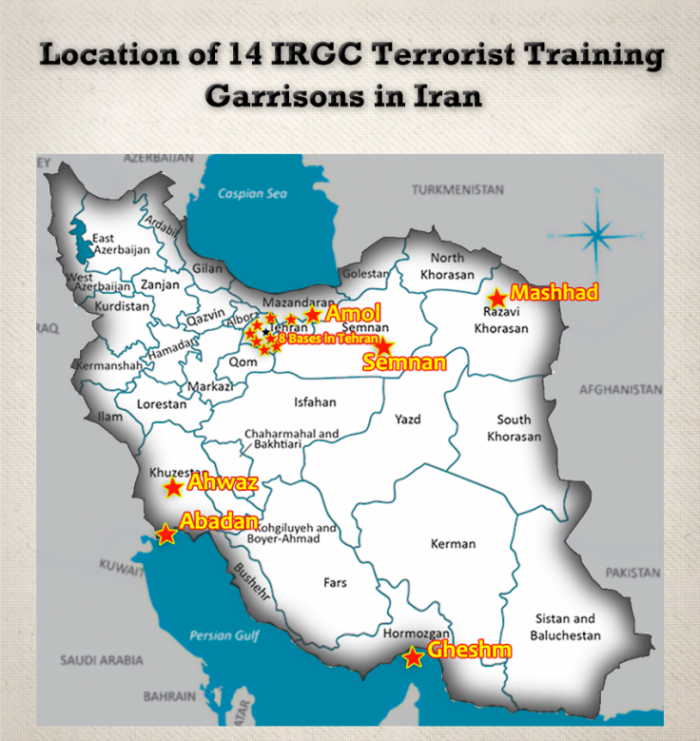
Using intelligence gleaned from sources within Iran, the NCRI claimed that the IRGC had created a training command operating dozens of military bases across Iran specializing in all aspects of warfare with units divided by national origin and specialization such as missile and naval operations to insurgency and urban warfare.

The IRGC that is answerable only to the Iranian regime’s top mullah, Ali Khamenei. It specializes in insurgency and guerilla tactics and is notorious for having supplied most of the IEDs used by Iranian-controlled Shiite militias in Iraq targeting U.S. and foreign troops; resulting in the deaths and wounding of thousands of Americans.

The IRGC was the initial unit that came to the rescue of the Assad regime in Syria as it teetered on the brink of collapse by smuggling in weapons and cash, as well as recruiting and directing Hezbollah fighters. It eventually expanded its role to include Iranian military, as well as the recruitment of Afghan mercenaries and deployment of Shiite militias from Iraq.

According to the NCRI, every month, hundreds of forces from Iraq, Syria, Yemen, Afghanistan and Lebanon — countries where the regime is involved in frontline combat — receive military training and are subsequently dispatched to the various frontlines. For operations in countries where there is no open warfare – including Persian Gulf countries, such as Bahrain and Kuwait – terrorists cells are trained instead.

The NCRI highlighted 14 IRGC training camps, as well as described the command structure, detailing how the commander of the Training Directorate, reports directly to Quds Force Commander, Qassem Soleimani.

Terrorist training for operatives from across the globe is commanded by Colonel Tahmasebi. Codenamed ‘320’, the commander of heavy weapons training at Imam Ali military base is Colonel Ali Mohammad. In charge of ‘VIP Security’ is Colonel Ramky, the NCRI said.

The sheer scale of the Training Directorate’s efficiency in producing fighters is underscored by the fact that just one of its training camps is currently sending 2,000 Afghans to Syria every week, according to the NCRI.

“The IRGC is actually the entity that runs the whole show when it comes to terrorism,” even though they are spearheaded by the Quds force, Jafarzadeh said. “You cannot do the separation. You cannot have the Quds force designated as a terrorist entity, but not the IRGC.”

Jafarzadeh said there is bipartisan support in Congress for the designation of the IRGC as a terrorist group, and suggested that with the new Trump administration, there is “a better possibility for those measures to move forward.”

The disclosures by the NCRI are significant since they provide first-hand and eyewitness accounts of the IRGC and Quds Force activities as it relates to the active support of terrorism and terror-related operations. It also points out with disturbing clarity the efforts by the Iranian regime to ramp up its military activities outside of its borders during the time it sought to portray itself as a “moderate” nation intent on resolving disputes peacefully.

Another example of those destabilizing activities has been the IRGC’s initiation of the revolt in Yemen with Houthi rebels supplied by IRGC forces; mostly smuggled aboard non-descript fishing boats in the Gulf of Aden.

Many of these ships have been intercepted and weapons confiscated by Saudi Arabian and Gulf State warships; the arms eventually traced back to Iranian factories.

Sanam Vakil, Ph.D an Associate Fellow at Catham House told IBTimes UK that the PMOI report spoke to the extent of the IRGC’s training scheme, although she could not independently verify the numbers.

“What I take from this is that this is a very sophisticated operation,” Vakil said. “Iran’s strategic strength is in a-symmetrical proxy relationships. Its conventional military is weak particularly in Iraqi and Syria they have had success in the past. Of course we also know they are the God Parents of Hezbollah.”

It is becoming increasingly clear that in order to effect the growth of Islamic-inspired terrorism abroad, the restraint of the IRGC will be a key factor. Designating it a FTO would be an important step in the right direction.

Michael Tomlinson

Filed Under: Blog, News Tagged With: Featured, Iran, Iran deal, Iran Human rights, Iran Mullahs, Iran Terrorism, IRGC, Khamenei, Syria, Yemen

Iran Regime Suffering Setbacks on Multiple Fronts

January 24, 2017 by admin

Iran Regime Suffering Setbacks on Multiple Fronts

Iran Regime Suffering Setbacks on Multiple Fronts

The start of the Trump administration is coinciding with a tougher time for the Iranian regime as it begins to suffer setbacks large and small, causing anxiety amongst the mullahs in Tehran as they try to figure out how to deal with President Trump.

Their initial comments to the new president were cautious and low key as Iranian regime Foreign Ministry spokesman Bahram Ghasemi told reporters on Monday that the Islamic state had no immediate pronouncement on Trump.

Ghasemi says that it’s “too soon to assess him and analyze his remarks, stance and the framework of his viewpoints.”

Ghasemi’s remarks mark the first official comment from Iran on Trump since his inauguration as the 45th American president.

That lack of response may be calculated to minimize the risk of antagonizing Trump or be placed in the infamous target of his tweeting habits which have laid low his political opponents, but for Iran the news to start the week only looked worse.

In the Syrian peace talks that began in Astana, Kazakhstan, Syrian rebel groups have rejected a plan that allows the Iranian regime to play a role in monitoring the ceasefire.

The proposal for a trilateral ceasefire commission, overseen jointly by the talks’ sponsors, is the most specific new measure set out in a draft communique the Russians hope to release on Tuesday, the second and closing day of the talks.

The Syrian fighting groups believe militia linked to Iran, such as Lebanon’s Hezbollah, are – along with Bashar al-Assad’s government – systematically breaching the ceasefire agreed on 29 December. The Syrian fighters believe Iranian regime, as perpetrators of innumerable ceasefire breaches, cannot credibly monitor or enforce a ceasefire, according to the Guardian.

As well as the ceasefire commission proposal, the leaked draft communique also broadly supports the existing UN talks process and calls for joint action to defeat Islamic State and other terrorist groups in Syria.

The fact that Syrian rebel groups actively engaged in fighting Syrian and Iranian regime military units have a seat at the table at last marks a significant step forward in diminishing Iranian influence in the long conflict.

The Syrian civil war erupted over opposition to harsh crackdowns by the Assad regime on the Syrian people and gaining momentum when Iranian regime opted to back Assad with Hezbollah fighters and cash to prop up the regime. The conflict escalated when the Iranian regime recruited Afghan mercenaries, Iraqi Shiite militias and eventually brought Russia into the civil war.

The prospect of peace talks moving forward that pushes the Iranian regime out of the way must be causing severe handwringing in Tehran, but more bad news came for Iran as Ukrainian authorities have confirmed that they seized a shipment of missile system components bound for Iran, according to official statements that could put the Islamic state in violation of international bans on such behavior.

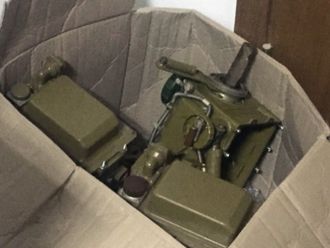
The State Border Guard Service of Ukraine, or DPSU, announced late last week that it had seized at least 17 boxes filled with missile components bound for Iran, according to IHS Jane’s.

“The DPSU said that, during an inspection of the aircraft on 19 January, its personnel had found 17 boxes with no accompanying documents, which the aircraft’s crew said contained an aircraft repair kit,” according to the report. “Three boxes contained components that were believed to be for a Fagot anti-tank guided missile system, the rest contained aircraft parts.”

Days after this finding, the DPSU said that it had confirmed the missile components were destined for Iran’s Fagot system.

Michael Rubin, a former Pentagon adviser and expert on rogue regimes, said that Iran has been illicitly moving such weapons for quite some time.

“This isn’t the first time Iran has gotten caught red handed smuggling weapons with false manifests, for example, in 2010 in Nigeria,” Rubin said. “The question is how often does Iran get away with such smuggling and for what purpose? After all, if the weaponry is legal, there’s no reason for lying. If it’s not, Iran is violating international agreements. Either way, only fools and secretaries of state would trust Iran to uphold its agreements.”

While many countries around the world listened with concern to Trump’s protectionist inaugural address, Gulf Arab officials appear optimistic. In Gulf Arab eyes, that involves above all checking what they see as a surge of Iranian support for paramilitary allies in Syria, Iraq, Yemen and Lebanon and for fellow Shi’ite Muslims in Bahrain and Saudi Arabia’s oil-producing Eastern Province.

There have been tensions over Syria, where Obama dismissed Gulf Arab urgings to give more aid to rebels fighting President Bashar al-Assad, who has survived thanks to Iranian backing.

“Perception is important: Trump does not look like the kind of guy who will bend towards Iran or anyone else,” said Abdulrahman al-Rashed, a veteran Saudi commentator.

“If he behaves as he says, then we will see another Ronald Reagan, someone all the forces in the region will take seriously. That’s what we have missed in the past eight years, unfortunately.”

We can only hope that the Gulf States are right about the new president.

Michael Tomlinson

Filed Under: Blog, News Tagged With: #NuclearDeal, Appeasement policy, Featured, Iran, Iran deal, Iran Terrorism, IRGC, Syria, Yemen

  • « Previous Page
  • 1
  • 2
  • 3
  • 4
  • 5
  • 6
  • Next Page »

National Iranian-American Council (NIAC)

  • Bogus Memberships
  • Survey
  • Lobbying
  • Iranians for International Cooperation
  • Defamation Lawsuit
  • People’s Mojahedin
  • Trita Parsi Biography
  • Parsi/Namazi Lobbying Plan
  • Parsi Links to Namazi & Iranian Regime
  • Namazi, NIAC Ringleader
  • Collaborating with Iran’s Ambassador

Recent Posts

  • NIAC Trying to Gain Influence On U.S. Congress
  • While Iran Lobby Plays Blame Game Iran Goes Nuclear
  • Iran Lobby Jumps on Detention of Iranian Newscaster
  • Bad News for Iran Swamps Iran Lobby
  • Iran Starts Off Year by Banning Instagram

© Copyright 2026 IranLobby.net · All Rights Reserved.