Iran Lobby

Exposing the Activities of the lobbies and appeasers of the Mullah's Dictatorship ruling Iran

  • Home
  • About
  • Current Trend
  • National Iranian-American Council(NIAC)
    • Bogus Memberships
    • Survey
    • Lobbying
    • Iranians for International Cooperation
    • Defamation Lawsuit
    • People’s Mojahedin
    • Trita Parsi Biography
    • Parsi/Namazi Lobbying Plan
    • Parsi Links to Namazi& Iranian Regime
    • Namazi, NIAC Ringleader
    • Collaborating with Iran’s Ambassador
  • The Appeasers
    • Gary Sick
    • Flynt Leverett & Hillary Mann Leverett
    • Baroness Nicholson
  • Blog
  • Links
  • Media Reports

Iran Regime Supporters Continue Defense of Controversies

August 28, 2016 by admin

Iran Regime Supporters Continue Defense of Controversies

Iran Regime Supporters Continue Defense of Controversies

Supporters of the Iranian regime have lately begun a full frontal assault against the tidal wave of criticisms and bad news afflicting the regime ranging from the disclosures of the $400 million ransom payment for American hostages to a just announced crackdown against social media users in Iran.

The embarrassing revelations about the Obama administration’s use of the $400 million as “leverage” over the Americans being held hostage was the key issue causing consternation among Iran lobby supporters.

The simple correlation of money for hostages resonated with Americans and forced many of the more prominent members of the Iran lobby to go into virtual hibernation on the issue. One of the defendants of the cash swap was a policy intern and student writing in Politico.

Michael Wackenreuter made the argument that American diplomacy is often rife with venturing into “gray areas” where leaders have had to compromise core principles. He harkens back to the Reagan administration’s upholding of an asset transfer to Iran the Carter administration negotiated. The difficulty with his position is that none of his examples are applicable to this situation.

The issue is one of perception and the perception involved here is not from the U.S. viewpoint, but rather those of the mullahs in Tehran because it what they believe that has the most impact and ramifications for the future. If they believe that holding hostages yields important benefits such as concessions or cash and there are no repercussions, then why not keep doing it?

It is this perception that now dominates as the Iranian regime once again goes on a hostage-taking binge including more Americans and yet again it finds there are no consequences for their actions.

That, more than anything else, is why the Iran lobby is fighting so hard against these negative stories because if Iran was indeed held accountable for its actions, then the narrative and even the regime itself would change dramatically.

That much was on display with Ali Gharib’s post in Lobelog.com, a well-known water carrier for the Iranian regime, in which he tries to dispute the Wall Street Journal story by Jay Solomon looking back at the year since the nuclear deal was reached and how ineffective it has been in curbing Iran’s more aggressive and militant intentions.

Chief among Gharib’s contentions is the alleged victory by “moderates” in parliamentary elections in Iran, but he himself neglects to mention the eradication of thousands of candidates from the ballot by the senior clerical leadership of the regime, including virtually every moderate or dissident candidate not already in prison or on their way to the gallows.

“Then there is the hope—again, not the prime aim—of the deal’s proponents that Iran’s foreign policy might become more moderate as well. As Solomon points out in his bill of particulars, that has not been the case: the Iranian government has used the financial benefits brought by the accord to beef up its military spending, and still involves itself in nefarious ways in the Middle East, continuing its support to unsavory groups like Lebanon’s Hezbollah and Yemen’s Houthis and, especially, its robust assistance to Syrian dictator Bashar al-Assad,” Gharib said, even admitting the how the Iran regime continues to wage war throughout the region.

Even with all these efforts to defend the regime, the criticisms against how the U.S. has appeased the mullahs has mounted as the evidence grows of the ramifications of such actions.

Aaron David Miller, vice president at the Woodrow Wilson Center for Scholars, took to the Wall Street Journal to explain how the dangerous the precedent is in bowing to Iran’s demands for the future.

“Here’s the larger and more potentially damaging perception beyond the general embarrassment: In the Middle East, strength and negotiating acumen are prized; they demonstrate power and credibility. And the region tends to consider actions and strategy in a time frame that stretches far beyond the four- and eight-year scale of U.S. politics. Meanwhile, the Obama administration’s handling of Iran in this situation plays into the narrative that the U.S. is weak and feckless and behaving as if it doesn’t know what it’s doing,” he writes.

“Some will see this as proof that the U.S. is unable or unwilling to contain Iran’s influence in the region, whether because the administration fears that pushing the Iranians too hard on Syria might jeopardize the international agreement over Tehran’s nuclear program–a seminal achievement for Mr. Obama–or because the U.S. is wary of deeper involvement in the region,” he adds.

All of which feeds into the narrative of a weakened U.S. foreign policy that lacks focus and commitment, as displayed when the ransom payment became the butt of a joke from a foreign leader.

President of the Philippines Rodrigo Duterte recently remarked that all it takes to extract money out of the U.S. is to insult the country and hope U.S. officials come running to make amends with funds.

“After Kerry visited the Philippines, he left us $33 million,” Duterte told an audience at Camp Lapu Lapu. “I told myself, ‘this seems cool. Let’s take a swipe at them again so they will make amends with money.’”

The perceived lack of repercussions in the face of growing Iranian human rights abuses has started a flurry of provocative actions, the latest of which was that the cyber-arm of Iran’s repressive Revolutionary Guard says it has summoned, detained and warned some 450 administrators of social media groups in recent weeks.

The announcement Tuesday, carried on a website affiliated with the Guard’s cyber arm, says those detained used social media like the messaging app Telegram, which is popular in Iran.

The announcement says those detained or summoned made posts that were considered immoral, were related to modeling, or which insulted religious beliefs. It says the Guard only took action after “judicial procedures” were completed, without elaborating.

The move augurs a new phase in a domestic crackdown in Iran, one that the Iran lobby will surely work to divert attention from.

By Laura Carnahan
Filed Under: News Tagged With: ALi Gharib, Featured, Iran deal, Iran Human rights, Iran Lobby, Lobelog, Sanctions

Week of Living Dangerously in Persian Gulf By Iran Regime

August 27, 2016 by admin

Week of Living Dangerously in Persian Gulf By Iran Regime

Week of Living Dangerously in Persian Gulf By Iran Regime

A lot can happen in one week. According to the Bible, God created the heavens and earth and all the creatures in just a week’s time. You can have half of an Olympic Games run in one week.

For the Iranian regime, one week is enough time to create an international crisis in the Persian Gulf and threaten to spark a shooting war with the U.S. Navy.

The week started out on Tuesday with the Iranian regime’s Revolutionary Guard Corps sending several ships to harass the U.S. Navy destroyer Nitze by closing at high rates of speed, then veering off and returning again.

The Arleigh Burke-class destroyer issued several warnings including radioed messages, fired flares and whistles at the regime ships which did not respond as it transited international waters; well away from Iranian waters. A Navy spokesman described the Iranian maneuvers as “unsafe and unprofessional.”

That incident was followed on Wednesday by another one in which three IRGC ships approached the U.S. coastal patrol ships Squall and Tempest at high speed in the northern Persian Gulf.

According to the Washington Post, “later in the day, an Iranian vessel came within 200 yards of the Tempest. After the Tempest shot flares and tried to communicate using the ship’s loudspeaker, Squall personnel fired three shots into the water from that ship’s .50-caliber gun. The Iranian ship then departed.”

That same Iranian ship later approached the USS Stout, a guided-missile destroyer, later Wednesday. “The [IRGC] vessel proceeded to cross the bow of the Stout at close range on three separate occasions,” said William Urban, a spokesman for the U.S. 5th Fleet.

Responding to a U.S. complaint, the Iranian regime rejected the American version of events. The defense minister, Brig. Gen. Hossein Dehghan, said in remarks quoted by the state news media that the Iranian boats patrolled only Iran’s territorial waters and had a mission to “counter any unintentional or aggressive intrusion.”

“If an American ship enters Iran’s maritime region, it will definitely get a warning. We will monitor them and, if they violate our waters, we will confront them,” Dehghan said in a statement reported by the Iranian Students’ News Agency.

It clearly shows the regime’s intentions of antagonizing the U.S. at a time when the Iran lobby had promised a new era of cooperation following the Iran nuclear deal.

Obama administration officials say Iran has abided by its commitments on the nuclear program, but there have been few signs of change in Iranian regime’s behavior in other arenas, including tensions in the Persian Gulf, clashes with U.S. allies in the region and the civil wars in Syria and Yemen.

Congressional Republicans and critical private analysts have been angry about this behavior since late last year, when the Islamic republic conducted two tests of nuclear-capable ballistic missiles in defiance of U.N. sanctions and then staged a live-fire exercise dangerously close to a U.S. warship in the Persian Gulf.

The situation worsened in January, when the Iranian regime detained 10 U.S. Navy sailors whose boats had drifted mistakenly into Iranian waters in the Gulf.

Although administration officials hoped the deal might lead to a less-confrontational posture from Iran, House Foreign Affairs Committee Chairman Edward R. Royce, California Republican, said Iran continues to pursue policies that are “destabilizing the region.”

“Iran is on a roll, and the perception is that the administration is getting rolled at this moment,” Mr. Royce said in January. “We need to see more backbone, not backing down.”

Revelations this month of how the Obama administration worked out a $1.7 billion settlement of a failed Iranian missile sale in January at virtually the same time as the release of five American prisoners held in Iran has only fueled criticism that the Obama administration is overlooking continued misbehavior by Tehran to preserve the nuclear deal.

Stephen Bryen, a senior fellow in defense studies at the American Foreign Policy Council, authored an editorial in U.S. News and World Report, in which he criticizes the administration’s oddly held belief that somehow the Iranian regime can still be a friend to the U.S.

“This view, strongly held by the White House, State Department, Pentagon and CIA, is a true fantasy. … Washington persists in fostering the illusion. There is no immediate cure for a political disease: We have yet to invent an anti-regime-biotic that, when injected into the insane, returns them to normalcy,” Bryen writes.

“As there is no solution, the Obama administration will explain the Persian Gulf incident as some sort of aberration or unauthorized action by the Iranian Revolutionary Guards, or a mistake, but not an act of overt hostility,” he adds.

More darkly, he raises the specter that the Iranian regime is merely testing a “swarming boat attack” tactic to learn how they might fling multiple small, fast attack boats at much larger U.S. warships.

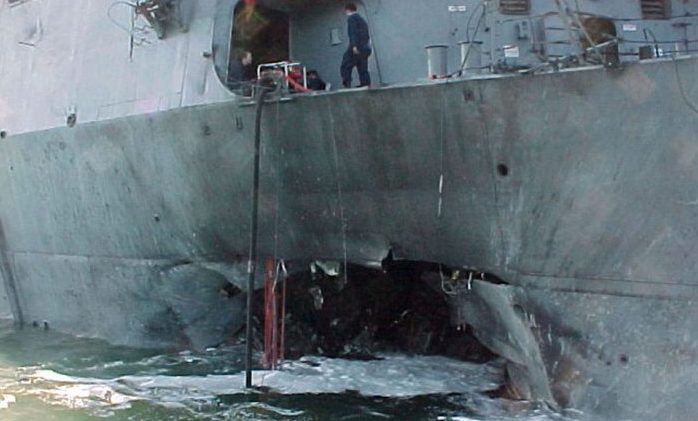
“Recently the Iranians added another dimension to the swarming boats: a vessel known as the Ya Mahdi, a remotely piloted fast patrol boat that can fire rockets or be stuffed with explosives. It is a new version of the boat that attacked the USS Cole in Aden in 2000 at a cost of 17 lives, 39 injuries and severe damage to the ship,” Bryen warns.

Criticism from the White House is sorely lacking as these provocations increase. One explanation may be the announcement that Ben Rhodes, the national security advisor who created the so-called “echo chamber” of support for the Iranian regime and nuclear deal, is now scheduled to keynote a conference sponsored by Iran lobby loyalist, the National Iranian American Council.

Outside organizations such as NIAC and the Ploughshares Fund, which is co-sponsoring the upcoming conference, were cited as key parts of the White House’s effort to mislead the public about the deal.

The NIAC event is being viewed as another sign that the White House is seeking to boost these organizations in return for their efforts to push the nuclear deal and support the pro-Iran “echo chamber.”

“Pro-Iran lobbies like NIAC were helpful to Ben Rhodes when he created his echo chamber to sell the Iran nuclear deal and the Iran money-for-hostages deal,” said one senior foreign policy consultant who has worked with Congress on the Iran deal. “It’s only fair that Rhodes would return the favor by keynoting NIAC’s conference. It’s not clear what he’ll talk about more: Iran developing its nuclear program, Iran expanding across the region, or Iran seizing more American hostages including those with close links to NIAC itself.”

The cozy relationship between Iran lobbyists and Obama administration may well explain why this past week it has been silent on the provocations, but it does not explain how to stop the regime.

BY Michael Tomlinson

Filed Under: Blog, News Tagged With: #NuclearDeal, Appeasement policy, Ben Rhodes, Featured, Iran deal, Iran Lobby, Iran Terrorism, IRGC, National Iranian American Council, NIAC Action

US Warns of Travel to Iran as Regime Shows off Military Might

August 24, 2016 by admin

US Warns of Travel to Iran as Regime Shows off Military Might

US Warns of Travel to Iran as Regime Shows off Military Might

In what is becoming annual rite of summer, the U.S. State Department on Monday issued a warning urging U.S. citizens to avoid traveling to Iran. This latest advisory, which emphasizes Iran’s desire to capture U.S. citizens, comes on the heels of a growing scandal over the Obama administration’s decision to pay Iran $400 million in cash on the same day that it freed several U.S. hostages, according to the Washington Free Beacon.

The new warning replaces an existing one the department issued on March 14, 2016 and reiterates and highlights the risk of arrest and detention of Americans, particularly dual national Iranian-Americans, which the Iranian regime does not recognize.

“Iranian authorities continue to unjustly detain and imprison U.S. citizens, particularly Iranian-Americans, including students, journalists, business travelers, and academics, on charges including espionage and posing a threat to national security,” the advisory said.

“Iranian authorities have also prevented the departure, in some cases for months, of a number of Iranian-American citizens who traveled to Iran for personal or professional reasons. U.S. citizens traveling to Iran should very carefully weigh the risks of travel and consider postponing their travel. U.S. citizens residing in Iran should closely follow media reports, monitor local conditions, and evaluate the risks of remaining in the country,” the advisory added.

The advisory goes on to warn of the threats posed to religious minorities and a wide range of other classifications of individual at risk of arrest, harassment and detention by regime authorities.

“The Iranian government continues to repress some minority religious and ethnic groups, including Christians, Baha’i, Arabs, Kurds, Azeris, and others.  Consequently, some areas within the country where these minorities reside, including the Baluchistan border area near Pakistan and Afghanistan, the Kurdish northwest of the country, and areas near the Iraqi border, remain unsafe.

“Iranian authorities have detained and harassed U.S. citizens, particularly those of Iranian origin. Former Muslims who have converted to other religions, religious activists, and persons who encourage Muslims to convert are subject to arrest and prosecution,” the advisory said.

Despite the warning, Iran remains a tourism destination for some with The New York Times offering two-week trips to Iran several times a year. It is noteworthy that the Times has long been an editorial supporter of accommodating the Iranian regime as part of the Obama administration’s echo chamber of support.

The warning flies in the face of the all of the claims made by the Iran lobby during the nuclear talks last year when prominent advocates for the regime such as Trita Parsi of the National Iranian American Council, bloggers Ali Gharib and Jim Lobe, all promised a more moderate and stabilizing Iranian regime.

Clearly the opposite has happened if the U.S. government has to update warnings about its citizens being kidnapped by the Iranian government and then warning that it can do little to help you out if you are taken hostage.

Top that level of aggressive militancy with new announcements by the Iranian regime of is newly grown military muscle which it puts on display with the glee of a child showing off a new bicycle.

The regime released images of its first domestically built long-range missile defense system on Sunday, a project started when the country was under international sanctions.

Images on multiple state news agencies showed President Hassan Rouhani and Minister of Defense Hossein Dehghan standing in front of the new Bavar 373 missile defense system, according to France 24 News.

The system was designed to intercept cruise missiles, drones, combat aircraft and ballistic missiles, according to earlier statements by Dehghan. He claimed that Iran’s missile range capabilities have been expanded by two to three times across its arsenal. The upgrades now give Iran’s current stock of cruise missiles the ability to hit targets 62 miles off its coast, easily putting ships traveling through the Persian Gulf’s Strait of Hormuz at risk.

Rouhani said in a televised speech on Sunday that Iran’s military budget had more than doubled compared with last year.

“If we are able to discuss with world powers around the negotiating table, it is because of our national strength” he said.

Rouhani also unveiled the first Iranian-made turbo-jet engine on Sunday, saying it was capable of flight at 50,000 feet.

“The Islamic republic is one of eight countries in the world who have mastered the technology to build these engines,” Rouhani said.

Dehghan added that Iran was now looking to develop seaborne cruise missiles capable of supersonic speed.

The new missile was developed as a response to the suspension of delivery of a Russian-made S-300 missile system because of earlier sanctions, but with those sanctions lifted because of the nuclear agreement, Russia completed delivery of the advanced weapons system this year.

Dehghan also boasted on regime television that the regime would also negotiate with Russia to acquire its sophisticated Sukhoi fighter and attack aircraft to bring its air force capability for long-range force projection and air combat against the more sophisticated air forces of regional rivals such as Saudi Arabia and the Gulf states.

Iran has also discussed with Russia the production licensing of the Russian T-90 tank inside Iran. The focus of the Iranian regime is on acquiring the capability and technology to produce the systems in-country rather than depending on the mood of the Kremlin to sell Iran weapons.

The world should be aware now that the Iranian regime’s intentions are anything but peaceful and moderate.

By Michael Tomlinson

Filed Under: Blog, News Tagged With: #NuclearDeal, Featured, hassan rouhani, Iran, Iran deal, Iran Human rights, Iran Terrorism, Khamenei, nuclear talks

A Year of Proof the Iran Nuclear Deal Failed

August 24, 2016 by admin

A Year of Proof the Iran Nuclear Deal Failed

A Year of Proof the Iran Nuclear Deal Failed

Jay Solomon of the Wall Street Journal wrote an engrossing look back at the Iran nuclear deal after one year and why the Iranian regime’s mullahs, especially its top leader, Ali Khamenei, believe they were the true winners following the deal.

The proof of that belief is in tallying the butcher’s bill of death, misery and military expenditure the regime has dispensed over the last 12 months.

It is a record that cannot be hidden by the Iran lobby. It cannot be explained away by the Obama administration’s “echo chamber” of regime supporters. It will not be ignored by news media intent on trying to resuscitate the quaint notion that somewhere within the Iranian regime is some cadre of “moderates.”

What Solomon notes, is that while the Iranian regime, especially Khamenei, has engaged in almost virulent anti-Western rhetoric since the deal was passed, he and his fellow mullahs are unlikely to willfully walk away from the nuclear deal since it was heavily weighted in the favor of their regime—not the Iranian people mind you, but to the mullahs and their military forces.

As Solomon writes, “for all his complaints about American treachery, Mr. Khamenei and his allies recognize that the nuclear deal has produced significant benefits for their hobbled theocracy.”

“Since the accord was announced last summer, Mr. Khamenei and his elite military unit, the Islamic Revolutionary Guard Corps, have moved to solidify their hold. As international sanctions against Iran have slackened, the ayatollah and his core allies have expanded the Iranian military and pursued new business opportunities for the companies and foundations that finance the regime’s key ideological cadres. Iran has continued to fund and arm its major regional allies, including the Assad regime in Syria, the Lebanese militia Hezbollah and Houthi rebels in Yemen—all of which are at war with America’s regional partners—and the regime has continued to test and develop ballistic missiles. The government has also stepped up arrests of opposition leaders and political activists,” he added.

What brought Khamenei and the mullahs to the bargaining table in the first place was the effect tough sanctions were having on the regime’s finances and their shaky hold over the Iranian people. Coupled with plunging oil prices, the squeeze on the mullahs was considerable.

The mandate Khamenei gave to Iranian negotiators was explicit: preserve the regime’s military and nuclear infrastructure, delink any changes to the regime’s human rights policies or domestic political agenda and ensure financial benefits flowed to refill their depleted coffers immediately.

The nuclear deal agreed to by the U.S. and the other P5+1 nation’s did all that and recouped nothing in terms of moving Iran closer towards a true democracy. As Solomon describes, if anything, the deal has helped control of the nation and its people firmly in the hands of the religious leadership and Revolutionary Guards.

The most overused rationale for the deal by the Obama administration and Iran lobby was that the agreement severely constrained the regime from a pathway to a nuclear weapon, but Khamenei himself espoused the greatest omission in the deal which is the exemption of Iran’s civilian nuclear program.

While the Iran lobby, especially the Ploughshares Fund and National Iranian American Council, have loudly boasted the deal brings Iran’s centrifuge capacity to 5,000 machines, Khamenei has openly called for a “civilian” centrifuge capacity of a whopping 100,000 machines.

“After a decade, the international community would go along with Mr. Khamenei’s vision of an Iran that could develop an industrial-scale, civilian nuclear program without checks on the number or capacity of the centrifuges spinning. The U.S. had won only a short-term pause in the expansion of the Iranian program, and the supreme leader had gained international approval for his longer-term plan,” Solomon writes.

“Indeed, in recent weeks, Iranian officials have talked of their preparations to build 10 new nuclear reactors with Russian help. This will require a steady supply of nuclear fuel from centrifuges that will be allowed to go online in a decade,” he adds.

That close cooperation with Russia has become a major foreign policy headache for U.S. as Russia has sold Iran billions in new sophisticated military hardware and intervened in the Syrian conflict at Iran’s urging and has now begun flying bombers from Iranian airfields.

Most importantly of all for the regime and its mullahs has been the lifting of sanctions to finally sell oil and gas products on the open market and the allowance for foreign investment back into Iran, especially its heavy industries such as agriculture, chemicals and manufacturing which had all but fallen apart.

That influx of investment, as well as the reportedly $400 million in cash the U.S. paid in exchange for the release of American hostages, has essentially saved the regime from collapse with its military commitments in three full-scale wars draining their treasury.

With the financial gain, the mullahs have moved aggressively to secure their prospects domestically with the rigging of parliamentary elections by the removal of almost two-thirds of candidates from the ballot, instituting a harsh crackdown on dissent including mass arrests of journalists, bloggers, dissidents and artists, mass execution of Sunni political prisoners, along with a steep increase in the arrest of dual national citizens that can be used for more ransom payments or hostage exchanges since it worked so well already.

Tied together with the advances made in driving anti-Assad rebels back in Syria, solidifying control over Iraq through Shiite militias now comprising the bulk of Iraqi military activity and now with the backing of the Houthis in Yemen, the Middle East can safely be called the most instable it’s been in the last four decades.

All of this poses a significant challenge for the next American president.

By Michael Tomlinson

Filed Under: Blog, News Tagged With: echo-chamber, Featured, Iran deal, Iran Human rights, Iran Lobby, Khamenei, Ploughshares

Parsi vs Daioleslam: Correcting the Record

August 24, 2016 by admin

Hassan Daioleslam (left) beat back and won $183,000 from Trita Parsi and NIAC

Hassan Daioleslam (left) beat back and won $183,000 from Trita Parsi and NIAC

Source: Middle East Forum

Al-Monitor’s congressional correspondent, Julian Pecquet, wrote an article in Al-Monitor about the divided Iranian community in the United States, showing the Mujahideen-e Khalq (MeK or NCRI) against the regime in Tehran on one side, and the National Iranian American Council (NIAC) with the regime.

In the course of the article, he paraphrases the head of NIAC, Trita Parsi:

Today’s critics, Parsi said, are the same Iran hawks – and their allies in the NCRI – who urged a tougher stance against Tehran at the time.

In particular, Parsi points to the fact that the legal defense of Seyyed Hassan Daioleslam, the man NIAC sued for defamation, was organized by Daniel Pipes, a hawkish critic of radical Islam. The firm chosen to represent Daioleslam? Legal giant Sidley Austin, which just so happens to have been the US lawyer for arch-Iran foe Israel since 1992. NIAC failed to prove Daioleslam was acting out of malice and lost the case, even though the veracity of his claims was not established.

This passage contains multiple errors that could have been avoided had Mr. Pecquet done what a journalist should do and check with both sides of a dispute (rather than just with NIAC). As he did not, I’ll help him by presenting a few facts:

1) I did not “organize” the defense of Daioleslam. This was done entirely independently by Brooke Goldstein, the head of the Legal Project (the Middle East Forum initiative protecting the free discussion of Islam and related topics) at the time. I only learned about Parsi vs Daioleslam and Sidley Austin’s willingness to defend Mr. Daioleslam after she had arranged it.

2) Parsi states that Sidley Austin “just so happens to have been the US lawyer” for Israel since 1992. I looked into this and I see no evidence that Sidley Austin represents the Government of Israel, let alone since 1992. I challenge him to document this. As a large international law firm, Sidley Austin has “represented numerous Israeli clients in connection with transactional activity, as well as litigation, throughout the U.S. since the late 1980s,” but that’s not what Parsi said.

3) In characterizing Sidley Austin, Parsi ignores two important facts: that Sidley Austin was the law firm where both Michelle and Barack Obama started their legal careers; and FEC records show the firm’s lawyers collectively to be one of the very largest donors to the Obama campaigns of both 2008 and 2012.

4) Once we’re talking about who hired whom, let’s note that NIAC hired the PR firm Brown Lloyd James to help its case against Daioleslam and BLJ just happened also to work on behalf of Middle East dictators like Bashar al-Assad of Syria and Muammar al-Qaddafi of Libya.

5) Yes, NIAC lost the case concerning Daioleslam’s malice, but that’s not the whole story. After dismissing the lawsuit against Daioleslam, the court issued a second ruling in which it sanctioned NIAC and Trita Parsi for discovery abuses (including false declarations to the court) and ordered them to pay $183,000 to Daioleslam for his legal expenses.

6) The veracity of Daioleslam’s claims were indeed “established,” as the court obliged NIAC to release internal documents revealing the organization’s extensive ties to Tehran, including a lobby effort coordinated with Iran’s ambassador to the United Nations and collaboration with two individuals named in a Congressional report as agents of Iranian intelligence.

Daniel Pipes (DanielPipes.org, @DanielPipes) is president of the Middle East Forum.

by Daniel Pipes • Aug 23, 2016
Cross-posted from Danielpipes.org

Filed Under: Media Reports, National Iranian-American Council Tagged With: Featured, Iran Lobby, National Iranian American Council, NIAC, NIAC Action, Trita Parsi

Iran Lobby Assurances Proven False Again

August 21, 2016 by admin

Iran Lobby Assurances Proven False Again

Iran Lobby Assurances Proven False Again

The “echo chamber” created by the Obama administration to help push through passage of the badly flawed Iran nuclear deal has beat the drum repeatedly in efforts to defend the deal in the face of growing and incontrovertible proof that all of the assumptions of the Iran lobby have been proven false.

The revelations of the falsehoods surrounding the Iran lobby’s participation in that now infamous echo chamber have almost become legendary:

  • Allen S. Weiner, a Stanford law professor and contributor to the Washington Post’s opinions section who co-authored a piece arguing in favor of the $400 million “ransom payment” failed to disclose he had long been on the payroll of the Ploughshares Fund, an organization recently exposed as a key cog in a White House-orchestrated campaign to build what it called a pro-Iran “echo chamber;”
  • Shortly after approval of the nuclear deal, in which the Iran lobby argued it would empower “moderate” forces within the regime, parliamentary elections were rigged to eliminate virtually all perceived moderates and usher in solid majorities loyal to the ruling mullahs; and
  • Promises by the Iran lobby, especially the National Iranian American Council, that the deal would help steer Iran as a player in the Middle East to stabilize regional conflicts was proven wrong when wars in Syria and Iraq widened, ISIS rose up and Iran launched a rebellion in Yemen by the Houthis.

In each case, the Iran lobby has sought to assure the world of the good intentions of the Iranian regime, only to have those assurances fall flat in the face of new regime transgressions, but for the Iran lobby the battle being waged by its members is the battle of public perception.

It serves the purposes of the mullahs to have the perception there is a chance for moderation, rather than actually delivering any.

Nothing illustrates that point more than the controversy over the $400 million cash payment made by the Obama administration in what appeared to be linkage for the release of several American hostages.

Even though the Iran lobby remained relatively silent on the issue, “echo chamber” participants such as Weiner made a strong case for denouncing any link of cash for hostages. Of course, the Iranian regime did nothing to steer speculation away from that scenario; with various regime officials all but boasting of how the Islamic state cowed the U.S. and forced it to pay it millions of dollars.

Even though the Obama administration at first vigorously denied any connection, the issue was never what the administration thought, but what the regime thought since if the mullahs indeed believed this was a straight cash for hostage swap, it would only serve to validate their belief that this was a sound policy to pursue in advancing the goals of the regime.

That much was true when the Obama administration finally admitted the other day that the $400 million ransom payment was held up until confirmation of the hostages’ release and flight back home, thereby validating the use of the money as leverage tied directly to the hostages’ plight.

For months the Obama administration had maintained that the payment was part of a settlement over an old dispute and did not amount to a “ransom” for the release of the Americans. Instead, administration officials said, it was the first installment of the $1.7 billion that the United States intends to pay Iran to reimburse it for military equipment it bought before the Iranian revolution that the United States never delivered.

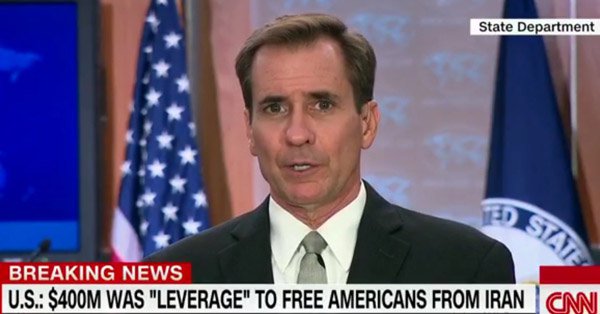
But at a briefing on Thursday, John Kirby, the State Department spokesman, said the United States “took advantage of the leverage” it felt it had that weekend in mid-January to obtain the release of the hostages and “to make sure they got out safely and efficiently.”

According to the New York Times, the acknowledgment by Kirby on Thursday touched off a torrent of criticism from Republicans.

“It was ransom,” said Representative Ed Royce of California, chairman of the House Foreign Affairs Committee. “We now know it was ransom. And on top of that it put more American lives at risk. And we’ve emboldened Iran. We’ve encouraged them, frankly, to take more hostages and put more American lives at risk of being taken hostage.”

Iranian regime press has described the payment as a ransom — which fits Tehran’s narrative that it has outmaneuvered the Obama administration.

Kirby conceded that while the deals were negotiated separately, the timing of the final transactions was linked. “As we said at the time, we deliberately leveraged that moment to finalize these outstanding issues nearly simultaneously,” he said.

The Wall Street Journal editorial board took a harsh tack with the ransom payment, saying the Obama Administration’s handling of the Iran ransom-for-hostages story brings to mind the classic Chico Marx line in the movie “Duck Soup”: “Who are you going to believe—me or your own eyes?”

“Mr. Obama, meanwhile, spent August denying that a ransom was a ransom. Since the January “leverage” moment, Iran has taken three more Americans as hostage and is now demanding the return of $2 billion in funds that U.S. courts have ordered held for the victims of Iranian-sponsored terrorism. The eyes of the world can simply stare,” the Journal added.

The campaign to pass this ill-fated nuclear deal has also been undergoing even more scrutiny with disclosures that Ploughshares Fund sought $750,000 from billionaire financier’s George Soro’s Open Society Foundation to pay off “experts and validators” to vouch for the nuclear agreement.

The disclosure of the Ploughshares request shines further light on backroom efforts by the White House and its top allies to create what they called an “echo chamber” to galvanize public support for the nuclear deal with Iran.

According to the Washington Free Beacon, one foreign policy consultant who has worked intimately with Congress on the Iran deal said that the Ploughshares funding request is further proof that the White House’s efforts were well funded and highly influential.

“You couldn’t turn around last summer without bumping into some Iran deal booster complaining about all the money that skeptics were spending,” the source said. “Now we find out that the architects of the Iran echo chamber were soliciting hundreds of thousands of dollars from dark money groups to pour into manipulating the media and pushing fabricated experts into the mainstream.

By Michael Tomlinson

Filed Under: Blog, News Tagged With: #NuclearDeal, Appeasement policy, Featured, Iran Lobby, National Iranian American Council, NIAC, Nuclear Deal, nuclear talks, Ploughshares

Iran Regime Goes For Broke to Save Assad in Syria

August 17, 2016 by admin

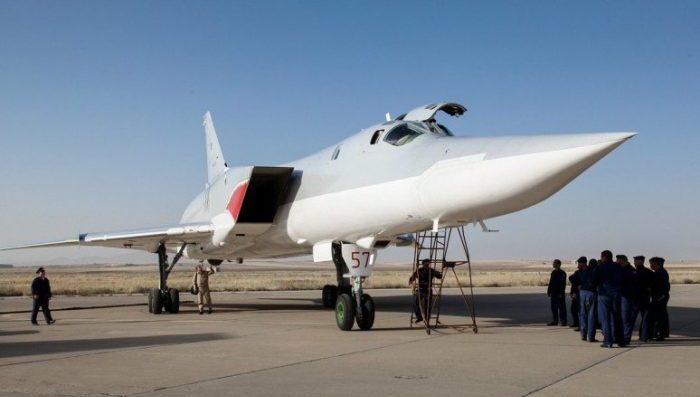
Russian bombersFor the first time in the five year long Syrian civil war, Russian bombers took off from Iranian airfields to carry out strikes in Syria against ISIS; opening up a new and potentially disturbing new dimension to the widening war.

While the Russian military alerted U.S. military commanders in advance—a welcome break from past episodes that almost resulting in strikes against U.S. personnel—the attacks can be debated as to whether or not ISIS was truly the target or moderate rebel forces opposed to Assad were targeted instead.

The complications arising out of Syria grow even more intertwined as the mullahs in Tehran ratchet up the stakes to keep Assad in power and maintain their own foothold on that important region of the Middle East.

That commitment of going all in to save the Assad regime as well as their Shiite sphere of influence was confirmed by U.S. military officials who now estimate as many as 100,000 Iranian-backed Shiite militia are fighting on the ground in Iraq, raising legitimate concerns that if ISIS is defeated in Iraq and Syria, the U.S. would now be stuck facing a hostile force in three unified countries.

Whether the force size is 80,000 or 100,000, the figures are the first-known estimates of the Iranian-backed fighters. The figure first surfaced in a recent Tampa Bay Times article and marks the latest evidence of Tehran’s deepening involvement in the war against ISIS. The growth also could create greater risk for Americans operating in the country, as at least one Iran-backed group vowed earlier this year to attack U.S. forces supporting the Iraqis.

Last August, Fox News first reported Qassem Soleimani, head of the regime’s Quds Forces, visited to Moscow 10 days after the landmark nuclear agreement in July to meet with Russian President Vladimir Putin and top Russian officials to plan Russia’s upcoming deployment to Syria in late September.

That was followed by a massive arms purchase of Russian weapons by Iranian mullahs, following the nuclear agreement and now comes the staging of air strikes from Iranian airfields.

The strikes in Syria and Iraq mirror and heightened intensity within Iran to suppress dissent as well as gather more pieces to be used on the hostage chessboard as the regime confirmed the arrest of yet another dual-national citizen, this one reportedly a British subject.

The person faces espionage charges after being taken into custody, prosecutor general Abbas Jafari Dowlatabadi told the official Islamic Republic News Agency. He didn’t disclose the person’s name or second nationality, or elaborate further on the case according to the Wall Street Journal.

At least six other Iranian dual nationals have been arrested this year, many of whom stand accused of spying or attempting to undermine the Iranian system. The pickup in arrests follows a rare prisoner swap agreed to in January under which Iran released four prominent American prisoners—including Washington Post reporter Jason Rezaian—and the U.S. freed seven Iranians, along with a widely ridiculed payment of $400 million in cash the regime has claimed as ransom.

Recent arrests in Iran include Nazanin Zaghari-Ratcliffe, a British-Iranian employee of the Thomson Reuters Foundation, the charitable arm of media giant Thomson Reuters, who was picked up in April and later accused of being a spy. Others include three Iranian-Americans and an Iranian-Canadian professor.

The latest American to be arrested, San Diego-resident Robin (Reza) Shahini was formally charged with “acting against national security,” “participating in protest gatherings in 2009,” “collaborating with Voice of America (VOA) television” and “insulting the sacred on Facebook,” but his lawyer has not been granted access to the evidence being used against Shahini, an informed source who requested anonymity told the media.

Interestingly, the Iran lobby has been particularly silent on the new wave of hostage taking, as well as the expansion of the Syrian and Iraqi conflicts and news came out today of how one of the ardent supporters of the regime’s receipt of the $400 million ransom payment was on the payroll of a prominent Iran lobby group without disclosing it.

A Washington Post writer who recently claimed that a $400 million cash payment to Iran was “American diplomacy at its finest” failed to disclose that he has been on the payroll of an organization that emerged as a chief architect of the White House’s self-described campaign to build a pro-Iran “echo chamber,” according to information obtained by the Washington Free Beacon.

Allen S. Weiner, a Stanford law professor and contributor to the Post’s opinions section, co-authored a piece arguing in favor of the Obama administration’s decision to pay Iran $400 million in hard currency in what many described as a “ransom payment” for the release of several U.S. hostages.

Weiner and the Post failed to disclose that the writer has long been on the payroll of the Ploughshares Fund, an organization recently exposed as a key cog in a White House-orchestrated campaign to build what it called a pro-Iran “echo chamber.”

Ploughshares provided millions of dollars to writers and experts who publicly pushed for last summer’s nuclear deal with Iran. Senior White House officials subsequently cited the group as its top pro-Iran ally.

The disclosure paints an even more disturbing picture of the efforts the Iran lobby and supporters of the regime will go to in order to paper over the bloody conflicts the Iranian regime is now waging around the world.

By Michael Tomlinson

Filed Under: Blog, News Tagged With: Featured, Iran, Iran deal, Iran Human rights, Iran Lobby, Moderate Mullahs, Qassem Soleimani, Syria

For Iran Regime Religion Defines Policies

August 16, 2016 by admin

For Iran Regime Religion Defines Policies

For Iran Regime Religion Defines Policies

From the beginning of the Islamic revolution, the mullahs and religious cleric followers of Ruhollah Khomeini secured for themselves a nation-state completely under their control. Over three decades before ISIS spawned its own dreams of an Islamic caliphate, the mullahs in Tehran had already achieved that goal.

As a religious state, the Iranian regime stands virtually alone in a secular world of nations governed by parliaments, democracies, constitutional monarchies and even communist or socialist regimes.

Aside from the Vatican city-state, Iran is unique among nations, which makes understanding its religious leaders vital in understanding its national goals and policies.

For the mullahs, there were only one goal they had: To preserve power under the banner of the Islamic revolution and expansion and exporting of that same revolution.

Iranian regime’s constitution is emblematic of those priorities; vesting all final authority with the supreme leader, especially critical areas such as foreign policy, the military and judiciary. The control of virtually all sectors of Iranian life places the Iranian people squarely under the thumb of the mullahs.

They subject the Iranian people to the harshness of the religious courts that control daily family life. They subject the Iranian people to legions of morality police that enforce moral codes for everything from women driving cars and their style of dress to the gathering of young men and women at cafes.

With each beating given out, with each Iranian thrown into prison, with each public execution, the mullahs attempt to enforce their control over the Iranian people and in doing so only sow the seeds of discontent deeper into the soil of Iranian society from which springs for dissent and discontent in ways large and small.

Opposition to the mullahs rule can come in the form of a selfie by a young Iranian woman posting without a hijab or another young Iranian woman holding up a sign courtside of a volleyball game at the Rio Olympics.

It can take the form in mass protests and street demonstrations or it can take the form of hooking up a simple satellite dish to watch banned newscasts from Europe or the U.S.

For the mullahs, each rising level of defiance has to be met with even more brutal suppression because allowing even a small crack or glimmer of hope to shine through would only undermine their rule and bring forward the prospect of regime change.

This explains why the mullahs are always seeking provocations to fight against or blame for their own inadequacies. It is also why they regularly snatch hostages and balance their fate against the needs of the religious regime.

The mullahs inability to improve the economy following the nuclear deal points to their own ineptness, as well as their priorities to shift billions in recovered funds, as well as a $400 million ransom payment for American hostages, to use not for the Iranian people, but to line their own pockets and continue to fund their terrorist proxies in wars in Syria, Iraq and Yemen.

Regime-controlled media, as well as the Iran lobby have been busy pushing the idea that the lack of progress in improving the Iranian economy is to be blamed on the U.S. failure to open up all financial channels for the mullahs’ use.

Mohammad Javad Larijani, the head of the regime’s judiciary council , was quoted citing perceived serious flaws in the nuclear agreement leaving Iran without benefits it was promised.

“The US has completely retained the structure of the sanctions, and is not intending to lift them in the near future,” he said.

The flawed documentation and ill-definition of commitments in the JCPOA and the subsequent UN Security Council Resolution 2231 enable Washington to make very little concessions to Iran, Larijani explained, adding that having control over how to interpret the deal has given US politicians the power to impose what they want.

That point of view by the regime was reinforced over and over by statements by top mullah Ali Khamenei who claims that the duty to lift all sanctions lies with the U.S. and failure to do so would end up negating the agreement.

It is conspicuous Khamenei makes these claims on the eve of the U.S. presidential elections in which the days of the current administration are numbered as is the continuation of the same policy of appeasement it has been following for the past two years.

What remains is a violent regime bent on preserving its religious control over the Iranian people and willing to commit any atrocity to achieve it and preserve its Islamic revolution.

If the world truly wants a free and democratic Iran, the first step will have to be the continued opposition to the rule of the mullahs and the empowerment of the Iranian people through the dissidents and oppressed fighting for their freedom.

By Michael Tomlinson

Filed Under: Blog, News Tagged With: Featured, Iran, Iran deal, Iran Human rights, Iran sanctions, Iran Terrorism, Khamenei

Abuses and Reach of Iranian Regime is Proof to Keep Sanctions

August 16, 2016 by admin

Abuses and Reach of Iranian Regime is Proof to Keep Sanctions

Abuses and Reach of Iranian Regime is Proof to Keep Sanctions

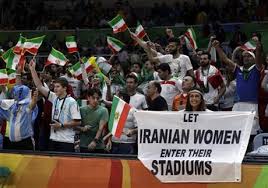
The sign read “Let Iranian women enter their stadiums.”

As protest signs go against the Iranian regime, this one was pretty tame, but the setting of where it was held aloft made for news; it was at the Rio Olympics.

Darya Safai, an Iranian-born Belgian, held aloft the sign during the men’s volleyball match between Iran and Egypt. As security personnel approached her to take down the sign, she broke into tears. Safai was allowed to stay and keep her sign and she vowed to show up—with sign—at all other matches with Iran’s volleyball team, even though the International Olympic Committee bans political statements at games.

Safai was protesting an Iranian regime edict that bans women from attending sporting events. She has lived in Belgium since 2000, after being arrested in Iran in 1999 and put in prison for taking part in anti-government demonstrations. She has been staging sports protests since 2014.

Since 2012, the Iranian government has banned women from attending volleyball tournaments as the sport became increasingly popular in Iran with both sexes.

It has arrested women for trying to enter stadiums, human rights groups say.

Her small protest is emblematic of the much larger protests and demonstrations that have become part and parcel against the Iranian regime, including a recent hunger strike staged in front of 10 Downing Street in London and the recent mass gathering outside of Paris by 100,000 human rights activists and Iranian dissidents.

The protests have stepped up as the Iranian regime has stepped up its various human rights abuses, most notably the renewal of its penchant for nabbing dual-nationality citizens without charge and tossing them into prison.

An editorial by Dr. Majid Rafizadeh, president of the International American Council on the Middle East, in Huffington Post, talked about the sharp spike in arrests of foreigners by the Iranian regime.

“Even the State Department has acknowledged the increasing threat ‘Iran has continued to harass, arrest, and detain US citizens, in particular dual nationals,” he said.

“Many believed that Iran would open up politically and socially after rejoining the global financial system and after sanctions were lifted. Rouhani encouraged the Iranian Diaspora to visit Iran without fear,” he added. “Iranian authorities use dual citizens as pawns for extracting economic concessions or receiving political and financial gains and can also use them to swap prisoners.”

The use of hostages pales in comparison though to the regime’s heavy use of executions, especially mass executions lately, to reinforce its policies of fear and dread, as described in a piece for The Hill by Shahriar Kia, a press spokesman for residents of Camp Liberty, Iraq, and members of the People’s Mujahedin Organization of Iran opposition group (PMOI, also known as MEK).

Iran is known for its skyrocketing number of executions and practice of obtaining coerced confessions through torture and other banned methods. The mullahs have also proved their “sickening enthusiasm” of sending juveniles to the gallows, all in violation of international laws and respecting no bounds in this regard, said Magdalena Mughrabi, Deputy Middle East and North Africa Program Director of Amnesty International. International law, including the Convention on the Rights of the Child to which Iran is a state party, absolutely prohibits the use of death penalty for crimes committed when the defendant was below 18 years of age. Yet apparently this is a pretext Iran refuses to respect.

“The recent execution of nearly three dozen Sunni Kurds in one day adds to Iran’s already dismal human rights history, especially in the past three years after the ‘moderate’ Hassan Rouhani came to power,” he writes.

The Iranian regime’s brutal policies have also helped serve as a breeding ground of discontent that is driving willing Sunni recruits into the arms of ISIS. Far from the public perceptions being pounded by the Iran lobby the truth is that Iran is doing more to drive ISIS’s growth than anything the West is doing.

Wahab Raofi, a former interpreter for NATO forces in Afghanistan, described such a problem in a piece for Huffington Post.

“Politicians keep taking jabs at ISIS, yet the world’s most notorious terrorist group continues to carry out spectacular, deadly attacks around the world. This is because politicians jab only at the extremities of their foe – they cannot win unless they deliver a knockout blow to the head. And that target is Iran,” he said.

“Peace-seeking governments need to pinpoint the source of the problem. Why is ISIS, for all its brutality, still able to recruit young Sunni Muslims from around the world? The path of destruction leads to the doorstep of Shiite Iran,” he added.

The Iranian regime stands as the most destabilizing influence throughout the world today and ignoring that threat under the misguided hope of gaining favor with “moderate” forces within Iran is a mistake of monumental proportions.

The fact that human rights and sponsorship of terrorism were not attached to the Iran nuclear agreement and thus the opportunity exists to reauthorize the Iran Sanctions Act, as well as maintain existing sanctions related to those areas where the regime’s conduct has been plain for the world to see.

A reminder of what the mullahs in Tehran believe in comes from an editorial penned by Barry Rosen, one of the 51 Americans taken hostage 40 years ago in the takeover of the American embassy during the Islamic revolution, in the Telegraph where he voiced his support and concern for Nazanin Zaghari-Ratcliffe, a British-Iranian aid worker imprisoned by the regime who’s health is reported to be in steep decline.

“She is a young mother of British-Iranian citizenship who has dedicated her life to aid and charity work. And, simply because she was in the wrong place at the wrong time, she has been taken from her family, and is subject to the brutality of the Iranian prison regime,” he writes.

“In 1979, the Iranians were very clear that I and the other hostages would only be released if there was a financial payment to Iran. The deal was made in 1981 and that’s why we were free. And no matter how much the agencies dress it up, the $400m that has just been paid to Iran by the US, at the same time as five Americans were released from Iranian jails, was just the same. Some $400m in foreign currency, packed onto crates and delivered to Iran on the same day as our hostages being released is a quid pro-quo that bad timing alone cannot explain,” he added.

Rosen knows the regime well and has found that in 40 years very little has changed.

“Businesses, organizations, charities and agencies that operate in Iran are at risk, and the people who work for them – especially if they have dual nationality – are in a very dangerous position. It is my deep concern that further investment in Iran will, rather than open it to the world, will actually put more dual citizens at risk; will help the country obtain nuclear weapons; and will help fund human rights abuses,” Rosen warns.

It is a warning the world would be well served to remember.

By Laura Carnahan

Filed Under: Blog, News Tagged With: Featured, Iran, Iran Human rights, Iran Lobby, Iran sanctions, Iran Terrorism, Rouhani

Iranian Regime Human Rights Abuses Go Back to 1980s

August 13, 2016 by admin

Iranian Regime Human Rights Abuses Go Back to 1980s

Iranian Regime Human Rights Abuses Go Back to 1980s

The Iranian revolution brought significant change not only to Iran, but the Middle East, but it was a revolution hijacked by religious mullahs intent on creating a strict theocratic state in which power was solely vested in their rule.

As part of that process in securing its base, the Iranian regime forged a bloody history based on the ruthless suppression of dissent and the cruel imposition of the most severe penalties for anyone that stepped out of line.

This bloody birthright has marked the chief characteristic of the mullahs reign since the 1980s and a bit of that history had some light shed on it when an audio file surfaced in which Hussein Ali Montazeri, the onetime deputy supreme leader for the regime and a leading Shiite cleric, spoke out against the murder of thousands of dissidents that were part of the Mujahedeen-e-Khalq (MEK) resistance group, who had been imprisoned by the regime after the revolution.

Montazeri’s objections led to his political downfall after the estimated 30,000 Iranian dissidents were murdered in one of the largest mass killings since the end of World War II.

Montazeri died in 2009, while the country was in the middle of the post-election uprisings using the presidential election results as an opportunity to come out to the streets and protest the reign of terror and repression of the mullahs. Completely sidelined from the government, he remained a critic until his final days, publishing letters and statements against many government policies and leaders.

Since then, the Iranian regime has cut a bloody swath of death and destruction aimed at the mullahs’ perceived enemies both within and outside Iran.

Averaging almost an execution every day in 2016, the regime has quickly moved into first place among all countries in executing people on a per capita basis demonstrating for all the world to see that no matter what Hassan Rouhani has said about a new more “moderate” Iran, the regime remains firmly committed to honoring its bloody heritage.

Rooting out dissent has become a full-time obsession for the regime, which devotes considerable resources to ferreting out any possible contrarian voice, even employing one of the largest networks of cyber hackers to monitor and break into social media and messaging platforms to catch suspected dissenters.

Iranian hackers with suspected ties to the regime penetrated the messenger app Telegram to monitor activists, journalists, and others dissidents, according to cybersecurity researchers.

With the help of an Iranian phone company, the hackers broke into more than a dozen Iranians’ Telegram accounts by intercepting text messages that contained activation codes to link the accounts to new devices, Claudio Guarnieri, an Amnesty International technologist, and Collin Anderson, an independent cybersecurity researcher, told Reuters.

“A majority of what the regime calls counterterrorism activity is not focused on what you imagine — managing threats posed by terrorist groups like the Islamic State,” Michael Smith II, chief operating officer of Kronos Advisory, a defense consulting firm, told The Christian Science Monitor. “Foremost among the regime’s concerns is the preservation of its authority. So ‘counterterrorism’ often refers to managing internal anti-regime activism.”

Amnesty International also announced on Wednesday that dozens of women’s rights activists in Iran were being arrested and interrogated for spurious charges of espionage and trying to overthrow the government.

According to Mediaite, since January, more than a dozen women’s rights activists in Tehran have been summoned for long interrogations by the Revolutionary Guards and threatened with imprisonment on national security-related charges. Many had been involved in a campaign launched in October which called for the increased representation of women in Iran’s recent parliamentary elections.

Women taken in for interrogations have been given no reason for their summonses, but once inside the interrogation room were bombarded with accusations of espionage and collusion with “foreign-based currents seeking the overthrow of the Islamic Republic system”.  Amnesty understands that the Revolutionary Guards subjected the women to verbal abuse, including gender-related slurs. The activists were not allowed to be accompanied by their lawyers during interrogations, which in some cases lasted eight hours.

“It is utterly shameful that the Iranian authorities are treating peaceful activists who seek women’s equal participation in decision-making bodies as enemies of the state. Speaking up for women’s equality is not a crime. We are calling for an immediate end to this heightened harassment and intimidation, which is yet another blow for women’s rights in Iran,” said Magdalena Mughrabi, Interim Deputy Middle East and North Africa Program Director at Amnesty International.

That attitude of mullahs pervades their anointed proxies as groups as such as Hezbollah and the Houthis exhibit the same bloodthirsty calculations to advance their goals. In the case of Iranian regime-backed Houthis rebels in Yemen, they have begun using hospitals as human shields from aerial attacks.

Hostilities in the Yemeni conflict resumed at the weekend following the collapse of peace talks in Kuwait. The talks came after Houthi fighters, who are backed by the regime’s Revolutionary Guards, rejected a U.N.-sponsored peace plan and announced the establishment of a 10-member governing body to run the country.

The revelation that Iranian-backed Houthi rebels are deliberately using civilian institutions for their war effort inevitably will draw comparisons with the tactics used by other extremist Islamist groups.

“It is clear that the tactics used by the Houthis, where they are using places like hospitals for their military campaign, has contributed significantly to the heavy civilian death toll,” said a senior Western official.

If breeding is an indication of future development, then the Iranian regime’s bloody start in the 1980s explains its continued bloody actions today.

By Michael Tomlinson

Filed Under: Blog, News Tagged With: 1988Massacre, Featured, Iran Human rights, Iran Mullahs, mek, Montazeri, Mujahedeen-e-Khalq (MEK)

  • « Previous Page
  • 1
  • …
  • 30
  • 31
  • 32
  • 33
  • 34
  • …
  • 72
  • Next Page »

National Iranian-American Council (NIAC)

  • Bogus Memberships
  • Survey
  • Lobbying
  • Iranians for International Cooperation
  • Defamation Lawsuit
  • People’s Mojahedin
  • Trita Parsi Biography
  • Parsi/Namazi Lobbying Plan
  • Parsi Links to Namazi & Iranian Regime
  • Namazi, NIAC Ringleader
  • Collaborating with Iran’s Ambassador

Recent Posts

  • NIAC Trying to Gain Influence On U.S. Congress
  • While Iran Lobby Plays Blame Game Iran Goes Nuclear
  • Iran Lobby Jumps on Detention of Iranian Newscaster
  • Bad News for Iran Swamps Iran Lobby
  • Iran Starts Off Year by Banning Instagram

© Copyright 2026 IranLobby.net · All Rights Reserved.