Iran Lobby

Exposing the Activities of the lobbies and appeasers of the Mullah's Dictatorship ruling Iran

  • Home
  • About
  • Current Trend
  • National Iranian-American Council(NIAC)
    • Bogus Memberships
    • Survey
    • Lobbying
    • Iranians for International Cooperation
    • Defamation Lawsuit
    • People’s Mojahedin
    • Trita Parsi Biography
    • Parsi/Namazi Lobbying Plan
    • Parsi Links to Namazi& Iranian Regime
    • Namazi, NIAC Ringleader
    • Collaborating with Iran’s Ambassador
  • The Appeasers
    • Gary Sick
    • Flynt Leverett & Hillary Mann Leverett
    • Baroness Nicholson
  • Blog
  • Links
  • Media Reports

NIAC Example of Helsinki for Iran Dead Right

March 12, 2015 by admin

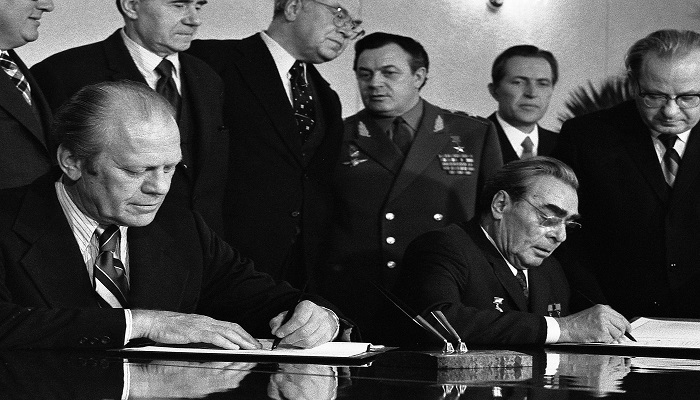
Helsinki AccordsThe lack of intellectual rigor coming from the Iranian regime’s foremost lobbying team in the National Iranian American Council fails to impress and today is no exception with an inane editorial written by Tyler Cullis and appearing in the New York Times.

In it, Cullis attempts to draw parallels between the diplomatic efforts made by President Gerald in overcoming Senate opposition to craft an accord with the old Soviet Union in an effort to lay the groundwork for détente between the East and West. He aligns this scenario with what is currently happening in talks between the Iranian regime and the P5+1 group of nations seeking to restrict the mullahs march to a nuclear weapon.

Cullis fails to mention several key and crucial distinctions between the two that have an even more profound impact on current talks.

For one thing, President Ford attempted to make human rights a core feature of the accords in recognition of the terrible human rights violations occurring regularly within the Warsaw Pact nations. In a speech he gave while trying to sell the Accords to the American public, he said:

“The Helsinki documents involve political and moral commitments aimed at lessening tension and opening further the lines of communication between peoples of East and West. . . We are not committing ourselves to anything beyond what we are already committed to by our own moral and legal standards and by more formal treaty agreements such as the United Nations Charter and Declaration of Human Rights.”

It was significant for President Ford to stress the human rights aspects of the Accords since the agreement would effectively make permanent the Soviet Union’s annexation of the Baltic states of Lithuania, Latvia and Estonia after World War II and place them under harsh rules for the next 30 years.

The Accords were also significant because they were not a treaty per se, as evidenced by the strong objections by nations such as Canada, Spain and Ireland in allowing the Soviets to swallow the Baltic States. In a bit of historical irony, the Accords laid the groundwork for the later Organization for Security and Cooperation in Europe, the same working group which has floundered in building a cohesive response to Russia’s recent annexation of the Crimea and invasion of Eastern Ukraine.

All of which further demonstrates the feebleness of Cullis argument. At no point during the P5+1 talks has the Iranian regime’s dismal human rights record ever been put on the negotiating table, nor its long support and sponsorship of global and Islamic extremist terror groups.

One of the key recognitions of the Helsinki Accords was its commitment and focus to the preservation of human rights as a key element in the dialogue between the West and Soviet Union. It presented the framework by which later talks under détente efforts by preceding Presidents were always framed by the need to dissuade the Soviets from abusing its own people and those of nations under their sway.

It is a model of success that has borne early fruit with the Iranian regime by forcing it to come to the negotiating table after economic sanctions began having their desired effect, but Cullis and other regime sympathizers would have us give Iran’s mullahs the breathing room necessary to rebuild their economy while arming themselves with nuclear weapons under the guise of peaceful talks.

While Cullis holds the Helsinki Accords as a model for Iranian talks, he unwittingly reinforces the true reason why those Accords succeeded and it had nothing to do with President Ford ignoring Congress, but had everything to do with his focus on human rights.

According to the Cold War scholar John Lewis Gaddis in his book “The Cold War: A New History” (2005), “Leonid Brezhnev had looked forward, Anatoly Dobrynin recalls, to the ‘publicity he would gain…when the Soviet public learned of the final settlement of the postwar boundaries for which they had sacrificed so much’… ‘[Instead, the Helsinki Accords] gradually became a manifesto of the dissident and liberal movement’… What this meant was that the people who lived under these systems — at least the more courageous — could claim official permission to say what they thought.”

We can only hope that this proposed agreement with the regime gets scrapped and instead a true human rights-driven manifesto takes its place rightly restoring the importance of Iran’s mullahs getting an agreement conditioned only by their acceptance and implementation of human rights improvements and the renunciation of terror.

Thank you Mr. Culis for so eloquently making my point.

By Michael Tomlinson

Filed Under: Blog, National Iranian-American Council, The Appeasers Tagged With: Helsinki Accord, Iran, Iran deal, Iran Lobby, Iran Talks

Parallel Nuclear Talks with the Iranian Regime

February 23, 2015 by admin

Magnifying GlassWhile U.S. Secretary of State John Kerry leads diplomats from the P5+1 negotiating team in meetings with his counterparts from the Iranian regime, another set of talks have been going on in parallel concerning inspections and access to the Iranian regime’s nuclear facilities by the International Atomic Energy Agency (IAEA) that have so far drawn much less media attention.

But in a secret report issued by the IAEA to its member states and obtained by some Western news agencies including the New York Times and Reuters, the IAEA declared that Iran’s mullahs have stalled for the past three years on several critical areas of concern over nuclear weapons development and have not been provided answers to questions that had been promised by the Iranian regime as late as last year.

The timing of the release of the report, coming as the third round of talks between the Iranian regime and the West gets underway in Geneva is interesting because it demonstrates the level of frustration international inspectors have reached in attempt to squeeze answers out of the Iranian regime over issues such as the use of next-generation centrifuges for enrichment of nuclear fuel and the testing of conventional high explosives which could be used in detonators for nuclear warheads.

The IAEA and the United Nations have always maintained that any accord reached with the Iranian regime be conditional on Iran’s mullahs fully answering the questions that still linger after years of stonewalling.

“We’ve been stonewalled on all those questions,” one European official involved in the talks said recently in the New York Times story. “And the question is does it make sense to lift sanctions against Iran before it satisfies the inspectors?”

In the Times article, an initial report by the IAEA in 2011 published a list of a dozen technologies, most of them necessary to build a nuclear weapon that inspectors said Iran had tried to master. That list was narrowed down to three which the IAEA wanted Iran to explain first.

More than a year later, the Iranian regime has still failed to provide information on even one single topic of concern to inspectors; that being the development of conventional explosives to create focused shock waves sufficient to compress the core of a nuclear device and start the chain reaction necessary for a nuclear blast.

The IAEA has been consistently blocked by the Iranian regime in getting even the most basic answers, which raises more concerns over the apparent shroud of secrecy that has fallen on the most current round of P5+1 talks. Many international observers critical of any agreement with Iran’s religious leaders, including opposition groups such as the National Council of Resistance of Iran, have contended the talks need to be transparent and open in order to allay international concerns and hold Iran’s rulers accountable because of a past history of obstruction and evasion.

In the Reuters story, Western diplomats have viewed such stalling as an indicator of the Iranian regimes unwillingness to cooperate fully until punitive sanctions are lifted in talks with the United States, Russia, China, France, Germany and Britain. This intent to have Iran’s mullahs be rewarded for simply sitting at the table is at the heart of the regime’s negotiating position and the reason why two earlier rounds of talks had failed.

Pressure to craft a framework of a deal by a March 24th deadline has placed both sides on a path towards a complex game of chicken to see who will blink first. Given the Iranian regime’s past willingness to tank previous talks, Western negotiators should be wary of giving in to regime demands simply to satisfy the appearance of progress.

No doubt the regime’s lobbying machine in the U.S. including the National Iranian American Council, that recently published a $200K ad in New York Times in favor of the mullahs, will press for a deal that hides most of the key components from public or Congressional scrutiny, but as the IAEA report has demonstrated, the Iranian regime has and continues to flaunt international concerns even after concessions and shows no interest in changing its ways.

By Michael Tomlinson

Filed Under: Blog, The Appeasers Tagged With: Iran, Irandeal, IranGeneva, Irantalks, NIAC

Iran’s Way or the Highway?

February 18, 2015 by admin

Gareth PorterOne of the more intriguing aspects of the arguments put forward by the Iranian regime lobbyists and PR flaks is the near constant drumbeat of the message that hopes for any possible deal with Iran on nuclear weapons lies with the U.S. and not Iran.

It is an argument advocated by Iranian regime loyalists such as Trita Parsi of the National Iranian American Council and Gareth Porter, a self-proclaimed historian and journalist, who most recently advanced the theory the U.S. negotiating position is unworkable and only foments the deep suspicions already inherent in Iran’s religious ruling class.

Consequently, he takes the position the U.S. must recognize the Iranian regime’s insistence on maintaining its enrichment capacity is not irrational and the sooner Washington recognizes it, the sooner a breakthrough will occur.

It’s a position that might elicit laughter if the stakes weren’t so high. Porter further posits that decades of aggressive U.S. policy towards Iran has forced Iran’s leadership to harden its approach to the U.S. in negotiations with the ultimate goal of the immediate lifting of economic sanctions.

Porter never mentions Iran’s broad and deep sponsorship and support of terrorist groups such as Hezbollah, Quds force, etc. and their past attacks killing U.S. personnel.

He never mentions the almost decade-long brutal crackdown on Iran’s own people which includes censorship and access to media and the internet, as well as mass arrests and halts to demonstrations, rigged national elections – twice – and a sharp increase in the number and frequency of public executions of men, women and religious and ethnic minorities.

Porter’s inability to exercise his historical insights to recount past acts by the Iranian regime as clouding American policy making is inexcusable and betrays his almost dogmatic approach to supporting whatever the Iranian regime position happens to be. One might daresay if the mullahs said the sky was green, Porter would concur.

Even more telling is his comment that criticism coming from rivals within mullah’s hierarchy that their Supreme Leader Ali Khamenei’s failure to support negotiations with the U.S. was wrong because it would mean Iran was negotiating with the U.S. from a woefully weak position. The fact Porter believes Iran’s negotiating position needs to be one of strength vis á vis the West says more about his allegiances than the need to eliminate nuclear weapons and prevent a new arms race in the Middle East.

If Porter was the historian he pretends to be, he would recognize the mistakes made in the run up of the first Cold War in which unbridled nuclear development placed the world at the brink of a nuclear apocalypse. At no point does Porter decry Iran’s march towards a nuclear weapon. In fact, he acknowledges Iran’s mullahs already possess the ability to build a nuclear weapon with the enriched fuel on hand. Instead he maintains the party line that sanctions must be lifted in order for any agreement to be reached.

While Porter argues “in the context of the history of the sanctions in US-Iran relations, Iran’s determination to hold out for a better deal is hardly irrational. If the Obama administration fails to understand that fact the diplomatic stalemate is likely to continue.”

He misses the exact opposite point of view that given the brutal nature of the Iranian regime and its involvement in literally all of the world’s hot spots involving extremist Islamist groups, one could hardly call the responses to Iran irrational.

By Laura Carnahan

Filed Under: Blog, The Appeasers

Why Munich 2015 is Munich 1938

February 9, 2015 by admin

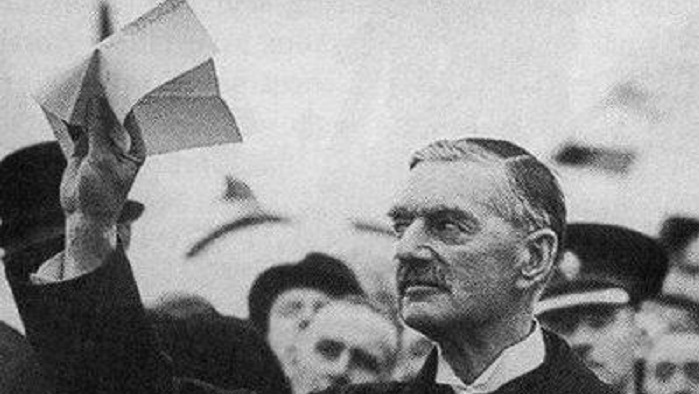
Chamberlain in MunichThis was readily apparent in comments made this weekend by Iranian regime’s Supreme Leader Khamenei who said in a statement released by his office and carried by the ISNA news agency:

“I would go along with any agreement that could be made. Of course, I am not for a bad deal. No agreement is better than an agreement which runs contrary to our nation’s interests,” Khamenei said.

He then alluded to the possibility of agreeing to a deal that did not deliver all that Iran was seeking, which on casual inspection might bode well for a deal to finally be closed. His comments came at the start of the annual Munich Security Conference where an impromptu meeting of the P5+1 negotiating countries (the U.S., Russia, China, Britain and China) took place with Iran’s Foreign Minister Mohammad Javad Zarif.

While the Munich conference was ostensibly going to be focused on the conflict between Russia and Ukraine, Zarif and Secretary of State John Kerry took the opportunity to do some bargaining.

The renewed push for a deal reflects the very real deadline imposed by a newly energized Congress eager to flex its muscles against a recalcitrant Iranian regime that has so far stalled for two years in reaching a deal while at the time contributed greatly to the growing and rapid deterioration of the Middle East.

Khamenei and his handpicked front man in President Hassan Rouhani have calculated correctly the patience of the American people had finally been worn down to a nub and if any deal was going to be done, it had to come sooner rather than later. The only question for them was how willing was the West to cave and give Iran what it wanted which was a preservation of its enriching and refining capacity in order to continue the development of a nuclear device?

Given the relative paucity of any positive news on the foreign policy front with radical Islamist attacks in Canada, Australia and France and the brutal beheadings and burnings by ISIS and the collapse of Yemen and chaos in Libya and Nigeria, it is reasonable to assume the West might very well give in for even the merest glimmer of deal.

For historians, the parallels to Munich and British Prime Minister Neville Chamberlain’s fateful meeting with Adolf Hitler where he essentially gave Czechoslovakia away to Nazi Germany in 1938 in order to hold up a piece of paper upon his returning declaring “Peace in our time” to what is happening in Munich this weekend is striking and deeply disturbing.

Just as appeasement of a brutal dictator by the West did not work and instead accelerated the start of World War II, the same appeasement of Iran by the West today will only inevitably lead to a dangerous reckoning down the road.

George Santayana, the noted philosopher, essayist, poet and novelist, famously wrote in The Life of Reason in 1905:

“Those who cannot remember the past are condemned to repeat it.”

A powerful and insightful comment Secretary Kerry would be wise to remember while in Munich.

By Michael Tomlinson

Filed Under: Blog, The Appeasers

Iran Cashes U.S. Checks Without Penalty

January 23, 2015 by admin

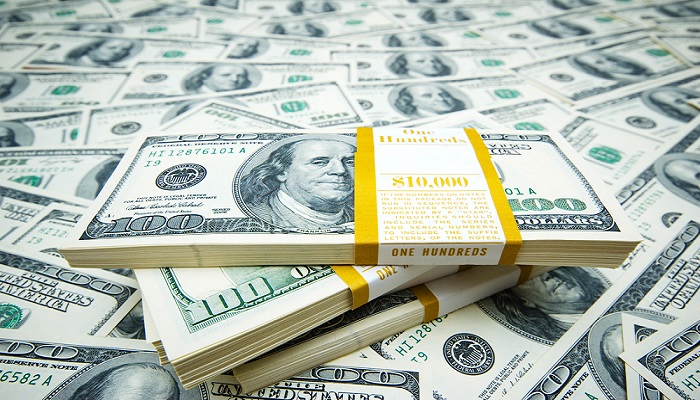
Stacks of CashEarlier this week, the Obama administration paid out $490 million in cash to mullahs in Iran and will have given the Iranian regime a whopping $11.9 billion in cash by June 2015 when this third and latest round of nuclear talks are scheduled to end according to figures released by the U.S. State Department.

The $490 million transfer to Iran was the third payment sent to Iran as part of the interim agreement between Iran and the Obama administration during an extension agreed to last November. Under the agreement, Iranian regime will receive a total of $4.9 billion in unfrozen cash in 10 separate payments through June of this year in the hopes a final nuclear agreement can be reached.

This comes on top of $4.2 billion Iranian regime received as part of the 2013 interim agreement, which the Obama administration followed with another $2.8 billion last year in a last ditch attempt by the Obama administration to entice mullahs in Iran to stay at the bargaining table.

Iran loyalists and supporters have touted the payments as the down payment on building trust between Iranian regime and the rest of the West. The more rational view is that the U.S. has been suckered by mullahs in Iran into handing over billions in cash which mullahs have put to good use funding their various foreign adventures. Namely to fund Hezbollah militias in Syria and their likes in Iraq to kill innocent people.

The payments have come at an especially good time for Iran as plunging oil prices worldwide coupled with massive outflows of cash to support terror groups such as Hezbollah and prop up the Assad regime in Syria and fund a growing war in Iraq have drained Iran’s foreign currency reserves and placed it on shaky financial footing.

The almost $12 billion injection of U.S. cash will be equal to nearly 18 percent of Iran’s total foreign currency reserves as of 2014; a massive payment that comes at the most critical time for Iran. The U.S. is essentially bailing Iran out right now as it engages in some of the most extreme fighting and terror activities around the world:

• Iranian regime’s funding of Hezbollah has provided Syria’s Bashar al-Assad with the manpower to turn the tide of civil war after being isolated internationally for using chemical weapons. The shift in power directly led to the growth of ISIS as the opposition faltered and splintered into extremist factions that Assad’s forces pushed into Iraq;
• Iranian regime’s control of the Iraqi government of Nouri al-Maliki led to the sectarian war against Sunni tribes and weakened its military to the extent ISIS was able to swiftly move across Iraq and enabled mullahs the excuse to move large numbers of troops and arms into Iraq in a de facto takeover of the country.

In each case, the flow of cash from the U.S. softened the financial blows of these adventures and enabled Iran’s mullahs to keep an iron grip on its domestic politics with continued oppression of its people.

While Iran’s lobbying groups such as the National Iranian American Council would have Americans believe the release of these funds was an act of good faith that will be rewarded with a more peaceful future, the truth has been the opposite. Iran has made no significant concessions except a promise to reduce the rate of enrichment of nuclear fuel. Iran has increased its crackdown domestically and significantly stepped up its role in extremists and military activities worldwide in the two years since the payments began.

A new Congress should be asking the tough questions of what exactly $11.9 billion has bought from Iran. The only is unfortunately nothing.

By Michael Tomlinson

Filed Under: Blog, The Appeasers

“The Iran Project”-Enemies of Democracy

November 15, 2014 by admin

"Dedicated to Improving the Relationship Between the U.S. and Iranian Governments"

“Dedicated to Improving the Relationship Between the U.S. and Iranian Governments”

The Iran Project, a pro-Iranian regime organization in the US comprised mainly of former government officials and academics, released a report in August 2014 that offers potential foreign policy consequences if the US concludes a nuclear agreement with Iran.

That a viable agreement can be reached is far from certain and releasing the report beforehand would appear to be propaganda ploy to promote an agreement rather than a serious examination of foreign policy issues.

The original deadline to conclude a comprehensive nuclear agreement was July 20, 2014.  It was extended four months due to “substantial differences” and there is already discussion to further stretch out the timetable.

Other than a small spattering of negative comments, the report presents a benign view of the Iran regime.  The authors acknowledge Iran is an “international pariah” and has “ties with at least seven terrorist groups.”  They raise the issue of Iran’s miserable human rights record but then decline to address these issues in the report.

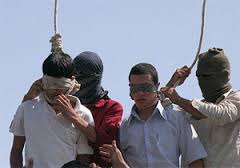
Over 1000 people executed During Rouhani's first year in office.

Over 1000 people executed During Rouhani’s first year in office.

The authors fail to mention anything about the regime’s repressive government, public hangings, crackdown on free speech, and political persecutions.

The report falsely asserts that Iran has “largely abandoned attempts in the 1990s to export its revolution to the Gulf.”  This is surely seen different by the international community, among which the Saudi Foreign Minister Saud al-Faisal, who recently demanded Iran’s mullahs withdraw their “occupying forces” from Syria, Iraq and Yemen.   He said Iran was not part of a solution in these areas, but the problem.

The report calls attention to “Afghanistan’s “nascent democracy” and claims Iran “was helpful to the United states in inserting provisions for democracy, elections, and anti-terrorism into the Afghan Constitution.”  Not discussed is the regime’s assistance to al Qaeda, helping them escape from Afghanistan and letting them set up a “management council” on their territory.

The report is also silent when it comes to the Iranian public’s yearning for democracy and the regime’s brutal attacks on political dissidents.  The mullahs view democracy as an “usurpation of God’s authority to rule” and refuse to allow the open selection of candidates in elections.  They also manipulate voting tallies and then claim to be legitimate rulers.

The authors of the report declare they oppose Iran’s development of a nuclear weapon, but then shut their eyes to overwhelming evidence the regime is doing just this.  The authors believe the mullahs have not made a decision to build a nuclear weapon.  They cite one reference to a US intelligence assessment and reiterate Ayatollah Khamenei’s public declaration in a fatwa that the development and use of nuclear weapons are forbidden. While an article in Townhall, by a high rank Ayatollah who lives in exile describes Khamenei’s Nuclear Fatwa, an Irrefutable Lie, absent in the report is the fact that Khamenei has never written any document against nuclear weapons that carries his stamp, a standard practice for all fatwas.  Also, the fact that fatwas aren’t necessarily binding for the government and officials, and there is no punishment for failing to abide by a fatwa.

The authors conveniently neglect to quote from the same intelligence assessment that Iran has “pursued the capabilities … to give it the ability to build missile-deliverable nuclear weapons.”  In other words, the regime is developing the wherewithal to build a nuclear bomb, but hasn’t completed the process.

The International Atomic Energy Agency (IAEA) believes the regime recently tested nuclear detonators at the Prachin military site in Iran.  But the mullahs refuse to give inspectors access to the facility.

This isn’t the first time the regime has tried to hide its nuclear weapon development program.  In March 2003, IAEA inspectors were initially denied access to Kalaye Electric, which Iranian officials falsely described as a watch manufacturing company.   After months of delay, the inspectors were finally allowed to examine the site.  They discovered walls had recently been removed, floors were covered with new concrete, and a significant part of the plant was repainted.  Despite these efforts, the inspectors found trace amounts of uranium that had been enriched to a level needed to build a nuclear weapon.  Given the evidence, the regime confessed it had secretly conducted enrichment tests at the Kalaye Electric site.

This is just one of many instances of deception and subterfuge by the mullahs.  Economic sanctions were imposed on Iranian regime by the UN Security Council because of the regime’s ongoing failure to provide transparency in its nuclear program and repeated violations of the Non Proliferation Treaty (NPT).

The Iran Project authors sweep all of these inconvenient issues under the rug and suggest the US should become a partner with the mullahs to deal with various problems in the Middle East.  This includes joining forces to combat the Islamic State or ISIS in Iraq and working with the regime “as a full partner” to assist Afghanistan after US troops are withdrawn.

The report correctly blames former Iraqi Prime Minister Nuri al-Maliki for many of the problems today in Iraq.  He refused to share power with the Sunni Arabs and other rivals, corrupted the election process, and sought to monopolize power.  Not surprisingly, the authors of the report make no reference to Iran’s behind-the-scenes influence over al-Maliki, who was their puppet, implementing their policies.  The mullahs tried desperately to keep al-Maliki in power, using their considerable political influence in Iraq, without success.

At the heart of the Iran Project report is an effort by the authors to persuade readers to accept the Iranian regime as a legitimate authority.  Providing readers an accurate description of the regime would have undermined their political objective, hence their whitewash of the regime.

The authors portray a positive future if a nuclear agreement is reached with Iran.  The United States, they posit, “stands to reap more benefit than any other outside power from new patterns of cooperation [with Iran].”   Concluding a nuclear agreement, they claim, “will unlock the door to new options.”  It might integrate Iran into the world community and would encourage the regime “to pursue its interests through legitimate means rather than covert or illegal means.”

If the US fails to reach a nuclear accord with Iran, the authors predict dire consequences.   If there is no agreement, the US should be prepared for a “sustained confrontation with Iran.”   It would trigger a loss of support for economic sanctions and the mullahs would most likely refuse to collaborate with the US on other issues.

Furthermore, if the Rouhani government failed to reach a nuclear agreement and relieve the sanctions, “then the conservatives in Tehran would return to dominate the thinking and actions of the Supreme Leader.”

The mullahs would “build its nuclear program with renewed conviction…and might make a decision to build a nuclear weapon.”  And America would renew its interest in regime change, creating an environment that “could lead the United States and Israel to threaten military strikes, with the probability of war, either deliberate or inadvertent.”

The authors offer only two roads ahead.  One is based on negotiating a nuclear agreement that, in turn, might defang the Iranian pariah and open the door to partnering with the US to resolve foreign policy difficulties.  The other road leads to Iran’s development of a nuclear bomb and the probability of war. The very familiar tactic repeatedly used over the years to justify the failed policy of appeasement towards the mullahs in Iran, which has not only been unable to contain their progress on the nuclear front but has actually embolden the mullahs to meddle in the region and to create more crisis everywhere including Syria, Iraq and lately in Yemen.

The report, which claims to be a “tough-minded assessment” and “balanced,” is, in fact, fear-mongering propaganda.

Iranian regime is now the biggest sponsor of estate terrorism and is therefore the largest threat to the global peace. It is absurd to think America would collaborate with them to solve regional conflicts.  And only the most gullible and naive would have suggested diplomacy could tame the mullahs.

Yet now the authors of the Iran Project report recommend this same pathway in the hope the Iranian regime may become more peaceful and shed its extremist Islamic zeal.

The Iranian mullahs view the West’s appeasement as weakness.  They are hoping to buy enough time to complete work on a missile-deliverable nuclear weapon. 

Hassan Rouhani, Iran’s smiling president, is no moderate.  Rouhani has held many of the top national defense positions and was appointed in 1991 by Supreme Leader Ali Khamenei to the Supreme National Security Council (SNSC), the country’s highest national security organization, comprised by the head of the Armed Forces, Chief of the Army, Minister of Intelligence and Security, Chief of the IRGC, and others.

The SNSC has a parallel organization (Omure Vijeh Committee) that oversees extralegal actions.  Rouhani was a member of the panel when it approved the bombing of the Israel Embassy in 1992 in Buenos Aires, which killed 29 people and wounded 242 others.  He also was a member when it authorized the 1994 suicide bombing of the AMIA building in Buenos Aires and the 1996 Khobar Towers truck bombing in Saudi Arabia that killed 19 American servicemen and wounded more than 500 other people.

Rouhani is no moderate as the authors of the report claim.  They falsely predict the conservatives in Tehran will return to dominate the “thinking and actions of the Supreme Leader” if a nuclear agreement is not reached.   Rouhani is a protégé of Khamenei and they both share responsibility for many terrorist attacks and assassinations of pro-democracy patriots seeking to overthrow the despotic regime.  Rouhani is a conservative, just as every other president of Iran has been a conservative in the past 35 years. 

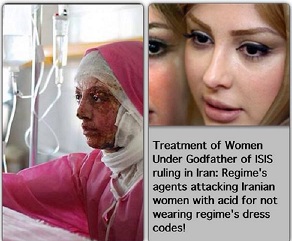
Victim of  acid attacks on girls and women in Iran for disobeying regime's dress code.

Victim of acid attacks on girls and women in Iran for disobeying regime’s dress code.

The recent Acid attacks on women and girls in Iran, and the unprecedented repression of religious minorities in Iran under Rouhani’s watch, only have one message, the Rouhani’s regime is no different than its predecessors and certainly not a moderate. In fact there is no evidence to suggest the Iranian regime can be rehabilitated.  The mullahs are driven by an extremist Islamic ideology. Even without nuclear weapon, they have been supporting the use of terror and have dispatched armed forces to disrupt neighboring governments with the goal of installing Islamic Republics. 

The authors of the report offer only two options for dealing with the Iranian regime.  But there is a third option – regime change.  The West should announce its support for regime change in Iran.  It should not align with its tyrannical rulers, but with pro-democracy organizations that  seek to restore freedom in Iran.

The authors of the Iran Project refuse to adopt any measures that might undermine the mullahs’ authority, including regime change.  Instead, they seek policies that will enhance their legitimacy and appease their hegemonic ambitions.  As such they are enemies of democracy and their report should be discarded as a propaganda ploy designed to legitimatize the despotic Iranian regime.

Filed Under: Current Trend, The Appeasers

The Truth about Iran’s Religious Exceptions on Nuclear Weapons

October 23, 2014 by admin

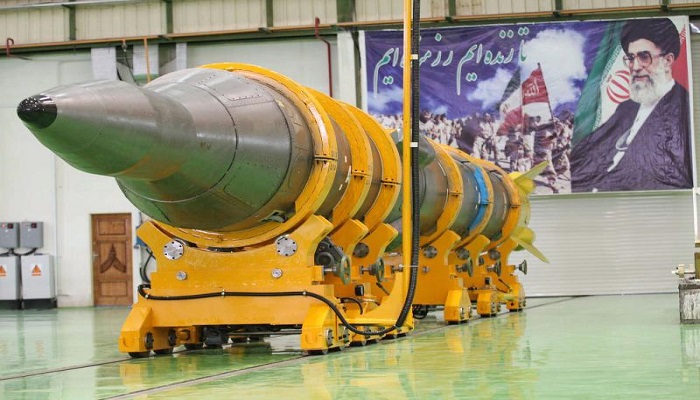
Iran missile program

Iran’s Sejil 2 missile is seen in front of a picture of Supreme Leader Ali Khamenei before a test launch.
Photo credit: The Daily Signal

In a recent piece in Truthout, Gareth Porter lays out a historical rationale for Iran not wanting to develop nuclear weapons based on a fatwa, or religious edict, issued by Supreme Leader Ali Khamenei. He goes on to cite a historical precedent with Ayatollah Ruhollah Khomeini, Iran’s first supreme leader in the new Islamic Republic, issuing his own fatwa against chemical weapons after Iraq used them in Saddam Hussein’s war against Iran.

Unfortunately Mr. Porter’s observations and conclusion are fatally flawed for a number of reasons, the biggest being that unlike he has reasoned, the Iranian regime did use chemical weapons against Iraqis, and since the then Supreme Leader lied about it, the present one can certainly lie as well. It is also worth mentioniong that the present Supreme Leader is often  under question as a habitual liar.

It is a given of politics since the dawn of civilization that people in power will do or say most anything that preserves their power or position. Iran and its religious theocracy are not immune to the same temptations. Running a nation state in the service of your religious belief is not much different than serving your political party. In Iran’s case, Khamenei has exemplified the slightly bipolar nature of politics by condemning nuclear weapons, yet ardently defending Iran’s capabilities to develop them.

Mr. Porter fails to note during this summer’s first round of nuclear talks between Iran and the P5+1 group of Western nations, Khamenei delivered his nation’s version of the State of Union where he went into highly technical detail about Iran’s desire to not only preserve its enriching capacity, but indeed significantly expand it almost a hundredfold from where negotiators were at. While negotiators were debating allowing Iran to keep anywhere from 1,900 to 4,000 centrifuges, Khamenei called for 190,000 Separative Work Units (SWU) and the presumption of the rights to build enough centrifuges of the next-generation models (which are the most efficient at refining uranium into highly enriched fuel suitable for nuclear warheads or heavy water reactors which could produce plutonium) as the minimum requirements for their “peaceful nuclear program”.

Since Khamenei represents the final authority in Iran on international treaties, that round of talks was effectively dead on arrival this past July. It is a credit though to the significant international circle of Iranian regime sympathizers and cheerleaders that that collapse was not fatal and in fact another round of talks were scheduled with a November 24th deadline this year.

Mr. Porter bases nearly all his story on the single viewpoint of Mohsen Rafighdoost, who served as minister of the Islamic Revolutionary Guard during the Iran-Iraq war and is obviously responsible for any chemical attacks carried out during the war, and claims that he had broached the subject of weapons of mass destruction to Khomeini who dissuaded him at the time. However as documented by many media outlets, including an article in New York Times, dated January 31, 2003, the truth is the polar opposite.

We only have the current Supreme Leader’s words to go by and unlike the tea reading that went on at May Day parades in front of Lenin’s Tomb of the Politburo members from the old Soviet Union, we are left to discern the rants and ravings of a theocrat that hasn’t spared anything against his own people, while his men in power are widely known to govern the primary state sponsor of terrorism, and had already run a clandestine nuclear program for 18 years before it was first exposed by its opponents in 2002. And in his most recent comments, he certainly lays open the door for enriching on a massive scale.

Indeed the clear facts, unlike Mr. Porters picture of the situation is totally different. In Iran’s case under the leadership of president Hassan Rouhani, Khamenei’s handpicked moderate face to the world, police crackdowns on dissent have sharply risen as have executions; now in excess of 1,000 according to Amnesty International. Access to the internet and outside communications and social media are sharply curtailed if not blocked completely and Iran has stepped up its military and financial support to terror groups such as Hamas and Hezbollah, as well as become involved in the Syrian civil war and the battle with ISIS in Iraq in an attempt to preserve its control of a Shiite hegemony in the region.

Given those actions, it is hard for anyone to take Iran’s leadership at its word that its only interest is in boosting its economy to give its people more access to iPhones and clothes from Gap Kids.

While Mr. Porter’s hopes for a nuclear-free Iran may be commendable and sincere, he may very well have been taken for a ride by an Iranian flying carpet courtesy of the Revolutionary Guard Corps.

By: Michael Tomlinson

Filed Under: Blog, News, The Appeasers Tagged With: Gareth Porter, Iran, Nuclear, Nuclear Iran, nuclear talks

Call for Investigation into VOA for Pro-Iran Corruption

October 18, 2014 by admin

Iranian Lobby

Archive Photo -Taken from Google for Iran lobbies and appeasers

The Washington Free Beacon, has recently reported that a group of bipartisan congressmen have written to Senator Kerry asking for a probe in to the VOA- Persian program’s pro-Iranian regime policies. The program is viewed by the Iranian diaspora as biased and cozy to the Iranian dictatorship for widely censoring the views and activities of the pro regime-change opposition in Iran, or for always offering a negative and absurd picture perpetuated by Iranian intelligence or Iranian lobbies abroad.

The report written by Adam Kredo, a senior commentator of the website, was published on October 17, 2014 on the website.

Excerpts of the article that show how the media is used in favor of the Iranian regime and its lobbies to advocate favorable reports to the Mullahs in Iran is published here:

“Congress is calling for an investigation into Voice of America’s (VOA) Persian language news service as a result of what they say is the station’s systemic pro-Iran bias and cozy ties to the anti-American ruling regime, according to a letter sent recently to Secretary of State John Kerry”, writes Adam Kredo.

Explaining the background, Washington Free Beacon (WFB) writes: “Lawmakers and Iranian dissidents have long accused VOA’s Persian News Network (PNN) of producing sympathetic coverage of the Iranian regime and blacklisting prominent Iranian opposition voices from appearing on the air.”

“The call from Congress for an investigation into these alleged practices comes just a month after the Washington Free Beacon revealed that PNN had banned from the network a prominent Iranian opposition member and placed him on a so-called “black list” after he attacked Iran’s ruling regime for sponsoring terrorism.”

The article continues, “Nine House lawmakers from both sides of the aisle are now demanding that the State Department launch a formal investigation into potential mismanagement at PNN, according to a letter sent to Kerry on Wednesday and obtained by the Free Beacon.”

“We request that you [Kerry] look into this matter and investigate any possible mismanagement and slanted coverage of news by VOA-PNN, including the oversight of management, staffing, and content,” the lawmakers wrote.

“Those members concerned about PNN’s coverage include Reps. Steve Cohen (D., Tenn.), Dana Rohrabacher (R., Calif.), Steve Stockman (R., Texas), Trent Franks (R., Ariz.), Howard Coble (R., N.C.), and several others.”

The core of the corruption

In the article, Adam Kredo explains that “The lawmakers say that their Iranian-American constituents have been complaining about PNN’s failure to cover Iran’s human rights abuses and other matters that are potentially embarrassing to the ruling regime.

“We have received complaints from our Iranian-American constituents that VOA-PNN programs have neglected to adequately cover the abysmal situation of human rights violations in Iran, particularly the alarming and dramatic rise in executions,” they write in the letter.

Examples of the misbehavior of VOA-PNN

Giving examples of the misbehavior of the program, WFB reiterates: “During [Iranian] President Hassan Rouhani’s first term in office, nearly 900 hangings have been ordered with very few of these executions receiving VOA-PNN coverage,” they say. “In our efforts to protect and give voice to vulnerable populations, we must ensure that VOA-PNN upholds its mission to provide truthful news and does not suppress the voices of those Iranians seeking human rights protections and Democratic change in their country.”

“In addition to a significant rise in executions, including one scheduled for a female rape victim who spoke out against her attacker, Iran has continued its pursuit of nuclear weapons and support for terrorism in the Middle East.”

“PNN critics, including former staffers and guests, have discussed systematic corruption at the network that includes a policy of censoring those who criticize the regime and those who may reveal information damaging to the network’s senior officials, some of whom have had ties to the Iranian regime,” WFB’s article continues.

“We are concerned that this network, which is meant to promote freedom and democracy through objective news and information, may have harmed instead of helped the plight of Iranians seeking to claim their human rights,” the lawmakers state in their letter.

Iranian-American community leaders welcomed Congress’ call to investigate PNN.

Majid Sadeghpour, political director of the Organization of Iranian-American Communities-US (OIAC), said that U.S. taxpayers expect better of VOA.

“Regrettably, while VOA-PNN has given voice to the pro-Tehran crowd inside the Beltway, it has censored the views of those who seek a democratic, secular, and non-nuclear republic in Iran,” said Sadeghpour in a statement provided to the Free Beacon.

Regime opponents who have been invited onto PNN say that their comments have been censored, and in some cases have been thrown off the air.

Nikahang Kowsar, an Iranian cartoonist, journalist, and regime critic, told the Free Beacon that he was booted off PNN’s airwaves in March, in the midst of an interview, for discussing corruption in Iran’s oil industry that could be traced back to high-level officials.

Kowsar was being interviewed on VOA Persian’s Last Page program when the host was apparently ordered to stop the interview.

“I was waiting for the second round of questions” when a PNN host claimed that “he was told and ordered not to ask any more questions to me,” recalled Kowsar. “Then a gentleman from the studio came and disconnected my microphone.”

Kowsar said he was shocked by the experience. He later petitioned the Broadcasting Board of Governors (BBG), which oversees VOA and PNN, about the incident.

“When I was in Iran I went to prison for drawing a cartoon, I was cut off from national TV … I was censored in Iran, so somebody who has been censored inside the Islamic republic is not news. But being in the VOA studios in the U.S., the land of the free, and then learning that I have to be censored is … news.”

“If VOA is the channel that wants to talk about American values and freedom of speech and is run by people who have the Islamic republic mindset, that’s not nice,” Kowsar said. “In a way you see that the Islamic republic has exported its values to the heart of Washington and I can’t tolerate that.”

In September – a few months after Kowsar was booted off air – Majid Mohammadi, an Iranian-American academic and critic of Tehran’s hardline regime, was purportedly placed on the station’s “black list” for comparing the Islamic Republic to the terror group Islamic State (IS, ISIS, or ISIL).

“After the program, I was called and one of the staff members of PNN (Mr. Homan Bakhtiar) told me that Mr. Mohammad Manzarpour, the editor, has put me in the black list and PNN will no longer contact me for providing my expertise on Middle East issues in VOA Persian programs,” Mohammadi later wrote in a letter to the BBG.

PNN editor Manzarpour has been singled out for particular criticism by several of the station’s critics and even former employees who have worked with him.

Manzarpour, they allege, has had ties to the Iranian regime and uses his platform at PNN to censor information he finds objectionable.

Manzarpour, his critics note, has previously worked for Iran’s Atieh Bahar Consulting company, which helps foreign companies invest in Iran’s oil sector and “acts as intermediary between them and the government,” according to the Iranian American Forum.

Manzarpour’s previous ties to Atieh Bahar could influence his editorial decisions at PNN, Kowsar said.

“There is something wrong over there, a virus,” Kowsar explained. “You feel there is a sort of conflict of interest over there. Why should somebody coming from Atieh Bahar be in charge of the editorial staff over there?”

“When he cuts me off from a program relating somehow to the oil [industry] … you feel something sketchy over there,” he said.

Read the Source article here


Filed Under: News, The Appeasers Tagged With: Iran, Iran Lobby, VOA, VOA Persian, VOA-PNN

Baroness Nicholson

August 21, 2014 by admin

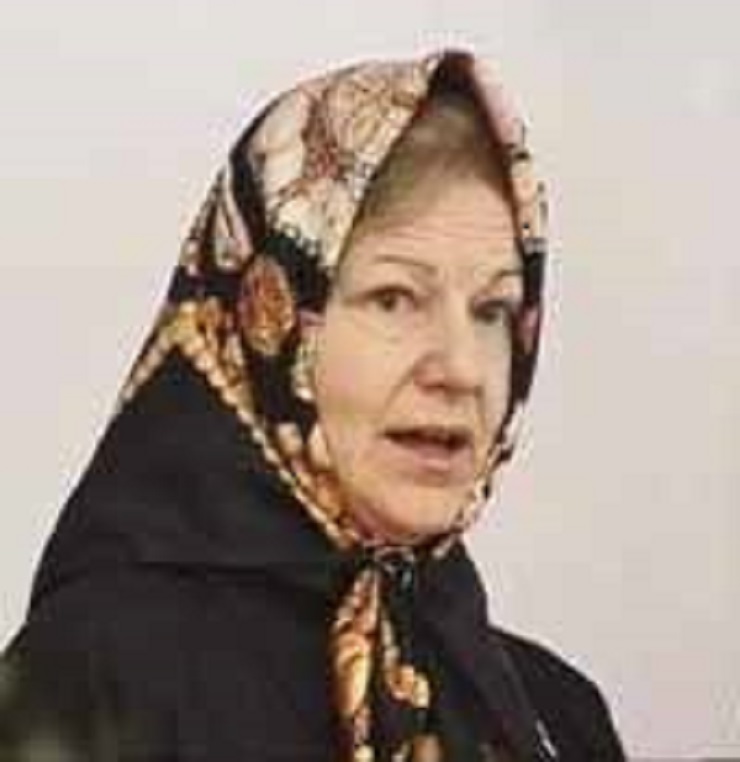
Baroness Emma Nicholson appears to have lost all objectivity in her views toward Iran and has been used by the regime to disseminate propaganda in the West.

Baroness Emma Nicholson appears to have lost all objectivity in her views toward Iran and has been used by the regime to disseminate propaganda in the West.

Emma [Baroness] Nicholson

Baroness Emma Nicholson, a former UK Member of Parliament, deserves praise for her efforts to provide assistance to the Marsh Arabs in southern Iraq.  But while helping them, she appears to have lost all objectivity toward the Iranian regime and has been used to disseminate disinformation in the West.

Nicholson first traveled to Iraq in 1991 to assess Saddam Hussein’s brutal suppression of the Shiite uprising in the southern region.  She returned to London with a young boy, named Amar, who had been severely injured, and later he set up a charity, Amar Appeal, to provide assistance to the Marsh Arabs.

Through the years, the Iranian regime has provided “considerable help” to her charity.   Nicholson repeatedly condemned Saddam Hussein for the torture and persecution of Iraqi Shiites “on the scale of what Hitler did to the Jews.”[1]  But about the Iranian regime’s similar torture and persecution of its citizens, she has remained silent, often going out of her way to appease the regime’s actions.

  • In 2002, Nicholson sided with the Iranian regime regarding the Ayatollah Khomeini’s fatwa, offering $2 million to anyone who killed author Salman Rushdie for publishing his novel, The Satan Verses. Rather than defend Rushdie, a British citizen, and free speech, she termed his novel “blasphemy” and “intolerable.”[2]  The Saturday Post said Nicholson announced “at the height of the fatwa that she had grown to ‘respect and like’ Iran’s authoritarian regime.”[3]

In February 2003, Nicholson claimed she had “evidence from others that the MKO [PMOI] has actively hidden weapons of mass destruction from the earlier inspectors…I have clear evidence of the ways in which the MKO shifted around weapons of mass destruction. Their commanders pushed them away, hid them, and boasted afterwards of having been successful in fooling the inspectors.”[4]  The disinformation was refuted when US authorities confirmed Saddam never had amassed a stockpile of nuclear, biological, and chemical weapons.  The UN Special Commission (UNSCOM) conducted numerous ground and aerial inspections of PMOI camps and never found anything suspicious.  In fact, the inspectors were welcomed by the PMOI to dispel the disinformation distributed the Iranian regime.

  • In 2003, Nicholson urged allied forces to destroy the PMOI/MEK, an Iranian opposition group that seeks to restore freedom and democracy in Iran. The mullahs fear the PMOI because of its broad support in Iran.  Nicholson, echoing the views of the corrupt mullahs, said “I welcome the destruction of the PMOI camps.  I strongly warn the world that this group must be destroyed.”

In 2004, Nicholson held a meeting in her parliamentary office with

In 2005, she help a meeting in her parliamentary office with members of Iran’s Ministry of Intelligence and Security (MOIS), which included Anne Singleton, a British citizen and agent of Iran.

Also in 2005, he reportedly met with Ali Younesi, then Iran’s head of the MOIS.  According to an article in Kayhan, an Iranian newspaper, the MOIS was using Ms. Nicholson to distribute propaganda to the West.

In 2005, she said “The Iranian government may not be popular globally, but it is highly organized and democratically elected within the Islamic code of understanding….Iran has the most advanced women’s rights in the region.”

About Ms. Nicholson, MEP Ulla Sandbaek said:  “It is well known that Baroness Nicholson strongly supports the regime in Iran to the extent that she totally disregards the fact that all international human rights organizations have expressed their concern and indeed outrage at the gender apartheid against Iranian women.”

In 2003, Nicholson’s charity, AMAR Foundation, organized a three day conference on Iran.  MEP Nelly Maes described the conference as a “forum that serves the propaganda purposes of the despotic regime which rules Iran.”

[1] “Shiites Napalm-Bombed, Tortured in Iraq, Says British MP,”Agence France Presse, October 11, 1991.

[2] “Chewing the Fatwa,” Evening Standard, April 14, 1993.

[3] “Rushdie on Gandhi, the Fatwa and the Stones,” Saturday Post, September 28, 2002.

[4] Statement by Win Griffiths, former Labour MP for Bridgend, November 9, 2005.

Filed Under: The Appeasers

Flynt Leverett & Hillary Mann Leverett

August 21, 2014 by admin

Flynt Leverett & Hillary Mann Leverett Flynt Leverett & Hillary Mann Leverett avoid any condemnation of Iran’s rulers and have been described as “America’s most prominent, and abrasive, defenders of the Iranian regime.”

Flynt Leverett & Hillary Mann Leverett
Flynt Leverett & Hillary Mann Leverett avoid any condemnation of Iran’s rulers and have been described as “America’s most prominent, and abrasive, defenders of the Iranian regime.”

Among the top of the list of Iran appeasers are Flynt and Hillary Leverett, both former US government officials.  Flynt was a member of the National Security Council (NSC) for about a year, until forced to leave in mid 2003.[1]


The Leveretts, according to a NY Times writer, “have drunk the Islamic Republic’s Kool-Aid to the last drop.”[2]  They are also known as “America’s most prominent, and abrasive, defenders of the Iranian regime.”[3]


Flynt published “Inheriting Syria” in 2006 and then he turned his attention to Iran.  His next book, co-authored with his wife, titled, “Going to Iran; Why the US Must Accept the Islamic Republic of Iran,” was released the following year.  It asserts the US should negotiate directly with Iran if it hopes to prevent the regime’s development of a nuclear weapon and deal with other political and security issues.


Like other Iran appeasers, the Leveretts avoid any condemnation of the regimes’ repressive and intolerant rule.  They oppose economic sanctions, calling them “inhumane and illegal,” but are voiceless about the regime’s inhumane torture, flogging, and other attacks on its citizens, especially minorities.


Flynt defends the regime’s misogynist laws, claiming “this notion of gender apartheid is just belied by the reality of modern Iranian society.”[4]


The Leveretts said the US should craft “a deal recognizing Iran as an independent, truly sovereign and rightfully rising power in its own region – as the United States did with China 40 years ago.”[5]


But this analysis is deeply flawed.  In the mid 1960s, a schism began to develop between the Communist governments of China and the Soviet Union.  The rapprochement between China and the US was a strategic decision on both their parts to counter Soviet power and had nothing to do with wanting with China wanting to be recognized as an independent sovereign nation and rightfully rising power in the region.


The Iranian regime more closely is analogous to the Soviet Union, which sought to export communism around the world.  It never was agreeable to compromising its ideology and there is no evidence Iran’s mullahs are amenable to – or capable of – modifying their fundamentalist ideology.


Flynt says the Iranian regime wants “to see signs, indicating that the United States does want a fundamentally different kind of relationship with the Islamic Republic.”[6]  But he does not think it necessary for Iran’s mullahs to do the same.


Flynt, not surprisingly, is opposed to regime change in Iran.  This policy option, he said, is “built on the belief that Tehran is a house of cards waiting to be pushed over and if the US is smart enough, it could push the house of cards over, and I think this is not a very prudent way to proceed.”[7]  This same excuse, he neglects to acknowledge, was often voiced in the past when discussing the Soviet Union.  Had the US not challenged the Soviet regime, its collapse would likely not have occurred.  It was prudent for the US to aggressively challenge Moscow and it is equally prudent today to challenge the Iranian regime’s totalitarian system.


In their defense of the mullahs, the Leveretts claim an “overwhelming majority of Iranians” prefer the current regime to a “secular liberal democracy.”[8]  This is a bogus comparison.  Iranians want freedom and democracy and a non-fundamentalist Islam and, if given a chance, would overwhelming vote the mullahs out of power.   There is widespread support in Iran for the People’s Mojahedin, which is both Islamic and pro-democratic.


Articles by the Leveretts have been featured on the NIAC and CASMII websites.   Flynt has also participated at NIAC conferences.


[1] “Why Does Anyone Trust the Leveretts?” by Pejman Yousefzadeh, Newstex, February 15, 2010.

[2] “Ruthless Iran: Can a Deal be Made,” Roger Cohen, New York Times, June 6, 2013.

[3] “Huffington Post Takes Down the Leveretts,” Commentary Magazine, May 7, 2010.

[4] “The Way Forward in Iran: Engagement or Regime Change,” Atlantic Council of the United States, March 3, 2010.

[5] “America Can’t Force Iran’s Surrender,’ Politico.com, June 16, 2014.

[6] “The Way Forward in Iran: Engagement or Regime Change,” Atlantic Council of the United States, March 3, 2010.

[7] “Pentagon Sets Sights on a New Tehran Regime,” Guardian (London), May 24, 2003.

[8] “The Accommodationists,” The New Republic, March 25, 2013.

Filed Under: The Appeasers

  • « Previous Page
  • 1
  • 2
  • 3
  • 4
  • Next Page »

National Iranian-American Council (NIAC)

  • Bogus Memberships
  • Survey
  • Lobbying
  • Iranians for International Cooperation
  • Defamation Lawsuit
  • People’s Mojahedin
  • Trita Parsi Biography
  • Parsi/Namazi Lobbying Plan
  • Parsi Links to Namazi & Iranian Regime
  • Namazi, NIAC Ringleader
  • Collaborating with Iran’s Ambassador

Recent Posts

  • NIAC Trying to Gain Influence On U.S. Congress
  • While Iran Lobby Plays Blame Game Iran Goes Nuclear
  • Iran Lobby Jumps on Detention of Iranian Newscaster
  • Bad News for Iran Swamps Iran Lobby
  • Iran Starts Off Year by Banning Instagram

© Copyright 2026 IranLobby.net · All Rights Reserved.