Iran Lobby

Exposing the Activities of the lobbies and appeasers of the Mullah's Dictatorship ruling Iran

  • Home
  • About
  • Current Trend
  • National Iranian-American Council(NIAC)
    • Bogus Memberships
    • Survey
    • Lobbying
    • Iranians for International Cooperation
    • Defamation Lawsuit
    • People’s Mojahedin
    • Trita Parsi Biography
    • Parsi/Namazi Lobbying Plan
    • Parsi Links to Namazi& Iranian Regime
    • Namazi, NIAC Ringleader
    • Collaborating with Iran’s Ambassador
  • The Appeasers
    • Gary Sick
    • Flynt Leverett & Hillary Mann Leverett
    • Baroness Nicholson
  • Blog
  • Links
  • Media Reports

Iran Regime Confronted At Home and Abroad

February 21, 2017 by admin

Iran Regime Confronted At Home and Abroad

Iran Regime Confronted At Home and Abroad

Another weekend and another round of aggressive military actions from the Iranian regime greeted the world. The mullahs engage in regular acts of defiance on a schedule as predictable as North Korea it seems.

The latest episode involves the regime’s announcement of another series of military war games by the Revolutionary Guard Corps with the first phase kicking off on Monday with the launching of a series of rockets and missiles.

“Today, various classes of smart rockets with pinpoint accuracy were successfully test-fired, which showed the power of the Islamic Republic of Iran,” Brigadier General Pakpour told reporters on Monday.

The type of rockets and missiles used were not disclosed, but the regime has been actively launching ballistic missiles of various types over the past several months, earning sharp rebukes from the international community and the U.S. in particular as violations of sanctions imposed by the United Nations Security Council.

The maneuvers are scheduled to last three days and are dubbed “Grand Prophet 11.” Pakpour said that some unspecified rockets, the IRGC’s drones, and artillery would also be used during the exercises.

The military drills will be held despite warnings from the United States and the implementation of new sanctions by Washington over a ballistic-missile test conducted by Iran on January 29.

“Iran would do well not to test the resolve of this new president [Donald Trump],” U.S. Vice President Mike Pence said earlier this month, as the new Trump administration had announced that it had put Iran “on notice” after the missile test last month.

U.S. Secretary of Defense Jim Mattis has also said that Iran is “the single biggest state sponsor of terrorism in the world.”

The ramp up in military actions, followed by threats of sanctions and retaliation have set a volatile stage for the Iranian regime in which its usual repertoire of threats followed by more threats may finally fall on deaf ears of an U.S. administration appearing to be more resolute in confronting the regime rather than appeasing it.

It also follows a new Congress which seems eager to push forward new sanctions after being held off by the Obama administration the past several years.

Sen. Lindsey Graham (R-S.C.) revealed plans Sunday to introduce legislation that would impose further economic sanctions on Iran, according to a Reuters report.

Graham, a member of the Senate Armed Services Committee, mentioned the plans for increased measures during a panel discussion at the 2017 Munich Security Conference.

“I think it is now time for the Congress to take Iran on directly in terms of what they’ve done outside the nuclear program,” Graham said.

Graham said he and other senators would be introducing a measure to hold Iran accountable for its actions, Reuters reported.

James Jones, a former Supreme Allied Commander in Europe and President Barack Obama’s first national security adviser, told a separate event in Munich that he remained convinced that sanctions had persuaded Iran to negotiate the 2015 landmark deal with six world powers to curb its nuclear program.

“The sanctions did work. Iran would never have come to the negotiating table without sanctions,” Jones said. “This is a new form of response that if properly utilized can change behavior and get people to do things that they otherwise wouldn’t do.”

Regime Foreign Minister Mohammed Javad Zarif, who also attended the Munich Security Conference, said Iran doesn’t “respond well” to coercion and threats.

“We don’t respond well to coercion. We don’t respond well to sanctions, but we respond very well to mutual respect. We respond very well to arrangements to reach mutually acceptable scenarios,” Zarif said on Sunday, according to an AP report.

It’s a curious statement for Zarif to make since the Iranian regime has done everything but act respectfully towards its neighbors and the rest of the international community.

It’s doubtful the government in Yemen would find Iranian regime’s supplying of Houthi rebel forces a respectful act, nor would the vast majority of Syrian civilians who have endured a savage conflict at the hands of the IRGC’s Quds Forces and Hezbollah fighters find that a respectful act as well.

But the pressure the mullahs are feeling from a new American administration has only compounded the pressure mounting from within Iran as they struggle with growing protests and environmental crises made worse by gross mismanagement.

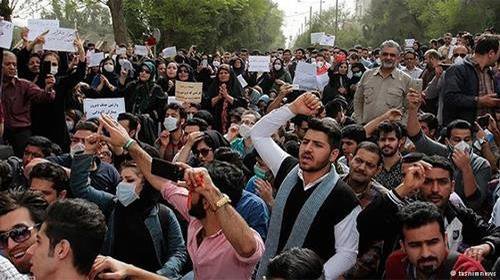
According to the New York Times, days of protests over dust storms, power failures and government mismanagement in one of Iran’s most oil-rich cities subsided on Sunday after security forces declared all demonstrations illegal.

Residents of Ahvaz, a city with a majority Arab population near the border with Iraq, had been protesting for five days in increasingly large gatherings, shown in cellphone video clips shared on social media.

The region around Ahvaz is a center of oil production in Iran, and since economic sanctions were lifted, Iranian people had hoped for changes to renovate the worn-out water and electricity instructures and fix deepening ecological problems.

The cellphone clips show protesters calling for the resignation of the local governor. And as the number of demonstrators grew, the demands started to include a call for top officials from the capital, Tehran, to come to Ahvaz to see the problems for themselves.

Demonstrators can also be heard shouting, “Unemployment, unemployment,” another big problem in the region, and urging their countrymen to offer assistance: “Iranian compatriots, help us, help us.”

A 15-year drought, in combination with poorly planned dam building, has caused local marshes to dry up, increasing the level of dust particles in the air to record highs.

The World Health Organization said in 2015 that Ahvaz was the most polluted city in the world.

With the ruling theocracy in Iran continuing to poor the country’s resources in to the Syrian war, supporting Yemeni’s Houthis, violent militia groups in Iraq, development of Ballistic Missiles,  the pressure will only mount and similar to how North Korea has handled persistent starvation, the Iranian regime will not flex its military muscles in an effort to divert attention from the misery of the Iranian people.

Michael Tomlinson
Filed Under: Blog, News Tagged With: Featured, Iran deal, Iran Human rights, Nuclear Deal

Case For Designating the IRGC as Terrorists Builds

February 15, 2017 by admin

Case For Designating the IRGC as Terrorists Builds

Case For Designating the IRGC as Terrorists Builds

Momentum continues to build for the U.S. to designate the Iranian Revolutionary Guard Corps a Foreign Terrorist Organization as a whole. Much of that momentum stems from the IRGC’s own actions over the years in supporting terrorism worldwide as well as initiating, supplying and controlling many of the proxy wars breaking out throughout the Middle East.

Even though there has already been well-documented disclosures about the IRGC’s illicit activities, new information continues to come to light as was the case on Tuesday when the National Council of Resistance of Iran (NCRI), a leading global organization of Iranian dissident and human rights groups, held a press conference in Washington, DC to disclose details of the IRGC’s terrorist training activities.

Alireza Jafarzadeh, deputy director of the Washington Office of the NCRI, presented information to reporters gathered by the social network of the People’s Mojahedin Organization of Iran, a dissident group located inside Iran. He said that information shows that since 2012, the NCRI has seen an increase in the training of foreign nationals in its terrorist training camps, which threatens a wide scope of countries, not just those beset by conventional warfare.

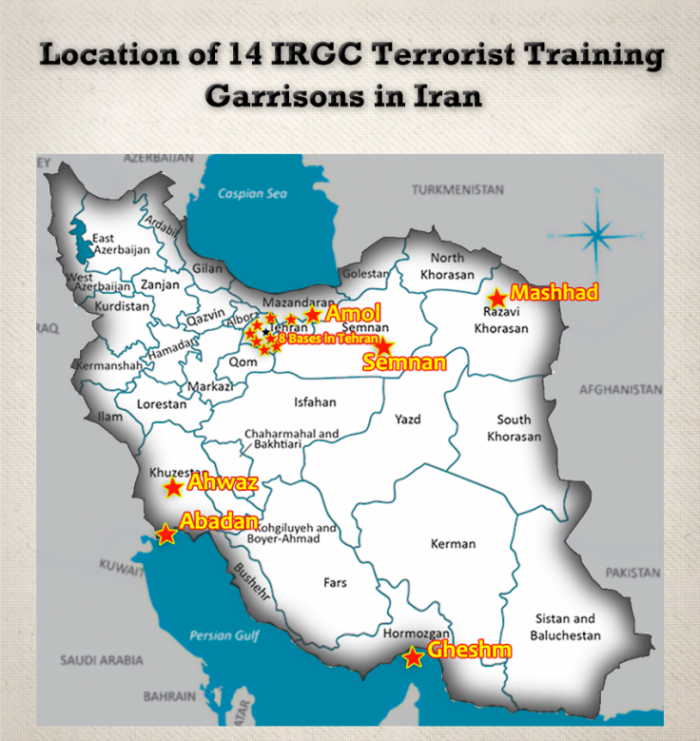
Using intelligence gleaned from sources within Iran, the NCRI claimed that the IRGC had created a training command operating dozens of military bases across Iran specializing in all aspects of warfare with units divided by national origin and specialization such as missile and naval operations to insurgency and urban warfare.

The IRGC that is answerable only to the Iranian regime’s top mullah, Ali Khamenei. It specializes in insurgency and guerilla tactics and is notorious for having supplied most of the IEDs used by Iranian-controlled Shiite militias in Iraq targeting U.S. and foreign troops; resulting in the deaths and wounding of thousands of Americans.

The IRGC was the initial unit that came to the rescue of the Assad regime in Syria as it teetered on the brink of collapse by smuggling in weapons and cash, as well as recruiting and directing Hezbollah fighters. It eventually expanded its role to include Iranian military, as well as the recruitment of Afghan mercenaries and deployment of Shiite militias from Iraq.

According to the NCRI, every month, hundreds of forces from Iraq, Syria, Yemen, Afghanistan and Lebanon — countries where the regime is involved in frontline combat — receive military training and are subsequently dispatched to the various frontlines. For operations in countries where there is no open warfare – including Persian Gulf countries, such as Bahrain and Kuwait – terrorists cells are trained instead.

The NCRI highlighted 14 IRGC training camps, as well as described the command structure, detailing how the commander of the Training Directorate, reports directly to Quds Force Commander, Qassem Soleimani.

Terrorist training for operatives from across the globe is commanded by Colonel Tahmasebi. Codenamed ‘320’, the commander of heavy weapons training at Imam Ali military base is Colonel Ali Mohammad. In charge of ‘VIP Security’ is Colonel Ramky, the NCRI said.

The sheer scale of the Training Directorate’s efficiency in producing fighters is underscored by the fact that just one of its training camps is currently sending 2,000 Afghans to Syria every week, according to the NCRI.

“The IRGC is actually the entity that runs the whole show when it comes to terrorism,” even though they are spearheaded by the Quds force, Jafarzadeh said. “You cannot do the separation. You cannot have the Quds force designated as a terrorist entity, but not the IRGC.”

Jafarzadeh said there is bipartisan support in Congress for the designation of the IRGC as a terrorist group, and suggested that with the new Trump administration, there is “a better possibility for those measures to move forward.”

The disclosures by the NCRI are significant since they provide first-hand and eyewitness accounts of the IRGC and Quds Force activities as it relates to the active support of terrorism and terror-related operations. It also points out with disturbing clarity the efforts by the Iranian regime to ramp up its military activities outside of its borders during the time it sought to portray itself as a “moderate” nation intent on resolving disputes peacefully.

Another example of those destabilizing activities has been the IRGC’s initiation of the revolt in Yemen with Houthi rebels supplied by IRGC forces; mostly smuggled aboard non-descript fishing boats in the Gulf of Aden.

Many of these ships have been intercepted and weapons confiscated by Saudi Arabian and Gulf State warships; the arms eventually traced back to Iranian factories.

Sanam Vakil, Ph.D an Associate Fellow at Catham House told IBTimes UK that the PMOI report spoke to the extent of the IRGC’s training scheme, although she could not independently verify the numbers.

“What I take from this is that this is a very sophisticated operation,” Vakil said. “Iran’s strategic strength is in a-symmetrical proxy relationships. Its conventional military is weak particularly in Iraqi and Syria they have had success in the past. Of course we also know they are the God Parents of Hezbollah.”

It is becoming increasingly clear that in order to effect the growth of Islamic-inspired terrorism abroad, the restraint of the IRGC will be a key factor. Designating it a FTO would be an important step in the right direction.

Michael Tomlinson

Filed Under: Blog, News Tagged With: Featured, Iran, Iran deal, Iran Human rights, Iran Mullahs, Iran Terrorism, IRGC, Khamenei, Syria, Yemen

Rebuilding the Global Coalition Against Iran

February 14, 2017 by admin

Rebuilding the Global Coalition Against Iran

Rebuilding the Global Coalition Against Iran

The early days of the Trump administration have offered opponents of the Iranian regime hope that a significant change in U.S. policy towards the Islamic state will presage a similar shift in global opinion towards the mullahs in Tehran.

If we reset back to when the first talks took place over Iran’s nuclear program, the unity amongst the international community was one of the hallmarks of forcing the regime to the bargaining table in the first place.

Three consecutive American presidential administrations imposed ever growing harsh sanctions on the regime. Coupled with the sinking Iranian economy due to gross mismanagement and corruption, the regime was brought to the bargaining table in a position of weakness. The mullahs recognized this in rigging a presidential election to install Hassan Rouhani as a benevolent “moderate” face following the much-reviled Mahmoud Ahmadinejad.

Unfortunately, instead of seizing the opportunity to effect significant changes to the regime’s conduct—especially its brutal human rights record and support for terrorism—the P5+1 group of nations, led by the Obama administration, picked the appeasement policy as its policy forward and folded like a cheap suit in caving to regime demands.

Gone were any restrictions on Iran’s ballistic missile program. Say goodbye to improving human rights within Iran. Forget about stemming the flow of terrorism around the world.

The opportunity to solve so many troubling problems through the single chance to make change within the Iranian regime was missed and for the past six years the world has paid a heavy price for that oversight.

While Iran lobby supporters such as the National Iranian American Council have been busy trumpeting the “wins” from the agreement, cities around the world have witnessed a much more dismal result.

Paris, Ottawa, Brussels, Sydney, Nice, Berlin, San Bernardino, Boston and Orlando are only some of the cities subjected to Islamic extremist terror, but far worse has been the whole sale slaughter committed in places such as Aleppo at the hands of Iranian regime forces.

Now with the Trump administration in place with the first encouraging signs of reversing the flow of moves aimed at appeasing the regime to one that is more confrontational and accountable, the diplomatic board has been reset with a fresh opportunity to rebuild that global coalition that was so effective before.

Reassembling a global consensus against the Iranian regime will be difficult, but it is achievable. The first promising signs have come from a Trump administration that has found prominent policy making positions for noted and vocal critics of the regime, including Mike Pompeo at the Central Intelligence Agency, Jeff Sessions as Attorney General and James Mattis as Secretary of Defense.

There has also been a unifying response from Iran’s neighbors, especially Arab nations who have been subjected to the prospect of terror attacks and outright war, including Saudi Arabia and the Gulf states. Their inclusion in any global consensus building against Iran will be vital.

Also, unlike the prior administration, the Iran lobby has been frozen out of the equation and does not have the same access it enjoyed previously into the White House and State Department. White House visitor logs are unlikely to show the National Iranian American Council’s Trita Parsi traipsing through the West Wing anymore.

Already, we have seen some possible signs of the Trump administration’s efforts to rebuild a relationship with Russia and drive a wedge between Russia and Iran. Of course, separating the two may prove unachievable, but it does set the scenario for Trump to engage in some old fashioned horse trading in which the Vladimir Putin might be induced to give up his support for Iran in exchange for something else.

An editorial by a scholar at the Foundation for the Defense of Democracies, offered some thoughts on how Russia might be persuaded to change its support for Iran in an editorial in the Wall Street Journal.

“What, then, is the best American strategy? Iran continues its campaign against the U.S., and it won’t end so long as the regime endures. Therefore American policy must rely on dismantling the Khamenei regime as peacefully as possible, perhaps from the inside out,” the editorial writes.

“Antiregime demonstrations erupt in Iran all the time, and most experts believe the vast majority of Iranians detest Mr. Khamenei and his henchmen. With U.S. support, these millions of Iranians could topple the Islamic Republic and establish a secular government resembling those in the West,” he adds. “With the Islamic Republic gone, the Trump administration would be in a much stronger position to strike a deal with Mr. Putin. The road to Moscow runs through Tehran.”

The more troublesome part of any international coalition might be getting a unified Europe which has responded to the lifting of economic sanctions on Iran with an unbridled rush to tap Iranian markets. Who can forget the parade of EU officials leading trade delegations to Tehran in the aftermath of the deal while Iranian men, women and children were being publicly executed.

Even after the swelling in terrorist attacks and flood of refugees fleeing the Iranian-caused Syrian civil war, some European leaders still seem to be adopting a position of bowing to Iranian regime demands.

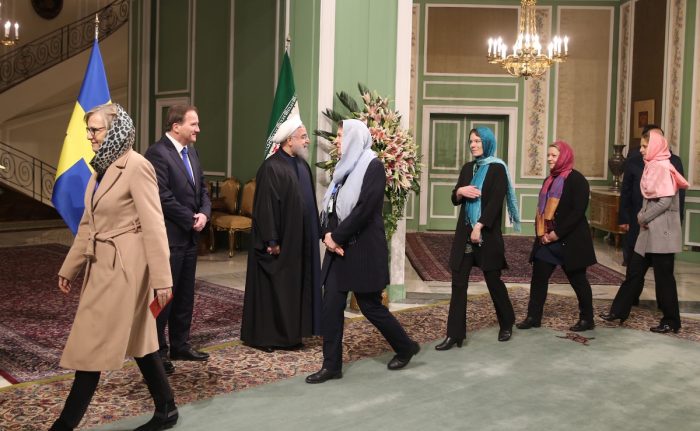
One such example was the much-criticized visit of the Swedish trade minister in which she and the female members of her delegation wore hijab coverings and met with Hassan Rouhani and an all-male team.

The irony of the photo opportunity was not lost on many human and women’s rights groups.

Considering that previous state visits to Saudi Arabia by female leaders such as Michelle Obama and German Defense Minister Ursula von der Leyen publicized their decisions to forgo wearing traditional head coverings, the willingness to acquiesce to Iranian demands is deeply troubling.

We can only hope that the rest of Europe realizes that winning a few dollars isn’t worth empowering more terrorism.

Laura Carnahan

Filed Under: Blog, News Tagged With: Featured, Iran deal, Iran Human rights, Iran Mullahs, Iran Terrorism, nuclear talks, Rouhani, Sanctions

Campaign of Disinformation by Iran Regime Revealed

February 14, 2017 by admin

Campaign of Disinformation by Iran Regime Revealed

Campaign of Disinformation by Iran Regime Revealed

Besides the much-discussed “echo chamber” that arose out of the negotiations for the Iran nuclear deal utilizing a network of so-called experts in academia and organizations such as the National Iranian American Council to push false narratives about the benefits of the deal, the Iranian regime itself has undertaken several initiatives to push other false and misleading narratives to defame the Iranian dissident movement.

At the center of that disinformation campaign lays the Iranian regime’s Ministry of Intelligence Services. If Hitler relied on Joseph Goebbels to help spread Nazi propaganda, the mullahs in Tehran rely on the MOIS to do the same job.

To say the MOIS is a shadowy organization is like saying grease is slippery. The MOIS was created out of the former Shah of Iran’s infamous SAVAK intelligence service which had been notorious for its brutal methods.

The mullahs opted to keep much of the former intelligence services more ruthless elements in support of the founding of their religious theocracy. As part of its first missions, it sought to infiltrate many of the democracy and opposition groups in those early years and insidiously target and even assassinate many of its leaders to help secure the mullahs’ rule.

Since then the MOIS has blazed a trail that included an infamous series of assassinations of dissident writers and intellectuals and Iranian political dissidents both inside and outside Iran. Of special importance were members of resistance groups such as the People’s Mojahedin Organization of Iran otherwise known as the Mojahedin-e Khalq.

For the MOIS and the mullahs it serves, nothing is more galling than to have fellow Iranians actively and aggressively resist their rule because as long as Iranians oppose their rule, the pathway exists for regime change and a transition to freedom and democracy.

One of the more aggressive tactics the MOIS has employed to distort the discussion about the Iranian regime’s policies has been the use of former dissident members who were either recruited or coerced into denouncing opposition movements.

Col. Wes Martin (US), former Anti-terrorism/Force Protection Officer of all Coalition forces in Iraq and a frequent news contributor, wrote about the MOIS use of disinformation in the U.S. in a piece in The Hill.

A report commissioned by the Pentagon and released by the Library of Congress provides an alarming look into the operations of Iran’s MOIS right here in the United States, he writes.

“MOIS recruited former members of the (People’s Mujahedin of Iran-PMOI, also known as MEK) in Europe and used them to launch a disinformation campaign against (PMOI),” the report reads.

Among those named in the Pentagon report are Massoud Khodabandeh and his British wife, Anne. They were recruited by the MOIS in the mid-1990s and used as assets against the opposition before launching the ‘Iran-Interlink’ website explicitly under Tehran’s orders, Martin adds.

“The MOIS resorts to character assassination against lawmakers and reporters who hold positive views of the Iranian opposition, aiming to silence their voices,” he said.

Martin cited a 2014 report by iSight Partners which uncovered a three-year espionage campaign, originating in Iran, that used an elaborate scheme involving a fabricated news agency, fake social media accounts and bogus journalist identities to deceive victims in the United States and elsewhere.

Martin went on to cite other fake news sites operated by Khodabandeh such as mesconult.com are hosted by Ravand Cybertech, an entity run by the Iranian regime directly. It is not a coincidence that postings from these sites are often cited in Iranian state-controlled media as “news sources.”

Dr. Majid Rafizadeh, an Iranian-American scholar, author and U.S. foreign policy specialist and president of the International American Council, also wrote about the more direct introduction of Iranian regime lobbyists and operatives into the U.S. and Europe on the ground to push the regime’s agenda.

“Many argue that some of Iran’s lobbyists work in plain sight and had access to top officials at the White House and State Department; they lobbied for the lifting of sanctions against the Islamic Republic, top state sponsor of terrorism, and subsequently lifting of sanctions against Iran’s Revolutionary Guards Corp (IRGC), while demonizing Iranian-Americans who called for firmness against Iran’s ruling clerics and ayatollahs,” he writes.

“Cutting to the chase, it seems that the lobbyists and advocates for the Islamic Republic, next dismiss anyone suggesting the US should respond to this appalling conduct with firmness as a warmonger. But nobody appears to want, or ask for, armed conflict with Iran, so that is not an option,” he adds.

The disconnect between the claims of the Iranian regime’s lobbyists and supporters and the reality of the day grows larger every day. Unfortunately, those who are capable of setting a new standard for disagreeing with the regime even on a subtle level seem to cave to the Iran lobby’s arguments.

One example was a visit by a delegation from Sweden’s self-declared “first feminist government” which folded and enshrouded themselves in head coverings as they met with Hassan Rouhani in a blatant blow to Iran’s feminist movement, which has been under severe attacks by the mullahs.

UN Watch declared in a press release its concern over Sweden’s failure to promote a “gender equality perspective.”

In doing so, the Swedish female politicians ignored the recent appeal by Iranian women’s right activists who urged Europeans female politicians “to stand for [their] own dignity” and refuse to wear the hijab when visiting Iran.

“European female politicians are hypocrites,” says one activist. “Because they stand up with French Muslim women and condemn the burkini ban—because they think compulsion is bad—but when it happens to Iran, they just care about money.”

The scene in Tehran on Saturday was also a sharp contrast to Deputy Prime Minister Isabella Lövin’s feminist stance against Trump, in a viral tweet and then in a Guardian op-ed last week, in which she wrote that “the world need strong leadership for women’s rights.”

Linde “sees no conflict” between her government’s human rights policy and signing trade deals with an oppressive dictatorship that tortures prisoners, persecutes gays, and is a leading executioner of minors, UN Watch declared.

We can only hope that world media attention is more tightly focused on the real machinations going on with the Iran lobby and its MOIS taskmasters.

Michael Tomlinson

Filed Under: Blog, News Tagged With: #NuclearDeal, Appeasement policy, Featured, Iran deal, Iran Human rights, Iran Lobby, Iran Terrorism, National Iranian American Council, NIAC, NIAC Action

Possible Designation of IRGC as Terror Organization Huge Step Forward

February 9, 2017 by admin

Possible Designation of IRGC as Terror Organization Huge Step Forward

Possible Designation of IRGC as Terror Organization Huge Step Forward

The Trump White House’s deliberations over designating the Iranian regime’s Revolutionary Guard Corps as a Foreign Terrorist Organization (FTO) is a monumental and long overdue step on the road to finally blocking the expansion of extremism in the region.

For too long, past administrations have placed sanctions on aspects of the IRGC, including specific leaders and even units within it such as the Quds Force, but none had been willing to seriously raise the question about designating the IRGC as a whole.

For the U.S., this administration’s team is making a series of calculations based on the fundamental truth about the IRGC, which is that to solve the puzzle of rising Islamic extremism, you cannot nibble at the edges, but have to attack it at its center.

The White House is likely to move more quickly on the designation of the Islamic Revolutionary Guard Corps, which could be less of a challenge to implement, one person familiar with the discussions said. It was unclear when a decision would be made on that designation, according to the Wall Street Journal.

The Revolutionary Guard is the Iranian regime’s elite military unit and reports directly to top mullah, Ali Khamenei, with a command separate from Iran’s traditional military. It was established following the 1979 Islamic revolution in Iran and over the past decade has also grown to dominate Iran’s economy, with holdings in property, oil and gas and telecommunications. U.S. officials estimate the IRGC controls as much as 50% of Iran’s economy.

The Trump administration last week imposed new sanctions on more than two dozen Iranian individuals and entities in retaliation for the country’s latest ballistic missile test launch, in January.

Taking the step of designating the Revolutionary Guard as a terrorist organization would give the U.S. further latitude to target the IRGC’s finances and companies, which would affect large sectors of Iranian regime’s economy.

Emanuele Ottolenghi, an expert at the Foundation for Defense of Democracies who supports the move to designate the IRGC, said it would go beyond efforts by the Bush administration to more narrowly target the military group’s illicit trade and funding for terrorism.

“The net effect would be more significant. It would cast the net more widely,” he said.

According to the Journal, there is broad and bipartisan support within Congress to designate the IRGC and levy additional sanctions much to the chagrin of the Iran lobby which went into full-defense mode and scrambled to block this latest in a string of moves aimed at the regime.

Loyal regime ally, the National Iranian American Council issued talking points opposing the designation which was a verbatim regurgitation of past defenses of the regime and offered nothing new; hanging its hat on the sole prospect that the nuclear deal would be jeopardized.

The move to designate the IRGC strikes at the very heart of the economic engine that fuels the mullahs rule and expansion of terrorism in the region.

Without access to the ill-gotten gains they secure from the industries controlled by the IRGC, the mullahs could not support their proxy wars, could not upgrade its military and could not continue to funnel cash to the Assad regime in Syria or keep Hezbollah afloat.

As pointed at in a piece for the Daily Caller, targeting the IRGC is the culmination of a long series of militant actions by the IRGC that has resulted in loss of U.S. lives.

Iran and elements of the IRGC were implicated several times in assisting in the killing of U.S. soldiers in Iraq. Marine Gen. Joseph Dunford, chairman of the Joint Chiefs of Staff, told Congress a year ago, “I know the total number of soldiers, sailors, airmen and Marines that were killed by Iranian activities, and the number has been recently quoted as about 500.”

It could also cripple the Iranian regime to a point where the prospect of true democratic reforms could finally emerge.

Of course all of this is only hopeful speculation at this point, but the prospect of aggressive action against the regime after years of trying to appease the mullahs bore no fruit is a welcome turnaround for critics of the regime and should provide a valuable morale boost to the long struggle against the regime waged by Iranian dissident groups.


Shahriar Kia, a political analyst and member of the Iranian opposition, the People’s Mujahedin Organization of Iran (PMOI, also known as the MEK), wrote in the Hill that the Kayhan daily, the known Khamenei mouthpiece, revealed the Iranian regime’s terrified status quo, describing this as a “historic turn.”

“There are times when developments take such an unprecedented pace, making any forecasting about the future quite difficult,” the piece reads.

Iranian Deputy Foreign Minister Abbas Araqchi said in a recent TV interview Tehran’s foreign policy will face serious crises with Donald Trump coming to the White House.

Ali Khorram, an Iranian Foreign Ministry official, suggested the mullahs’ regime should use “common sense” and keep a low profile during such times.

The state-run Iran daily wrote, “This measure by Iran provides an excuse for Trump to take actions against Iran, increasing his intention to disrupt the status quo resulting from the Iran nuclear deal.”

That has to be pretty disturbing to them.

Laura Carnahan

Filed Under: Blog, Current Trend, National Iranian-American Council, News Tagged With: Featured, Iran, Iran deal, Iran Human rights, Iran Lobby, Iran Terrorism, National Iranian American Council, NIAC, NIAC Action, Sanctions

Time for the NIAC to Pack It Up

January 27, 2017 by admin

Time for the NIAC to Pack It Up

Time for the NIAC to Pack It Up

The National Iranian American Council was born out of an idea hatched by Trita Parsi to develop a US-based group that could serve as an effective lobbying force for the interests of the Iranian regime. It could help provide “cover” for the mullahs by pushing a narrative seeking to reshape the public image of the Iranian regime.

It did so through editorials and press releases and through the use of NIAC staffers as so-called Iranian “experts” to news media. The intelligentsia and academia were regaled with lofty tales of how Iranian regime could be a friend to the US instead of an enemy and how the intractable problems of the Middle East could be solved through a moderate and willing Iranian partner.

The NIAC became part of the “echo chamber” created by the Obama administration to help push that narrative as it sought a nuclear deal with the mullahs in Tehran. NIAC staff such as Reza Marashi and Tyler Cullis obligingly offered up these fantasies even as Iran mullahs essentially set the stage for the Syrian civil war by jumping in to prop up the Assad regime.

The NIAC deepened its efforts by creating NIAC Action, a direct lobbying arm so it could knock on the doors of Congressmen and Senators and pressure them into supporting a badly flawed nuclear deal and promise them political cover by offering to say “Iranian-Americans” supported it.

Even as the death toll mounted by the thousands in Syria at the hands of Iranian forces and the barrels of Iranian guns and refugees flooded into Europe by the millions, the NIAC was resolutely pushing ahead to preserve the deal by blaming Saudi Arabia and other enemies of Iran for these problems.

Against the dubious backdrop of midnight flights of pallets loaded with cash in exchange for American hostages, the NIAC still kept at the narrative, ignoring the risk to Iranian-Americans and other dual nationals being arrested in Iran at an astonishing rate and Hassan Rouhani’s flat out refusal to recognize dual nationalities.

While the NIAC argued for loosening of restrictions to allow the freer flow of cash to Iran, the regime cracked down even harder on dissent at home with over 3,000 executions in four years and arrests of journalists, students, artists, bloggers and dissidents by the scores.

Even the US news media were getting the idea that NIAC did not have much to offer being apologists for the Iranian regime every time anything went wrong as NIAC staffers found less ink and air time on mainstream media and found themselves relegated to self-publishing blogs and fringe websites more prone to fake news than real news.

The election of Donald Trump and the sweep of Republicans into both houses of Congress put an even bigger damper on NIAC’s prospects to help the Iranian regime any more, which raises the most logical question: Is it time for the NIAC to close shop?

The question is not just rhetorical, but should prompt a serious discussion among supporters of the NIAC and its donors. What role will the NIAC play in a Trump presidency?

The same question must be vexing Parsi and his colleagues since we’ve seen a noticeable shift in their public comments on items. Instead of slavishly towing the party line of the mullahs in Tehran, the NIAC now has been busy commenting on issues related to Trump’s immigration proposes.

Some might argue that these topics should be the more traditional and appropriate topics for support and debate by an organization putatively claiming to support Iranian-Americans.

Unfortunately, the shift has less to do with genuine and sincere attention to a legitimate issue, but probably rather a need to justify the continued existence of NIAC.

One benchmark of that imperiled future will be the NIAC’s Bay Area fundraiser scheduled for February 12, 2017. The NIAC website states that the proceeds will be used “to support immediate efforts to combat discrimination, support civil rights, protect the US-Iran Nuclear Deal, and prevent war.”

Given the NIAC’s track record, virtually all the funds will be used to preserve the Iranian regime’s interest? Parsi and the NIAC have no real interest in the concerns and issues facing Iranian-Americans. They are more concerned about all facets of the Iranian regime and how to keep maintaining support for it. The NIAC’s checklist is absurdly limited given the state of the world:

  • Preserve the Iran nuclear deal so Iranian regime does not suffer renewed sanctions;
  • Oppose any new or re-imposition of sanctions on Iran;
  • Denounce and defend any accusation against the Iranian regime for sponsoring terror or human rights abuses;
  • Tie any effort to rein in Iran as a pathway to war and empowering “hardliners” in Iran; and
  • Keep the money flowing to Tehran and the mullah’s coffers at all costs.

These should not be the priorities of any group concerned with Iranian-American issues. They are the concerns only of an organization dedicated to doing the bidding of the mullahs in Tehran.

It’s time for the NIAC to go away and for a legitimate group to rise in its place to be a true advocate for Iranian-Americans and not a mouthpiece for Tehran.

Michael Tomlinson

Filed Under: Blog, National Iranian-American Council, News Tagged With: Featured, Iran deal, Iran Human rights, Iran sanctions, Iran Talks, Iran Terrorism, National Iranian American Council, NIAC, NIAC Action, nuclear talks, Reza Marashi, Sanctions, Trita Parsi, Tyler Cullis

Obama White House Logs Disclose Access to Iran Lobbyists

January 26, 2017 by admin

Obama White House Logs Disclose Access to Iran Lobbyists

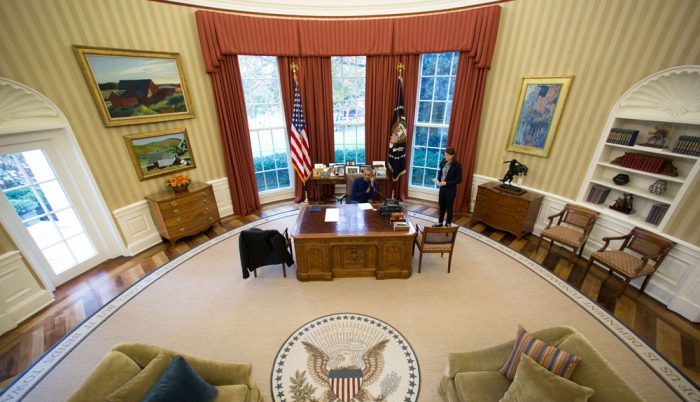
President Barack Obama makes Thanksgiving Day phone calls from the Oval Office to U.S. troops stationed around the world, Nov. 24, 2016. The President’s Coast Guard military aide, LCDR Ginny Nadolny is at right.
(Official White House Photo by Pete Souza)

The Washington Free Beacon disclosed that a former Iranian regime official and a leader in the Iran lobby enjoyed unprecedented access to the White House under the Obama administration.

The two were hosted at the White House for more than 30 meetings with top officials at key junctures in the former administration’s contested diplomacy with Iran, according to White House visitor logs that provide a window into the former administration’s outreach to leading pro-Iran advocates, according to the Free Beacon.

Seyed Mousavian, a former Iranian diplomat and head of the regime’s national security council, was hosted at the White House at least three times, while Trita Parsi, a pro-Iran advocate long accused of hiding his ties to the Iranian government, met with Obama administration officials a stunning 33 times, according to recently updated visitor logs.

Sources familiar with the nature of the meetings told the Washington Free Beacon that both Parsi and Mousavian helped the White House craft its pro-Iran messaging and talking points that helped lead to the nuclear agreement with Iran. These efforts were part of a larger pro-Iran deal “echo chamber” led by senior Obama administration officials who were tasked with misleading Congress about the nature of the deal.

Mousavian, who also served as Iran’s spokesperson during negotiations with the international community on the Iran deal, visited with White House National Security Council official Robert Malley, who advised the former president about the Middle East and the Islamic State terror group.

“Mousavian was Iran’s ambassador to Germany back in the 1990s, when that embassy was the central node of Iran’s European terror network and those in Germany were murdering dissidents in Berlin,” one veteran Iran analyst who frequently works with Congress on the issue told the Free Beacon. “Later he came to the U.S., where he’s being paid for with tens of thousands of dollars from the Ploughshares Fund, which funded the Ben Rhodes echo chamber.”

Parsi, head of the National Iranian American Council, a group tied to the broader Iran lobbying movement and tied to the Obama White House that helped spearhead a pro-Iran narrative, met with several senior Obama administration officials during dozens of visits to the White House, the logs show.

This included private, one-on-one meetings with Obama adviser Ben Rhodes, who helmed what he described as the White House’s pro-Iran deal “echo chamber,” as well as meetings with Malley and Colin Kahl, national security adviser to former Vice President Joe Biden. Parsi also met with the White House NSC’s director for Iran, its senior director, legislative liaisons, and public engagement officials, according to sources familiar with the nature of these meetings.

In one instance, Parsi was signed into the White House by Solomon Tarlin, a West Wing intern and supporter of the Middle East advocacy group J Street.

Free Beacon quoting an expert on Pentagon writes: “Talk about letting the fox into the hen house. Letting the head of an organization whose foreign policy positions are indistinguishable from the Islamic Republic more than 30 times would be analogous to letting the Soviet Union’s chief lobbyist help guide policy during the Cold War.”

“During the Bush administration, Parsi thought nothing of dining with [Former Iranian President] Mahmoud Ahmadinejad, and his private emails, released as part of a court-ordered discovery process, show that he lied to the U.S. press and coached Iranian officials in order to weaken sanctions and promote the Islamic Republic,” The expert said.

The visitor’s logs reveal the depth of Parsi’s involvement in building the false narrative of the Iran nuclear deal and also may explain why the Obama administration was quick to appease the mullahs in Tehran, by forgoing linking such important issues as ballistic missiles, human rights and terrorism.

With the incoming Trump administration, it is almost assured that Parsi’s access to the White House and key advisors has been reduced to zero, which explains why Parsi now has taken to authoring editorials in a tedious effort to influence a monumental shift in American foreign policy.

In many ways Parsi efforts are more akin to the Little Dutch Boy sticking his finger in dike than his previous august position as White House visitor.

In a piece for Foreign Policy, Parsi trotted out the same, tired talking points: Iran is good. Saudi Arabia is bad. Hard liners will be empowered in Iran. Trump’s cabinet picks are war mongers. Iran does not support proxies.

Parsi’s efforts to try and convince everyone that Iran does not fund and control Hezbollah or Shiite militias in Iraqi or Houthi rebels in Yemen is pathetic and patently false. All anyone has to do is follow the trail of cash and arms from Tehran to all parts of the Middle East and you can see how the Iranian regime sits at the center of the proxy wars in the region.

But Parsi’s efforts may be waning as he and his Iran lobby colleagues shift chaotically from issue to issue in an effort to keep up with the wide ranging agenda of the Trump administration which called for a moratorium on Syrian refugees pending verification of their backgrounds in a nod to the Islamic extremist terror attacks taking place across Europe in Paris, Nice, Brussels and Berlin.

A new poll revealed in the Wall Street Journal that support for Hassan Rouhani among the Iranian people has plummeted as years of war and economic stagnation coupled with unrelenting human rights abuses had sapped his favorability.

The survey results paint a picture of an Iranian public wary and skeptical about the economic benefits they thought it would bring as a result of the Iran Deal.

Conducted in December for the University of Maryland, the survey is based on telephone interviews with 1,000 Iranians and provides a gauge of public opinion in a country where independent polling is rare.

“Rouhani’s popularity is taking a hit primarily because he is perceived to have failed to deliver on his campaign promises,” said the president and chief executive of Toronto-based company which conducted the survey on the school’s behalf.

About 51% said the country’s economic conditions were worsening, up from 43% in June. Almost three-quarters of the Iranians surveyed said the deal hadn’t improved people’s living conditions.

With the presidential election looming in May, it is almost assured that the regime will once again rig the election to deliver a candidate in lock-step with the mullahs’ policies and those of top mullah Ali Khmenei.

Michael Tomlinson

Filed Under: Blog, Current Trend, Latest from Lobbies & Appeasers, National Iranian-American Council, News Tagged With: Appeasement policy, Featured, hassan rouhani, Iran, Iran deal, Iran Human rights, Iran Lobby, National Iranian American Council, NIAC, NIAC Action, Rouhani, Trita Parsi

Get it Right: Iran’s Rafsanjani Was Not a Moderate

January 10, 2017 by admin

Get it Right: Iran’s Rafsanjani Was Not a Moderate

Get it Right: Iran’s Rafsanjani Was Not a Moderate

Ali Akbar Hashemi Rafsanjani died and many Western media outlets breathlessly reported that his death would be a devastating blow to Iran’s “reformers” and how that moderate movement had lost one of its lions.

Let’s get something straight right off the bat: Rafsanjani was not a reformer or moderate. He was a staunch leader of the Iranian regime from the very beginning as a disciple of Ruhollah Khomeini and led Iran’s armed forces during its bloody war with Iraq and as president.

His long record is often overlooked by most journalists who are too enamored with the image of a pop-culture icon of change and reform and buy into the narrative that Rafsanjani was a man valiantly leading the fight against the obstructionist Islamists and hardcore neo-cons.

The headline from the New York Times was typical of this idiotic adoration for a man who oversaw the growth of the Iranian regime and committed various murders, assassinations and attacks against political opponents and dissidents to keep it firmly in his hands and his fellow mullahs.

“Death of Iran’s Rafsanjani Removes Influential Voice Against Hardliners” read the Times headline.

The distinction of calling Rafsanjani a moderate is like making a distinction between Hermann Goering and Henrich Himler in Nazi Germany. There is little difference and both collaborated to make the Nazi’s control of Europe a long and bloody one.

Over the past 38 years, both under Khomeini and in later years, Rafsanjani played a critical role in suppression at home and export of terrorism abroad as well as in the quest to acquire nuclear weapons. Though portrayed by some Western media outlets as a “pragmatist” or “moderate,” during his long career he was associated with some of the regime’s most egregious actions, including mass-casualty terror attacks and the assassinations of exiled dissidents.

Heshmat Alavi, an Iranian human rights activist, took the characterizations of Rafsanjani to task in an editorial in Forbes.

Recently Rafsanjani gained a reputation for his aggressive challenge against Iranian Supreme Leader Ali Khamenei, while playing the role model for Hassan Rouhani, Iran’s so-called “moderate” president,” Alavi said.

Of course, Rafsanjani was definitely considered part and parcel to the religious establishment in Iran, bearing in mind his special ties to regime founder Ruhollah Khomeini, who died back in 1989. However, appeasement advocates in the West dubbed him as a “pragmatic conservative” willing to work with the outside world, especially the “Great Satan,” he added.

While Rafsanjani’s power diminished noticeably in recent years, he continued to enjoy a final post as chief of the Expediency Council, assigned to seemingly resolve disputes between the Guardian Council and parliament. The former is an ultra-conservative body closely knitted to Khamenei and known to screen all electoral candidates according to their loyalty to the regime establishment.

Reuel Gerecht and Ray Takeyh detail Rafsanjani’s long and often bloody history in an editorial in the Washington Post pointing out that during his presidency (1989–1997), Rafsanjani revamped the Atomic Energy Organization, sought to lure Iranian scientists from abroad and went on a shopping spree for dual-use nuclear technologies.

Rafsanjani’s published daily journals, which cover his presidency, reveal tantalizing evidence of cooperation with North Korea on ballistic missiles and weapons of mass destruction. They also reveal Rafsanjani’s glee in outfoxing U.S. naval surveillance, Gerecht and Takeyh said.

Make no mistake, Rafsanjani was no egalitarian for the people. He accumulated a vast mountain of wealth for himself and his family amounting to billions.

“One brother headed the country’s largest copper mine; another took control of the state-owned TV network; a brother-in-law became governor of Kerman province, while a cousin runs an outfit that dominates Iran’s $400 million pistachio export business; a nephew and one of Rafsanjani’s sons took key positions in the Ministry of Oil; another son heads the Tehran Metro construction project (an estimated $700 million spent so far),” states a 2003 Forbes analysis.

The report also mentions billions stashed by the Rafsanjanis in overseas bank accounts.

“Some of the family’s wealth is out there for all to see. Rafsanjani’s youngest son, Yaser, owns a 30-acre horse farm in the super-fashionable Lavasan neighborhood of north Tehran, where land goes for over $4 million an acre. Just where did Yaser get his money? A Belgian-educated businessman, he runs a large export-import firm that includes baby food, bottled water and industrial machinery.”

More importantly, Rafsanjani represents one of the last leaders of the revolution and as such the power stemming from that iconic moment now falls to the oldest living leaders in the Islamic state such as Ali Khamenei and his handpicked leaders such as Hassan Rouhani.

Power in the Iranian regime does not flow down as much as it flows laterally among a small cadre of committed religious leaders who jealously guard their financial fortunes as much as the rigid Shiite ideology of the state.

So while media outlets are analyzing the impact this will have on Iran’s “moderates” the more important and appropriate question is how to reintroduce and empower true moderates back into Iranian politics and not simply settle for calling regime leaders “moderates” because they happen to be less brutal than others.

Is it a sign of moderation when one mullah advocates imprisonment for a dissident while another calls for a public hanging?

That is the mistake media outlets are making with Rafsanjani.

Laura Carnahan

Filed Under: Blog, News Tagged With: Appeasement policy, Featured, Iran Human rights, Rafsanjani

Iran Lobby Voice Becoming Lonelier With New Congress

January 7, 2017 by admin

Iran Lobby Voice Becoming Lonelier With New Congress

Iran Lobby Voice Becoming Lonelier With New Congress

A new Republican-controlled Congress took office on Tuesday and with it comes the promise of sweeping changes in American foreign policy versus the last eight years. Most notable will be an almost certain end to the policy of appeasing the Iranian regime followed by the Obama administration in the hopes of moderating Iran’s behavior.

What is also sure to happen as well is a greatly diminished role for the Iran lobby in this new administration, especially for supporters such as the National Iranian American Council. Evidence of that reduced stature and influence has come in the downward spiral in media opportunities members of the NIAC are receiving.

Trita Parsi for example has been relegated to providing analysis on Russia Today segments and the self-blogging forum TopTopic has become the go-to publisher of NIAC commentary. Gone are the heady days of placements in the New York Times and CBS News and now they face the uncomfortable truth that they are in danger of becoming irrelevant.

One of those TopTopic pieces was written by Ryan Costello from NIAC in which he lamented the tidal wave of bills being introduced aimed at punishing various aspects of the Iranian regime such as a bill by Rep. Alcee Hastings (D-FL) authorizing the Trump administration to use military force against Iran should it be necessary.

Costello characterizes Hasting’s move as representative of a “small minority” of Democrats opposed to the nuclear deal with Iran, but what he fails to acknowledge is the fact that there is actually a growing nucleus of Democrats that the American people want to stop giving Iran endless concessions.

Costello goes on to mention additional bills being offered up including one proposal by Sen. Dean Heller (R-NV) that would impose sanctions on Iran for its ballistic missile program. While Costello laments the flood of bills coming to the fore with the change in Congress, he—and the rest of the Iran lobby—ignore the reasons why these bills are being offered up now.

The mood in America and frankly through most of Europe has swung dramatically since the nuclear agreement was reached with Iran from one of hopeful optimism to uncertainty and fear. The rise of Islamic extremism rippling across the globe, striking in cities such as Boston, San Bernardino, Orlando, Paris, Brussels, Nice and Berlin, have all been harsh reminders to elected officials that wishing for moderation does not yield moderation from extremist groups and hostile nations such as Iran.

The question of how to confront Iranian extremism has never been answered by the Iran lobby other than to repeatedly call for more accommodation and more restraint. That position has now lost its status and consigned to the political junk heap of obscure blogs and media controlled by Iran and its few allies.

Now the major media have turned their attention to the specific pathways open to Trump to restrain the Iranian regime and that is a fundamentally different approach from what the Iran lobby has tried to champion over the past five years.

The Wall Street Journal looked at the possibility of re-imposing economic sanctions, which may be opposed by European allies, is certainly available to Trump as a leverage tool at the very least.

President Trump could, among other things, re-impose the “secondary” sanctions that bar foreign companies from doing business with those individuals or entities on sanctions lists, the Journal said.

“The Iran sanctions program will be the one with the quickest attempt by the administration to put their mark on,” said Adam Smith, an attorney at Gibson Dunn & Crutcher LLP who previously served as a senior adviser at the U.S. Treasury Department’s Office of Foreign Assets Control, the main enforcement body for sanctions.

Heshmat Alavi, a political and rights activist, authored a piece in The Hill tackling this notion of Iranian “moderation” and declaring it a myth solely designed to gain Western support for a deal that would allow the mullahs access to billions of dollars in desperately needed cash.

“If Tehran truly bore the intent to not only embrace the nuclear agreement but the spirit of the accord with the West, they would not have test-fired missiles in March or October of this year,” he said.

“If the mullahs are actually sensitive about the human rights of ordinary Iranian citizens, then this regime would not have executed over 3,000 people in the past four years alone and nearly 1,000 in 2015.

“This regime, if actually sensitive about its ‘moderate’ image, would not be executing women and minors, and would not be sending opposition supporters to the gallows. This certainly doesn’t sound anything similar to ‘moderate’ behavior, at least not in the democratic world,” Alavi added.

Alavi calls for greater outreach by the Trump administration to avowed opposition and dissident groups such as the National Council of Resistance of Iran, a broad coalition of Iranian dissident and human rights groups opposed to the mullahs rule.

By switching from listening to the propaganda of the Iran lobby to the sound policy recommendations of the Iranian opposition, Trump can advance the cause of peace and democracy in the Middle East faster than anyone could imagine.

Michael Tomlinson

Filed Under: Blog, National Iranian-American Council, News Tagged With: #NuclearDeal, Appeasement policy, Featured, hassan rouhani, Iran Human rights, Iran Lobby, NIAC, NIAC Action, Trita Parsi, Tyler Cullis

Iran Regime Operates Through Fear and Intimidation to Work

January 7, 2017 by admin

Iran Regime Operates Through Fear and Intimidation to Work

Iran Regime Operates Through Fear and Intimidation to Work

“I learned that courage was not the absence of fear, but the triumph over it. The brave man is not he who does not feel afraid, but he who conquers that fear,” said Nelson Mandela, the former president of South Africa and prisoner of conscience who led his nation out of apartheid rule.

He recognized during his long imprisonment for his political beliefs that to conquer a regime and policy of institutionalized oppression, one had to first conquer the fear that institution uses to control its people. It is through the tools of violence, fear and intimidation that a people can remain oppressed for generations.

For the Iranian regime, the mullahs learned early on the lessons of similar oppressive regimes throughout history. Whether you were a Roman tribune enslaving barbarians or a Nazi Stormtrooper kicking down doors in the Warsaw ghetto or a Boko Haram fighter kidnapping scores of girls to auction them as sex slaves, the tools of intimidation and fear were universal in your efforts to maintain control.

Throughout Iran, the mullahs impose the same practices through the use of religious courts that hand down brutal sentences almost on a whim with no accountability, to roving bands of Basji paramilitaries who are free to accost and beat women on the street for violating dress codes.

The mullahs use the same principles in exporting their extremist brand of Islam by supporting terrorist proxies such as Hezbollah or growing their own Shiite militia in Iraq which can be used to subjugate Sunni villages or be shipped off to fight in Syria.

The use of military power and violence is a tried and tested prescription for the Iranian regime to impose its will.

Unfortunately for the mullahs, history has proven those policies eventually fail. Although Rome stood for thousands of years, it eventually collapsed under its own corruption and inability to assimilate the regions it conquered into peaceful co-existence. Eventually all totalitarian regimes have fallen throughout human history; the only question has been how long has it taken?

For the Iranian regime, the clock is running and the mullahs recognize their time may very well run out on them as their economy remains stagnant, unemployment especially among young people remains sky-high and technology improvements in social media and mobility have made it almost impossible to keep a lid on dissenting voices.

Even a string of hunger strikes by political prisoners has resonance as their plight is carried throughout the world on Twitter, Facebook, WhatsApp and Snapchat and has led to noted people such as Nobel peace prize laureate Shirin Ebadi to openly call for the head of Iran’s judiciary to quit.

Sadeq Larijani was appointed by Ali Khamenei and cannot be summoned by MPs for questioning and is not directly accountable to the public. Under his watch the judiciary has made a number of high-profile arrests of dual nationals, according to the Guardian.

Ebadi, a human rights lawyer and women’s rights activist living in exile in the UK, said she considered Larijani to be “directly responsible for the injustices and corruption” in the system.

She said that “in the name of religion and with the excuse of national security”, the judiciary was “overseeing a miscarriage of justice”.

“Civil and social activists and thinkers who voice criticism or protest are put in jail and condemned to lengthy prison sentences and torture and persecution, while criminals, serial killers and those involved in embezzlement continue to abuse people under the shadows of a corrupted judicial system,” she said in a statement posted on the website of the Defenders of Human Rights Centre, of which she is president.

“A considerable number of prisoners are those held on political or religious grounds. In what part of the world and according to what history, you would call this judicial system fair?” she added.

An example of the harsh treatment by Iranian courts was put on display when a British-Iranian woman being held in Tehran’s notorious Evin prison has appeared in an appeals court, using the last legal opportunity to challenge her five-year jail sentence.

Nazanin Zaghari-Ratcliffe, a project manager with the Thomson Reuters Foundation, the news agency’s charitable arm, was found guilty in September on unspecific charges relating to national security.

On Wednesday, she attended a court session in the Iranian capital that lasted up to three hours, her husband told the Guardian. Few details have emerged about the hearing but a verdict is expected to be announced next week.

The exact reason why the 38-year-old has been convicted in Iran is still unclear, but the Revolutionary Guards, which arrested her at the airport in April while she was about to return to the UK after a family visit, have accused her of fomenting a “soft overthrow” of the Islamic republic.

“What I know is that the appeals happened and went on for three hours, the family weren’t able to go but Nazanin was there and her lawyer was there,” said Richard Ratcliffe. “There were lots of revolutionary guards there from both Kerman’s branch and the Tehran branch.”

According to Amnesty International, Iranian authorities have hinted that Zaghari-Ratcliffe’s arrest is connected to the 2014 imprisonment of several employees of an Iranian technology news website. They were given lengthy prison terms for participating in a BBC journalism training course. Zaghari-Ratcliffe was a project assistant at the BBC’s Media Action, the broadcaster’s international development charity, in 2008-09.

Ratcliffe said he last spoke to his wife on Christmas Day. Zaghari-Ratcliffe, who was previously described as being at breaking point, has recently been removed from solitary confinement and taken to Evin’s women’s wards alongside other political prisoners including journalist Reyhaneh Tabatabaei and leading activist Narges Mohammadi, and a number of Baha’i women held because of their faith.

Ultimately, the full force and weight of the Iranian judicial system is being used to focus on a British mother and charity worker and is emblematic of how fragile the mullahs control is if they are forced to have to imprison someone like her.

Michael Tomlinson

Filed Under: Blog, News Tagged With: #NuclearDeal, Appeasement policy, Featured, hassan rouhani, Iran, Iran deal, Iran Human rights, Iran Lobby, Iran Mullahs, Iran sanctions, Khamenei

  • « Previous Page
  • 1
  • …
  • 6
  • 7
  • 8
  • 9
  • 10
  • …
  • 22
  • Next Page »

National Iranian-American Council (NIAC)

  • Bogus Memberships
  • Survey
  • Lobbying
  • Iranians for International Cooperation
  • Defamation Lawsuit
  • People’s Mojahedin
  • Trita Parsi Biography
  • Parsi/Namazi Lobbying Plan
  • Parsi Links to Namazi & Iranian Regime
  • Namazi, NIAC Ringleader
  • Collaborating with Iran’s Ambassador

Recent Posts

  • NIAC Trying to Gain Influence On U.S. Congress
  • While Iran Lobby Plays Blame Game Iran Goes Nuclear
  • Iran Lobby Jumps on Detention of Iranian Newscaster
  • Bad News for Iran Swamps Iran Lobby
  • Iran Starts Off Year by Banning Instagram

© Copyright 2026 IranLobby.net · All Rights Reserved.