Iran Lobby

Exposing the Activities of the lobbies and appeasers of the Mullah's Dictatorship ruling Iran

  • Home
  • About
  • Current Trend
  • National Iranian-American Council(NIAC)
    • Bogus Memberships
    • Survey
    • Lobbying
    • Iranians for International Cooperation
    • Defamation Lawsuit
    • People’s Mojahedin
    • Trita Parsi Biography
    • Parsi/Namazi Lobbying Plan
    • Parsi Links to Namazi& Iranian Regime
    • Namazi, NIAC Ringleader
    • Collaborating with Iran’s Ambassador
  • The Appeasers
    • Gary Sick
    • Flynt Leverett & Hillary Mann Leverett
    • Baroness Nicholson
  • Blog
  • Links
  • Media Reports

One Year after Nuclear Agreement Iran Is Worse

April 6, 2016 by admin

One Year after Nuclear Agreement Iran Is Worse

One Year after Nuclear Agreement Iran Is Worse

This weekend marked one year since the nuclear agreement with the Iranian regime – known as the Joint Comprehensive Plan of Action – was reached between Iran and the group of nations known as the P5+1 and subsequently adopted by the United Nations Security Council and European Union.

The Iran lobby made it a life or death struggle between forces of good and moderation versus dark and hardliners. The Iran lobby promised a new era of rising moderate political influence and an opening to the West. The Iran lobby warned that failure to approve the agreement would plunge the region into chaos and open the door for decades of unremitting violence and turmoil.

The Iran lobby promised that failure to approve a deal would lead to a cataclysmic war with Iran that could unleash nuclear weapons. It warned of a war-mongering hunger within the U.S. government intent on eradicating the poor, peaceful mullahs.

“War against Iran has been on the agenda in Washington since at least 2005. The 2007 National Intelligence Estimate is credited with thwarting the George W. Bush administration’s plans — confirmed to me by administration officials — to attack Iran by revealing that the U.S. intelligence community had concluded that Iran did not have an active nuclear weapons program,” wrote Trita Parsi of the National Iranian American Council last June 2015 in Foreign Policy.

His warnings were part of the “good cop, bad cop” playbook the Iran lobby used in praising Iran’s intentions and denouncing the threat of war from those opposed to the deal.

Unfortunately for the rest of the world, they were spectacularly wrong in their promises and warnings. One year later the Middle East is in chaos with three full blown wars raging across Syria, Iraq and Yemen, causing the largest refugee crisis the world has seen since Adolf Hitler went goose-steeping across Europe.

Yousef al-Otaiba, the ambassador of the United Arab Emirates to the U.S., wrote in this weekend’s Wall Street Journal of the uncertainty and angst being felt throughout the region with a newly empowered and aggressive Iranian regime since the nuclear deal.

“Since the nuclear deal, however, Iran has only doubled down on its posturing and provocations. In October, November and again in early March, Iran conducted ballistic-missile tests in violation of United Nations Security Council resolutions.

“In December, Iran fired rockets dangerously close to a U.S. aircraft carrier in the Strait of Hormuz, just weeks before it detained a group of American sailors. In February, Iranian Defense Minister Hossein Dehghan visited Moscow for talks to purchase more than $8 billion in Russian fighter jets, planes and helicopters.

“In Yemen, where peace talks now hold some real promise, Iran’s disruptive interference only grows worse. Last week, the French navy seized a large cache of weapons on its way from Iran to support the Houthis in their rebellion against the U.N.-backed legitimate Yemeni government. In late February, the Australian navy intercepted a ship off the coast of Oman with thousands of AK-47s and rocket-propelled grenades. And last month, a senior Iranian military official said Tehran was ready to send military ‘advisers’ to assist the Houthis,” Otaiba writes.

The laundry list of militant acts by the Iranian regime grows longer each day to include smuggling warheads and arms to Shiite cells in Bahrain and Saudi Arabia, widespread crackdowns at home aimed at political dissidents and religious minorities, large-scale human rights violations including historic levels of executions of women and children, and rigging of parliamentary elections to remove over half of the candidates from even appearing on the ballot, including the most loyal agents and officials of the same regime in the past few decades.

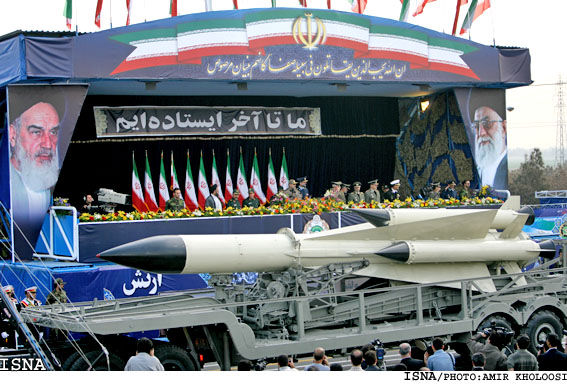
The swiftness of the transformation of the Iranian regime since the nuclear deal was approved last year has been stunning. The mullahs are flush with cash, they’ve invited foreign companies to invest billions, not suffered any repercussions from human rights violations or involvement in proxy wars, kept their nuclear enrichment infrastructure intact and elevated development of their ballistic missiles to reach Europe, Africa and American military bases from the Indian Ocean to the Mediterranean.

And the regime has no intentions of taking its foot off the gas, especially in the area of boosting its missile capability.

Ali Larijani, the regime’s parliamentary speaker and someone lauded by the Iran lobby as a “born-again moderate” said that Iran should continue to develop its missile capabilities despite opposition from western countries.

“Although some excuses recently raised by a number of Western countries about Iran’s missile [tests] are flimsy and legally worthless, they are indicative of their long-term policy which [shows] that they do not want the Islamic Republic to be powerful enough to ensure regional security,” he said according to Tasnim News on Saturday.

“For this reason,” he added, “we should insist on strengthening the country’s defense capability, especially in the field of missiles.”

There is a certain irony that last year the world was worried about nuclear warheads and now it has to worry about missiles to carry those warheads and battlefields across the region, as well as a sharp rise in terror attacks striking at cities around the world killing hundreds.

The ultimate irony came in President Obama’s remarks at the so-called National Security Summit this weekend in Washington in which he criticized the regime for undermining the “spirit” of the agreement even as they stick to the “letter” of the deal.

“Iran so far has followed the letter of the agreement, but the spirit of the agreement involves Iran also sending signals to the world community and businesses that it is not going to be engaging in a range of provocative actions that are going to scare businesses off,” Obama said at a press conference.

“When they launch ballistic missiles with slogans calling for the destruction of Israel, that makes businesses nervous.”

“Iran has to understand what every country in the world understands, which is businesses want to go where they feel safe, where they don’t see massive controversy, where they can be confident that transactions are going to operate normally,” he added. “And that’s an adjustment that Iran’s going to have to make as well.”

I can’t tell if the president is naïve or just-plain dumb when he equates a burgeoning missile program and threat of nuclear annihilation to a need to improve Iran’s business climate. The problem the world is dealing with in Iran is not that businesses are skittish of investing, but rather that the mullahs are intent on remaking the world in their own image.

We can only hope that come November, a new administration will be more intent on reigning in Iranian extremism rather than the opening of a new McDonalds or Starbucks in Tehran.

By Michael Tomlinson

Filed Under: Blog, News Tagged With: #NuclearDeal, Featured, Iran deal, Iran Human rights, Iran Lobby, National Iranian American Council, NIAC Action, Trita Parsi

Brussels Attacks Shows Need to Confront Islamic Extremism at its Source

March 23, 2016 by admin

Brussels Attacks Shows Need to Confront Islamic Extremism at its Source

Brussels Attacks Shows Need to Confront Islamic Extremism at its Source

An airport ticket counter and Starbucks location crowded with people were the scenes of devastating suicide bombings in Brussels, as was a crowded commuter train where ISIS quickly claimed responsibility for the devastating attacks that so far has killed at least 30 and injured over 200 in a stark reminder of the vulnerability of Europe to sophisticated attacks.

The Islamic State-affiliated news agency has issued a bulletin claiming responsibility for the deadly attacks Tuesday in Brussels.

The claim was disseminated on the group’s official channel on Telegram, a social media platform, and picked up by other official ISIS channels on Telegram and on Twitter.

“Islamic State fighters carried out a series of bombings with explosive belts and devices on Tuesday, targeting an airport and a central metro station in the center of the Belgian capital Brussels, a country participating in the coalition against the Islamic State,” the statement says. “Islamic State fighters opened fire inside the Zaventem airport, before several of them detonated their explosive belts, as a martyrdom bomber detonated his explosive belt in the Maalbeek metro station.”

A security camera image was released depicting three men, two of who wore black gloves that many security experts indicated could have hid the triggering devices or prevented a premature detonation; steps detailed in training manuals developed and distributed by ISIS indicating a high level of planning, coordination and sophistication.

Brussels has now entered the lexicon of Islamic terror attacks that include New York, London, Paris, Madrid, Sydney and Ottawa and adds to the mounting evidence that Islamic extremists and ISIS will not simply be defeated by smart bombs and drones.

To defeat any extremist ideology, one has to look for its sources and how it is nurtured and exported. The blueprint for ISIS was laid out long ago by the Iranian regime which pioneered state-sponsored terrorism by formalizing its deployment in its Quds Forces, backed by the resources of the Revolutionary Guard Corps and excused by the theological nonsense espoused by the regime’s mullahs.

To say the Iranian regime is the godfather of Islamic terror would be accurate. To say the Iranian regime gave birth to ISIS is even more accurate.

ISIS rise out of the quagmire of the Syrian civil war could not have been made possible without the Iranian regime’s support of the Assad regime that prolonged that conflict and reduced the effectiveness of moderate, Western-backed rebel groups in favor of Al-Qaeda affiliated militias.

The splintering and creation of ISIS from Al-Qaeda alone might not have been sufficient to launch the global army of terror we know face unless the meddling of the Iranian regime in Iraq forced the departure of Sunni tribes from the government of Nouri al-Maliki and created a power vacuum allowing for ISIS rapid advances in Iraq, culminating in the conquest of Mosul, which gave ISIS a quadrupling of territory, a ready-made labor force and fertile recruiting ground among disenfranchised Sunni communities.

The fact that Iran went all in by arming and deploying Shiite militias to fight ISIS initially in Iraq quickly turned this conflict into the bloody sectarian war it has now become.

The lack of an appropriate response from the Obama administration only intensified the conflict as Iran sought regional hegemony in a Shia crescent, thereby creating ISIS with a powerful recruiting tool among Sunnis.

Even as the evidence is clear and strong of the links between ISIS and the Iranian regime, the Iran lobby has ramped up to protect Iran from any criticism and have begun to mobilize to lobby the presidential candidates to protect the nuclear deal reached with Iran.

The National Iranian American Council (NIAC), strong advocates for Tehran, urged Hillary Clinton to follow President Obama’s lead in encouraging openings with Iran. It warned that “any deviation from Obama’s prudent and wise rhetoric and diplomacy will risk the significant progress achieved in the past few years.”

“At a time when President Obama is seeking to make his historic Iran policy change as irreversible as possible, we are concerned by Secretary Clinton downplaying the possibility of a larger diplomatic opening,” said Jamal Abdi, NIAC Action executive director.

The move to lobby Clinton is the clearest sign yet the NIAC and other Iran supporters are alarmed at the universal declarations coming from all the presidential candidates warning against accommodating the Iranian regime. Public opinion polls show Americans are leery of the regime and find little confidence in the mullahs promises of moderation that the Iran lobby have been flogging for the better part of three years.

The Brussels attacks are only another chapter in a long and bloody novel that is being authored in Tehran and the failure to connect the two will only result in more attacks and more deaths. Only by dealing effectively with Iran and pushing back its forces abroad back within Iran can we hope to curb the influence of the Revolutionary Guards and more importantly the nihilistic ideology the people like Ali Khamenei peddle in weekly chants of “Death to America” which still holds passionate meaning for him and his fellow clerics.

No matter how the Iran lobby tries to paper over the spread and growth of Islamic extremism, the root and source of that poisoned tree lies in Tehran with deep roots.

By Michael Tomlinson


Filed Under: News Tagged With: Featured, Iran, Iran deal, Iran Lobby, National Iranian American Council, NIAC, NIAC Action, Nuclear Deal

Iran Lobby Excuses Get Stranger and Stranger

March 17, 2016 by admin


Iran Lobby Excuses Get Stranger and Stranger

Iran Lobby Excuses Get Stranger and Stranger

The Iran lobby has offered up a variety of excuses for the actions and militant behavior of the Iranian regime ranging from pleas of peace-loving intent and political moderation to feigned ignorance and indignation over escalating human rights abuses and proxy wars throughout the Middle East.

One of the newest lines being trotted out by the Iran lobby is the absurd notion that Iran has never started a war.

A scholar at the American Enterprise Institute, took that claim to task in a column for Commentary Magazine.

He showcased comments made by Iranian regime apologists Juan Cole, a University of Michigan professor, and retired Congressman Ron Paul who said “There’s no history to show that Iran are aggressive people. When’s the last time they invaded a country? Over 200 years ago!”

“Iran has not launched an aggressive war in modern history (unlike the US or Israel), and its leaders have a doctrine of ‘no first strike.’ This is true of Supreme Leader Ali Khamenei, as well as of Revolutionary Guards commanders,” said Cole.

The Iranian regime knows when it has got a good thing going. Foreign Minister Mohammad Javad Zarif yesterday tweeted, “Iran hasn’t attacked any country in 250 years. But when Saddam rained missiles on us and gassed our people for 8 yrs, no one helped us.”

These are absurd comments when looked at in the context of what the mullahs have wrought since the Islamic revolution in 1979. The mullahs preferred method of aggression is to use proxies, either in the form of terrorist groups such as Hezbollah or local militias such as in Iraq and Yemen.

Hezbollah alone has served as a conduit of death and destruction for decades by carrying acts of terror either under the direction of or direct cooperation with Revolutionary Guards and Quds Forces personnel. In the most recent Syrian conflict, senior Iranian commanders have been in the field directing combat operations and even getting killed.

It’s noteworthy that Syria never posed a direct conflict with Iran, not even sharing borders, but the mullahs felt it necessary to engage in armed conflict there and even expanded it by calling for Russia to join in the bloodshed and widen the war.

Since the revolution, Iran has been involved in military campaigns in:

  • 1982-present: Lebanon
  • 2003-present: Iraq
  • 2006: Israel (via Hezbollah)
  • 2011-present: Syria
  • 2015-present: Yemen

Not exactly a record of pacifism, but certainly in line with the extremist nature of the regime and the duplicitous nature of the excuses made by the Iran lobby.

Another example of that stranger than fiction messaging came when regime-controlled media blasted the report issued by Ahmed Shaheed, the UN special rapporteur for human rights in Iran, which blistered the regime for appalling human rights abuses, including a near historic 1,000 executions in 2015 and a distressing willingness of the mullahs to kill children and women.

Iran Foreign Ministry Spokesman Hossein Jaber Ansari criticized the recent report as “biased,” “politically motivated” and “prejudicial, Tasnim news agency reported.

He said that the report is “imbalanced” and has been prepared based on “unreliable information.”

Those criticisms fell on deaf ears though as the Committee to Protect Journalists joined 34 other organizations in calling on the U.N. Human Rights Council to vote in favor of renewing the mandate Shaheed’s term as special rapporteur. The vote is scheduled to take place during the 31st session of the council, which ends March 24.

In the joint letter, the organizations drew attention to the range of “serious and systematic violations” of civil and political rights in Iran, as well as the need for the council to urge Iranian authorities to implement long overdue legal changes that would address the grievances of those who have borne the brunt of human rights abuses.

Journalists and other political and civic actors are “arbitrarily detained and given increasingly harsh prison sentences, often for trumped-up national security-related charges,” the letter said. Iran is one of the leading jailers of journalists, with 19 behind bars as of CPJ’s annual prison census on December 1. Ahead of last month’s legislative elections, journalists were arrested and at least one publication was banned, CPJ research shows.

In the meantime, even the modest “moderate” election wins hailed by the Iran lobby were under assault as several women who won seats were being verbally attacked for making comments deemed threatening to the regime, such as criticizing laws mandating women wear traditional veils and coverings.

All of which provides additional proof that any hope of moderation offered up by the Iran lobby is never really going to happen. This was put on bold display when Reza Marashi, research director for the National Iranian American Council, published a plaintive editorial in Huffington Post pleading for the release of his fellow regime supporter, Siamak Namazi, who was arrested and imprisoned by the regime and not part of the prisoner swap resulting from the nuclear deal.

“After finishing his graduate studies abroad, he again returned to Iran in 1999, this time as a consultant. Most people in his shoes returned to try and make a quick buck as a big fish in a small pond. Not Siamak. He helped run a world-renowned consulting firm – staffed predominantly with Iranian-born citizens – that facilitated badly-needed foreign investment from blue-chip multinational corporations,” Marashi said.

Unfortunately, Marashi neglects to mention how that firm, Atieh Consulting, become embroiled in regime politics since his family had deep connections to various parts of the regime’s leadership and actively cooked up the idea of creating an Iran lobby in the U.S. through the NIAC to help advocate for the lifting of international sanctions and far from being a selfless act, Namazi and others had hoped to position themselves to serve as middlemen to funnel foreign investment back into the regime and steer it towards their political allies as described in several investigative pieces.

It is also noteworthy how Marashi did not write similar heartfelt pieces on behalf of other Americans held captive in Iranian prisons such as Amir Hekmati or Saeed Abedini or endured years of torture in Iran.

It would certainly be interesting to see Marashi put his feet where his mouth is and go to Iran himself to plead with the mullahs and see if he can avoid a lengthy prison term as well as another political pawn for them.

By Michael Tomlinson

Filed Under: Blog, News Tagged With: Featured, Iran, Iran deal, Iran Human rights, Iran Lobby, Iran sanctions, National Iranian American Council, NIAC, NIAC Action, Reza Marashi

Holding Iran Accountable Starts by Not Believing Iran Lobby

March 11, 2016 by admin

Holding Iran Accountable Starts by Not Believing Iran Lobby

Holding Iran Accountable Starts by Not Believing Iran Lobby

The Iran lobby, consisting of lobbying groups such as the National Iranian American Council and media platforms like Lobelog.com, has long argued that agreement on a nuclear deal would bring about a new period of moderation within Iran and smooth the way for normalized relations.

Since the agreement was completed last summer, the Iranian regime has acted nothing like a moderate government engaging in a wide variety of foreign policy excesses such as going all-in on the Syrian civil war and stepping up support for Houthi rebels in Yemen, to instituting a harsh crackdown at home imprisoning dissidents and journalists and keeping the gallows busy by marching over 2,200 people to their deaths over the past two years.

Throughout it all, the Iran lobby has worked hard to maintain its charade and keep journalists believing in this false narrative no matter how incredible the proof has been otherwise. One example of this is a Q&A in the New York Times by Rick Gladstone in which he regurgitates many of the Iran lobby’s myths. For example, Gladstone asks:

  • Is Iran honoring the nuclear agreement? He writes it is according to the International Atomic Energy Agency, but neglects to mention admissions by the head of that agency that inspection protocols had been comprised at various points and full reporting may never be achievable;
  • Are recent missile tests prohibited under the nuclear agreement? He says no, such launchings are considered a separate issue, but neglects to mention that the regime pushed hard to unlink a host of issues such as ballistic missiles, human rights and support for terrorism from the deal, thereby allowing the regime a free hand to continue its illegal activities;
  • Iran’s parliamentary elections last month were supposed to have strengthened moderate supporters of Hassan Rouhani. So why is Iran provoking its critics by testing missiles? Gladstone explains that the launches are conducted by the Revolutionary Guard Corps which is outside of Rouhani’s control, but neglects to point out that Rouhani has been a willing supporter of these hardline tactics since his government has overseen one of the harshest crackdowns in 20 years against public dissent.

This militancy on the part of the Iranian regime was reinforced by boasts by senior military commanders that the tests would continue even though they are in violation of United Nations Security Council resolutions, which are being proven impotent by the lack of any consequences for these violations.

Brig. Gen. Amir Ali Hajizadeh, a senior commander for the Iranian Revolutionary Guard Corps that runs the regime’s missile program, told state television that it has more missiles ready to launch, and they are for defensive purposes.

“Iran’s missile program will not stop under any circumstances,” Hajizadeh said. “We are always ready to defend the country against any aggressor.”

The fact that the argument over the regime’s violations have shifted from calling for swift action to debates over whether or not imposition of sanctions might jeopardize a nuclear agreement that has already proven ineffectual in curbing the regime demonstrates how weak the international response has become.

This broad policy of appeasing the mullahs has already generated severe negative consequences as Iran seeks to aggressive upgrade its military and rearm in the wake of its deep involvement in three ongoing proxy wars in Syria, Iraq and Yemen as well as a potential new arms race with its chief regional rival, Saudi Arabia.

Hajizadeh also announced that Iran is calling its own version of a spy drone, “Simorgh,” which is Iranian for “Phoenix,” according to the country’s state controlled media.

Iran’s version of the drone “was manufactured through reverse engineering of the U.S. drone, which was tracked and hunted down in Iran late in 2011, and has been equipped by the IRGC with bombing capability,” according to Fars News Agency.

This comes on the heels of an $8 billion shopping spree in Moscow by the Iranian regime and the imminent delivery of an advanced S-300 anti-aircraft missile system.

Most disturbing of all was the announcement by Ahmed Shaheed, U.N. special rapporteur on human rights in Iran, that there had been a “staggering surge in the execution of at least 966 prisoners last year – the highest rate in over two decades,” Shaheed told a news briefing.

The number of executions are roughly double the number executed in 2010 and 10 times as many as were executed in 2005 and demonstrate how Rouhani’s promises of a more moderate government when he was elected were merely political window dressing.

“A large percentage of those executions are for drug offences and under Iran’s current drug laws, possession of 30 grams of heroin or cocaine would qualify for the death penalty. So there’s a number of draconian laws,” he said.

“Fundamental problems also exist with regard to the due process and fair trial rights of the accused,” Shaheed said.

“I continue to receive frequent and alarming reports about the use of prolonged solitary and incommunicado confinement, torture and ill-treatment, lack of access to lawyers and the use of confessions solicited under torture as evidence in trials – practices that clearly violate Iran’s own laws,” he said.

Hundreds of journalists, bloggers, activists and opposition figures “currently languish in Iran’s prisons and detention facilities,” he said.

None of which has stopped the Iran lobby from trying to divert attention to anything else as evidenced by an appearance by Jamal Abdi, of the NIAC, at a summit in Washington, DC aimed at criticizing the U.S. relationship with Saudi Arabia.

He spoke of how the Saudi regime tried to jeopardize the U.S. nuclear deal with Iran and criticized the visa restrictions the U.S. imposed on Iranians and Iranian dual nationals. He also spoke of how the U.S. is essentially “renting” the Saudi army to carry out the war in Yemen, and potentially even Syria, which is ironic considering that it was the Iranian regime’s support of the Assad regime in Syria and Houthi rebels in Yemen that started both conflicts in the first place.

All of which demonstrates how the Iran lobby will address any issue other than the current activities of the regime.

By Michael Tomlinson

Filed Under: Blog, News Tagged With: Featured, Iran Human rights, Iran Lobby, Iran sanctions, IRGC, Jamal Abdi, Lobelog, National Iranian American Council, NIAC, NIAC Action

Pushback Grows Against Iran Lobby Claims of Moderate Win

March 4, 2016 by admin

Pushback Grows Against Iran Lobby Claims of Moderate Win

Pushback Grows Against Iran Lobby Claims of Moderate Win

Basking in the afterglow of the Iranian regime’s parliamentary election results, the Iran lobby predictably boasted of the massive wins by moderate and reformist forces within Iran, but now the pushback is coming from a wide variety of the political spectrum as the results and actual winning candidates are absorbed and evaluated.

The realization is settling in that far from the moderate tsunami described by regime supporters such as Trita Parsi and Reza Marashi of the National Iranian American Council, the truth is that very little has changed within the regime leadership and the Iranian people still remain firmly in the grip and thrall of the mullahs.

The parade of cold water on the moderate landslide theory was led by the editorial board of the Washington Post, which has intimate first-hand knowledge of the extremist nature of the regime through the hostage taking and eventual prisoner swap of its reporter, Jason Rezaian. It editorialized:

“Claims of a reformist triumph, however, are overblown. Before the elections, an Iranian liberal coalition said that 99 percent of 3,000 pro-reform candidates had been disqualified by a hard-line clerical council. Most of those in Mr. Rouhani’s coalition are, like him, moderate conservatives, meaning they favor economic reforms and greater Western investment, but not liberalization of the political system or a moderation of Iran’s aspiration to become the hegemon of the Middle East. True Iranian religious and political reformers, like those who joined the 2009 Green Movement, are in jail or exile, or were banned from the ballot.

“For now, Iran can be expected to continue the course it has been pursuing in the months since the nuclear deal was struck: waging proxy wars against the United States and its allies around the Middle East, using its unfrozen reserves to buy weapons, and defying non-nuclear limits — such as by testing long-range missiles. The elections won’t make the regime more pliable, and they won’t change the need for a U.S. counter to its aggressions. They shouldn’t provide an excuse for the Obama administration to tolerate Tehran’s provocations,” the Post said.

The Post is correct in its assertions and admits to the basic problem facing those nervously praising the “moderate” wins: they are left with hoping for the best outcome even though it will most likely come to pass since the alternative is to face the difficult choices of pushing for regime change against a regime firmly entrenched.

The Atlantic’s Kathy Gilsinan noted some of the difficulties in the tea leaf reading going on post-election in discerning who actually won.

“Institutions whose members aren’t popularly elected, including the office of the supreme leader, the Guardian Council, the judiciary, and the security services, are the most powerful in Iran’s government. And they remain in the hands of hardliners,” she writes.

“Another reason it’s difficult to know the significance of these elections—aside from the dueling claims of victory from each camp, and the fact that, as Thomas Erdbink of The New York Times reported Wednesday, ‘there has been no official comment on the affiliation of the winning candidates’—is that Iran does not have strong political parties. Knowing that Republicans have a majority in the U.S. Congress, for example, gives you a rough sense of that body’s legislative priorities and how they would differ from those of a Democratic Congress. As Majlis Monitor, a website devoted to Iranian politics, notes, ‘While political parties help us see a country’s political fault-lines, their absence in Iran makes it difficult to understand how politics are actually [organized] and work there.’”

This points out the fundamental problem with the claims being made by Parsi or Jim Lobe over at Lobelog that moderates won the election: the absence of political parties stems from the mullahs aim to eliminate all dissent and organize the government around homogenous support for the Islamic revolution. True dissident parties such as the Mojahedin Khalgh (MEK or PMOI) were outlawed and membership was classified as punishable by death.

There is no doubt that the Iranian people want real reform and a true turn towards democracy. They are tired of living in an oppressive regime where their every online move is monitored and their every economic move is stymied by widespread official corruption.

The New York Times’ Erdbink also explained how results of the election may never be publicly revealed.

“The Interior Ministry, which is overseeing the voting for the 290-seat Parliament and the clerical Assembly of Experts, announced on Tuesday the names of 222 parliamentary candidates who won nationwide. It also announced that there would be a second round of voting for 68 seats in several constituencies in April,” he said. “But there has been no official comment on the affiliation of the winning candidates, and there may never be, making it difficult to determine how many seats the various factions have won.”

The Interior Ministry also oversees the internal security for the regime and already has a checkered history with the hijacking of the 2009 elections. It wouldn’t be unreasonable to see some similar shenanigans with these results to ensure the right kinds of “moderates” eventually won seats.

Former UN ambassador John R. Bolton took a similar viewpoint in writing for the American Enterprise Institute:

“Efforts to distinguish Tehran’s moderates from hard-liners have a long historical record of failure, as have similar precedents in analyzing Moscow and Beijing. Today in Iran, while there are disagreements over economic, social and religious policies among the elite, there is no disagreement over the objective of mastering the difficult science and technology required to achieve nuclear weapons deliverable on ballistic missiles. There is simply no credible evidence that the ayatollahs and other key Iranian leaders have ever diverged on that goal. Moreover, the nuclear and ballistic missile programs are firmly controlled by the Revolutionary Guards, which is about as likely to cede responsibility to the elected Majlis as to America’s Congress,” he writes.

Ultimately the real test of real reform will come if Evin Prison is emptied, ballistic missiles are shelved and support is withdrawn from Syria, Iraq and Yemen.

I wouldn’t hold your breath for that.

By Michael Tomlinson

Filed Under: Blog, News Tagged With: Appeasement policy, Featured, Iran, Iran deal, Iran Lobby, Lobelog, National Iranian American Council, NIAC, Reza Marashi, Trita Parsi

Who Are These So-Called “Moderates” in Iran Elections?

March 1, 2016 by admin

Who Are These So-Called “Moderates” in Iran Elections?

Who Are These So-Called “Moderates” in Iran Elections?

The New York Times, among other news outlets, trumpeted the election results from Iran with great fanfare announcing “strong” gains by moderates and reformists in this weekend’s parliamentary elections. Predictably, the spin revolved around the notion that this was a step in the right direction towards a more moderate future in Iran.

“Though hard-liners still control the most powerful positions and institutions of the state, two national elections last week appeared to build on the slow but unmistakable evolution toward a more moderate political landscape — now and into the future,” wrote Thomas Erdbrink in the Times. “While the hard-liners still remain firmly in control of the judiciary, the security forces and much of the economy, the success of the moderate, pragmatic and pro-government forces seemed to give Mr. Rouhani political currency to push a course of greater liberalization of the economy at home and accommodation abroad.”

What Erdbrink and most other Western journalists miss is the simple fact that the mullahs in control of the regime – virtually all of the important sectors of power as Erdbrink notes – have allowed a smattering of candidates to run that can appear “moderate” when compared to the more vocal conservatives in power, but in fact all share the same loyalty to the aims of the Islamic state.

Revolution and regime change are not coming anytime soon to Iran under these mullahs no matter what rosy picture some media wish to paint.

What is even more amusing is that all the celebration is focused on the election of a small minority dubbed “moderates” in the lower house parliament, but in the 88-member Assembly of Experts, over three-quarters of the original candidates seeking to run were swept off the ballot before voting even began, leaving only hardcore supporters of top mullah Ali Khamenei to win seats.

As to whom actually won, the Wall Street Journal editorial board took a closer look at the winners and found them less than “moderate” and downright unsavory.

  • Mostafa Kavakebian. The General Secretary of Iran’s Democratic Party, Mr. Kavakebian is projected to enter the Majlis as a member for Tehran. In a 2008 speech he said: “The people who currently reside in Israel aren’t humans, and this region is comprised of a group of soldiers and occupiers who openly wage war on the people.”
  • Another moderate is Kazem Jalali, who previously served as the spokesman for the National Security and Foreign Affairs Committee of the Majlis and is projected to have won a seat. In 2011 Mr. Jalali said his committee “demands the harshest punishment”—meaning the death penalty—for Mir Hossein Mousavi and Mehdi Karroubi, the two leaders of the Green Movement that was bloodily suppressed after stolen elections in 2009. Those two leaders are still under house arrest.

According to the Journal, as for new Assembly of Experts, many of the “moderates” projected to have won seats were also listed on the hard-liners’ lists, since the ratio of candidates to seats was well below two, including:

  • Mohammad Reyshahry, a former Intelligence Minister believed to have helped spearhead the 1988 summary execution of thousands of leftists;
  • Ghorbanali Dorri-Najafabadi, another former Intelligence Minister believed to have directed the “chain murders” of the late 1990s; and
  • Ayatollah Yousef Tabatabainejad, a fierce opponent of women’s rights who has called Israel “a cancerous tumor.”

That seems like quite a slate of “moderate” new faces that got elected. Maybe Trita Parsi and Reza Marashi from the National Iranian American Council, can fly over and have lunch with these moderates, unless they are worried they might be arrested like their fellow Iran lobby supporter Siamak Namazi who now languishes in an regime prison.

“The political reality in Iran is that the Ayatollahs, backed by the Revolutionary Guards, remain firmly in control,” the Journal correctly points out.

The funny thing about the parade of optimistic and sunny news headlines is how they eerily echo the same notes of hope that came in the wake of the nuclear agreement only to be followed by grimmer headlines of illegal ballistic missile tests, detaining of American sailors, rocket launches at U.S. and French navy warships, recruiting Russia to fight in Syria and the largest refugee crisis since World War II.

Even as regime supporters laud these “moderate” wins, shocking news came of a village in southern Iran of a heinous incident announced by Shahindokht Molaverdi, the ironically named vice president for women and family affairs.

“We have a village in Sistan and Baluchestan province where every single man has been executed,” she said, without naming the place or clarifying whether the executions took place at the same time or over a longer period. “Their children are potential drug traffickers as they would want to seek revenge and provide money for their families. There is no support for these people.”

Maya Foa, from the anti-death penalty campaigning group Reprieve, said: “The apparent hanging of every man in one Iranian village demonstrates the astonishing scale of Iran’s execution spree. These executions — often based on juvenile arrests, torture, and unfair or nonexistent trials — show total contempt for the rule of law, and it is shameful that the UN and its funders are supporting the police forces responsible.”

Amnesty is particularly concerned about Iran’s execution of juveniles. In a report published in January, the group said Iran had carried out 73 executions of juvenile offenders between 2005 and 2015.

Sistan and Baluchestan, where the unnamed village is situated, “is arguably the most underdeveloped region in Iran, with the highest poverty, infant and child mortality rates, and lowest life expectancy and literacy rates in the country,” according to Ahmed Shaheed, the UN special rapporteur on the situation of human rights in Iran. “The province … experiences a high rate of executions for drug-related offences or crimes deemed to constitute ‘enmity against God’ in the absence of fair trials.”

Even as the Iran lobby celebrates these wins, an Iranian village has seen all the men in it killed indiscriminately by these same “moderates.”

By Laura Carnahan

Filed Under: Blog, News Tagged With: Featured, Iran Human rights, Iran Lobby, Iran Mullahs, Khamenei, Marashi, National Iranian American Council, NIAC, Reza Marashi, Rouhani, Trita Parsi

Iran Lobby Ignores Money Trail from Iranian Regime

February 18, 2016 by admin

Iran Lobby Ignores Money Trail from Iranian Regime

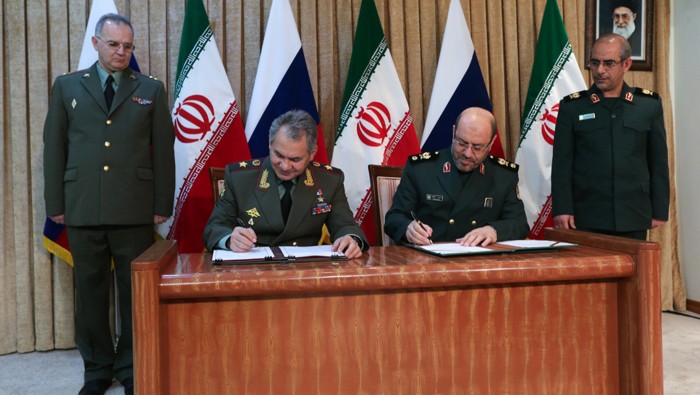
In this Tuesday, Jan. 20, 2015 photo Russia’s Defense Minister Sergei Shoigu, second left, and Iran’s Defense Minister Hossein Dehghan, second right, sign an agreement to expand military ties in Tehran Iran. Sergei Shoigu, in remarks carried by Russian news agencies, said Moscow wants to develop a “long-term and multifaceted” military relationship with Iran. He said that the new agreement includes expanded counter-terrorism cooperation, exchanges of military personnel for training purposes and an understanding for each country’s navy to more frequently use the other’s ports. (AP Photo/ Vadim Savitsky, Russian Defense Ministry Press Service)

While the Iran lobby argued strenuously that a nuclear deal with the Iranian regime would facilitate a moderation in its outlook, it also suggested that the financial windfall coming from the release of sanctions would help bolster the Iranian economy, benefitting the Iranian people and helping turn the Islamic state into an economic engine in the region.

Regime advocates such as the National Iranian American Council (NIAC) and The Ploughshares Fund were outspoken in their conviction that ultimately the Iranian people – hurt after years of international sanctions – would be the ones lifted up by the rising tide of new capital flooding into the country.

Predictably those claims have turned out to be just another in the truckloads of false promises made by the Iran lobby. The reality has been harsh and unforgiving.

In the months following completion of the deal, the regime has turned all of its attention to just two issues: the crackdown on dissidents at home in advance of parliamentary elections and upgrading as quickly as possible its military forces.

This was evidenced on Hassan Rouhani’s recent European tour in which he signed a flurry of business deals with foreign companies aimed at rebuilding the country’s infrastructure and funnel billions of dollars toward companies controlled by the Islamic Revolutionary Guards Corps (IRGC).

It is no surprise that the IRGC is the first institution in Iran to benefit from the largess. Rouhani’s government made the decision to keep the bulk of the $100 billion in their overseas accounts in order to pay for foreign military purchases in euros or dollars and they have wasted no time buying.

The first deal to be completed was the sale of S-300 anti-aircraft missile batteries that are a significant upgrade to the regime’s defenses and could be used to protect any nuclear facilities the regime chose to restart.

In addition, the regime announced another round of purchases of Russian arms totaling $8 billion. According to news reports, Iran wants to purchase more sophisticated anti-aircraft missile systems and also a new cadre of warplanes. The new deals will be in addition to several outstanding arms and military contracts that have already been signed between Iran and Russia.

Iran will “seriously focus on its air force and fighter jets,” according to comments by regime defense minister Hossein Dehghan while in Moscow to sign the defense agreements. “We are moving toward a contract. We told them that we need to be involved in the production [of the fighter planes] as well.”

A Russian source who spoke to the media said Iran is also interested in the latest anti-aircraft technology.

“Iran would like to buy Russia’s latest S-400 Triumph anti-aircraft missile system, developed by Almaz-Antey. And they make no secret of it,” the source was quoted as telling the Russian press. “On the eve of his visit to Moscow, Dehghan openly said to Iranian media they want to purchase the S-400s.”

Iran also is seeking to buy and possibly license for domestic production Russia’s new Sukhoi Su-30SM fighter jet, which is used for air-to-air and air-to-surface combat.

“Iran is also interested in Russia’s Bastion mobile coastal defense missile system, equipped with supersonic Yakhont anti-ship missiles, along with Mi-8/17 helicopters and other arms,” according to the regime-controlled media.

The military purchases represent one of the largest investments in state-of-the-art military hardware anywhere in the Middle East. The addition of supersonic fighter jets, anti-ship missiles and even more sophisticated anti-aircraft systems poses a grave threat to international shipping lanes through the Strait of Hormuz.

News reports also indicated the regime would seek to diversify its military suppliers by seeking arms purchases from China as it dips heavily into its newfound wealth. The rapid buying binge indicates the mullahs’ strong desire to rearm Iran into the region’s most powerful military.

To give the expenditures perspective, the entire publicly reported budget for the Iranian regime’s military was $10.2 billion, supporting over half a million active duty regime personnel. The Russian agreement nearly equaled the entire budget last year and more buying is on the way.

The inevitable question that needs to be asked of the Iran lobby is where is the money to help the Iranian people? Little of the money has been brought back to Iran and even less has been disbursed to help ordinary Iranians with healthcare, education, or even food. Why does the Iran lobby ignore all these actions? Probably the same reason it is ignoring the carnage in Syria being wrought by the Iranian regime as well.

In fact, the civil war in Syria is at the heart of the Iranian regime military buildup and an example of why the regime cannot be trusted.

As the Independent newspaper detailed the obvious contradiction in supporting a nuclear deal that only served to supply the regime with fresh resources to wage an even bloodier war in support of keeping Syrian dictator Bashar al-Assad in power.

Kyle Orton cites the brutal battle over the Syrian city of Aleppo as the case in point, writing:

“The Geneva III peace process is the most immediate cause for this latest offensive against Aleppo, led on the ground by Iran’s Islamic Revolutionary Guard Corps (IRGC) and its proxies, as well as Russian airstrikes. The regime and Russia have used it as a cover to gain ground. The US took the process seriously so sought to de-escalate, taking steps to weaken its own side. This included restricting the rebels’ access to anti-tank missiles”.

“Russia, on the other hand, enabled the IRGC-run forces that control the Bashar al-Assad regime’s security sector to cut the rebels’ final Aleppo supply line into Turkey and move to impose a starvation-siege on the city like the ones they have imposed on forty-nine other areas in Syria. The regime coalition can then either bring the city to its knees and complete the reconquest, or quarantine the rebels in the city, freeing up resources to deploy against rebels on other fronts,” he added.

The Iranian regime’s intentions in Syria are simple: 1) Keep Assad in power; and 2) Do it anyway it can.

“Assad, Iran, and Russia have worked tirelessly to eliminate the moderate opposition so that there will be nobody for the international community to interface with, and Assad’s reign will have to be accepted—and perhaps even supported to reconquer the Isis-held areas in the east,” Orton said.

The brutal evidence of that ruthless strategy can be seen in the deliberate targeting of civilians and the use of barrel bombs and now starvation as a tactic to weaken the opposition.

The mullahs are well acquainted with using death, destruction and executions as a tactic for winning its conflicts. The diplomacy the Iran lobby publicizes with great fanfare cannot be found on the battlefields of Syria, Yemen or Iraq where the Iranian regime’s policies are killing tens of thousands.

By Michael Tomlinson

Filed Under: Blog, News Tagged With: #NuclearDeal, IRGC, National Iranian American Council, NIAC, NIAC Action, Trita Parsi

Iran Lobby Ignores Upcoming Iran Election Shenanigans

February 18, 2016 by admin

Iran Lobby Ignores Upcoming Iran Election Shenanigans

Iran Lobby Ignores Upcoming Iran Election Shenanigans

On February 26, Iran will hold its parliamentary elections and similar to almost every election held since the Islamic revolution in 1979, the results will be largely a forgone conclusion since the mullahs control who goes on the ballot in the first place and in the case of the top spot – currently occupied by Ali Khamenei – that is a position that doesn’t even get voted on by the public in a process that old-line Soviets would find reminiscent of the Politburo.

Michael J. Totten, writing in World Affairs, took to task some idiotic observations made by Max Fisher in Vox magazine in which Fisher waxes rapturously about how the Iranian election could be historic. It the same kind of nonsense first advocated by the Iran lobby, most notably bloggers Jim Lobe and Ali Gharib, the National Iranian American Council and other regime advocates such as Paul Pillar.

The notion that the nuclear deal has set the stage for a historic election in which moderates and dissidents will finally get a fair shake and opportunity to put their stamp on the Islamic state moving into the 21st century is about as realistic as Boko Haram suddenly deciding to endorse women’s rights.

The truth of the matter, as Totten rightly points out, “let’s leave aside the blatant vote-stealing in Iran’s 2009 presidential election, when Mahmoud Ahmadinejad was declared the winner in districts that opposed him as overwhelmingly as San Francisco opposes Dick Cheney. Nevermind that disgraceful episode.”

“Elections in Iran are rigged even when they aren’t rigged,” Totten said. “Supreme Leader Ali Khamenei hand-picks everybody who runs for president. Moderates are rejected routinely. Only the less-moderate of the moderates—the ones who won’t give Khamenei excessive heartburn if they win—are allowed to run at all. Liberal and leftist candidates are rejected categorically.”

In the case of the position of president of the regime, a position held by Hassan Rouhani, Totten points out that “he’s not quite a figurehead. He can tinker with a few things around the edges. But the country is run by the unelected Supreme Leader, the Guardian Council, and the Revolutionary Guard Corps, which is officially designated as a terrorist organization.”

NIAC hacks such as Trita Parsi and Reza Marashi have argued that “moderates” will be empowered in a resurgent Iran and that will be reflected in more moderates being elected to the upper legislative body, the Assembly of Experts which nominally selects the new Supreme Leader when Khamenei dies.

Nothing could be further from the truth. The Guardian Council dumped thousands of potential candidates, the overwhelming majority of them more moderate than the ruling mullahs in a similar political exorcism it conducted during Rouhani’s election when it cleared the field for him to run virtually unopposed.

Let’s also consider that a “moderate” in regime politics is like calling someone a moderate who opposes hanging a political dissident, but doesn’t mind locking up a political dissident; in much the same way as Rouhani was hailed as a moderate, but since his ascension he has presided over more executions in his first term than even Ahmadinejad carried out.

In another sign that the elections are going turn out in favor of Khamenei and his cronies no matter what the actual vote is, Khamenei’s office issued a press release through regime-controlled media warning of “enemy” efforts to undermine the elections.

The statement read in part: “Their plot for the February 26 elections is to undermine the Guardian Council and question its decisions,” Ayatollah Khamenei said, “describing the Council as one of the fundamental institutions of the Islamic Establishment, which the US has been strongly opposed to since the victory of the Islamic Revolution.”

“When the Guardian Council’s decisions are called into question, the elections would be perceived to be illegal, and, consequently, the elected parliament as well as the laws it ratifies would be deemed illegal, the Leader explained.”

The regime learned its lessons from the 2009 election debacles that resulted in violent street demonstrations that had to be put down with bloody consequences and is doing all it can to pre-ordain the results and impose order such that there would be no repeat of civil disobedience.

All of which has not gone unnoticed by an American public who’s opinion of the regime’s leadership has astonishingly remained virtually unchanged since the 1980s according to a new Gallup Poll released this week.

A stunningly low 14 percent of Americans have a favorable viewpoint of the regime in a benchmark for futility that has not budged in spite of all the public relations and social media posturing conducted by the Iran lobby. It’s nice to see that no matter how many tweets Trita Parsi puts out, Americans remain skeptical and wary of a regime that has put to the hangman’s noose over 2,300 people under Rouhani.

By Michael Tomlinson


Filed Under: Blog, Current Trend, News Tagged With: Featured, hassan rouhani, Khamenei, National Iranian American Council, NIAC, Reza Marashi, Trita Parsi

Iran Lobby Picks and Chooses Hostages to Support

February 9, 2016 by admin

Iran Lobby Picks and Chooses Hostages to Support

Iran Lobby Picks and Chooses Hostages to Support

Five Iranian-American groups sent a letter to U.S. Secretary of State John Kerry urging him to work for the release of an Iranian-American being held by the Iranian regime and not part of the prisoner swap that occurred last month.


The signatories to the letter were the Public Affairs Alliance of Iranian Americans, the Pars Equality Center, the National Iranian American Council, Iranian Alliances Across Borders, and the International Campaign for Human Rights in Iran. Most of these groups actively supported the nuclear agreement with the Iranian regime and have campaigned on behalf of it; most notably the NIAC.

Siamak Namazi has been held in Iranian prison since last October and his continued imprisonment has now become something of a cause amongst groups such as NIAC who have previously not dared to voice any public disagreement with the regime on previous occasions, including the imprisonment of other more notable Iranian-Americans such as Washington Post reporter Jason Rezaian, Christian pastor Saeed Abedini and former U.S. Marine Amir Hekmati, who had been subjected to torture and released as part of the prisoner swap.

The U.S. released seven Iranian nationals held in the U.S., in return and agreed to drop international arrest warrants and charges against 14 Iranians outside of the U.S. who had been involved in the smuggling of arms and nuclear components.

Other Iranian-Americans, some of whom spoke on the condition of anonymity to the New York Times, said they were postponing or scrapping planned trips to Iran until Namazi was released, or at least until the circumstances surrounding his case were clearer since his arrest has stirred anxiety among those who thought the nuclear deal portended a new era.

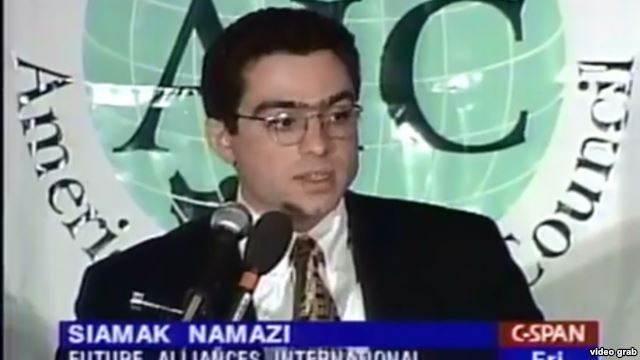
Trita Parsi traveled with Siamak Namazi to Isfahan, Iran’s third largest city, in August 2000. They also toured the Zoroastrian “Fire of Victory” Temple in Yazd. At the time, Siamak was living in Tehran, working for Atieh Bahar, a consultant company with close ties to the government. In 1999, Parsi and Siamak co-authored a paper that recommended setting up a lobbying organization in Washington to influence US-Iran policy. Siamak took a sabbatical in 2005 to complete a fellowship at the Woodrow Wilson Center in Washington, DC. While at the Center, Siamak helped Parsi formulate NIAC policies supportive of the Iranian regime.

Trita Parsi traveled with Siamak Namazi to Isfahan, Iran’s third largest city, in August 2000. They also toured the Zoroastrian “Fire of Victory” Temple in Yazd.
At the time, Siamak was living in Tehran, working for Atieh Bahar, a consultant company with close ties to the government.
In 1999, Parsi and Siamak co-authored a paper that recommended setting up a lobbying organization in Washington to influence US-Iran policy. Siamak took a sabbatical in 2005 to complete a fellowship at the Woodrow Wilson Center in Washington, DC. While at the Center, Siamak helped Parsi formulate NIAC policies supportive of the Iranian regime.

The ties between Namazi and Trita Parsi of the NIAC previously exposed by Iranlobby.net were also revealed in a Daily Beast expose that detailed how in 1999, Namazi got together with Parsi at a conference in Cyprus. The conference, titled, “Dialogue and Action Between the People of Iran and America,” was convened to help ameliorate U.S.-Iranian relations in advance of reconciliation by forming an aggressive public relations and lobbying response to any anti-Iranian regime policies and legislation.

Two years later Parsi founded the NIAC, which long advocated opening up commercial and financial lines back to Iran with Namazi’s family companies offering to provide foreign companies and investors with connections and access to regime officials in a cozy relationship that no longer appears that cozy.

This is especially ironic since in March 2006 (at the height of the covert Iranian war with the U.S. in Iraq), Parsi told a colleague not to worry about a trip to Tehran, “NIAC has a good name in Iran and your association with it will not harm you.” When the colleague was briefly questioned by the regime, then released, he reported back (PDF) to Parsi that he’d been told the reason he was let go was “that they knew NIAC had never done anything seriously bad against the Islamic Republic.”

The shifting political winds within the Iranian regime have been reflected in the mass dismissals of thousands of proposed candidates for parliamentary election seats, but of more immediate concern is the prospect of mass demonstrations by ordinary Iranians – not over election issues, but because a large number of Iranians who receive public payments have not been paid by the regime. This also shows that as far as the ordinary Iranians are concerned, they have no illusion about the existence of a moderate or any moderation within the mullah’s regime.

An extraordinary directive from the Herasat Office, the regime’s domestic intelligence and security forces, entitled: “Issue: Paying workers’ wages in the final days of the year”:

“With greeting and respect, you are hereby informed that given that the end of the [Persian calendar] year is approaching and taking note of the instructions handed down by the minister and competent authorities regarding timely payment of workers’ wages and back pay, you must instruct that all wages, bonuses, back pay and overtime pay be paid no later than February 24, 2016 in order to prevent any possible gatherings or sit-ins and their related negative consequences.

“You are reminded that given the upcoming elections of the Assembly of Experts and Islamic Assembly (Parliament), this issue must be treated with especial importance and sensitivity in order to prevent any misuse of this matter for publicity in particular in the realm of workers’ protests.”

In other words, a lot of Iranians haven’t been paid their salaries, and the Khamenei regime is ordering that they be paid the money they’re owed by February 24, two days before the election, in the hope of defusing any potential mass protests.

The prospect of election protests is worrisome to regime leaders, especially since these elections will be held at the same time International Women’s Day is observed, which is all the more problematic for the regime when one considers the abysmal state of women’s rights in the regime today.

Nothing exemplifies this more than reports that Press TV, the regime’s state-run, English language news channel, suspended two executives on Monday after a prominent newscaster exposed that she had endured years of sexual harassment from them.

The newscaster, Sheena Shirani, has fled the country according to the New York Times.

Press TV is a part of the Voice and Vision organization of Iran, a powerful state media organization that is widely seen as a tool of the country’s hardline factions. One expatriate journalist who previously worked for Newsweek said that Emadi doubled as an interrogator in the Evin prison and once interrogated him. Emadi was later placed on a European blacklist of human rights violators.

The incident has also led to debate on social media. Several women have said such forms of harassment are commonplace in Iran under the mullahs rule, where unemployment is high and laws overwhelmingly favor men.

By Michael Tomlinson

Filed Under: News Tagged With: Featured, National Iranian American Council, NIAC, siamak Namazi, Trita Parsi

Hassan Rouhani Begins European Tour Under Cloud of Executions

January 25, 2016 by admin

Hassan Rouhani Begins European Tour Under Cloud of Executions

Hassan Rouhani Begins European Tour Under Cloud of Executions

Iran regime leader Hassan Rouhani begins a European tour previously postponed because of the terrorist attacks in Paris with stops in France and Italy which has been highlighted by the regime as a goodwill tour as well as a shopping spree to use some of the $100 billion in frozen assets being returned to Iran as part of the nuclear agreement.

Both in France and Italy there are companies with long established business relationships in Iran but they remain hesitant given the regime’s actions in the months immediately following signing of the deal including the test launching of ballistic missiles violating United Nations sanctions against development of nuclear-capable missiles and the continued escalation of the Syrian conflict and support for proxy militias in Iraq and Yemen leading to broad sectarian violence.

More recently the regime engaged in a prisoner swap, releasing several Americans being held by the regime including Washington Post reporter Jason Rezaian and Christian pastor Saeed Abedini, in exchange for a large number of Iranians who had been charged and convicted of arms smuggling and trading in illegal nuclear and military components.

Additionally, both Democrats and Republicans in Congress and on the presidential campaign trail have expressed doubts over the regime’s ability and willingness to give up its militant ways, as well as what the mullahs plan do with all of the billions of dollars they are about to receive. Several pieces of legislation have been put forward addressing the levying of additional sanctions on Iran should the regime prove recalcitrant moving forward.

This has caused the Iran lobby to push back and attempt to make the issue of new sanctions a partisan issue by placing blame on Republicans, even though support for a tough approach to Iran has come from both sides of the aisle.

“From the European side, there is a concern that if they enter Iranian market they will be subjected to American sanctions. Because there are conflicts in the U.S.,” said Trita Parsi, head of National Iranian American Council, the regime’s chief lobbyist. “Congress is very skeptical about the deal and republicans are still pushing for new sanctions and this is sending a conflicting message making Europeans concerned.”

Parsi made his comments to regime-controlled media in an attempt to convince European companies on the eve of Rouhani’s visit to open wide the doors of trade and investment to the regime even with growing doubts over the corrupt nature of the economy and high level of censorship, human rights abuses and control of most industries by the Revolutionary Guard Corps.

Those doubts were only reinforced this weekend by comments made by top mullah Ali Khamenei who commended the actions taken by Revolutionary Guard Corps members in detaining American sailors, calling their actions “courageous.”

“You did a brilliant, interesting and timely job. In fact, this event should be considered God’s work. He drew them towards our waters so that with your timely measure, they would be arrested in that manner – with their hands on their heads,” Khamenei said on his official website.

The statements being made by Khameneni, Rouhani and other regime officials over all the incidents are often conflicting; adding to the confusion over what the regime’s true goals and aims are. Doyle McManus examined this almost bipolar quality within the Iran regime in an editorial in the Los Angeles Times.

“The underlying problem is that Iran still hasn’t made the choice Henry Kissinger described several years ago: whether it is a country or a cause — a normal state, or a revolutionary one,” McManus writes. “On the other hand, the Iranians have repeatedly rejected proposals for normal diplomatic relations with the U.S. (an offer floated by George W. Bush before Barack Obama). They even rejected a U.S. proposal for a hotline between the two countries’ armed forces, even though that could avert unnecessary clashes.”

“This resistance to formal normalization is partly about preserving Iran’s revolutionary self-image,” he added. “So even as he has authorized a de facto rapprochement with the United States, Khamenei has released an uninterrupted flow of statements denouncing the Great Satan and warning against Western subversion.”

This explains much of what is confounding to outside observers about the regime and why the arguments made by the Iran lobby about regime “moderation” is so much hot air. As Michael Rubin, a resident scholar at American Enterprise Institute, pointed out in a recent editorial:

“So what to make of President Hassan Rouhani’s election? Rouhani might have embraced a softer rhetorical style than Mahmoud Ahmadinejad, his predecessor, but he is no more reformist. True, he purged a lot of the Islamic Revolutionary Guard Corps officers from the cabinet, but he replaced them with Ministry of Intelligence veterans. Public executions have skyrocketed under Rouhani.”

“Khamenei is not only supreme leader, but he’s also master marionette, playing factions off each other in order to maintain his own power. The seeming rotation between hardline and less hardline factions has less to do with liberalization and more to do with simply cleaning house before any alternative power can consolidate.” Rubin added. “Obama may believe change in Iran to be inevitable. Unfortunately, it is not the change he imagines. That the Iran deal as constructed provides the cash to Iran’s most hardline elements will only catalyze the slow decline of Iranian reformism.”

It is against this backdrop that Rouhani’s European tour comes soaked in the blood of over 2,000 men, women, children, political opponents, dissidents, activists and others who have been executed since Rouhani took power; a large number of them in grisly public hangings.

According to human rights groups, Iranian dissidents and even United Nations officials, the pace of executions have been stunning even for Iran’s bloody history and are likely to continue unabated. According to the National Council of Resistance of Iran, the first two weeks in January have already seen over 52 executions.

The prospects for the future remain bleak as the regime’s Guardian Council, comprised of 12 Islamic jurists appointed by Khamenei, disqualified more than 6,500 candidates from upcoming parliamentary elections, with opposition groups claiming upwards of 90 percent of “reformist” candidates had been eliminated.

For Europeans meeting with Rouhani this week, it is best to think twice before making a big risk in trading with the regime in Iran, particularly since in the eyes of the Iranians inside and outside the country trading with the mullahs is the equivalent to neglecting the gross violations of human rights in Iran.

By Michael Tomlinson

Filed Under: Blog, News Tagged With: Featured, hassan rouhani, Iran deal, Iran Human rights, Iran sanctions, National Iranian American Council, NIAC Action

  • « Previous Page
  • 1
  • …
  • 15
  • 16
  • 17
  • 18
  • 19
  • 20
  • Next Page »

National Iranian-American Council (NIAC)

  • Bogus Memberships
  • Survey
  • Lobbying
  • Iranians for International Cooperation
  • Defamation Lawsuit
  • People’s Mojahedin
  • Trita Parsi Biography
  • Parsi/Namazi Lobbying Plan
  • Parsi Links to Namazi & Iranian Regime
  • Namazi, NIAC Ringleader
  • Collaborating with Iran’s Ambassador

Recent Posts

  • NIAC Trying to Gain Influence On U.S. Congress
  • While Iran Lobby Plays Blame Game Iran Goes Nuclear
  • Iran Lobby Jumps on Detention of Iranian Newscaster
  • Bad News for Iran Swamps Iran Lobby
  • Iran Starts Off Year by Banning Instagram

© Copyright 2026 IranLobby.net · All Rights Reserved.