Iran Lobby

Exposing the Activities of the lobbies and appeasers of the Mullah's Dictatorship ruling Iran

  • Home
  • About
  • Current Trend
  • National Iranian-American Council(NIAC)
    • Bogus Memberships
    • Survey
    • Lobbying
    • Iranians for International Cooperation
    • Defamation Lawsuit
    • People’s Mojahedin
    • Trita Parsi Biography
    • Parsi/Namazi Lobbying Plan
    • Parsi Links to Namazi& Iranian Regime
    • Namazi, NIAC Ringleader
    • Collaborating with Iran’s Ambassador
  • The Appeasers
    • Gary Sick
    • Flynt Leverett & Hillary Mann Leverett
    • Baroness Nicholson
  • Blog
  • Links
  • Media Reports

Iran Tries Blackmail in Threatening Failed Nuclear Deal

August 16, 2017 by admin

Iran Tries Blackmail in Threatening Failed Nuclear Deal

Iran Tries Blackmail in Threatening Failed Nuclear Deal

One of the key provisions of the Iran nuclear deal was an agreement to not include so-called “side issues” into the agreement such as the regime’s sponsorship of terrorism or any improvement in its human rights record.

The mullahs in Tehran knew they would instantly fail any of those litmus tests and fought hard to keep them out of the agreement, but in doing so they set themselves up for failure down the road when continued abuses would force the U.S. to act in levying new sanctions for terrorism support and Iran’s burgeoning ballistic missile program.

The mullahs found themselves stuck between a rock and a hard place. The nuclear agreement did not contain any language prohibiting economic sanctions on non-core nuclear issues per the mullahs’ demands so as the Trump administration and U.S. Congress imposed new sanctions the mullahs were left to cry foul without any basis to stand on.

The Iran lobby then went to work trying to stave off sanctions by pushing the message that these additional sanctions would threaten the “essence” of the agreement and cause its collapse leading to Iran building a nuclear arsenal.

Trita Parsi of the National Iranian American Council tried to blame President Donald Trump for the potential collapse of the deal and issued a statement that reeked of falsehoods commonly trotted out by the Iran lobby.

“It should now be clear that Donald Trump’s moves to violate and hold certification of the Iran nuclear deal in doubt are actively destabilizing the accord. Unfortunately, in response to Trump’s increasingly hostile rhetoric, as well as Congress’ moves to escalate sanctions, Iran is now warning that it has its own options to back out of the deal if the U.S. continues to undermine it,” Parsi said.

Let’s be clear: Iranian regime, not the U.S., is responsible for destabilizing the nuclear deal with their bloody war in Syria, efforts to sow insurrection in the Gulf states, and start launching ballistic missiles at a clip rivaling North Korea. The U.S. did nothing to inspire those acts and all those acts began actually years ago and under the Obama administration.

Also, the U.S. Congress and American electorate has had the luxury to see how the nuclear deal has turned out after two years and their answer has been overwhelmingly negative. While Parsi may try to affix blame on President Trump, the real culprits are in Tehran.

But Parsi didn’t stop there.

“We have repeatedly warned that President Trump’s beating of the war drum with Iran, even if confined to rhetoric, in addition to new Congressional sanctions and zero diplomatic outreach, could only produce negative consequences. Iran’s parliament has now voted to increase spending on its ballistic missile program and the IRGC in direct response to new sanctions on the country,” Parsi added.

Incredibly, Parsi tries to also blame the U.S. President for Iranian regime’s decision to ramp up its missile program; ignoring the fact the regime’s missile program was begun a decade ago with technology licensing agreements with North Korea and fully funded by illicit oil sales.

It is a blatant example of how the Iran lobby tries to rewrite history to protect the Iranian regime after it acts to toss away the international agreements it signs.

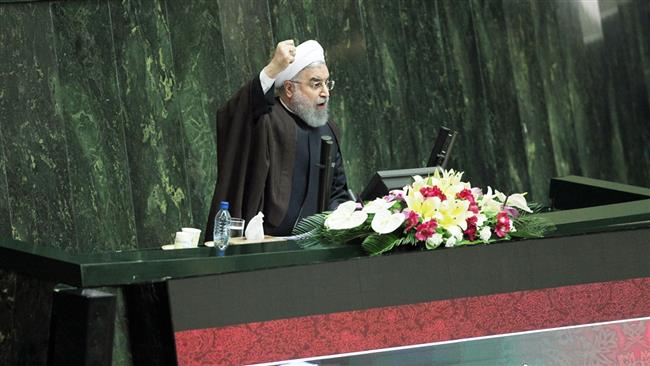
Regime president Hassan Rouhani did his part in warning the regime could quickly ramp up its nuclear program and achieve an advanced level if the U.S. continued its “threats and sanctions.”

Rouhani’s remarks to Iranian regime lawmakers were his most direct warning that the deal could fall apart and risked ratcheting up tensions with the United States.

While most media focused on Rouhani’s threats, virtually no one picked up on the key inconsistency he made which is that Iran could “quickly” build nuclear weapons. This simple declaration proves the biggest lie offered by the regime and Iran lobby supporters such as Parsi: the nuclear deal did not push back the much-debated “breakout” period for Iran to build a nuclear device.

“In an hour and a day, Iran could return to a more advanced (nuclear) level than at the beginning of the negotiations” that preceded the 2015 deal, Rouhani said.

The nuclear deal has been a complete and utter failure.

United Nations ambassador Nikki Haley issued a stern and forceful rebuke to Rouhani’s comments and accurately pointed out the problem with the arguments being made by the Iran lobby about saving the nuclear deal at all costs.

Haley said on Tuesday Iran must be held responsible for “its missile launches, support for terrorism, disregard for human rights, and violations of U.N. Security Council resolutions.”

“Iran cannot be allowed to use the nuclear deal to hold the world hostage … The nuclear deal must not become ‘too big to fail’,” Haley said in a statement, adding that new U.S. sanctions were unrelated to the Iran nuclear deal.

What is ironic in all this debating about Iran is how North Korea is widely reviled, heavily sanctioned and appropriately feared by the rest of the world over its ballistic missile program, but in the case of Iran’s missile program, the European Union has struggled to stay mute and not offend the mullahs.

Why does North Korea’s missile program drive the world to the brink of striking back, but in the case of Iran, many American partners refuse to criticize Iran?

Part of the answer lies in the Iranian regime’s aggressive efforts to open its markets to European firms to make investment and economic hamstring themselves from taking future action against Iran. Another explanation comes from EU policy makers who naively believe in the lies of the Iran lobby and hope for the best while ignoring the evidence of Iranian regime’s extremism.

Europe’s reaction is eerily similar to the reaction their predecessors had to the rise of Adolf Hitler’s Nazi Germany in the 1930s.

We can only hope the world doesn’t pay again for that same policy of appeasement.

Michael Tomlinson
Filed Under: Blog, Current Trend, National Iranian-American Council, News Tagged With: #NuclearDeal, Appeasement policy, Featured, Iran, Iran deal, Iran Human rights, Iran Lobby, Iran Missile program, Iran Mullahs, Iran sanctions, Iran Talks, Iran Terrorism, National Iranian American Council, NIAC, NIAC Action, Rouhani, Sanctions, Trita Parsi

Iran Regime Adds Funds for Missile and Terrorism Programs

August 15, 2017 by admin

Iran Regime Adds Funds for Missile and Terrorism Programs

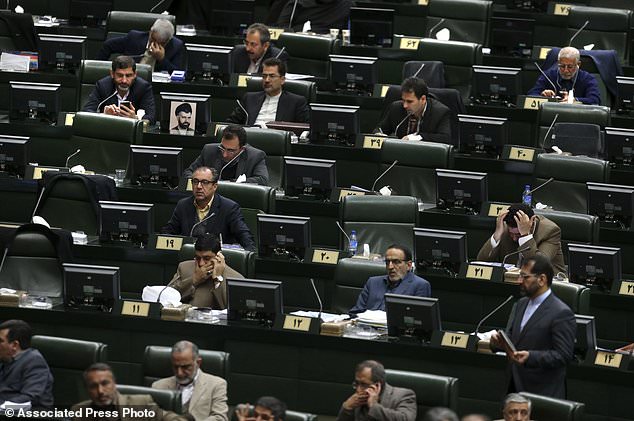
In this photo taken on Sunday, Feb. 19, 2017, lawmakers attend an open session of the Iranian parliament in Tehran, Iran. Iran’s parliament voted overwhelmingly Sunday, Aug. 13, to increase spending on its ballistic missile program and the foreign operations of its paramilitary Revolutionary Guard, chanting “Death to America” in a direct challenge to Washington’s newest sanctions on the Islamic Republic. (AP Photo/Vahid Salemi)

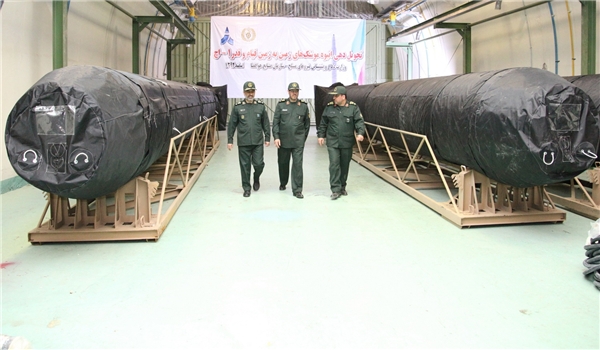
The Iranian regime parliament burnished its hardline credentials by approving an enormous boost in spending for its ballistic missile program and its Quds Forces within the Revolutionary Guard Corps, which has been at the heart at virtually all the proxy wars Iran is currently fighting throughout the Middle East.

The estimated $609 million boost will be divided evenly between the Quds Forces and missile effort, which the regime called the nation’s “deterrent capability,” according to regime-controlled Tasmin news agency.

Some lawmakers chanted, “death to America” as the bill was passed, according to state media.

The increase in funding comes as no surprise as the Iranian regime has steadily been funneling millions of dollars to fund its growing military commitments and support for proxies and terrorist organizations such as Hezbollah in Syria, Shiite militias in Iraq and Houthi rebels in Yemen.

If we think back to the completion of the Iranian nuclear agreement two years ago, the Obama administration shipped pallets full of cash via Iranian airliners in exchange for the release of American hostages. There were no conditions attached to the money which undoubtedly found its way to support Iran’s efforts to save the Assad regime in Syria.

Also, the Iranian regime does not report funding for its military nor for its paramilitary operations through its Quds Forces so we really don’t know how much money Iran really is spending on its missile and terror programs, but there can be little doubt the mullahs consider both high priorities.

Hassan Rouhani, the regime’s president, essentially tried to blame the Trump administration’s levying of new economic sanctions as the reason for the increase in funding, as well as the president’s public statements promising to rip up the nuclear deal.

“Anyone who harms the accord harms himself and his country,” Rouhani was quoted as saying by the Iranian Students News Agency. If the U.S. seeks to act against the agreement “everyone will side with us and against the person who wants to weaken it” he said in reference to other signatories to the deal including Germany and France, which have expressed their support for its continuation.

The move by the regime to boost its missile program comes in the wake of fellow rogue state North Korea’s rapid push into launching ballistic missiles capable of reaching the U.S. mainland, as well as intelligence reports that North Korea now possesses at least one nuclear device capable of being mounted on a missile.

It also follow’s North Korea’s threats to turn waters around the island of Guam and home to a sprawling U.S. naval base into a sea of fire with multiple missile strikes.

The roadmap North Korea has laid out in its missile and nuclear development is being closely followed by the Iranian regime in spite of the false promises consistently made by the Iran lobby that Iran was not pursuing nuclear capability.

North Korea’s licensing of its missile technology to Iran gave the regime a head start on missile development and provided a much-needed source of cash to the North Korean regime as it become the most isolated and sanctioned nation in the world.

In fact, North Korea’s Kim Yong Nam, the speaker of the parliament, attended Rouhani’s swearing in ceremony last week in a sign of the hermit kingdom’s close ties with the Iranian regime.

This isn’t Yong Nam’s first trip to Iran. He also visited in 2012 to attend the Non-Aligned Movement’s summit in Tehran. Then as now he was in the country for about 10 days, making many official visits and appearances, signing agreements for technical and educational cooperation between Iran and North Korea, according to the Daily Beast.

The connections between North Korea and Iran extend beyond building a missile fleet together as explained by David French in the National Review. The 1994 “Framework Agreement” between North Korea and the U.S. was almost a carbon copy of the Iran nuclear deal.

Like the Iran Deal, it sought to halt the pursuit of nuclear weaponry. Like the Iran Deal, it was supposed to bring a rogue nation back into the “global community.” Like the Iran Deal, it allegedly had enough safeguards to prevent cheating, French writes.

“Unfortunately, North Korea cheated. It maintained a secret uranium-enrichment program, and the deal collapsed soon after the Bush administration confronted the North Koreans with evidence of their noncompliance,” French added.

French goes on to point out that given this history, the Iran Deal may have been the worst possible model. For example, agreement with Iran famously provides the regime up to 24 days of notice before inspectors are allowed access to some suspect cites, and a regime with a record of cheating like North Korea’s is the worst possible regime to grant any leeway or any trust.

Moreover, the same deal granted Iran enormous economic benefits, access to international arms markets, and the ability to build ballistic missiles. A similar deal with North Korea would have the potential to supercharge the DPRK threat.

Instead, the Iran deal has pumped hundreds of millions of dollars into Iran which the mullahs are now funneling into the IRGC. North Korea demonstrates clearly that relying on “trust” to verify a nuclear agreement fails miserably when the rogue regime in question can’t be trusted in the first place.

The bolstering of Iran’s missile fleet and Quds Forces comes at the worst possible time for hopes of regional stability as Iran is now deeply involved in full-blown war and covert subversive campaigns in Syria, Iraq, Bahrain, Qatar, Kuwait, Yemen and now recently fired mortars and rockets along the Pakistan border.

All of the promises made by groups such as the National Iranian American Council that Iran would be a moderate force with the nuclear deal passed have been proven false and the world is now going to live under the threat of Iranian missiles because of it.

Michael Tomlinson

Filed Under: Blog, News Tagged With: #NuclearDeal, Featured, hassan rouhani, Iran, Iran deal, Iran Lobby, Iran Mullahs, Iran sanctions, Iran Terrorism, Khamenei, National Iranian American Council, NIAC, NIAC Action

Iran Regime Human Rights Cruelty Knows No Limits

August 14, 2017 by admin

Iran Regime Human Rights Cruelty Knows No Limits

Iran Regime Human Rights Cruelty Knows No Limits

A young Iranian man who was arrested, convicted and sentenced to die as a 15-year-old, was put to death by the Iranian regime this week in a new low in human rights even for this brutal regime.

Alireza Tajiki was 21 years old at the time of his execution. He was arrested in May 2012 when aged 15 and sentenced to death nearly a year later in April 2013. The trial was grossly unfair and relied primarily on “confessions” which Alireza Tajiki had said were extracted through torture, including severe beatings, floggings and suspension by the arms and feet, according to Amnesty International.

The use of torture to coerce confessions is notoriously widespread throughout Iran and is indiscriminately applied against men, women and children and has been documented by news media and international human rights groups.

Iran is one of the last few countries in the world that still executes juvenile offenders. As of August 2017, Amnesty International had identified at least 89 individuals on death row who were under the age of 18 when the crime was committed.

“By going ahead with this execution in defiance of their obligations under international law, and despite huge public and international opposition, the Iranian authorities have again cruelly demonstrated their complete disdain for children’s rights. This shameful act marks a critical turning point for Iran, and exposes the hollowness of the authorities’ claims to have a genuine juvenile justice system,” said Magdalena Mughrabi, Amnesty International’s Deputy Director for the Middle East and North Africa.

“This execution is a flagrant violation of Iran’s obligations under the UN Convention on the Rights of the Child, which it ratified two decades ago. By putting Alireza Tajiki to death, the Iranian authorities have demonstrated their appalling commitment for continuing with this abhorrent practice and shown they do not even have the will to implement their half-hearted reforms to save the lives of those convicted as children,” he added.

The liberal use of the death penalty has been a hallmark of the Iranian regime’s control over the Iranian people, but alongside the gruesome punishments, the mullahs enforce morality laws in such odd fashion that seemingly innocuous acts are often characterized as crimes, such as women riding bicycles.

The fact that women receive the brunt of these morals violations is no coincidence as the mullahs work aggressively to oppress Iranian women and deny them educational opportunities, careers and even basic freedoms to move about without restriction.

One example of this the recent crackdown against women participating in Zumba dance classes and exercises in one of the more ludicrous actions by the regime.

A group of four men and two women were charged for trying to “change lifestyles” over their Zumba dancing and for not adhering to the country’s strict hijab dress code this week.

“The members of a network teaching and filming Western dances have been identified and arrested,” said Hamid Damghani, an official with the Revolutionary Guard Corps.

“They were arrested by the Guards’ intelligence forces while teaching and creating video clips… as they sought to change lifestyles and promote a lack of hijab,” Damghani said.

The fight by the regime to suppress all kinds of creativity by young Iranians has been long-running. The latest Zumba arrests are a reminder that in 2014, seven young Iranians were arrested for dancing to Pharrell Williams’s hit “Happy” in a home-made video that went viral on the internet. They were given suspended jail and lashing sentences.

Far from being random or non-sensical, the arrests are deadly serious business for the mullahs because they represent a threat to the strict ideology and religious culture imposed by them since the Islamic revolution.

Creativity, artistry, even a simple exercise dance class can lay the seeds for rebellion in a society governed by the whims of religious zealots. For the mullahs in Tehran, even free thought can pose a counter-revolutionary risk.

This explains why the regime also spends considerable time, energy and resources in trying to stifle, suppress and even kill any members of Iranian opposition or dissident groups.

The long history of the regime’s efforts to annihilate the People’s Mojahedin Organization of Iran, a long-time opposition group have been well-documented by international monitoring and human rights groups, especially the covert attacks on a refugee camp in Iraq housing members of the PMOI resulting in the murder of scores on refugees.

What is most disturbing though is as the Iranian regime steps up its brutal suppression of human rights with more executions and campaign to arrest women for taking part in innocent activities, the Iran lobby has been stone-deaf silent; none more so than the National Iranian American Council.

The NIAC in particular has thrown itself into the fight to save the Iran nuclear deal and virtually ignored the mounting human rights abuses in Iran. It points out the lie in the NIAC which claims to fight for Iranian-American issues and dignity, but does neither.

Its sole agenda is to fight to preserve the lifting of economic sanctions that keep the flow of cash running to the mullahs’ pockets.

Unfortunately, young Iranians like Alireza Tajiki are the ones left to pay the ultimate price.

Laura Carnahan

Filed Under: Blog, News Tagged With: #NuclearDeal, Featured, Iran Human rights, Iran Lobby, National Iranian American Council

Regime Change in Iran will Come from the People

August 8, 2017 by admin

Regime Change in Iran will Come from the People

Regime Change in Iran will Come from the People

The passage of new economic sanctions against the Iranian regime and the signing of the legislation by President Donald Trump officially buried the Obama administration’s policies of trying to appease the mullahs in Tehran into trying to turn towards moderation.

The response from the Iran lobby was predictable with dire warnings of war and destruction being pedaled, but the reality is that the regime change being sought by the U.S. is not the regime change the Iran lobby is trying to portray.

One of the great misconceptions about the idea of regime change is that it must come about violently and it would be externally driven by outside forces such as the U.S. scheming to plot the overthrow of the mullahs by some armed insurrection or brutal invasion.

It serves the purposes of regime supporters such as Trita Parsi of the National Iranian American Council to push the narrative that President Trump is itching for a war with Iran.

The reality though is much different. The president campaigned strongly on the platform that the Iraq invasion by the Bush administration was a mistake and worse yet, not planning for its aftermath was blunder.

Most historians would not find fault with that appraisal and apparently not many American voters did either. It would be ironic then for a president—who campaigned against more wars in the Middle East—to start of his administration with seeking to instigate a war with the region’s largest army in Iran.

Then again, logic was never a strong suit for regime advocates such as Parsi, which is why we see his messages for what they are: diversions.

There are efforts to divert attention from the real concerns the mullahs have and are constantly battling against which is the potential for their rule to end because of the desire of the Iranian people to want change.

History has proven that all dictatorial regimes fail eventually. No government can stand against the entropy that occurs by suppressing basic human rights, using fear as a means of intimidation and control, and world events that reshape the region around a regime.

More recently, the Arab Spring protests toppled firmly established autocratic governments throughout the Mediterranean and reshaped the Middle East radically and it did so without the violence of bloody revolution that accompanied the Iranian revolution for example in 1979.

Even the more recent election demonstrations of 2009 showed the Iranian regime clearly that the Iranian people were more than capable of toppling their reign and it probably scared them to death and like any reactionary totalitarian regime, the mullahs did what came naturally for them: they cracked down even harder.

They rigged the election for Hassan Rouhani in 2013 by clearing the field of any other candidates. The did the same thing during parliamentary elections, keeping control with an overwhelming majority of loyalists.

They arrested journalists, stepped up attacks on dissidents, seized satellite dishes, banned social media, imprisoned students and artists and expanded the size and reach of “morality” police forces to enforce order.

Under Rouhani’s first time, the use of the death penalty skyrocketed to all-time highs as gallows and cranes were busy throughout public squares in Iran hanging Iranian men, women and even youngsters.

Even under this onslaught, protests still flourished in Iran with Rouhani’s re-election earlier this year in which he was greeted by masses of protesters at some campaign stops that turned ugly. Regime change in Iran won’t come at the point of an American invasion. It will come from the shouts and marches of millions of Iranians in city streets throughout the country.

Which is why the imposition of sanctions by the Trump administration is an opening step to making regime change possible; not through the threat of war as the Iran lobby would you believe, but rather in the reapplication of pressures that nearly forced the mullahs to lose control prior to the nuclear deal.

If we recall, the stage set prior to the nuclear negotiations showed the Iranian economy was groaning under the onslaught of an economy that had been drained of cash through rampant corruption and the funding of proxy wars and terrorist operations.

Ordinary Iranians were struggling to make ends meet and dealing with diminished expectations as career paths were blocked and opportunities shrank. Iranian small businesses struggled to stay afloat, while dual-national Iranians coming back to visit relatives or conduct business were increasingly being arrested and thrown in jail for no reason other than to be used as hostage pawns by the mullahs.

The level of discontent only needed a channel to express itself and that venue is increasingly becoming the Iranian resistance movement through groups such as the Mujahedin-e Khalq (MEK) which has long been a thorn in the side of the mullahs.

Comprised of Iranians abroad and inside Iran, these dissidents and others, form the basis of the most viable option for Iranians looking for a change. Within Iran lies a strong core of supporters, even those Iranians who may not support the MEK specifically, but are more than willing to work towards regime change anyway.

A central platform to the Iranian dissident movement’s policies is a call for pluralistic and democratic change in a multi-party system. While the concept might seem perfectly ordinary to anyone living in a democratic society, it is anathema to the Iranian regime. The biggest threat to the mullahs is the very simple idea that the Iranian people might want a political choice other than the Islamic state created by the mullahs.

All of which leads us back to the original imposition of new sanctions by President Trump and the start of the process to designate the Revolutionary Guard Corps as a Foreign Terrorist Organization. These actions place the mullahs back in the crosshairs of international scrutiny, but most importantly attempt to recreate the environment back from 2009-13 when four years of tumultuous change was being demanded by the Iranian people.

It is time for the U.S. government to support and recognize the various Iranian dissident and opposition groups and empower them to begin the process of regime change; peacefully.

Michael Tomlinson

Filed Under: Blog, News Tagged With: #NuclearDeal, Appeasement policy, Featured, mek, Mujahedeen-e-Khalq (MEK), National Iranian American Council, NIAC, NIAC Action, Regime Change, Trita Parsi

Iran Regime on Twin Tracks of Aggression with Missiles and Human Rights

August 4, 2017 by admin

The Iranian regime has invested heavily—much of it from funding derived by the lifting of economic sanctions by the nuclear deal—in its ballistic missile program. It has become as integral to the long-term plans of the mullahs as oil policy has been for economic planning.

Iran’s ballistic missile program gives it the ability to project force far beyond its borders. For most superpowers and nuclear-capable nations, force projection otherwise known as “over-the-horizon” capability distinguishes them from any other nation on Earth.

The U.S., Russia, China, France and Great Britain have long been the pillars of the ability to project force around the world. Historically speaking, Britannia ruled its empire because of its navy, while after World War II, the U.S. established supremacy with carrier battle groups and air power.

In today’s world though, ballistic missiles have become to the tool du jour of force projection for despotic regimes such as North Korea and Iran. They can—on the cheap—threaten neighbors and nations far away as a means of extorting concessions.

Missiles alone though cannot guarantee internal security for these regimes. Missiles are a tool of external terror, but for internal suppression of dissent, both North Korea and Iran rely heavily on cults of personality for their respective leaders and use execution, imprisonment and ample torture as means of population control.

It is striking how similar both regimes are in action and planning. Their respective ideologies, one devout atheist, the other devoutly sectarian, both focus absolute allegiance to the state.

Their use of hostages as negotiating pawns and crackdown of any open dissent makes them more sister-states than one might imagine. In fact, both earn heavy and regular condemnation by human rights groups.

In the case of Iran, Amnesty International has paid special attention to tracking the regime’s efforts to vilify human rights defenders as “enemies of the state” in putting out an updated report on Iran’s brutal human rights crackdown.

“It is a bitter irony that as the Iranian authorities boast about their increased engagement with the UN and the EU, particularly in the aftermath of the nuclear deal, human rights defenders who have made contact with these same institutions are being treated as criminals,” said Philip Luther, Amnesty International’s Research and Advocacy Director for the Middle East and North Africa.

“Rather than propagating the dangerous myth that human rights defenders pose a threat to national security, the Iranian authorities should focus on addressing the legitimate concerns they raise. These are people who have risked everything to build a more humane and just society – it is appalling that they are so viciously punished for their bravery,” he added.

The organization is calling on the EU, which announced plans to relaunch a bilateral human rights dialogue with Iran in 2016, to speak out in the strongest terms against the persecution of human rights defenders in the country.

“The international community, and in particular the EU, must not stay silent over the outrageous treatment of human rights defenders in Iran,” said Philip Luther.

“Instead of appeasing Iranian officials, the EU should forcefully call for the immediate and unconditional release of all those jailed for their peaceful human rights activism and for an end to the misuse of the justice system to silence activists.”

The timing of Amnesty International’s report is auspicious in light of new sanctions signed into law by President Donald Trump against Iran and North Korea’s ballistic missile program and a new diplomatic initiative aimed at the United Nations to curb Iran’s “destabilizing effect in the region.”

U.S. Ambassador Nikki Haley, in a letter to the UN Security Council on August 2, said the launch of a missile carrying a satellite into space “represents a threatening and provocative step by Iran.”

Her letter, written on behalf of the United States, France, Germany, and Britain, called on the Council to “discuss appropriate responses” against Tehran for its “provocative action.”

U.S. officials said that type of technology is inherently designed to carry a nuclear payload, and the Pentagon said the technology can be used to develop intercontinental ballistic missiles (ICBM).

Predictably the Iran lobby’s chief advocate, the National Iranian American Council, condemned the sanctions move by the U.S. and warned of a march to war with these moves, but even the NIAC had to acknowledge the overwhelming bipartisan support sanctions against Iran have in Congress right now.

“The alarm bells should be ringing but instead of restraining Trump’s reckless inclinations on Iran, Congress appears to be actively encouraging him,” said the statement by Jamal Abdi, executive director for NIAC Action, the lobbying arm of the NIAC.

In the letter to the UN though, the four nations called on Iran “to immediately cease all activities related to ballistic missiles designed to be capable of delivering nuclear weapons, including launches using such ballistic missile technology.” They said Iran’s “long-standing program to develop ballistic missiles continues to be inconsistent with” the UN resolution and has a destabilizing effect in the region, according to Bloomberg.

This new diplomatic effort represents a watershed moment of sorts because it unites the Western partners in the Iran nuclear deal into a unified front to stop Iran’s missile program before it becomes the kind of full-blown headache the world is now experiencing with North Korea.

In many ways, North Korea serves as the clearest warning sign of where Iran will inevitably reach in a short time and represents a defining moment in the close collaboration between the two regimes.

Finally, the world is waking up to the dual threats posed by them.

Laura Carnahan

Filed Under: Blog, News Tagged With: Featured, Iran Ballistic Missile, Iran Mullahs, National Iranian American Council, NIAC, NIAC Action

Iran Lobby in Full Attack Mode Against Trump

August 4, 2017 by admin

Iran Lobby in Full Attack Mode Against Trump

Iran Lobby in Full Attack Mode Against Trump

The Iran lobby is in full attack mode against President Donald Trump and it’s not a surprise. We predicted as early as last December that the Iran lobby would mobilize to block any moves made by the new Trump administration to curb Iranian regime excesses.

It did not matter what the administration did so long as it might be construed to make things more difficult for the mullahs in Tehran then it deserved fierce opposition from the Iran lobby.

To that end the Iran lobby’s chief architect, the National Iranian American Council, first turned its attention to the debate over immigration, since for the NIAC, it was a perfect opportunity to burnish its credentials as a progressive fighter for human rights. An ironic notion since it all but encourages Iran to abuse its own people by not voicing any opposition to the continued imprisonment, torture and execution of thousands of Iranians.

It then tried to attack the Trump administration over its escalation in Syria in the fight against ISIS and the Assad regime, but as they say in the Deep South, “that dog just wouldn’t hunt.”

The NIAC and its allies got little traction on that issue, especially in light of horrific scenes of chemical attacks by Assad forces on Syrian civilians and the increase of direct attacks on U.S.-backed forces by Iranian-backed Iraqi Shiite militias.

The handwriting was on the wall that trying to defend Iran in Syria was a no-winner for the NIAC.

It then shifted back to familiar ground by pushing the idea that the president was actively seeking a war with Iran and looking for excuses to start one.

It’s a stupid notion since the provocations for starting a conflict with Iran are already abundant and excessive:

  • Iranian regime has detained American sailors and repeatedly made attack runs at several U.S. warships in international waters warranting the firing of warning shots;
  • They have falsely arrested and detained several American citizens;
  • Iranian regime has supported the smuggling of weapons and insurgents to U.S. allies in Bahrain, Qatar and Kuwait—home to important U.S. military bases—in an effort to de-stabilize and topple those governments;
  • Iranian Revolutionary Guard Corps commanders have consistently made threats of attacks on U.S. personnel in Syria, Afghanistan and Iraq and have used their Quds Force units to supply insurgents and militias with IEDs and weapons to target them;
  • Iranian regime has launched multiple missiles in violation of United Nations Security Council resolutions with heavier payload capacity and extended ranges now long enough to strike throughout Europe, Africa and Asia;
  • Iran mullahs have used cash gained from the lifting of economic sanctions from the nuclear deal not for restarting a moribund economy, but rather to fund its wars in Syria and Yemen with the express purpose of destabilizing Saudi Arabia, the most important Arab ally the U.S. has in the region; and
  • Iranian regime has continued to escalate cyberattacks against U.S. financial institutions, commercial enterprises and infrastructure elements in a wide-ranging effort to de-stabilize the U.S.

Any of these actions, by themselves, would warrant a strong U.S. response and yet the NIAC and its cohorts in the “echo chamber” of Iranian regime support have always sought to portray the mullahs as some poor, defenseless lambs.

Take for example Mitchell Plitnick, a so-called policy analyst that has bounced around several progressive Jewish outfits and now finds a home as a frequent supporter of the Iranian regime.

He authored a recent editorial that appeared on the same day in noted Iran lobby mouthpiece, Lobelog, and +972 Magazine, that President Trump’s demand for more access for international inspectors to Iranian military bases for evidence of nuclear development work was a “red line” for the mullahs and would effectively kill the deal.

“Access to those sites was an Iranian red line during negotiations, and the agreement to omit that access from the deal was an important component in getting the deal done,” Plitnick writes.

It’s a stupid argument to make since he neglects to mention that Iran’s deep desire to keep its military bases off limits from inspection already created the high probability that Iran is cheating and conducting nuclear work in those safe zones.

Remember, in the ramp up of its nuclear program, which Iran always claimed never existed, the regime spread its development and research work across the vast deserts of Iran and buried them deep in fortified bunkers. The International Atomic Energy Agency, the UN watchdog, has never had a complete and thorough accounting of every potential nuclear site in Iran.

Also, Iran was allowed to scrub several sites clean with bulldozers in clearing tons of dirt and debris away before soil samples were taken by Iranians and handed over to the IAEA. Even then, particles of nuclear materials were still detected.

The position that Trita Parsi of the NIAC takes that the president is actively seeking to invalidate the nuclear agreement is false since the truth is that the nuclear agreement is largely being ignored by Iran already.

Also, he fails to note in his extensive press interviews this week that the president’s own State Department has certified Iran every 90 days even though it could have pulled the plug from the president’s swearing in.

All of which means, President Trump is not in a hurry to dump the nuclear deal as much as he is eager to find a plausible pathway for addressing all of the concerns he has with Iran including terrorism, human rights and ballistic missiles.

Parsi’s intense focus on the nuclear deal is yet another distraction to turn attention away from the most menacing aspects of Iran today which is its North Korean-like march to missile dominance.

That is the issue grabbing headlines and global attention and Parsi and his friends are desperate to turn the spotlight away.

Michael Tomlinson

Filed Under: Blog, Latest from Lobbies & Appeasers, National Iranian-American Council, News Tagged With: #NuclearDeal, Appeasement policy, Featured, Iran, Iran Human rights, Iran Lobby, Iran Mullahs, Iran sanctions, IRGC, National Iranian American Council, NIAC, NIAC Action, Trita Parsi

Why Does the Iran Lobby Care About the Nuke Deal?

August 1, 2017 by admin

Why Does the Iran Lobby Care About the Nuke Deal?

Why Does the Iran Lobby Care About the Nuke Deal?

The Iran lobby, including the National Iranian American Council and other groups, invested heavily in supporting the Iran nuclear deal. They lobbied for it, wrote editorials, sent out loads of press releases, made appearances on news programs, held meetings with elected officials and coordinated strategy with the Obama White House through countless meetings.

The Iran lobby ostensibly was doing all this in the name of peace and in support of a whole host of promised positives coming from its passage, including:

  • Bolstering moderate elements within the Iranian regime and aiding their cause in upcoming elections;
  • Shifting Iran back towards diplomacy and serving as a moderating force in a deeply destabilized Middle East;
  • Empower international inspectors to keep Iran under close scrutiny and push back its development of a nuclear weapon; and
  • Propel Iran’s re-entry in the community of nations and become a partner economically and politically with the world once again.

It was a nice idea and attractive to many in Congress. Unfortunately, like most good intentions, it fell flat on its face when confronted by the evil nature inherent within the ruling mullahs in Tehran.

The one thing everyone seemed to forget and the Iran lobby was careful to obscure was that the Iranian regime never really cared about a nuclear deal since the mullahs knew it would never halt their nuclear program, only postpone it slightly.

What they and their Iran lobbyist allies really cared about was the lifting of crippling sanctions that, more than anything else, was and still is the true goal of the regime and its allies.

Preserving the nuclear deal is not the real concern of the regime. It is the potential for the re-imposition of economic sanctions under a skeptical Trump administration and a reset back to 2012 in which the Iranian regime was on the verge of collapse and widespread dissatisfaction among the Iranian people still simmered from the violent crackdown on the 2009 democracy protests.

This is why the deal was crafted to preserve Iranian regime’s missile program and never take up the issues of human rights and terrorism since the mullahs had always planned to use the cash it received from the nuclear deal to jumpstart their ballistic missile program and keep the Assad regime afloat in Syria.

The mullahs and by extension the Iran lobby relied on the passiveness of the U.S. under Obama. As British politician Edmund Burke once famously said: “The only thing necessary for the triumph of evil is for good men to do nothing.”

In this, the Iran lobby sought to dissuade action against Iran by promising a changed regime, but since none of that has happened and the situation throughout the Middle East has clearly gotten worse under the expansion of several proxy wars by Iran, the Iran lobby has shifted its tone and tactics to a much darker and fear-based message.

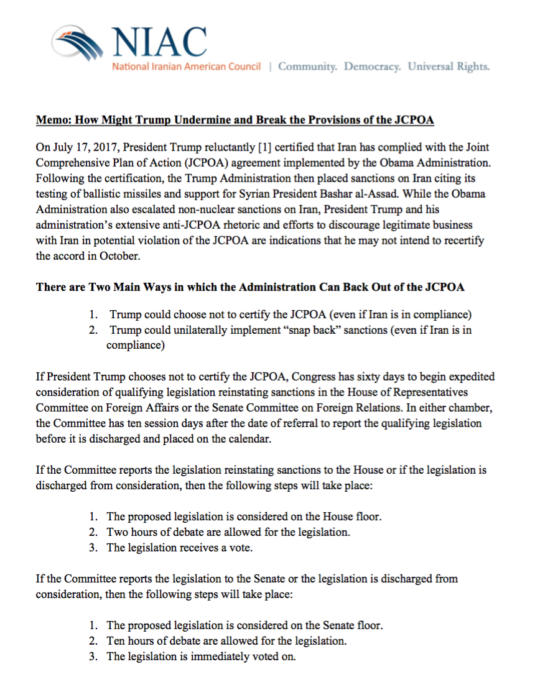
It now relies on the banging of war fears in trying to keep the nuclear deal alive as evidenced by the mounting PR push by groups such as the NIAC which put out a policy memo outlining how the Trump administration could undermine the nuclear agreement.

It is typically long-winded and rests its logic on the notion that President Trump can kill the Joint Comprehensive Plan of Action (JCPOA) agreement by choosing not to certify the JCPOA or implementing “snap back” sanctions.

The NIAC memo then goes on to exhaustively explain the various steps the Congress would take in reviewing either action by the president.

What the NIAC does not discuss is the fact the Congress voted to pass new sanctions on Iran by stunningly huge bipartisan majorities that made clear no one actually believes in any of the promises made by the NIAC earlier.

Iranian regime has clearly become a threat not only to the U.S., but to the entire region as its ballistic missiles can now reach targets throughout Europe, Asia and Africa.

The NIAC briefing also glaringly misses the essential point of what is happening now which is the Iranian regime’s actions on human rights violations, sponsorship of terror and accelerating a missile program that will soon surpass North Korea is what is driving the debate about Iran; not the nuclear agreement.

But the NIAC hopes that focus on the JCPOA will deflect attention on these other areas where Iranian regime is so blatantly awful on right now. It is akin to pointing at the crack den and ignoring the building on fire right next to it.

You can see how the Iran lobby is trying to push issues such as terrorism and missiles off the front pages by talking about the nuclear deal, when the nuclear deal isn’t even the issue being debated by Congress and the Trump administration.

This is the “new” grand lie of the Iran lobby and its supporters. They hope that by focusing on the JCPOA and Iranian regime’s continued “compliance” with the agreement that mullahs’ regime in Iran is somehow still a good global citizen. The lobby never addresses the ballistic missile program or the threat it poses, especially with heightened concerns over North Korea. It also never deals with the horrific human rights violations Iranian regime and its IRGC has perpetuated in the Syrian conflict.

Unfortunately for the NIAC and other Iran lobby members, everyone has pretty much caught on to the lie and ignoring what they say which explains the overwhelming bipartisan push to target Iran.

For the NIAC, it quickly finds itself alone in Washington’s Beltway with few open supporters and even less leverage in trying to boost Iranian regime’s fortunes. It’s time for the NIAC to pack it in.

Michael Tomlinson

Filed Under: Blog, Current Trend, Latest from Lobbies & Appeasers, National Iranian-American Council, News Tagged With: Appeasement policy, Featured, Iran, Iran deal, Iran Human rights, Iran Lobby, Iran Mullahs, Iran sanctions, Iran Talks, Iran Terrorism, IRGC, National Iranian American Council, NIAC, NIAC Action, Trita Parsi

Iran Remains Top Global Sponsor of Terrorism

July 28, 2017 by admin

Iran Remains Top Global Sponsor of Terrorism

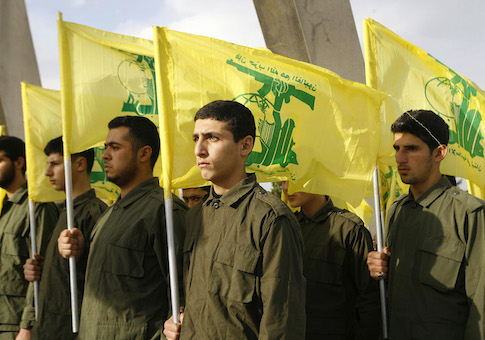
In this picture taken on Friday Feb. 14, 2014, Hezbollah fighters hold flags as they attend the memorial of their slain leader Sheik Abbas al-Mousawi, who was killed by an Israeli airstrike in 1992, in Tefahta village, south Lebanon. Hezbollah says Israel carried out an airstrike targeting its positions in Lebanon near the border with Syria earlier this week, claiming it caused damage but no casualties. Hezbollah said the attack was near the eastern Lebanese village of Janta. It vowed to retaliate but said it will “choose the appropriate time and place.” (AP Photo/Mohammed Zaatari)

Unsurprisingly, the U.S. State Department once again listed the Iranian regime in its annual Country Reports on Terrorism; keeping it atop a dubious list of countries involved in the sponsorship and support of terrorism.

The report based the designation on the regime’s continued support for terrorist proxies such as Hezbollah and its overall efforts to destabilize the Middle East as a whole as evidenced by its spurring of the Houthi rebellion in Yemen and its long support for the Assad regime in Syria, as well as the rapid growth of Shiite militias in Iraq involved in new rounds of sectarian warfare with Sunni tribes.

Iranian regime has been designated as a state sponsor of terrorism by the U.S. since 1984, making it one of the longest-running state sponsors of terror in the world. Iranian regime sits alone only next to Sudan and Syria as officially designated state sponsors in the annual report.

The report cited a wide range of activities the Iranian regime has undertaken to foster the spread of terror and violence:

“Iran used the Islamic Revolutionary Guard Corps‑Quds Force (IRGC-QF) to implement foreign policy goals, provide cover for intelligence operations, and create instability in the Middle East. Iran has acknowledged the involvement of the IRGC-QF in the conflicts in Iraq and Syria and the IRGC-QF is Iran’s primary mechanism for cultivating and supporting terrorists abroad,” the report said.

“In 2016, Iran supported various Iraqi Shia terrorist groups, including Kata’ib Hezbollah, as part of an effort to fight ISIS in Iraq and bolster the Assad regime in Syria. Iran views the Assad regime in Syria as a crucial ally and Syria and Iraq as crucial routes to supply weapons to Hezbollah, Iran’s primary terrorist partner. Iran has facilitated and coerced, through financial or residency enticements, primarily Shia fighters from Afghanistan and Pakistan to participate in the Assad regime’s brutal crackdown in Syria. Iranian-supported Shia militias in Iraq have committed serious human rights abuses against primarily Sunni civilians and Iranian forces have directly backed militia operations in Syria with armored vehicles, artillery, and drones,” the State Department added.

In another nod to the Iranian regime expanding its actions to destabilize the Gulf states, the report also detailed how “Iran has provided weapons, funding, and training to Bahraini militant Shia groups that have conducted attacks on the Bahraini security forces. On January 6, 2016, Bahraini security officials dismantled a terrorist cell, linked to IRGC-QF, planning to carry out a series of bombings throughout the country.”

And contrary to the repeated denials of regime officials and the Iran lobby, Iran has “remained unwilling to bring to justice senior al-Qa’ida (AQ) members it continued to detain and has refused to publicly identify the members in its custody. Since at least 2009, Iran has allowed AQ facilitators to operate a core facilitation pipeline through the country, enabling AQ to move funds and fighters to South Asia and Syria.”

The facilitation of terrorism from within its own Quds Forces and through external terror groups directly under Iran’s control such as Hezbollah, as well as others it has shielded such as Al-Qaeda and helped facilitate such as ISIS, points out the consistent lies perpetuated by the Iran lobby and regime supporters in maintaining that Iran’s government was locked in a power struggle with “moderate” elements.

There are no moderate elements within the regime’s government.

Supporting terror is a tool of statecraft for the Iranian regime and an important lever the mullahs in Tehran use frequently to advance their foreign policy goals.

This is also the reason why the Iran nuclear deal was never going to work in the first place since it did nothing to change the behavior of the mullahs. They remain as intent as ever on spreading their extremism, known as “Shia sphere” of influence and using violence to achieve it, which is why the Trump administration has moved on imposing additional sanctions even as it certifies the regime in compliance with the nuclear agreement.

The Iran lobby, especially advocates such as Trita Parsi of the National Iranian American Council, have shouted to the rooftops that Iran mullahs are acting in a moderate and open manner with respect to the nuclear agreement, but refuse to acknowledge the near-homicidal behavior of mullahs regarding terrorism and war.

There can be no clear approach to Iranian regime without recognizing the linkages that exist between the regime’s behavior on terror and human rights, as well as its approach to nuclear weapons development. The great flaw in the Obama administration’s approach to Iran was to treat these issues as separate and apart.

It’s a silly notion since one can no more divorce a substance abuser from one drug than he starts using another. For the Iranian regime, violence is its narcotic of choice and it is addicted to it in all facets of its society.

This explains why the Iranian regime reacted so violently to the continued run of new sanctions by the Trump administration which led its leaders to make some outrageous boasts and demands this week.

Iran’s president, Hassan Rouhani, said on Wednesday that Iran would stand up to the U.S. and hit back with its own sanctions.

Meanwhile his foreign minister, Javad Zarif, took to CBS News to warn that the sanctions could jeopardize the nuclear deal; a curious position to take since President Trump seems intent on scrapping it in the first place.

Also on Wednesday, Gen. Mohammad Ali Jafari, head of Iranian regime’s Revolutionary Guard, warned the U.S. against imposing sanctions on the paramilitary group. He said the Guard’s missile program is not negotiable and hinted that new sanctions could put U.S. military bases in the region in danger.

“If the U.S. intends to pursue sanctions on the Guard, it should first disassemble its military bases within 1,000 kilometers, or 620 miles,” Jafari was quoted as saying by state TV, apparently referring to the range of Iranian missiles.

It was a not-too subtle threat against U.S. bases in Qatar, Kuwait and Bahrain all of which ties back to the original point made in the State Department’s annual report: the Iranian regime can never be trusted.

Michael Tomlinson

Filed Under: Blog, News Tagged With: Featured, Iran deal, Iran Human rights, Iran Lobby, Iran Mullahs, Iran Terrorism, IRGC, National Iranian American Council, NIAC Action, Nuclear Deal, Rouhani, Sanctions, Trita Parsi

Two Years of Appeasing Iran Regime Officially Ends

July 28, 2017 by admin

Two Years of Appeasing Iran Regime Officially Ends

Two Years of Appeasing Iran Regime Officially Ends

Two years have passed since the Iran nuclear deal was agreed to by the U.S. and other nations and during that time virtually every promise made by the Iran lobby and the Obama administration about moderating the Iranian regime and improving the stability of the Middle East have fallen faster than Twitter’s stock price lately.

The practice of trying to appease the Iranian regime by conceding just about anything the mullahs wanted bought neither stability nor moderation. In fact, the opposite has occurred and places the Joint Comprehensive Plan of Action (JCPOA), as it is more formally known, on par with the Munich Agreement with Adolf Hitler or the Treaty of Versailles in terms of effectiveness.

History has demonstrated over again that rewarding tyranny only invites more tyranny and in the case of the Iranian regime, it has been a textbook case of that lesson.

Thankfully that period of appeasement is finally at an end with passage of a sanctions bill approved by a 97-2 margin targeting Iran, North Korea and Russia and headed to President Donald Trump’s desk for signature.

The U.S. House passed the sanctions package Tuesday in a 419-3 vote, sending the legislation to the Senate. The White House has not definitively said that President Trump will sign the bill, but the measure won a veto-proof majority in both the House and Senate, which makes his approval moot.

At its core is the imposition of economic sanctions on Iran for its ballistic missile program which violates a United Nations Security Council resolution, as well as the JCPOA which prohibited Iran’s development of a ballistic launch system with intercontinental range.

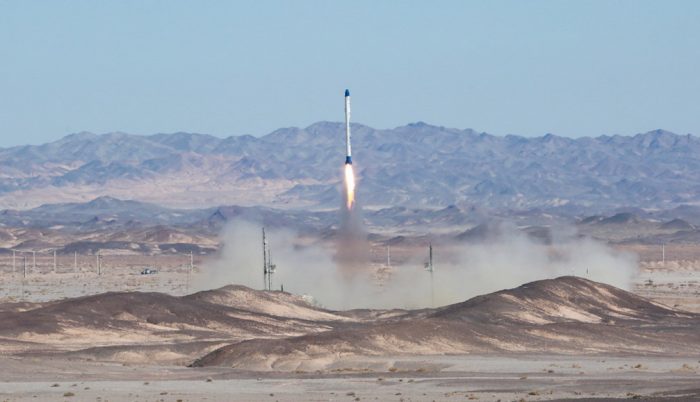
That fact was put on display with the announcement by the Iranian regime of its launching of a satellite into orbit on a ballistic missile.

Iranian state media confirmed the launch of a Simorgh rocket which the Trump administration considers a violation of the JCPOA.

State Department spokeswoman Heather Nauert said the launch appeared to be related to Iran’s attempts to develop ballistic missiles, which is not covered under the nuclear deal but is a subject of protest and sanctioning by the U.S.

“We would consider that a violation of UNSCR 2231,” Nauert said at a briefing with reporters when asked about the launch. “We consider that to be continued ballistic missile development. … We believe that what happened overnight, in the early morning hours here in Washington, is inconsistent with the Security Council resolutions.”

The Simorgh is a two-stage rocket first revealed in 2010. It is larger than an earlier model known as the Safir that Iran has used to launch satellites on previous occasions.

The U.S. National Air and Space Intelligence Center said in a report released last month that the Simorgh could act as a test bed for developing the technologies needed to produce an intercontinental ballistic missile, or ICBM.

“Tehran’s desire to have a strategic counter to the United States could drive it to field an ICBM. Progress in Iran’s space program could shorten a pathway to an ICBM because space launch vehicles (SLV) use inherently similar technologies,” the report said.

Iran’s satellite-launch program falls under the responsibility of the defense ministry, which has denied that the space program is a cover for weapons development, but such denials are silly on its surface since Iran has no civilian space agency.

Clearly the regime is using the guise of “scientific development” to advance its ballistic missile capability, especially now that the mullahs see their advantages disappear under an energized Congress and president intent on rolling back gains made by Iran.

For the mullahs, it is clearly a race now for the regime to develop additional technologies necessary to complete a nuclear delivery system such as heat shields and targeting systems designed to allow a payload to re-enter the Earth’s atmosphere to strike at targets thousands of miles away.

The table is now set for President Trump to walk away from the nuclear deal and news media have reported that he has instructed aides to closely re-examine the deal and evaluate against the regime’s actions over the past two years.

While the Iran lobby was nearly apoplectic over the news, it could not ignore the real possibility that all its hard work in securing the deal is about to be erased like tracks across sand dunes swept away by wind.

Trita Parsi of the National Iranian American Council issued a typically hysterical statement claiming that the president’s call for expanded inspections of Iran’s military installations for nuclear violations was a pretext to war.

“Clearly, facts don’t matter to the Trump administration – their desire to start a war trumps everything. Now, his team appears to be putting his desires into action,” Parsi said.

We advise Parsi to take a Xanax and calm down since his protestations have always been proven false in the past and this latest one is no different.

The fact that the JCPOA excluded large segments of Iran’s military-industrial complex allowed the regime ample room to hide its nuclear activities and the fact that international inspectors are restricted from accessing sites and many sites they were allowed to visit were scrubbed clean of any evidence months in advance shows how wrong Parsi is and how correct the president is in seeking additional inspections.

The Iranian regime predictably reacted with false anger and vitriol at the developments, but could not ignore the fact that the JCPOA is not a treaty and President Trump has wide latitude to simply walk away from the agreement.

Laura Carnahan

Filed Under: Blog, News Tagged With: #NuclearDeal, Featured, Iran, Iran Human rights, Iran Lobby, Iran sanctions, Iran Terrorism, IRGC, National Iranian American Council, NIAC Action, Sanctions, Syria, Trita Parsi

Threat of Iran Sanctions Drives Iran Lobby and Regime Crazy

July 28, 2017 by admin

Threat of Iran Sanctions Drives Iran Lobby and Regime Crazy

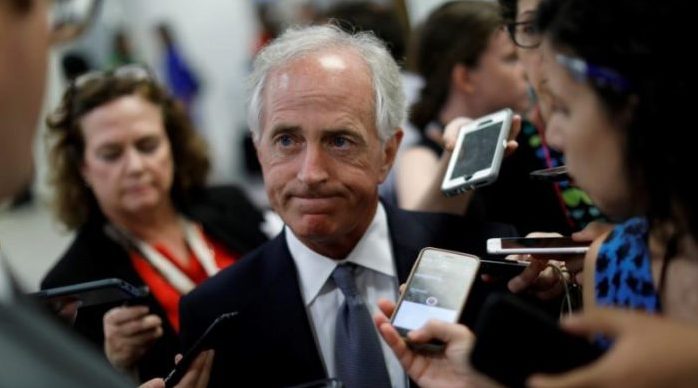
Senator Bob Corker (R-TN) speaks with reporters about the withdrawn Republican health care bill on Capitol Hill in Washington, U.S., July 18, 2017. REUTERS/Aaron P. Bernstein

It’s all but a done deal. House and Senate negotiators reached agreement according to news reports on Wednesday to get sanctions legislation against Iran, Russia and North Korea through the Senate without further amendments; avoiding needing another House vote.

“Following very productive discussions with [House Majority Leader Kevin McCarthy], I am glad to announce that we have reached an agreement that will allow us to send sanctions legislation to the president’s desk,” said Sen. Bob Corker (R-Tenn.), chair of the Senate Foreign Relations Committee. “The Senate will move to approve the Iran and Russia sanctions it originally passed six weeks ago, as well as the North Korea sanctions developed by the House.”

Votes in both houses of Congress up to this point have been lopsided, bipartisan affairs as Democrats joined with Republicans in a rare show of unity on confronting the three nations in question.

Both sides agreed on the need to take further action against North Korea even as the rogue nation has ramped up launches of ballistic missiles with ranges reaching the continental U.S.

The speed with which the sanctions legislation is moving through Congress demonstrates sharply how the landscape has changed over the last two years since the Iran nuclear deal went into effect.

The Iranian regime’s provocative actions in Iraq, Syria, Yemen, Pakistan, Bahrain and Kuwait have aptly shown the world how an unrestrained regime will act. It has also proven false the narrative used by the Iran lobby that by approving the nuclear deal, moderate elements in Iran would be empowered to take a leading role there.

Clearly, the truth has been shown that there are no moderate elements in Iran’s government.

But that hasn’t stopped the Iran lobby from trying to stop this speeding train from running over the mullahs in Tehran as evidenced by the latest editorial by Jamal Abdi of NIAC Action in The Hill.

Abdi tries to make the argument that in their rush to punish Russia, Democrats are allowing President Trump to dismantle the Iran nuclear deal.

“While Democrats may score a victory on Russia, they may be setting the stage for turning Trump into a wartime president. And if that happens, few will remember the Democrats as the party that sanctioned Russia. Instead they will remember when Democrats acquiesced to, and even encouraged, Trump’s push towards war with Iran,” Abdi said.

There is little doubt that Abdi’s words are not only ineffectual, but largely being ignored on Capitol Hill; demonstrating how far the Iran lobby has fallen in its effectiveness and ability to set the national debate.

Long gone are the days of the vaunted “echo chamber” banging the PR drum loudly in support of the mullahs; only replaced by vivid images of multiple missile launches, Iranian navy ships speeding at American warships, and wide swathes of destruction in Syria and Yemen at the hands of Iranian troops.

The inability of the Iran lobby to offer any policy whatsoever calling for any reform or restrictions to the Iranian regime’s behavior is fueling the belief that the Iran lobby can offer no more solutions.

The most recent hostage-taking by Iran of a Chinese-American researcher from Princeton University and the 10-year anniversary of the arrest of former FBI agent Robert Levinson who is still being held in Iran only reinforced the perception that the regime was lawless and recalcitrant.

The recent death of North Korean-hostage Otto Warmbier only reinforced the urgent necessity of getting American captives out of Iran and has become a focal point for President Trump as he demanded the release of several other Americans being held in Iran.

Typically, Reza Marashi of the National Iranian American Council, proposed another hostage swap, taking a page from the Obama administrations appeasement policies, and echoing demands from Iran’s leadership for the U.S. to release Iranians convicted of smuggling nuclear technology to Iran.

For President Trump, his ultimate leverage may be the very nuclear deal the Iran lobby is trying desperately to save. Even though the flawed deal served up all of the freebies and goodies for the Iranian regime in the beginning, it does represent the last fig leaf covering up the ugliness of the Iranian regime’s actions under the guise of “compliance.”

Without it, the regime would have no political cover and would become a pariah nation again so the president’s warnings in a recent interview with the Wall Street Journal that he may ultimately find the Iranian regime “noncompliant” with the deal could prove a key turning point for his administration.

The regime’s leadership responded with characteristic bravado as Hassan Rouhani vowed a “reciprocal” response should U.S. sanctions pass.

Rouhani said his country would “take any action that is necessary for the country’s expedience and interests” should the sanctions go into effect, according to The Associated Press.

“If the enemy breaches parts of the deal, we will breach parts of it,” the Iranian president added. “If they breach the entire deal, we will breach it in its entirety.”

The threats seem pointless at this time since whatever restrictive effects the deal purportedly had have been largely bypassed with Iran’s ability to keep its entire nuclear refining capacity and aggressive expansion of its ballistic missile program.

For the mullahs, they have already milked that deal dry and walking away from it would probably cause them little to no discomfort.

Filed Under: Blog, News Tagged With: Featured, Iran, Iran deal, Iran Human rights, Iran Lobby, Iran sanctions, Iran Terrorism, IRGC, Jamal Abdi, National Iranian American Council

  • « Previous Page
  • 1
  • …
  • 4
  • 5
  • 6
  • 7
  • 8
  • …
  • 20
  • Next Page »

National Iranian-American Council (NIAC)

  • Bogus Memberships
  • Survey
  • Lobbying
  • Iranians for International Cooperation
  • Defamation Lawsuit
  • People’s Mojahedin
  • Trita Parsi Biography
  • Parsi/Namazi Lobbying Plan
  • Parsi Links to Namazi & Iranian Regime
  • Namazi, NIAC Ringleader
  • Collaborating with Iran’s Ambassador

Recent Posts

  • NIAC Trying to Gain Influence On U.S. Congress
  • While Iran Lobby Plays Blame Game Iran Goes Nuclear
  • Iran Lobby Jumps on Detention of Iranian Newscaster
  • Bad News for Iran Swamps Iran Lobby
  • Iran Starts Off Year by Banning Instagram

© Copyright 2026 IranLobby.net · All Rights Reserved.