Iran Lobby

Exposing the Activities of the lobbies and appeasers of the Mullah's Dictatorship ruling Iran

  • Home
  • About
  • Current Trend
  • National Iranian-American Council(NIAC)
    • Bogus Memberships
    • Survey
    • Lobbying
    • Iranians for International Cooperation
    • Defamation Lawsuit
    • People’s Mojahedin
    • Trita Parsi Biography
    • Parsi/Namazi Lobbying Plan
    • Parsi Links to Namazi& Iranian Regime
    • Namazi, NIAC Ringleader
    • Collaborating with Iran’s Ambassador
  • The Appeasers
    • Gary Sick
    • Flynt Leverett & Hillary Mann Leverett
    • Baroness Nicholson
  • Blog
  • Links
  • Media Reports

Iran Lobby Ignores Upcoming Iran Election Shenanigans

February 18, 2016 by admin

Iran Lobby Ignores Upcoming Iran Election Shenanigans

Iran Lobby Ignores Upcoming Iran Election Shenanigans

On February 26, Iran will hold its parliamentary elections and similar to almost every election held since the Islamic revolution in 1979, the results will be largely a forgone conclusion since the mullahs control who goes on the ballot in the first place and in the case of the top spot – currently occupied by Ali Khamenei – that is a position that doesn’t even get voted on by the public in a process that old-line Soviets would find reminiscent of the Politburo.

Michael J. Totten, writing in World Affairs, took to task some idiotic observations made by Max Fisher in Vox magazine in which Fisher waxes rapturously about how the Iranian election could be historic. It the same kind of nonsense first advocated by the Iran lobby, most notably bloggers Jim Lobe and Ali Gharib, the National Iranian American Council and other regime advocates such as Paul Pillar.

The notion that the nuclear deal has set the stage for a historic election in which moderates and dissidents will finally get a fair shake and opportunity to put their stamp on the Islamic state moving into the 21st century is about as realistic as Boko Haram suddenly deciding to endorse women’s rights.

The truth of the matter, as Totten rightly points out, “let’s leave aside the blatant vote-stealing in Iran’s 2009 presidential election, when Mahmoud Ahmadinejad was declared the winner in districts that opposed him as overwhelmingly as San Francisco opposes Dick Cheney. Nevermind that disgraceful episode.”

“Elections in Iran are rigged even when they aren’t rigged,” Totten said. “Supreme Leader Ali Khamenei hand-picks everybody who runs for president. Moderates are rejected routinely. Only the less-moderate of the moderates—the ones who won’t give Khamenei excessive heartburn if they win—are allowed to run at all. Liberal and leftist candidates are rejected categorically.”

In the case of the position of president of the regime, a position held by Hassan Rouhani, Totten points out that “he’s not quite a figurehead. He can tinker with a few things around the edges. But the country is run by the unelected Supreme Leader, the Guardian Council, and the Revolutionary Guard Corps, which is officially designated as a terrorist organization.”

NIAC hacks such as Trita Parsi and Reza Marashi have argued that “moderates” will be empowered in a resurgent Iran and that will be reflected in more moderates being elected to the upper legislative body, the Assembly of Experts which nominally selects the new Supreme Leader when Khamenei dies.

Nothing could be further from the truth. The Guardian Council dumped thousands of potential candidates, the overwhelming majority of them more moderate than the ruling mullahs in a similar political exorcism it conducted during Rouhani’s election when it cleared the field for him to run virtually unopposed.

Let’s also consider that a “moderate” in regime politics is like calling someone a moderate who opposes hanging a political dissident, but doesn’t mind locking up a political dissident; in much the same way as Rouhani was hailed as a moderate, but since his ascension he has presided over more executions in his first term than even Ahmadinejad carried out.

In another sign that the elections are going turn out in favor of Khamenei and his cronies no matter what the actual vote is, Khamenei’s office issued a press release through regime-controlled media warning of “enemy” efforts to undermine the elections.

The statement read in part: “Their plot for the February 26 elections is to undermine the Guardian Council and question its decisions,” Ayatollah Khamenei said, “describing the Council as one of the fundamental institutions of the Islamic Establishment, which the US has been strongly opposed to since the victory of the Islamic Revolution.”

“When the Guardian Council’s decisions are called into question, the elections would be perceived to be illegal, and, consequently, the elected parliament as well as the laws it ratifies would be deemed illegal, the Leader explained.”

The regime learned its lessons from the 2009 election debacles that resulted in violent street demonstrations that had to be put down with bloody consequences and is doing all it can to pre-ordain the results and impose order such that there would be no repeat of civil disobedience.

All of which has not gone unnoticed by an American public who’s opinion of the regime’s leadership has astonishingly remained virtually unchanged since the 1980s according to a new Gallup Poll released this week.

A stunningly low 14 percent of Americans have a favorable viewpoint of the regime in a benchmark for futility that has not budged in spite of all the public relations and social media posturing conducted by the Iran lobby. It’s nice to see that no matter how many tweets Trita Parsi puts out, Americans remain skeptical and wary of a regime that has put to the hangman’s noose over 2,300 people under Rouhani.

By Michael Tomlinson


Filed Under: Blog, Current Trend, News Tagged With: Featured, hassan rouhani, Khamenei, National Iranian American Council, NIAC, Reza Marashi, Trita Parsi

Iran Lobby Attacks Saudi Arabia to Distract from Worsening Syrian Situation

February 16, 2016 by admin

Iran Lobby Attacks Saudi Arabia to Distract from Worsening Syrian Situation

Iran Lobby Attacks Saudi Arabia to Distract from Worsening Syrian Situation

There is a certain reliable predictability in what the Iran lobby will write about and advocate. It will always defend the Iranian regime from any potential sanctions no matter how egregious its acts. It will always stay mute on horrific human rights violations or terrorist acts springing from Tehran. It will always find someone else to blame for the region’s troubles that come directly from Iranian actions.

Reza Marashi, the research director for the National Iranian American Council and one of the staunchest defenders of the regime, penned an editorial in The Cairo Review which essentially places blame on Saudi Arabia for the all the ills befalling the Middle East. It is an all-too predictable attempt at shifting blame away from Tehran and dumping it on Riyadh.

Among the literary ruins of his diatribe lie a few choice nuggets of deception such as:

“The Obama administration rightly recognizes the aggressive regional policies of both Iran and Saudi Arabia. But here’s the catch: Tehran has been willing to negotiate de-escalation for nearly three years. Washington has encouraged it. To date, Riyadh has refused,” Marashi writes.

The remarkable thing about Marashi’s editorial is that you could trade places between Saudi Arabia and Iran and his editorial would make perfect sense. For example, the previous piece would read now as:

“The Obama administration rightly recognizes the aggressive regional policies of both Iran and Saudi Arabia. But here’s the catch: Riyadh has been willing to negotiate de-escalation for nearly three years. Washington has encouraged it. To date, Tehran has refused.”

In this reality, the truth actually comes out correctly! Tehran has been the sole reason why the Syrian civil war escalated into the conflagration it has become. Top mullah Ali Khamenei and his handpicked puppet Hassan Rouhani made the calculation that keeping Syrian dictator Bashar al-Assad in power was their only hope of maintaining a Shia arc of influence stretching from the Mediterranean Sea to the Indian Ocean through Syria, Iraq and Yemen.

If Iran’s chief regional ally was allowed to fall, the Iranian regime’s position would become precarious and the very real possibility of regime change would finally be available to the overwhelming numbers of ordinary oppressed Iranians who yearn for freedom from the yoke of theocratic control.

Instead, the mullahs went all in by first pouring billions of dollars into the Assad regime to keep it afloat after most of the world imposed harsh sanctions for the use of barrel bombs and chemical weapons on Syrian and opposition civilians.

Then Tehran directed its terrorist proxy Hezbollah to pour fighters into Syria while at the same time it recruited and coerced Afghan refugees in Iran to enlist and shipped them off to fight. Even with all this support, Assad’s regime was on the verge of crumbling from opposition fighters, forcing Rouhani to beg Russia’s Vladimir Putin to intervene and throw Moscow’s weight into the fray to save the Iranian regime’s proverbial bacon.

Even as Syrian peace talks have taken place in Geneva, Marashi contends that Saudi Arabia has no place at the table which is ironic since Marashi conveniently ignores the fact that all lines of conflict flow back to Tehran and Saudi Arabia is intricately caught up in this web with the Iranian regime’s sponsorship and support of Houthi rebels in Yemen who have brought another war to the Saudi Arabian border; a fact Marashi neglects to mention.

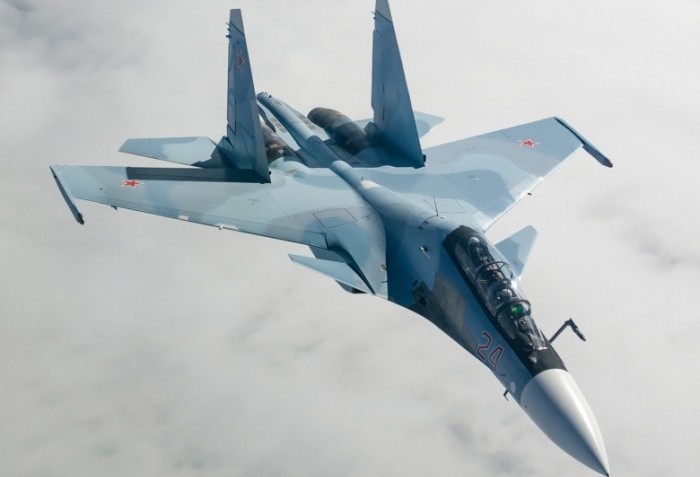
Marashi further contends that the nuclear deal with Iran did not pre-ordain regional conflicts as a result. In fact, that is exactly what it has done. The lifting of economic sanctions and the awarding of over $100 billion in cash to Iran has caused ripples far and wide as Tehran embarked on a mass shopping spree including sophisticated Russian anti-aircraft missiles and now an agreement to buy advanced Sukhoi Su-30 Flanker fighters.

The rapid re-armament of Iran has justifiably spooked its neighbors who plainly see the results of regime aggression and adventurism. Their concerns have sparked talked of a nuclear arms race as Iran’s neighbors seriously weigh their options in pursuing comparable weapons to the Iranian regime, even raising the specter of a new nuclear arms race – a glaring point that Marashi neglects to remark on.

The total commitment of the Iranian regime to support Assad manifested itself with a demand from regime foreign minister Javad Zarif that Iran and its allies in Syria won’t allow a cessation of hostilities in Syria to enable opponents of the Assad regime to “regroup.”

The demand to press the fight against Assad’s opponents by the Iranian regime recognizes that Iran cannot sustain an indefinite war, especially as it drains that $100 billion credit line quickly and global petroleum prices continue to sink, denying the regime the opportunity to cash in immediately on the lifting of embargoes on oil sales.

The clock is definitely running on the mullahs, and they and their allies such as the NIAC know it. This was shown in comments made by the Iranian regime’s air defense chief who vowed that Iran would help Syria further by beefing up its air defense capabilities as the possibility of the establishment of no-fly zones was being raised at the Geneva talks.

One only wonders if that includes transferring some of the new S-300 advanced missile batteries the Iranian regime has just purchased from Russia over to Syria, in what would amount to a dramatic escalation in military support for the Assad regime by Iran.

The reality is that Marashi’s editorial is an indicator of the growing level of concern the mullahs have over the successes Saudi Arabia and neighboring Gulf states have had in stemming Iranian regime advances, especially in intercepting arms being smuggled by Iran into Yemen for Houthi rebels.

By Michael Tomlinson


Filed Under: Blog, News Tagged With: Featured, Iran Lobby, Reza Marashi, Syria

Iran Lobby Cannot Defend Growing Human Rights Violations

February 16, 2016 by admin

Iran Lobby Cannot Defend Growing Human Rights Violations

Iran Lobby Cannot Defend Growing Human Rights Violations

“You cannot escape the responsibility of tomorrow by evading it today.” – Abraham Lincoln

On this President’s Day, it is fitting we look back on past presidents for lessons and observations that hold true in today’s chaotic world and Lincoln’s quote is as powerful and meaningful today as it was in his day, especially as we look at the downward spiral that is the Middle East in general and the Iranian regime specifically.

Lincoln, faced with a great split down the middle of his country, believed deeply in uniting a nation under the principles of freedom and equality for all. He saw slavery as a morally corrupt practice that – if allowed to continue – would darken and sicken the heart of his nation to its core. His quote hearkens to the need to stand firm in the face of great adversity and make the hard decisions today because any delay would force ever harder decisions tomorrow.

The same sentiment applies to the world’s approach to the mullahs in Tehran. The rush to appease the Iranian regime with a dubious nuclear agreement and the move to delink from it a wide range of regime abuses such as support for terror, development of ballistic missiles, holding of hostages and crackdowns on human rights, have proven to be problematic in its aftermath.

Lincoln’s words are also a necessary reminder that we cannot bargain away important moral points today in the hopes for political expediency and we certainly cannot be lured by the siren song of false promises that emanate from the Iran lobby which fought hard to position the regime as a moderate-seeking group of bureaucrats and not a bunch of thuggish theocrats which they really are.

When regime advocates such as Trita Parsi and Reza Marashi of the National Iranian American Council argue for an almost obsequious approach to dealing with the mullahs in the hopes of gaining favor, they in fact are arguing the world give away all of its leverage in the hope of gaining some whiff of cooperation when none will be forthcoming.

Even now, Parsi and Marashi and others in the Iran lobby have consistently ignored the broader implications of aggressive regime behavior since the nuclear deal and instead focused on non-issues such as visa waivers and holding the line against any possible future sanctions.

They have ignored the widespread imprisonment of journalists, Iranian dissidents, artists, students and bloggers throughout Iran.

They have ignored the dramatic escalation in the Syrian war as the mullahs begged Russia to enter on behalf of saving the Assad regime.

They have ignored the blatant acts of aggression committed by the regime in detaining ten U.S. sailors and then using them in a constant stream of propaganda exercises; releasing video of them kneeling underneath guns, even one sailor crying and now revelations they were subjected to constant and intense questioning by regime officials.

The Iran lobby has consistently ignored the repeated reports and demands of international human rights groups such as Amnesty International and Ahmed Shaheed, the United Nations Special Rapporteur for human rights in Iran, all of whom have revealed evidence of mounting regime abuses of increasing size and barbarity.

An Iranian who fled the bloodshed of the regime wrote in the American Thinker his own story of the atrocities committed by the regime and sad state of affairs for ordinary Iranians.

“In the last 37 years, the Iranian nation has lived under the reign of the most backward regime.  The truth is that the clergymen who rule Iran do not belong in this age and cannot deal with the realities of the modern world.  At best, the Islamic revolution of 1979 was the revolution of century against century.  They believe that after 37 years of mismanagement and brutality, the only way they can extend their rule is by increasingly terrorizing their critics.  The Islamic regime has taken this noble Iranian nation into the Middle Ages, creating some of the most medieval laws and implementing them against its citizens in the most vicious manner,” he writes.

“The regime’s atrocities include stoning men and women, cutting off their fingers, torturing innocent people for their opinion, incarcerating religious minorities on fabricated charges, imprisoning Iranian youths for upholding their very basic human rights, and organizing vigilantes to murder political opponents.  They have created an atmosphere of fear and intimidation, where Iranians cannot trust one another.  In brief, in the name of religion, the clergymen have created a society where sadness and despair have replaced hope and optimism,” he added.

This testimony is only one of many that pour out of Iran demanding to be addressed by the world’s governments and news media. Iranian dissident groups such as the National Council of Resistance of Iran have provided much of the proof of the atrocities being committed through smuggled video of public executions, sworn testimony from victims of the regime and tracking of prisoners who all too often disappear in the labyrinth of infamous black holes such as Evin Prison.

Ultimately, Lincoln’s message may prove prophetic as the price to be paid in confronting Iranian regime aggression will only rise in the next president’s term. We can only hope that price will not be too high to pay in light of recent appeasement of the mullahs.

By Laura Carnahan

Filed Under: Blog, News Tagged With: Abraham Lincoln, Featured, Iran Human rights, Iran Lobby, Reza Marashi, Trita Parsi

Iranian Regime Antagonizes as Iran Lobby Ignores It All

February 11, 2016 by admin

Iranian Regime Antagonizes as Iran Lobby Ignores It All

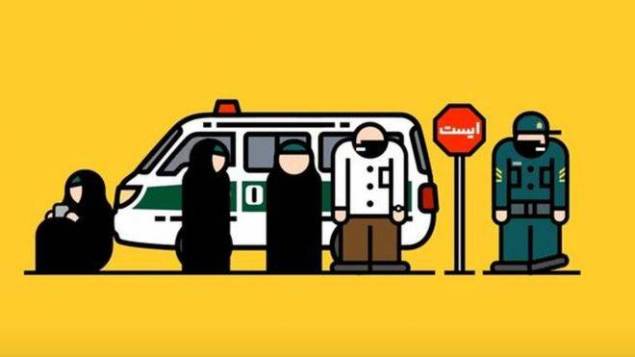
New App to get around the oppressive “Ershad” security units.


W

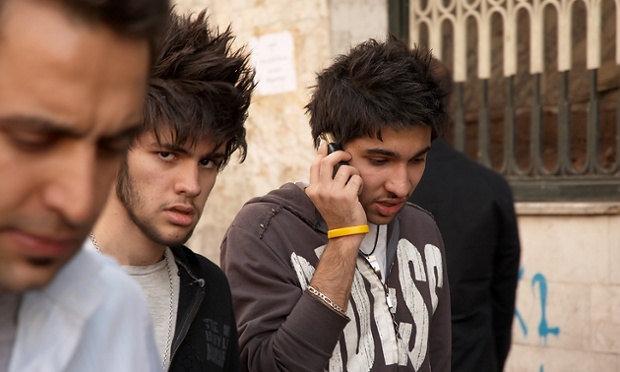
hile the Iran lobby is trying to push for the idea, of moderate forces existing inside the Iranian regime, the violation of human rights in Iran is on the rise. Things have gotten so bad, that some smart Iranian app developers have created a remarkable mobile phone app to help young fashion conscious Iranians avoid the regime’s notorious morality police known as “Ershad.”

According to the BBC, Ershad’s mobile checkpoints which usually consist of a van, a few bearded men and one or two women in black chadors, are deployed in towns across Iran and appear with no notice.

Ershad personnel have a very extensive list of powers ranging from issuing warnings and forcing those they accuse of violating the regime’s strict Islamic code of conduct, to make a written statement pledging to never do so again, to fines or even prosecuting offenders.

The new phone app which is called “Gershad” (probably meaning get around Ershad instead of facing them) however, will alert users to checkpoints and help them to avoid them by choosing a different route.

The data for the app is crowdsourced. It relies on users to point out the location of the Ershad vans on maps and when a sufficient number of users point out the same point, an alert will show up on the map for other users. When the number decreases, the alert will fade gradually from the map.

In a statement on their web page the app’s developers explain their motives in this way: “Why do we have to be humiliated for our most obvious right which is the right to wear what we want? Social media networks and websites are full of footage and photos of innocent women who have been beaten up and dragged on the ground by the Ershad patrol agents.”

“Police need to provide security for the citizens not to turn into a factor for fear. A while ago, angry with such unreasonable oppressions, we looked for a solution to find a practical way to resist the volume of injustices peacefully with low risk level, to restore part of our freedom.”

According to the designers of Gershad, in 2014 alone, around three million people were issued with official warnings, 18,000 were prosecuted and more than 200,000 were made to write formal pledges of repentance.

While it is laudable that Iranians are developing new and innovative ways to get around the strict control imposed by the mullahs, the price of that covert activity can be high in a regime where over 2,200 executions have already occurred under the tenure of Hassan Rouhani.

That point was emphasized by Mohammad Rez Naqdi, commander of the regime’s infamous Basij paramilitary force, who claimed that the U.S. could no longer act in the Middle East without the consent of top mullah Ali Khamenei.

Those kinds of boasts have caused an ever-increasing number of news outlets and political leaders from both sides of the aisle to demand more accountability from the regime.

According to the Washington Post, this week alone, U.S. lawmakers will gather for at least five separate committee meetings specifically dedicated to reviewing Iran’s actions ranging from its compliance with the nuclear pact to its dedication to locating and freeing still-missing former FBI agent Robert Levinson, who disappeared in Iran in 2007. Top U.S. intelligence officials were grilled Tuesday in two additional hearings for their take on the threat posed by Iran.

And later this month, senators are expected to roll out a series of bills to bring the greater weight of more non-nuclear sanctions down on Tehran, seeking to punish Iran for everything from recent ballistic missile tests to pervasive human rights abuses.

Among the proposals was one offered by Sen. Chris Coons (D-Del.) who pledged to get more funding for the group responsible for making sure Iran doesn’t cheat on the nuclear deal, suggesting President Obama’s budget request doesn’t go far enough.

“As a member of the Appropriations Committee, I am committed to doing everything I can to increase funding for the [International Atomic Energy Agency] during the Appropriations process,” he said in a statement. “However, this goal is made considerably more difficult by the administration’s low baseline request.”

It is almost a given that Iran’s upcoming parliamentary elections are being engineered by the mullahs to deliver an overwhelming slate of winners favorable to Khamenei and his cadre of mullahs. It remains to be seen what the rest of the world will do in response to another stolen election in Iran.

By Michael Tomlinson

Filed Under: Blog, News Tagged With: Featured, Iran deal, Iran Human rights

Iran Lobby Promises of More Moderate Iran Rebutted

February 10, 2016 by admin

Iran Lobby Promises of More Moderate Iran Rebutted

Iran Lobby Promises of More Moderate Iran Rebutted

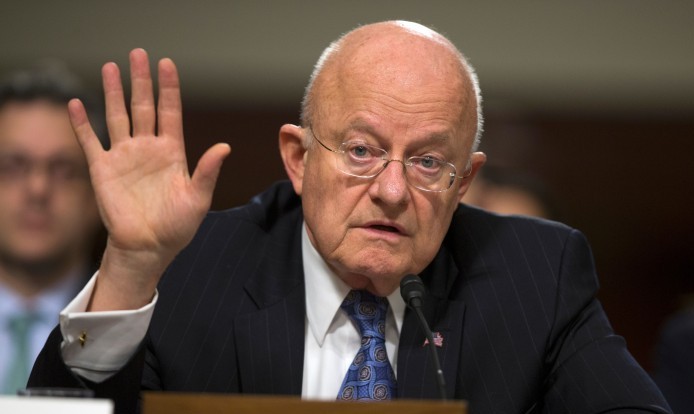
In an appearance before the Senate Armed Services Committee on Tuesday, James Clapper, director of national intelligence, gave a very somber description of what he sees as the Iranian regime’s intentions toward the U.S. now that last summer’s nuclear deal has commenced.

In particular, his statements offered little assurance the regime is acting as an honest actor with the U.S. and the other states involved in last year’s negotiations, or that the nuclear deal will stop Iran regime from obtaining a nuclear weapon.

“Iran probably views JCPOA [Iran deal] as a means to remove sanctions while preserving nuclear capabilities, as well as the option to eventually expand its nuclear infrastructure,” said Clapper.

The U.S. intelligence community has concluded that “Iran does not face any insurmountable technical barriers to producing a nuclear weapon, making Iran’s political will the central issue,” according to Clapper.

Clapper’s statements stand in stark contrast with those made by the Iran lobby led by the National Iranian American Council, which lauded the nuclear accord last summer, claiming it would not only stop all of Iran’s possible pathways to a nuclear weapon, but that “under its terms, Iran is never allowed to build a nuclear weapon.”When queried on Iran’s missile tests conducted in October and December of 2015 just months after the signing of the Iran deal, Clapper had no doubts the regime was trying to send a message.

“I think this was a deliberate message of defiance and that the Iranians are going to continue with an aggressive program to develop their missile force,” said Clapper.

The U.S. intelligence community predicts the Iranian regime “would choose ballistic missiles as its preferred method of delivering nuclear weapons, if it builds them,” according to Clapper. “Iran’s ballistic missiles are inherently capable of delivering [weapons of mass destruction], and Tehran already has the largest inventory of ballistic missiles in the Middle East.”

The regime also continues research on its space program, which is largely considered a front for the construction of advanced ballistic missile technology.

“Iran’s progress on space launch vehicles—along with its desire to deter the United States and its allies—provides Tehran with the means and motivation to develop longer-range missiles, including ICBMs,” Clapper said.

At the same time, Iran continues to be the world’s foremost sponsor of terrorism.

“Iran—the foremost state sponsor of terrorism—continues to exert its influence in regional crises in the Middle East through the Islamic Revolutionary Guard Corps—Quds Force (IRGC-QF), its terrorist partner Lebanese Hezbollah, and proxy groups,” Clapper said.

The Obama administration responded to the tests with a new round of sanctions on Iran’s missile program. Regime officials said the new sanctions would not deter its ambitious missile program, and that it will instead go on the “offensive” in response.

It is in this context that the recent ramp up in testing and deployment of new ballistic missiles and nuclear warheads by North Korea is the most troubling since it has been North Korea that has provided the initial designs and materials to the Iranian regime for its nuclear and missile programs as Clapper indicated in his testimony.

He testified that North Korea has expanded its Yongbyon plant for uranium enrichment and has restarted a plutonium reactor shut down in 2007 that could produce nuclear weapons fuel “within a matter of weeks to months.” North Korea could have as many as 100 nuclear bombs less than five years from now, plus, as Clapper warned, it’s developing an ICBM missile to carry them to the U.S. homeland.

North Korea in many ways is the preview of what the Iranian regime is on track to similarly do as it has broken all of the agreements it has made, developed its weapons program under the unsuspecting eyes of international inspections and freely traded in its technology to other radical nations.

North Korea is also a reminder that hollow diplomatic promises not backed up by severe consequences leads to only more appeasement in a desperate bid to regain perceived momentum with each new violation and militant act. It’s a pattern that is already being repeated with the Iranian regime which has launched new missiles, stepped up its wars in Syria and Yemen and instituted a large-scale crackdown on human rights and political dissidents at home in advance of upcoming elections.

And even with the Iran lobby’s own, most vocal supporters being similarly tossed into Iranian prisons, the Iran lobby cannot face the awful consequences of its actions and still expresses support for the totalitarian regime in Tehran.

That link between North Korea and the Iranian regime is under scrutiny by members of Congress who have called for an investigation of the cooperation between the two regimes.

Sen. David Perdue (R-Ga.) late Monday filed an amendment to a North Korea sanctions bill that would require the administration to disclose to Congress any cooperation between the rogue Asian nation and Iran on nuclear weapon and ballistic missile development.

Congress took up the issue after North Korea said it successfully tested a hydrogen bomb last month. On Saturday, the country conducted a missile launch that it claimed was to put a satellite into space for peaceful purposes, but the U.S. and allies suspect was a long-range missile test in violation of international law.

Perdue and other members of Congress suspect that North Korea and Iran are cooperating and that the administration has been reluctant to disclose to Congress what it knows.

“It’s undeniable that Iran and North Korea have been cooperating on nuclear weapon and ballistic missile development for years now,” said Perdue, a member of the Senate Foreign Relations Committee, in a statement.

“Iranians have reportedly been present for at least three of North Korea’s nuclear tests,” he said.

Perdue’s amendment would require the administration to submit a semiannual report to Congress on North Korea’s cooperation with Iran on nuclear weapon and ballistic missile testing, development and research.

It would also require the administration to disclose to Congress the identity of individuals who have knowingly engaged in or directed material support or exchanged information between governments of Iran and North Korea for their nuclear programs.

“This amendment forces the Obama administration to disclose to Congress what it knows about this cooperation between rogue nations, instead of denying the linkages. The sooner we acknowledge this illicit cooperation, the sooner we can work to put it to a halt,” Perdue said.

The failure to rein in North Korea and the appeasement of the mullahs in Iran with a deeply flawed nuclear deal has only emboldened these regimes to aggressively move forward with their plans. We can only hope that the world will respond soon enough to halt these threats before it’s too late.

By Michael Tomlinson

Filed Under: Blog, News Tagged With: #NuclearDeal, Featured, Iran, Iran Lobby

Iran Lobby Picks and Chooses Hostages to Support

February 9, 2016 by admin

Iran Lobby Picks and Chooses Hostages to Support

Iran Lobby Picks and Chooses Hostages to Support

Five Iranian-American groups sent a letter to U.S. Secretary of State John Kerry urging him to work for the release of an Iranian-American being held by the Iranian regime and not part of the prisoner swap that occurred last month.


The signatories to the letter were the Public Affairs Alliance of Iranian Americans, the Pars Equality Center, the National Iranian American Council, Iranian Alliances Across Borders, and the International Campaign for Human Rights in Iran. Most of these groups actively supported the nuclear agreement with the Iranian regime and have campaigned on behalf of it; most notably the NIAC.

Siamak Namazi has been held in Iranian prison since last October and his continued imprisonment has now become something of a cause amongst groups such as NIAC who have previously not dared to voice any public disagreement with the regime on previous occasions, including the imprisonment of other more notable Iranian-Americans such as Washington Post reporter Jason Rezaian, Christian pastor Saeed Abedini and former U.S. Marine Amir Hekmati, who had been subjected to torture and released as part of the prisoner swap.

The U.S. released seven Iranian nationals held in the U.S., in return and agreed to drop international arrest warrants and charges against 14 Iranians outside of the U.S. who had been involved in the smuggling of arms and nuclear components.

Other Iranian-Americans, some of whom spoke on the condition of anonymity to the New York Times, said they were postponing or scrapping planned trips to Iran until Namazi was released, or at least until the circumstances surrounding his case were clearer since his arrest has stirred anxiety among those who thought the nuclear deal portended a new era.

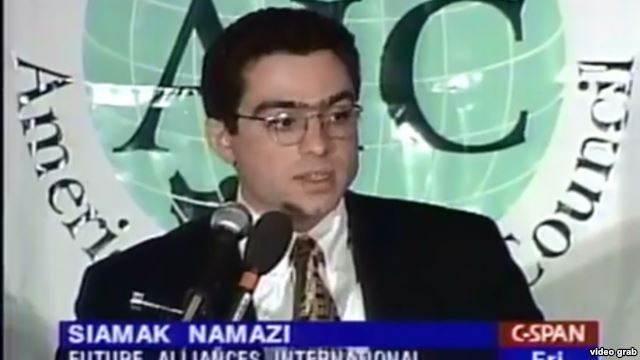
Trita Parsi traveled with Siamak Namazi to Isfahan, Iran’s third largest city, in August 2000. They also toured the Zoroastrian “Fire of Victory” Temple in Yazd. At the time, Siamak was living in Tehran, working for Atieh Bahar, a consultant company with close ties to the government. In 1999, Parsi and Siamak co-authored a paper that recommended setting up a lobbying organization in Washington to influence US-Iran policy. Siamak took a sabbatical in 2005 to complete a fellowship at the Woodrow Wilson Center in Washington, DC. While at the Center, Siamak helped Parsi formulate NIAC policies supportive of the Iranian regime.

Trita Parsi traveled with Siamak Namazi to Isfahan, Iran’s third largest city, in August 2000. They also toured the Zoroastrian “Fire of Victory” Temple in Yazd.
At the time, Siamak was living in Tehran, working for Atieh Bahar, a consultant company with close ties to the government.
In 1999, Parsi and Siamak co-authored a paper that recommended setting up a lobbying organization in Washington to influence US-Iran policy. Siamak took a sabbatical in 2005 to complete a fellowship at the Woodrow Wilson Center in Washington, DC. While at the Center, Siamak helped Parsi formulate NIAC policies supportive of the Iranian regime.

The ties between Namazi and Trita Parsi of the NIAC previously exposed by Iranlobby.net were also revealed in a Daily Beast expose that detailed how in 1999, Namazi got together with Parsi at a conference in Cyprus. The conference, titled, “Dialogue and Action Between the People of Iran and America,” was convened to help ameliorate U.S.-Iranian relations in advance of reconciliation by forming an aggressive public relations and lobbying response to any anti-Iranian regime policies and legislation.

Two years later Parsi founded the NIAC, which long advocated opening up commercial and financial lines back to Iran with Namazi’s family companies offering to provide foreign companies and investors with connections and access to regime officials in a cozy relationship that no longer appears that cozy.

This is especially ironic since in March 2006 (at the height of the covert Iranian war with the U.S. in Iraq), Parsi told a colleague not to worry about a trip to Tehran, “NIAC has a good name in Iran and your association with it will not harm you.” When the colleague was briefly questioned by the regime, then released, he reported back (PDF) to Parsi that he’d been told the reason he was let go was “that they knew NIAC had never done anything seriously bad against the Islamic Republic.”

The shifting political winds within the Iranian regime have been reflected in the mass dismissals of thousands of proposed candidates for parliamentary election seats, but of more immediate concern is the prospect of mass demonstrations by ordinary Iranians – not over election issues, but because a large number of Iranians who receive public payments have not been paid by the regime. This also shows that as far as the ordinary Iranians are concerned, they have no illusion about the existence of a moderate or any moderation within the mullah’s regime.

An extraordinary directive from the Herasat Office, the regime’s domestic intelligence and security forces, entitled: “Issue: Paying workers’ wages in the final days of the year”:

“With greeting and respect, you are hereby informed that given that the end of the [Persian calendar] year is approaching and taking note of the instructions handed down by the minister and competent authorities regarding timely payment of workers’ wages and back pay, you must instruct that all wages, bonuses, back pay and overtime pay be paid no later than February 24, 2016 in order to prevent any possible gatherings or sit-ins and their related negative consequences.

“You are reminded that given the upcoming elections of the Assembly of Experts and Islamic Assembly (Parliament), this issue must be treated with especial importance and sensitivity in order to prevent any misuse of this matter for publicity in particular in the realm of workers’ protests.”

In other words, a lot of Iranians haven’t been paid their salaries, and the Khamenei regime is ordering that they be paid the money they’re owed by February 24, two days before the election, in the hope of defusing any potential mass protests.

The prospect of election protests is worrisome to regime leaders, especially since these elections will be held at the same time International Women’s Day is observed, which is all the more problematic for the regime when one considers the abysmal state of women’s rights in the regime today.

Nothing exemplifies this more than reports that Press TV, the regime’s state-run, English language news channel, suspended two executives on Monday after a prominent newscaster exposed that she had endured years of sexual harassment from them.

The newscaster, Sheena Shirani, has fled the country according to the New York Times.

Press TV is a part of the Voice and Vision organization of Iran, a powerful state media organization that is widely seen as a tool of the country’s hardline factions. One expatriate journalist who previously worked for Newsweek said that Emadi doubled as an interrogator in the Evin prison and once interrogated him. Emadi was later placed on a European blacklist of human rights violators.

The incident has also led to debate on social media. Several women have said such forms of harassment are commonplace in Iran under the mullahs rule, where unemployment is high and laws overwhelmingly favor men.

By Michael Tomlinson

Filed Under: News Tagged With: Featured, National Iranian American Council, NIAC, siamak Namazi, Trita Parsi

What the Iran Lobby Will Not Talk About

February 8, 2016 by admin

What the Iran Lobby Will Not Talk About

What the Iran Lobby Will Not Talk About

While most of the U.S. and a good chunk of the global sports audience watched the Denver Broncos defeat the Carolina Panthers in Super Bowl 50 on Sunday, the rest of the world continued to struggle with the daily hardships that have come with the rise of Islamic extremism flowing out of the Iranian regime.

That extremism has come to take many forms including the world’s largest refugee crisis since World War II as Syrians flee the civil war that Iranian forces have exacerbated. It has also resulted in rising tensions with the Iranian regime since the completion of a nuclear deal that was sold as being an instrument for moderation by the Iran lobby – most notably the National Iranian American Council.

Those tensions have included the blatant violation of existing United Nations Security Council sanctions banning the development of nuclear-capable ballistic missiles and the continued crackdown on Iranians in advance of upcoming parliamentary elections, including the imprisonment of Iranian-Americans, Christians, dissidents, journalists, artists, bloggers and scores of others deemed a danger to the ruling mullahs.

Even after a prisoner swap that allowed for the release of long-time American prisoners Jason Rezaian, Saeed Abedini and Amir Hekmati, the specter of other Americans becoming prisoners in Iran has loomed to such an extent that the U.S. State Department updated its travel warning for Iran recently “to reiterate and highlight the risk of arrest and detention of U.S. citizens, particularly dual national Iranian Americans, in Iran.”

“Various elements in Iran remain hostile to the United States.  Since the United States and Iran reached a Joint Comprehensive Plan of Action to address the international community’s concerns over Iran’s nuclear program on July 14, 2015, Iran has continued to harass, arrest, and detain U.S. citizens, in particular dual national,” read the State Department warning.

“The Iranian government continues to repress some minority religious and ethnic groups, including Christians, Baha’i, Arabs, Kurds, Azeris, and others.  Consequently, some areas within the country where these minorities reside, including the Baluchistan border area near Pakistan and Afghanistan, the Kurdish northwest of the country, and areas near the Iraqi border, remain unsafe. Iranian authorities have detained and harassed U.S. citizens, particularly those of Iranian origin.  Former Muslims who have converted to other religions, religious activists, and persons who encourage Muslims to convert are subject to arrest and prosecution,” added the statement.

Naturally the Iran lobby is completely silent on this issue since there is really nothing it can say to defend the Iranian regime, unless of course it did a public service by reprinting the State Department warning on their own websites to provide a heads up to Iranian-Americans.

The only public pronouncements the Iran lobby has made on travel is to condemn the notion of requiring background checks on those wishing to secure a visa to travel to the U.S. from nations such as Iran.

The plight of those with dual citizenship being detained and imprisoned in Iran was made more public when Reuters confirmed that a number of these dual citizens were being charged with espionage similar to what Washington Post reporter Rezaian was charged.

“We have several dual citizens in jail. Their charges are mostly the same (as Rezaian’s),” the judiciary spokesman Gholamhossein Mohseni Ejei was quoted as saying by the Fars news agency. “It is still important to know what he and those related to him were doing in Iran. So their case is still open.”

The fact that the mullahs still view the holding of dual citizens as a form of political gamesmanship and bartering leaves little room for the Iran lobby to make any case for a new wave of “moderation” sweeping over the Iranian regime.

In an odd twist, Siamak Namazi, an Iranian-American with strong ties to the Iran lobby and others supportive of the regime and the nuclear deal, was arrested and is still being held in Iran. Namazi’s friends and supporters, including the NIAC, have attempted to portray his plight as being a pawn in the political power struggle between so-called “moderate” and “hardline” factions within the Iranian regime, but the simple truth may be he is just another bargaining chip the regime may want to use in the future.

But his arrest does send a clear signal to the Iran lobby that their utility to the regime is only as worthwhile as the mullahs deem fit and they – like any other Iranian – could just as quickly and easily find themselves in Evin Prison even after being a loyal supporter of the regime.

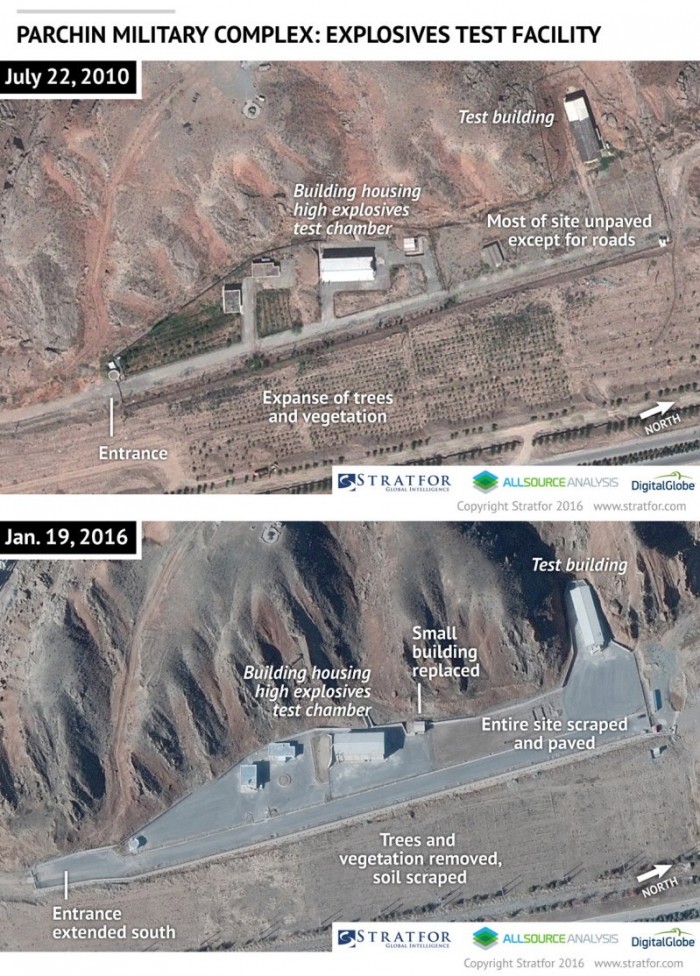
That nefarious nature of the regime was reinforced by disclosures that even as the Iranian regime was working to negotiate a nuclear deal, it was working to hide its atomic work at its Parchin military complex which has been used to test high explosives necessary for ignitors for nuclear warheads according to various intelligence agencies and Iranian dissident groups.

Forecasting site Stratfor.com says the images published Monday show Iran building a tunnel into a heavily guarded mountain complex inside the Parchin facility, some 20 miles southeast of Tehran, while also working to erase signs of alleged high-explosive testing at another area on the site.

“We’re not saying they’re cheating on the nuclear deal,” Stratfor analyst Sim Tack told The Daily Beast. “The images show Iran was going through the motions to hide what it’s done before, and it is still…developing facilities that the IAEA may or may not have access to,” Tack said, referring to the International Atomic Energy Agency.

The progression of satellite images tracking construction at Parchin from 2012 to 2015 show how Iran’s leaders apparently worked to keep regime hardliners happy by moving forward with weapons programs, even as the leadership worked to erase signs of an illegal nuclear weapons program, Tack said.

The imagery reveals new paving around a building alleged to be used for high-explosive testing, while another shows plants and trees removed and soil scraped and hauled away as possible evidence of radioactive contamination was removed in advance of inspections.

The simultaneous construction of a tunnel entrance into the mountain complex is also worrisome since the regime has since released new photos showing its inventory of ballistic missiles stored in new underground bunkers.

Yet even with all of these acts and revelations, the Iran lobby remains silent. We can only assume it has been waiting for the Super Bowl so they can relax while their fellow Iranian citizens undergo more torture.

By Michael Tomlinson

Filed Under: Blog, News Tagged With: #NuclearDeal, Featured, Iran Lobby, NIAC

Iran Lobby Cannot Hide Growing Discontent Within Iran Regime

February 5, 2016 by admin

Iran Lobby Cannot Hide Growing Discontent Within Iran Regime

Iran Lobby Cannot Hide Growing Discontent Within Iran Regime

The Iran lobby, led by the squawking voices of luminaries such as Trita Parsi and Reza Marashi of the National Iranian American Council and so-called journalists Jim Lobe and Ali Gharib, promised a new moderate Iran after the nuclear deal was announced, which was met with loud demonstrations and honking car horns on the streets of Tehran by Iranians hoping for a new shift in the regime’s policies moving forward.

That hope has slowly been strangled and has led to widespread disillusionment among ordinary Iranians, especially Iranian youth who face appalling high unemployment rates, are subjected to internet cyberwalls and live in constant fear of arrest and torture for engaging in counter-revolutionary acts such as posting photos on Instagram.

Their hopes had been bolstered by the false promise offered by the election of Hassan Rouhani, who has become the false face of a regime which has no intention of changing course. Reuters took a deeper look at the dissatisfaction running through Iranian society and the lack of progress towards the moderate promises made by Rouhani’s ascension.

Rouhani won the presidency in 2013, bolstered by the support of many women and young people who were encouraged by his comments that Iranians deserved to live in free country and have the rights enjoyed by other people around the world, said Reuters.

“I am not going to make the same mistake twice. I have decided not to vote,” said Setareh, a university graduate in the northern city of Rasht. “I voted for Rouhani – was he able to improve my situation? No.”

According to the Reuters reporting, Rouhani’s supporters hoped that his election victory would lead to social change in country where women have lesser rights than men in areas including inheritance, divorce and child custody and are subject to travel and dress restrictions, and strict Islamic law is enforced by a “morality police.”

But rights campaigners say there have been little, if any, moves to bring about greater political and cultural freedoms as the president has focused on striking the nuclear accord with world powers to end the international sanctions that have crippled Iran’s economy with no guarantees the financial windfalls would benefit the consumer economy.

Reuters found significant irony among young Iranians that Rouhani’s promises to loosen Internet restrictions have not been met. Access to social media remains officially blocked, though Rouhani and Khamenei have their own Twitter accounts.

This has been a particular grievance among those under 30, who represent more than two-thirds of the 78 million people living in Iran and were born after the 1979 Islamic revolution.

“I am not going to vote. What is the use of voting? My hopes are shattered,” said a 27-year-old engineer in Tehran, who refused to give his name.

The situation for Iranian women remains abysmal and shows no signs of improvement after parliamentary elections. Under regime law, men can divorce their spouses far more easily than women, while custody of children over seven automatically goes to the father.

Women have to get permission from their husbands to travel abroad. They are obliged to cover their hair and the shape of their bodies, their testimony as a legal witness is worth half that of a man’s and daughters inherit half of what sons do.

“What will change if I vote?” said Miriam, 26, who could not win custody of her eight-year-old son after getting divorced in the central city of Isfahan. “Can reformist candidates give me equal rights?”

A report by the U.N. special rapporteur on Iran last year said human rights in the country “remained dire” under Rouhani, while separately a U.N. child rights watchdog said this month that girls faced discriminatory treatment “in family relations, criminal justice system, property rights”.

Support for that nuclear deal may also appear to be cracking based on a new poll conducted by the University of Maryland’s Center for International and Security Studies in January. Another question asked whether the deal was a victory for Iran or a defeat for Iran. In August, 36.6 percent of Iranians said it was a victory, but that number has now dropped to 27.4 percent. Interestingly, the numbers of Iranians who felt it was a defeat also dropped. Instead, a third answer – that the deal is beneficial for both Iran and the world powers that agreed to it – gained adherents, rising 43 percent of Iranians to 54 percent between August and January.

Both are significant erosions of confidence by the Iranian people in what they believe from the Mullah’s regime and the fact they do not see any of the alleged benefits touted by the mullahs flowing to them and are unlikely to see any as the regime focuses on business deals benefitting industries controlled by the Revolutionary Guards Corps.

That focus on benefits for the ruling elites was highlighted by criticisms voiced by regime publications affiliated with the IRGC which criticized a number of the contracts signed by Rouhani on his recent European tour in an effort to justify the removal of almost 90 percent of candidates from election ballots who might be viewed as moderates or even outright dissenters from being able to run for office.

That militant and aggressive behavior was reinforced by comments made by the head of the regime army in the Fars news agency in he promised the regime would continue development of its ballistic missile program even though the international community has widely condemned it as a violation of existing sanctions, according to Reuters.

In October, Iran violated a United Nations ban by testing a precision-guided ballistic missile, prompting a U.S. threat to impose more sanctions. In December, Rouhani ordered Iran’s missile program to be expanded.

“Iran’s missile capability and its missile program will become stronger. We do not pay attention and do not implement resolutions against Iran, and this is not a violation of the nuclear deal,” Fars quoted commander-in-chief Ataollah Salehi as saying.

He was referring to Iran’s deal with world powers last year to curb a nuclear program that the West feared, despite Tehran’s denials, was aimed at acquiring atomic weapons.

But even as the Iranian regime was making these threatening statements, its foreign minister Javad Zarif was demanding that the U.S. make clear a public pledge not to penalize any European banks engaging in trade with the regime, according to Reuters.

Many foreign banks are cautious about resuming trade with Iran following January’s nuclear deal because they fear being caught up in ongoing U.S. sanctions.

Although world powers lifted many crippling sanctions against Iran in return for the country complying with a deal to curb its nuclear ambitions, some restrictions remain in place

Washington still prevents U.S. nationals, banks and insurers from trading with Iran and also prohibits any trades with Iran in U.S. dollars from being processed via the U.S. financial system.

This is a significant complication given the dollar’s role as the world’s main business currency.

European banks are also cautious – with some, including Deutsche Bank, remembering past fines from U.S. regulators for breaking sanctions, Reuters said.

European businesses should be wary of jumping too quickly back in bed with the regime given its aggressive actions and engagement in escalating conflicts in Syria, Iraq and Yemen, especially since the upcoming parliamentary elections will be just another act of political theater with no real benefit or relief for the Iranian people.

By Michael Tomlinson

Filed Under: Blog, News Tagged With: #NuclearDeal, Featured, Iran Lobby, Reza Marashi, Trita Parsi

Iran Lobby Ignores Continued Human Rights Violations by Iran Regime

February 4, 2016 by admin

Iran Lobby Ignores Continued Human Rights Violations by Iran Regime

Iran Lobby Ignores Continued Human Rights Violations by Iran Regime

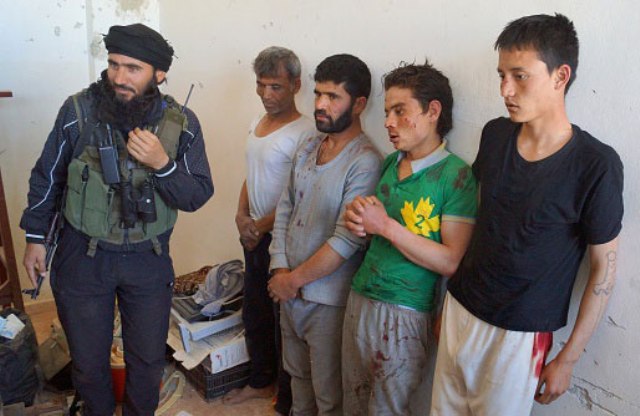
As the world convenes in Geneva to discuss the chaos that is the civil war in Syria, the Iranian regime continues to recruit and export thousands of undocumented Afghans to fight in Syria on behalf of the regime of Bashar al-Assad in a continuation of the unconditional support the mullahs in Tehran have given the Syrian dictator according to Human Rights Watch and the ongoing genocide.

Human Rights Watch in late 2015 interviewed more than two dozen Afghans who had lived in Iran about recruitment by Iranian officials of Afghans to fight in Syria. Some said they or their relatives had been coerced to fight in Syria and either had later fled and reached Greece, or had been deported to Afghanistan for refusing. One 17-year-old said he had been forced to fight without being given the opportunity to refuse. Others said they had volunteered to fight in Syria in Iranian-organized militias, either out of religious conviction or to regularize their residence status in Iran.

“Iran has not just offered Afghan refugees and migrants incentives to fight in Syria, but several said they were threatened with deportation back to Afghanistan unless they did,” said Peter Bouckaert, emergencies director at Human Rights Watch. “Faced with this bleak choice, some of these Afghan men and boys fled Iran for Europe.”

The Iranian regime hosts an estimated 3 million Afghans, most fleeing violence and persecution in Afghanistan; only 950,000 have formal legal status in Iran as refugees. The regime excludes the remainder from accessing asylum procedures, leaving many who may want to seek asylum undocumented or dependent on temporary visas and at the tender mercies of the mullahs.

HRW went on to document several instances of minor children being coerced into service and fight in Iranian-controlled and led militias in Syria. The Iranian regime, already cited by Amnesty International for executing juveniles in Iran, has adopted a similar attitude when it comes to using children as cannon fodder.

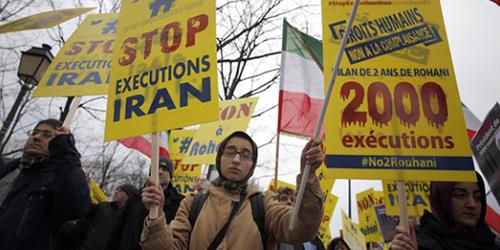
These practices by the Iranian regime have drawn broader attention in the wake of Hassan Rouhani’s European tour which was met by large demonstrations by thousands of Iranian dissidents and human rights groups in Paris.

Many Iranian expatriates and former victims of the regime participated in elaborate street performances and exhibitions to portray the human rights violations that are still running rampant in the country to this day. 2,200 people have been put to death during his tenure, most of them for non-violent offenses, and many for vague, political crimes like “insulting the Prophet” or “enmity against God”. Western diplomacy to solve this problem is missing- in what can only be called criminal negligence, according to the National Council of Resistance of Iran, a leading dissident group.

Even against the backdrop of business deals being announced and praise from the Iran lobby about the “moderate” turn by the regime, the mullahs continued to crackdown in advance of upcoming parliamentary elections, but are not satisfied with just arresting Iranians as they arrested a former BBC journalist on the eve of visit by regime foreign minister Javad Zarif to London.

Washington Post reporter Jason Rezaian must be feeling a case of déjà vu hearing this news.

Bahman Daroshafaei was taken to jail on Wednesday after facing a series of interrogations, according to sources in Tehran. Daroshafaei is of dual Iranian-British nationality and is a former employee of the BBC’s Persian service according to the Guardian.

Zarif is due to participate at a high-profile summit on Syria in London on Thursday, in the first visit to the UK by an Iranian foreign minister in 12 years. It comes after Britain and Iran reopened embassies in their respective capitals last August following the landmark nuclear deal.

The Iranian regime appears to have an active campaign that involves harassing BBC Persian journalists directly or indirectly by summoning their family members who live in Iran. A number of staff members at the BBC’s Persian service have been victims of false allegations of sexual misconduct, duplicated Facebook accounts, fake blogs and online identity theft designed to discredit them, this is while BBC Persian service is considered a program that mainly advocates an appeasement policy towards Iran and is actually referred to by most Iranian’s as “Ayatollah BBC” for its pro mullah’s programs.

The Guardian took the regime to task in an editorial in which it condemned the regime’s human rights violations, saying:

“Iran may have a president with a “moderate” profile – one whose smooth approach comes as a relief after the Ahmadinejad years – but that does not mean the authoritarian nature of the regime or the objectives of its foreign policy have changed. Iran still ranks as one of the most repressive states in the world, and there has been no improvement.

“The government was probably looking for a public relations bonus in the west when it recently released a number of journalists, but the statistics tell another story: in 2015 Iran executed at least 830 people, including juveniles, many for non-violent crimes. The security services continue to harass and detain activists, writers and journalists.

“Nor has Iran become in any way more “moderate” in its behaviour in the Middle East. In Syria, Iran’s militias and Republican Guards are direct participants in the war crimes that the Assad regime inflicts on its own population. Iran’s close ally Hezbollah played a key role in the siege of Madaya, where children died of hunger as a result, and it is part of similar operations elsewhere.”

It is encouraging to see more international media seeing past the charades offered by the Iran lobby and exposing the horrors that are still continuing in Iran.

By Michael Tomlinson

Filed Under: Blog, News Tagged With: Featured, Iran Talks, Irantalks, Moderate Mullahs

Iran Lobby Silent as Iranian Regime Promises More Humiliation of US

February 3, 2016 by admin

Iran Lobby Silent as Iranian Regime Promises More Humiliation of US

Iran Lobby Silent as Iranian Regime Promises More Humiliation of US

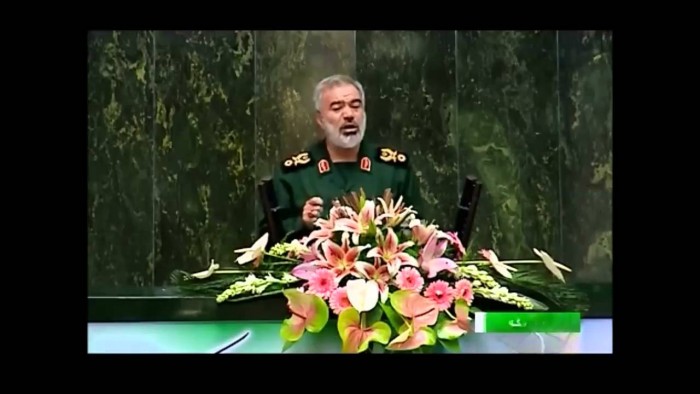
After awarding medals to Iranian navy commanders who had detained ten U.S. sailors, Sardar Fadavi, head of the regime’s Revolutionary Guards Corps Navy, addressed regime lawmakers about the incident, telling them his personnel had collected information from the sailors’ laptops and cell phones that had not yet been released, in addition to more footage. This information would be released if the United States ever sought to humiliate Iran, he said.

“If U.S. officials say they are angry with and frustrated by the footage released, they would be 100 times more embarrassed if the IRGC releases other films of the capture, the Iranian commander said,” Tasnim, the regime-owned news agency reported.

“Iran does not seek to humiliate any nation, he said, but stressed that if they want to humiliate Iran, the IRGC would publish the footage and make them even more embarrassed and humiliated,” it continued.

One could argue successfully that these are not the comments of a government interested in smoothing over differences and becoming an engaged, moderate member of the community of nations, but rather a regime that still views the world in a hostile, militant way and intent on enforcing its superiority in any manner possible.

But not everyone is buying the party line of the Iran lobby of Iran’s moderation and good intentions. The House of Representatives took up a new vote on legislation to prevent the Obama administration from lifting sanctions on Iranian entities unless it certifies they aren’t affiliated with terrorism or ballistic missile development technically already passed in the House last month, but a revote occurred on Tuesday to allow the full House to vote.

The Obama administration predictably issued a veto threat of the Iran legislation and warned it would hinder its ability to implement the nuclear accord.

“By preventing the United States from fulfilling its JCPOA commitments, H.R. 3662 could result in the collapse of a comprehensive diplomatic arrangement that peacefully and verifiably prevents Iran from acquiring a nuclear weapon,” the White House said in a Statement of Administration Policy.

Paradoxically though, the administration had previously imposed new sanctions on the regime for the test launching of illegal nuclear-capable ballistic missiles. If you confused by now, you’re not the only one.

The Senate Foreign Relations Committee also is taking fresh aim at Tehran with stepped-up sanctions to punish the regime for aggressive non-nuclear activities.

Chairman Bob Corker (R-Tenn.) and at least one other senator are crafting new measures to address everything from Iran’s recent ballistic missile tests to the country’s human rights violations to a reauthorization of the soon-expiring Iran Sanctions Act (ISA). The measures, which are likely to come up in February, will be Congress’ latest attempts to ensure President Obama punishes mullahs in Tehran for bad behavior in the wake of the now-implemented nuclear deal.

“We are looking at ways of having a much stronger pushback on the violations that took place,” Corker said of his proposed sanctions aimed at Iran’s recent ballistic missile tests.

The ballistic missile measure is part of a trio Corker is readying, along with a reauthorization of ISA — a sweeping, longstanding law to curb Iran’s nuclear and missile activities as well as its support for terrorism through sanctions on the trade, energy, defense and banking sectors. Corker is also crafting a third measure, but declined to identify its content.

Sen. Bob Menendez (D-N.J.) is also planning a package of “actions that we should be considering against Iran outside the nuclear portfolio.” Menendez has already co-authored, along with Sen. Mark Kirk (R-Ill.), legislation to extend ISA past 2016, and wants to step up sanctions against Tehran for its ballistic missile tests and human rights violations.

Their actions mark the first significant move by lawmakers against Iranian regime since the pact took effect as they seek to keep Tehran on a tight leash. It remains to be seen how the congressional pushback will be greeted by the White House.

The move by Congress are being motivated in part by the clear signals being sent by the Iranian regime in advance of parliamentary elections with the selective removal of any potential dissidents among candidates and to deliver a slate that is ideologically pure.

David Gardner, writing in the Financial Times, put it best:

“Iran’s rulers are best seen not so much as convinced theocrats but as a post-revolutionary elite of vested interests using religion as their standard. The institutions of theocracy, such as the Guardian Council or the Assembly of Experts that selects the supreme leader, guarantee their own hegemony over the republican institutions, such as the elected majlis…”

The upcoming elections then are just a formality for the ruling mullahs to legitimize their rule in their eyes and provide the illusion of democracy as they reap the financial rewards of the lifting of economic sanctions.

Ultimately the Iran lobby, led by the National Iranian American Council chooses to ignore these facts and instead continuing carrying the water for the mullahs.

By Michael Tomlinson

Filed Under: Blog, News Tagged With: #NuclearDeal, Featured, Iran deal

  • « Previous Page
  • 1
  • …
  • 38
  • 39
  • 40
  • 41
  • 42
  • …
  • 53
  • Next Page »

National Iranian-American Council (NIAC)

  • Bogus Memberships
  • Survey
  • Lobbying
  • Iranians for International Cooperation
  • Defamation Lawsuit
  • People’s Mojahedin
  • Trita Parsi Biography
  • Parsi/Namazi Lobbying Plan
  • Parsi Links to Namazi & Iranian Regime
  • Namazi, NIAC Ringleader
  • Collaborating with Iran’s Ambassador

Recent Posts

  • NIAC Trying to Gain Influence On U.S. Congress
  • While Iran Lobby Plays Blame Game Iran Goes Nuclear
  • Iran Lobby Jumps on Detention of Iranian Newscaster
  • Bad News for Iran Swamps Iran Lobby
  • Iran Starts Off Year by Banning Instagram

© Copyright 2026 IranLobby.net · All Rights Reserved.