Iran Lobby

Exposing the Activities of the lobbies and appeasers of the Mullah's Dictatorship ruling Iran

  • Home
  • About
  • Current Trend
  • National Iranian-American Council(NIAC)
    • Bogus Memberships
    • Survey
    • Lobbying
    • Iranians for International Cooperation
    • Defamation Lawsuit
    • People’s Mojahedin
    • Trita Parsi Biography
    • Parsi/Namazi Lobbying Plan
    • Parsi Links to Namazi& Iranian Regime
    • Namazi, NIAC Ringleader
    • Collaborating with Iran’s Ambassador
  • The Appeasers
    • Gary Sick
    • Flynt Leverett & Hillary Mann Leverett
    • Baroness Nicholson
  • Blog
  • Links
  • Media Reports

Why New Business Deals with Iran Should Be Tied to Human Rights

June 18, 2016 by admin

Why New Business Deals with Iran Should Be Tied to Human Rights

Why New Business Deals with Iran Should Be Tied to Human Rights

Although the nuclear deal with the Iranian regime reached last April lifted economic sanctions related to trade and released $100 billion in frozen assets back to the control of the mullahs in Tehran, it did not lift sanctions put in place for Iran’s abysmal human rights record and sponsorship of terrorism.

These sanctions largely affect U.S. currency exchanges and the ability to transact business through financial institutions connected to U.S. exchanges where currency would need to be converted, transmitted or deposited.

The sanctions lifted as part of the nuclear accord permits Iran to sell its oil back on the open market (even though it had already been doing so illicitly for some time), allow foreign firms to invest in Iran’s oil and gas industry and other industrial sectors such as automobiles and hotels, as well as allow Iran access to the global banking system known as SWIFT.

Predictably there has been a rush of foreign companies looking to get back into the Iranian marketplace; primarily firms that had pre-existing relationships within Iran prior to the imposition of most sanctions.

These largely comprised European, Chinese and Russian firms looking to announce deals, but most financial institutions in those same countries have been reluctant to jump in and engage in business with the regime; largely because of the regime’s unstable record on worsening human rights and the turbulence created by its involvement in proxy wars in Syria, Yemen and Iraq.

Now comes word – premature it seems – that U.S.-based Boeing was negotiating to sell 100 commercial aircraft to the regime in one of the largest re-entries into the Iranian market by a U.S. company.

There is already significant opposition building in Congress on both sides of the aisle to the deal since Iran’s previous use of commercial airlines such as Mahan Air to ferry troops and supplies to Hezbollah in Syria makes the potential high that American-made aircraft could be used in a similar military capacity, not to mention the technology transfer involved in advanced navigation, communications and avionics systems that the regime’s Revolutionary Guard Corps could take and adapt to their own purposes.

All of which raises a simple question: Should any business deal with the Iranian regime be predicated on improvements in human rights or the halt of sponsoring terror?

Two former U.S. Treasury officials cast doubt Wednesday on the prospects of the deal between Iran and Boeing, claiming concerns about Iranian money laundering and terrorism financing activities are likely to scuttle the agreement.

“The risks associated with doing business with Iran haven’t changed,” said Chip Poncy, who headed Treasury’s office of strategic policy for terrorist financing and financial crimes through 2013.

Eric Lorber, a former attorney in Treasury’s office of foreign assets control, said the Boeing deal will likely face the same problem that has kept a similar deal between Tehran and Airbus, Boeing’s European rival, from getting off the ground for the past seven months.

The mullahs have complained vigorously that the nuclear deal implementation applied to the lifting of all sanctions and that any sanctions still in place or the threatened imposition of new sanctions such as those proposed for its violation of ballistic missile testing would jeopardize the nuclear agreement.

The regime’s top mullah, Ali Khamenei, regularly threatens to tear up the nuclear deal each week for one reason or another. This past weekend it was because he didn’t like presidential candidate Donald Trump. The week before that it was because he thought Iran was being shortchanged by the U.S. on cash. Next week it will probably be about his inability to comprehend Snapchat.

The fact that the Obama administration inserted language in the nuclear deal specific to allowing investments in aircraft is seen as an effort to boost Boeing’s chances of doing the deal, but in the year since that deal was reached, the Iranian regime has been anything but compliant with efforts to moderate itself.

The litany of aggressive and illegal actions it has taken range from detaining American sailors on the high seas to widening the war in Syria to arresting just about any dual citizen it feels like including mothers, aid workers, journalists and businessmen without trial or charge.

The difficulty in many of these deals lies in the fact that the Revolutionary Guard Corps owns most of the economic and industrial capacity within Iran through a myriad of shell companies. In telecommunications for example, the IRGC owns the state phone company and controls virtually all internet access in Iran. The same goes for the oil and gas industry and airlines, which makes the Boeing deal problematic in many ways.

If we know the IRGC is engaged in supporting terrorism aggressively around the world and if we know its intelligence units and court system regularly sentences dissidents to death and uses torture on a mass scale on the Iranian people, then how can any U.S. entity conduct business in Iran without stepping on existing sanctions?

Jonathan S. Tobin writes in Commentary Magazine that Mark Dubowitz of the Foundation for the Defense of Democracies told the New York Times, despite the exception for aircraft sales in the text of the nuclear deal, much of Iran’s civilian aviation industry is run by companies linked to or run by the IRGC, which also operates the regime’s terror network.

Business with the IRGC and everything related to it is still very much against U.S. law and nothing in the Iran deal supersedes that fact. As Dubowitz notes, that makes any Boeing-Iran transaction a “due-diligence nightmare” for any U.S. companies as well as the banks that will also be involved, he added.

The conundrum is one that the Iran lobby is attempting to tackle head on with its typical subterfuge as evidenced by a piece written by Tyler Cullis of the National Iranian American Council in Foreign Policy, in which he makes the inane argument that since the nuclear deal is in danger of collapse, the U.S. should double down on it and go even further in accommodating the regime.

Cullis makes the argument that the Obama administration must provide foreign companies essentially a “get out of jail card” in terms of setting out guidelines essentially setting a legal standard for compliance with sanctions in order to engage in activities expressly forbidden by those same sanctions!

As Cullis is loath to mention, sanctions still in place are not related to the nuclear deal! In order for those sanctions to be lifted, the mullahs need to stop butchering their own people, stop arresting American businessmen, British mothers and Canadian professors and they need to stop sending guns, rockets and ammunition to terrorists around the world.

Is that too hard? For Cullis and the rest of the Iran lobby, it apparently is.

By Michael Tomlinson
Filed Under: Blog, News Tagged With: Featured, Iran, Iran deal, Iran Human rights, Iran Lobby, National Iranian American Council, Tyler Cullis

Iran Accuses British Mother of Trying to Overthrow Regime

June 16, 2016 by admin

Iran Accuses British Mother of Trying to Overthrow Regime

Iran Accuses British Mother of Trying to Overthrow Regime

There are many perceived threats that the mullahs in Tehran see around them. Nazanin Zaghari-Ratcliffe, an aid worker for the Thomson Reuters Foundation, was accused of trying to “overthrow” the government in a statement published Wednesday after having been arrested since April 3, 2016 on the day she was to leave to go back home in Britain.

“This person had membership in foreign companies and organizations and planned and carried out media and cyber projects with the intent of a soft overthrow of the holy Islamic Republic government,” the statement said. It was published by a Revolutionary Guard office in Kerman province, where Zaghari-Ratcliffe is being held.

Zaghari-Ratcliffe “carried out criminal activities with the guidance and protection of media and spy services of foreign governments,” according to the statement. She was arrested after “massive intelligence operations” by the Guard.

Her husband Richard Ratcliffe dismissed the accusation that Nazanin was trying to bring down the government as “preposterous.”

“To my understanding there are still no formal charges. It seems like this is a political case,” he said.

The Revolutionary Guards statement seemed directed at the Thomson Reuters company, a global media powerhouse regarded with suspicion and hostility in Iran because of its British foundations. Reuters merged with Canada’s Thomson company in 2008.

“The media corporations of hegemonic governments, especially the evil-minded British media, have made their best efforts in the recent months to support her in order to weaken the Islamic Revolutionary Guards Corps’ determination but this false hope will never come true,” the statement added.

The fact that Zaghari-Ratcliffe worked for the Thompson Reuters Foundation and not the news company may indicate that the Revolutionary Guards intelligence unit is not so intelligent, but didn’t read the fine print and arrested her thinking she worked for the news organization in an effort to replicate the Rezaian snatch and grab with the Washington Post.

Ratcliffe said the family had contact with Zaghari-Ratcliffe earlier this week and she’d been moved to the notorious Evin prison in Tehran.

Monique Villa, the Chief Executive of the Foundation, said that Zaghari-Ratcliffe has been employed for four years as a project coordinator in charge of grant applications and training, and had no dealing with Iran in her professional capacity.

“The Thomson Reuters Foundation has no dealings with Iran whatsoever,” she said, and has no plans to.

Villa said that Zaghari-Ratcliffe “had traveled to Iran in a personal capacity. She was on a family holiday with her two-year-old-daughter Gabriella.”

Since Zaghari-Ratcliffe was a dual British-Iranian citizen, it should come as no surprise that regime officials scooped her up since it does not recognize dual status and has regularly arrested and imprisoned large numbers of dual citizens to be used as political pawns for prisoner swaps for example such as what the U.S. did for Washington Post reporter Jason Rezaian, Christian pastor Saeed Abedini and former U.S. Marine Amir Hekmati as a result of the nuclear agreement.

The Iranian regime has already plucked other dual citizens to replenish its prison cells including Siamak Namazi, a longtime supporter of the Iran lobby and Homa Hoodfor, a Canadian university professor, and now Zaghari-Ratcliffe.

No charges have been filed in the case, but Zaghari-Ratcliffe has told family members in Iran that she was forced to sign a confession under duress, her husband said last month.

Zaghari-Ratcliffe’s file has been sent to Tehran to begin judicial proceedings but officials from the intelligence wing of the Revolutionary Guard are still interrogating her, according to the statement.

The all-too-familiar pattern by the Iranian regime is being repeated here:

  • Step 1) Arrest a dual citizen;
  • Step 2) Apply pressure and even torture to get them to confess to a false crime;
  • Step 3) Try them as an Iranian citizen in a show court;
  • Step 4) Begin negotiations to get something in return for them.

For the regime, it has been a recipe for success and until the rest of the world puts a halt to this despicable practice, it will continue.

By Laura Carnahan

Filed Under: Blog, News Tagged With: Featured, Iran, Iran Human rights, Iran Talks

Iran Attendance at Oslo Forum is Height of Hypocrisy

June 15, 2016 by admin

Iran Attendance at Oslo Forum is Height of Hypocrisy

Iran Attendance at Oslo Forum is Height of Hypocrisy

The Oslo Forum was created in 2003 as a gathering for mediation practitioners to meet and share their expertise. It was aimed at the hope of building a larger community of mediation experts and increase learning, serving as an incubator for testing and honing future peacemakers hoping to resolve conflicts around the world.

It has grown from its first meeting of 17 practitioners to now include over 100 notable key players from the United Nations, intergovernmental and private organizations, journalists, analysts and other experts.

Among its participants has been a veritable who’s who of global ambassadors for peace, including former UN General Secretary Kofi Annan, President Jimmy Carter, new Myanmar leader Aung San Suu Ki and many others.

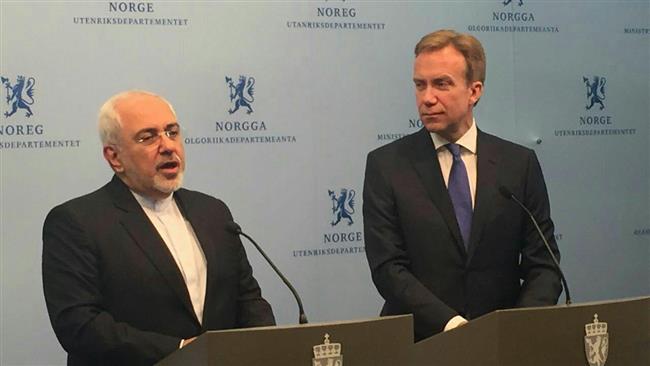
And like any progressive project, it has some more far-fetched ideas it has tried to implement including inviting Javad Zarif, the foreign minister for the Iranian regime to this year’s conclave in Norway.

While we know Norwegians are a kind, generous and thoughtful people, earnestly hoping and working for peace around the world, the participation of Zarif at this Forum to ostensibly share ideas for peace is one of the more incredulous things anyone has heard.

The Iranian regime stands alone in the world as the leading supplier and exporter for terrorism and proxy wars. Its Quds Forces and Revolutionary Guard are on the battlefields and shipping cash, arms and mercenaries to Syria, Iraq, Afghanistan and Yemen.

It has managed to become the second largest executioner of prisoners on the planet and regularly abuses its own men, women, children, ethnic and religious minorities, journalists, dissidents and just about anyone else the mullahs in Tehran have a disagreement with.

Zarif’s crowning achievement has foreign minister has been to snooker the world into supporting a nuclear agreement that essentially preserves Iran’s entire nuclear infrastructure, open the floodgates to billions in fresh cash and does not mandate any changes in its barbaric human rights practices.

That’s a neat trick and if the participants at the Oslo Forum are looking for tips on how to obscure the truth, they’ve invited the right man in Zarif.

No one can deny that Iran’s intervention in Syria is the single largest reason why the civil war has lasted this long and expanded so far. It is also the reason why Islamic extremist groups such as Al-Nusra and ISIS were able to spring into existence and expand.

The heavy military and economic involvement by the Iranian regime and refusal to engage in multilateral peace talks that involve any discussion of removing the bloody Assad regime from power has certainly shaped and molded the Syrian conflict into the bloody affair it is today.

All of which makes Iran’s participation in the Forum that much more curious since top mullah Ali Khamenei has been definitive and expressive in his beliefs concerning the use of violence and terror to achieve the regime’s aims. Compromise, negotiation, mediation and discussion are not words in the vocabulary of the mullahs.

That is certainly true when you look at the recent spate of arrests and imprisonments of dual-national Iranians who have been tossed into Iranian prison without charge or access to counsel, including a Canadian professor and a British mother.

It is also notable that during recent visits by various European leaders to Iran to seek out commercial trade opportunities with the nuclear agreement in effect, the Iranian regime did not slow down one bit the pace of executions, imprisonments and abuses during any of those visits.

Take for example Federica Mogherini, European Union policy chief, who visited Iran this past April only to see the regime execute three prisoners the day she arrived or Matteo Renzi, the Prime Minister of Italy, who visited Iran only to have the regime hang 17 people, including three juveniles at the same time.

These visits by European leaders and the inclusion of Zarif at a conference for peace negotiators makes a mockery of the human suffering in Iran and only emboldens the mullahs to continue with these practices since there seems to be no downside.

His participation is even stranger when you consider that the Iranian regime has opened up a recruiting center in Heart, Afghanistan to persuade and even coerce thousands of Afghans to fight in Syria.

The Christian Science Monitor visited the center and reported on what is no longer a secret in Iran as the regime seeks to bolster the number of mercenaries sent to fight for the Assad regime.

Some Afghans fight willingly for religious reasons, eager to take up a cause of “defending” Shiite shrines in Syria. Others fight for cash, upwards of $700 per month, or choose to realize promises of Iranian citizenship, schooling for their children, and jobs, if they survive the frontline – benefits usually beyond reach for Afghan migrants in Iran, the Christian Science Monitor reported.

Still other Afghans report coercion and intimidation, and say their second-class status inside Iran – among an estimated 3 million Afghans, only one-third are legal migrants – is taken advantage of. Afghans’ “vulnerable legal position in Iran and the fear of deportation may contribute to their decision [to join militias in Syria], making it less than voluntary,” Human Rights Watch said in a January report.

None of these revelations should be ignored at the Forum and in fact, Zarif should be confronted with these facts and asked why the regime has failed to work for peace in Syria instead of seeking to escalate the conflict.

Ultimately, as Zarif continues this European tour, he should be met with hard and tough questions and not platitudes and open arms.

By Michael Tomlinson

Filed Under: Blog, News Tagged With: Featured, Iran, Iran deal, Iran Human rights, Khamenei, oslo forum, Sanctions, zarif

Orlando Shootings Show Dangers of Islamic Extremism

June 14, 2016 by admin


Orlando Shootings Show Dangers of Islamic Extremism

Orlando Shootings Show Dangers of Islamic Extremism

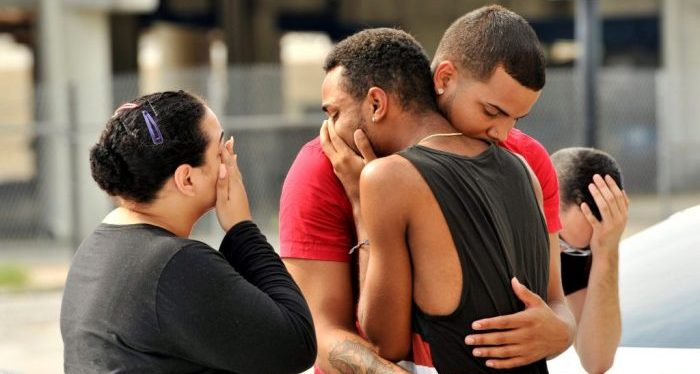
The list of mass killings grew longer this weekend as Orlando was added to San Bernardino, Paris, Sydney, Ottawa and others. Since the tragedy of 9/11, there has been an estimated 85 attacks attributed to Islamic fundamentalism; not counting the bloody proxy wars being waged in Syria, Iraq, Nigeria and Yemen.

In what is now the largest mass shooting in American history, and the largest terrorist attack since 9/11, the U.S. is once again a target for someone who appears to have been radicalized by Islamic fundamentalism.

In the coming weeks, there will be intense investigations looking into every aspect of the killer’s life, his possible contacts with radical elements overseas and his state of mind that might have allowed him to be radicalized.

What is clear though is that the root of all of these attacks lies within the propagation of a nihilistic ideology that is not based in religion, but rather in the debased whims of cold-blooded killers and those hungry for power and control.

The discussion in Orlando, just as it was in Paris, should not be debates about whether or not the shooter was motivated by anti-gay hatred, or if gun control could have stopped him, or if he was under the direct control of ISIS or some other Islamist group.

What should be the discussion is that what motivates these mass murders is really quite simple: it’s an idea.

This idea believes in the supremacy of a chosen few and that anyone else not sharing that same ideology is better off dead, enslaved or imprisoned. It’s an idea based on the concentration of power in the hands of a select few who have the power of life or death.

It’s an idea that wears the shroud of religion, but in fact shares no common ground with the faith it espouses to be. It is not an idea of peace. It is not an idea of equal rights. It is not an idea of democracy, or pluralism or freedom.

This idea is radical Islam and it is a cancer on the world; eating away at the hearts and minds of young men and women who are drawn to its allure and motivated to wreck death and destruction in the blind pursuit of eradicating all others who do not ascribe to this same vision.

But like any idea, it needs a safe haven to be broadcast and spread. It needs support, infrastructure and security from scrutiny. It needs a shield to protect it from eradication. In short, radical Islam needs the Iranian regime.

Like the fruit of a poisoned tree, the Iranian regime’s tree of death bears fruit that has been plucked and exported to Syria, Lebanon, Iraq, Afghanistan, Nigeria, Yemen and throughout the Gulf states.

It takes the form of illegal shipments of arms, recruited mercenaries and terrorist groups such as Hezbollah. It thrives in the form of extremist groups such as ISIS, Boko Haram and others that watch public executions in Iran and videotape similar barbaric executions.

It learns from misogynistic laws passed by the Iranian government permitting marriage for young girls as young as 13, even by their own step fathers, which in turn leads to sexual enslavement of young Nigerian girls and Yazidi Christians by Boko Haram and ISIS.

It mimics brutal punishments in Iranian religious courts that sanction public amputations, eye gouging, acid in the face, public beatings and imprisonment without charge or trial.

Since 1979, the Iranian regime has set the bar for the world’s terrorists and killers to follow and it has set it high. It is no coincidence that during the past two years since Hassan Rouhani was handpicked by Ali Khamenei and the nuclear deal was negotiated in an abysmal act of appeasement, the size, scope and scale of violence perpetrated and inspired by radical Islamists have mushroomed around the world.

The battlefields of the Middle East have now come to the streets of Paris, the suburbs of San Bernardino, the downtown of Orlando and many other cities and the Iranian regime and its mullahs in Tehran have been the clarion call to arms for those radicalized men and women.

They have been inspired to commit these acts because nothing is more dangerous than the lure of an ideology that is not combatted by effective ideas of our own. Nothing illustrates this more than the lack of support for competing ideas that resonate and come from dissidents living in these same countries.

People that are susceptible to being radicalized are not likely to be swayed by slick commercials produced in Hollywood or a commemorative pin worn by celebrities at a gala. They are more likely to be persuaded when men and women that share their same ethnicity, culture, history, religion and even family heritages make the case against radical Islam, which is why the priority by Western governments should be on supporting the cause of human rights and dissident groups in Iran and elsewhere.

Groups such as the National Council of Resistance of Iran have long fought the good fight in combatting the lies of the Iranian regime and ripping off the veil that obscures the harshness and brutality of the regime. Groups such as the NCRI often smuggle the only testimonials and accounts of executions, torture, arrests and imprisonment that feed into the narrative that radicalizes these disaffected people to commit violence.

Supporters of the regime, such as the National Iranian American Council, have participated as a lobby for Iran trying to hide the truth, but they know they cannot cover up atrocities such as what has happened in Paris or Orlando. They are struck deaf and mute in the face of such open and wanton violence and bloodshed.

Predictably, these groups forming the Iran lobby will mouth the appropriate words of sympathy and express horror at the killings, but they will also be sure to make the case that none of this should be used to discredit Iran, even though Iran serves as the well spring of hatred from which these acts flow.

And if they try to portray this as an isolated incident simply of anti-gay hatred, we should remember that for the past two years, Islamists had been finding gays in areas of Syria and Iraq they control and tossing them off the roofs of high rise buildings.

Hatred is bred within radical Islam and it needs a home to nurture. The world needs to deny that haven in Iran.

By Michael Tomlinson

Filed Under: Blog, News Tagged With: Featured, Iran Human rights, Iran Lobby, Iran Terrorism, National Iranian American Council, Orlando Shootings

Iran Regime Sets Sights on Canada and Cash

June 10, 2016 by admin

Iran Regime Sets Sights on Canada and Cash

Iran Regime Sets Sights on Canada and Cash

Incoming Canadian Prime Minister Justin Trudeau had expressed the hopes of improving relations with the Iranian regime, but those hopes are quickly running into the reality of the brutal policies and actions of the mullahs in Tehran.

Trudeau and Canada are learning the lessons from the Iranian regime playbook, much as the U.S. has had to learn the hard way, including the illegal abduction of its citizens. In this case, the plight of 65-year old Homa Hoodfar has placed Canada in the gun sights of the regime.

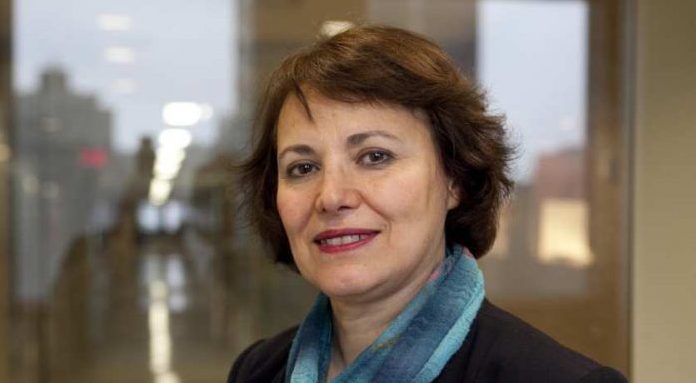
The university anthropologist was arrested by the regime this past weekend and thrown into Evin prison without charge. It was the second time she was arrested since arriving in Iran several months ago to do research work.

The regime accused Hoodfar, who holds both Canadian and Iranian passports, of “co-operating with a foreign state against the Islamic Republic of Iran.” A generic catch-all phrase the regime uses whenever it scoops up a dual-citizen like fish in a net. More often than not, the arrest is aimed at another agenda item for the mullahs.

In the case of several Americans held by Iran, Jason Rezaian, Amir Hekmati and Saeed Abedini, it was to serve as pawns to swap in a prisoner exchange in order to gain the release of suspected and convicted Iranian regime arms smugglers.

Shortly after Hoodfar’s family went public with her arrest and expressed concerns over health, the Iranian regime officials called out the Canadian government for failing to extradite an Iranian banker who settled in Toronto for what they call was his involvement in an embezzlement scheme.

The regime’s justice minister, Mostafa Pourmohammadi, was reported in a semi-official news agency report as saying that Canada was ignoring Iranian demands to extradite Mahmmoud Reza Khavari.

The report, which appeared Wednesday from the Fars News Agency, says Pourmohammadi told reporters in Tehran that Canada “is not committed and has not rendered any co-operation” with its extradition request.

The Canadian branch of human rights group Amnesty International announced Thursday it would take up Hoodfar’s case and called on Ottawa to pressure Iran for her release.

“The arrest of respected and accomplished scholar, Dr. Homa Hoodfar, is the latest attempt by the Iranian authorities at targeting individuals, including academics, for the peaceful exercise of their rights to freedom of expression and association.” said Alex Neve, secretary general of Amnesty International Canada.

“It is deeply troubling that someone whose research focuses on addressing women’s inequality can find herself arbitrarily arrested and held, possibly in solitary confinement, without access to a lawyer and her family.”

The family said it was unclear why Hoodfar had been arrested and that she had been “conducting historical and ethnographic research on women’s public role.”

Analysts say the recent arrest of Hoodfar and others seems to be part of a concentrated effort by the regime to pressure dual citizens. In recent months, the unit that arrested Hoodfar has questioned dozens of people with two nationalities and arrested several.

Among the current prisoners of the regime include:

  • Nazanin Zaghari-Ratcliffe, a British-Iranian employee of Thomson Reuters, was separated from her young daughter in April and taken to a prison in Kerman, in southern Iran. Another British-Iranian citizen, a businessman named Kamal Foroughi, was also arrested; and
  • Nizar Zakka, Lebanese information technology expert who has legal permanent residency in the United States.

But the turbulence between Iran and Canada also extended into a contentious court case in which the regime lost a key battle when an Ontario judge ordered the regime’s non-diplomatic assets in Canada to be handed over to the victims of terrorist attacks by groups sponsored and supported by the Iranian regime.

“As Canada seeks to re-engage Iran it is critical that Iran continue to be held to account in Canadian courts for its terrorism and human rights abuses,” said Danny Eisen of the Canadian Coalition Against Terror, which represents victims and lobbied for a 2012 law allowing victims to collect damages from state sponsors of terrorism.

The only states designated sponsors of terror by Canada are Iran and Syria.

What Canada is experiencing though is par for the course for how the regime acts and intimidates nations. Just like the Iran lobby, the regime pushes out a message of moderation when in reality it is gearing up for policies of extortion, political blackmail and terrorist actions.

Policies of appeasing the regime have done little to actually effect change and only encourage the regime to be more aggressive. The classic example of that is the regime’s continued test firing of illegal ballistic missiles and the tepid response by the world community.

Alireza Jafarzadeh, Deputy Director of the Washington office of the National Council of Resistance of Iran, made a persuasive argument in an editorial in The Hill.

“The current U.S. policy toward Iran threatens to enable the regime’s behavior by channeling money into the hands of the individuals and institutions associated with the Iranian Revolutionary Guard Corps and the unaccountable foundations, who still exert the greatest influence on Iranian foreign policy,” he writes.

“With U.S. presidential elections just around the corner, there is good reason to hope that this policy will come to an end. But every influential person in Washington who recognizes the danger posed by Iran’s ballistic missile program must help to make sure not only that change is guaranteed, but also that it will lead to an alternative policy that specifically constrains the power of the IRGC and similar entities,” he adds.

The experience Canada is having is another reminder that the world should not be trusting the messages of moderation coming out of Iran and its lobby, but rather should only be judged on its actions.

By Laura Carnahan

Filed Under: Blog, News Tagged With: Featured, Iran, Iran deal, Iran Human rights, Iran Lobby, Iran Mullahs, Irandeal, Moderate Mullahs, Rouhani

Iran Regime Pushes Human Rights to Absurd Levels

June 10, 2016 by admin

Iran Regime Pushes Human Rights to Absurd Levels

Iran Regime Pushes Human Rights to Absurd Levels

The Iranian regime’s human rights abuses are well documented by a whole host of organizations and governments. Amnesty International regularly lists Iran as one of its worst offenders and catalogs the list of executions, arrests, sham trials and accounts of torture with mind-numbing repetition.

The United Nations has also documented the long abuses perpetrated by the mullahs in Tehran to the extent it appointed a special rapporteur for human rights just for Iran. That appointee, Ahmed Shaheed, has released extensive reports detailing those abuses ranging from public executions of juveniles to summary trials without legal representation.

The persecution of religious minorities has been an especially problematic area of concern for Shaheed who has spoken out aggressively on the plight of those of the Baha’i religious minority in Iran.

A statement issued on June 8 by the United Nations Commission on Human Rights accused the Iranian regime’s religious, judicial, and political authorities of making “verbal attacks” that show “extreme intolerance” toward the Baha’i community and that “could encourage discrimination and possibly acts of violence against the group by others.”

Shaheed, said there was an “ongoing and systematic persecution” of Baha’is by the Iranian government that violates the country’s international legal obligations.

The UN says there are currently at least 72 Baha’is in Iranian prisons “solely because of their religious beliefs and practices.”

Heiner Bieelfeldt, the UN special rapporteur on freedom of religion, said that “increasingly hostile rhetoric” now puts Iran’s Baha’i community at “a very dangerous precipice where its very existence may be threatened.”

Various nations such as the U.S. State Department and the European Union have regularly issued annual reports citing these abuses and levied economic sanctions to punish the Iranian regime for the worst of them.

For the Iran lobby, it has been a full time job defending the regime and trying to divert attention away whenever these reports and condemnations come out. Groups such as the National Iranian American Council make every effort to divert attention away from human rights abuses because it knows it has no defense, no argument that can obscure the horrific details of the atrocities committed on innocent Iranians.

But the extent of Iran’s human rights violations extend beyond the gross abuses that capture headlines and reach out into less sinister, but more effective ways of keeping a restive population in check and silencing its critics.

One of the chief tools the regime relies on is not making any distinction for Iranians holding passports of foreign countries. For the mullahs in Tehran, once an Iranian, always an Iranian, even if you are a citizen of the U.S., Canada or Brazil, which allows them to arrest any Iranian they wish.

It’s the extralegal tool the Iranian regime has used to pluck anyone it finds critical of the regime’s policies or a threat to the rule of the mullahs. It has been used to arrest and imprison people such as Jason Rezaian of the Washington Post and most recently a 65-year old Canadian university professor.

Homa Hoodfar was arrested Monday after being interrogated by authorities, according to a statement published by her family.

Her relatives say the Concordia University professor was in Iran conducting research. She was initially arrested in March, shortly before she was scheduled to leave the country, her family says, and was prohibited from leaving.

Her passport, research documents, computer and other personal belongings were confiscated by the state, the statement said. Hoodfar was then rearrested this week and placed in the notorious Evin prison without benefit of legal counsel.

“The authorities have not made clear whether Prof. Hoodfar is being charged with espionage, sedition or propaganda against the state,” her family said.

The Iranian regime has also used generic violations of law such as “spreading propaganda” to arrest anyone ranging from rappers and bloggers to journalists to students.

For example, two musicians and a film-maker have begun three-year jail sentences in Iran for the online distribution of underground music.

The three men, who have been described by Amnesty International as prisoners of conscience, were summoned to serve their sentences last week after an appeals court upheld their conviction.

A three-minute trial in 2015 found brothers Mehdi and Hossein Rajabian, 26 and 31, and their friend Yousef Emadi, 35, guilty of “insulting Islamic sanctities”, “spreading propaganda against the system” and “illegal audio-visual activities” for the distribution of music unlicensed by the cultural ministry.

They did not have access to lawyers during the trial, activists said.

The mullahs in Iran don’t miss an opportunity to push the boundaries of what acceptable behavior is according to them, even go to the absurd length of banning a popular Iranian soccer player for six months for wearing yellow “SpongeBob pants” based on the cartoon character in photos on social media.

The images show Sosha Makani, a former goalkeeper for Iran’s Persepolis Football Club, wearing a blue shirt and tight yellow dotted trousers that Iranian media described as resembling the SpongeBob SquarePants cartoon character.

The Iranian football federation’s morality committee cited Makani’s clothing as “inappropriate” and the cause for his suspension. However, the decision isn’t final, and Makani can appeal through an Appeals Committee.

The fact that Iran has a “morality” committee for sports demonstrates just how far afield the regime is and how it will never bend as long as the mullahs are in charge.

By Michael Tomlinson


Filed Under: Blog, News Tagged With: Featured, Iran, Iran Human rights, Iran Lobby, National Iranian American Council, NIAC

Why the Iran Lobby Avoids Discussing Human Rights and Terrorism

June 8, 2016 by admin

Why the Iran Lobby Avoids Discussing Human Rights and Terrorism

Why the Iran Lobby Avoids Discussing Human Rights and Terrorism

In a world where it is common place knowledge that the Iranian regime is a state sponsor of terrorism, with a long and bloody history, it always seems that the Iran lobby operates in a different plane of existence.

For regime supporters such as Trita Parsi of the National Iranian American Council and Joseph Cirincione of the Ploughshares Fund, issues such as human rights violations and terrorism are less than inconvenient truths about Iran; they are things never meant to be spoken of in public or on social media.

The Iran lobby consistently seems to operate on the premise that if you never mention either of these topics, then they must not be real.

This is obvious by simply perusing the blogs and social media feeds for these Iran support groups periodically. Reading them within the context of what is happening in real time in the Middle East and Iran provides a surreal view that is totally disconnected from reality.

It’s also pretty darn funny to read.

Take for example Trita Parsi’s Twitter feed (@tparsi) which can’t help but be viewed as comedy material or pure ignorance. More likely it resonates as part of the famed “echo chamber” that national security staffer Ben Rhodes boasted about in a recent New York Times Magazine article.

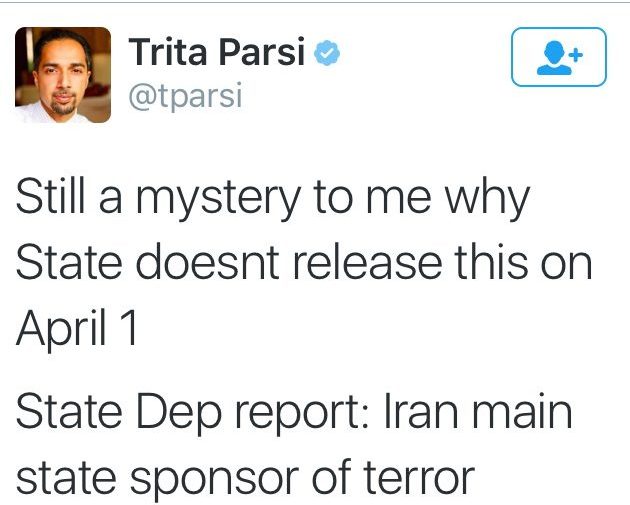
Take for example this nugget in which Parsi derides the U.S. State Department’s annual terrorism report in which it identifies Iran as a leading state sponsor of terrorism:

“Still a mystery to me why State doesnt release this on April 1,” he tweets, implying that the report is a joke better left for an April Fools prank.

Unfortunately for Parsi and the rest of the Iran lobby, mockery and ridicule can’t hide the facts laid out in the report in which the State Department spells out the Iranian regime’s longstanding support for Hezbollah, a key cog in the regime’s long-running involvement in the Syrian civil war, and its support for Shiite militias in Iraq that have roamed throughout Sunni areas as death squads and Houthi rebels in Yemen that have displaced nearly half of the country’s population as part of a civil war.

Parsi’s Twitter feed is absent any mentions of those Iran-backed wars and the role the mullahs and the regime’s Quds Forces and Revolutionary Guard Corps play in them. He does make mention of the plight of Syrian refugees fleeing the war and the high price they pay in trying to cross the Mediterranean, but never urges Iran to seek a peaceful resolution of the conflict or even open its borders to those refugees it is forcing out.

Parsi does however spend considerable social media time attacking Saudi Arabia, the Iranian regime’s biggest rival, accusing it of “terrorism” and acts more readily identified with the mullahs in Tehran.

He even goes to the absurd level of defending top mullah Ali Khamenei’s incendiary speech over the weekend in which he denounced the U.S. and called Great Britain “evil” and blamed his country’s continued economic woes on existing U.S. sanctions on Iran’s access to U.S. currency markets tied to human rights violations and not the nuclear deal from last year.

“Khamenei said today what Iran’s been signaling the US for a while: Anti-ISIS cooperation on hold due to sanctions relief problems,” Parsi tweets.

The implication Parsi tries to make is that continued sanctions against Iran for the mass executions of over 2,500 Iranian men, women and children, as well as its sponsorship of three major wars is somehow halting the war against ISIS.

He conveniently ignores the bulk of Khamenei speech which is filled with vitriol and hate and the usual threats to wipe Iran’s enemies off the face of the Earth.

The more appropriate evaluation to make of Parsi social media postings and those his colleagues at NIAC is that they spend more time posting about Donald Trump than they do about the misery being suffered by Iranians at the hands of their own government.

They spend more time posting about the Cannes Film Festival than they do about the threats being made by the creation of a new morality police force designed to enforce strict Islamic codes against Iranian women.

They spend more time discussing the plight of Siamak Namazi, an Iranian-American arrested and imprisoned in Iran who is a long-time supporter of the NIAC, than the thousands of Iranian dissidents, journalists, artists, bloggers and activists that were rounded up, imprisoned and tortured leading up to parliamentary elections.

The priorities of the Iran lobby are always on display to anyone who wishes to scan through the social feeds of supporters such as Parsi. What is telling is what is NOT in those feeds, such as any criticism of the mullahs, any calls for a Syrian cease fire, any demands for a release of all Iranian journalists or dissidents, any urging for the end of the barbaric practice of public hangings of prisoners, or any hopes for a cessation of the practice of beating women who do not wear hijabs.

Parsi and his cohorts do not do any of these things because they are – above all else – committed to supporting the Iranian regime and keeping it safe from any threats.

By Michael Tomlinson

Filed Under: Blog, Current Trend, News Tagged With: Featured, Iran, Iran Human rights, Iran Lobby, National Iranian American Council, NIAC, NIAC Action, Reza Marashi, Ryan Costello, Trita Parsi

While Iran Maintains Hostility, Iran Lobby Stays Silent

June 6, 2016 by admin

While Iran Maintains Hostility, Iran Lobby Stays Silent

While Iran Maintains Hostility, Iran Lobby Stays Silent

Iran’s top mullah, Ali Khamenei, used his weekly appearance on state-run television to renew his hostility to the West and reinforce the commitment by the regime to pursuing policies that advance its own agenda of expanding the regime’s influence and control over the Middle East.

The statement by Khamenei, made in a nationally televised speech, was the latest in a series of signals that the regime’s senior leadership was not likely to allow any easing of hostility toward what he called “many small and big enemies”, referring to the U.S. and the West.

While much of the vitriol he directed at the U.S. and its allies is historically the same as he usually trowels out in these speeches, it is noteworthy to read media reports on the growing dissatisfaction within the regime about the inability to generate the significant economic benefits from the nuclear deal reached last year.

Much of that inability is attributed to the inept management of the Iranian economy by the mullahs in which corruptions runs deep and wide throughout a system rigged to benefit the ruling elites and the Revolutionary Guard Corps.

Some of that also is attributed to U.S. sanctions still in place not related to the nuclear deal, but linked to the regime’s historic support for terrorism and abysmal human rights record which prevents Iran from having access to U.S. currency markets and exchanges. These restrictions have stymied efforts by the regime to broaden its foreign trade, especially with European Union and Asian financial institutions reluctant to run afoul of any future U.S. sanctions.

Predictably the mullahs in Tehran and their allies in the Iran lobby have decried these sanctions and accuse the U.S. of trying to sabotage the nuclear deal, which is an absurd argument to make since the Obama administration has done virtually everything in its power to accommodate the Iranian regime including leading Americans astray with false arguments in support of the deal to doctoring official State Department video to cover up references to the early start of negotiations with hardliners in Tehran.

“They use human rights, terrorism … as pretexts to avoid fulfilling their commitments,” Khamenei said.

“If we remain strong and united and revolutionary, those who are trying to bully Iran and are against us will not succeed,” he told a gathering to commemorate the anniversary of the death of the founder of the Velayat-e-Faqih (The mullah’s supreme leader), Rouhollah Khomeini, in 1989.

Khamenei referred to Iran’s “important” role in the Middle East’s political direction, stating that Iran is the only obstacle preventing the triumph of Washington’s strategy for the volatile Middle East region.

They were planning for a “new Middle East”, a “greater Middle East”, several years ago, but their plans for Iraq, Syria, Lebanon and the Palestinian territories, have failed due to Iran’s defiance, Khamenei said.

Khamenei’s comments point out the regime’s expansionist policies to create an arc of Shia influence stretching from the Mediterranean to the Indian Ocean and have used terrorist proxies such as Hezbollah, armed militias in Iraq and rebel groups such as the Houthis in Yemen in blatant military efforts to topple governments, expel undesirables such as Christians and Sunni Muslims, and persecute dissidents.

The map of the Middle East is basically a human rights wasteland unlike anything the world has seen since the heyday of terrorism and Cold War in the 1970s, that in the absence of a firm policy towards the mullahs in Tehran, the mullahs have been eager to exploit and take advantage of.

The determination of the Iranian regime to push past the boundaries of the nuclear deal and make it a shambles was again on display as the Iranian regime announced the launch of an offshore bank on one of its Gulf islands according to a report by the regime’s IRNA news agency, as it continues to seek ways around restrictions on international payments.

The bank will be set up on Kish Island, which has been developed as a tourism destination and a free trade zone over the past few decades. The aim is to tap into rising demand for cross-border banking transactions, according to comments by Ali Jirofti, deputy head of the Kish Free Zone Organization. He told IRNA on June 5 that the new, unnamed offshore bank will be able to transfer money and facilitate domestic and foreign investment activities.

The establishment of such an offshore facility would make a mockery of sanctions on Iran for human rights and terrorism violations and if allowed, it would prove devastating in efforts to hold the regime accountable for its appalling human rights record.

Meanwhile, the U.S. State Department released its annual report on terrorism and again listed the Iranian regime as a chief sponsor of terrorism worldwide.

Predictably the regime rejected the damning report.

As in many previous years, the report identified Iran as the world’s “foremost state sponsor of terrorism in 2015” through its financing, training and equipping of various armed groups, notably Lebanon’s Hezbollah, as well as the government of Syrian President Bashar Assad.

The report said that despite reaching a landmark agreement with world powers on its nuclear program, Iran continued to use the Quds Force of its Revolutionary Guard to create instability throughout the Middle East.

In addition to arming Hezbollah and the Assad government, Iran also provided weapons and other assistance to militants in Bahrain and remained active in supporting groups such as Hamas, the report said.

The report is an annual rite of summer now to point a bloody finger at the mullahs. It is a reminder never to allow wiggle room to the mullahs and reinforce the efforts of Iranian dissident groups and human rights organizations working for freedom in Iran.

By Michael Tomlinson

Filed Under: Blog, News Tagged With: Featured, Iran, Iran Human rights, Iran sanctions, National Iranian American Council, NIAC

Iran Demands Social Media Sites Store Data Only In Iran

June 1, 2016 by admin

Iran Demands Social Media Sites Store Data Only In Iran

Iran Demands Social Media Sites Store Data Only In Iran

The Iranian regime issues ultimatums with the regularity of a cuckoo clock. Whether it’s an indictment of perceived transgressions by human rights groups to blustery pronouncements threatening devastation on its enemies, the mullahs in Tehran are frequently making demands, threats and promises.

The latest demand came this weekend courtesy of the regime’s Supreme Council of Cyberspace, which said:

“Foreign messaging companies active in the country are required to transfer all data and activity linked to Iranian citizens into the country in order to ensure their continued activity,” in new regulations carried by state news agency IRNA on Sunday.

Putting aside the fact that the regime has a group dedicated to cyberspace with a name straight out of bad James Bond villain list, the regime has put a public face to one of the more sinister efforts it pushes in using the internet to track down dissenters, activists and others that oppose the rule of the mullahs.

Iran has some of the strictest controls on internet access in the world and blocks access to social media platforms such as Facebook and Twitter, although many users are able to access them through widely available software; notably the regime’s leadership has free access to those same platforms to push out its propaganda such as social feeds for Hassan Rouhani and even Ali Khamenei.

The council, whose members are selected by Khamenei, gave social media companies a year to comply, IRNA said, adding that the measures were based on the “guidelines and concerns of the supreme leader.”

The new requirements could affect messaging app Telegram in particular. The cloud-based instant messaging service has gained popularity because of its high level of security and is estimated to have about 20 million users in Iran, which has a total population of about 80 million, placing it at the forefront of most of the digital communications taking place among ordinary Iranians the regime cannot spy on.

Iranians have proven adept at using technology to circumvent strict government rules in the past. The Gershad app, launched in February, helps Iranian women track the morality police in large cities, so they can avoid being stopped for dress code violations.

The technology community, especially social media companies based in Silicon Valley such as Facebook and Twitter and in Silicon Beach such as Snapchat, reacted negatively to the mullahs’ demands.

The tech blog TechCrunch noted how the “Iranian government wants to be able to track private and semi-private conversations on messaging apps. Many social networks are already blocked in Iran, but it looks like the government wants even more control.”

But TechCrunch explained the devil was in the details since moving servers to Iran might not be enough, as WhatsApp recently completed its rollout of end-to-end encryption. With end-to-end encryption, WhatsApp can’t even read the content of communications, as they are encrypted, and only WhatsApp users involved in these conversations can decrypt them.

Apple’s iMessage is another example of an encrypted messaging protocol. Apple isn’t able to hand out messages to a government.

Earlier this month Iranian authorities placed eight women under arrest for posting Instagram photos of themselves without a headscarf on as part of a larger crackdown on social media usage that began before the most recent parliamentary elections.

The regime had previously arrested the entire staff of an Iranian tech blog and actively seeks out Iranian citizens posting on social media anything that could be construed as defying the Iranian regime’s extremist rule and authority or posing a threat to the regime leaders.

Even in the face of tough web censorship, Iranians are still using the internet in droves. A government report last year showed that 67.4 per cent of the country’s youth are online, with 19.1 percent claiming that they use messaging apps, and 15.3 per cent on social media. It is also widely believed that Iran’s tech-savvy citizens are utilizing VPNs to access sites blocked by the government.

This poses a significant problem for the regime since news often is smuggled out electronically of the atrocities and human rights abuses within Iran by dissident and human rights activists, including shocking photos and videos of public executions, amputations and other medieval punishments enforced by the regime.

Unsurprisingly, the Iran lobby has remained silent on this issue and the threat to free speech and freedom it poses. For groups such as the National Iranian American Council, whose members such as Trita Parsi, Ryan Costello and Tyler Cullis make ample and aggressive use of social media, the attempt to electronically spy on and muzzle Iranians, including those living in places such as the U.S. with relatives in Iran, have been met with silence.

This move by the Iranian regime only adds to the mountains of evidence proving the mullahs are neither moderate, nor peaceful.

By Laura Carnahan

Filed Under: Blog, News Tagged With: Featured, Iran Human rights, Iran Lobby, National Iranian American Council, NIAC, Reza Marashi, Ryan Costello, Trita Parsi, Tyler Cullis

This Memorial Day Remember Victims of the Iran Regime

May 31, 2016 by admin

This Memorial Day Remember Victims of the Iran Regime

This Memorial Day Remember Victims of the Iran Regime

Memorial Day, which recognizes service personnel killed in the line of duty, originated from Decoration Day after the American Civil War in 1868 and formalized as a commemoration of all the men and women who died while serving.

Unlike Veterans Day, Memorial Day recognizes the greatest sacrifice made by those donning the uniform and making the ultimate sacrifice for the protection of their loved ones and the ideals and way of life embodied in America.

But for our purposes, Memorial Day is also an appropriate time to reflect on all those who have paid the ultimate sacrifice for freedom, dignity and human rights at the hands of the mullahs of Tehran.

Since the takeover of the revolution in Iran in 1979, the mullahs and religious cohorts have placed a stranglehold on the Iranian people; enforcing their own nihilistic vision of Islamic law that imposes the most dreaded penalties for the slightest deviations from their reactionary thought.

But the mullahs were never simply content to violate every basic right of the people of Iran, they also wanted to extend their extremist vision of Islamic revolution throughout the world and most especially to their closet neighbors in order to create a kind of Islamic Warsaw Pact to shield the revolution from potential challenges.

From the crafting of its constitution to the construction of its judiciary and religious courts, the mullahs have sought to impose their will in virtually every part of Iranian life; from fashion and the economy to foreign policy and women’s rights.

As part of that zealotry, the mullahs have undertaken a militant foreign policy over the last 30 years that has spurred war, terrorism and death throughout most of the Middle East. They have done so through the supplying of proxies such as Hezbollah, their long-time terrorist ally, to Shiite militias and insurgents in Iraq to Houthi rebels in Yemen.

Most notably, Iran largest military commitment outside of the Iran-Iraq War has been its full-fledged participation in the Syrian civil war to keep the regime of Bashar al-Assad firmly in control no matter the collateral damage or consequences.

The butcher’s bill for the mullahs over the years has been long and bloody and it is worth remembering this Memorial Day so the world does not forget the suffering, loss and misery inflicted by them:

  • On October 23, 1983, in Beirut, Lebanon, during the Lebanese Civil War, two truck bombs struck separate buildings housing United States and French military forces—members of the Multinational Force in Lebanon (MNF)—killing 241 U.S. and 58 French servicemen, six civilians, under the direction and with the support of the Iranian regime;
  • Almost 4,500 U.S. service members were killed in Iraq between 2003 and 2014 with at least 500 U.S. military deaths in Iraq and Afghanistan directly linked to Iran and its support for anti-American militants according the U.S. defense officials;
  • On April 23, 2016, the United Nations and Arab League Envoy to Syria put out an estimate of 400,000 people had died so far in the Syrian war, in which Iran has supplied Quds Force, Revolutionary Guard fighters and commanders, as well as supplied Hezbollah troops and Afghan mercenaries equipped with Iranian arms and ammunition;
  • According to the United Nations, from March 2015 to March 2016 over 6,500 people have been killed in Yemen, including 3,218 civilians, as part of the civil war being waged by Houthi rebels armed and supplied illicitly by the Iranian regime;
  • In March 2016, the UN special rapporteur for human rights in Iran, said in a report to the organization’s Human Rights Council that at least 966 people were put to death in the country in 2015, roughly double the number executed in 2010 and 10 times as many as were executed in 2005. The report noted that executions in Iran were at the highest level since 1989; and
  • Iranian dissident groups such as the National Council of Resistance of Iran have documented and chronicled over 2,500 executions since the installation of “moderate” president Hassan Rouhani, with almost near daily executions of men, women and children.

The reach of the regime is long and respects no boundaries. Agents of the regime have participated in bombings and attempted assassinations in places as far away as Argentina and Washington, DC. Its forces inflict suffering by attacking places such as Camp Liberty in Iraq, home of thousands of Iranian dissidents who oppose the mullahs and are targeted by them for that opposition.

The Iranian regime’s leadership is for all intents a purposes a death cult, devoted to an Islamic extremist ideal that has no place in today’s civilized world and should be met by the international community with condemnation and indignation, not negotiations and treaties.

For the families who have loved ones killed by the regime, for the wives, sons and daughters who lost fathers to Iran-supplied IEDs, to the children of Iran who have lost fathers and mothers to the gallows of the mullahs, this Memorial Day should be marked with moments of silence and remembrance for them and their suffering and the hope for a free Iran where these types of memorials will no longer be necessary.

By Michael Tomlinson

Filed Under: Blog, News Tagged With: Featured, Iran, Iran Human rights, Memorial Day

  • « Previous Page
  • 1
  • …
  • 14
  • 15
  • 16
  • 17
  • 18
  • …
  • 22
  • Next Page »

National Iranian-American Council (NIAC)

  • Bogus Memberships
  • Survey
  • Lobbying
  • Iranians for International Cooperation
  • Defamation Lawsuit
  • People’s Mojahedin
  • Trita Parsi Biography
  • Parsi/Namazi Lobbying Plan
  • Parsi Links to Namazi & Iranian Regime
  • Namazi, NIAC Ringleader
  • Collaborating with Iran’s Ambassador

Recent Posts

  • NIAC Trying to Gain Influence On U.S. Congress
  • While Iran Lobby Plays Blame Game Iran Goes Nuclear
  • Iran Lobby Jumps on Detention of Iranian Newscaster
  • Bad News for Iran Swamps Iran Lobby
  • Iran Starts Off Year by Banning Instagram

© Copyright 2026 IranLobby.net · All Rights Reserved.